


 Скачать презентацию Heart surgical simulator Жуковский Москва Heart as
Heart surgical simulator (2007).ppt
- Количество слайдов: 49
 Heart surgical simulator Жуковский Москва
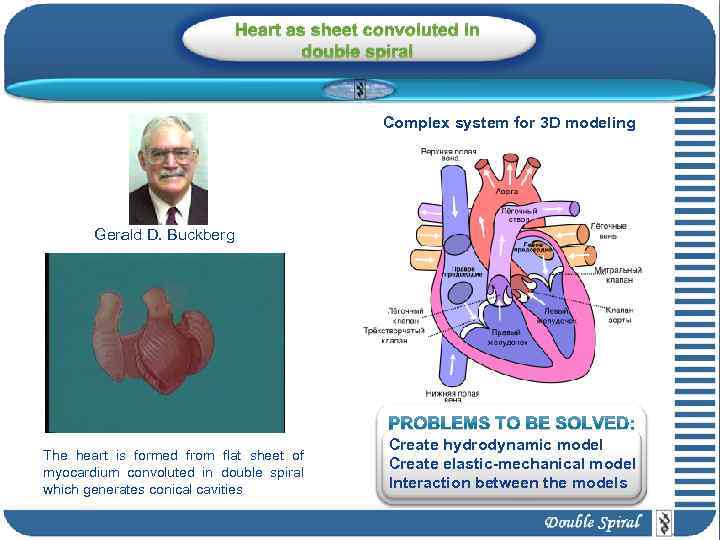 Heart as sheet convoluted in double spiral Complex system for 3 D modeling Gerald D. Buckberg The heart is formed from flat sheet of myocardium convoluted in double spiral which generates conical cavities Create hydrodynamic model Create elastic-mechanical model Interaction between the models
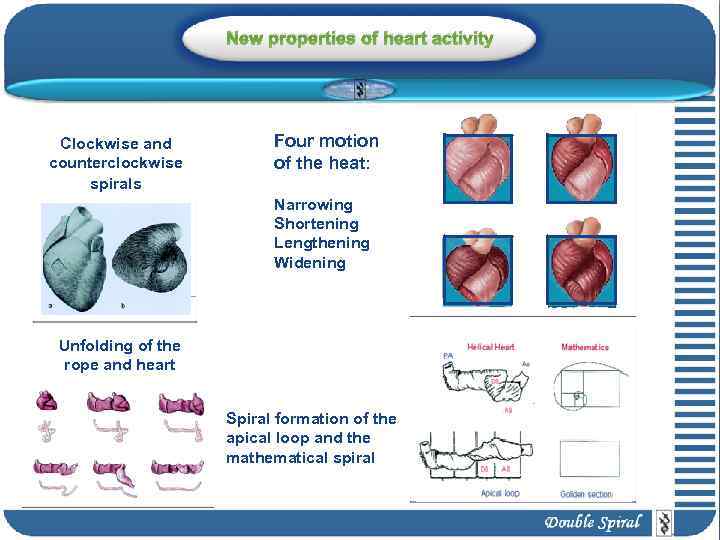 New properties of heart activity Clockwise and counterclockwise spirals Four motion of the heat: Narrowing Shortening Lengthening Widening Unfolding of the rope and heart Spiral formation of the apical loop and the mathematical spiral
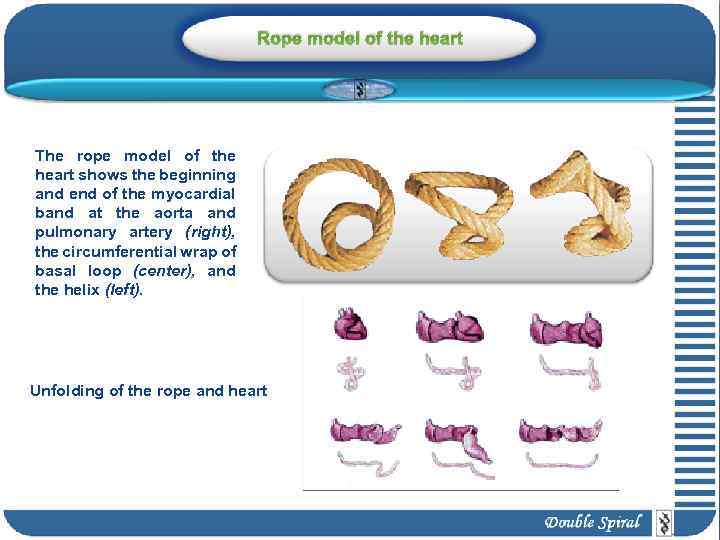 Rope model of the heart The rope model of the heart shows the beginning and end of the myocardial band at the aorta and pulmonary artery (right), the circumferential wrap of basal loop (center), and the helix (left). Unfolding of the rope and heart
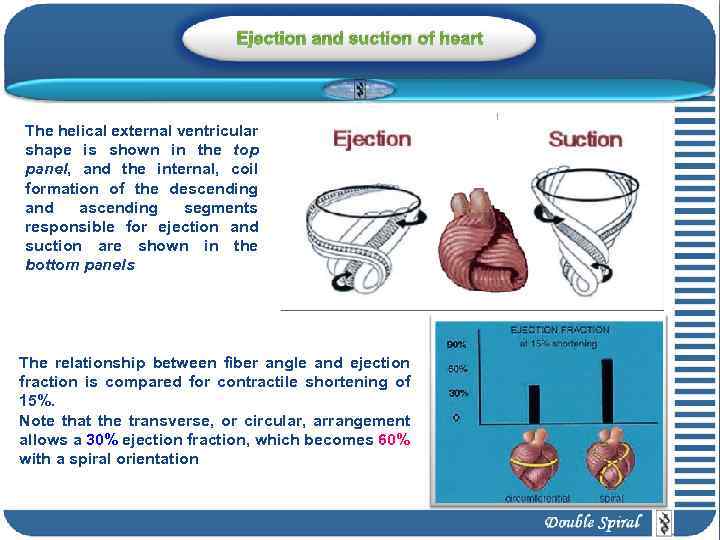 Ejection and suction of heart The helical external ventricular shape is shown in the top panel, and the internal, coil formation of the descending and ascending segments responsible for ejection and suction are shown in the bottom panels The relationship between fiber angle and ejection fraction is compared for contractile shortening of 15%. Note that the transverse, or circular, arrangement allows a 30% ejection fraction, which becomes 60% with a spiral orientation
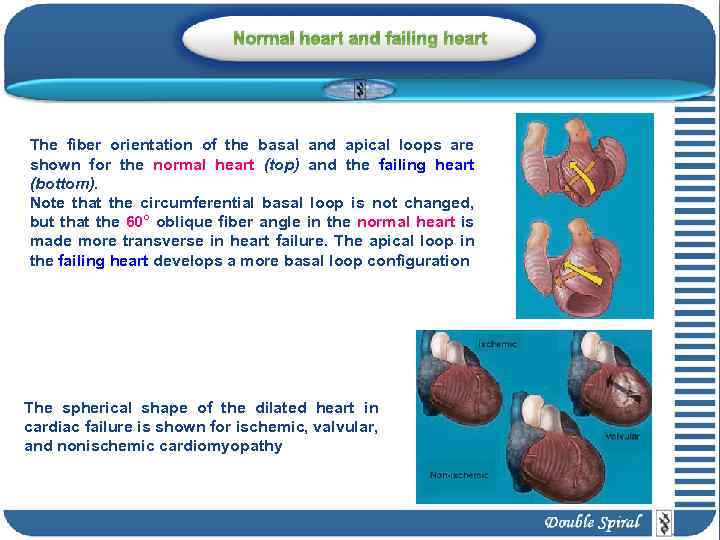 Normal heart and failing heart The fiber orientation of the basal and apical loops are shown for the normal heart (top) and the failing heart (bottom). Note that the circumferential basal loop is not changed, but that the 60° oblique fiber angle in the normal heart is made more transverse in heart failure. The apical loop in the failing heart develops a more basal loop configuration The spherical shape of the dilated heart in cardiac failure is shown for ischemic, valvular, and nonischemic cardiomyopathy
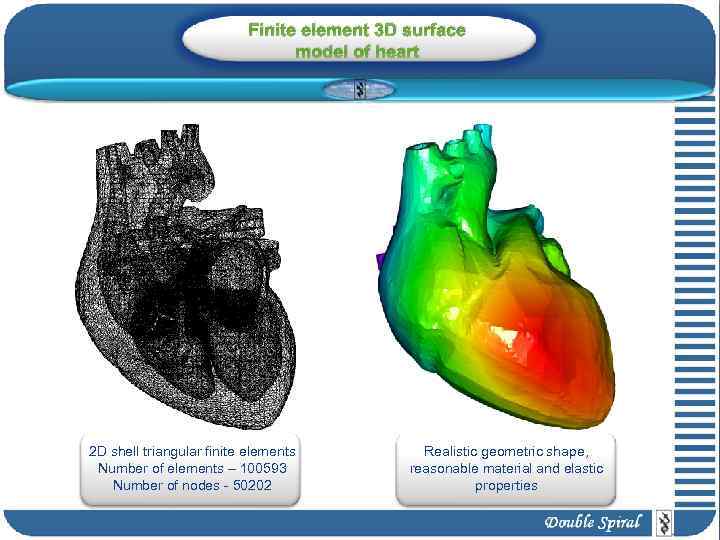 Finite element 3 D surface model of heart 2 D shell triangular finite elements Number of elements – 100593 Number of nodes - 50202 Realistic geometric shape, reasonable material and elastic properties
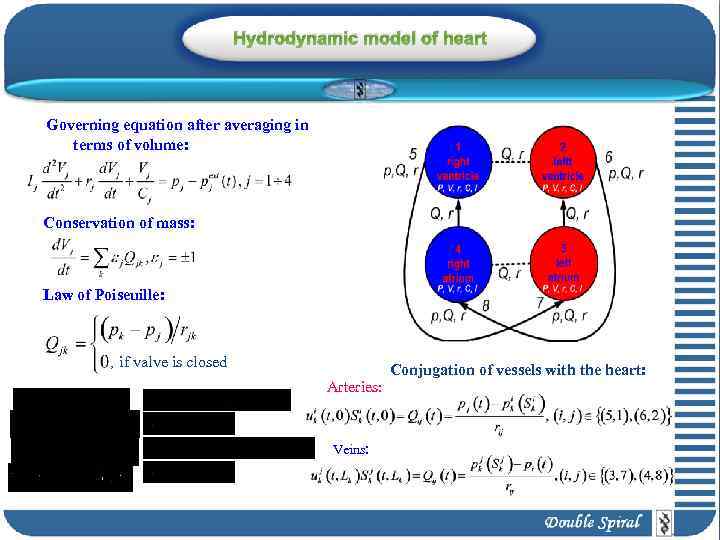 Hydrodynamic model of heart Governing equation after averaging in terms of volume: Conservation of mass: Law of Poiseuille: , if valve is closed Arteries: Veins: Conjugation of vessels with the heart:
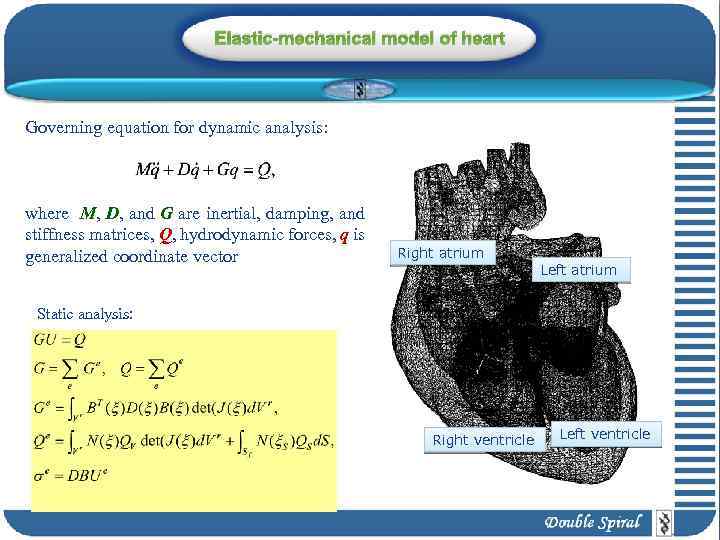 Elastic-mechanical model of heart Governing equation for dynamic analysis: where M, D, and G are inertial, damping, and stiffness matrices, Q, hydrodynamic forces, q is generalized coordinate vector Right atrium Left atrium Static analysis: Right ventricle Left ventricle
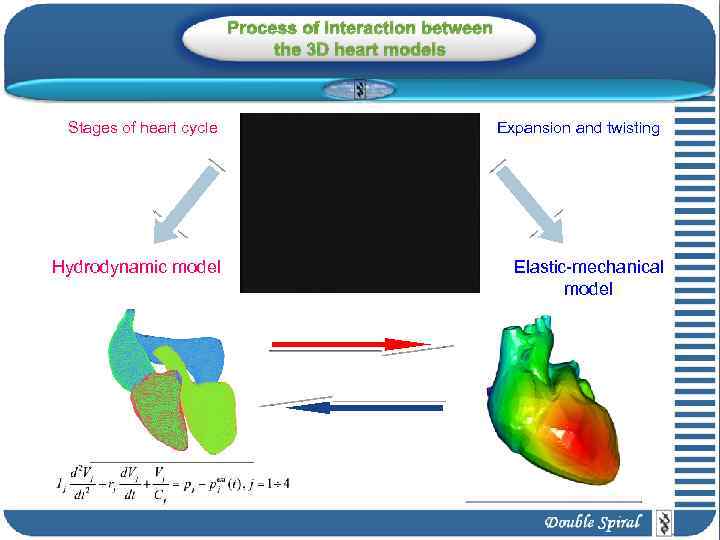 Process of interaction between the 3 D heart models Stages of heart cycle Expansion and twisting Hydrodynamic model Elastic-mechanical model
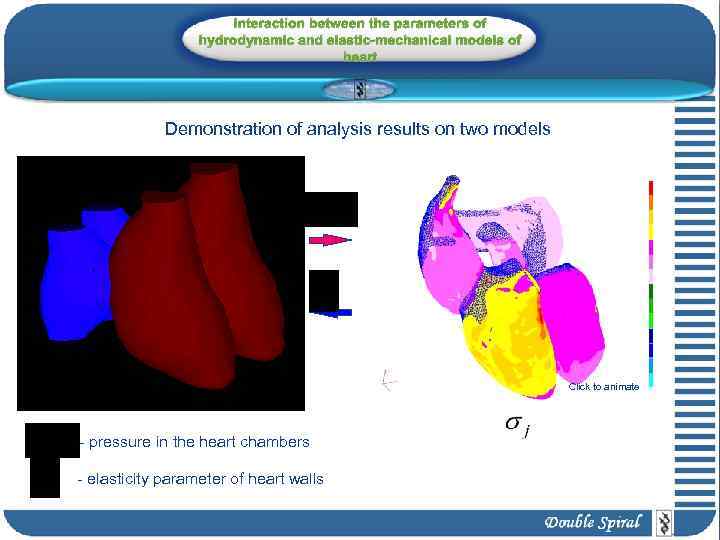 Interaction between the parameters of hydrodynamic and elastic-mechanical models of heart Demonstration of analysis results on two models Click to animate - pressure in the heart chambers - elasticity parameter of heart walls
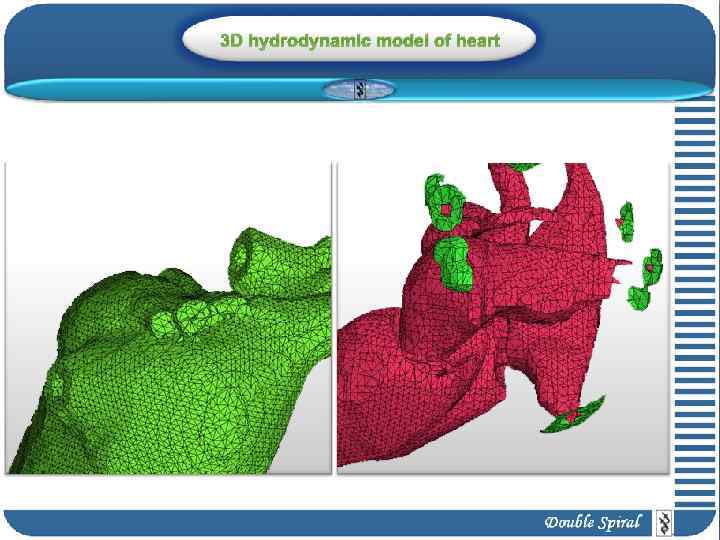 3 D hydrodynamic model of heart
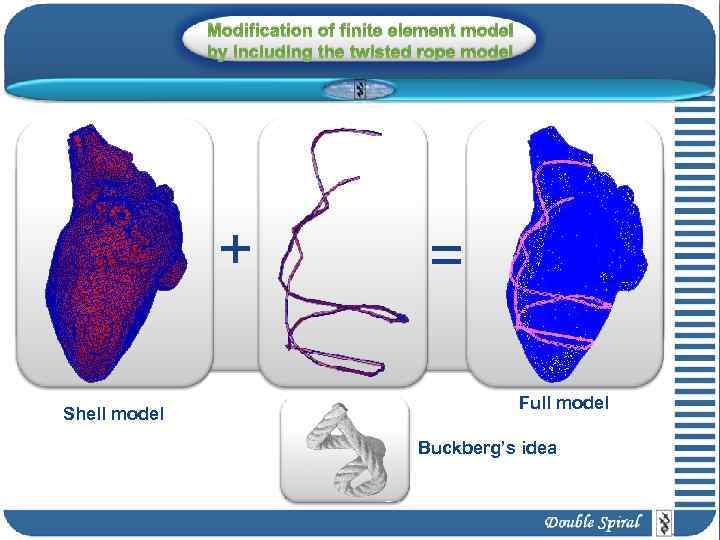 Modification of finite element model by including the twisted rope model + Shell model = Full model Buckberg’s idea
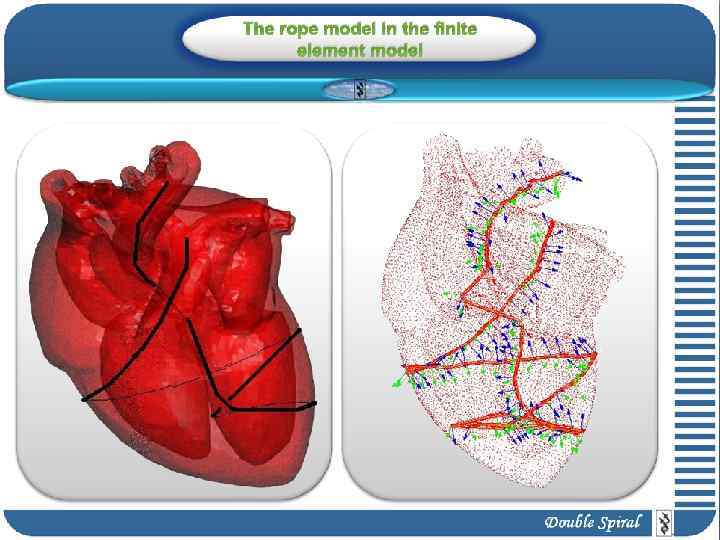 The rope model in the finite element model
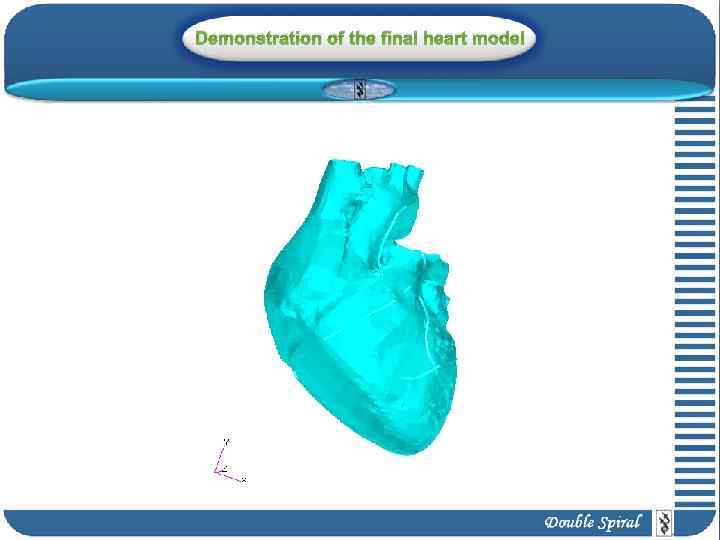 Demonstration of the final heart model
 Analysis results
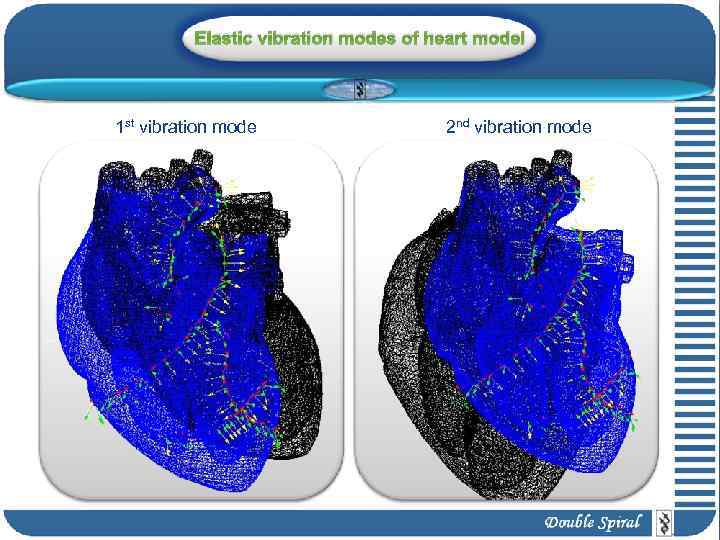 Elastic vibration modes of heart model 1 st vibration mode 2 nd vibration mode
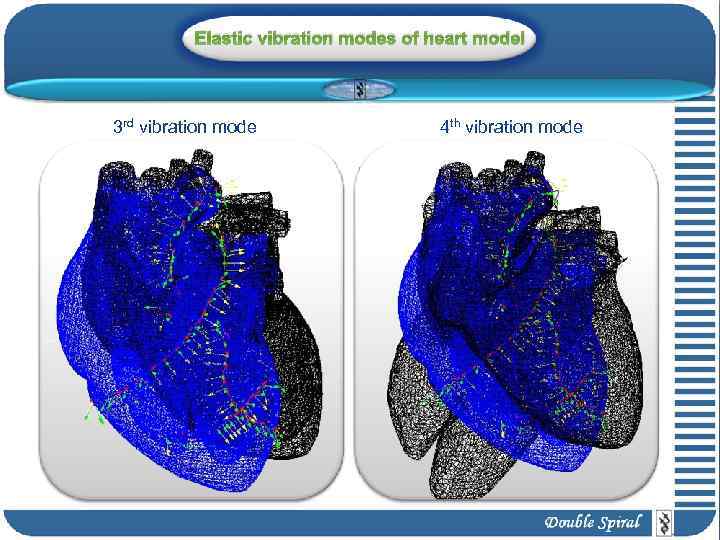 Elastic vibration modes of heart model 3 rd vibration mode 4 th vibration mode
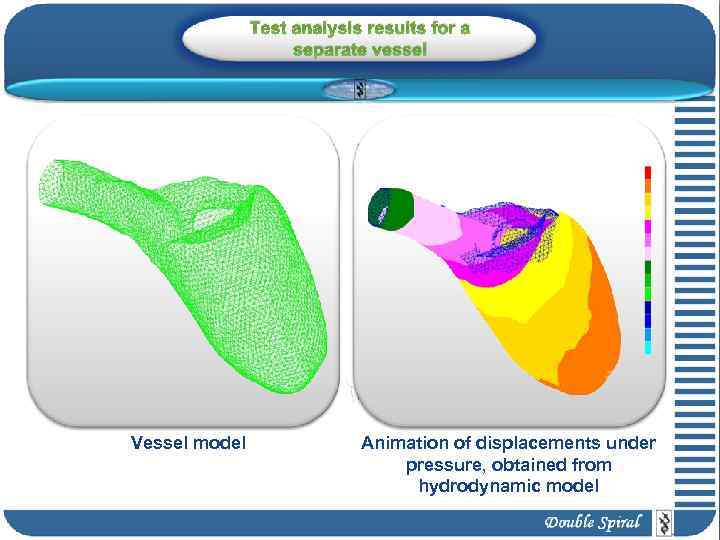 Test analysis results for a separate vessel Vessel model Animation of displacements under pressure, obtained from hydrodynamic model
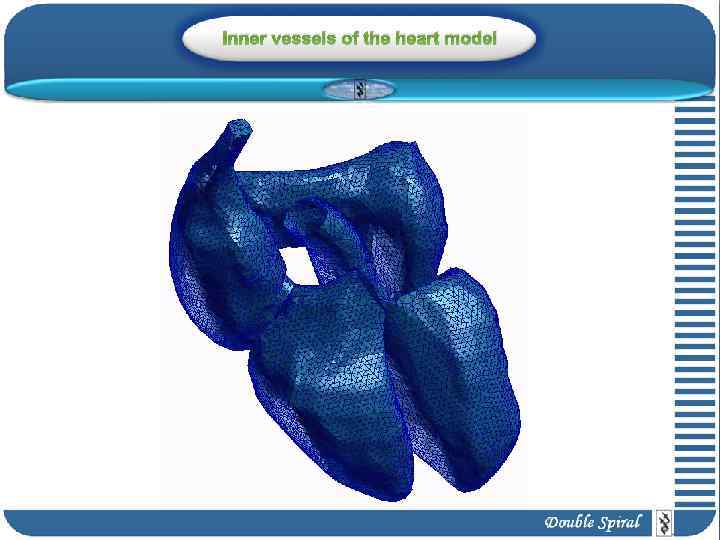 Inner vessels of the heart model
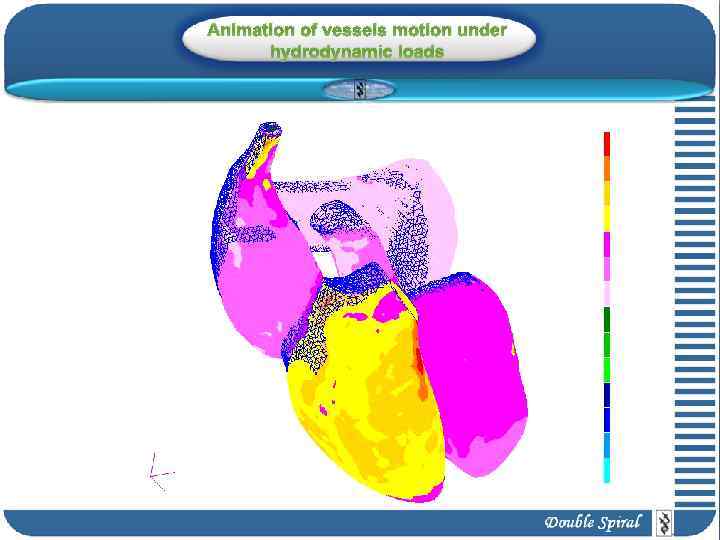 Animation of vessels motion under hydrodynamic loads
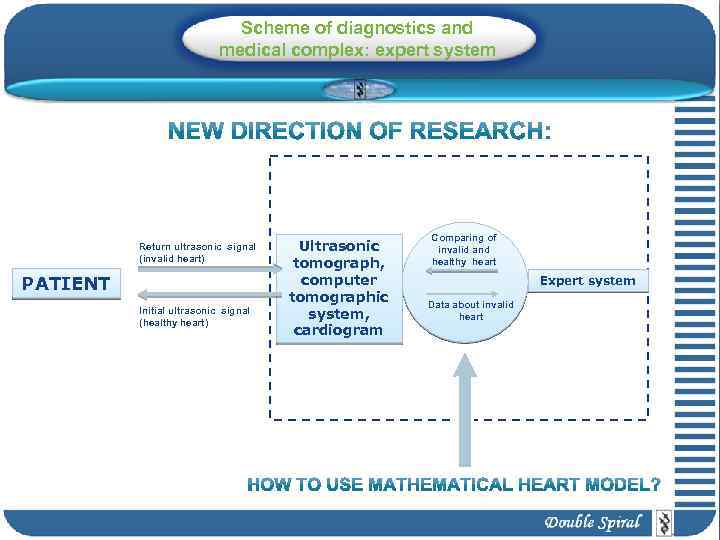 Scheme of diagnostics and medical complex: expert system Return ultrasonic signal (invalid heart) PATIENT Initial ultrasonic signal (healthy heart) Ultrasonic tomograph, computer tomographic system, cardiogram Comparing of invalid and healthy heart Expert system Data about invalid heart
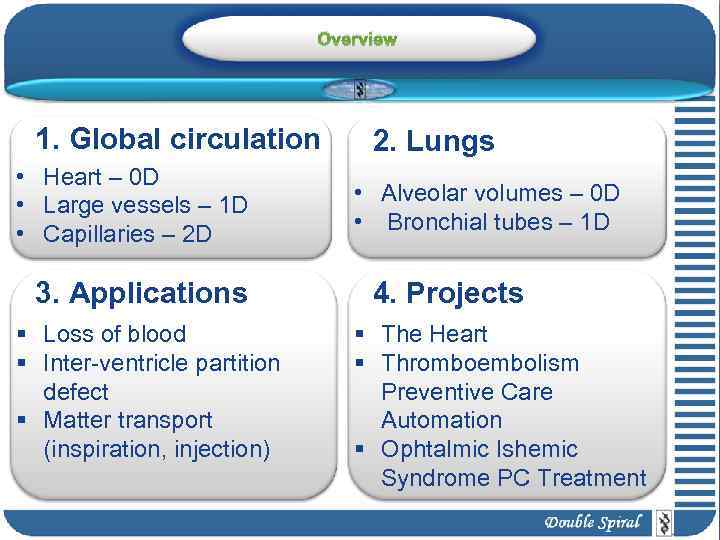
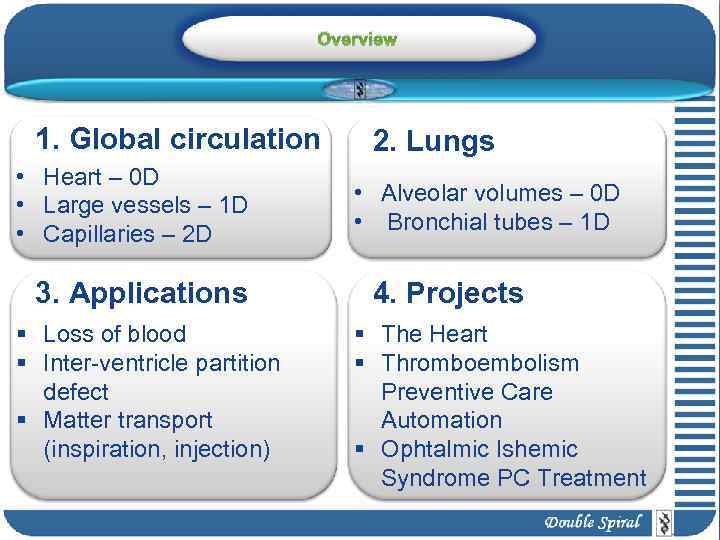 Overview 1. Global circulation • Heart – 0 D • Large vessels – 1 D • Capillaries – 2 D 3. Applications § Loss of blood § Inter-ventricle partition defect § Matter transport (inspiration, injection) 2. Lungs • Alveolar volumes – 0 D • Bronchial tubes – 1 D 4. Projects § The Heart § Thromboembolism Preventive Care Automation § Ophtalmic Ishemic Syndrome PC Treatment
 1. Global circulation
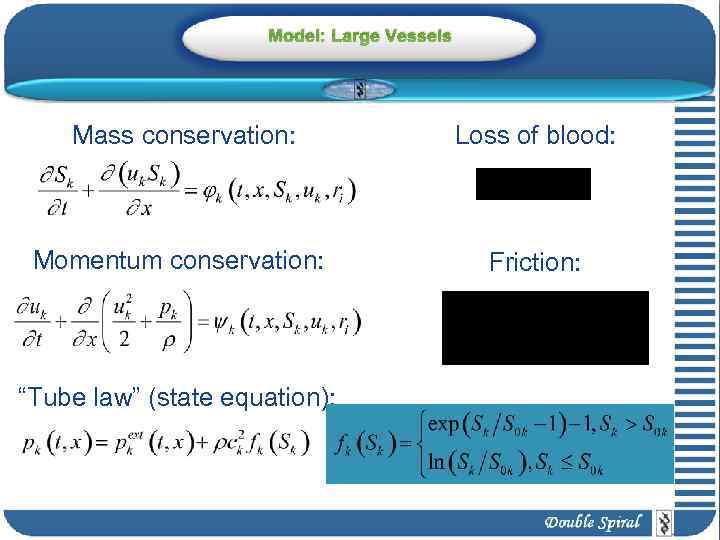 Model: Large Vessels Mass conservation: Loss of blood: Momentum conservation: Friction: “Tube law” (state equation):
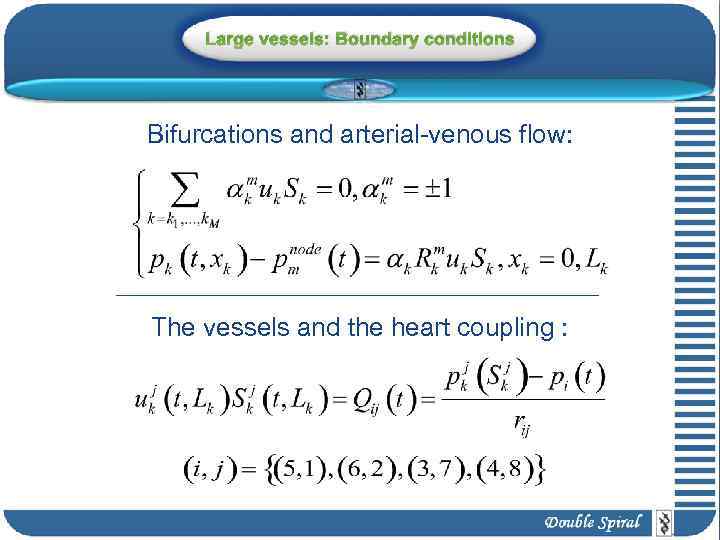 Large vessels: Boundary conditions Bifurcations and arterial-venous flow: The vessels and the heart coupling :
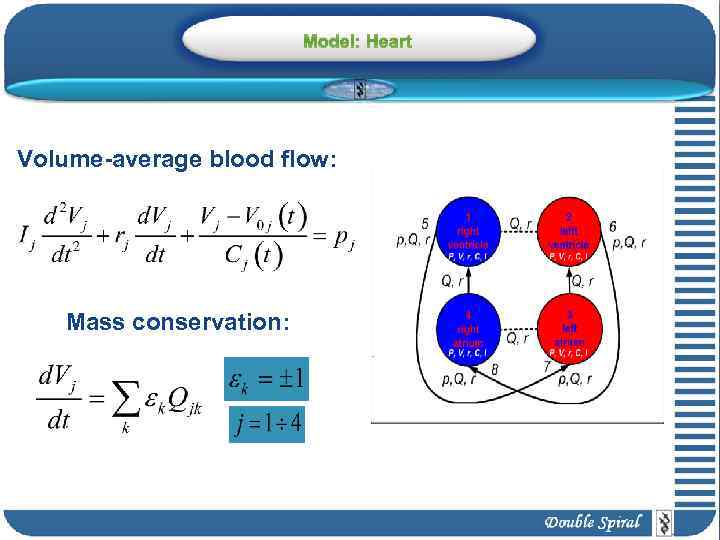 Model: Heart Volume-average blood flow: Mass conservation:
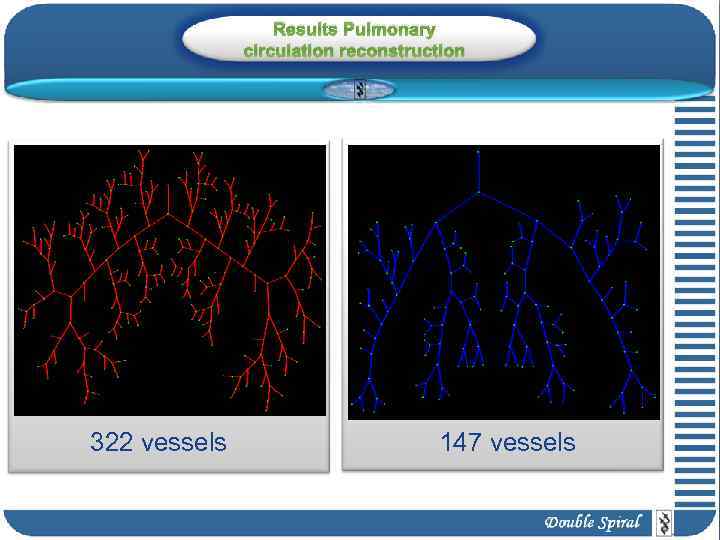 Results Pulmonary circulation reconstruction 322 vessels 147 vessels
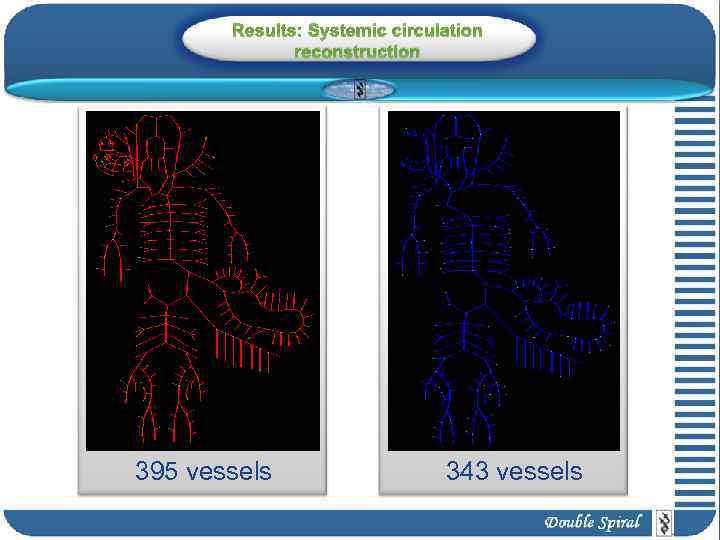 Results: Systemic circulation reconstruction 395 vessels 343 vessels
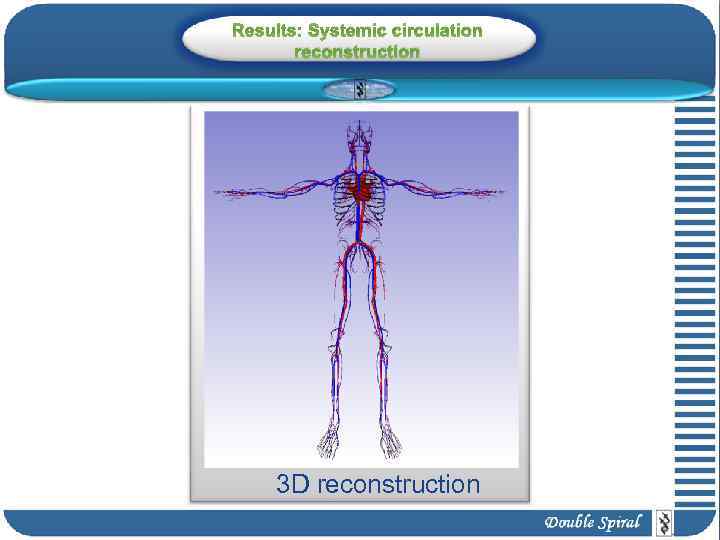 Results: Systemic circulation reconstruction 3 D reconstruction
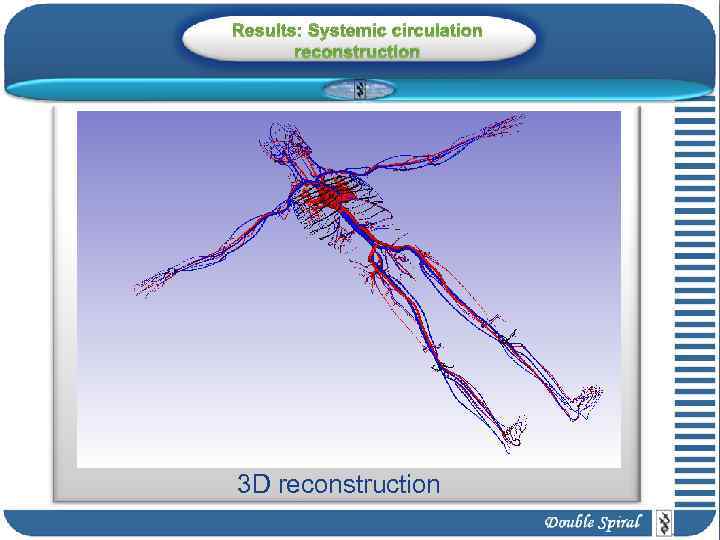 Results: Systemic circulation reconstruction 3 D reconstruction
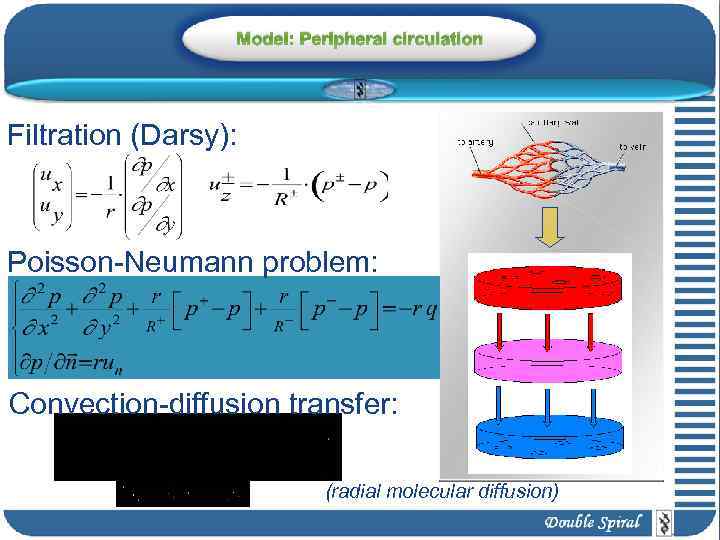 Model: Peripheral circulation Filtration (Darsy): Poisson-Neumann problem: Convection-diffusion transfer: (radial molecular diffusion)
 2. Lungs
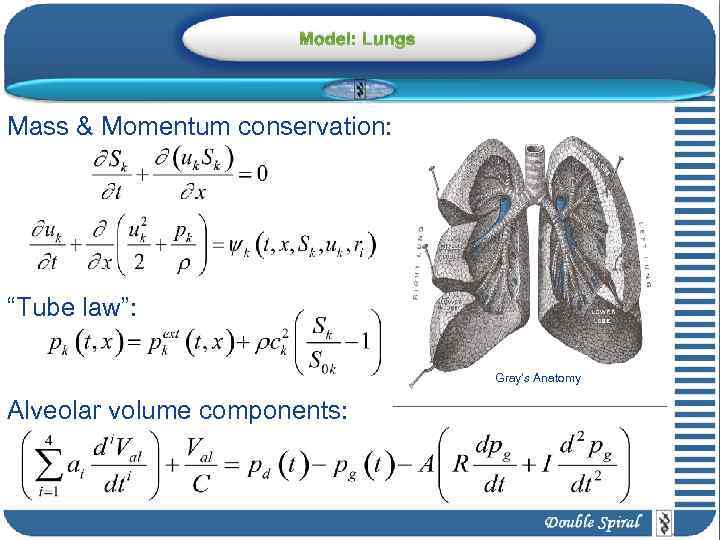 Model: Lungs Mass & Momentum conservation: “Tube law”: Gray’s Anatomy Alveolar volume components:
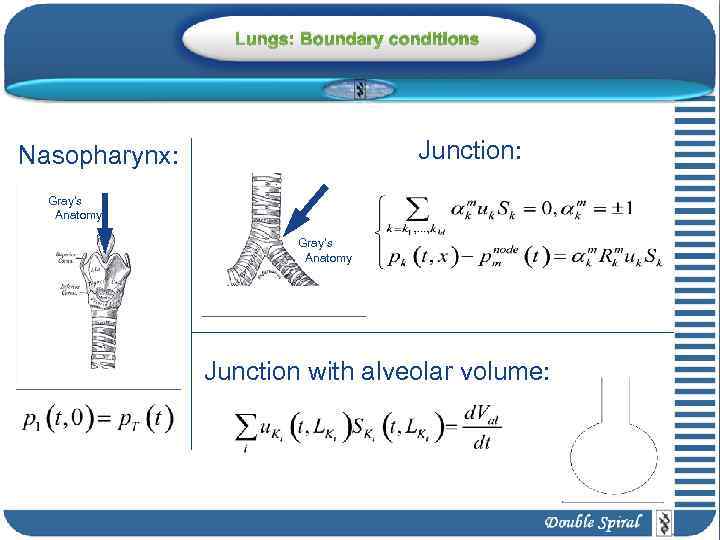 Lungs: Boundary conditions Junction: Nasopharynx: Gray’s Anatomy Junction with alveolar volume:
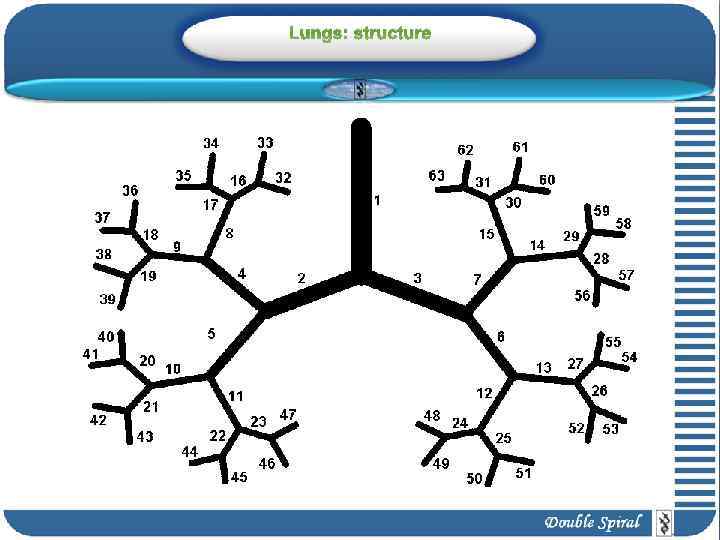 Lungs: structure
 3. Applications
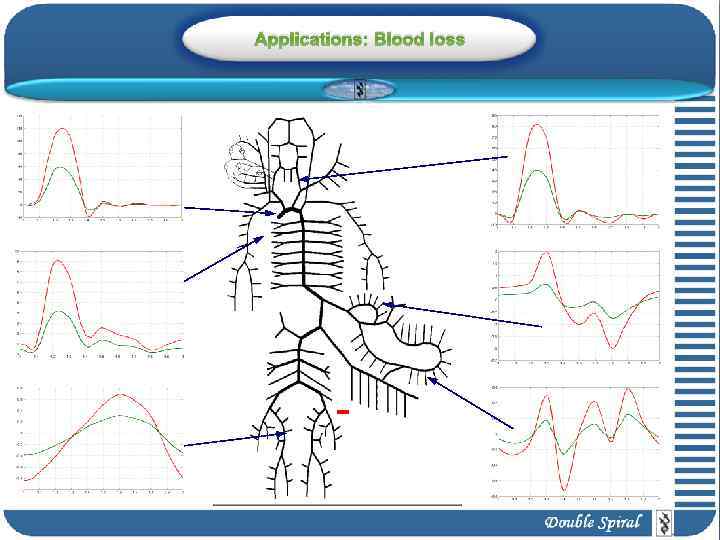 Applications: Blood loss
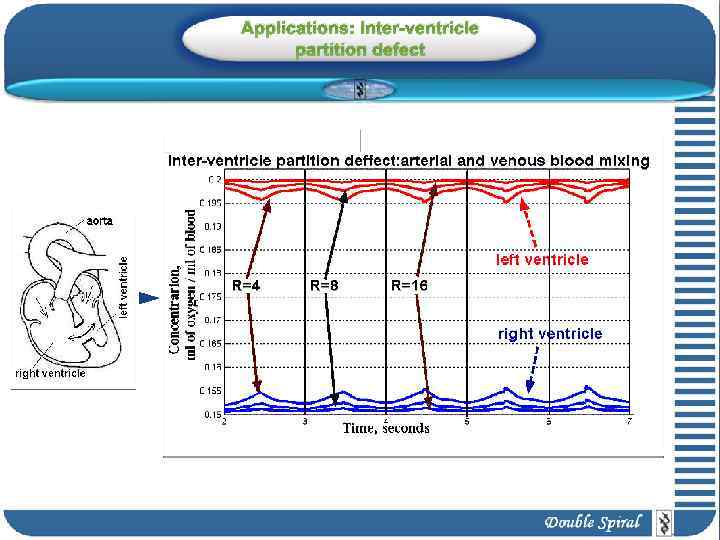 Applications: Inter-ventricle partition defect
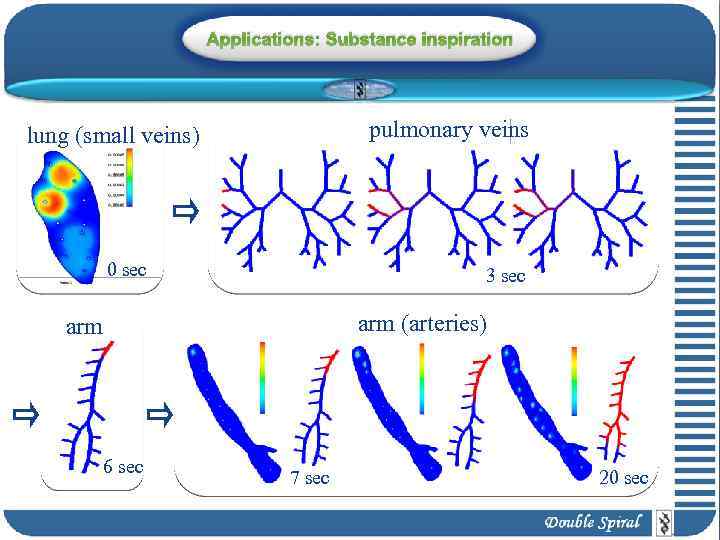 Applications: Substance inspiration pulmonary veins lung (small veins) 0 sec 3 sec arm (arteries) arm 6 sec 7 sec 20 sec
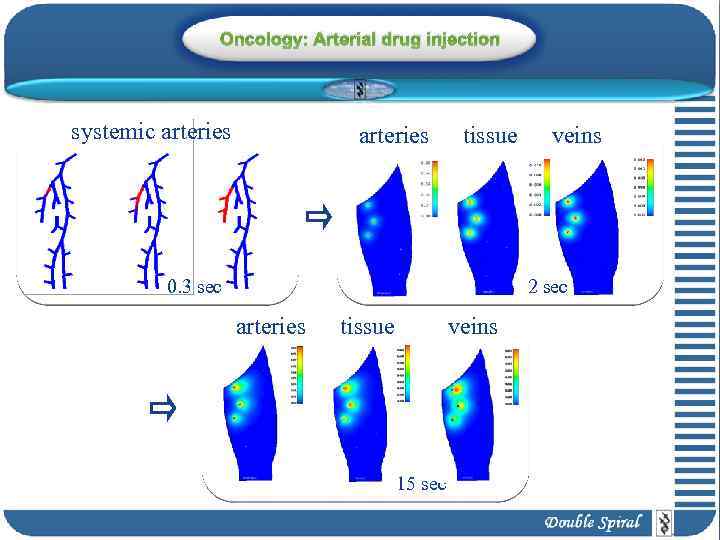 Oncology: Arterial drug injection systemic arteries tissue 0. 3 sec veins 2 sec arteries tissue veins 15 sec
 4. Projects
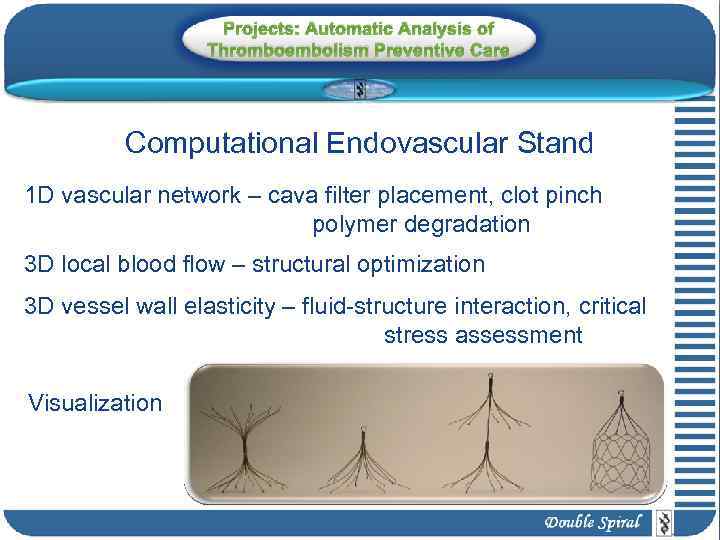 Projects: Automatic Analysis of Thromboembolism Preventive Care Computational Endovascular Stand 1 D vascular network – cava filter placement, clot pinch polymer degradation 3 D local blood flow – structural optimization 3 D vessel wall elasticity – fluid-structure interaction, critical stress assessment Visualization
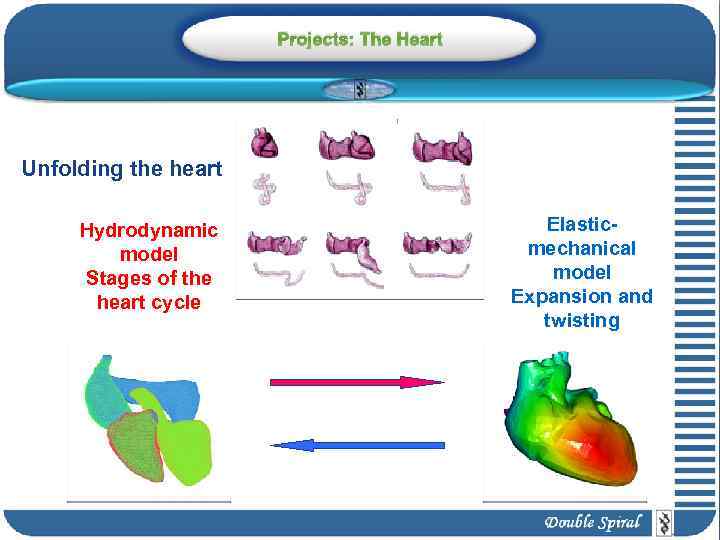 Projects: The Heart Unfolding the heart Hydrodynamic model Stages of the heart cycle Elasticmechanical model Expansion and twisting
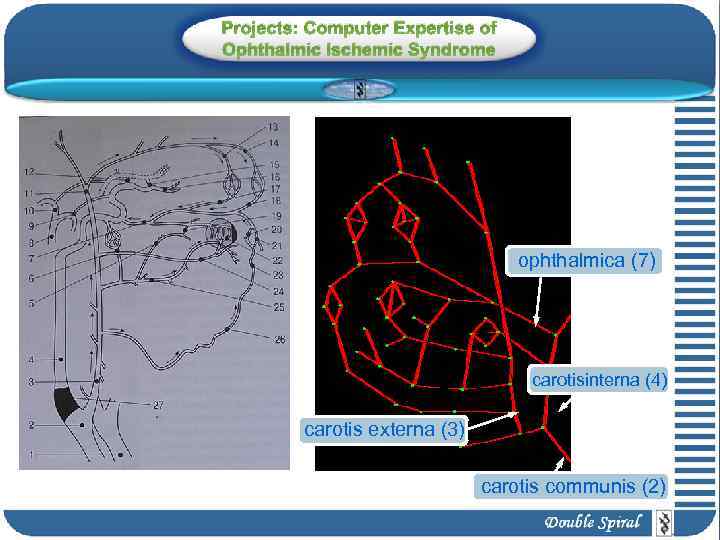 Projects: Computer Expertise of Ophthalmic Ischemic Syndrome ophthalmica (7) сarotisinterna (4) carotis externa (3) carotis communis (2)
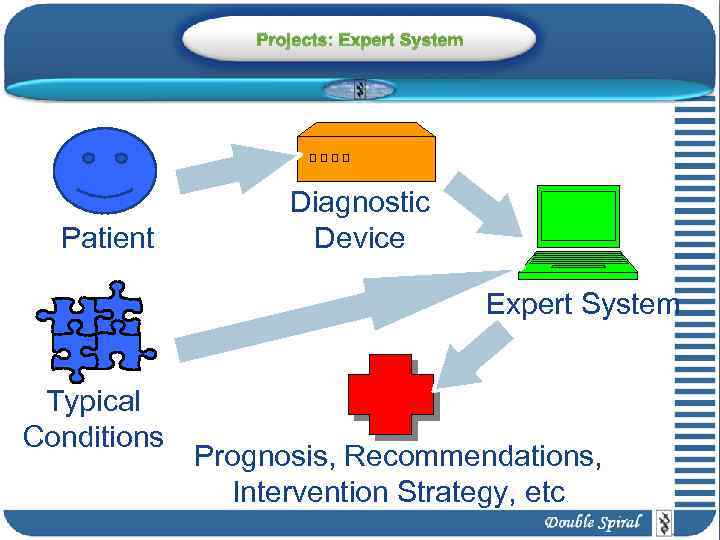 Projects: Expert System Patient Diagnostic Device Expert System Typical Conditions Prognosis, Recommendations, Intervention Strategy, etc
 Projects: Expert System 1. Human organism frontiers assesment 2. Variational series: relative PC-based comparison to the CVS performance 3. Transitional processes under load: anaerobiotic – anaerobiotic 4. CVS performance under different loads (long-time periodic, short intensive, etc. )
 Projects: Expert System 1. Typical cases identification 2. The models improvement 3. Principal parameters analysis and identification 4. Computational experiments 5. Interface
 Overview 1. Global circulation • Heart – 0 D • Large vessels – 1 D • Capillaries – 2 D 3. Applications § Loss of blood § Inter-ventricle partition defect § Matter transport (inspiration, injection) 2. Lungs • Alveolar volumes – 0 D • Bronchial tubes – 1 D 4. Projects § The Heart § Thromboembolism Preventive Care Automation § Ophtalmic Ishemic Syndrome PC Treatment