


 Скачать презентацию Heart Disease in Firefighters STEFANOS N KALES MD
67dce9d55d1028b169c61d7e37e267d8.ppt
- Количество слайдов: 53
 Heart Disease in Firefighters STEFANOS N. KALES, MD, MPH, FACP, FACOEM MEDICAL DIRECTOR EMPLOYEE HEALTH & INDUSTRIAL MEDICINE CAMBRIDGE HEALTH ALLIANCE ASSISTANT PROFESSOR OF MEDICINE HARVARD MEDICAL SCHOOL Kales et al ASSISTANT PROFESSOR & DIRECTOR, OCCUPATIONAL & ENVIRONMENTAL MEDICINE RESIDENCY, HARVARD SCHOOL OF PUBLIC HEALTH
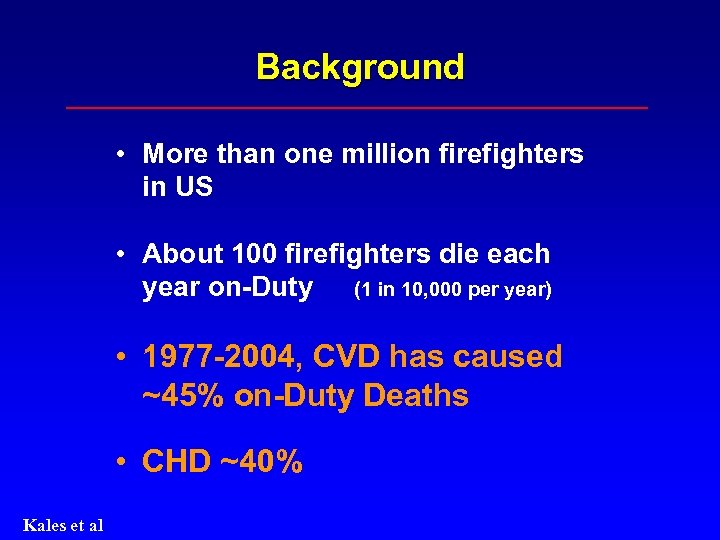 Background • More than one million firefighters in US • About 100 firefighters die each year on-Duty (1 in 10, 000 per year) • 1977 -2004, CVD has caused ~45% on-Duty Deaths • CHD ~40% Kales et al
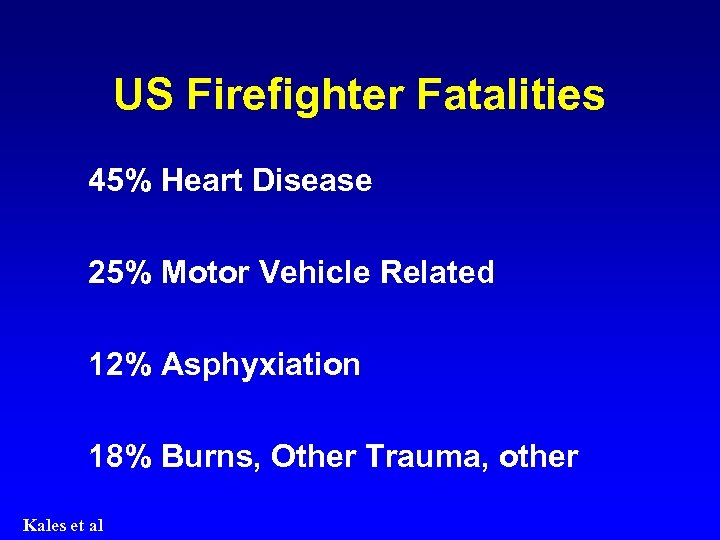 US Firefighter Fatalities 45% Heart Disease 25% Motor Vehicle Related 12% Asphyxiation 18% Burns, Other Trauma, other Kales et al
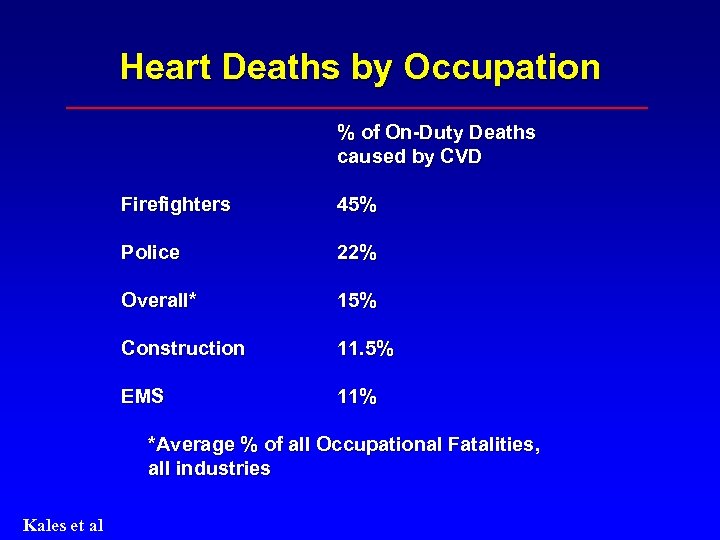 Heart Deaths by Occupation % of On-Duty Deaths caused by CVD Firefighters 45% Police 22% Overall* 15% Construction 11. 5% EMS 11% *Average % of all Occupational Fatalities, all industries Kales et al
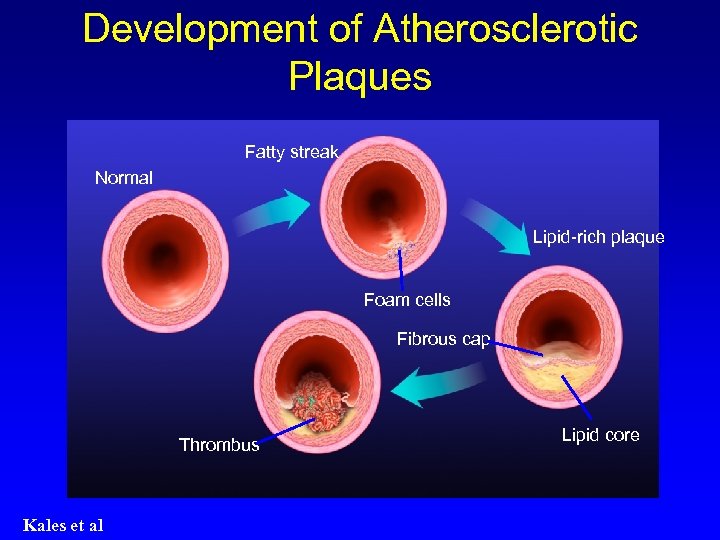 Development of Atherosclerotic Plaques Fatty streak Normal Lipid-rich plaque Foam cells Fibrous cap Thrombus Kales et al Lipid core
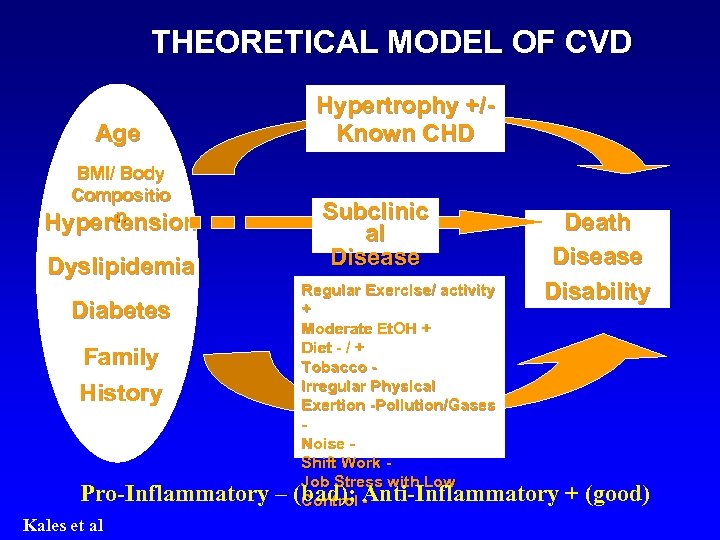 THEORETICAL MODEL OF CVD Age BMI/ Body Compositio n Hypertension Dyslipidemia Hypertrophy +/Known CHD Subclinic al Disease Death Disease Disability Regular Exercise/ activity + Diabetes Moderate Et. OH + Diet - / + Family Tobacco Irregular Physical History Exertion -Pollution/Gases Noise Shift Work Job Stress with Low Pro-Inflammatory – (bad); Anti-Inflammatory + (good) Control - Kales et al
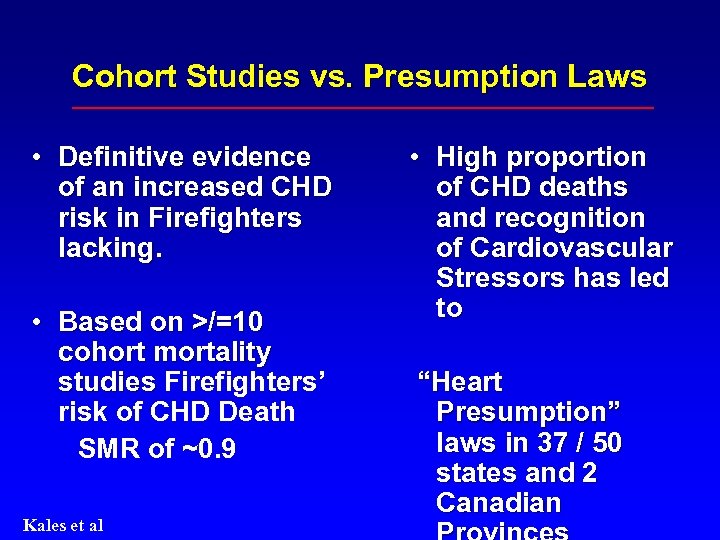 Cohort Studies vs. Presumption Laws • Definitive evidence of an increased CHD risk in Firefighters lacking. • Based on >/=10 cohort mortality studies Firefighters’ risk of CHD Death SMR of ~0. 9 Kales et al • High proportion of CHD deaths and recognition of Cardiovascular Stressors has led to “Heart Presumption” laws in 37 / 50 states and 2 Canadian
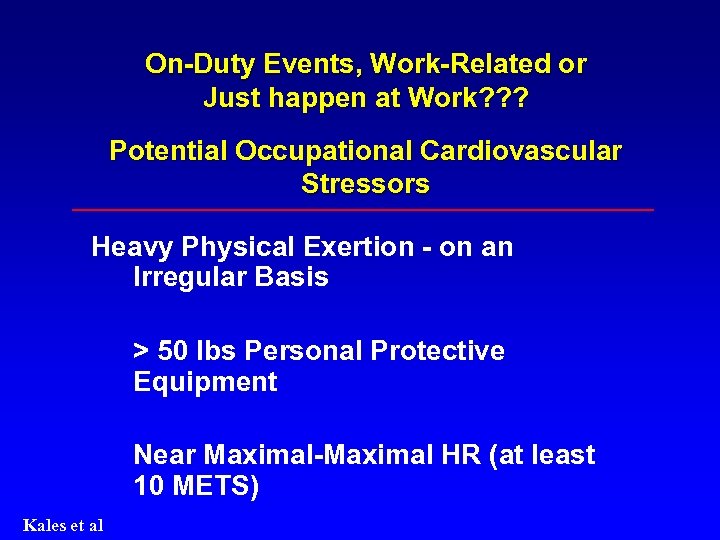 On-Duty Events, Work-Related or Just happen at Work? ? ? Potential Occupational Cardiovascular Stressors Heavy Physical Exertion - on an Irregular Basis > 50 lbs Personal Protective Equipment Near Maximal-Maximal HR (at least 10 METS) Kales et al
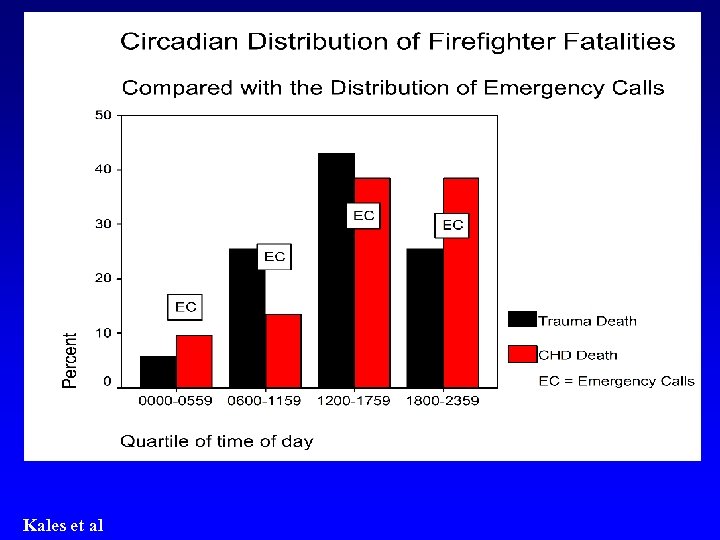
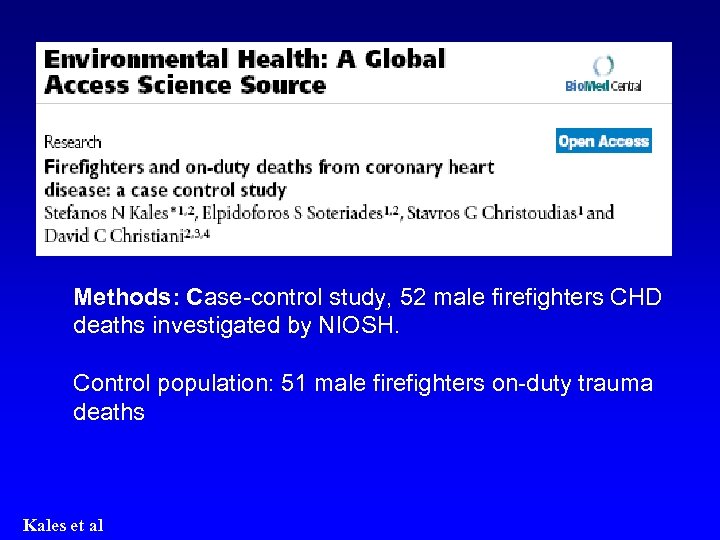 Methods: Case-control study, 52 male firefighters CHD deaths investigated by NIOSH. Control population: 51 male firefighters on-duty trauma deaths Kales et al
 Kales et al
 Kales et al
 Kales et al
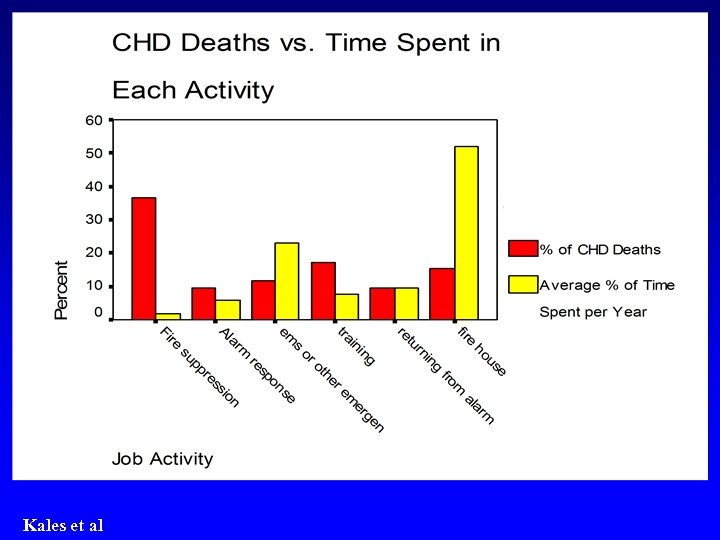 Kales et al
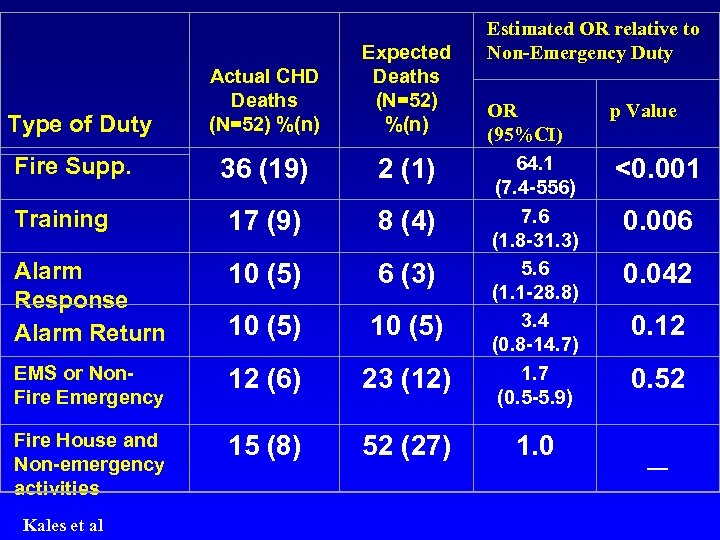 Actual CHD Deaths (N=52) %(n) Expected Deaths (N=52) %(n) 36 (19) 2 (1) Training 17 (9) 8 (4) Alarm Response Alarm Return 10 (5) 6 (3) 10 (5) EMS or Non. Fire Emergency 12 (6) 23 (12) Fire House and Non-emergency activities 15 (8) 52 (27) Type of Duty Fire Supp. Kales et al Estimated OR relative to Non-Emergency Duty OR (95%CI) 64. 1 (7. 4 -556) 7. 6 (1. 8 -31. 3) 5. 6 (1. 1 -28. 8) 3. 4 (0. 8 -14. 7) 1. 7 (0. 5 -5. 9) p Value 1. 0 <0. 001 0. 006 0. 042 0. 12 0. 52 _
 Kales et al
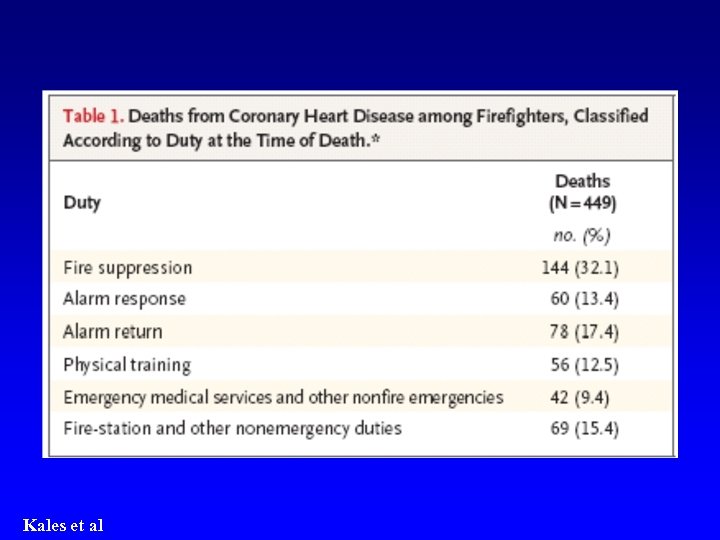
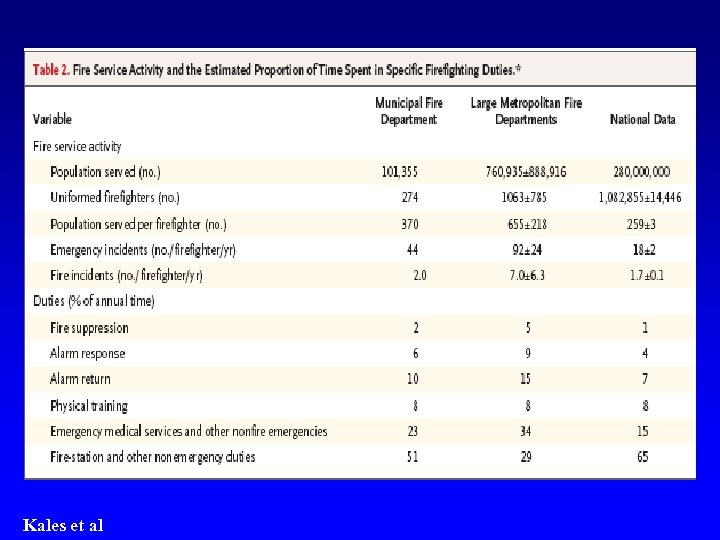
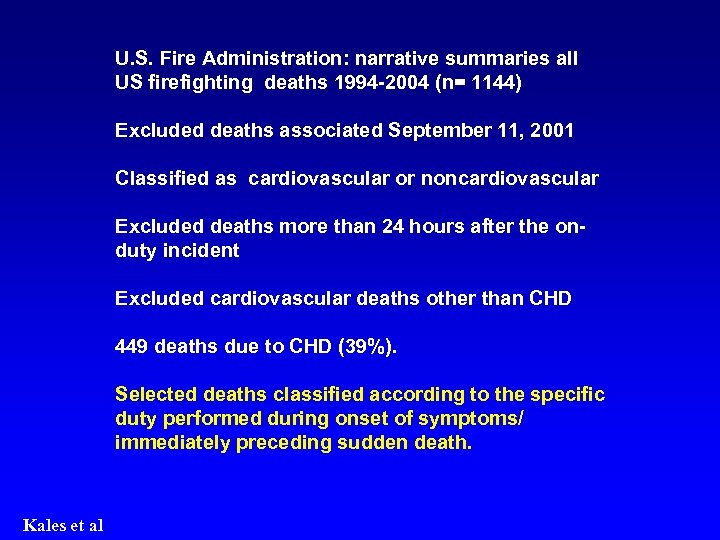 U. S. Fire Administration: narrative summaries all US firefighting deaths 1994 -2004 (n= 1144) Excluded deaths associated September 11, 2001 Classified as cardiovascular or noncardiovascular Excluded deaths more than 24 hours after the onduty incident Excluded cardiovascular deaths other than CHD 449 deaths due to CHD (39%). Selected deaths classified according to the specific duty performed during onset of symptoms/ immediately preceding sudden death. Kales et al
 Kales et al
 Kales et al
 Kales et al
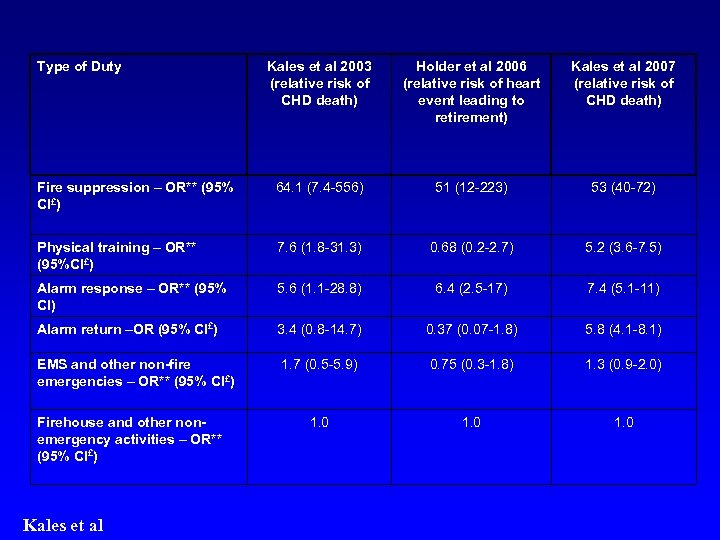 Type of Duty Kales et al 2003 (relative risk of CHD death) Holder et al 2006 (relative risk of heart event leading to retirement) Kales et al 2007 (relative risk of CHD death) Fire suppression – OR** (95% CI£) 64. 1 (7. 4 -556) 51 (12 -223) 53 (40 -72) Physical training – OR** (95%CI£) 7. 6 (1. 8 -31. 3) 0. 68 (0. 2 -2. 7) 5. 2 (3. 6 -7. 5) Alarm response – OR** (95% CI) 5. 6 (1. 1 -28. 8) 6. 4 (2. 5 -17) 7. 4 (5. 1 -11) Alarm return –OR (95% CI£) 3. 4 (0. 8 -14. 7) 0. 37 (0. 07 -1. 8) 5. 8 (4. 1 -8. 1) EMS and other non-fire emergencies – OR** (95% CI£) 1. 7 (0. 5 -5. 9) 0. 75 (0. 3 -1. 8) 1. 3 (0. 9 -2. 0) 1. 0 Firehouse and other nonemergency activities – OR** (95% CI£) Kales et al
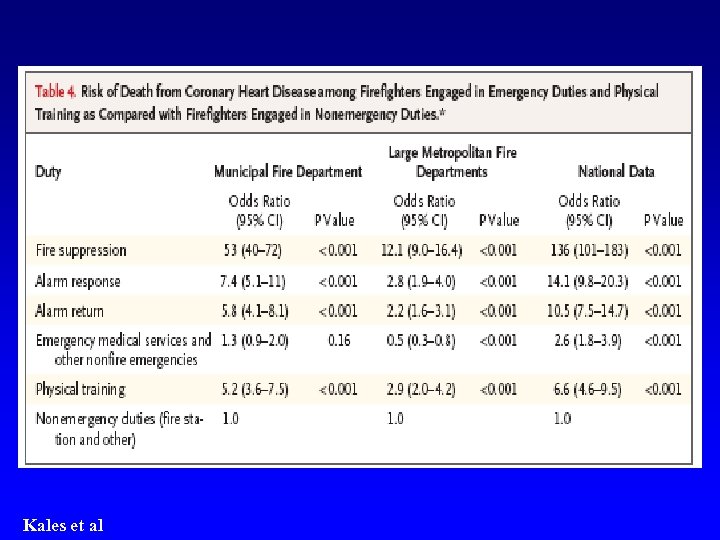
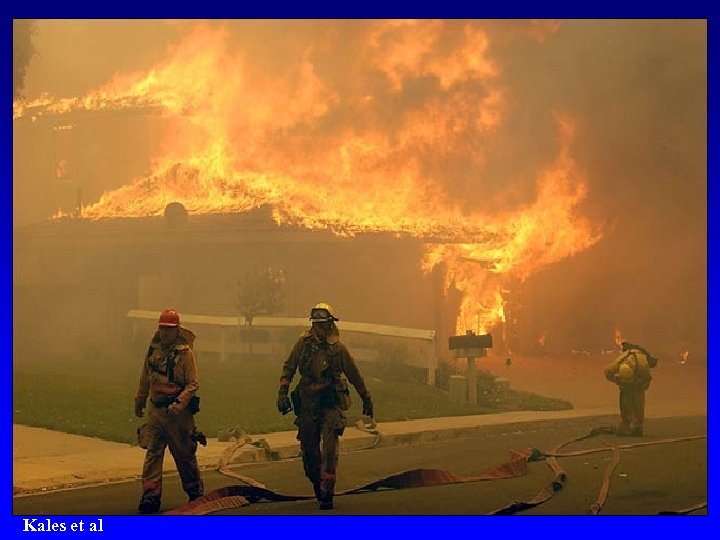
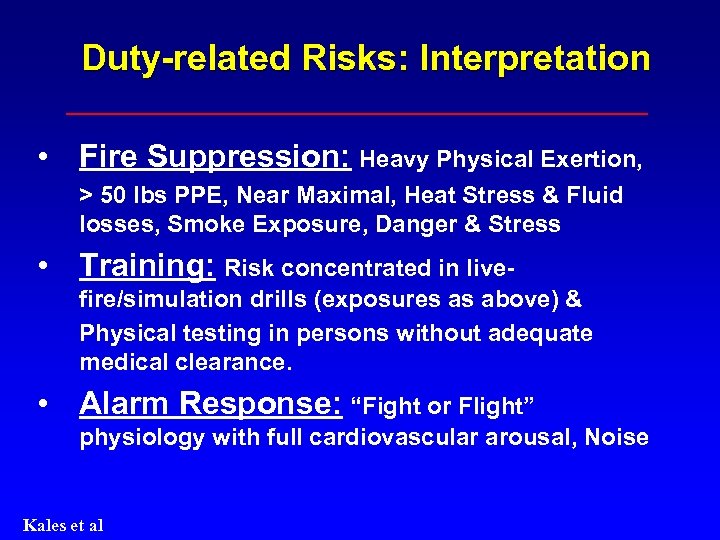 Duty-related Risks: Interpretation • Fire Suppression: Heavy Physical Exertion, > 50 lbs PPE, Near Maximal, Heat Stress & Fluid losses, Smoke Exposure, Danger & Stress • Training: Risk concentrated in livefire/simulation drills (exposures as above) & Physical testing in persons without adequate medical clearance. • Alarm Response: “Fight or Flight” physiology with full cardiovascular arousal, Noise Kales et al
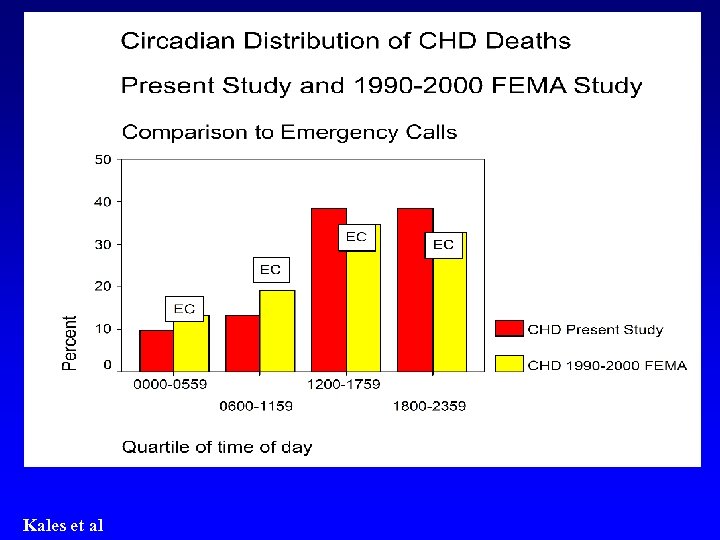
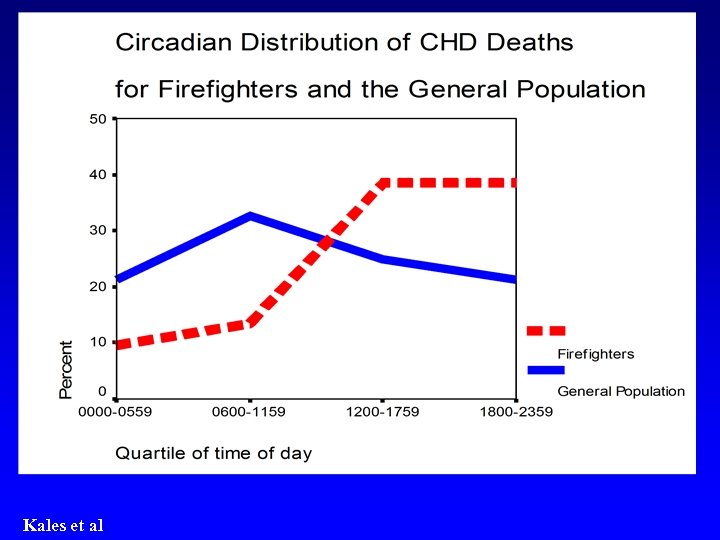
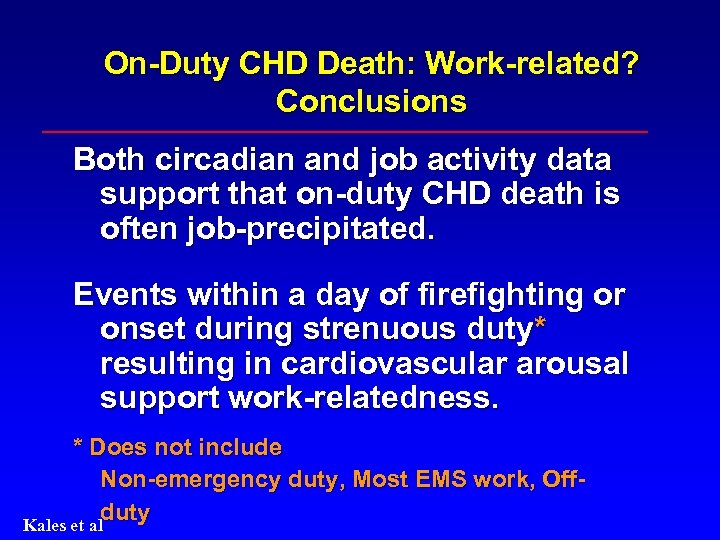 On-Duty CHD Death: Work-related? Conclusions Both circadian and job activity data support that on-duty CHD death is often job-precipitated. Events within a day of firefighting or onset during strenuous duty* resulting in cardiovascular arousal support work-relatedness. * Does not include Non-emergency duty, Most EMS work, Offduty Kales et al
 Kales et al
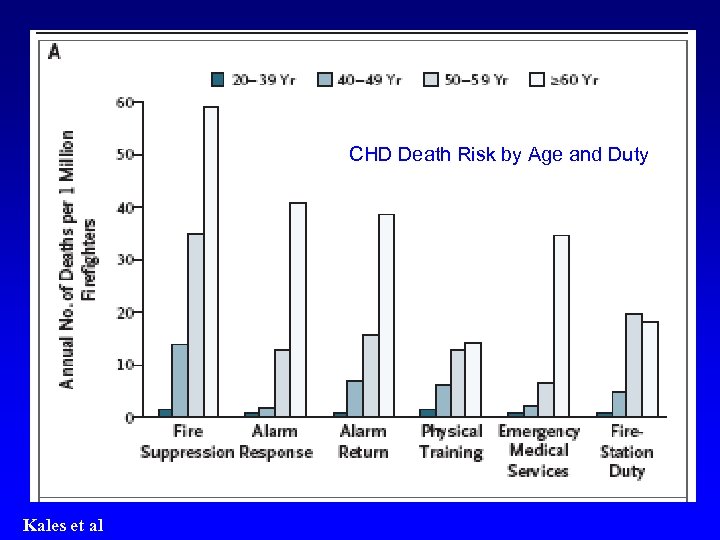 CHD Death Risk by Age and Duty Kales et al
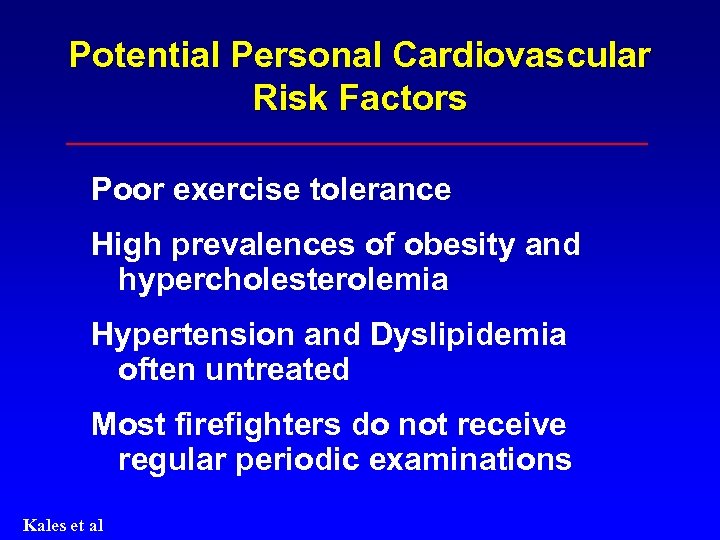 Potential Personal Cardiovascular Risk Factors Poor exercise tolerance High prevalences of obesity and hypercholesterolemia Hypertension and Dyslipidemia often untreated Most firefighters do not receive regular periodic examinations Kales et al
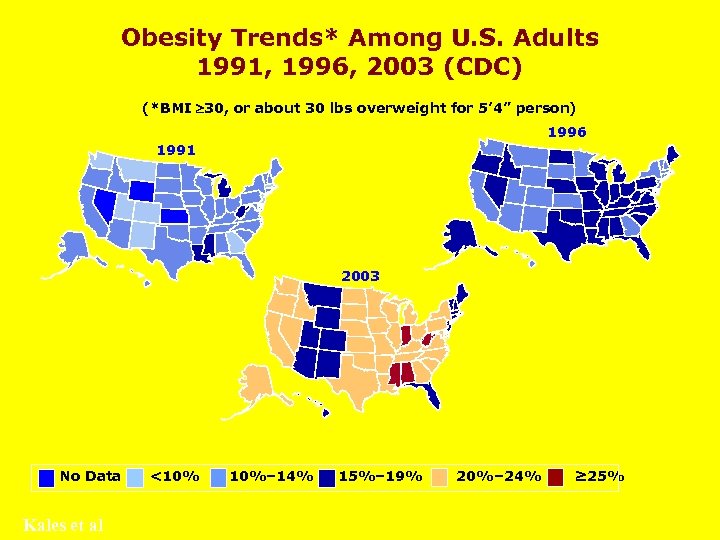 Obesity Trends* Among U. S. Adults 1991, 1996, 2003 (CDC) (*BMI 30, or about 30 lbs overweight for 5’ 4” person) 1996 1991 2003 No Data Kales et al <10% 10%– 14% 15%– 19% 20%– 24% ≥ 25%
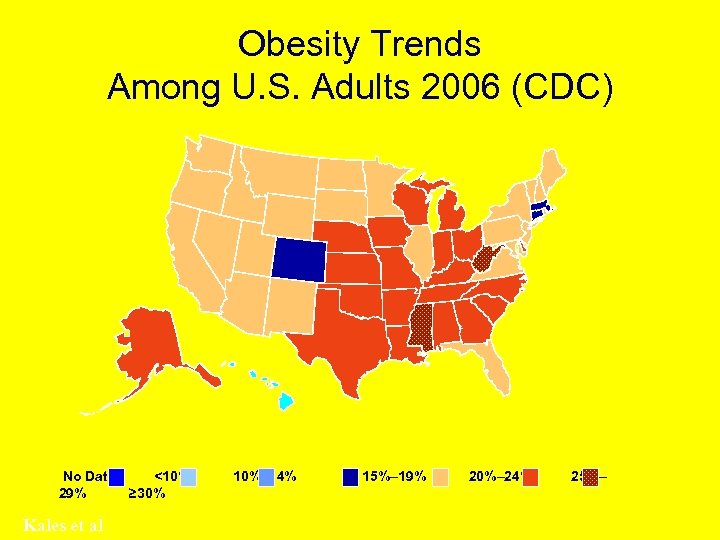 Obesity Trends Among U. S. Adults 2006 (CDC) No Data <10% 29% ≥ 30% Kales et al 10%– 14% 15%– 19% 20%– 24% 25%–
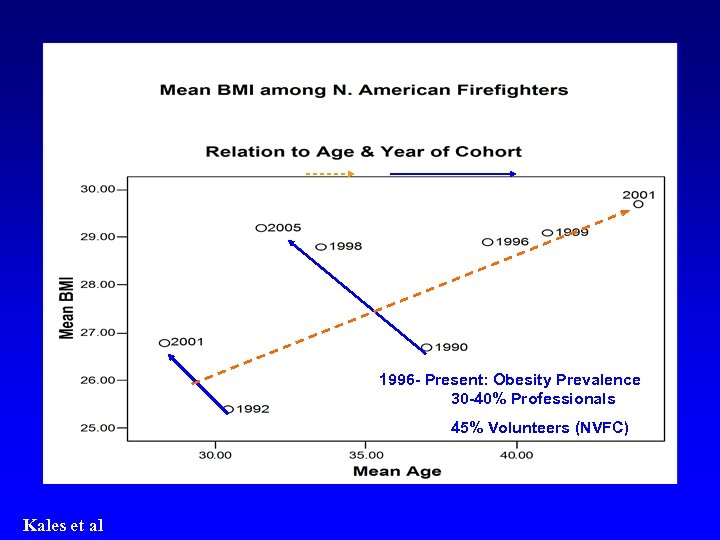 1996 - Present: Obesity Prevalence 30 -40% Professionals 45% Volunteers (NVFC) Kales et al
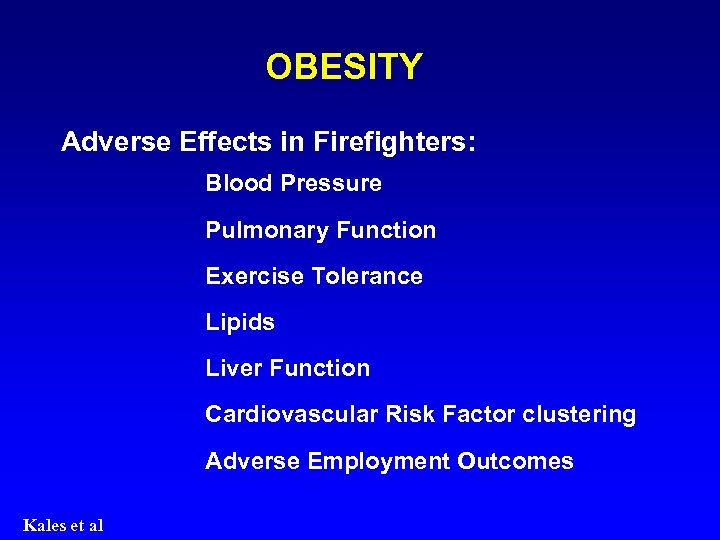 OBESITY Adverse Effects in Firefighters: Blood Pressure Pulmonary Function Exercise Tolerance Lipids Liver Function Cardiovascular Risk Factor clustering Adverse Employment Outcomes Kales et al
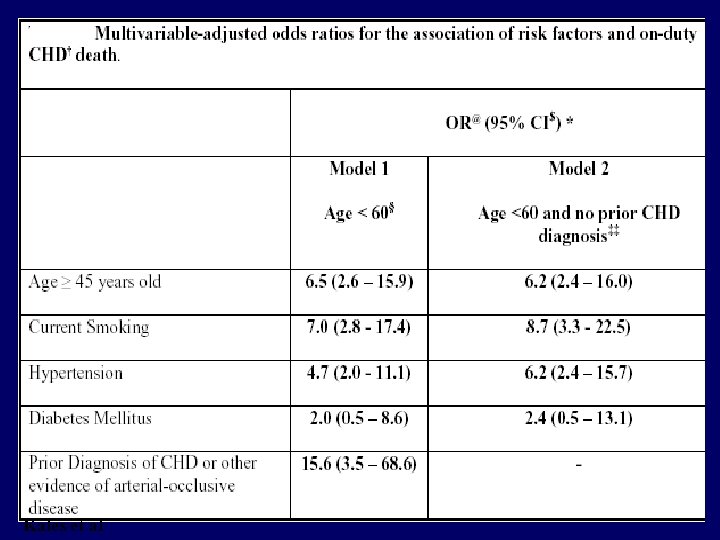
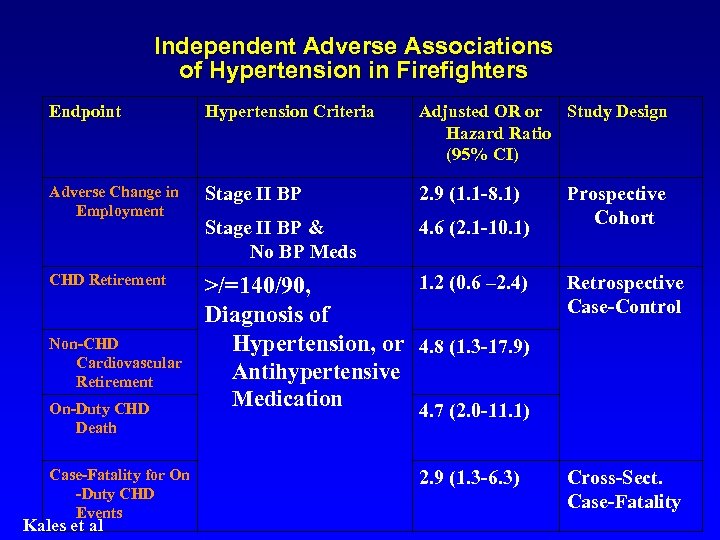 Independent Adverse Associations of Hypertension in Firefighters Endpoint Hypertension Criteria Adjusted OR or Study Design Hazard Ratio (95% CI) Adverse Change in Employment Stage II BP 2. 9 (1. 1 -8. 1) Stage II BP & No BP Meds 4. 6 (2. 1 -10. 1) CHD Retirement 1. 2 (0. 6 – 2. 4) >/=140/90, Diagnosis of Hypertension, or 4. 8 (1. 3 -17. 9) Antihypertensive Medication 4. 7 (2. 0 -11. 1) Non-CHD Cardiovascular Retirement On-Duty CHD Death Case-Fatality for On -Duty CHD Events Kales et al 2. 9 (1. 3 -6. 3) Prospective Cohort Retrospective Case-Control Cross-Sect. Case-Fatality
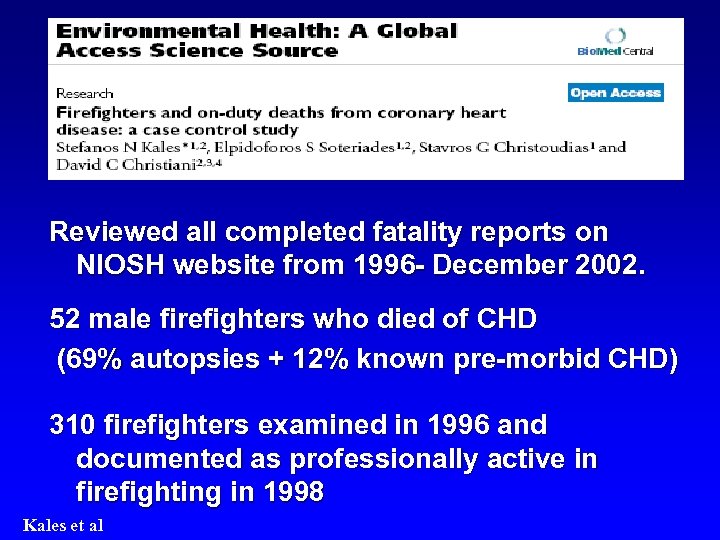 Reviewed all completed fatality reports on NIOSH website from 1996 - December 2002. 52 male firefighters who died of CHD (69% autopsies + 12% known pre-morbid CHD) 310 firefighters examined in 1996 and documented as professionally active in firefighting in 1998 Kales et al
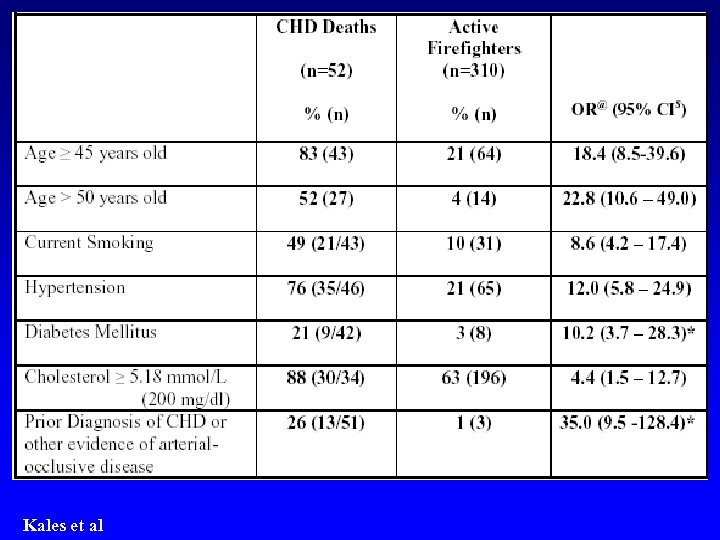 Kales et al
 Kales et al
 Heart Retirements Describe Massachusetts firefighters receiving pensions under state “Heart Presumption” legislation 1997 -2004: All cases approved by PERAC after review by PERAC-appointed medical panels. Kales et al
 Research Plan Controls: Active- Non-retired Firefighters drawn from all regions of Massachusetts 310 male firefighters examined in 1996/1997, whose vital status and continued professional activity were re-documented in 1998. Kales et al
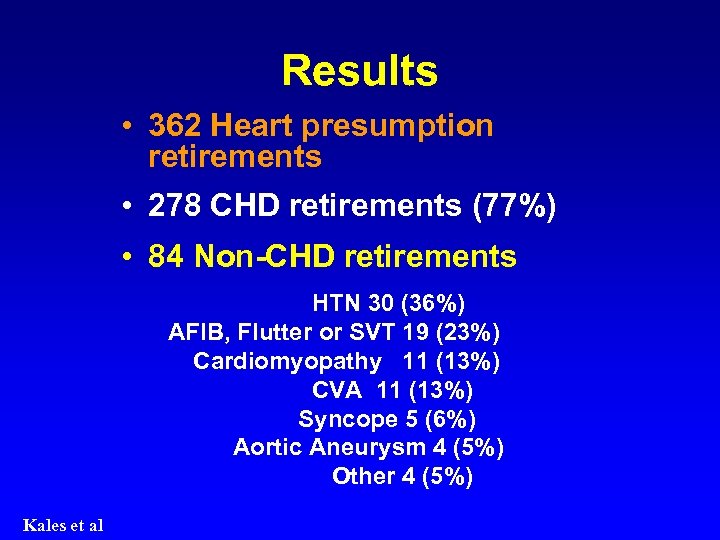 Results • 362 Heart presumption retirements • 278 CHD retirements (77%) • 84 Non-CHD retirements HTN 30 (36%) AFIB, Flutter or SVT 19 (23%) Cardiomyopathy 11 (13%) CVA 11 (13%) Syncope 5 (6%) Aortic Aneurysm 4 (5%) Other 4 (5%) Kales et al
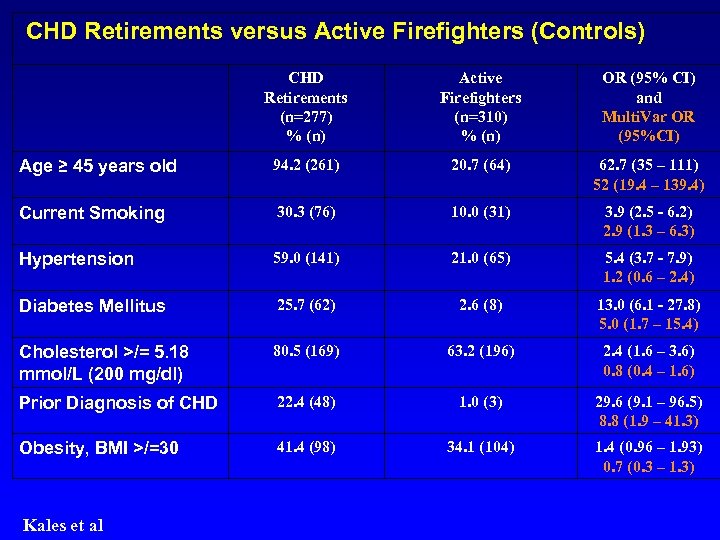 CHD Retirements versus Active Firefighters (Controls) CHD Retirements (n=277) % (n) Active Firefighters (n=310) % (n) OR (95% CI) and Multi. Var OR (95%CI) Age ≥ 45 years old 94. 2 (261) 20. 7 (64) 62. 7 (35 – 111) 52 (19. 4 – 139. 4) Current Smoking 30. 3 (76) 10. 0 (31) 3. 9 (2. 5 - 6. 2) 2. 9 (1. 3 – 6. 3) Hypertension 59. 0 (141) 21. 0 (65) 5. 4 (3. 7 - 7. 9) 1. 2 (0. 6 – 2. 4) Diabetes Mellitus 25. 7 (62) 2. 6 (8) 13. 0 (6. 1 - 27. 8) 5. 0 (1. 7 – 15. 4) Cholesterol >/= 5. 18 mmol/L (200 mg/dl) 80. 5 (169) 63. 2 (196) 2. 4 (1. 6 – 3. 6) 0. 8 (0. 4 – 1. 6) Prior Diagnosis of CHD 22. 4 (48) 1. 0 (3) 29. 6 (9. 1 – 96. 5) 8. 8 (1. 9 – 41. 3) Obesity, BMI >/=30 41. 4 (98) 34. 1 (104) 1. 4 (0. 96 – 1. 93) 0. 7 (0. 3 – 1. 3) Kales et al
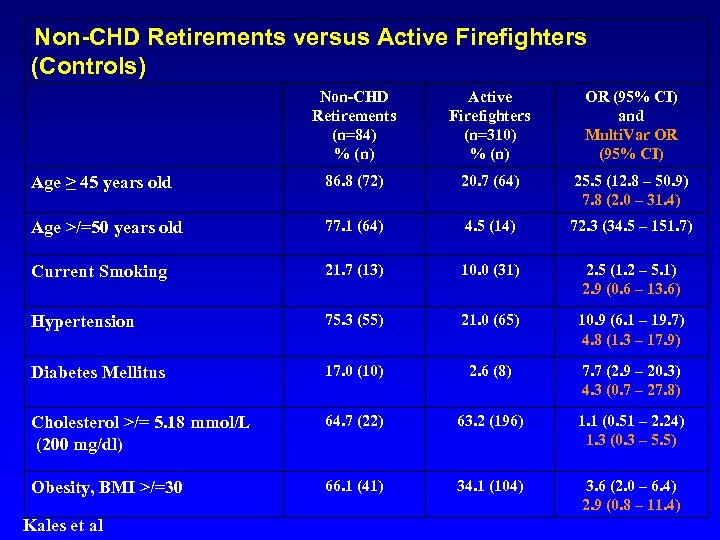 Non-CHD Retirements versus Active Firefighters (Controls) Non-CHD Retirements (n=84) % (n) Active Firefighters (n=310) % (n) OR (95% CI) and Multi. Var OR (95% CI) Age ≥ 45 years old 86. 8 (72) 20. 7 (64) 25. 5 (12. 8 – 50. 9) 7. 8 (2. 0 – 31. 4) Age >/=50 years old 77. 1 (64) 4. 5 (14) 72. 3 (34. 5 – 151. 7) Current Smoking 21. 7 (13) 10. 0 (31) 2. 5 (1. 2 – 5. 1) 2. 9 (0. 6 – 13. 6) Hypertension 75. 3 (55) 21. 0 (65) 10. 9 (6. 1 – 19. 7) 4. 8 (1. 3 – 17. 9) Diabetes Mellitus 17. 0 (10) 2. 6 (8) 7. 7 (2. 9 – 20. 3) 4. 3 (0. 7 – 27. 8) Cholesterol >/= 5. 18 mmol/L (200 mg/dl) 64. 7 (22) 63. 2 (196) 1. 1 (0. 51 – 2. 24) 1. 3 (0. 3 – 5. 5) Obesity, BMI >/=30 66. 1 (41) 34. 1 (104) 3. 6 (2. 0 – 6. 4) 2. 9 (0. 8 – 11. 4) Kales et al
 Predictors of Fatal on-Duty CHD Events (vs. Non-Fatal Events) Kales et al
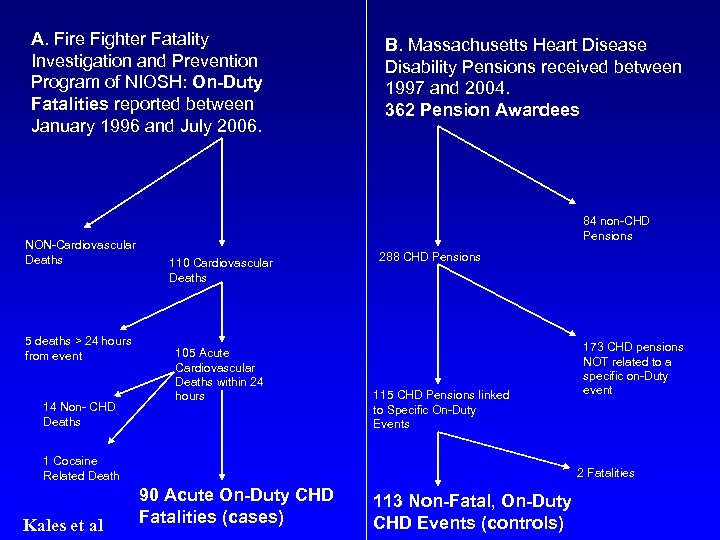 A. Fire Fighter Fatality Investigation and Prevention Program of NIOSH: On-Duty Fatalities reported between January 1996 and July 2006. NON-Cardiovascular Deaths 5 deaths > 24 hours from event 14 Non- CHD Deaths B. Massachusetts Heart Disease Disability Pensions received between 1997 and 2004. 362 Pension Awardees 84 non-CHD Pensions 110 Cardiovascular Deaths 105 Acute Cardiovascular Deaths within 24 hours 288 CHD Pensions 115 CHD Pensions linked to Specific On-Duty Events 1 Cocaine Related Death Kales et al 173 CHD pensions NOT related to a specific on-Duty event 2 Fatalities 90 Acute On-Duty CHD Fatalities (cases) 113 Non-Fatal, On-Duty CHD Events (controls)
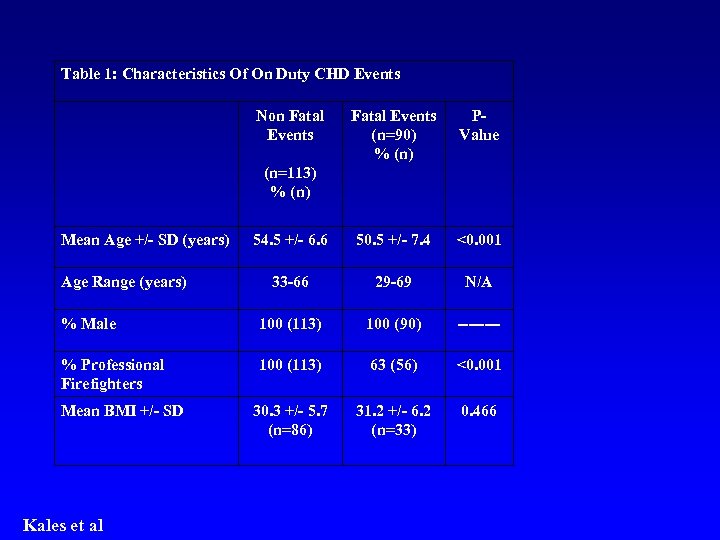 Table 1: Characteristics Of On Duty CHD Events Non Fatal Events (n=113) % (n) Fatal Events (n=90) % (n) PValue 54. 5 +/- 6. 6 50. 5 +/- 7. 4 <0. 001 33 -66 29 -69 N/A % Male 100 (113) 100 (90) ---- % Professional Firefighters 100 (113) 63 (56) <0. 001 30. 3 +/- 5. 7 (n=86) 31. 2 +/- 6. 2 (n=33) 0. 466 Mean Age +/- SD (years) Age Range (years) Mean BMI +/- SD Kales et al
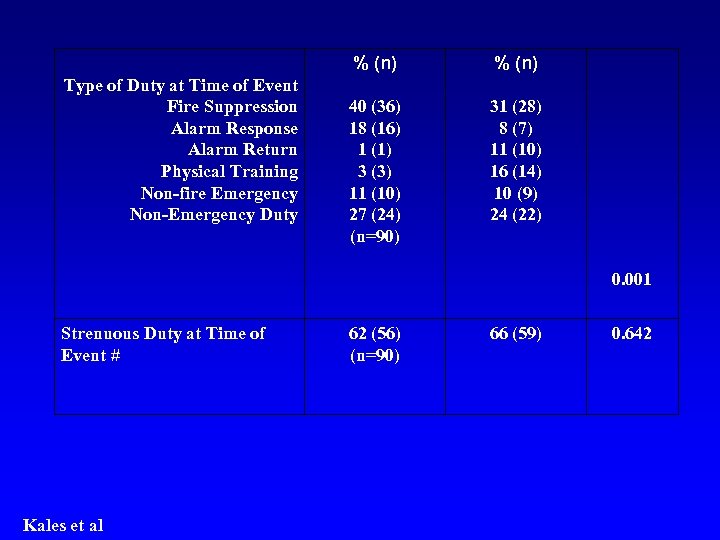 % (n) Type of Duty at Time of Event Fire Suppression Alarm Response Alarm Return Physical Training Non-fire Emergency Non-Emergency Duty % (n) 40 (36) 18 (16) 1 (1) 3 (3) 11 (10) 27 (24) (n=90) 31 (28) 8 (7) 11 (10) 16 (14) 10 (9) 24 (22) 0. 001 Strenuous Duty at Time of Event # Kales et al 62 (56) (n=90) 66 (59) 0. 642
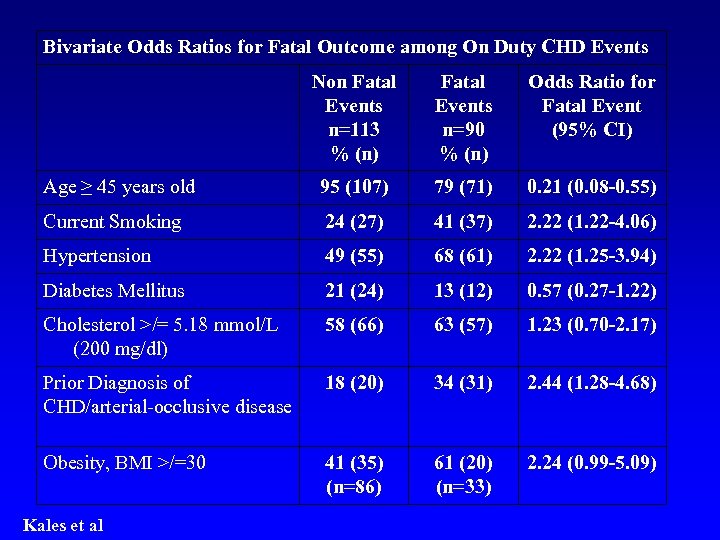 Bivariate Odds Ratios for Fatal Outcome among On Duty CHD Events Non Fatal Events n=113 % (n) Fatal Events n=90 % (n) Odds Ratio for Fatal Event (95% CI) Age ≥ 45 years old 95 (107) 79 (71) 0. 21 (0. 08 -0. 55) Current Smoking 24 (27) 41 (37) 2. 22 (1. 22 -4. 06) Hypertension 49 (55) 68 (61) 2. 22 (1. 25 -3. 94) Diabetes Mellitus 21 (24) 13 (12) 0. 57 (0. 27 -1. 22) Cholesterol >/= 5. 18 mmol/L (200 mg/dl) 58 (66) 63 (57) 1. 23 (0. 70 -2. 17) Prior Diagnosis of CHD/arterial-occlusive disease 18 (20) 34 (31) 2. 44 (1. 28 -4. 68) Obesity, BMI >/=30 41 (35) (n=86) 61 (20) (n=33) 2. 24 (0. 99 -5. 09) Kales et al
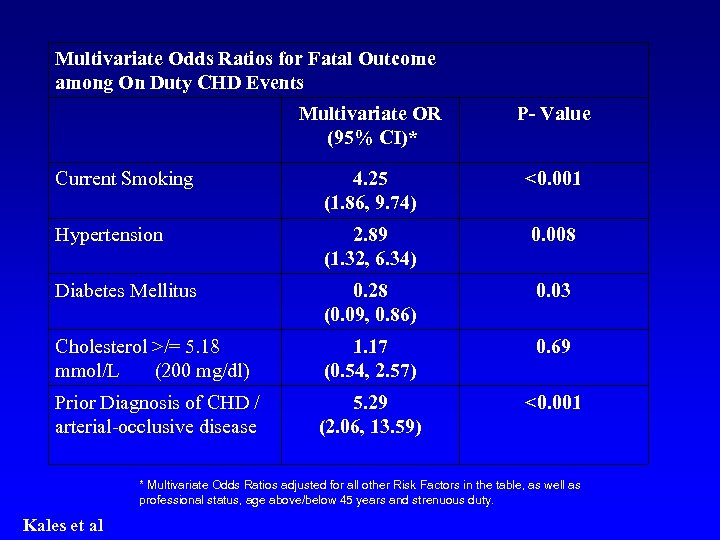 Multivariate Odds Ratios for Fatal Outcome among On Duty CHD Events Multivariate OR (95% CI)* P- Value Current Smoking 4. 25 (1. 86, 9. 74) <0. 001 Hypertension 2. 89 (1. 32, 6. 34) 0. 008 Diabetes Mellitus 0. 28 (0. 09, 0. 86) 0. 03 Cholesterol >/= 5. 18 mmol/L (200 mg/dl) 1. 17 (0. 54, 2. 57) 0. 69 Prior Diagnosis of CHD / arterial-occlusive disease 5. 29 (2. 06, 13. 59) <0. 001 * Multivariate Odds Ratios adjusted for all other Risk Factors in the table, as well as professional status, age above/below 45 years and strenuous duty. Kales et al
 PREVENTION 1 1) Fitness Promotion: Physical Standards not maintained; high prevalence of obesity (>33%); ~75% Nationally- NO fitness programs Mandatory exercise programs Nutrition programs Flu Shots Kales et al
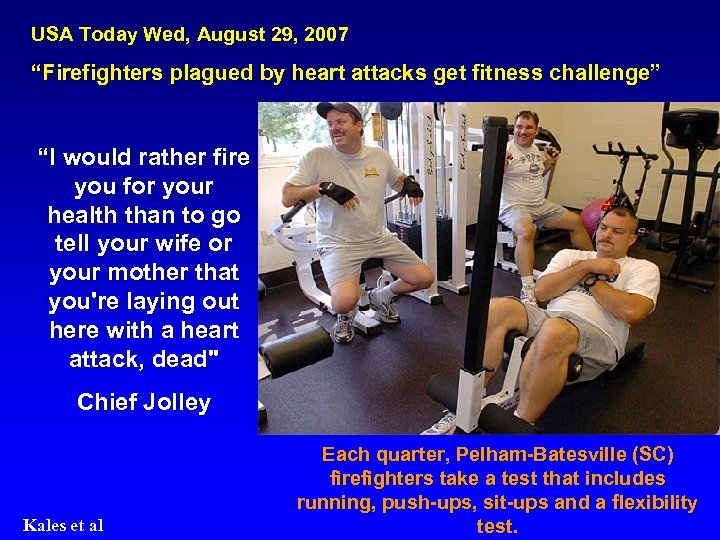 USA Today Wed, August 29, 2007 “Firefighters plagued by heart attacks get fitness challenge” “I would rather fire you for your health than to go tell your wife or your mother that you're laying out here with a heart attack, dead" Chief Jolley Kales et al Each quarter, Pelham-Batesville (SC) firefighters take a test that includes running, push-ups, sit-ups and a flexibility test.
 PREVENTION 2 2) Medical Screening: Few CHD fatalities or Retirements had a FD medical w/in 48 months of their event Ideally should integrate occupational exams with primary care follow-up Kales et al
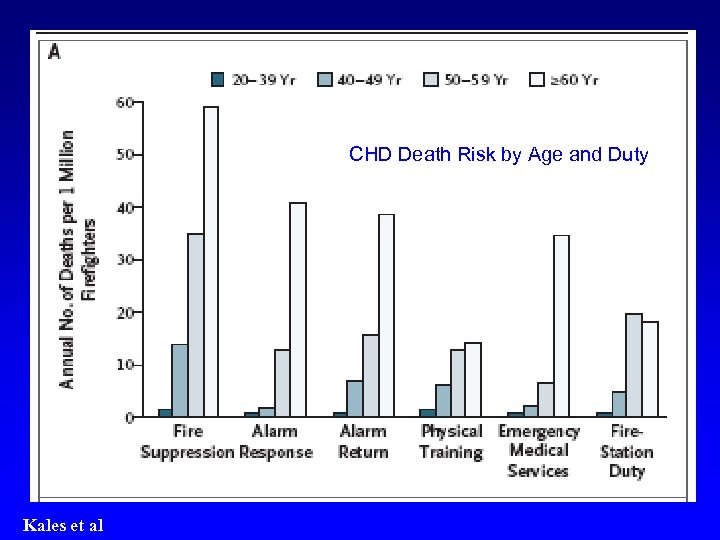 CHD Death Risk by Age and Duty Kales et al
 PREVENTION 3 3) Risk Factor Reduction: Low rates of HTN and lipid treatment Change Blood Pressure Standards Data supports Smoking BAN 4) Exercise Testing: Should be mandated >45 and sooner if excess risk factors, study needed to determine best protocols Kales et al
 PREVENTION 4 5) RTW Protocols: Need Occupational Medicine Clearance after Illness or Injury 6) Pre-Existing CHD: Once CHD is diagnosed, most affected Firefighters should be removed from Emergency Operations Kales et al
 Major Study Team Members 19962007 Kales et al Elpidoforos Soteriades, MD, MSc, Sc. D Jonathan Holder, DO, MPH Costas Christophi, Ph. D Ibe Mbanu MD, MPH Jesse Geibe, MD, MPH Gerry Polyhronopoulos, MD Jon Aldrich, MD Stavros Christoudias Antonios Tsismenakis David Christiani, MD, MPH, MS Professor & Director
 Bibliography Kales SN, Polyhronopoulos GN, Aldrich JM, Leitao ED, Christiani DC. Correlates of body mass index in hazardous materials firefighters. J Occup and Environ Med 1999; 41: 589 -595. Kales SN, Christiani DC. Cardiovascular Fitness in Firefighters. Journal of Occupational and Environmental Medicine 2000; 42: 467 -468. Kales SN, Soteriades ES, Christoudias SG, Tucker S, Nicolaou M, Christiani DC. Firefighters’ blood pressure and Employment Status on Hazardous Materials Teams in Massachusetts: A Prospective Study. J Occup Env Med 2002; 44: 669 -676. Soteriades ES, Kales SN, Christoudias, SG, Tucker S, Liarokapis D, Christiani, DC. The Lipid Profile of Firefighters Over Time: Opportunities for Prevention. J Occup Env Med 2002; 44: 840 -846. Kales et al
 Bibliography Soteriades ES, Kales SN, Liarokapis D, Christiani, DC. Prospective Surveillance of Hypertension in Firefighters. J Clinical Hypertension 2003; 5: 315 -321. Kales SN, Soteriades ES, Christoudias SG, Christiani DC. Firefighters and On-Duty Deaths from Coronary Heart Disease: a Case Control Study. Environmental Health: A Global Access Science Source 2003, 2: 14. Soteriades ES, Hauser R, Kawachi I, Liarokapis D, Christiani DC, Kales SN. Obesity and Cardiovascular Disease Risk Factors in Firefighters: A Prospective Cohort Study. Obesity Research 2005; 13: 1756 -1763. Holder JD, Stalling L, Peeples L, Burress JW, Kales SN. Firefighter Heart Presumption Retirements in Massachusetts: 1997 -2004. J Occup Environ Med. 2006; 48: 1047 -1053. Kales SN, Soteriades ES, Christouphi CA, Christiani DC. Emergency Duties and Deaths from Heart Disease among Firefighters in the United States. N Engl J Med 2007; 356: 1207 -1215. Mbanu I, Wellenius GA, Mittleman MA, Peeples L, Stallings LA, Kales SN. Seasonality and Coronary Heart Disease Deaths in United States Firefighters. Chronobiol Int. 2007; 24: 715– 726. Kales et al