


 Скачать презентацию Hearing the Voices of the Children Measuring Pediatric
6da9f781ebba6de07f659817c6b02175.ppt
- Количество слайдов: 41
 Hearing the Voices of the Children Measuring Pediatric Health-Related Quality of Life from the Perspective of the Children and Their Parents Quantifying the Qualitative James W. Varni, Ph. D. Texas A&M University 1
 World Health Organization Definition “Health as a state of complete physical, mental, and social wellbeing, and not merely the absence of disease or infirmity. ” - World Health Organization (1948) 2
 Quality of Life Measurements n In recent years, Quality of Life (QOL) measurement has emerged as an important health outcome in clinical trials, clinical practice improvement strategies, and healthcare services research and evaluation 3
 Use of QOL assessments n n Utilizing QOL assessments in the clinical setting can facilitate physician-patient communication and identify “hidden morbidities, ” or physical and psychosocial functioning deficits in individual patients that might otherwise go under-identified. Results of such assessment may indicate problem areas that need to be further explored and can aid a physician or other healthcare professional in designing treatment interventions and/or making the appropriate referrals 4
 Pediatric QOL measurement n n Prediction of pediatric risk and future resource utilization may assist in proactive targeting of healthcare resources to minimize morbidity and associated costs. Serial QOL screenings integrated into standard clinical practice may increase the probability that pediatric patients can be managed with optimal QOL. 5
 The Peds. QL™ Pediatric Quality of Life Inventory™ n n n Pediatric Health-Related Quality of Life Measurement Experiences with 18, 792 Healthy and Ill Children and Adolescents and Their Parents: Child Self-Report (N = 11, 355 ) Parent Proxy-Report (N = 18, 617) 6
 The Peds. QL™ n Measures Child’s and Parent’s Perceptions of Child’s Health-Related Quality of Life n Child Self-Report: Ages 5 -18 n Parent Proxy-Report: Ages 2 -18 7
 The Peds. QL™ Instructions (Child Report) n Standard Version n n In the past ONE month, how much of a problem has this been for you … Acute Version n In the past 7 days, how much of a problem has this been for you … 8
 The Peds. QL™ Instructions (Parent Report) n Standard Version n n In the past ONE month, how much of a problem has your child had with … Acute Version n In the past 7 days, how much of a problem has your child had with … 9
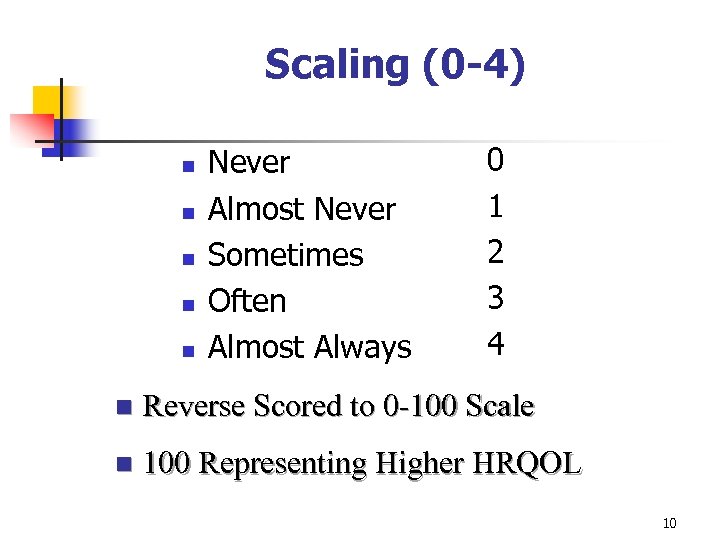 Scaling (0 -4) n n n 0 Never 1 Almost Never 2 Sometimes 3 Often 4 Almost Always n Reverse Scored to 0 -100 Scale n 100 Representing Higher HRQOL 10
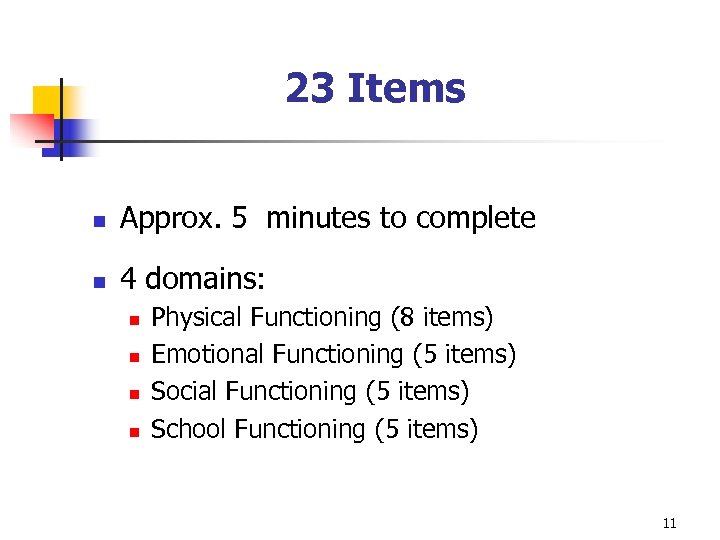 23 Items n Approx. 5 minutes to complete n 4 domains: n n Physical Functioning (8 items) Emotional Functioning (5 items) Social Functioning (5 items) School Functioning (5 items) 11
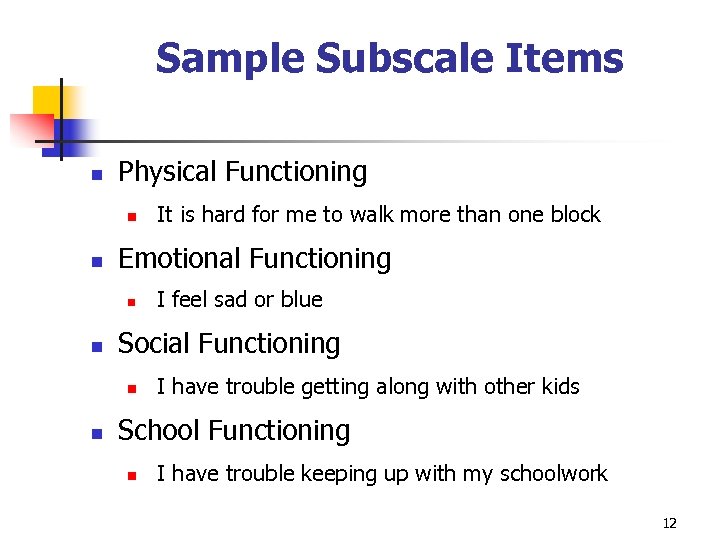 Sample Subscale Items n Physical Functioning n n Emotional Functioning n n I feel sad or blue Social Functioning n n It is hard for me to walk more than one block I have trouble getting along with other kids School Functioning n I have trouble keeping up with my schoolwork 12
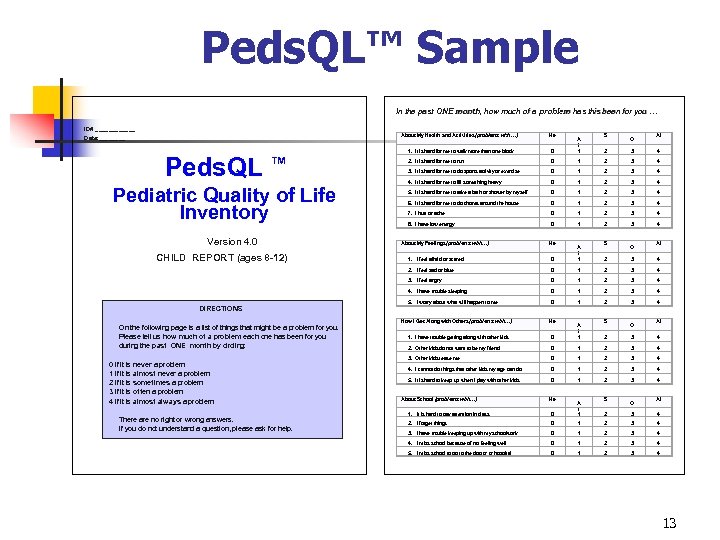 Peds. QL™ Sample In the past ONE month, how much of a problem has this been for you … month, ID# ______ Date: ____ About My Health and Activities (problems with…) Peds. QL ™ Pediatric Quality of Life Inventory Version 4. 0 S 1. It is hard for me to walk more than one block 0 2 3 4 2. It is hard for me to run 0 1 2 3 4 3. It is hard for me to do sports activity or exercise 0 1 2 3 4 4. It is hard for me to lift something heavy 0 1 2 3 4 5. It is hard for me to take a bath or shower by myself 0 1 2 3 4 6. It is hard for me to do chores around the house 0 1 2 3 4 7. I hurt or ache 0 1 2 3 4 8. I have low energy 0 1 2 3 4 About My Feelings (problems with…) Ne S O Al A l 1 O Al 1. I feel afraid or scared 0 A l 1 2 3 4 2. I feel sad or blue 0 1 2 3 4 3. I feel angry 0 1 2 3 4 4. I have trouble sleeping 0 1 2 3 4 5. I worry about what will happen to me CHILD REPORT (ages 8 -12) Ne 0 1 2 3 4 DIRECTIONS On the following page is a list of things that might be a problem for you. Please tell us how much of a problem each one has been for you during the past ONE month by circling: 0 if it is never a problem 1 if it is almost never a problem 2 if it is sometimes a problem 3 if it is often a problem 4 if it is almost always a problem There are no right or wrong answers. If you do not understand a question, please ask for help. How I Get Along with Others (problems with…) Ne S 1. I have trouble getting along with other kids 0 2 3 4 2. Other kids do not want to be my friend 0 1 2 3 4 3. Other kids tease me 0 1 2 3 4 4. I cannot do things that other kids my age can do 0 1 2 3 4 5. It is hard to keep up when I play with other kids 0 1 2 3 4 About School (problems with…) Ne 1. It is hard to pay attention in class 0 A l 1 2. I forget things 0 3. I have trouble keeping up with my schoolwork S O Al A l 1 O Al 2 3 4 1 2 3 4 0 1 2 3 4 4. I miss school because of not feeling well 0 1 2 3 4 5. I miss school to go to the doctor or hospital 0 1 2 3 4 13
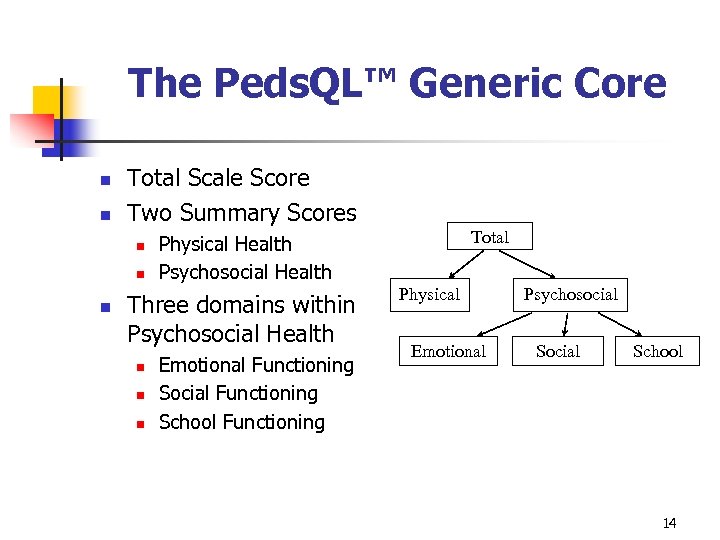 The Peds. QL™ Generic Core n n Total Scale Score Two Summary Scores n n n Physical Health Psychosocial Health Three domains within Psychosocial Health n n n Emotional Functioning Social Functioning School Functioning Total Physical Emotional Psychosocial School 14
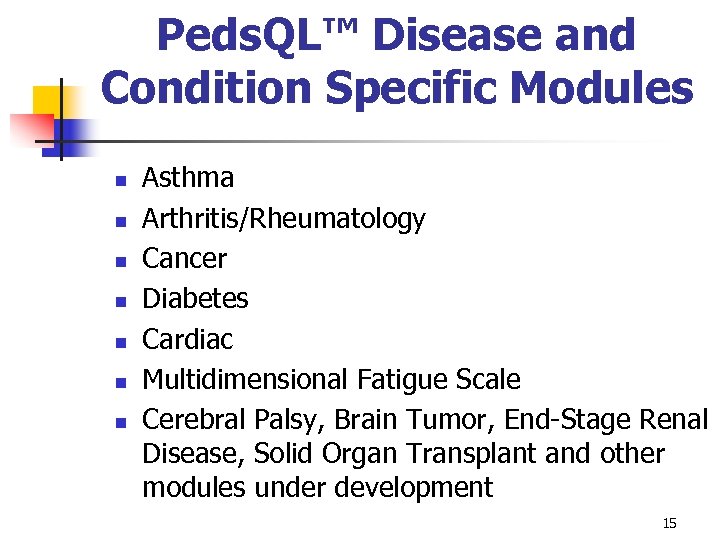 Peds. QL™ Disease and Condition Specific Modules n n n n Asthma Arthritis/Rheumatology Cancer Diabetes Cardiac Multidimensional Fatigue Scale Cerebral Palsy, Brain Tumor, End-Stage Renal Disease, Solid Organ Transplant and other modules under development 15
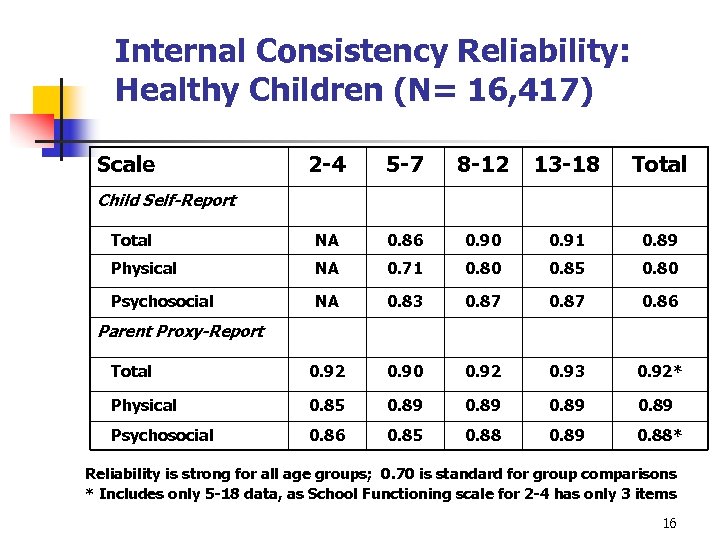 Internal Consistency Reliability: Healthy Children (N= 16, 417) Scale 2 -4 5 -7 8 -12 13 -18 Total NA 0. 86 0. 90 0. 91 0. 89 Physical NA 0. 71 0. 80 0. 85 0. 80 Psychosocial NA 0. 83 0. 87 0. 86 Total 0. 92 0. 90 0. 92 0. 93 0. 92* Physical 0. 85 0. 89 Psychosocial 0. 86 0. 85 0. 88 0. 89 0. 88* Child Self-Report Parent Proxy-Report Reliability is strong for all age groups; 0. 70 is standard for group comparisons * Includes only 5 -18 data, as School Functioning scale for 2 -4 has only 3 items 16
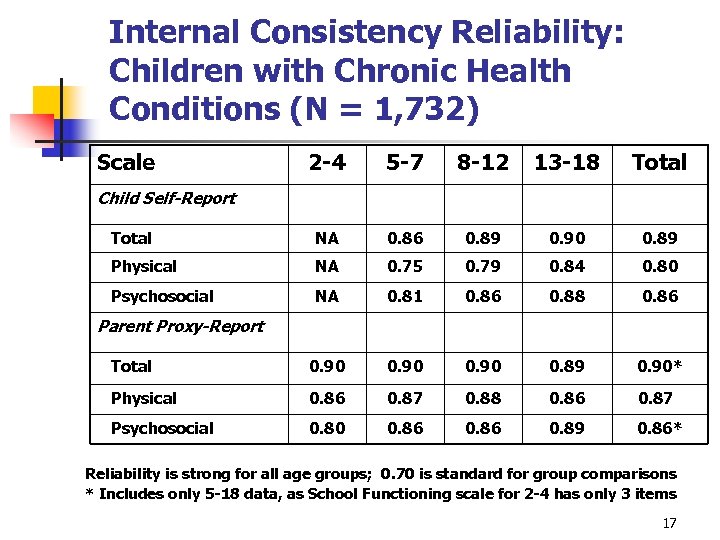 Internal Consistency Reliability: Children with Chronic Health Conditions (N = 1, 732) Scale 2 -4 5 -7 8 -12 13 -18 Total NA 0. 86 0. 89 0. 90 0. 89 Physical NA 0. 75 0. 79 0. 84 0. 80 Psychosocial NA 0. 81 0. 86 0. 88 0. 86 Total 0. 90 0. 89 0. 90* Physical 0. 86 0. 87 0. 88 0. 86 0. 87 Psychosocial 0. 80 0. 86 0. 89 0. 86* Child Self-Report Parent Proxy-Report Reliability is strong for all age groups; 0. 70 is standard for group comparisons * Includes only 5 -18 data, as School Functioning scale for 2 -4 has only 3 items 17
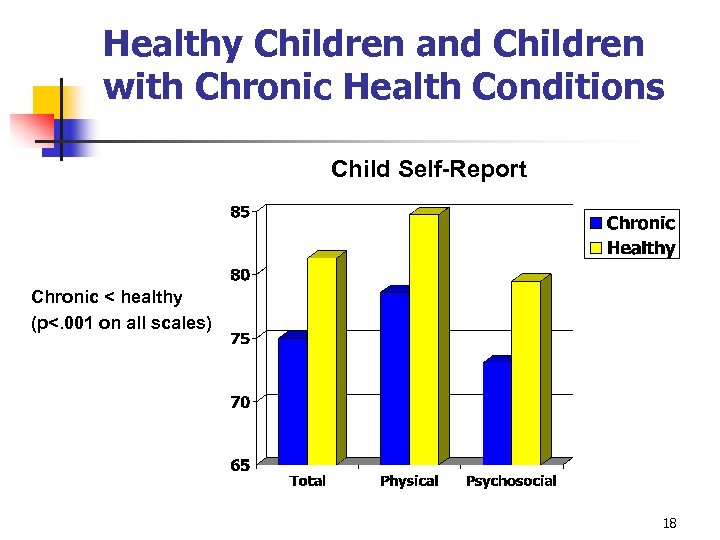 Healthy Children and Children with Chronic Health Conditions Child Self-Report Chronic < healthy (p<. 001 on all scales) 18
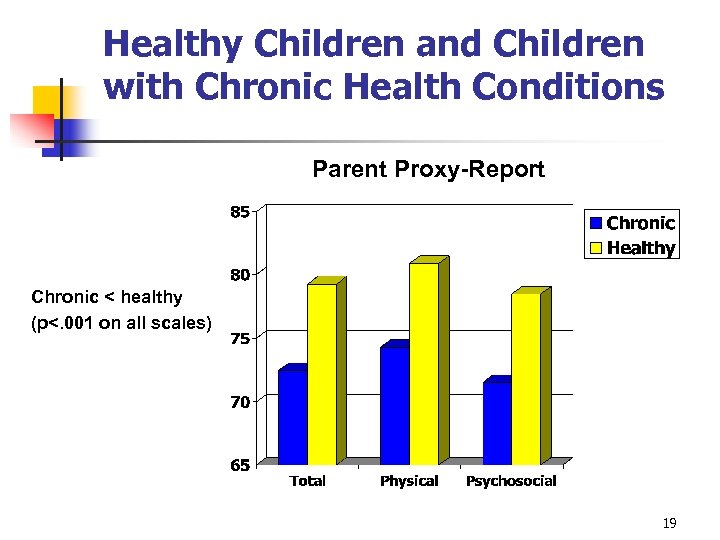 Healthy Children and Children with Chronic Health Conditions Parent Proxy-Report Chronic < healthy (p<. 001 on all scales) 19
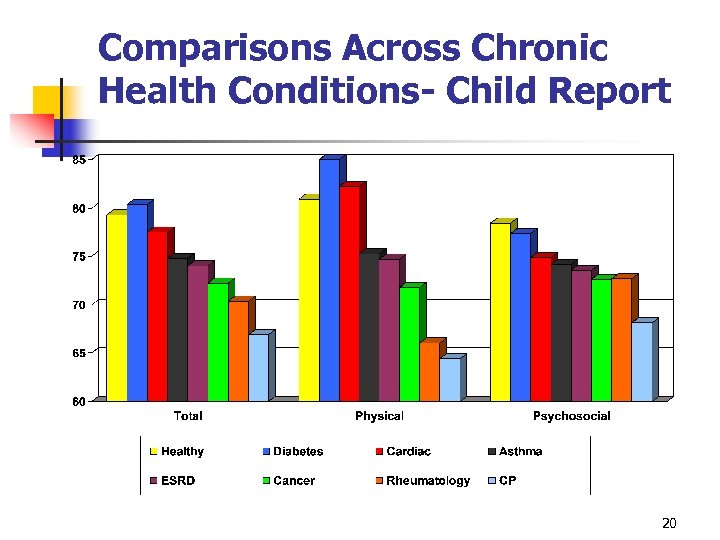 Comparisons Across Chronic Health Conditions- Child Report 20
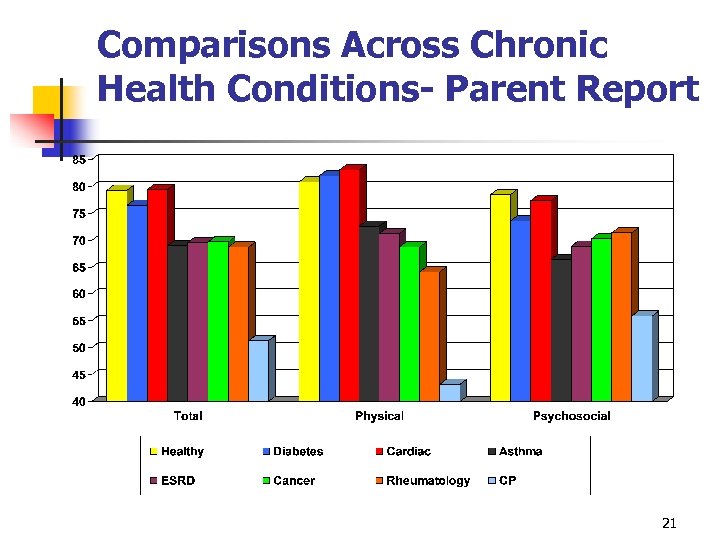 Comparisons Across Chronic Health Conditions- Parent Report 21
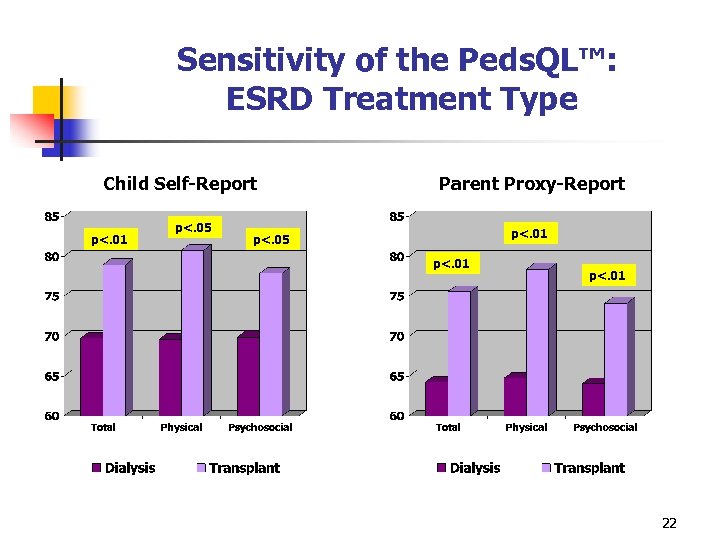 Sensitivity of the Peds. QL™: ESRD Treatment Type Child Self-Report p<. 01 p<. 05 Parent Proxy-Report p<. 01 p<. 05 p<. 01 22
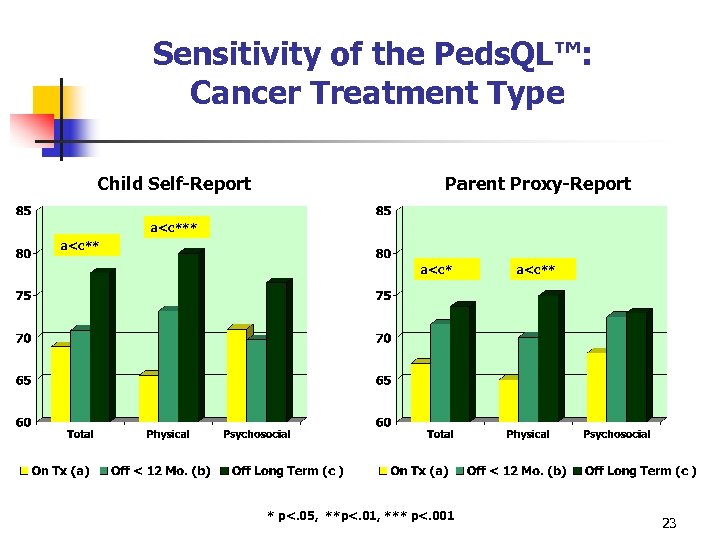 Sensitivity of the Peds. QL™: Cancer Treatment Type Child Self-Report Parent Proxy-Report a
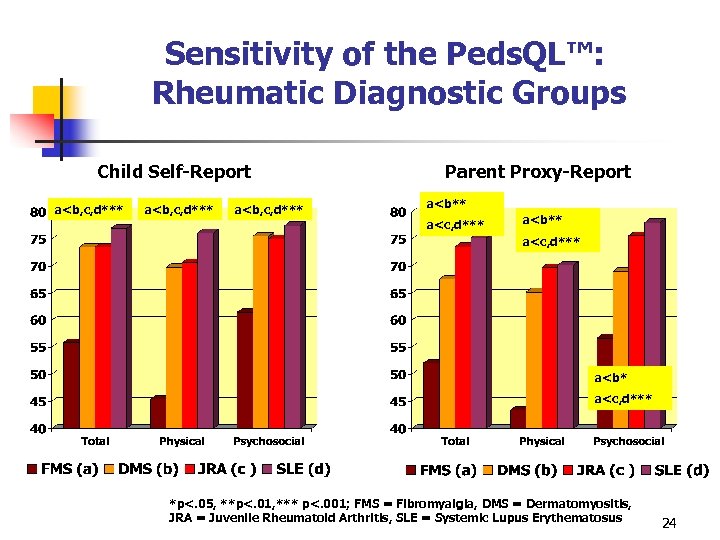 Sensitivity of the Peds. QL™: Rheumatic Diagnostic Groups Child Self-Report a
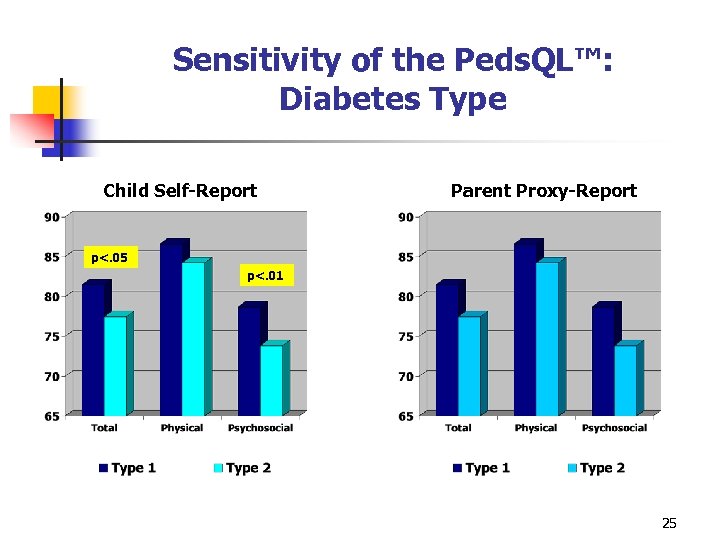 Sensitivity of the Peds. QL™: Diabetes Type Child Self-Report Parent Proxy-Report p<. 05 p<. 01 25
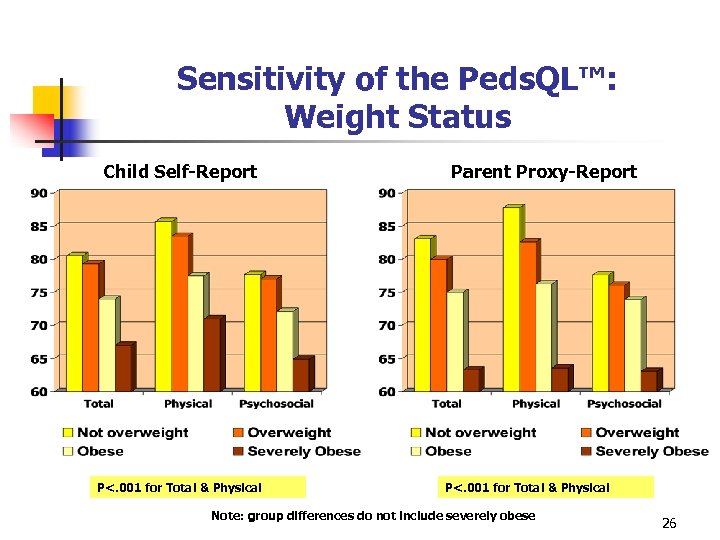 Sensitivity of the Peds. QL™: Weight Status Child Self-Report P<. 001 for Total & Physical Parent Proxy-Report P<. 001 for Total & Physical Note: group differences do not include severely obese 26
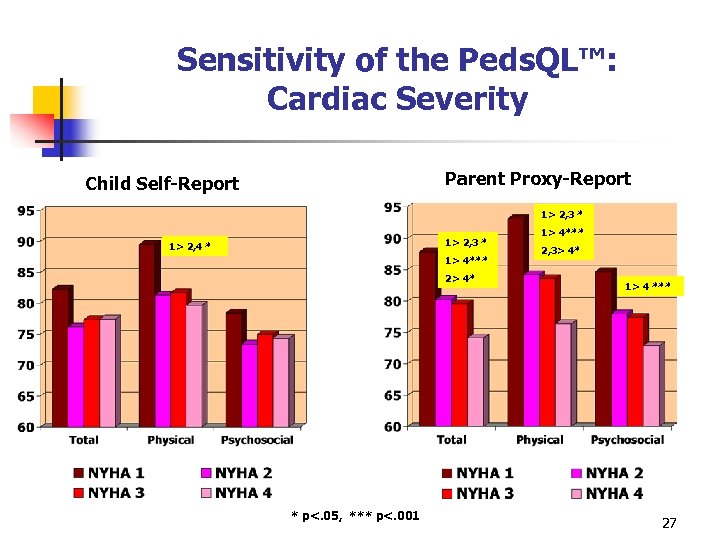 Sensitivity of the Peds. QL™: Cardiac Severity Parent Proxy-Report Child Self-Report 1> 2, 3 * 1> 2, 4 * 1> 4*** 2> 4* * p<. 05, *** p<. 001 1> 4*** 2, 3> 4* 1> 4 *** 27
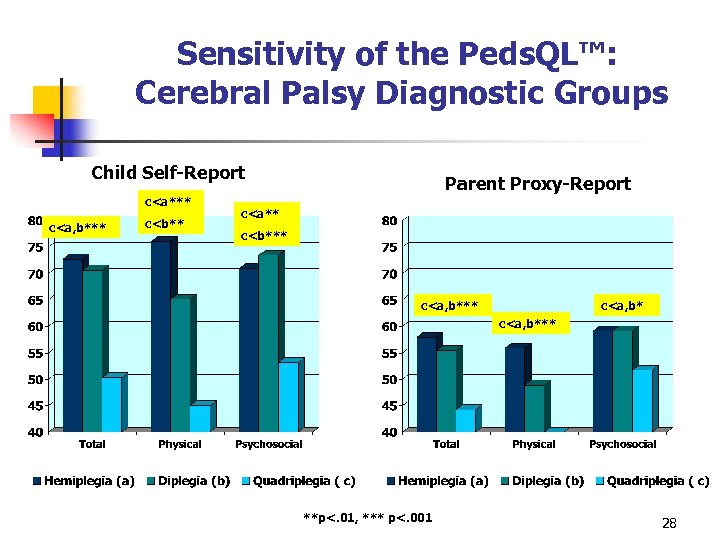 Sensitivity of the Peds. QL™: Cerebral Palsy Diagnostic Groups Child Self-Report c
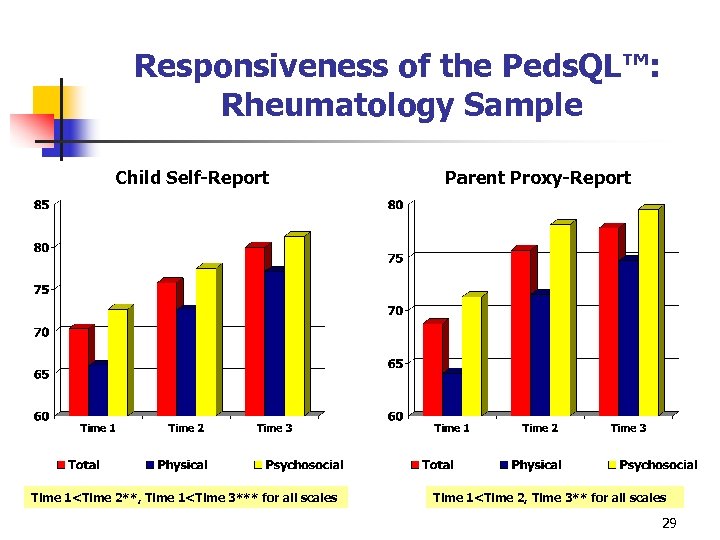 Responsiveness of the Peds. QL™: Rheumatology Sample Child Self-Report Time 1
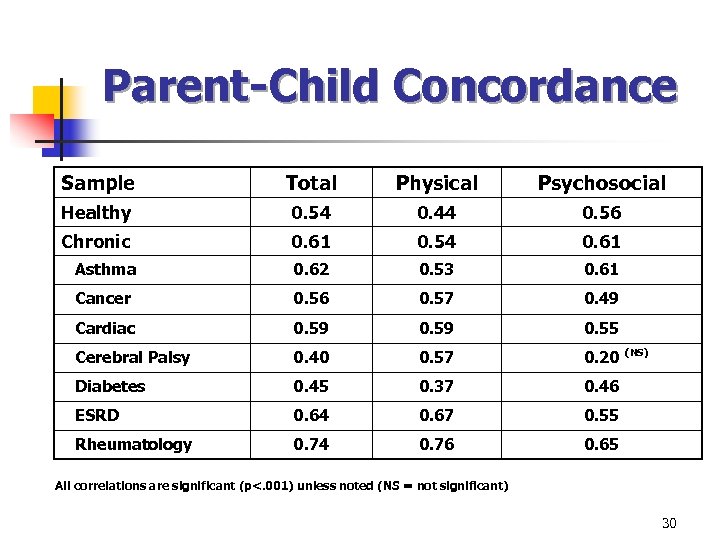 Parent-Child Concordance Sample Total Physical Psychosocial Healthy 0. 54 0. 44 0. 56 Chronic 0. 61 0. 54 0. 61 Asthma 0. 62 0. 53 0. 61 Cancer 0. 56 0. 57 0. 49 Cardiac 0. 59 0. 55 Cerebral Palsy 0. 40 0. 57 0. 20 Diabetes 0. 45 0. 37 0. 46 ESRD 0. 64 0. 67 0. 55 Rheumatology 0. 74 0. 76 0. 65 (NS) All correlations are significant (p<. 001) unless noted (NS = not significant) 30
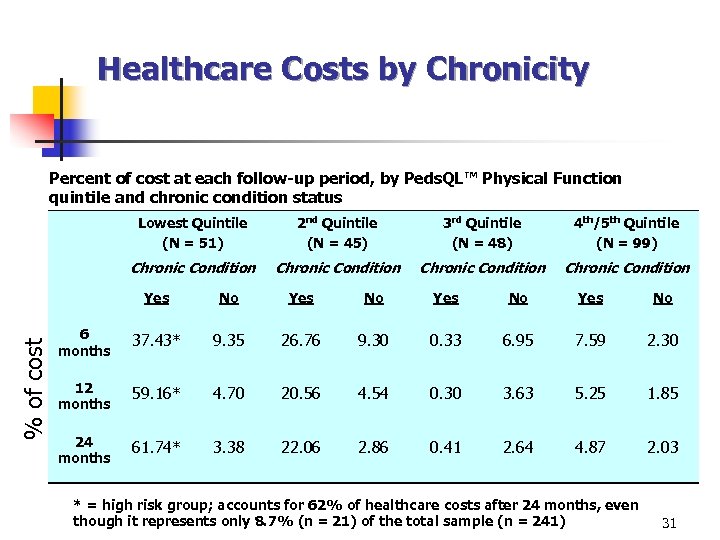 Healthcare Costs by Chronicity Percent of cost at each follow-up period, by Peds. QL™ Physical Function quintile and chronic condition status Lowest Quintile (N = 51) 2 nd Quintile (N = 45) 3 rd Quintile (N = 48) 4 th/5 th Quintile (N = 99) Chronic Condition % of cost Yes No 6 months 37. 43* 9. 35 26. 76 9. 30 0. 33 6. 95 7. 59 2. 30 12 months 59. 16* 4. 70 20. 56 4. 54 0. 30 3. 63 5. 25 1. 85 24 months 61. 74* 3. 38 22. 06 2. 86 0. 41 2. 64 4. 87 2. 03 * = high risk group; accounts for 62% of healthcare costs after 24 months, even though it represents only 8. 7% (n = 21) of the total sample (n = 241) 31
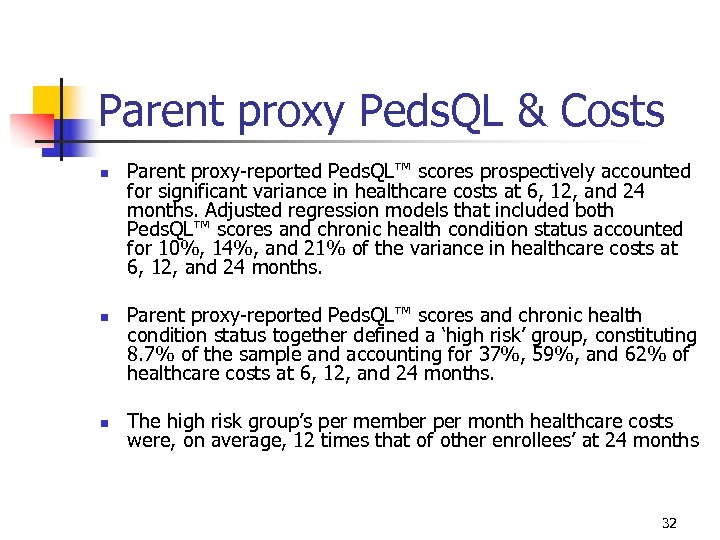 Parent proxy Peds. QL & Costs n n n Parent proxy-reported Peds. QL™ scores prospectively accounted for significant variance in healthcare costs at 6, 12, and 24 months. Adjusted regression models that included both Peds. QL™ scores and chronic health condition status accounted for 10%, 14%, and 21% of the variance in healthcare costs at 6, 12, and 24 months. Parent proxy-reported Peds. QL™ scores and chronic health condition status together defined a ‘high risk’ group, constituting 8. 7% of the sample and accounting for 37%, 59%, and 62% of healthcare costs at 6, 12, and 24 months. The high risk group’s per member per month healthcare costs were, on average, 12 times that of other enrollees’ at 24 months 32
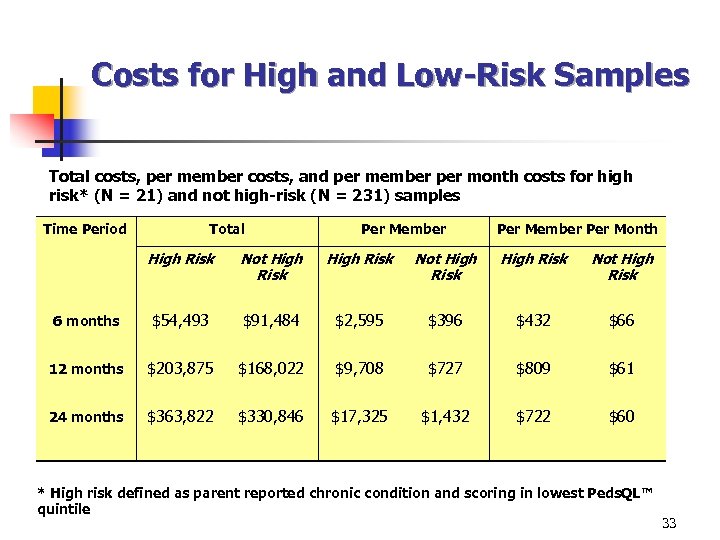 Costs for High and Low-Risk Samples Total costs, per member costs, and per member per month costs for high risk* (N = 21) and not high-risk (N = 231) samples Time Period Total Per Member Per Month High Risk Not High Risk 6 months $54, 493 $91, 484 $2, 595 $396 $432 $66 12 months $203, 875 $168, 022 $9, 708 $727 $809 $61 24 months $363, 822 $330, 846 $17, 325 $1, 432 $722 $60 * High risk defined as parent reported chronic condition and scoring in lowest Peds. QL™ quintile 33
 Parent proxy Peds QL ™ & Costs n n Parent proxy-reported Peds. QL™ scores can be used to prospectively predict healthcare costs. When combined with chronic health condition status, parent proxy-reported Peds. QL™ scores can identify an at risk group of children as candidates for proactive care coordination and cost containment. 34
 Improved Quality of Life n n A standardized assessment of patients’ QOL is necessary… when combined with physician knowledge of treatment options and referral sources patient functioning and quality of life can improve. 35
 Future Directions n n n Integrating Generic and Condition/Disease Specific Instruments Item Response Theory Facilitated Items Computerized Adaptive Testing 36
 The End Please proceed to the post test n Download the post test n Complete the post test n Return the post test to Dr. Oliver 407 I TAMUII n 37
 Post Test Question One 1. Child reported quality of life is lowest in which of the following diseases? 1. Diabetes 2. CP 3. Cancer 4. Asthma 38
 Post Test Question Two 2. Parent-child concordance in Peds. QL was significant in all diseases except: 1. Diabetes 2. CP 3. Cancer 4. Asthma 39
 Post Test Question Three 3. Children with chronic health conditions self reported which of the following QOL functional subscale variables lowest? 1. Physical 2. Psychosocial 40
 Thank you 41