 Скачать презентацию Hearing the Universe with Gravitational Waves Brennan Hughey
db6c9eecf5b8bca50bf5dd99abc8e249.ppt
- Количество слайдов: 49



Hearing the Universe with Gravitational Waves Brennan Hughey ERAU Physics Seminar March 23 rd 2010 1
I. Gravitational Waves II. LIGO and Burst Analysis III. Electromagnetic Follow-ups of LIGO/Virgo Triggers 2
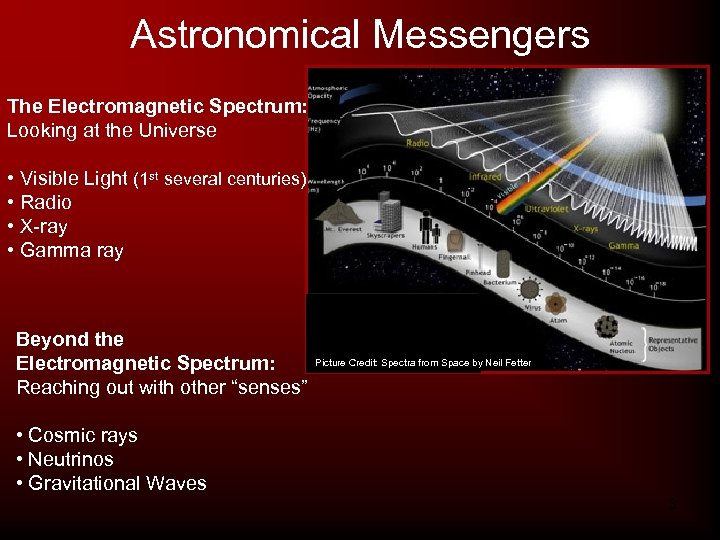
Astronomical Messengers The Electromagnetic Spectrum: Looking at the Universe • Visible Light (1 st several centuries) • Radio • X-ray • Gamma ray Beyond the Electromagnetic Spectrum: Reaching out with other “senses” Picture Credit: Spectra from Space by Neil Fetter • Cosmic rays • Neutrinos • Gravitational Waves 3
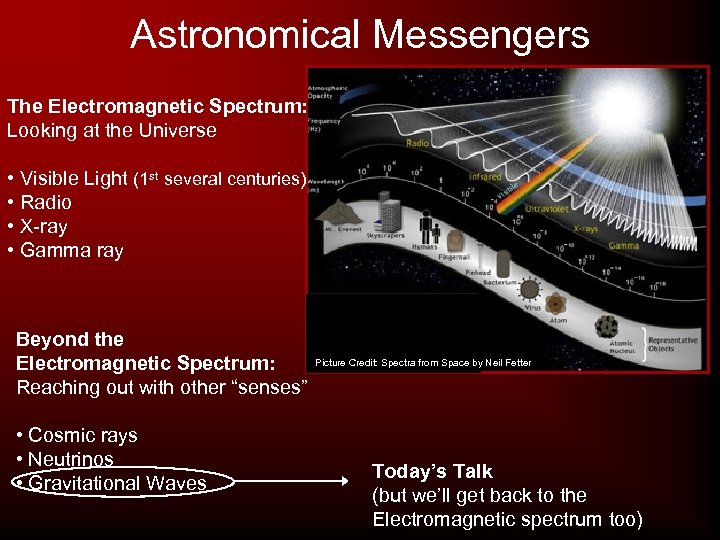
Astronomical Messengers The Electromagnetic Spectrum: Looking at the Universe • Visible Light (1 st several centuries) • Radio • X-ray • Gamma ray Beyond the Electromagnetic Spectrum: Reaching out with other “senses” • Cosmic rays • Neutrinos • Gravitational Waves Picture Credit: Spectra from Space by Neil Fetter Today’s Talk (but we’ll get back to the Electromagnetic spectrum too) 4
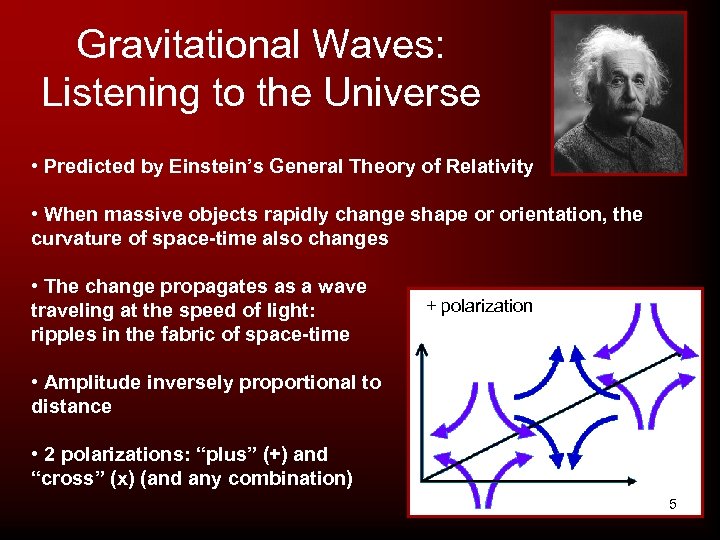
Gravitational Waves: Listening to the Universe • Predicted by Einstein’s General Theory of Relativity • When massive objects rapidly change shape or orientation, the curvature of space-time also changes • The change propagates as a wave traveling at the speed of light: ripples in the fabric of space-time + polarization • Amplitude inversely proportional to distance • 2 polarizations: “plus” (+) and “cross” (x) (and any combination) 5
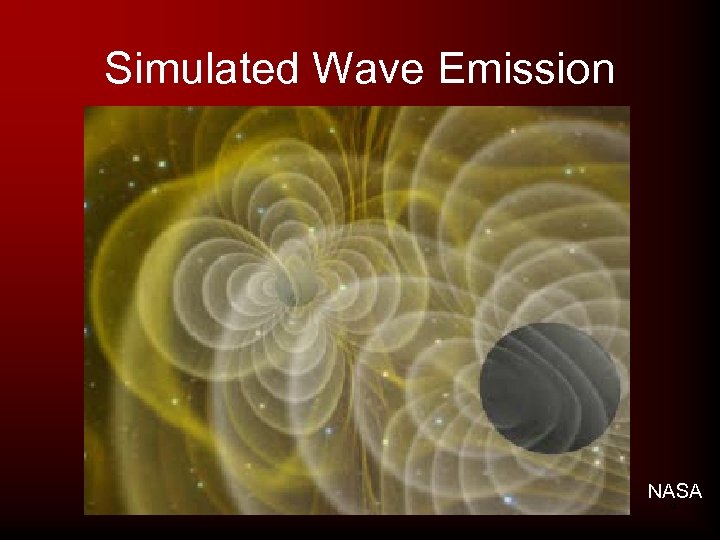
Simulated Wave Emission NASA 6
How “Loud” Are They? • Amplitude is described by dimensionless strain: stretching of space h = ΔL/L • Back-of-envelope calculation: – Laboratory dumbbell 7
How “Loud” Are They? • Amplitude is described by dimensionless strain: stretching of space h = ΔL/L • Back-of-envelope calculation: – Laboratory dumbbell (1 ton, 2 m, 1 k. Hz) h = 10 -38 8
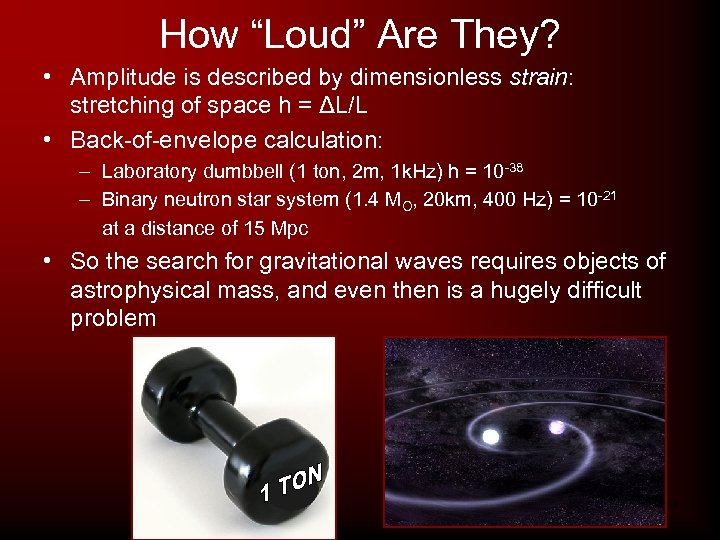
How “Loud” Are They? • Amplitude is described by dimensionless strain: stretching of space h = ΔL/L • Back-of-envelope calculation: – Laboratory dumbbell (1 ton, 2 m, 1 k. Hz) h = 10 -38 – Binary neutron star system (1. 4 MO, 20 km, 400 Hz) = 10 -21 at a distance of 15 Mpc • So the search for gravitational waves requires objects of astrophysical mass, and even then is a hugely difficult problem 9
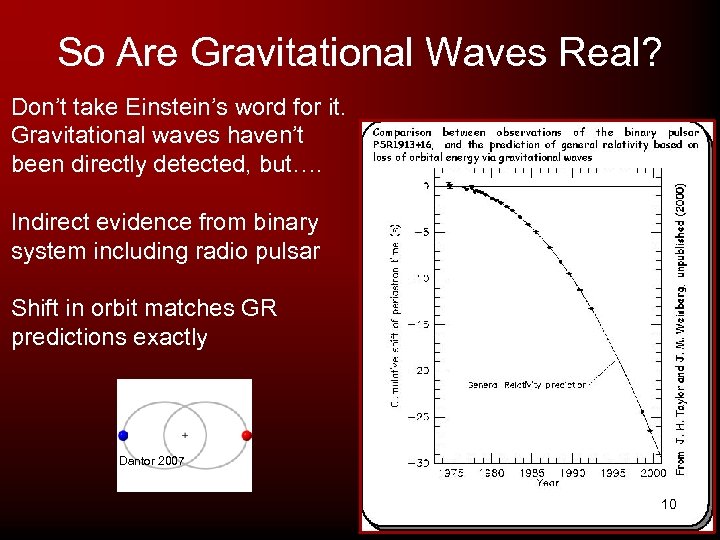
So Are Gravitational Waves Real? Don’t take Einstein’s word for it. Gravitational waves haven’t been directly detected, but…. Indirect evidence from binary system including radio pulsar Shift in orbit matches GR predictions exactly Dantor 2007 10
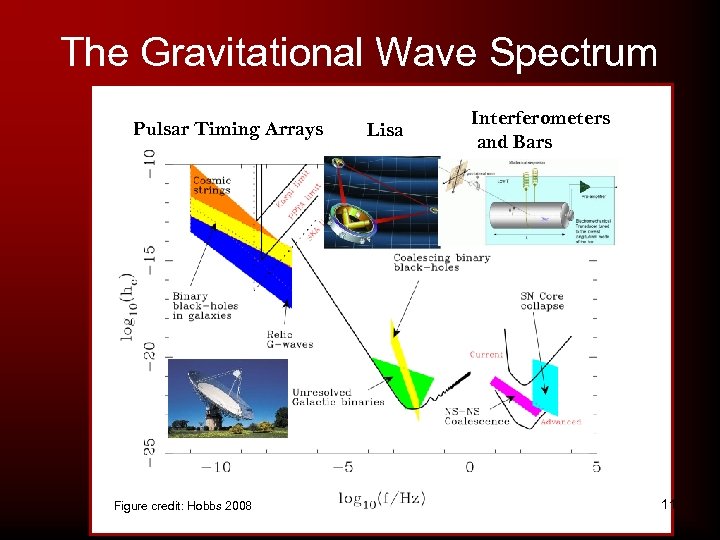
The Gravitational Wave Spectrum Pulsar Timing Arrays Figure credit: Hobbs 2008 Lisa Interferometers and Bars 11
I. Gravitational Waves II. LIGO and Burst Analysis III. Electromagnetic Follow-ups of LIGO/Virgo Triggers 12
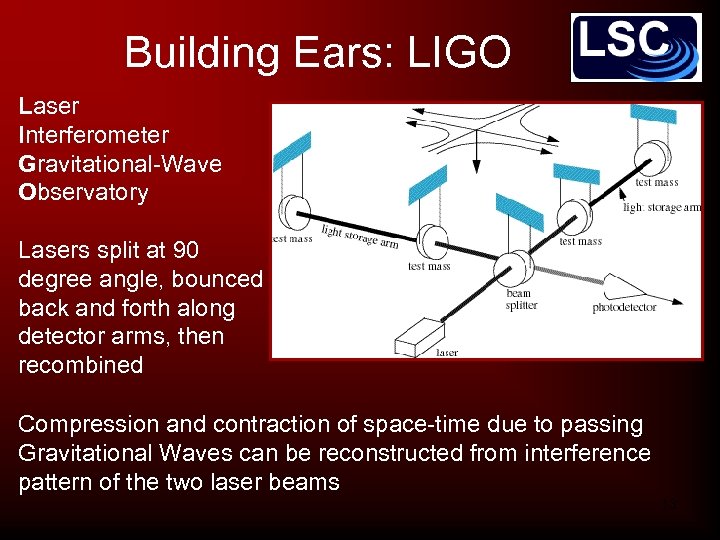
Building Ears: LIGO Laser Interferometer Gravitational-Wave Observatory Lasers split at 90 degree angle, bounced back and forth along detector arms, then recombined Compression and contraction of space-time due to passing Gravitational Waves can be reconstructed from interference pattern of the two laser beams 13
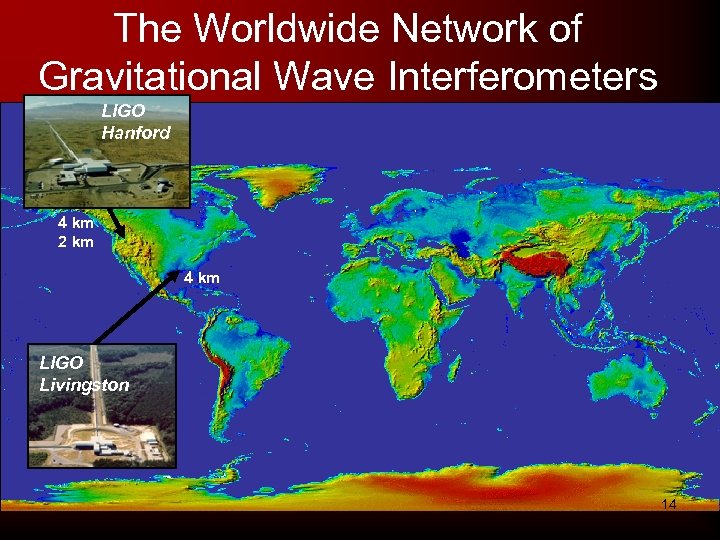
The Worldwide Network of Gravitational Wave Interferometers LIGO Hanford 4 km 2 km 4 km LIGO Livingston 14
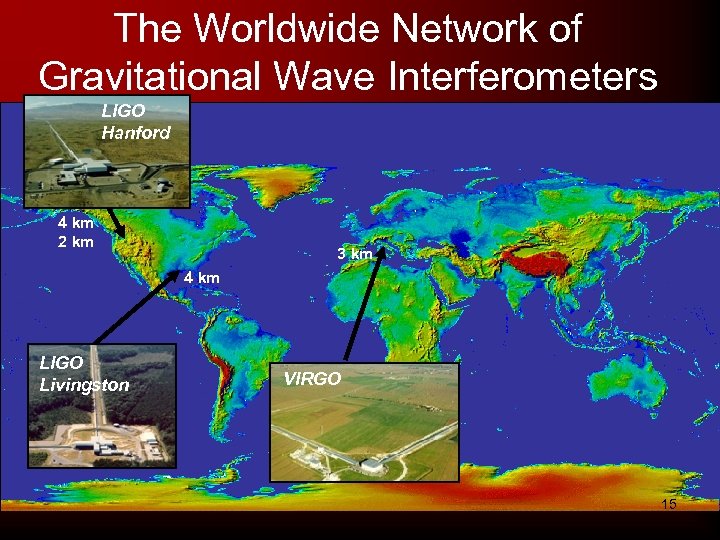
The Worldwide Network of Gravitational Wave Interferometers LIGO Hanford 4 km 2 km 3 km 4 km LIGO Livingston VIRGO 15
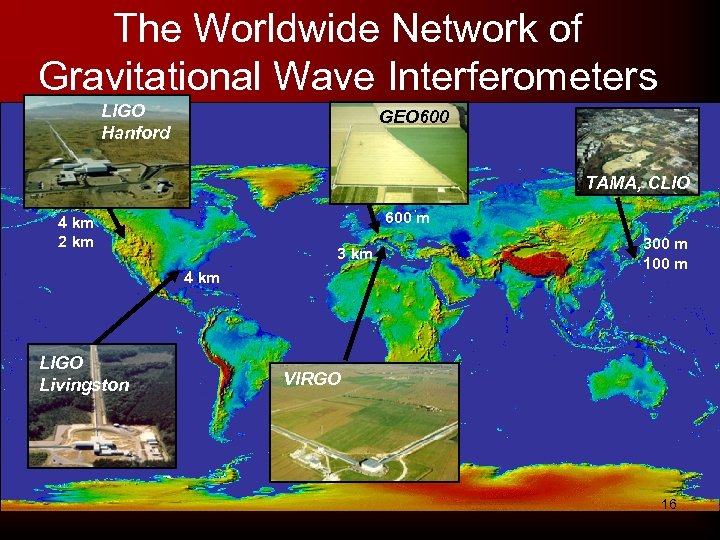
The Worldwide Network of Gravitational Wave Interferometers LIGO Hanford GEO 600 TAMA, CLIO 600 m 4 km 2 km 3 km 4 km LIGO Livingston 300 m 100 m VIRGO 16
LIGO Scientific Collaboration 17
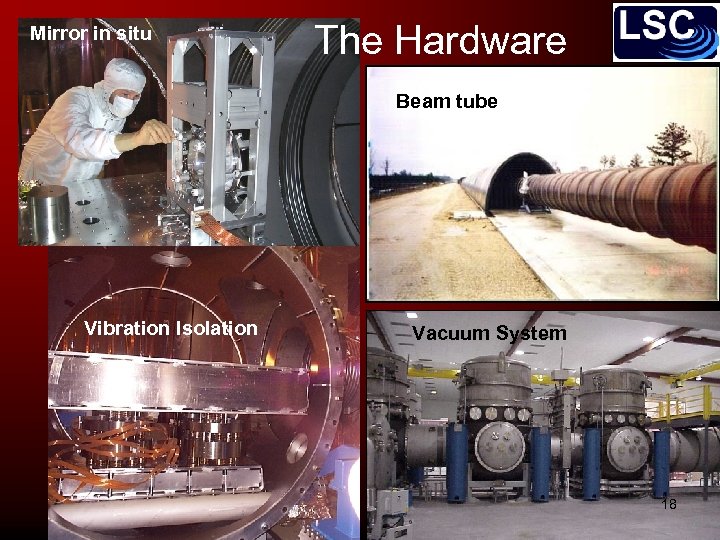
Mirror in situ The Hardware Beam tube Vibration Isolation Vacuum System 18
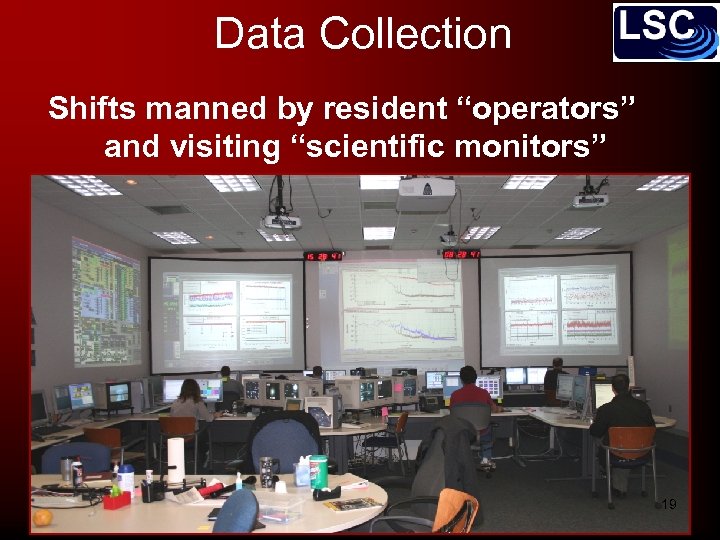
Data Collection Shifts manned by resident “operators” and visiting “scientific monitors” 19
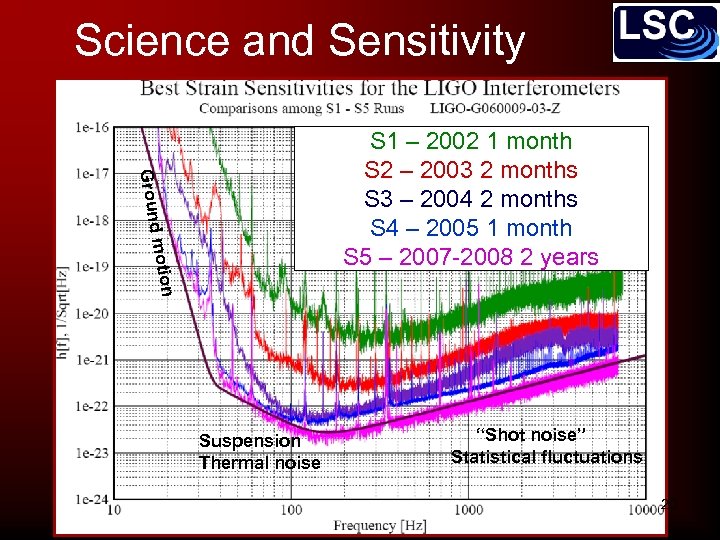
Science and Sensitivity d moti Groun S 1 – 2002 1 month S 2 – 2003 2 months S 3 – 2004 2 months S 4 – 2005 1 month S 5 – 2007 -2008 2 years on Suspension Thermal noise “Shot noise” Statistical fluctuations 20
S 6 and the Road Ahead A new science run is currently underway: S 6/VSR 2 July 2009 to ~September 2010 (expected) with some commissioning breaks Virgo and recent LIGO data improved w. r. t S 5/VSR 1 Incorporates some new technology and methods These improvements are prototypes for… 21
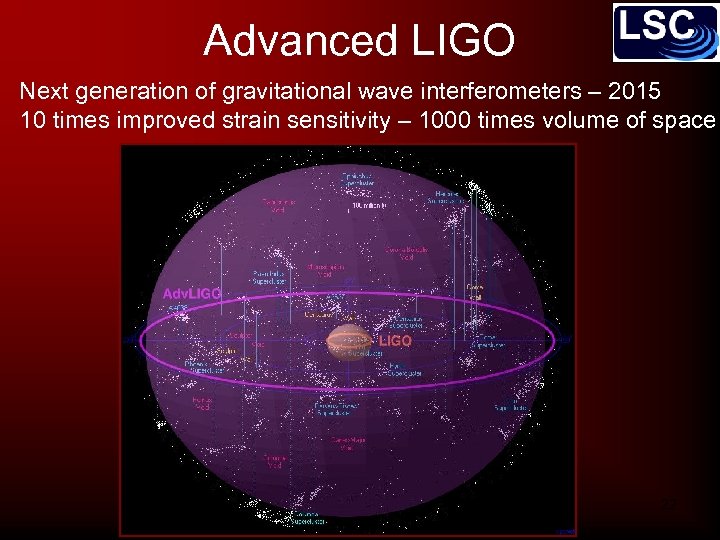
Advanced LIGO Next generation of gravitational wave interferometers – 2015 10 times improved strain sensitivity – 1000 times volume of space 22
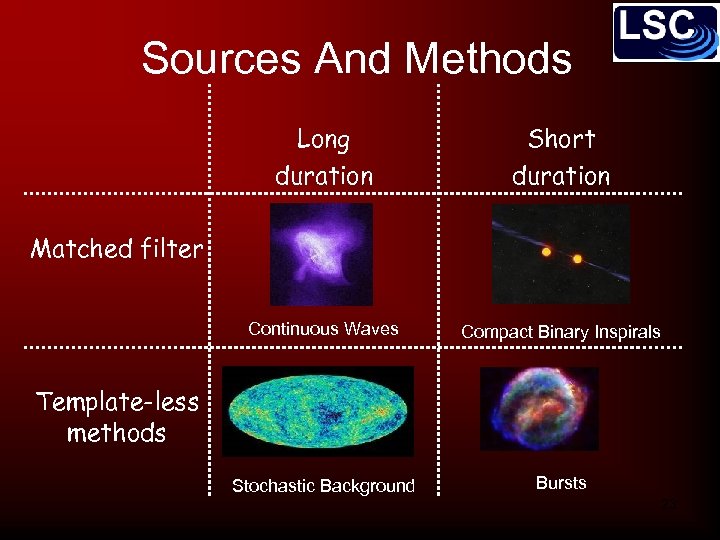
Sources And Methods Long duration Short duration Continuous Waves Compact Binary Inspirals Stochastic Background Bursts Matched filter Template-less methods 23
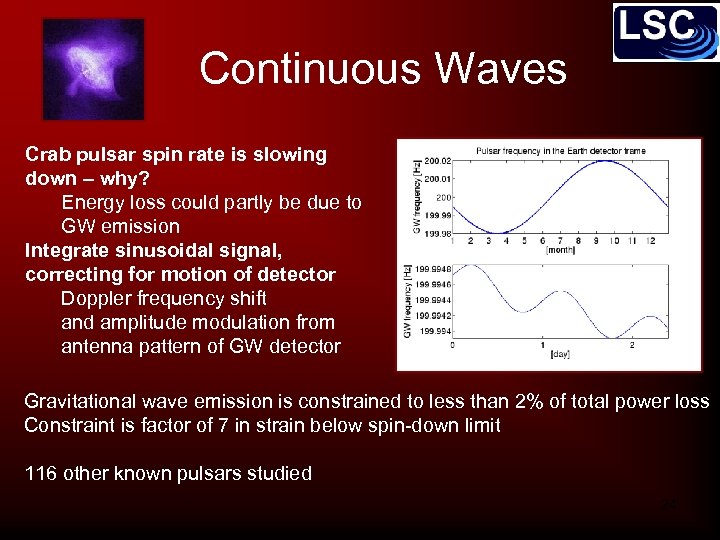
Continuous Waves Crab pulsar spin rate is slowing down – why? Energy loss could partly be due to GW emission Integrate sinusoidal signal, correcting for motion of detector Doppler frequency shift and amplitude modulation from antenna pattern of GW detector Gravitational wave emission is constrained to less than 2% of total power loss Constraint is factor of 7 in strain below spin-down limit 116 other known pulsars studied 24
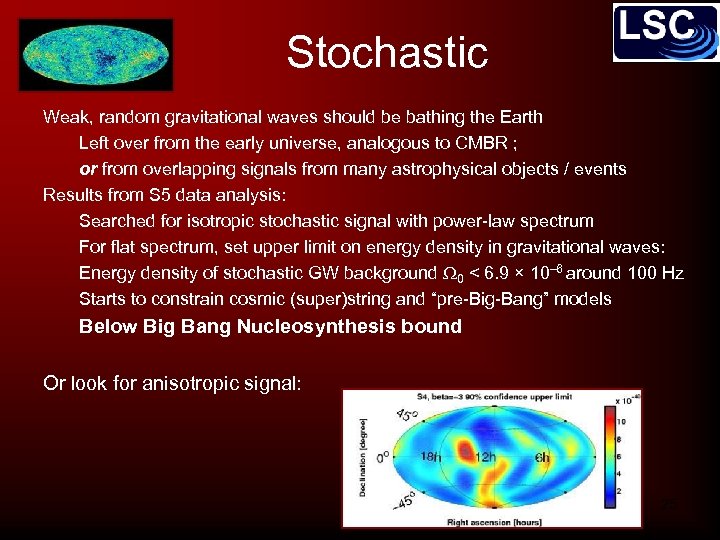
Stochastic Weak, random gravitational waves should be bathing the Earth Left over from the early universe, analogous to CMBR ; or from overlapping signals from many astrophysical objects / events Results from S 5 data analysis: Searched for isotropic stochastic signal with power-law spectrum For flat spectrum, set upper limit on energy density in gravitational waves: Energy density of stochastic GW background 0 < 6. 9 × 10– 6 around 100 Hz Starts to constrain cosmic (super)string and “pre-Big-Bang” models Below Big Bang Nucleosynthesis bound Or look for anisotropic signal: 25
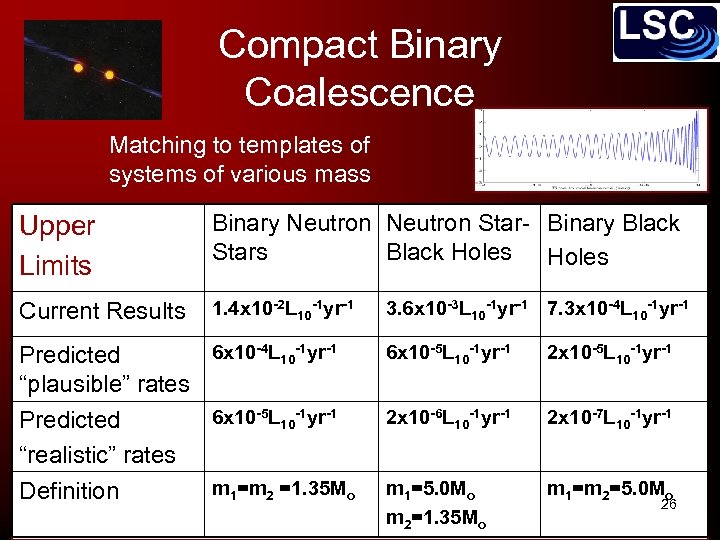
Compact Binary Coalescence Matching to templates of systems of various mass Upper Limits Binary Neutron Star- Binary Black Stars Black Holes Current Results 1. 4 x 10 -2 L 10 -1 yr-1 3. 6 x 10 -3 L 10 -1 yr-1 7. 3 x 10 -4 L 10 -1 yr-1 6 x 10 -4 L 10 -1 yr-1 Predicted “plausible” rates 6 x 10 -5 L 10 -1 yr-1 2 x 10 -5 L 10 -1 yr-1 6 x 10 -5 L 10 -1 yr-1 2 x 10 -6 L 10 -1 yr-1 2 x 10 -7 L 10 -1 yr-1 m 1=m 2 =1. 35 Mo m 1=5. 0 Mo m 2=1. 35 Mo m 1=m 2=5. 0 Mo Predicted “realistic” rates Definition 26
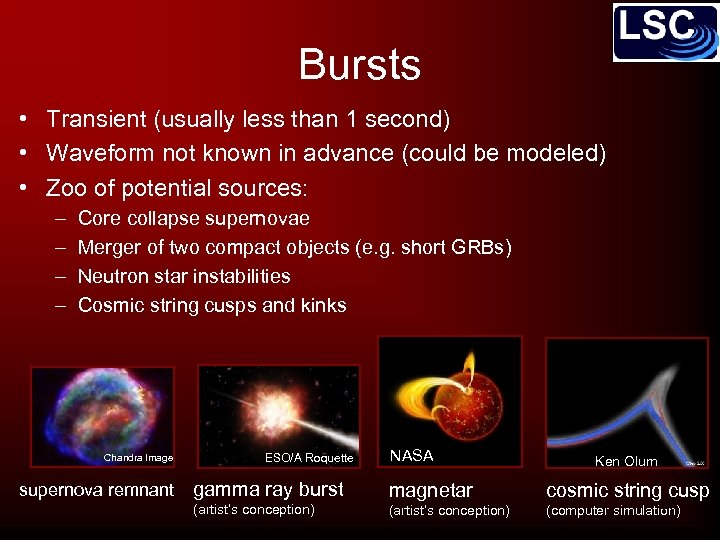
Bursts • Transient (usually less than 1 second) • Waveform not known in advance (could be modeled) • Zoo of potential sources: – – Core collapse supernovae Merger of two compact objects (e. g. short GRBs) Neutron star instabilities Cosmic string cusps and kinks Chandra Image supernova remnant ESO/A Roquette NASA gamma ray burst magnetar (artist’s conception) Ken Olum cosmic string cusp 27 (computer simulation)
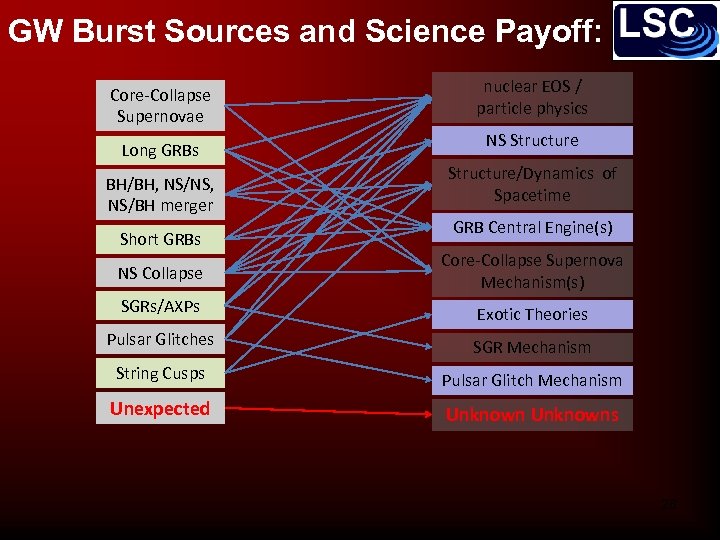
GW Burst Sources and Science Payoff: Core-Collapse Supernovae Long GRBs BH/BH, NS/NS, NS/BH merger Short GRBs nuclear EOS / particle physics NS Structure/Dynamics of Spacetime GRB Central Engine(s) NS Collapse Core-Collapse Supernova Mechanism(s) SGRs/AXPs Exotic Theories Pulsar Glitches SGR Mechanism String Cusps Pulsar Glitch Mechanism Unexpected Unknowns 28
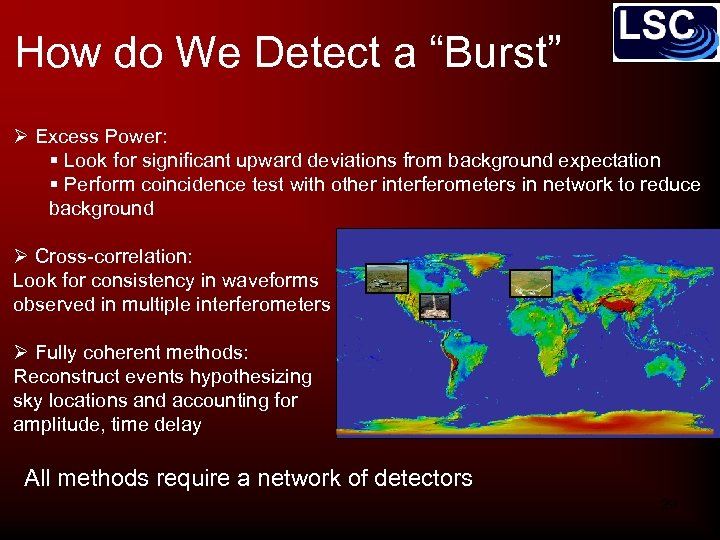
How do We Detect a “Burst” Ø Excess Power: § Look for significant upward deviations from background expectation § Perform coincidence test with other interferometers in network to reduce background Ø Cross-correlation: Look for consistency in waveforms observed in multiple interferometers Ø Fully coherent methods: Reconstruct events hypothesizing sky locations and accounting for amplitude, time delay All methods require a network of detectors 29
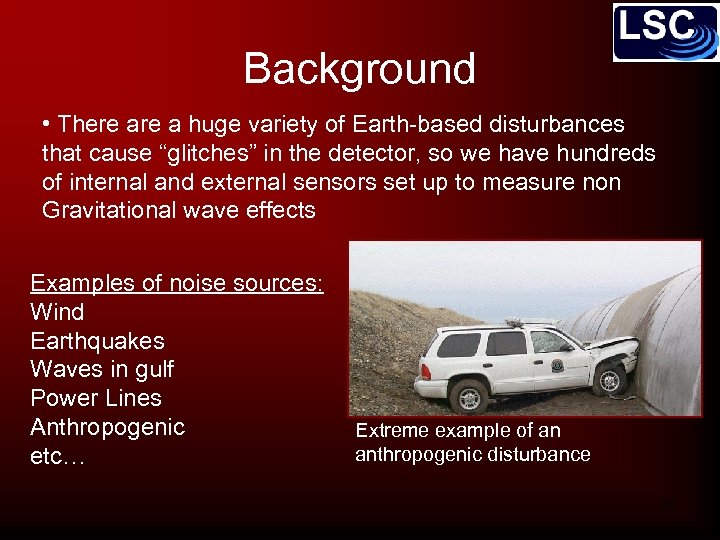
Background • There a huge variety of Earth-based disturbances that cause “glitches” in the detector, so we have hundreds of internal and external sensors set up to measure non Gravitational wave effects Examples of noise sources: Wind Earthquakes Waves in gulf Power Lines Anthropogenic etc… Extreme example of an anthropogenic disturbance 30
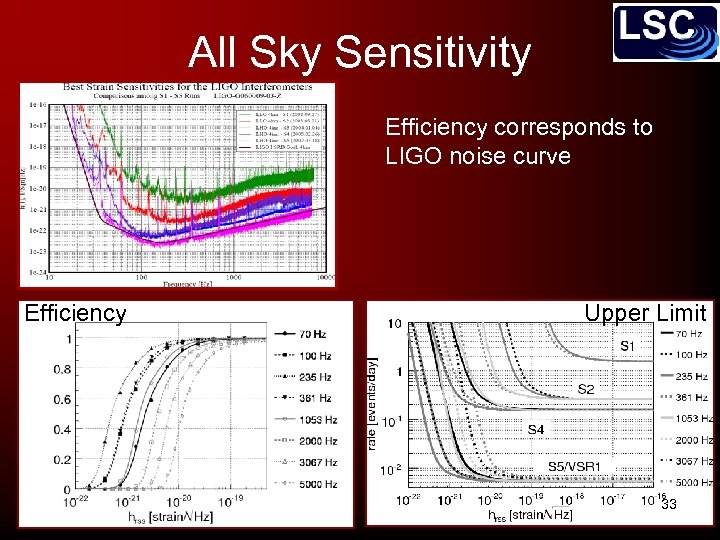
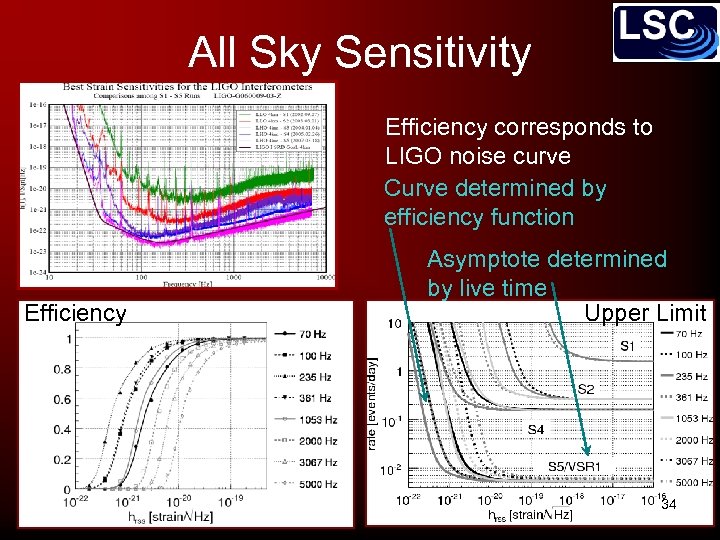
Burst Results: S 5 All Sky Search • Try to identify signal any time detector is on from anywhere • S 5 results available in 2 papers: • 1 st year LIGO (PRD 80: 102001, 2009) • 2 nd year LIGO + Virgo (ar. Xiv: 1002. 1036) • Analyses tuned for ~0. 1 event false alarm probability using “time slide” method to remove real GW coincidence • No signals found (except a blind injection) 31
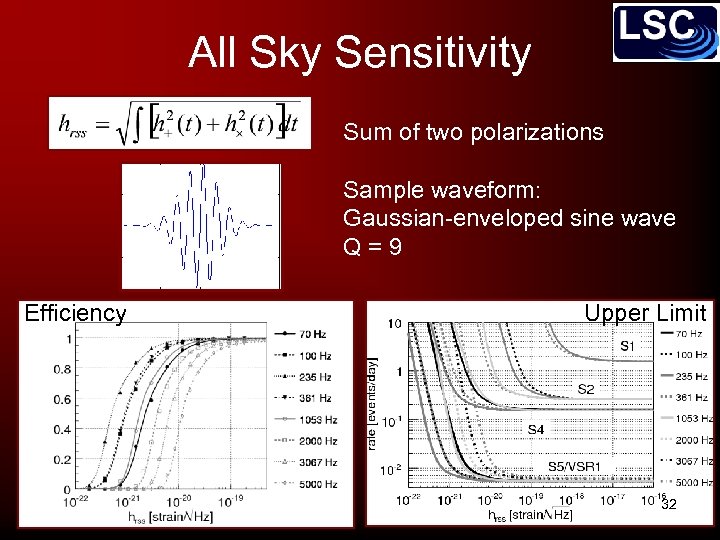
All Sky Sensitivity Sum of two polarizations Sample waveform: Gaussian-enveloped sine wave Q=9 Efficiency Upper Limit 32
All Sky Sensitivity Efficiency corresponds to LIGO noise curve Efficiency Upper Limit 33
All Sky Sensitivity Efficiency corresponds to LIGO noise curve Curve determined by efficiency function Efficiency Asymptote determined by live time Upper Limit 34
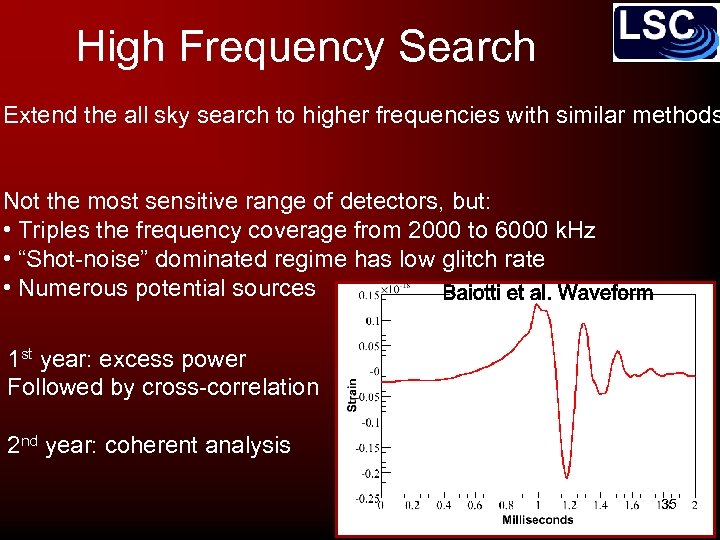
High Frequency Search Extend the all sky search to higher frequencies with similar methods Not the most sensitive range of detectors, but: • Triples the frequency coverage from 2000 to 6000 k. Hz • “Shot-noise” dominated regime has low glitch rate • Numerous potential sources 1 st year: excess power Followed by cross-correlation 2 nd year: coherent analysis 35
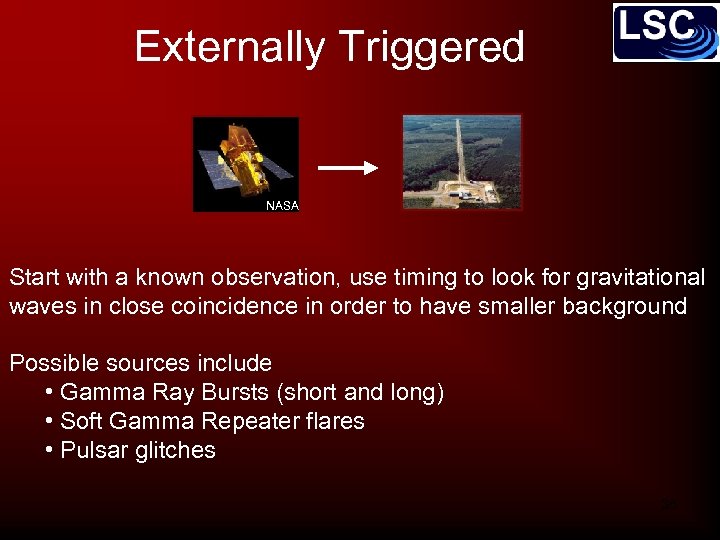
Externally Triggered NASA Start with a known observation, use timing to look for gravitational waves in close coincidence in order to have smaller background Possible sources include • Gamma Ray Bursts (short and long) • Soft Gamma Repeater flares • Pulsar glitches 36
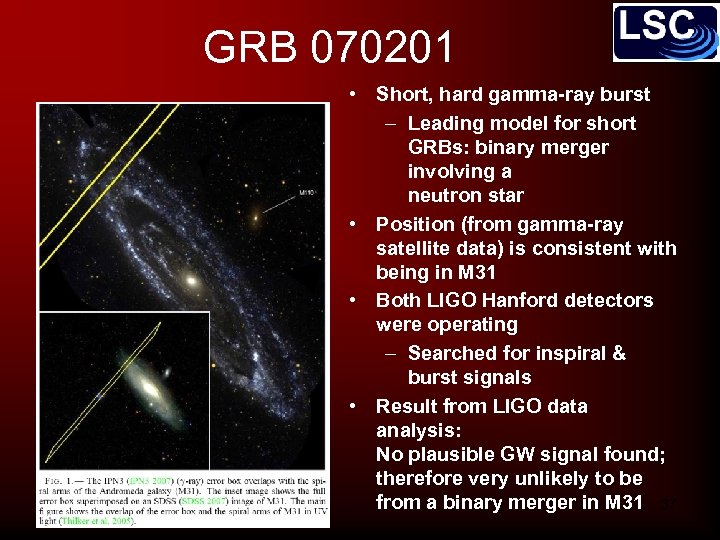
GRB 070201 • Short, hard gamma-ray burst – Leading model for short GRBs: binary merger involving a neutron star • Position (from gamma-ray satellite data) is consistent with being in M 31 • Both LIGO Hanford detectors were operating – Searched for inspiral & burst signals • Result from LIGO data analysis: No plausible GW signal found; therefore very unlikely to be from a binary merger in M 31 37
I. Gravitational Waves II. LIGO and Burst Analysis III. Electromagnetic Follow-ups of LIGO/Virgo Triggers 38
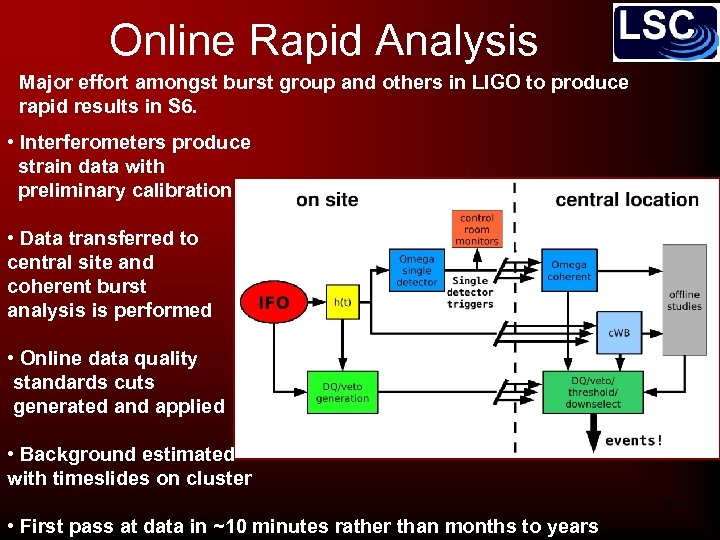
Online Rapid Analysis Major effort amongst burst group and others in LIGO to produce rapid results in S 6. • Interferometers produce strain data with preliminary calibration • Data transferred to central site and coherent burst analysis is performed • Online data quality standards cuts generated and applied • Background estimated with timeslides on cluster 39 • First pass at data in ~10 minutes rather than months to years
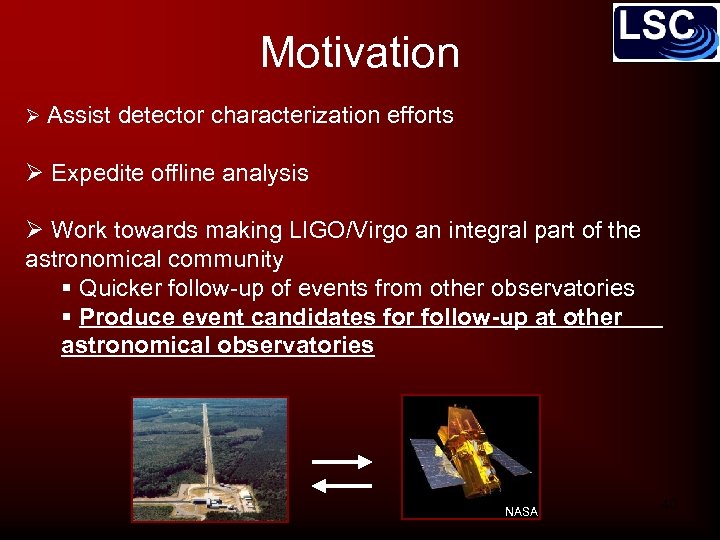
Motivation Ø Assist detector characterization efforts Ø Expedite offline analysis Ø Work towards making LIGO/Virgo an integral part of the astronomical community § Quicker follow-up of events from other observatories § Produce event candidates for follow-up at other astronomical observatories NASA 40
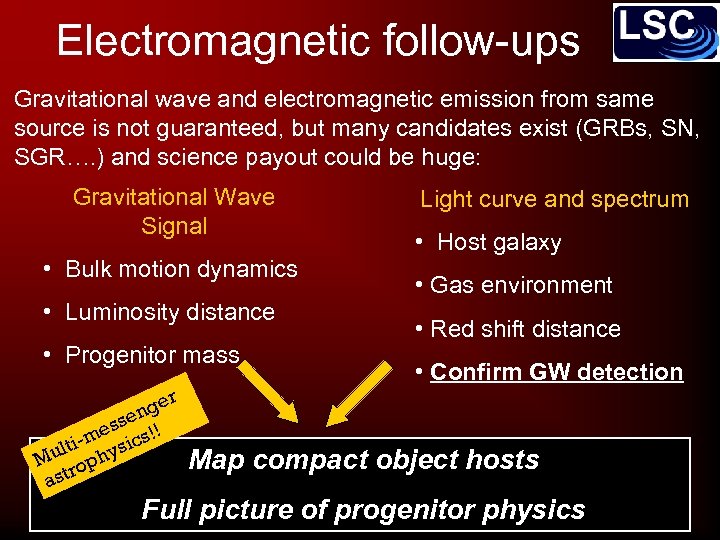
Electromagnetic follow-ups Gravitational wave and electromagnetic emission from same source is not guaranteed, but many candidates exist (GRBs, SN, SGR…. ) and science payout could be huge: Gravitational Wave Signal • Bulk motion dynamics • Luminosity distance • Progenitor mass er ng e ess s!! -m c ulti physi M o r ast Light curve and spectrum • Host galaxy • Gas environment • Red shift distance • Confirm GW detection Map compact object hosts Full picture of progenitor physics 41
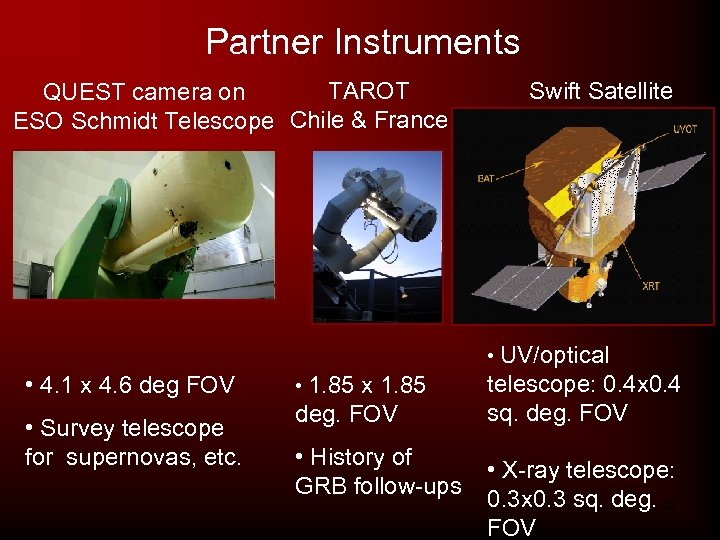
Partner Instruments TAROT QUEST camera on ESO Schmidt Telescope Chile & France Swift Satellite • UV/optical • 4. 1 x 4. 6 deg FOV • Survey telescope for supernovas, etc. • 1. 85 x 1. 85 deg. FOV • History of GRB follow-ups telescope: 0. 4 x 0. 4 sq. deg. FOV • X-ray telescope: 0. 3 x 0. 3 sq. deg. 42 FOV
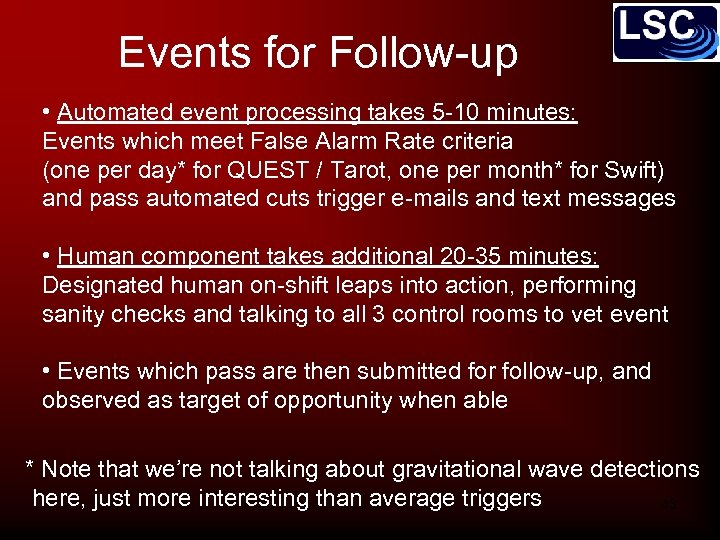
Events for Follow-up • Automated event processing takes 5 -10 minutes: Events which meet False Alarm Rate criteria (one per day* for QUEST / Tarot, one per month* for Swift) and pass automated cuts trigger e-mails and text messages • Human component takes additional 20 -35 minutes: Designated human on-shift leaps into action, performing sanity checks and talking to all 3 control rooms to vet event • Events which pass are then submitted for follow-up, and observed as target of opportunity when able * Note that we’re not talking about gravitational wave detections here, just more interesting than average triggers 43
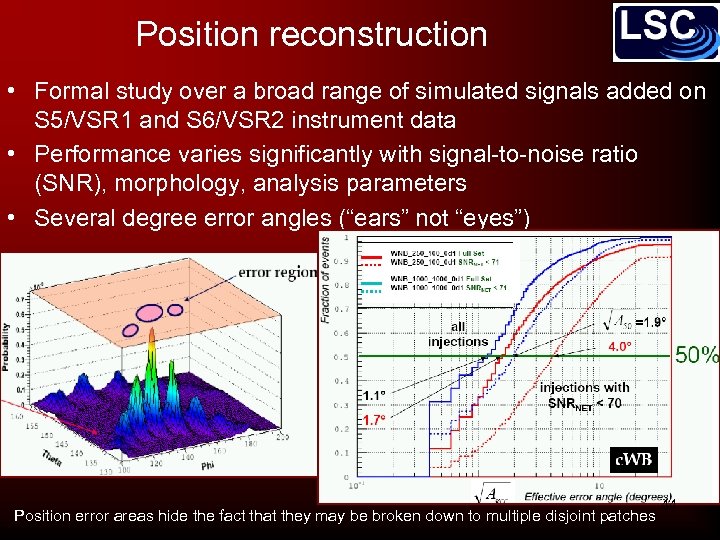
Position reconstruction • Formal study over a broad range of simulated signals added on S 5/VSR 1 and S 6/VSR 2 instrument data • Performance varies significantly with signal-to-noise ratio (SNR), morphology, analysis parameters • Several degree error angles (“ears” not “eyes”) Position error areas hide the fact that they may be broken down to multiple disjoint patches 44
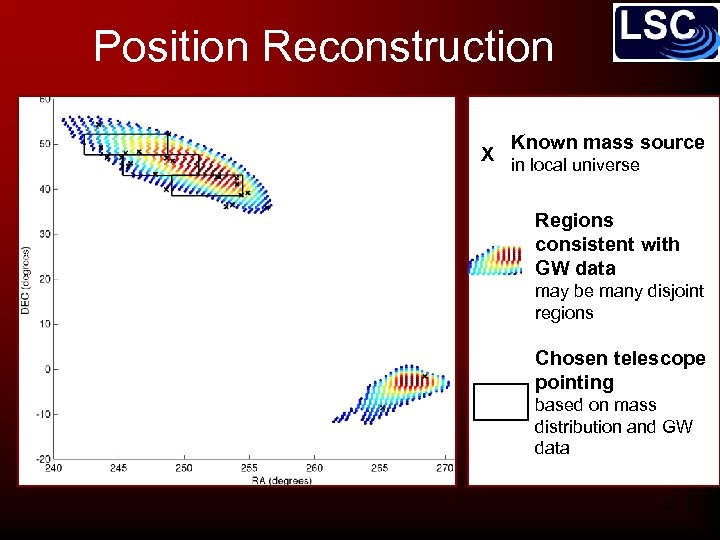
Position Reconstruction X Known mass source in local universe Regions consistent with GW data may be many disjoint regions Chosen telescope pointing based on mass distribution and GW data 45
December – January Run • After test period, program went live from Dec 20 th 2009 through Jan 8 th 2010 (ended by Virgo commissioning) • 8 events sent for follow-ups, 3 followed up by QUEST and 1 by TAROT • 1 “Engineering run” Swift observation • Series of collected images currently being studied: hands on study will help us understand challenges of linking GW and EM observations 46
Future Prospects • 2 nd observation period (hopefully) coming this summer - criteria for follow-ups and mass targeting being refined - will attempt to increase automation • Compact Binary Coalescence group working towards inclusion in EM follow-ups program as well • Discussions ongoing with other experiments - Pi of the Sky: improved sky coverage - Radio telescopes • Successful program paves the way for Advanced detector era 47
Summary • Gravitational waves have the potential to let us hear the universe in an entirely new way • LIGO and Virgo continue to pursue the detection of gravitational waves through a variety of methods, including partnering with more conventional telescopes. • Work now paves the way for the Advanced Detector era, with a factor of 10 farther astrophysical reach 48

The End 49
Скачать презентацию Hearing the Universe with Gravitational Waves Brennan Hughey
db6c9eecf5b8bca50bf5dd99abc8e249.ppt