


 Скачать презентацию Hearing Protection Devices Theresa Y Schulz Ph D
749cd291932a0ed5748913934165be06.ppt
- Количество слайдов: 69

 Hearing Protection Devices Theresa Y. Schulz, Ph. D. Lt. Col. USAF (ret. )
 Agenda • • Selecting Hearing Protection Noise Reduction Fitting Tips Motivating Workers
 Introduction Noise-Induced Hearing Loss Causes no pain Causes no visible trauma Leaves no visible scars Is unnoticeable in its earliest stages Accumulates with each overexposure Takes years to notice a change Is Permanent + 100% Preventable
 Introduction Noise-induced hearing loss is the most common permanent and preventable occupational injury in the world. World Health Organization
 Introduction Worker’s Compensation In many countries, excessive noise is the biggest compensable occupational hazard. Cost of NIHL to developed countries ranges from 0. 2 to 2% of its GDP. NIHL is on the rise globally. (Source: WHO)
 Introduction United States Statistics Most common occupational injury in the United States. 22 million US workers are exposed to hazardous noise at work on a daily basis. Approx. 8 million Americans suffer from NIHL. (Source: NIOSH, 2009)
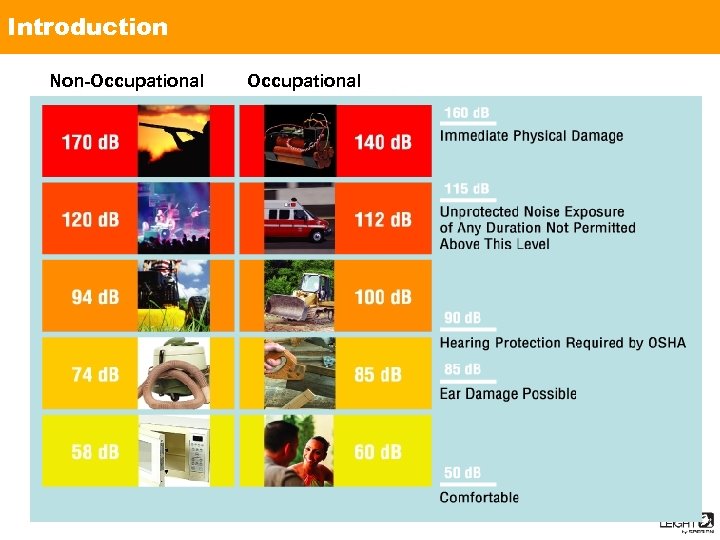 Introduction Non-Occupational
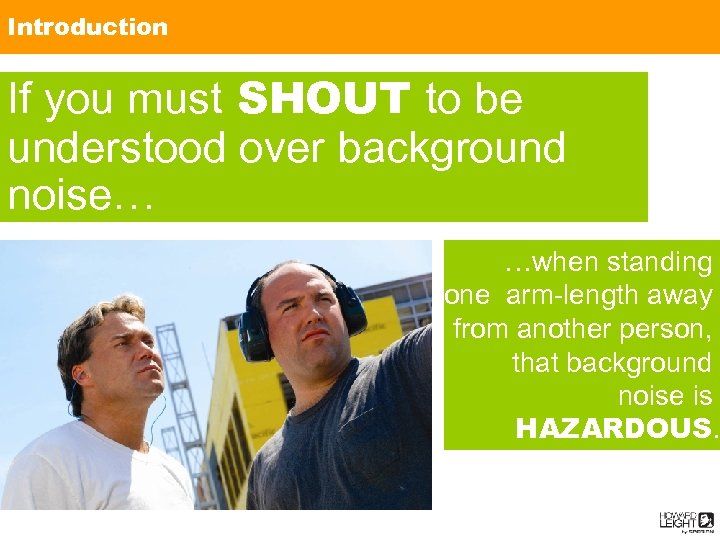 Introduction If you must SHOUT to be understood over background noise… …when standing one arm-length away from another person, that background noise is HAZARDOUS.
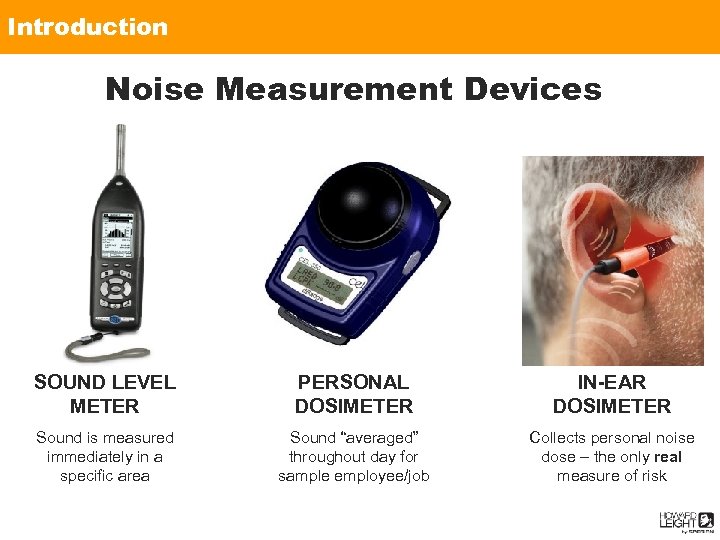 Introduction Noise Measurement Devices SOUND LEVEL METER PERSONAL DOSIMETER IN-EAR DOSIMETER Sound is measured immediately in a specific area Sound “averaged” throughout day for sample employee/job Collects personal noise dose – the only real measure of risk
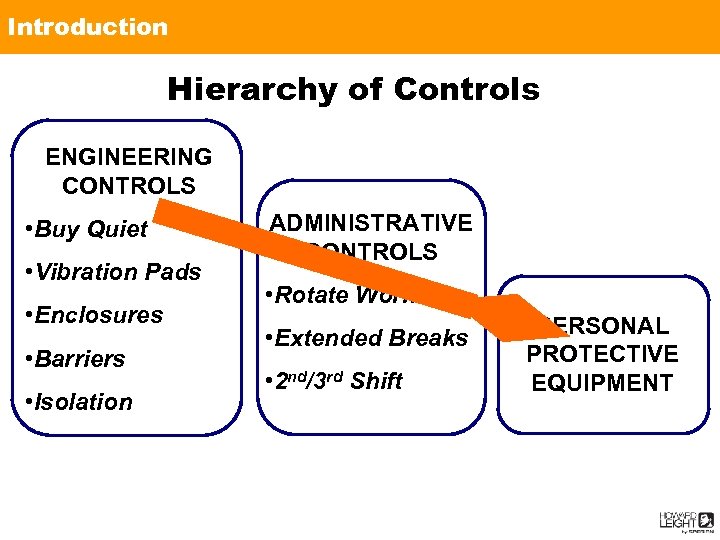 Introduction NOISE AND ACOUSTICS ~ Hierarchy of Controls ENGINEERING CONTROLS • Buy Quiet • Vibration Pads • Enclosures • Barriers • Isolation ADMINISTRATIVE CONTROLS • Rotate Workers • Extended Breaks • 2 nd/3 rd Shift PERSONAL PROTECTIVE EQUIPMENT
 Hearing Protection Selection
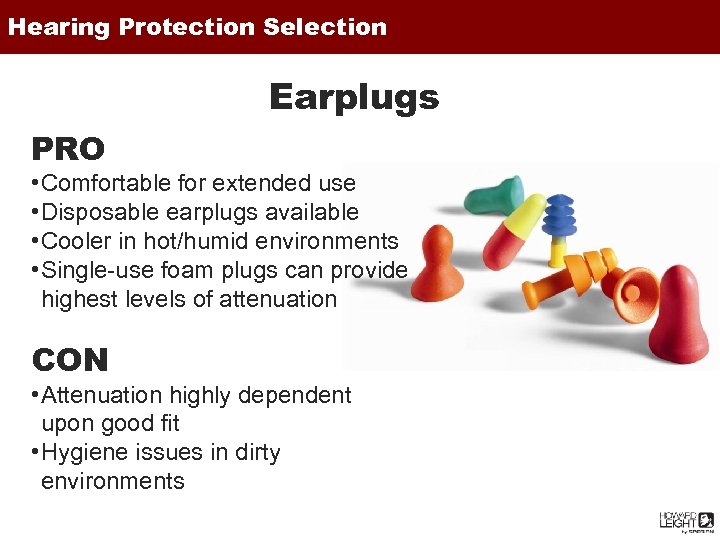 Hearing Protection Selection Earplugs PRO • Comfortable for extended use • Disposable earplugs available • Cooler in hot/humid environments • Single-use foam plugs can provide highest levels of attenuation CON • Attenuation highly dependent upon good fit • Hygiene issues in dirty environments
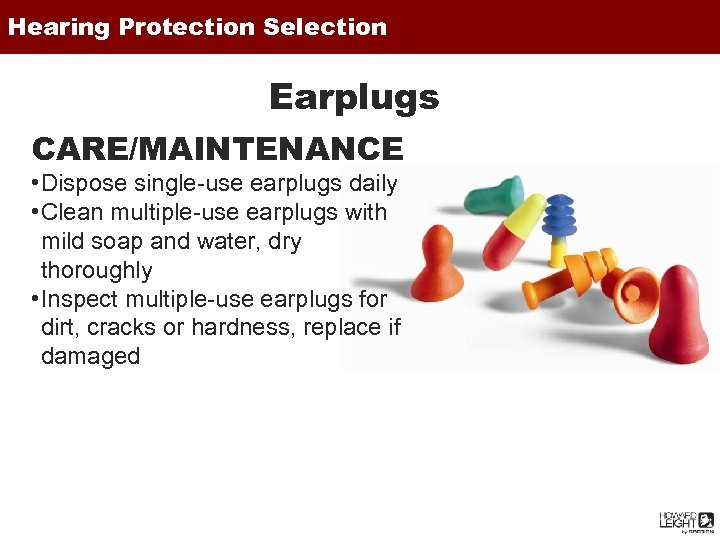 Hearing Protection Selection Earplugs CARE/MAINTENANCE • Dispose single-use earplugs daily • Clean multiple-use earplugs with mild soap and water, dry thoroughly • Inspect multiple-use earplugs for dirt, cracks or hardness, replace if damaged
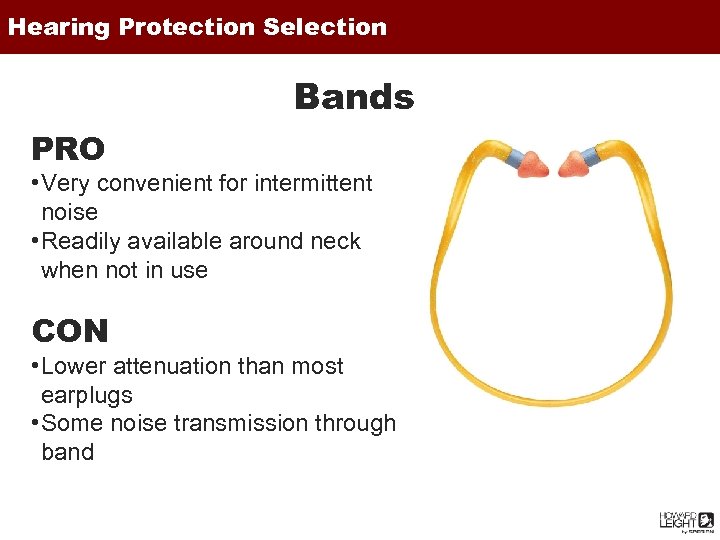 Hearing Protection Selection Bands PRO • Very convenient for intermittent noise • Readily available around neck when not in use CON • Lower attenuation than most earplugs • Some noise transmission through band
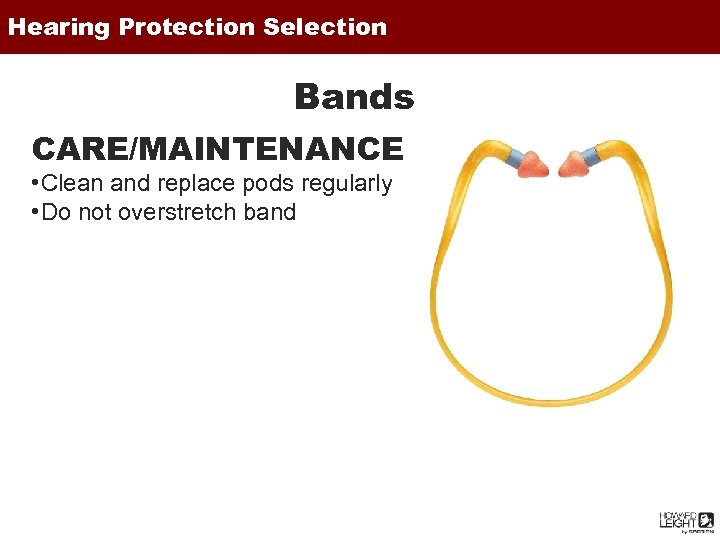 Hearing Protection Selection Bands CARE/MAINTENANCE • Clean and replace pods regularly • Do not overstretch band
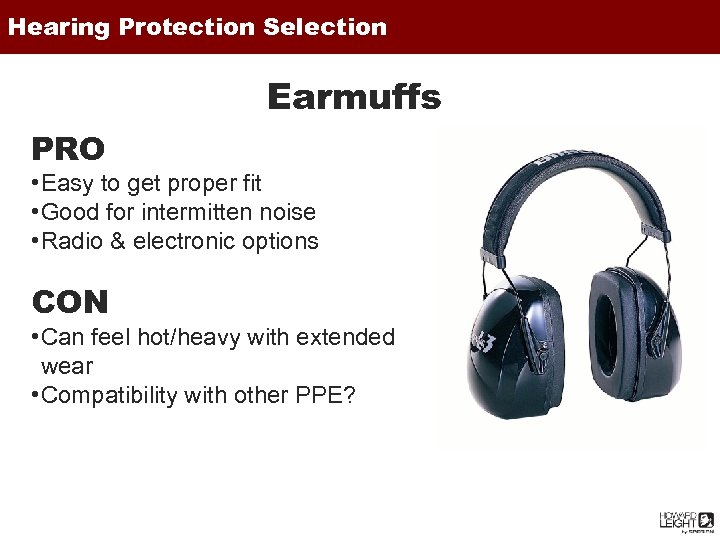 Hearing Protection Selection Earmuffs PRO • Easy to get proper fit • Good for intermitten noise • Radio & electronic options CON • Can feel hot/heavy with extended wear • Compatibility with other PPE?
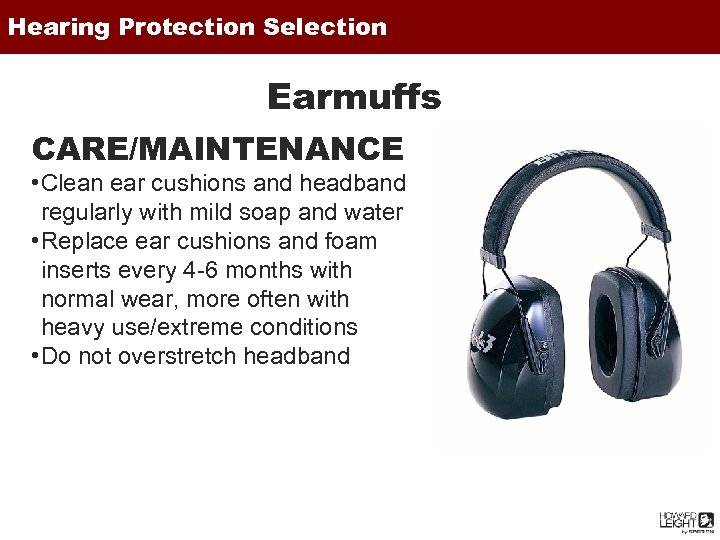 Hearing Protection Selection Earmuffs CARE/MAINTENANCE • Clean ear cushions and headband regularly with mild soap and water • Replace ear cushions and foam inserts every 4 -6 months with normal wear, more often with heavy use/extreme conditions • Do not overstretch headband
 Hearing Protection Selection Factors Comfort Noise Reduction Size Communication Job Requirements Hygiene Use with Other PPE Consider canal • The right hearing can Select care Proper HPDs Keep ear HPDs with Every workersthat Selecting joband has requirements canfeel protector should. PPE work with to and maintenance in connectedother HPD its own attenuation suitableshapetheir selection and comfortable without compromise extend life environment size for noise environment • performance offit with Detectable earplugs One protector may Cap-mounted Uniform attenuation Ensure proper HPDs Avoid overprotection for satisfyearplug • not processallhard earmuffs Examine and workers allows of forindustries variety speech/signals in marginal noise clean hats and more all multiple-use to be hearshapes sizes a variety • environments of Hi-visibility earmuffs Offer earplugs or earmuffs for dark/high traffic earplugs banded • naturally daily Multiple-position Sized multiple-use Consider areas varying • to meetamplification earmuffs Clean Soundand replace earplugs for full-brim hard hats HPDs ear cushions and earmuffs for workers intermittent noise or Dielectric • worker needson for Low-pressure foam earmuffs every with hearing 4 -6 electronicfor electrical earmuffs • preferences smallerfor Ultraslim earplugs neckband months with impairment impact noise. welding environments earmuffs ear canals shields
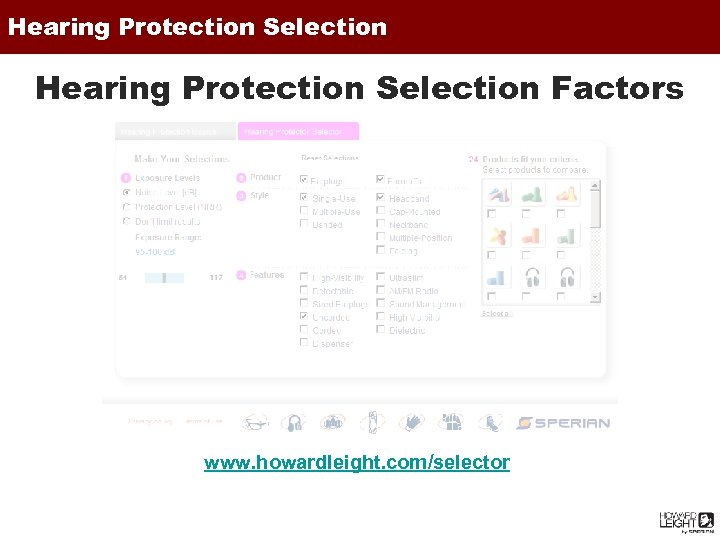 Hearing Protection Selection Factors www. howardleight. com/selector
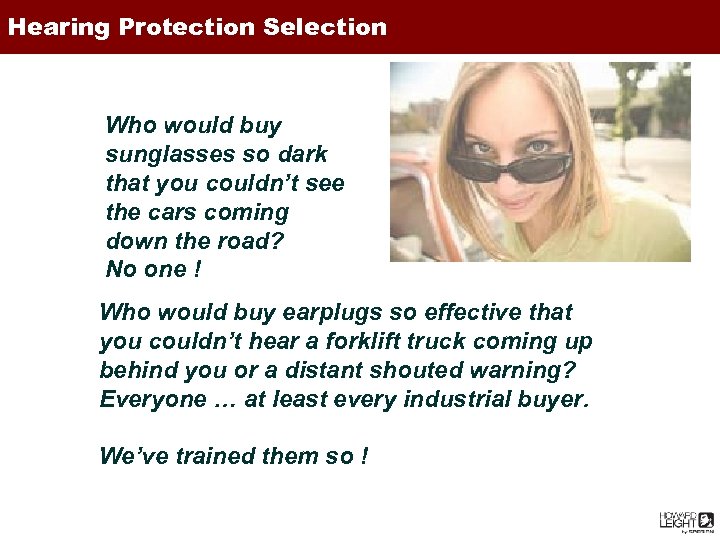 Hearing Protection Selection “ Who would buy sunglasses so dark that you couldn’t see the cars coming down the road? No one ! Who would buy earplugs so effective that you couldn’t hear a forklift truck coming up behind you or a distant shouted warning? Everyone … at least every industrial buyer. We’ve trained them so ! ”
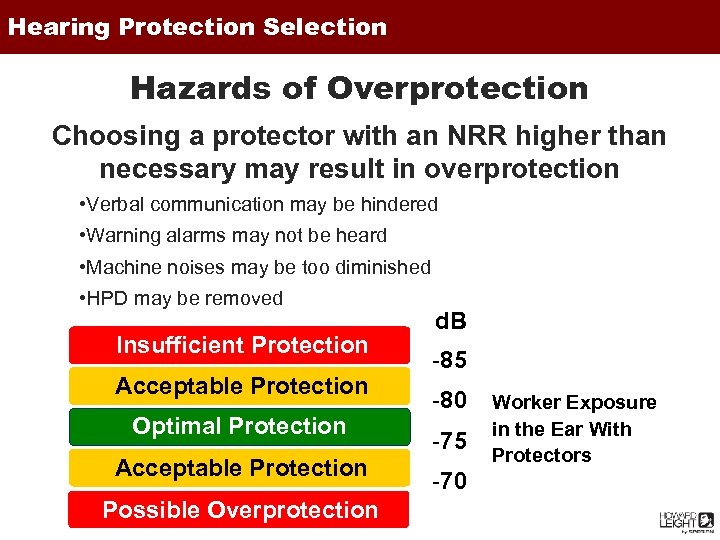 Hearing Protection Selection Hazards of Overprotection Choosing a protector with an NRR higher than necessary may result in overprotection • Verbal communication may be hindered • Warning alarms may not be heard • Machine noises may be too diminished • HPD may be removed Insufficient Protection Acceptable Protection Optimal Protection Acceptable Protection Possible Overprotection d. B -85 -80 -75 -70 Worker Exposure in the Ear With Protectors
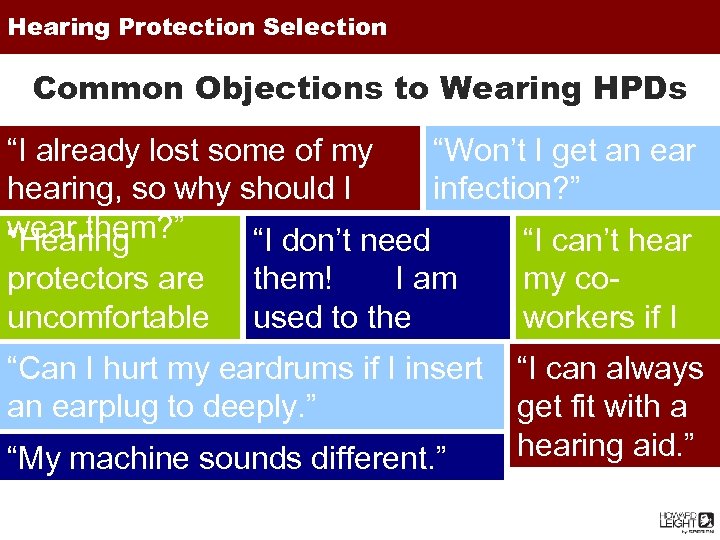 Hearing Protection Selection Common Objections to Wearing HPDs “I already lost some of my “Won’t I get an ear hearing, so why should I infection? ” wear them? ” “Hearing “I don’t need “I can’t hear protectors are them! I am uncomfortable used to the to wear. ” my eardrums if I insert noise. ” “Can I hurt my coworkers if I wear always “I can them. ” an earplug to deeply. ” get fit with a hearing aid. ” “My machine sounds different. ”
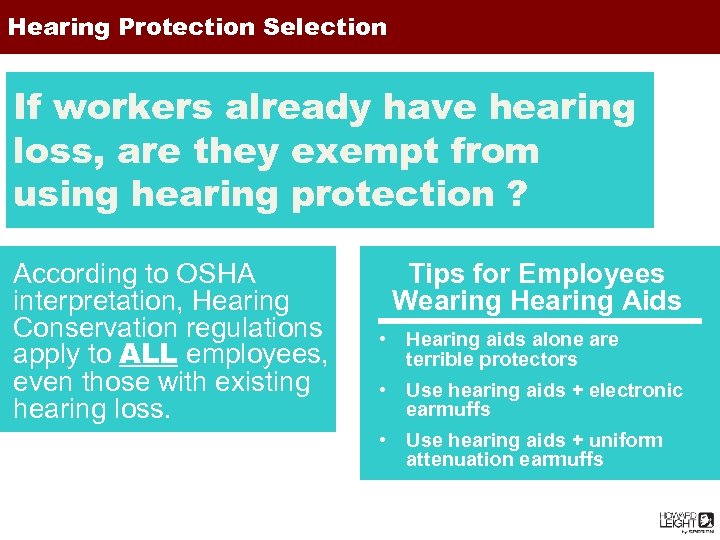 Hearing Protection Selection If workers already have hearing loss, are they exempt from using hearing protection ? According to OSHA interpretation, Hearing Conservation regulations apply to ALL employees, even those with existing hearing loss. Tips for Employees Wearing Hearing Aids • Hearing aids alone are terrible protectors • Use hearing aids + electronic earmuffs • Use hearing aids + uniform attenuation earmuffs
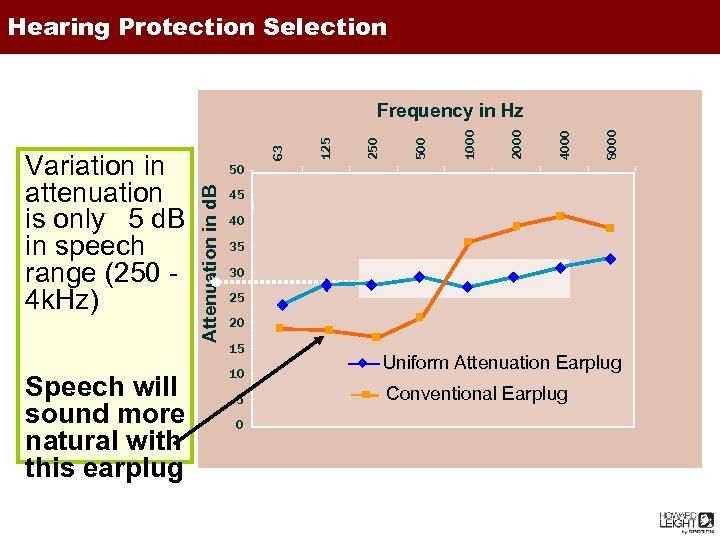 Hearing Protection Selection Speech will sound more natural with this earplug 8000 4000 2000 1000 500 250 125 50 Attenuation in d. B Variation in attenuation is only 5 d. B in speech range (250 4 k. Hz) 63 Frequency in Hz 45 40 35 30 25 20 15 10 5 0 Uniform Attenuation Earplug Conventional Earplug
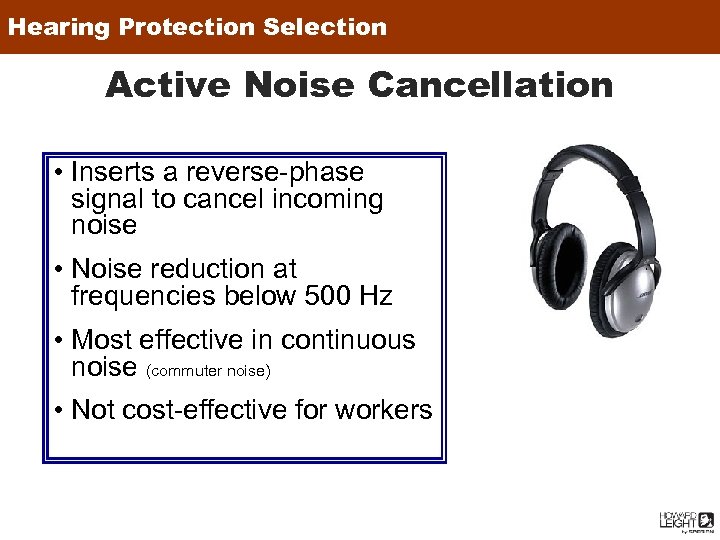 Hearing Protection Selection Active Noise Cancellation • Inserts a reverse-phase signal to cancel incoming noise • Noise reduction at frequencies below 500 Hz • Most effective in continuous noise (commuter noise) • Not cost-effective for workers
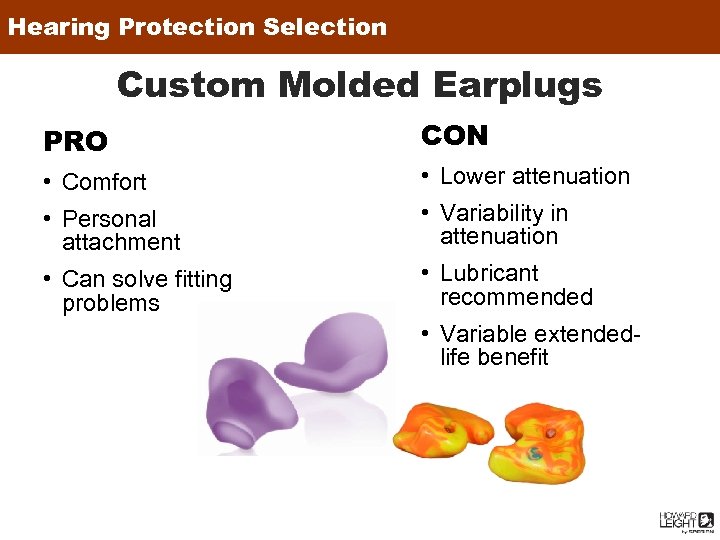 Hearing Protection Selection Fitting Tips Custom Molded Earplugs PRO CON • Comfort • Lower attenuation • Personal attachment • Variability in attenuation • Can solve fitting problems • Lubricant recommended • Variable extendedlife benefit
 Noise Reduction Rating (NRR)
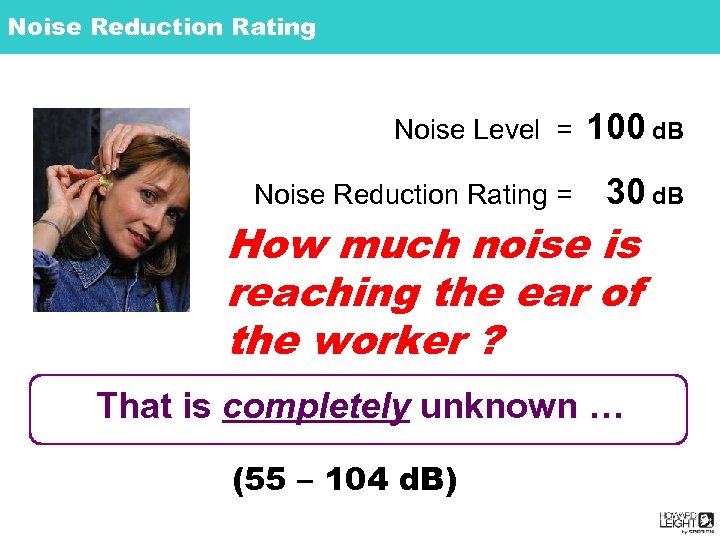 Noise Reduction Rating Noise Level = 100 d. B Noise Reduction Rating = 30 d. B How much noise is reaching the ear of the worker ? That is completely unknown … (55 – 104 d. B)
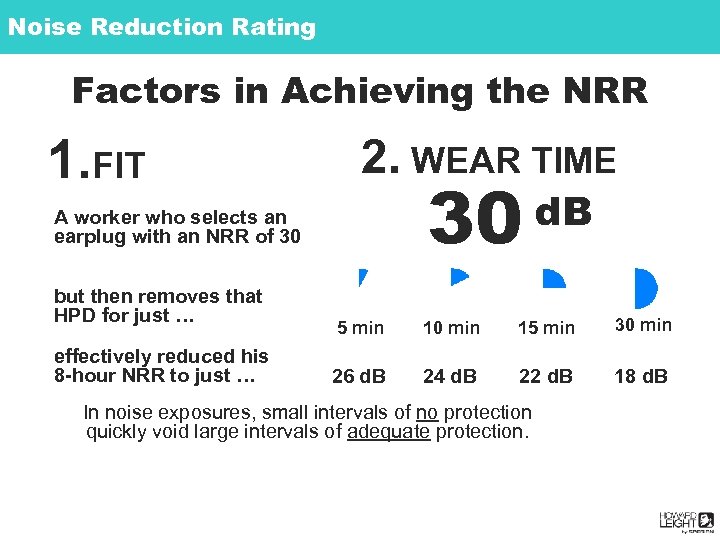 Noise Reduction Rating Factors in Achieving the NRR 1. FIT 2. WEAR TIME 30 A worker who selects an earplug with an NRR of 30 but then removes that HPD for just … effectively reduced his 8 -hour NRR to just … d. B 5 min 10 min 15 min 30 min 26 d. B 24 d. B 22 d. B 18 d. B In noise exposures, small intervals of no protection quickly void large intervals of adequate protection.
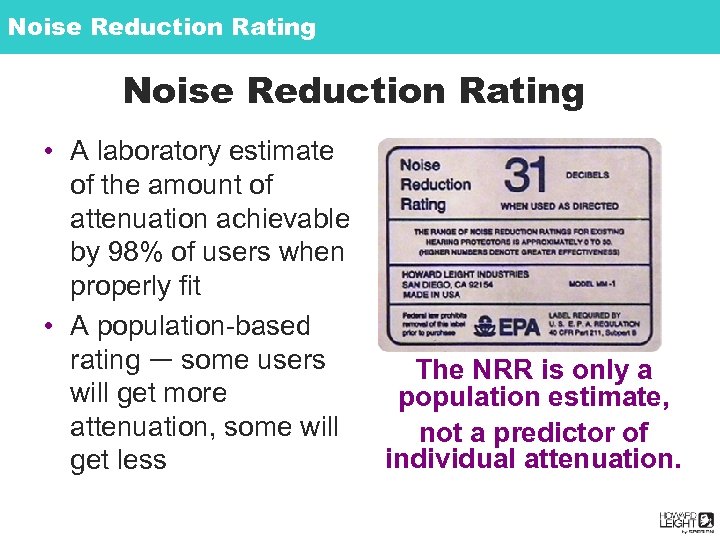 Noise Reduction Rating • A laboratory estimate of the amount of attenuation achievable by 98% of users when properly fit • A population-based rating ― some users will get more attenuation, some will get less The NRR is only a population estimate, not a predictor of individual attenuation.
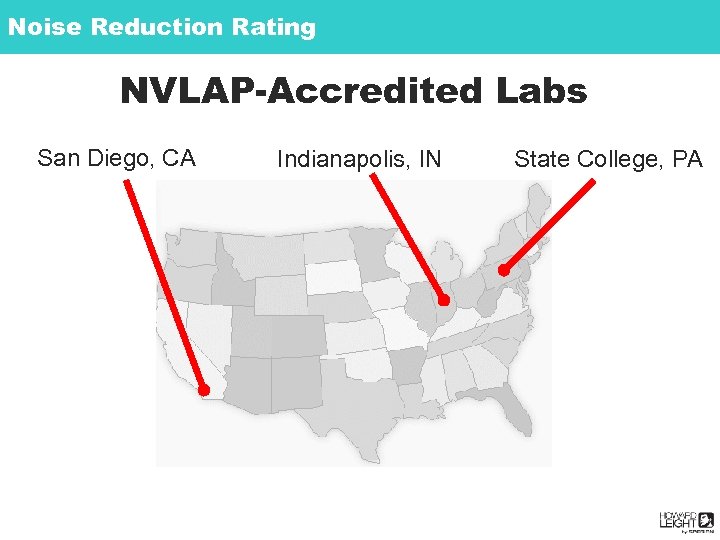 Noise Reduction Rating NVLAP-Accredited Labs San Diego, CA Indianapolis, IN State College, PA
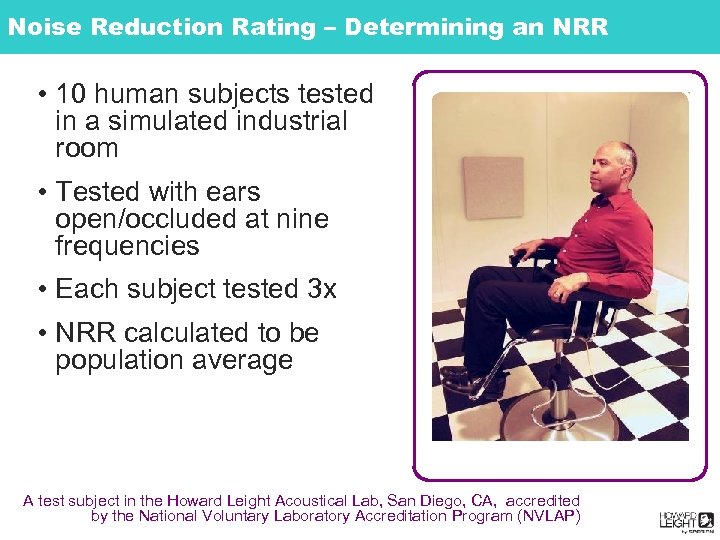 Noise Reduction Rating – Determining an NRR • 10 human subjects tested in a simulated industrial room • Tested with ears open/occluded at nine frequencies • Each subject tested 3 x • NRR calculated to be population average A test subject in the Howard Leight Acoustical Lab, San Diego, CA, accredited by the National Voluntary Laboratory Accreditation Program (NVLAP)
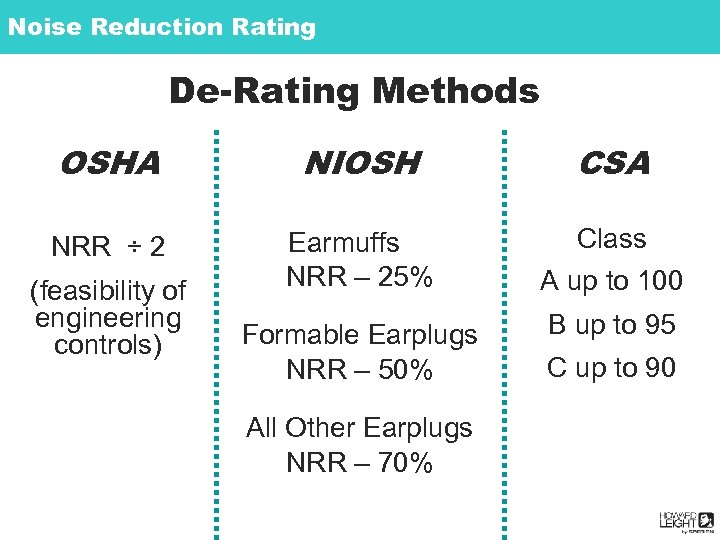 Noise Reduction Rating De-Rating Methods OSHA NIOSH CSA NRR ÷ 2 Earmuffs NRR – 25% Class A up to 100 Formable Earplugs NRR – 50% B up to 95 (feasibility of engineering controls) All Other Earplugs NRR – 70% C up to 90
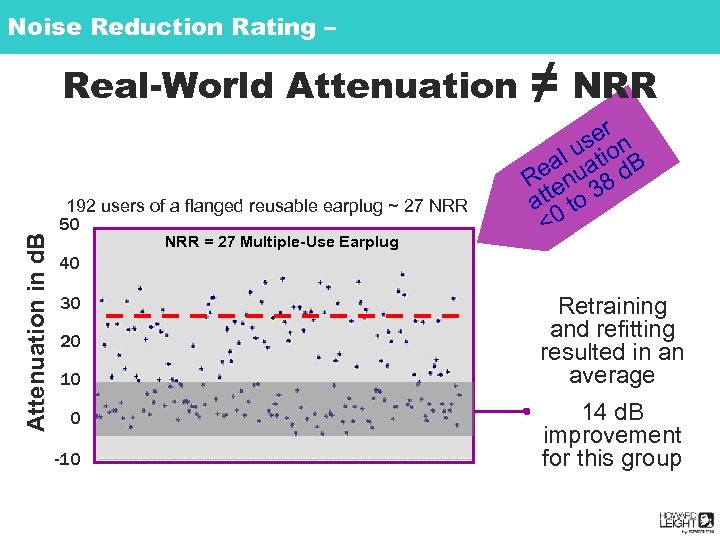 Noise Reduction Rating – Attenuation in d. B Real-World Attenuation ≠ NRR 192 users of a flanged reusable earplug ~ 27 NRR 50 er n s l u atio B ea nu d R e 38 att to <0 NRR = 27 Multiple-Use Earplug 40 30 20 10 0 -10 From Kevin Michael, Ph. D and Cindy Bloyer “Hearing Protector Attenuation Measurement on the End-User” Retraining and refitting resulted in an average 14 d. B improvement for this group
 Noise Reduction Rating • The EPA recently made an announcement about a proposed change to the Noise Reduction Rating [NRR] • This is the first change in hearing protector regulation in nearly 30 years
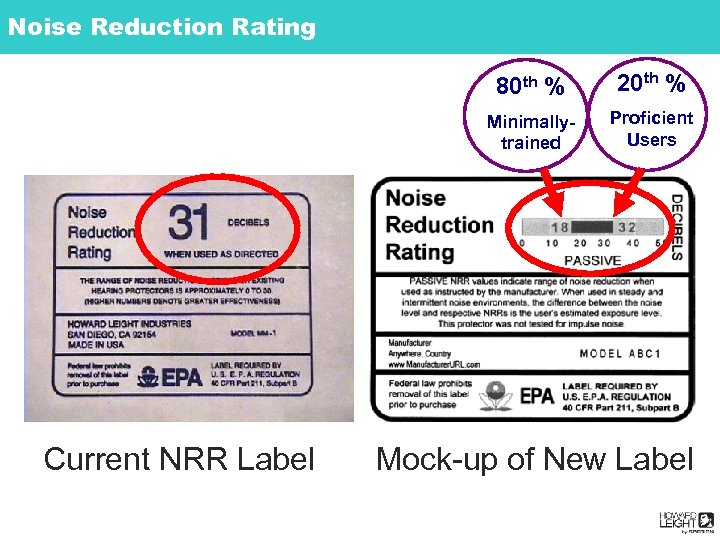 Noise Reduction Rating 80 th % Minimallytrained Current NRR Label 20 th % Proficient Users Mock-up of New Label
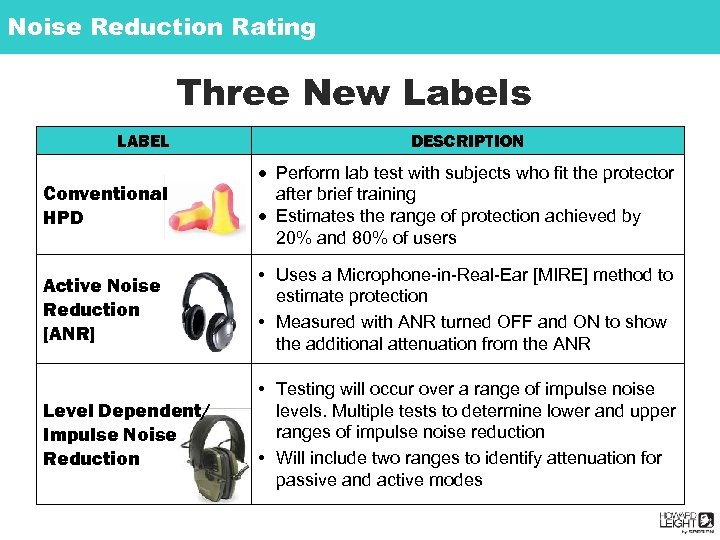 Noise Reduction Rating Three New Labels LABEL DESCRIPTION Conventional HPD Perform lab test with subjects who fit the protector after brief training Estimates the range of protection achieved by 20% and 80% of users Active Noise Reduction [ANR] • Uses a Microphone-in-Real-Ear [MIRE] method to estimate protection • Measured with ANR turned OFF and ON to show the additional attenuation from the ANR Level Dependent/ Impulse Noise Reduction • Testing will occur over a range of impulse noise levels. Multiple tests to determine lower and upper ranges of impulse noise reduction • Will include two ranges to identify attenuation for passive and active modes
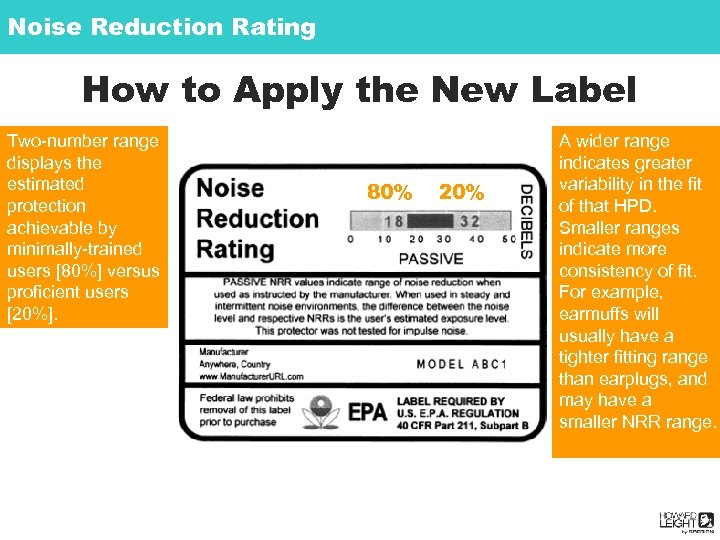 Noise Reduction Rating How to Apply the New Label Two-number range displays the estimated protection achievable by minimally-trained users [80%] versus proficient users [20%]. 80% 20% A wider range indicates greater variability in the fit of that HPD. Smaller ranges indicate more consistency of fit. For example, earmuffs will usually have a tighter fitting range than earplugs, and may have a smaller NRR range.
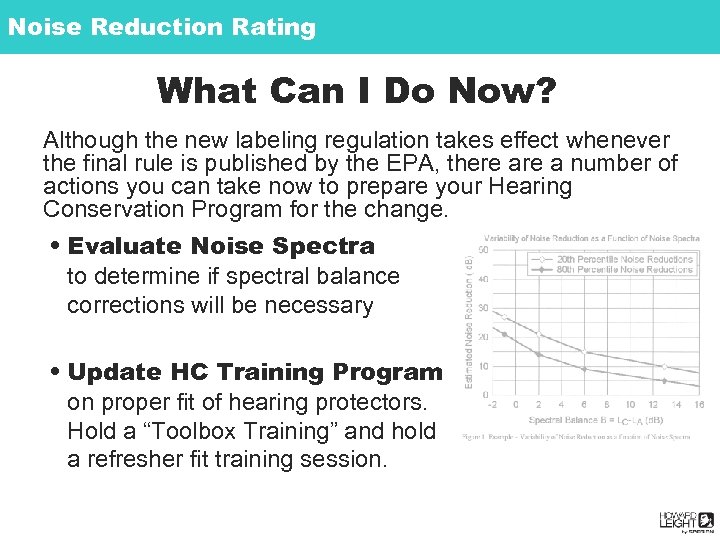 Noise Reduction Rating What Can I Do Now? Although the new labeling regulation takes effect whenever the final rule is published by the EPA, there a number of actions you can take now to prepare your Hearing Conservation Program for the change. • Evaluate Noise Spectra to determine if spectral balance corrections will be necessary • Update HC Training Program on proper fit of hearing protectors. Hold a “Toolbox Training” and hold a refresher fit training session.
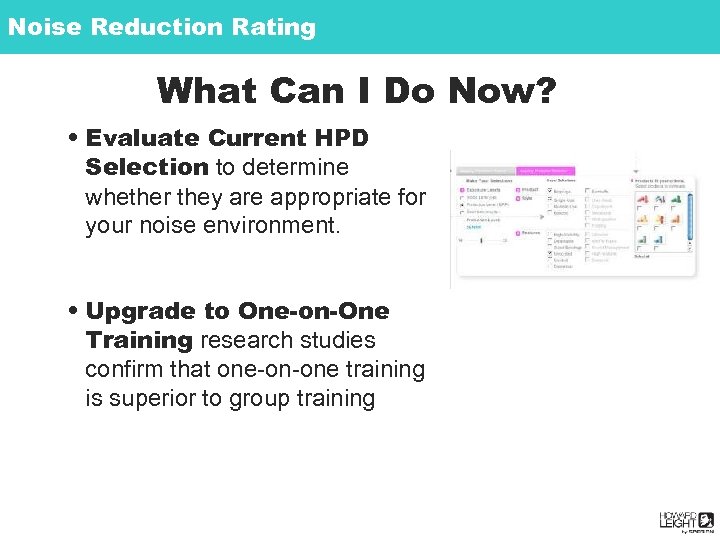 Noise Reduction Rating What Can I Do Now? • Evaluate Current HPD Selection to determine whether they are appropriate for your noise environment. • Upgrade to One-on-One Training research studies confirm that one-on-one training is superior to group training
 Field Verification – Fit-Testing
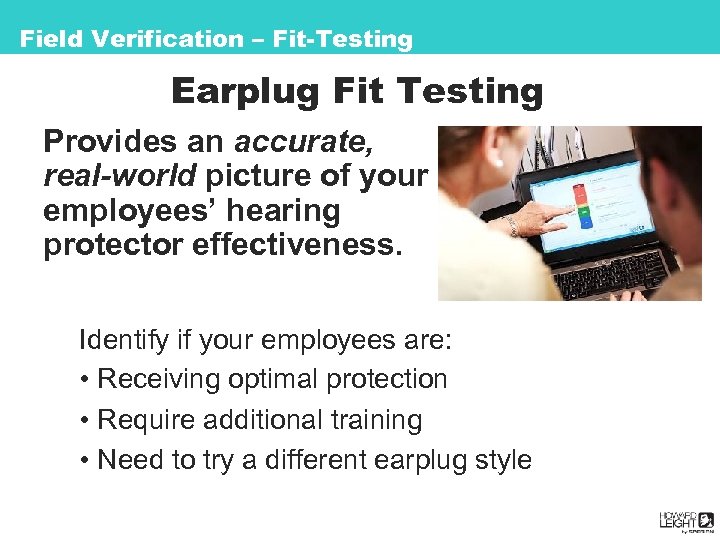 Noise Reduction Rating Field Verification – Fit-Testing Earplug Fit Testing Provides an accurate, real-world picture of your employees’ hearing protector effectiveness. Identify if your employees are: • Receiving optimal protection • Require additional training • Need to try a different earplug style
 Noise Reduction Rating Earplug Fit Testing As a problem solver: • Derating Schemes • One-on-One Training • HPD Selection • NRR Change
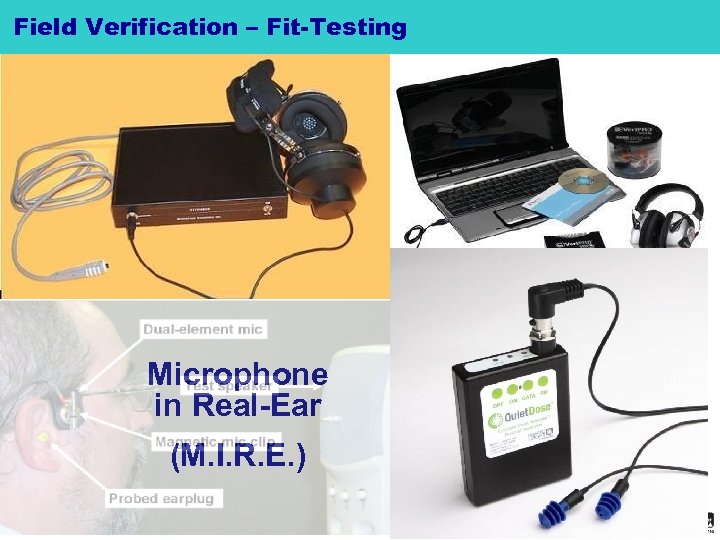 Field Verification – Fit-Testing Real-Ear Attenuation at Threshold Loudness Balance (R. E. A. T. ) (Real-Ear Attenuation Above Threshold) Microphone in Real-Ear In-Ear Dosimetry (M. I. R. E. )
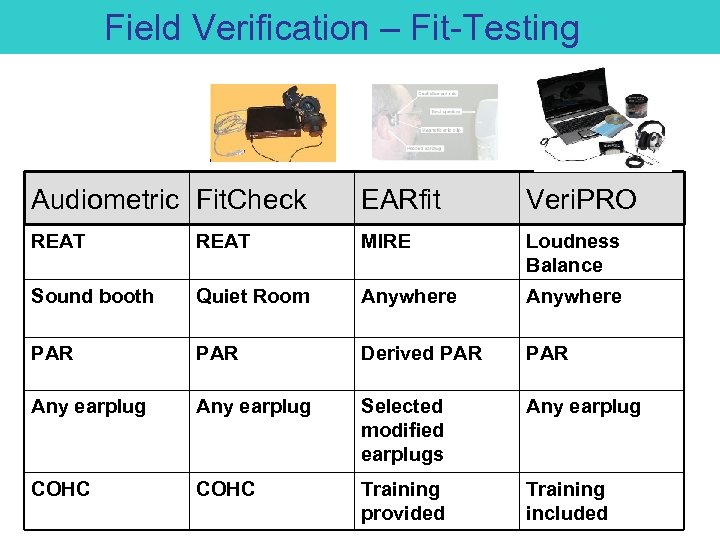 Field Verification – Fit-Testing Audiometric Fit. Check EARfit Veri. PRO REAT MIRE Loudness Balance Sound booth Quiet Room Anywhere PAR Derived PAR Any earplug Selected modified earplugs Any earplug COHC Training provided Training included
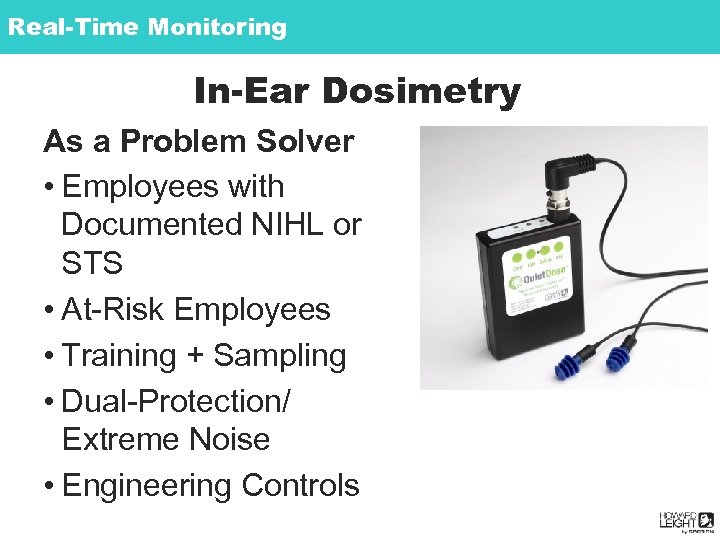 Real-Time Monitoring In-Ear Dosimetry As a Problem Solver • Employees with Documented NIHL or STS • At-Risk Employees • Training + Sampling • Dual-Protection/ Extreme Noise • Engineering Controls
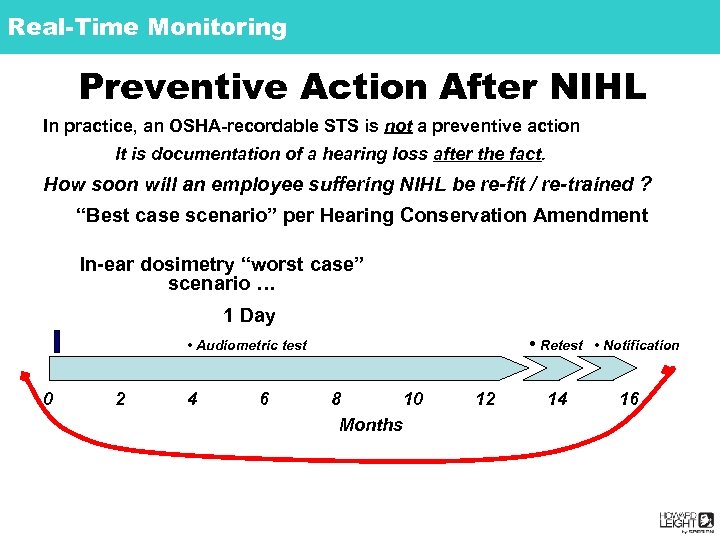 Real-Time Monitoring Preventive Action After NIHL In practice, an OSHA-recordable STS is not a preventive action It is documentation of a hearing loss after the fact. How soon will an employee suffering NIHL be re-fit / re-trained ? “Best case scenario” per Hearing Conservation Amendment In-ear dosimetry “worst case” scenario … 1 Day • Retest • Audiometric test 0 2 4 6 8 10 Months 12 14 • Notification 16
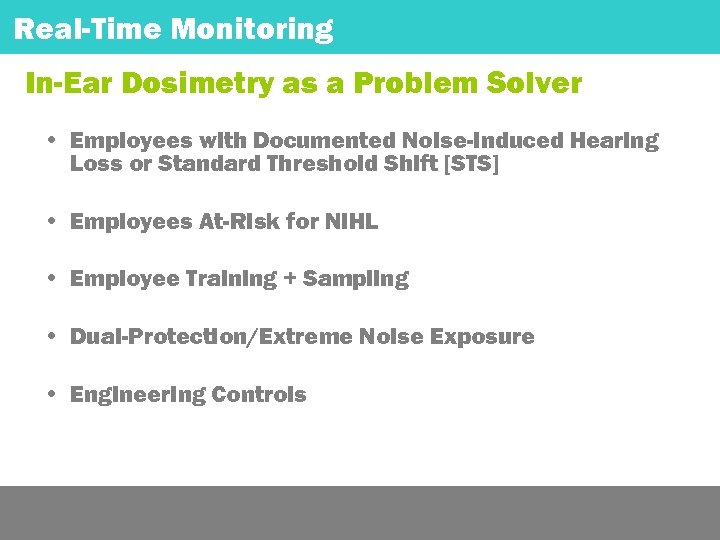 Reducing Costs + Claims Real-Time Monitoring In-Ear Dosimetry as a Problem Solver • Employees with Documented Noise-Induced Hearing Loss or Standard Threshold Shift [STS] • Employees At-Risk for NIHL • Employee Training + Sampling • Dual-Protection/Extreme Noise Exposure • Engineering Controls
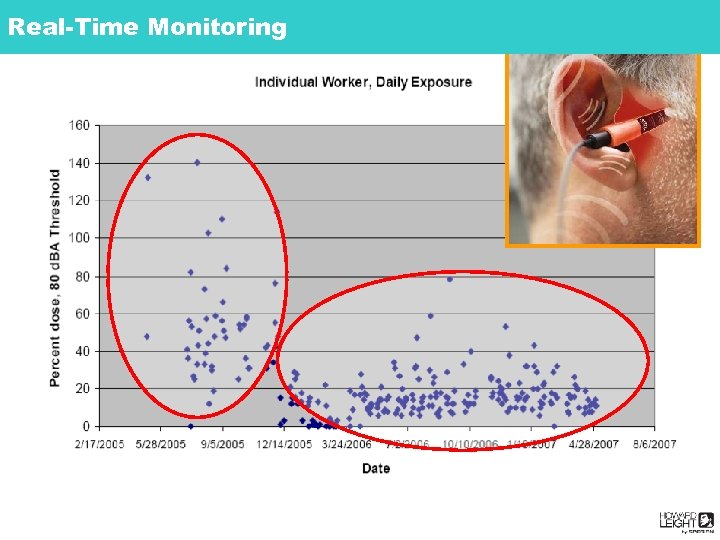 Real-Time Monitoring Reducing Costs +Claims
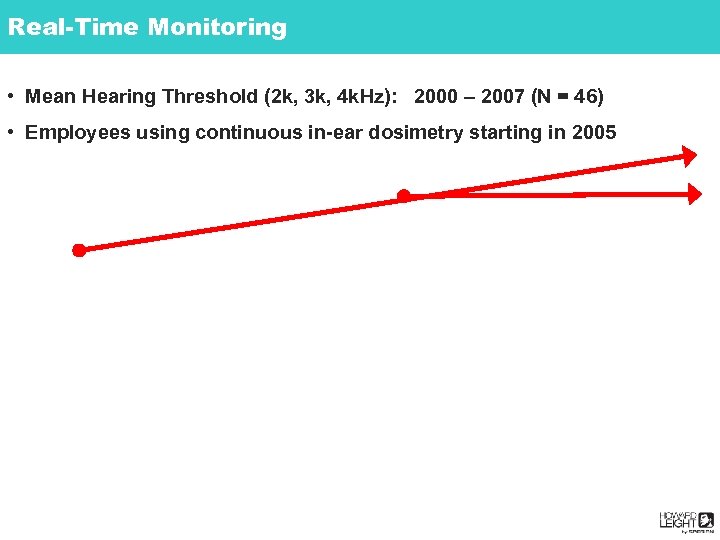 Research Costs + Claims Works Real-Time Monitoring Reducing > Alcoa Intalco • Mean Hearing Threshold (2 k, 3 k, 4 k. Hz): 2000 – 2007 (N = 46) • Employees using continuous in-ear dosimetry starting in 2005
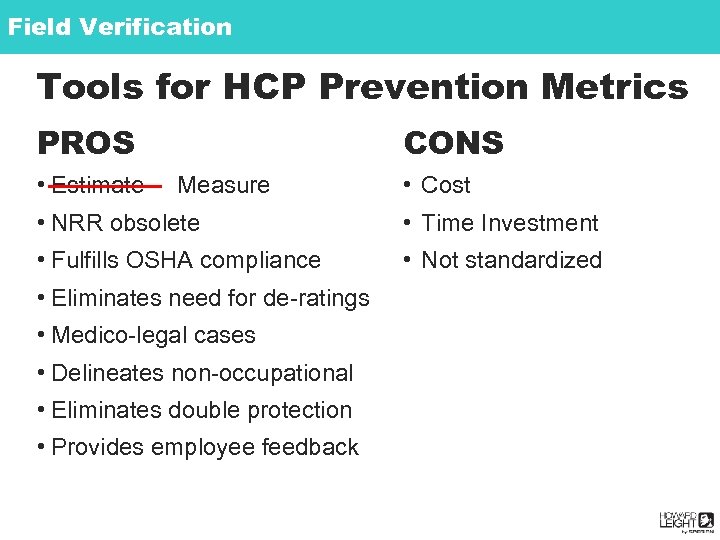 Field Verification Reducing Costs + Claims Tools for HCP Prevention Metrics PROS • Estimate CONS Measure • Cost • NRR obsolete • Time Investment • Fulfills OSHA compliance • Not standardized • Eliminates need for de-ratings • Medico-legal cases • Delineates non-occupational • Eliminates double protection • Provides employee feedback
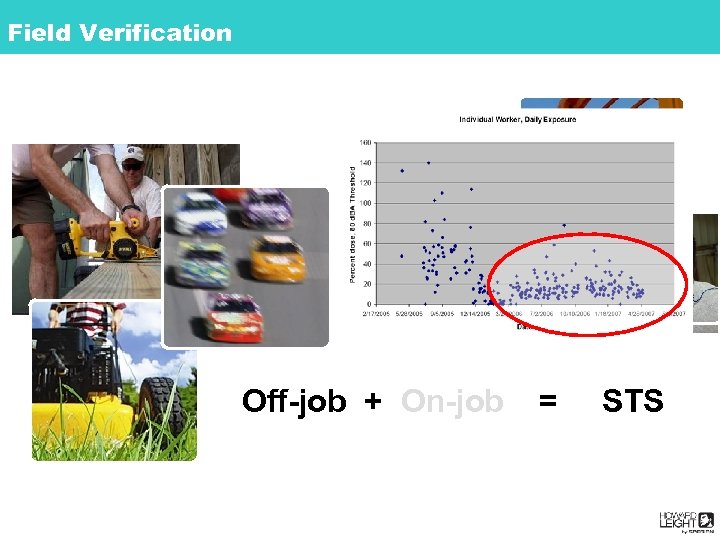 Reducing Costs + Claims Field Verification Off-job + On-job = STS
 Hearing Protectors + Fitting Tips
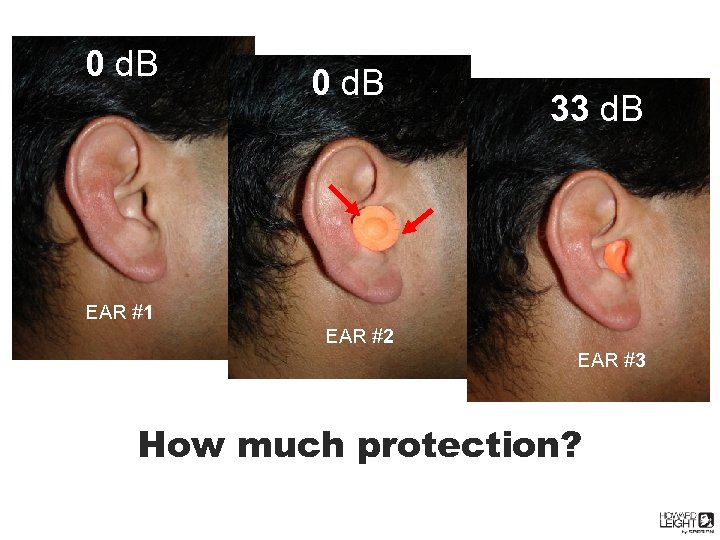 0 d. B 33 d. B EAR #1 EAR #2 EAR #3 How much protection?
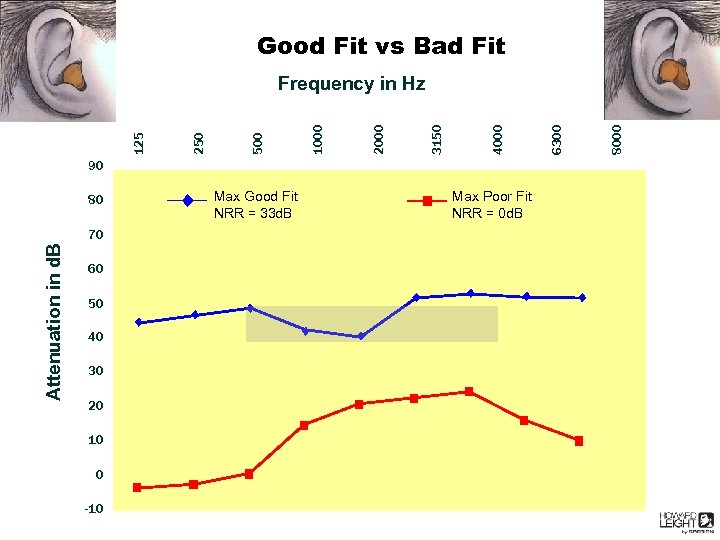 Good Fit vs Bad Fit 90 80 Attenuation in d. B 70 60 50 40 30 20 10 0 -10 Max Good Fit NRR = 33 d. B Max Poor Fit NRR = 0 d. B 8000 6300 4000 3150 2000 1000 500 250 125 Frequency in Hz
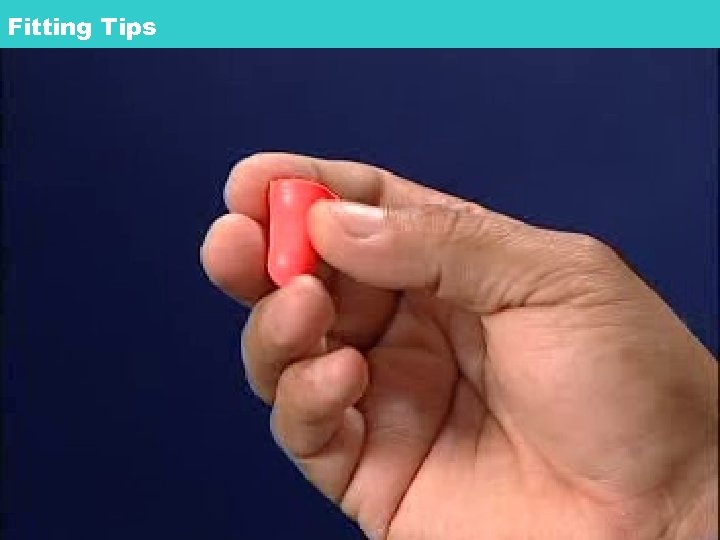
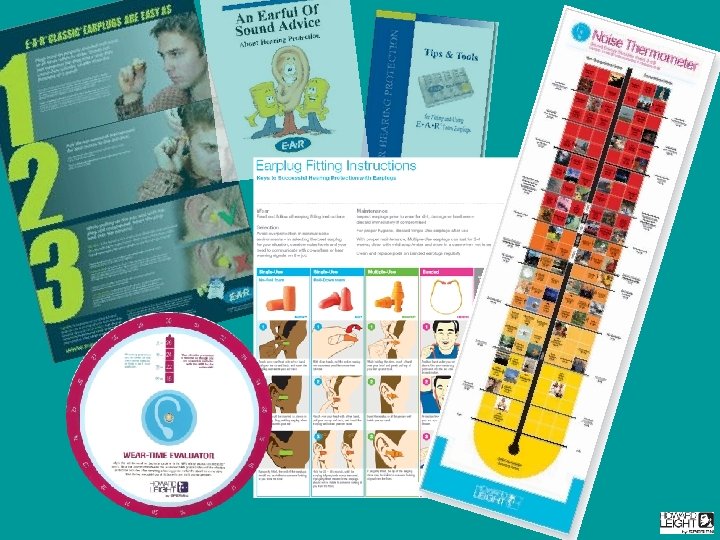
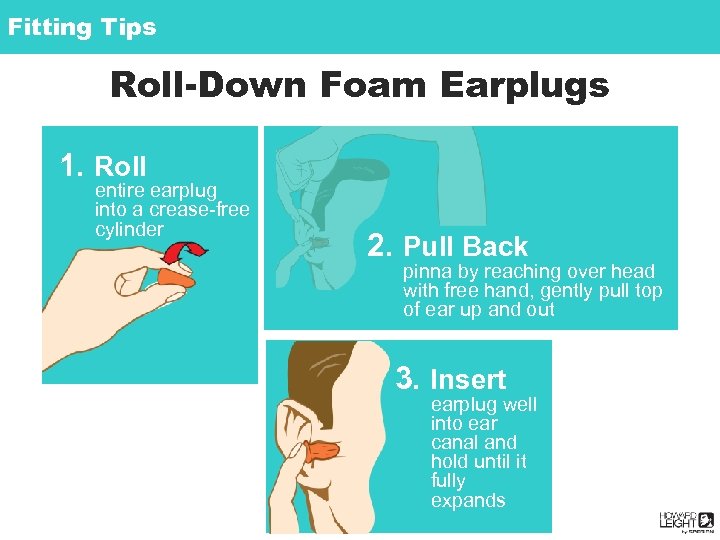 Fitting Tips Roll-Down Foam Earplugs 1. Roll entire earplug into a crease-free cylinder 2. Pull Back pinna by reaching over head with free hand, gently pull top of ear up and out 3. Insert earplug well into ear canal and hold until it fully expands
 Fitting Tips
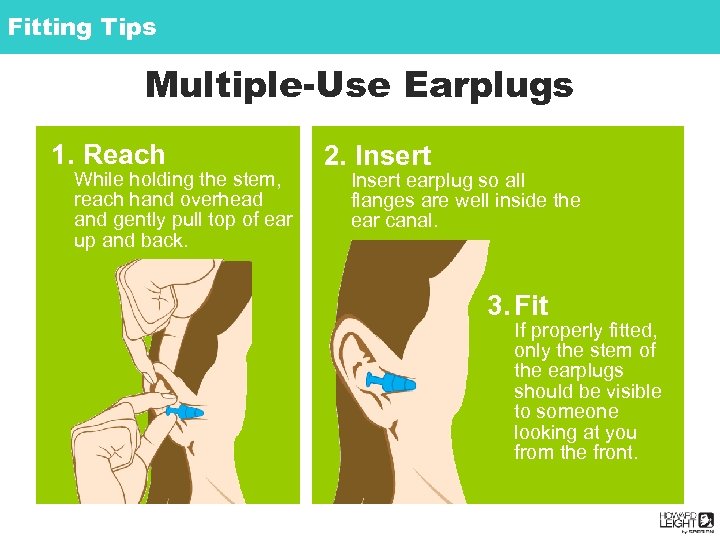 Fitting Tips Multiple-Use Earplugs 1. Reach While holding the stem, reach hand overhead and gently pull top of ear up and back. 2. Insert earplug so all flanges are well inside the ear canal. 3. Fit If properly fitted, only the stem of the earplugs should be visible to someone looking at you from the front.
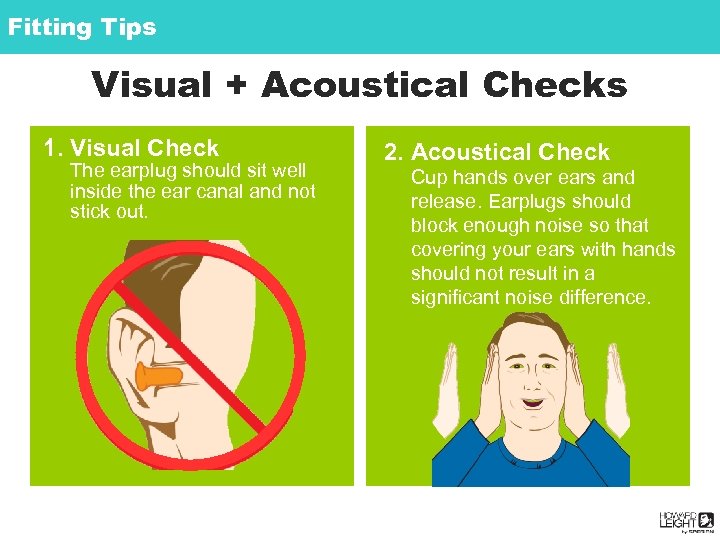 Fitting Tips Visual + Acoustical Checks 1. Visual Check The earplug should sit well inside the ear canal and not stick out. 2. Acoustical Check Cup hands over ears and release. Earplugs should block enough noise so that covering your ears with hands should not result in a significant noise difference.
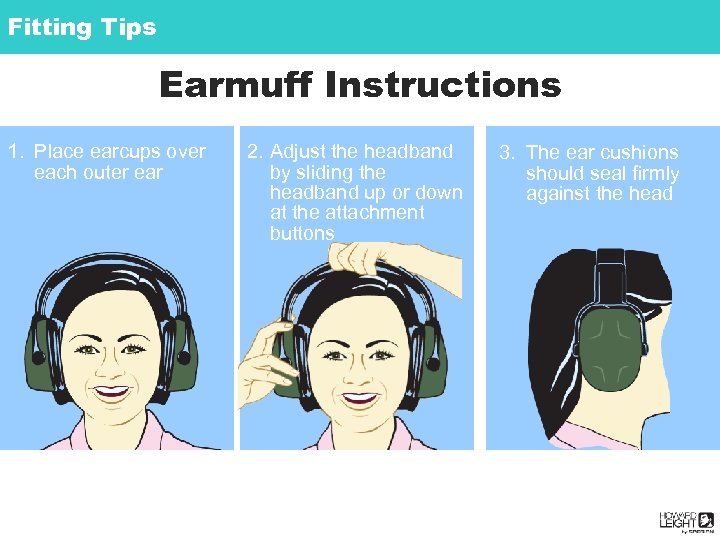 Fitting Tips Earmuff Instructions 1. Place earcups over each outer ear 2. Adjust the headband by sliding the headband up or down at the attachment buttons 3. The ear cushions should seal firmly against the head
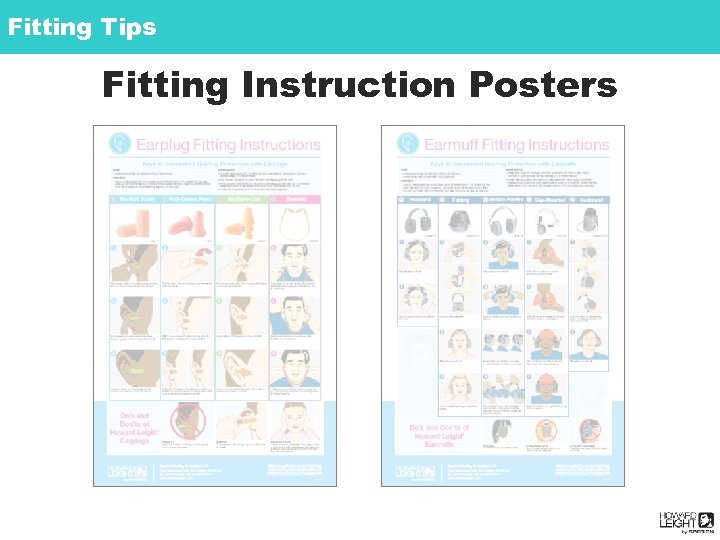 Fitting Tips Fitting Instruction Posters
 Training + Motivation
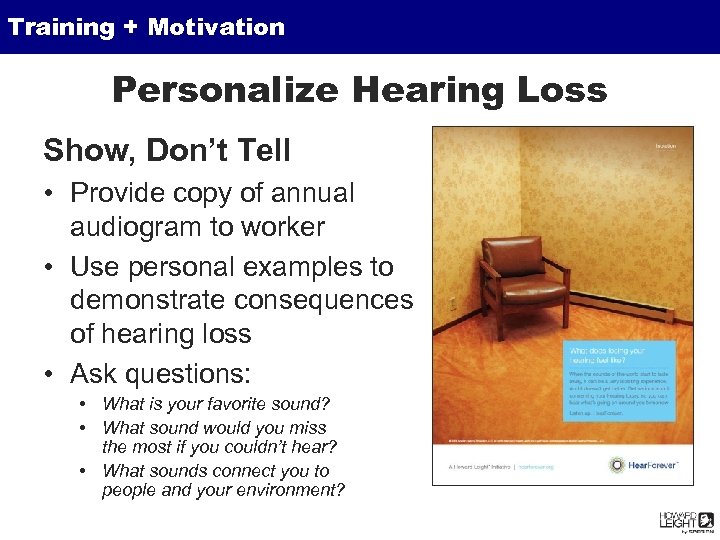 Training + Motivation Personalize Hearing Loss Show, Don’t Tell • Provide copy of annual audiogram to worker • Use personal examples to demonstrate consequences of hearing loss • Ask questions: • What is your favorite sound? • What sound would you miss the most if you couldn’t hear? • What sounds connect you to people and your environment?
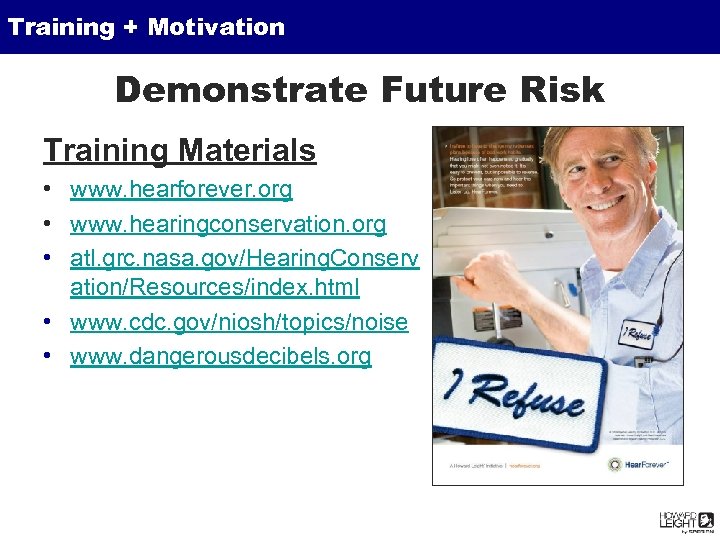 Training + Motivation Demonstrate Future Risk Training Materials • www. hearforever. org • www. hearingconservation. org • atl. grc. nasa. gov/Hearing. Conserv ation/Resources/index. html • www. cdc. gov/niosh/topics/noise • www. dangerousdecibels. org
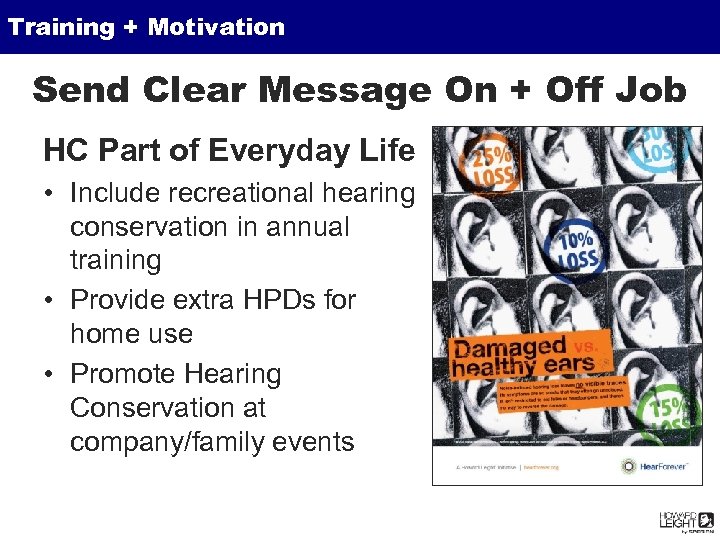 Training + Motivation Send Clear Message On + Off Job HC Part of Everyday Life • Include recreational hearing conservation in annual training • Provide extra HPDs for home use • Promote Hearing Conservation at company/family events
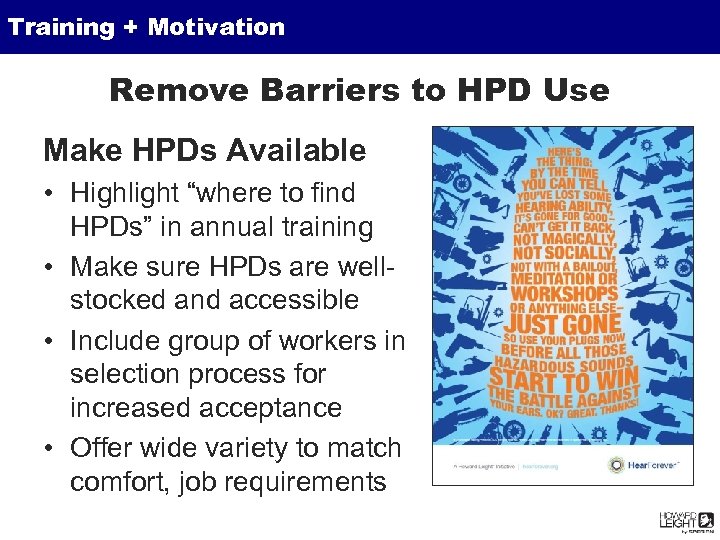 Training + Motivation Remove Barriers to HPD Use Make HPDs Available • Highlight “where to find HPDs” in annual training • Make sure HPDs are wellstocked and accessible • Include group of workers in selection process for increased acceptance • Offer wide variety to match comfort, job requirements
 Training + Motivation Hearing Loss Due To Noise Exposure Is … Painless Permanent Progressive … and very Preventable!