 Скачать презентацию HEALTHY SCHOOLS November 12 2004 Council of Ontario
baccfe174f67668e0481a8777b7a35ac.ppt
- Количество слайдов: 22



HEALTHY SCHOOLS November 12, 2004 Council of Ontario Medical Officers of Health
Purpose of the Presentation • Provide a “heads up” regarding the Healthy Schools movement and recent national and Ontario developments • Seek your support for health promotion in school settings within your respective jurisdictions and circles of influence
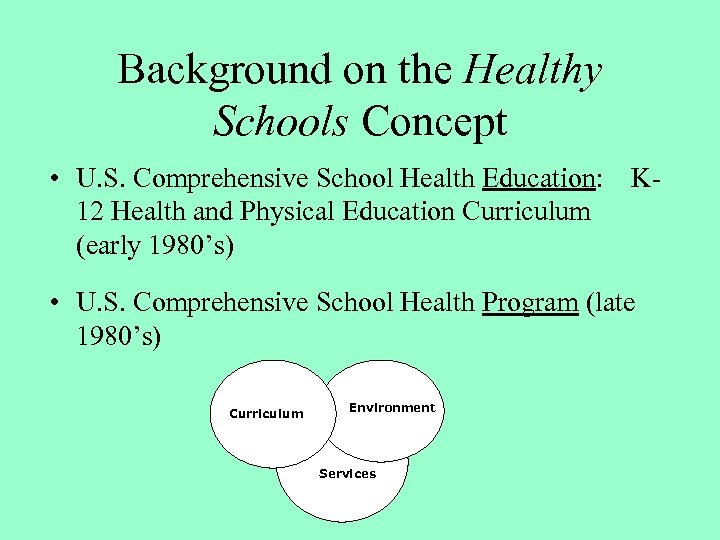
Background on the Healthy Schools Concept • U. S. Comprehensive School Health Education: K 12 Health and Physical Education Curriculum (early 1980’s) • U. S. Comprehensive School Health Program (late 1980’s) Curriculum Environment Services
![Comprehensive School Health [Canadian Association for School Health-CASH, 1988 -1990 ] • A broad](https://present5.com/presentation/baccfe174f67668e0481a8777b7a35ac/image-4.jpg "Comprehensive School Health [Canadian Association for School Health-CASH, 1988 -1990 ] • A broad")
Comprehensive School Health [Canadian Association for School Health-CASH, 1988 -1990 ] • A broad spectrum of programs, policies and activities • Involves many partners • Consensus statement on CSH is supported by 20 national organizations Instruction Services Supportive Social Environment Healthy Physical Environment
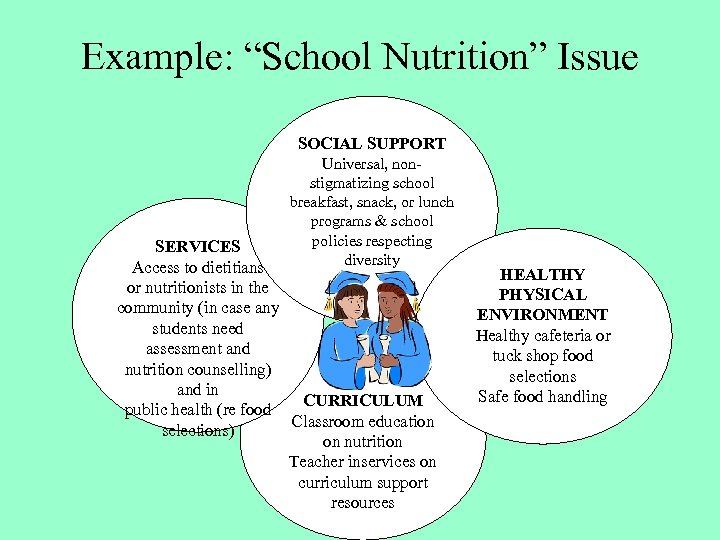
Example: “School Nutrition” Issue SOCIAL SUPPORT Universal, nonstigmatizing school breakfast, snack, or lunch programs & school policies respecting diversity SERVICES Access to dietitians or nutritionists in the community (in case any students need assessment and nutrition counselling) and in CURRICULUM public health (re food Classroom education selections) on nutrition Teacher inservices on curriculum support resources HEALTHY PHYSICAL ENVIRONMENT Healthy cafeteria or tuck shop food selections Safe food handling
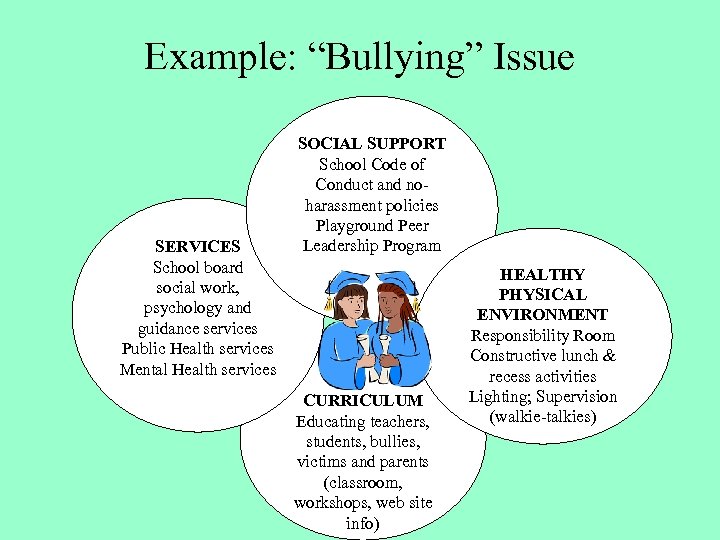
Example: “Bullying” Issue SERVICES School board social work, psychology and guidance services Public Health services Mental Health services SOCIAL SUPPORT School Code of Conduct and noharassment policies Playground Peer Leadership Program CURRICULUM Educating teachers, students, bullies, victims and parents (classroom, workshops, web site info) HEALTHY PHYSICAL ENVIRONMENT Responsibility Room Constructive lunch & recess activities Lighting; Supervision (walkie-talkies)
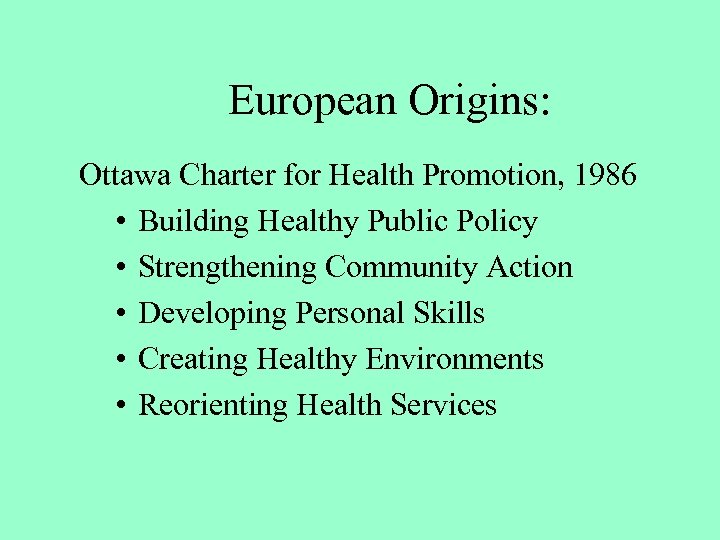
European Origins: Ottawa Charter for Health Promotion, 1986 • Building Healthy Public Policy • Strengthening Community Action • Developing Personal Skills • Creating Healthy Environments • Reorienting Health Services
![Health Promoting Schools [Europe & WHO, 1991/1997] 1. Democracy 6. Teacher Training 2. Equity](https://present5.com/presentation/baccfe174f67668e0481a8777b7a35ac/image-8.jpg "Health Promoting Schools [Europe & WHO, 1991/1997] 1. Democracy 6. Teacher Training 2. Equity")
Health Promoting Schools [Europe & WHO, 1991/1997] 1. Democracy 6. Teacher Training 2. Equity 7. Measuring Success 3. Empowerment & Action Competence 8. Collaboration 4. School Environment 9. Communities 5. Curriculum 10. Sustainability
![Health Promoting Schools [Australia, 1997] CURRICULUM, Teaching and Learning School Organization, Ethos and ENVIRONMENT](https://present5.com/presentation/baccfe174f67668e0481a8777b7a35ac/image-9.jpg "Health Promoting Schools [Australia, 1997] CURRICULUM, Teaching and Learning School Organization, Ethos and ENVIRONMENT")
Health Promoting Schools [Australia, 1997] CURRICULUM, Teaching and Learning School Organization, Ethos and ENVIRONMENT Children & Youth Community Links and Partnerships [SERVICES]
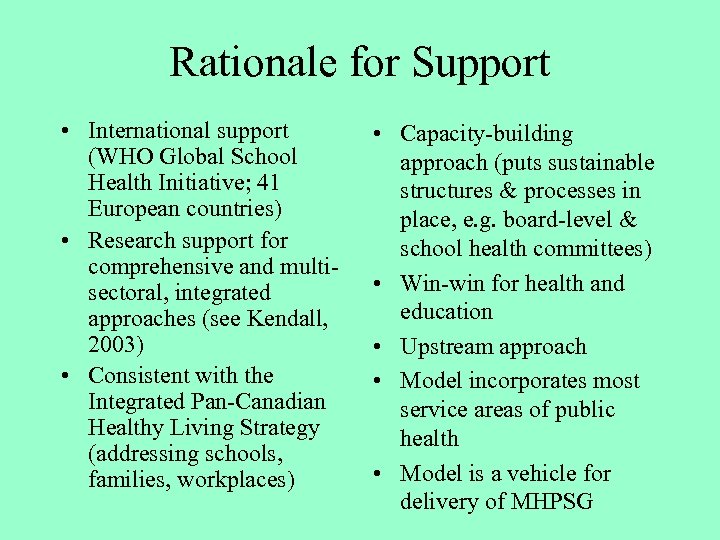
Rationale for Support • International support (WHO Global School Health Initiative; 41 European countries) • Research support for comprehensive and multisectoral, integrated approaches (see Kendall, 2003) • Consistent with the Integrated Pan-Canadian Healthy Living Strategy (addressing schools, families, workplaces) • Capacity-building approach (puts sustainable structures & processes in place, e. g. board-level & school health committees) • Win-win for health and education • Upstream approach • Model incorporates most service areas of public health • Model is a vehicle for delivery of MHPSG
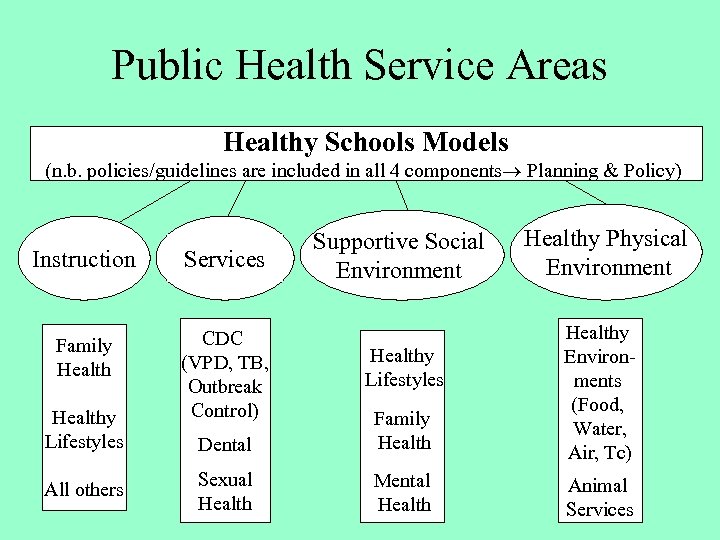
Public Health Service Areas Healthy Schools Models (n. b. policies/guidelines are included in all 4 components Planning & Policy) Instruction Services Family Health CDC (VPD, TB, Outbreak Control) Healthy Lifestyles All others Supportive Social Environment Healthy Physical Environment Dental Family Healthy Environments (Food, Water, Air, Tc) Sexual Health Mental Health Animal Services Healthy Lifestyles
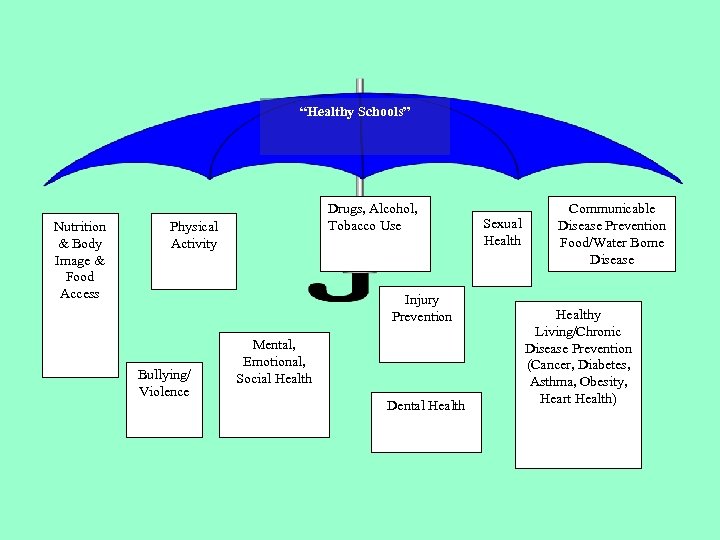
“Healthy Schools” Nutrition & Body Image & Food Access Drugs, Alcohol, Tobacco Use Physical Activity Injury Prevention Bullying/ Violence Mental, Emotional, Social Health Dental Health Sexual Health Communicable Disease Prevention Food/Water Borne Disease Healthy Living/Chronic Disease Prevention (Cancer, Diabetes, Asthma, Obesity, Heart Health)
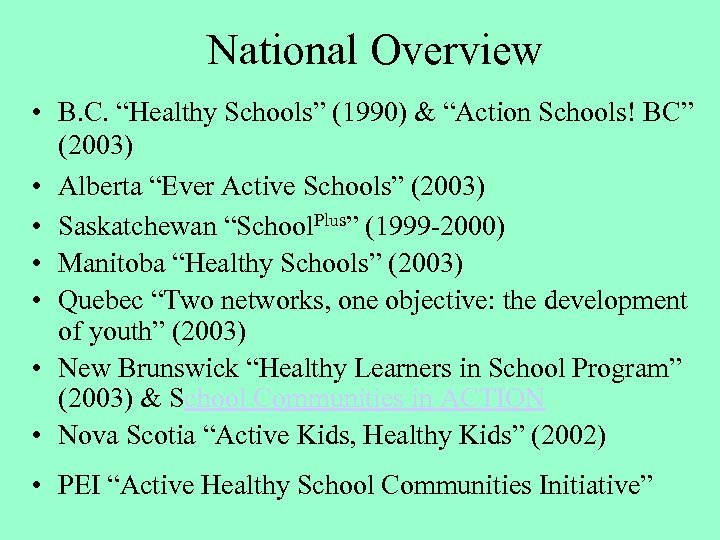
National Overview • B. C. “Healthy Schools” (1990) & “Action Schools! BC” (2003) • Alberta “Ever Active Schools” (2003) • Saskatchewan “School. Plus” (1999 -2000) • Manitoba “Healthy Schools” (2003) • Quebec “Two networks, one objective: the development of youth” (2003) • New Brunswick “Healthy Learners in School Program” (2003) & School Communities in ACTION • Nova Scotia “Active Kids, Healthy Kids” (2002) • PEI “Active Healthy School Communities Initiative”
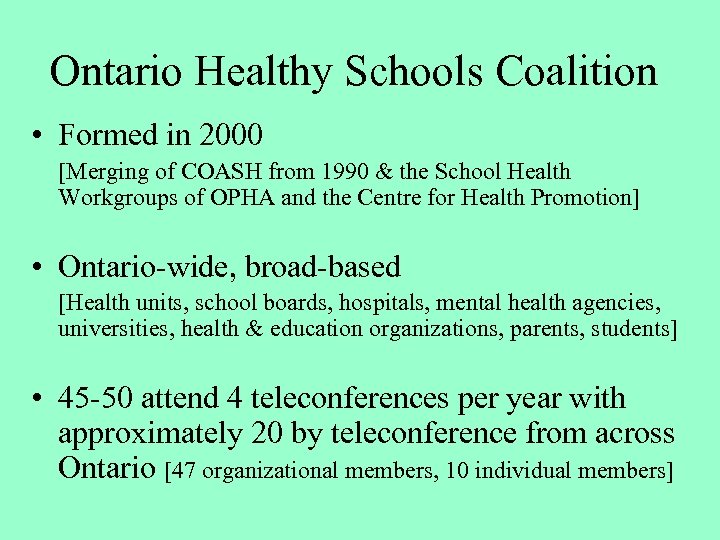
Ontario Healthy Schools Coalition • Formed in 2000 [Merging of COASH from 1990 & the School Health Workgroups of OPHA and the Centre for Health Promotion] • Ontario-wide, broad-based [Health units, school boards, hospitals, mental health agencies, universities, health & education organizations, parents, students] • 45 -50 attend 4 teleconferences per year with approximately 20 by teleconference from across Ontario [47 organizational members, 10 individual members]
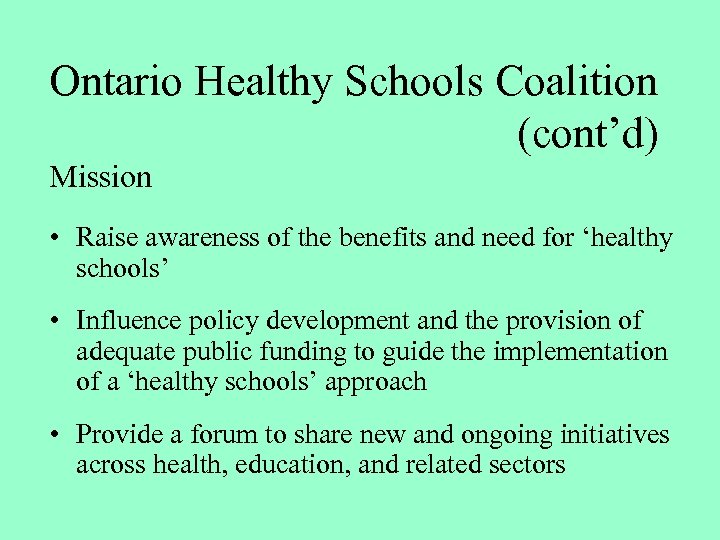
Ontario Healthy Schools Coalition (cont’d) Mission • Raise awareness of the benefits and need for ‘healthy schools’ • Influence policy development and the provision of adequate public funding to guide the implementation of a ‘healthy schools’ approach • Provide a forum to share new and ongoing initiatives across health, education, and related sectors
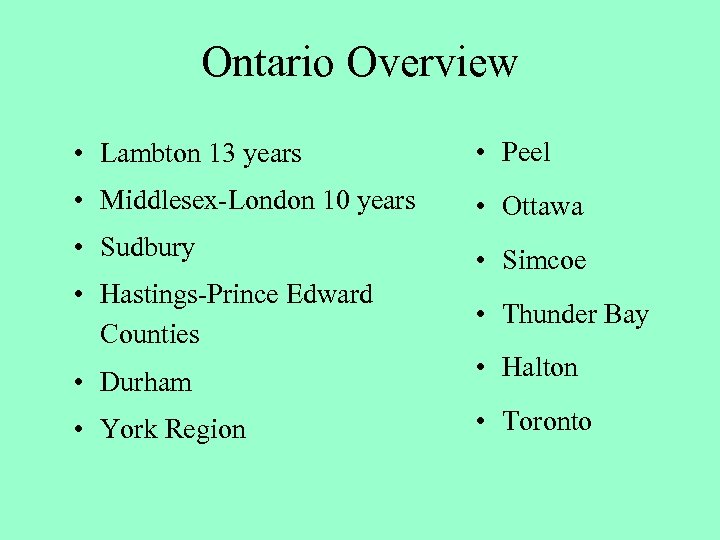
Ontario Overview • Lambton 13 years • Peel • Middlesex-London 10 years • Ottawa • Sudbury • Simcoe • Hastings-Prince Edward Counties • Thunder Bay • Durham • Halton • York Region • Toronto
![Living School [Ontario Physical and Health Education Association. Ophea, 2004] • Health Policies or](https://present5.com/presentation/baccfe174f67668e0481a8777b7a35ac/image-17.jpg "Living School [Ontario Physical and Health Education Association. Ophea, 2004] • Health Policies or")
Living School [Ontario Physical and Health Education Association. Ophea, 2004] • Health Policies or Guidelines • Skills-Based Health and Physical Education Curriculum • Safe and Supportive School Community Environments • School Community Programs and Services
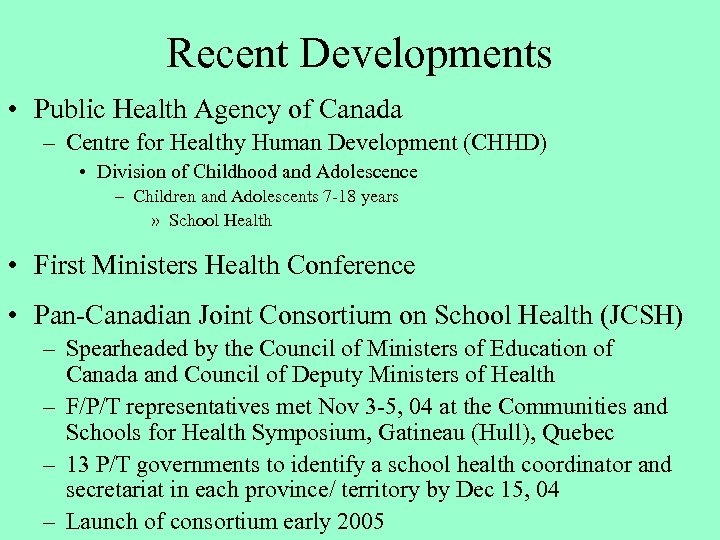
Recent Developments • Public Health Agency of Canada – Centre for Healthy Human Development (CHHD) • Division of Childhood and Adolescence – Children and Adolescents 7 -18 years » School Health • First Ministers Health Conference • Pan-Canadian Joint Consortium on School Health (JCSH) – Spearheaded by the Council of Ministers of Education of Canada and Council of Deputy Ministers of Health – F/P/T representatives met Nov 3 -5, 04 at the Communities and Schools for Health Symposium, Gatineau (Hull), Quebec – 13 P/T governments to identify a school health coordinator and secretariat in each province/ territory by Dec 15, 04 – Launch of consortium early 2005
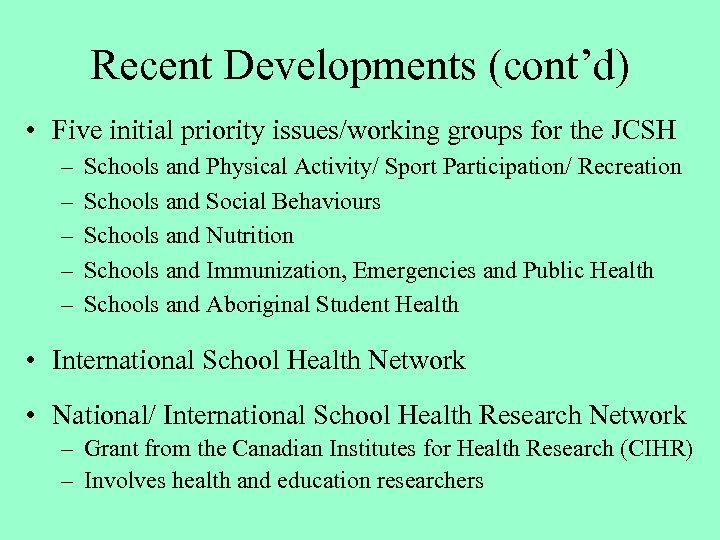
Recent Developments (cont’d) • Five initial priority issues/working groups for the JCSH – – – Schools and Physical Activity/ Sport Participation/ Recreation Schools and Social Behaviours Schools and Nutrition Schools and Immunization, Emergencies and Public Health Schools and Aboriginal Student Health • International School Health Network • National/ International School Health Research Network – Grant from the Canadian Institutes for Health Research (CIHR) – Involves health and education researchers
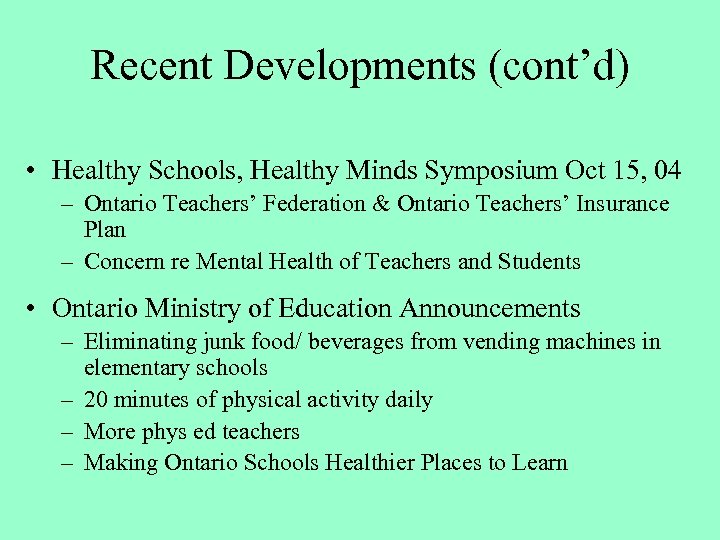
Recent Developments (cont’d) • Healthy Schools, Healthy Minds Symposium Oct 15, 04 – Ontario Teachers’ Federation & Ontario Teachers’ Insurance Plan – Concern re Mental Health of Teachers and Students • Ontario Ministry of Education Announcements – Eliminating junk food/ beverages from vending machines in elementary schools – 20 minutes of physical activity daily – More phys ed teachers – Making Ontario Schools Healthier Places to Learn
What You Can Do • Share and Prepare: Share this information with your management team and begin exploring the opportunities these developments present and operational considerations for implementation; connect with Ontario colleagues • Allocate: Consider aligning current staff and services with this model and establish a coordinating committee from your many service areas, as well as a joint committee involving school board-health unit senior administration • Advocate: for health promotion in school settings within Public Health Agency of Canada mandate; for frontline public health staff to work with schools/ boards; for interministerial coordination; for CSH in MHPSG
For More Information Ontario Healthy Schools Coalition www. opha. on. ca/ohsc Co-Chairs • Carol Mac. Dougall (416) 338 -7864 cmacdoug@toronto. ca • Barbara Ronson (416) 304 -1258 b. ronson@utoronto. ca Presentation Contributors • Gayle Bursey: Peel (905) 791 -7800 x 2617 • Yvette Laforêt-Fliesser: MLHU (519) 663 -5317 x 2242 • Cathy Jaynes: York 1 -877 -352 -1698 x 4534 • Denise Gaulin: Leeds, Grenville, Lanark (613) 345 -5685 x 2232
Скачать презентацию HEALTHY SCHOOLS November 12 2004 Council of Ontario
baccfe174f67668e0481a8777b7a35ac.ppt