


 Скачать презентацию Healthy Images of Manhood A Male Engagement Approach
39a03d6b7ae451b384cffbb44bd83547.ppt
- Количество слайдов: 37
 Healthy Images of Manhood: A “Male Engagement” Approach for Workplace Health Pauline Muhuhu David Wofford Extending Service Delivery Project February 11, 2010
 What is the Extending Service Delivery Project (ESD)? o Global project in reproductive health and family planning (RH/FP) funded by USAID o Addresses unmet need for RH/FP and increases access to services by the poor and underserved at the community level o Project Organizations: n Pathfinder International – Managing partner n Intra. Health – gender, religious leaders, BPs n Management Sciences for Health – Health systems n Meridian Group International Inc. – CSR
 What are ESD’s main technical focuses for reproductive health/family planning? o Best Practices – identifying BPs in and promoting use of BPs o CSR and Corporate Partnerships o Family Planning-HIV Integration (of services) o Healthy Timing and Spacing of Pregnancy o Gender – launching HIM approach for companies and workplaces
 What is ESD’s experience in Africa? o Country-level projects: Kenya (North East Province APHIA –HIV/AIDS); Burundi; Guinea; Angola; D. R. Congo; Ethiopia; Sudan o Tanzania n Unilever Tea: HIM + service delivery n Medical Women Association of Tanzania: healthy timing and spacing of pregnancy o Kenya n Dadaab/Kakuma – religious leaders training; youth training in gender-based violence prevention
 Who are ESD’s Corporate, NGO Partners? þ Unilever Tea Tanzania and Kenya Ltd. – workplace peer education project using the Healthy Images of Manhood approach þ Business for Social Responsibility – (Health Enables Returns) HERproject technical advisor þ Levi Strauss & Co. – Workplace health program in 3 supplier companies in Egypt/2 suppliers in Pakistan þ Bayer Schering Pharma – Healthy Timing and Spacing of Pregnancy education materials þ The Calvert Group (social investment firm) – the Calvert Women’s Principles/Gender Equity Principles þ Global Business Coalition on HIV/AIDS, TB, and Malaria – HIM in Kenya; CSR workshop on health
 Where did HIM come from? HIM takes the best of: o Proven “community-based” gender programs – Project H, Raising Voices, and Men as Partners AND o Integrates ESD’s expertise in reproductive health/family planning and workplace programs o TO address the needs of companies & workplaces.
 What is the HIM approach? o HIM is about men’s and women’s empowerment to improve health: n Helping men to reflect on negative social norms that lead to unhealthy behaviors n Providing peer educators “gender” knowledge and skills to influence their peers to adopt healthy behaviors n Linking health education to health services n Taking a holistic approach to health – integrating of HIV, family planning etc.
 What is the meaning of Gender?
 What is the meaning of Gender? Sex or Gender: o o o o Breastfeeding? Changing Nappies? Driving a trailer truck? Getting a vasectomy? Giving birth? Going to a bar? Washing clothes?
 Definition of Sex and Gender o Sex refers to the physiological characteristics that identify a person as male or female. o Gender refers to the widely shared, expectations and norms about BOTH men and women and their behaviors. Sex is a fact of biology (genitalia, hormones etc. ) Page 24 – HIM Training Manual
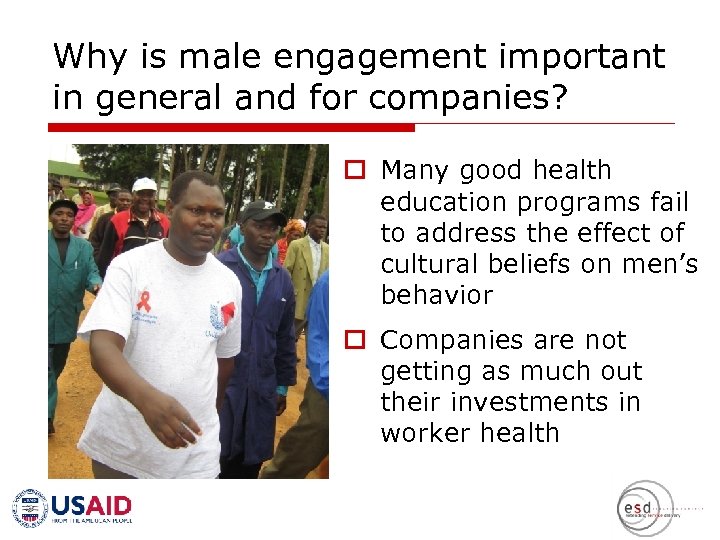 Why is male engagement important in general and for companies? o Many good health education programs fail to address the effect of cultural beliefs on men’s behavior o Companies are not getting as much out their investments in worker health
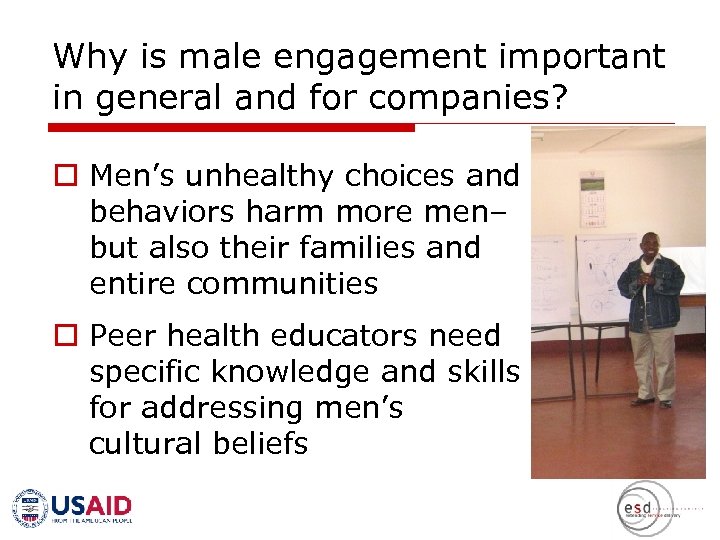 Why is male engagement important in general and for companies? o Men’s unhealthy choices and behaviors harm more men– but also their families and entire communities o Peer health educators need specific knowledge and skills for addressing men’s cultural beliefs
 What is unique about HIM as a gender program? It shares many elements BUT 1. Gender programs are not tailored to the workplace realities 2. They are focused on a narrow, specific area: Gender-Based Violence; HIV/AIDS and care-giving; 3. Family planning & reproductive health are not integral
 How is HIM different from most peer education training? Many elements are the same BUT 1. Gender skills/knowledge are made integral to development of communication skills and health knowledge and outreach 2. Personal behavior change by PHEs themselves is essential 3. HIM takes a “whole person” approach to health
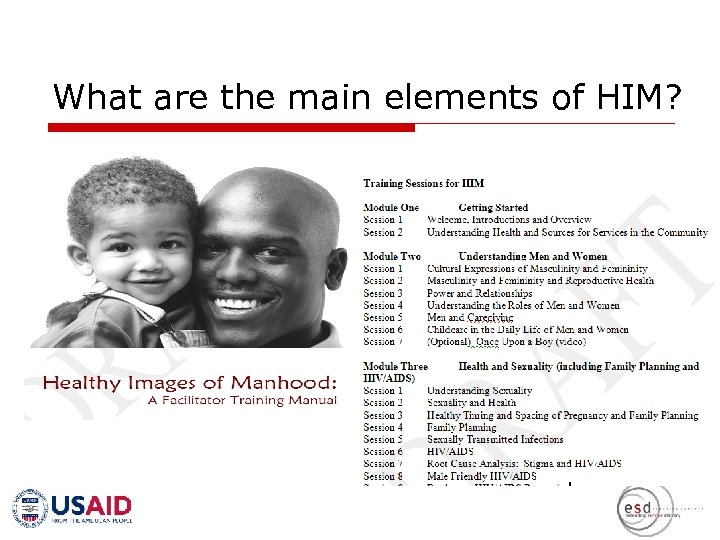 What are the main elements of HIM?
 What are the main elements of HIM? o Core Curriculum blending: n Gender skills/knowledge n Health knowledge (RH/FP/HIV/Child health) n Participatory outreach skills o Modular curriculum adaptable to each workplace o Other valuable elements n Linkages/improvements to health services n Capacity building: ü Strong supervision – focused on mentoring, ü Ongoing skills development for PEs ü Company management ability to maintain/expand program on its own
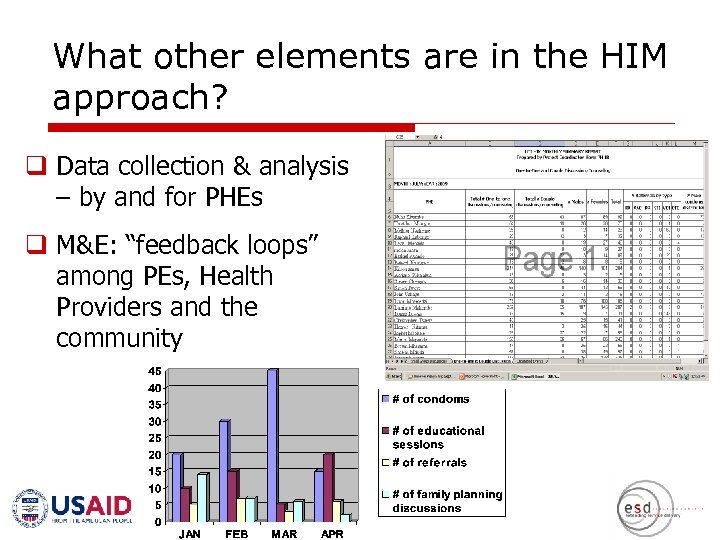 What other elements are in the HIM approach? q Data collection & analysis – by and for PHEs q M&E: “feedback loops” among PEs, Health Providers and the community
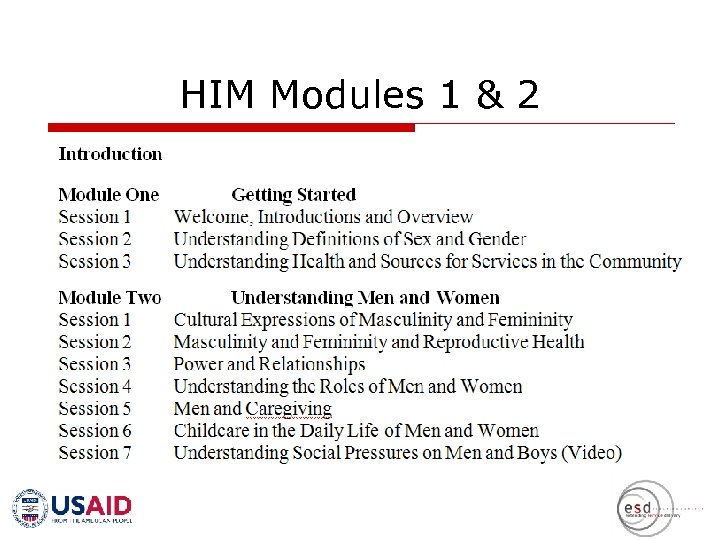 HIM Modules 1 & 2
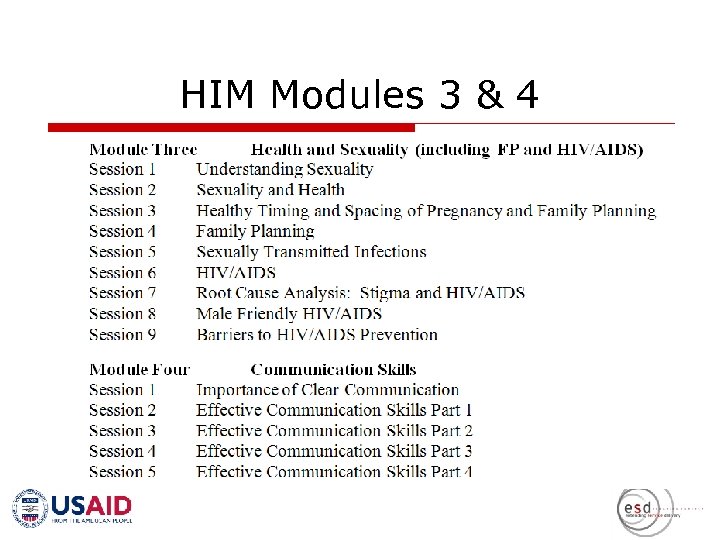 HIM Modules 3 & 4
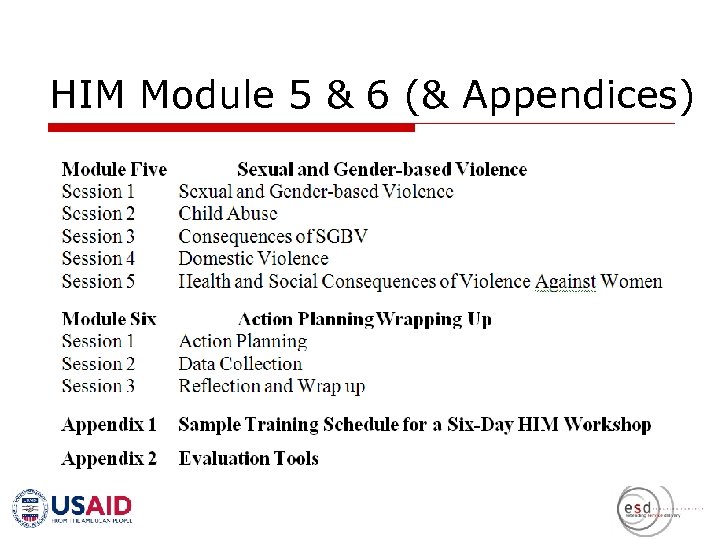 HIM Module 5 & 6 (& Appendices)
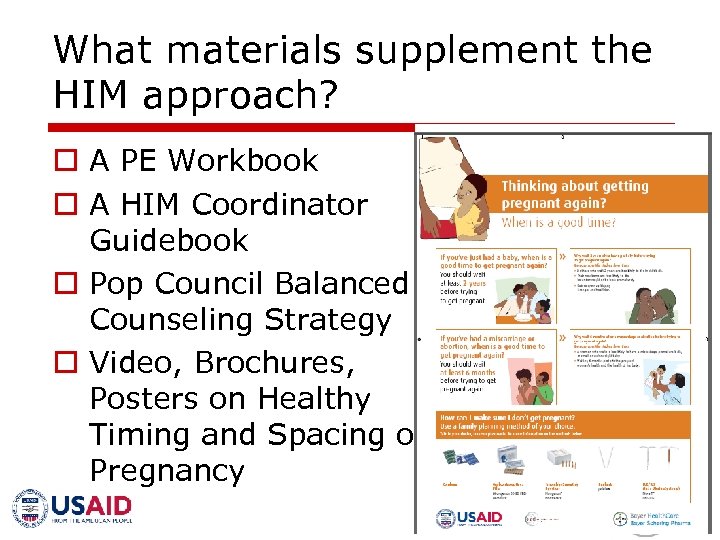 What materials supplement the HIM approach? o A PE Workbook o A HIM Coordinator Guidebook o Pop Council Balanced Counseling Strategy o Video, Brochures, Posters on Healthy Timing and Spacing of Pregnancy
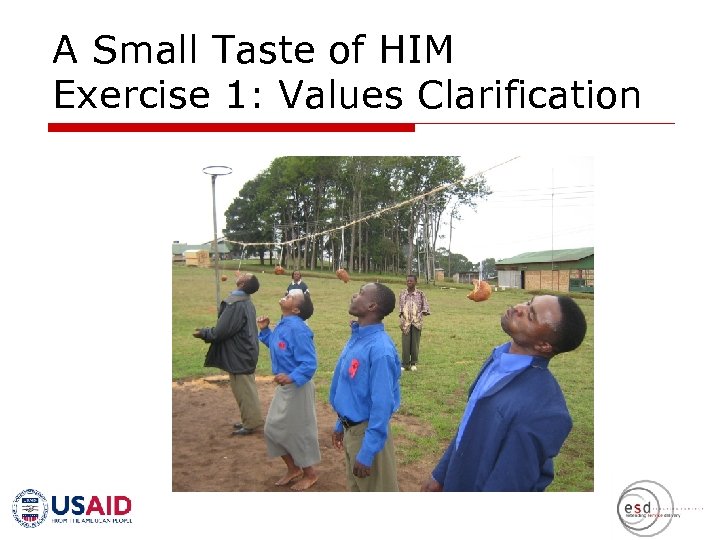 A Small Taste of HIM Exercise 1: Values Clarification
 Experiences with HIM
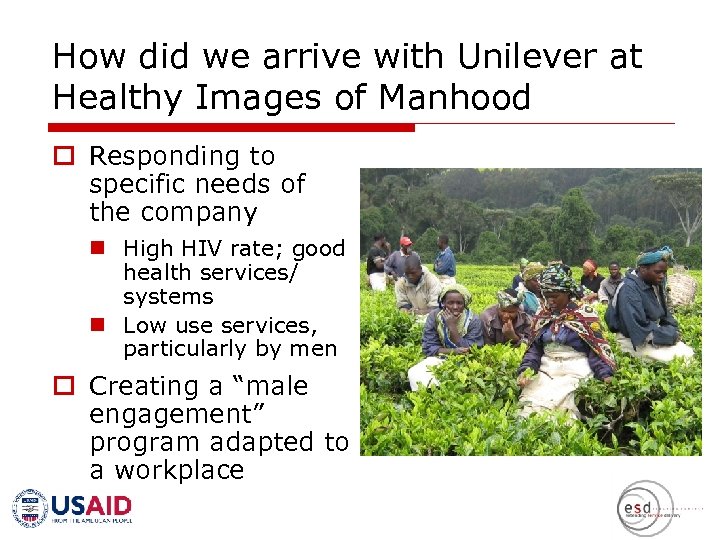 How did we arrive with Unilever at Healthy Images of Manhood o Responding to specific needs of the company n High HIV rate; good health services/ systems n Low use services, particularly by men o Creating a “male engagement” program adapted to a workplace
 What were the main goals of HIM at UTTL? o Primary Goal: to increase men’s use of UTTL’s health services (HIV, family planning etc. ) o Secondary Goals: n Improve the quality of PHEs’ outreach n Promote behavior change in PHEs themselves n Create linkages between peer education activities and service providers
 How was the HIM program implemented at UTTL? o HIM Program Start-Up: n Training program for 29 male peer health educators – begun January 2008 (six days) n ESD trained an external Tanzanian trainer in HIM for initial training and capacity building for coordinator n Full-time coordinator assigned: mentoring, support n Monthly follow-up meetings
 How was HIM implemented at UTTL? o HIM Development over 18 months: n September 2008: 3 -day refresher training n Full-time coordinator assuming full management n Data collection system improvements o Changes and Scale-Up of program n 52 new PHEs trained in HIM in September n Half of new HIM PHEs are women n HIM elements now in basic PHE training
 What has been the impact of HIM to date? o Referrals: n Increase in male enrollment at CTC n In 2009, for first time, men coming STI clinic at same rate as women (and lower STI rate overall) o Family Planning services: n Gradual uptake in FP by HIV clients (not previously offered in CTC): 17 new FP clients and 70 repeat visits Jan-June 2009 n Gradual increase overall of new FP clients: 16/month Jan-June 2009 compared to an average of 11/month for Jan-June 2007 o PHE Productivity: n 122, 492 male and 5, 321 female condoms distributed by HIMtrained PHEs over 17 months
 What has been the impact of HIM to date? o Qualitative: n HIM-trained peer educators highly positive about training and personal changes n Positive reaction from women: “HIM is our salvation” - PHEs have been asked to mediate marital dispute n Peer educators are seen as a resource n On mobile clinic days (Maternal & Child Health/FP), PHEs provide health education and assistance
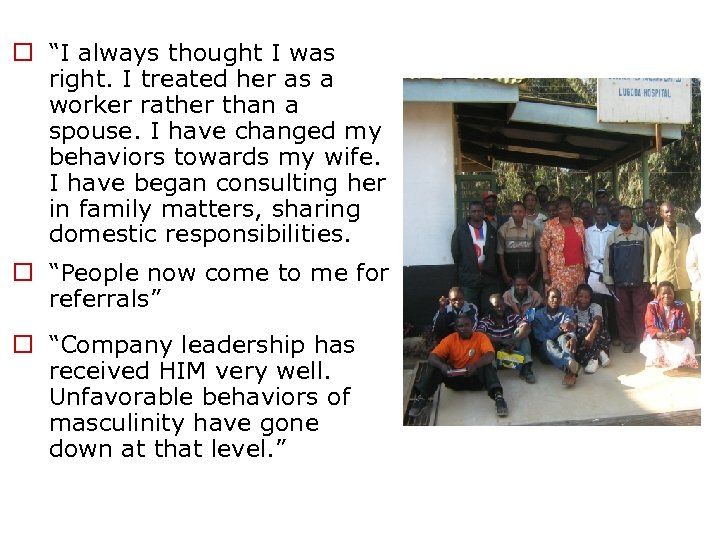 o “I always thought I was right. I treated her as a worker rather than a spouse. I have changed my behaviors towards my wife. I have began consulting her in family matters, sharing domestic responsibilities. o “People now come to me for referrals” o “Company leadership has received HIM very well. Unfavorable behaviors of masculinity have gone down at that level. ”
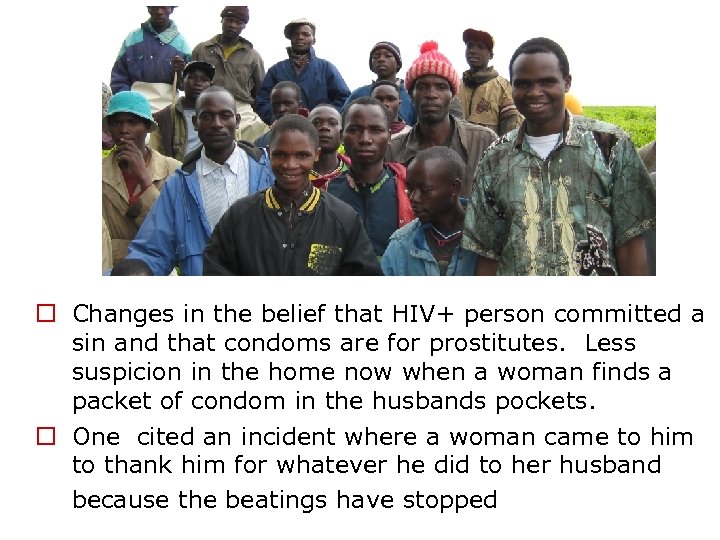 o Changes in the belief that HIV+ person committed a sin and that condoms are for prostitutes. Less suspicion in the home now when a woman finds a packet of condom in the husbands pockets. o One cited an incident where a woman came to him to thank him for whatever he did to her husband because the beatings have stopped
 HIM Exercise 2: Proverbs o Each group will receive a proverb or saying for around n Discuss what you think is the meaning of the proverb n Explain what it tells you about what is that society’s view of men or women o Each group will identify 1 -2 similar proverbs/sayings from their communities
 The Business Case for HIM o ESD has major focus on Return on Investment analysis: n Workplaces in Bangladesh and Guatemala (studies) n Interest in health outcomes and business outcomes o HIM also is designed with the business case in mind
 The Business Case for HIM o Business is investing in health program on HIV/AIDS, TB, Malaria: o HIM is designed to complement these efforts in order to: n Get more return from these investments n Be easily adapted cost-effectively into existing PE and health programs n Provide easy tools for implementation
 Business Case for HIM o Each company has its own business interests: n Fulfillment of CSR commitments and obligations n Legal obligations: eg. The Sexual Offenses Act in Kenya n Better use of resources n More impact from existing investments