


 Скачать презентацию Healthcare Services Specification Project A Project Tour Sydney
f77763f4efb12f9bc28f331936448f33.ppt
- Количество слайдов: 65
 Healthcare Services Specification Project A Project Tour Sydney, Australia May 2006 Ken Rubin EDS Co-Chair, OMG Healthcare Domain Task Force Co-Chair, HL 7 Services-oriented Architecture SIG ken. rubin@eds. com 3/19/2018 5: 57 PM
 Overview • Part I: Background – HSSP Background and Context • Part III: HSSP Project “Deep Dive” – Methdology – Active Subgroups © 2006 HSSP Project, http: //hssp. wikispaces. com Reuse with attribution permitted Page 2
![“How do you know that the [web-] services you’re building are not just the](https://present5.com/presentation/f77763f4efb12f9bc28f331936448f33/image-3.jpg "“How do you know that the [web-] services you’re building are not just the") “How do you know that the [web-] services you’re building are not just the next generation of stovepipes? ” Janet Martino, LTC, USAF (Retired) to a panel of Healthcare IT Leaders © 2006 HSSP Project, http: //hssp. wikispaces. com Reuse with attribution permitted Page 3
“How do you know that the [web-] services you’re building are not just the next generation of stovepipes? ” Janet Martino, LTC, USAF (Retired) to a panel of Healthcare IT Leaders © 2006 HSSP Project, http: //hssp. wikispaces. com Reuse with attribution permitted Page 3
 So, what is HSSP? • An project to create common “service interface specification” standards that are tractable within healthcare IT • A joint initiative co-sponsored by Health Level 7 (HL 7) and the Object Management Group (OMG) • Its objectives are: – To create useful, usable healthcare standards that address functions, semantics and technologies – To complement existing work and leverage existing standards – To focus on practical needs and not perfection – To capitalize on the best industry talent through open community participation and maximizing each community for its strengths © 2006 HSSP Project, http: //hssp. wikispaces. com Reuse with attribution permitted Page 4
 Why HSSP Was Created • Several large provider organizations were each facing challenges in integrating current and emerging systems – Veterans Health Administration – Kaiser-Permanente – Ser. API Project (Finland) • There were a number of shared beliefs among the founding partners… © 2006 HSSP Project, http: //hssp. wikispaces. com Reuse with attribution permitted Page 5
 In each case… • There was active integration and development work • There was a shared belief that messaging alone was not the optimal solution • A services-oriented architecture was the target environment • There was strong commitment to standards • There was recognition standard services would further interoperability with partners and products • It was recognized that developing “stovepipe” services would not address business challenges © 2006 HSSP Project, http: //hssp. wikispaces. com Reuse with attribution permitted Page 6
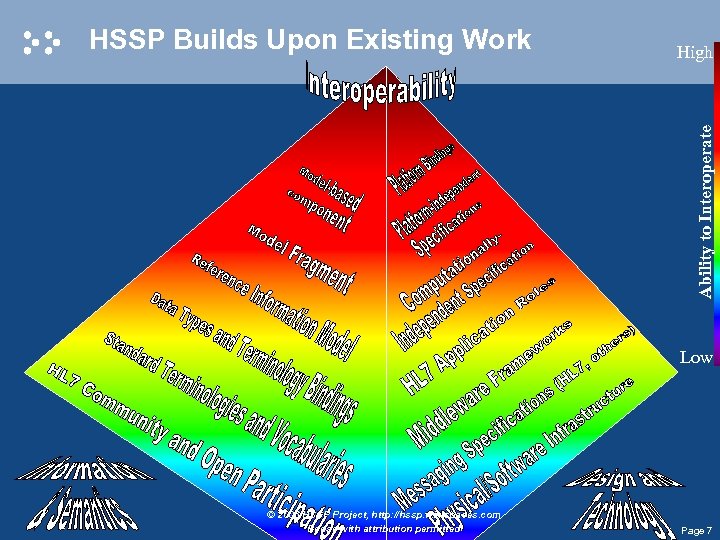 High Ability to Interoperate HSSP Builds Upon Existing Work Low © 2006 HSSP Project, http: //hssp. wikispaces. com Reuse with attribution permitted Page 7
 HL 7, OMG, and the Collaboration © 2006 HSSP Project, http: //hssp. wikispaces. com Reuse with attribution permitted Page 8
 Collaboration Rationale – Initial Thoughts… • HL 7 has a world-class functional community • …but HL 7’s strength is not service architecture • HSSP project needed to leverage talent of a strong architectural community • OMG has history and demonstrated leadership in service definition and SOA • OMG provided the ability to interact with multiple vertical domains (pharma, manufacturing, etc. ) © 2006 HSSP Project, http: //hssp. wikispaces. com Reuse with attribution permitted Page 9
 The Result… • • • HL 7 brings… – Healthcare semantic interoperability expertise and credibility – Rich, extensive international community perspective – Diverse membership base OMG brings – distributed systems architecture and modeling excellence – Effective, efficient, rapid process – Premise that standards must be implemented Resulting in… – Services will be identified by the community needing them – Improved methodology resultant from functional and architectural merging of the two groups – Facilitation of multi-platform implementation and broader implementation community © 2006 HSSP Project, http: //hssp. wikispaces. com Reuse with attribution permitted Page 10
 Project Operational Concerns © 2006 HSSP Project, http: //hssp. wikispaces. com Reuse with attribution permitted Page 11
 Project Organisation • One overarching project with five subproject efforts • Overall project – Meets at HL 7 and OMG meetings – Status teleconferences biweekly – Owns responsibility for planning, marketing, etc. • “Infrastructure” Subgroup – Developed and maintains methodology • Subprojects – Determine their own deadlines, meeting schedules, etc. – May be hosted by other committees – Leverage project infrastructure and methodology © 2006 HSSP Project, http: //hssp. wikispaces. com Reuse with attribution permitted Page 12
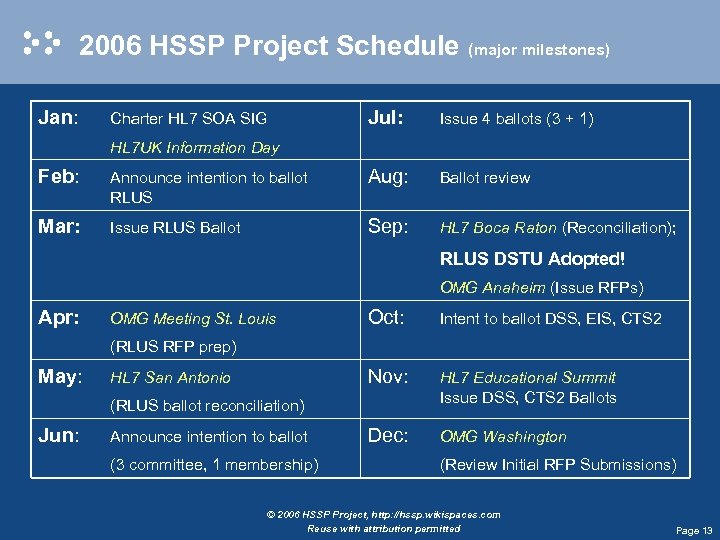 2006 HSSP Project Schedule (major milestones) Jan: Charter HL 7 SOA SIG Jul: Issue 4 ballots (3 + 1) HL 7 UK Information Day Feb: Announce intention to ballot RLUS Aug: Ballot review Mar: Issue RLUS Ballot Sep: HL 7 Boca Raton (Reconciliation); RLUS DSTU Adopted! OMG Anaheim (Issue RFPs) Apr: Oct: Intent to ballot DSS, EIS, CTS 2 Nov: OMG Meeting St. Louis HL 7 Educational Summit Issue DSS, CTS 2 Ballots Dec: OMG Washington (RLUS RFP prep) May: HL 7 San Antonio (RLUS ballot reconciliation) Jun: Announce intention to ballot (3 committee, 1 membership) (Review Initial RFP Submissions) © 2006 HSSP Project, http: //hssp. wikispaces. com Reuse with attribution permitted Page 13
 How the priorities were determined… • Based on an open selection process • Brainstorming gave way to successive refinement and downselect • Priorities determined by business need and resources • Initial list included Terminology, Entity ID, Record Location, Record Retrieval • Record Location and Retrieval activities subsequently merged • Decision Support added later based upon community interest and resources © 2006 HSSP Project, http: //hssp. wikispaces. com Reuse with attribution permitted Page 14
 The Bottom Line… © 2006 HSSP Project, http: //hssp. wikispaces. com Reuse with attribution permitted Page 15
 Why HSSP? • Relentless focus on added business value for healthcare and project participants – focused on and driven by business-need – not an “academic exercise” striving for perfection – “Standards must be used to be useful” – Emphasis on practical, achievable, & marketplace-relevant • Without these standards, we’re building “service stovepipes” • Aggressive timelines encourage progress • Assembled community of top industry talent • Project structure promotes targeted participation © 2006 HSSP Project, http: //hssp. wikispaces. com Reuse with attribution permitted Page 16
 HSSP Is Not Just Any Standards Activity • Active participation from three continents and 15+ organizations • Significant cross-cutting community involvement • Providers (Kaiser, VHA, Intermountain Health, Mayo) • Vendors (CSW Group, IBM, Patient. Keeper, Universata) • Value-added Providers (Medic. Alert, Ocean Informatics, Eclipse Foundation, etc. ) • Payers (Blue Cross/Blue Shield, Kaiser) • Integrators (IBM, EDS) • Governments (Veterans Health Administration, Canada Health Infoway, Health. Connect (Australia), Ser. API (Finland)) • Managing differences between SDOs in terms of membership, intellectual property, and cost models © 2006 HSSP Project, http: //hssp. wikispaces. com Reuse with attribution permitted Page 17
 HSSP In the “Community” • HSSP is actively seeking to collaborate with other groups • HSSP specs have a section citing existing work and its relevance • Working project relationships with: – HL 7 Clinical Decision Support Technical Committee – HL 7 Vocabulary Committee – Object Management Group Service-oriented Architecture SIG – Eclipse Open Healthcare Framework Initiative • Emerging relationships with: – Integrating the Healthcare Enterprise (IHE) – Medical Banking Initiative © 2006 HSSP Project, http: //hssp. wikispaces. com Reuse with attribution permitted Page 18
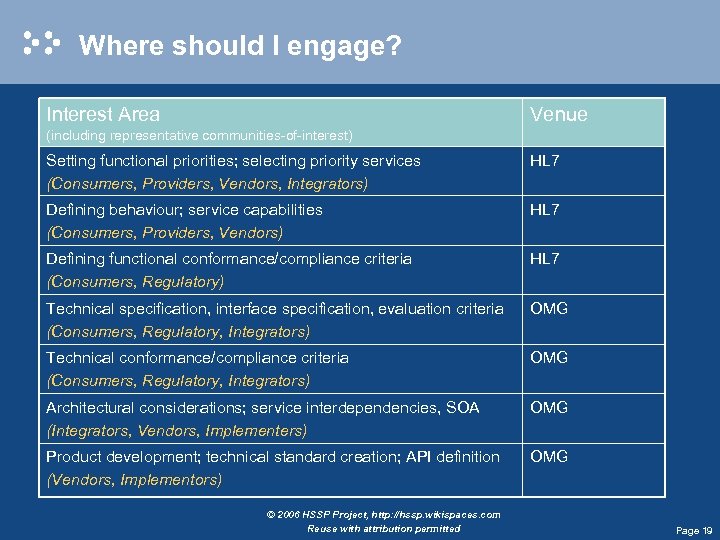 Where should I engage? Interest Area Venue (including representative communities-of-interest) Setting functional priorities; selecting priority services (Consumers, Providers, Vendors, Integrators) HL 7 Defining behaviour; service capabilities (Consumers, Providers, Vendors) HL 7 Defining functional conformance/compliance criteria (Consumers, Regulatory) HL 7 Technical specification, interface specification, evaluation criteria (Consumers, Regulatory, Integrators) OMG Technical conformance/compliance criteria (Consumers, Regulatory, Integrators) OMG Architectural considerations; service interdependencies, SOA (Integrators, Vendors, Implementers) OMG Product development; technical standard creation; API definition (Vendors, Implementors) OMG © 2006 HSSP Project, http: //hssp. wikispaces. com Reuse with attribution permitted Page 19
 The HSSP “Deep Dive” © 2006 HSSP Project, http: //hssp. wikispaces. com Reuse with attribution permitted Page 20
 The Service Development Framework (SDF) Methodology © 2006 HSSP Project, http: //hssp. wikispaces. com Reuse with attribution permitted Page 21
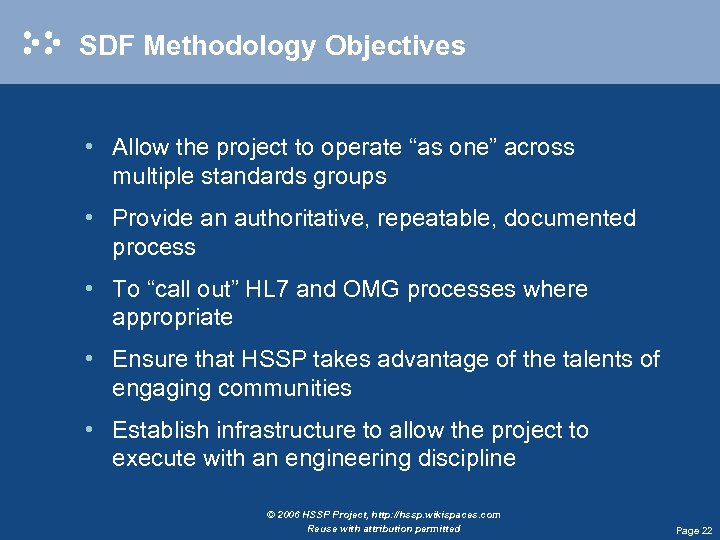 SDF Methodology Objectives • Allow the project to operate “as one” across multiple standards groups • Provide an authoritative, repeatable, documented process • To “call out” HL 7 and OMG processes where appropriate • Ensure that HSSP takes advantage of the talents of engaging communities • Establish infrastructure to allow the project to execute with an engineering discipline © 2006 HSSP Project, http: //hssp. wikispaces. com Reuse with attribution permitted Page 22
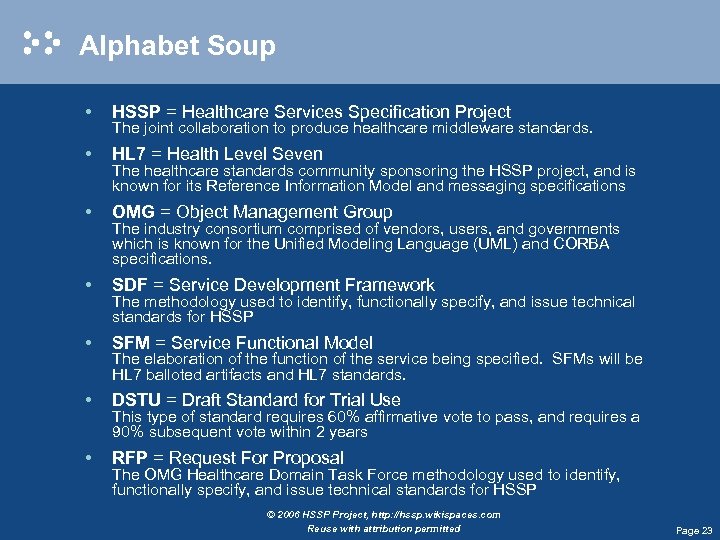 Alphabet Soup • HSSP = Healthcare Services Specification Project • HL 7 = Health Level Seven • OMG = Object Management Group • SDF = Service Development Framework • SFM = Service Functional Model • DSTU = Draft Standard for Trial Use • RFP = Request For Proposal The joint collaboration to produce healthcare middleware standards. The healthcare standards community sponsoring the HSSP project, and is known for its Reference Information Model and messaging specifications The industry consortium comprised of vendors, users, and governments which is known for the Unified Modeling Language (UML) and CORBA specifications. The methodology used to identify, functionally specify, and issue technical standards for HSSP The elaboration of the function of the service being specified. SFMs will be HL 7 balloted artifacts and HL 7 standards. This type of standard requires 60% affirmative vote to pass, and requires a 90% subsequent vote within 2 years The OMG Healthcare Domain Task Force methodology used to identify, functionally specify, and issue technical standards for HSSP © 2006 HSSP Project, http: //hssp. wikispaces. com Reuse with attribution permitted Page 23
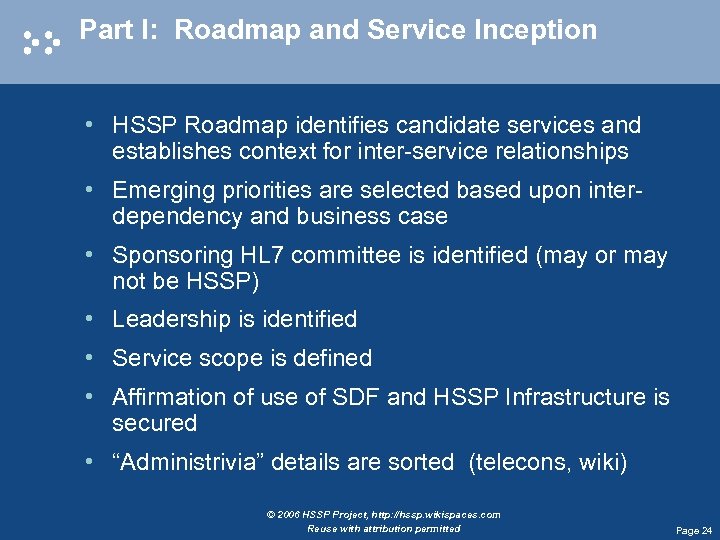 Part I: Roadmap and Service Inception • HSSP Roadmap identifies candidate services and establishes context for inter-service relationships • Emerging priorities are selected based upon interdependency and business case • Sponsoring HL 7 committee is identified (may or may not be HSSP) • Leadership is identified • Service scope is defined • Affirmation of use of SDF and HSSP Infrastructure is secured • “Administrivia” details are sorted (telecons, wiki) © 2006 HSSP Project, http: //hssp. wikispaces. com Reuse with attribution permitted Page 24
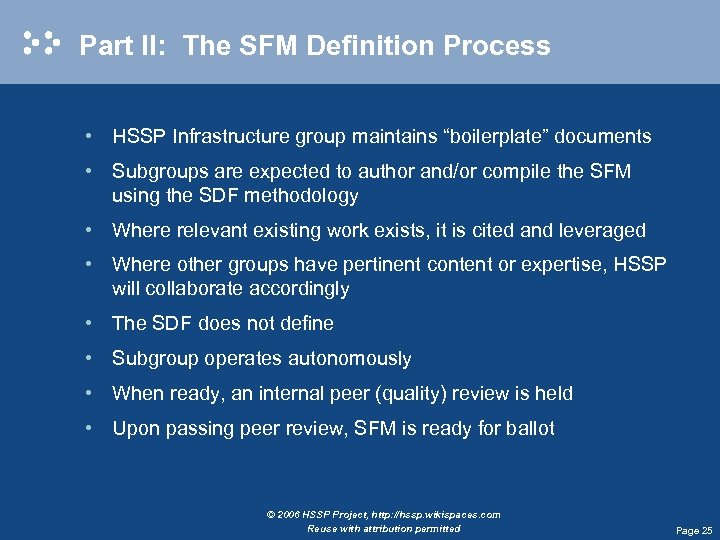 Part II: The SFM Definition Process • HSSP Infrastructure group maintains “boilerplate” documents • Subgroups are expected to author and/or compile the SFM using the SDF methodology • Where relevant existing work exists, it is cited and leveraged • Where other groups have pertinent content or expertise, HSSP will collaborate accordingly • The SDF does not define • Subgroup operates autonomously • When ready, an internal peer (quality) review is held • Upon passing peer review, SFM is ready for ballot © 2006 HSSP Project, http: //hssp. wikispaces. com Reuse with attribution permitted Page 25
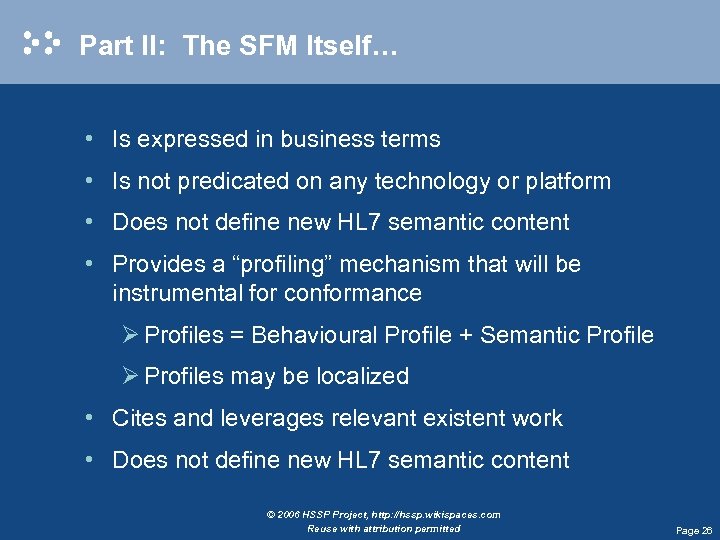 Part II: The SFM Itself… • Is expressed in business terms • Is not predicated on any technology or platform • Does not define new HL 7 semantic content • Provides a “profiling” mechanism that will be instrumental for conformance Ø Profiles = Behavioural Profile + Semantic Profile Ø Profiles may be localized • Cites and leverages relevant existent work • Does not define new HL 7 semantic content © 2006 HSSP Project, http: //hssp. wikispaces. com Reuse with attribution permitted Page 26
 SFM Highlights • Core SFM components: • Business case and business scenarios • Specification of service functionality • Specification of service payloads as necessary • Conformance profiles • Aspects not requiring specification by HL 7 intentionally left for OMG to specify © 2006 HSSP Project, http: //hssp. wikispaces. com Reuse with attribution permitted Page 27
 Part III: Ballot • Service Functional Models will undergo two ballots: – “Committee” Ballot – DSTU Ballot • DSTU requires 60% affirmative to pass • Ballot process is open to all members or materially affected parties • All ballot comments are reviewed and dispensed • Successful ballot triggers the next phase of SDF © 2006 HSSP Project, http: //hssp. wikispaces. com Reuse with attribution permitted Page 28
 Part IV: Technical Specifications and RFPs • Coordinated by Healthcare Domain Task Force (DTF) • HL 7 SFM used as basis for Request for Proposal (RFP) – Request for specification of a platform-independent model (PIM) and at least one platform-specific model (PSM) (e. g. SOAP/XML) conforming to SFM requirements • Letters of intent to specify and implement within 12 mo. initial specifications single revised specification based on merged efforts • Approval by Healthcare DTF Architectural Board Technology Committee Board of Directors • Specification not adopted unless at least one implementation available commercially © 2006 HSSP Project, http: //hssp. wikispaces. com Reuse with attribution permitted Page 29
 The Role of the HDTF • The role of the HDTF is to select RFPs, scope RFPs, and evaluate submissions • Technical Specifications are not a work product of the OMG. They are a product of the submitters to RFPs • “Ideal” RFPs contain exactly the specificity needed to be interoperable, and nothing more. Superfluous information constrains submitters ability to innovate. • RFP submitters must commit to developing software based upon their proposed standard within 18 months (no shelfware!) • The project team may influence four categories: – mandatory requirements, – optional requirements, – evaluation criteria, – issues to discuss © 2006 HSSP Project, http: //hssp. wikispaces. com Reuse with attribution permitted Page 30
 Part V: OMG Technology Adoption Process • Any interested vendor with OMG membership may submit • No submissions pass on initial submission • Vendors choose to partner to form joint submissions 95% of the time • All OMG standards are reviewed by OMG Architecture Board • The speed of the adoption is driven by marketplace pressure, not the process • The standards committee may either accept or reject submissions – nothing more • The approach assures business relevance and promotes rapid timelines and quality • The OMG Standard is published when software is available © 2006 HSSP Project, http: //hssp. wikispaces. com Reuse with attribution permitted Page 31
 Part VI: Functional Model Finalisation • DSTU is ideally suited to this process – Allows two years for “practical experience” – OMG Technology adoptions are typically 18 months • Throughout the process we will collect ‘lessons learned’ • Outcomes of the technology adoption will be incorporated and balloted into the SFM © 2006 HSSP Project, http: //hssp. wikispaces. com Reuse with attribution permitted Page 32
 Part VII: Continuous Process Improvement • The HSSP Subgroup is charged with maintaining the SDF Methodology and Boilerplate – Ongoing feedback from subgroups encouraged – All artifacts are versioned – Corrections are ongoing. Subgroups “opt-in” to newer releases at their discretion • Subgroups encountering significant problems receive highest priority attention © 2006 HSSP Project, http: //hssp. wikispaces. com Reuse with attribution permitted Page 33
 Current Status • SDF was baselined in January 2006 • Intentionally sparse, with plans for incremental refinement based upon experience • Currently being used by all HSSP subgroups • Under evaluation by OMG SOA SIG • Approach has been reviewed by liaison representatives from the HL 7 Board and OMG Architecture Board © 2006 HSSP Project, http: //hssp. wikispaces. com Reuse with attribution permitted Page 34
 Service Dynamics © 2006 HSSP Project, http: //hssp. wikispaces. com Reuse with attribution permitted Page 35
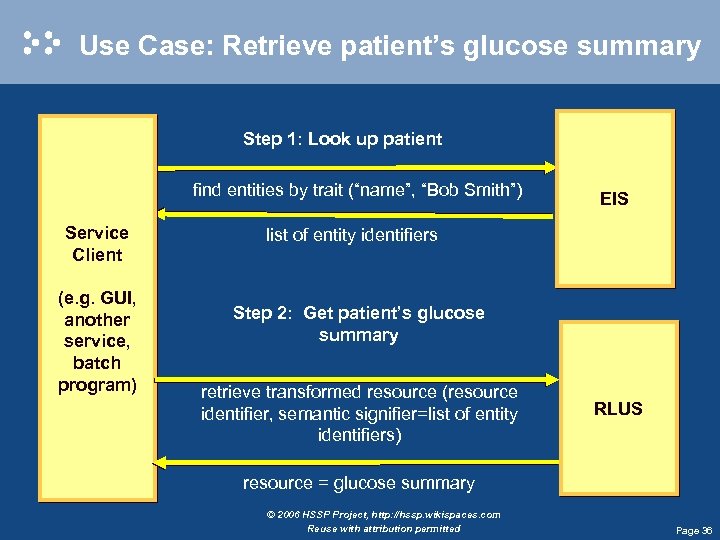 Use Case: Retrieve patient’s glucose summary Step 1: Look up patient find entities by trait (“name”, “Bob Smith”) Service Client (e. g. GUI, another service, batch program) EIS list of entity identifiers Step 2: Get patient’s glucose summary retrieve transformed resource (resource identifier, semantic signifier=list of entity identifiers) RLUS resource = glucose summary © 2006 HSSP Project, http: //hssp. wikispaces. com Reuse with attribution permitted Page 36
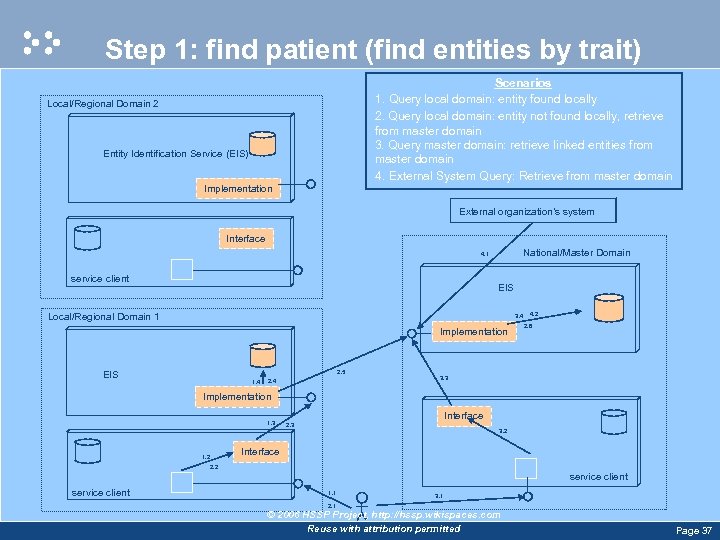 Step 1: find patient (find entities by trait) Scenarios 1. Query local domain: entity found locally 2. Query local domain: entity not found locally, retrieve from master domain 3. Query master domain: retrieve linked entities from master domain 4. External System Query: Retrieve from master domain Local/Regional Domain 2 Entity Identification Service (EIS) Implementation External organization’s system Interface National/Master Domain 4. 1 service client EIS Local/Regional Domain 1 3. 4 Implementation 2. 5 EIS 1. 4 2. 4 4. 2 2. 6 3. 3 Implementation 1. 3 Interface 2. 3 3. 2 Interface 1. 2 2. 2 service client 1. 1 3. 1 2. 1 © 2006 HSSP Project, http: //hssp. wikispaces. com Reuse with attribution permitted Page 37
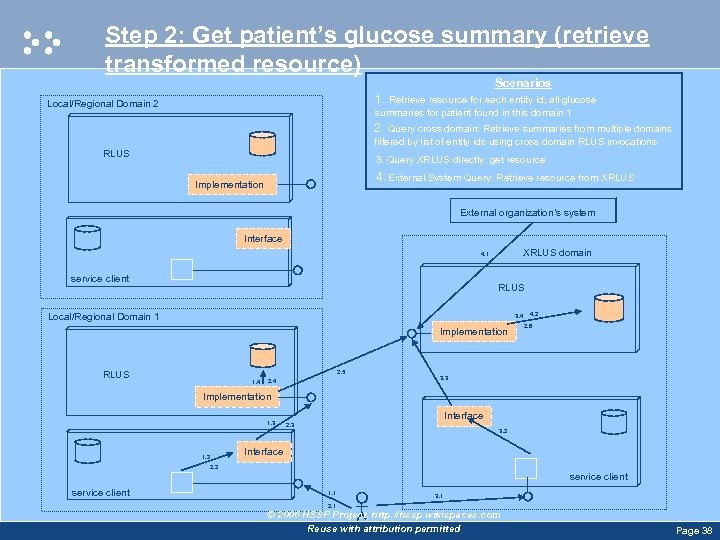 Step 2: Get patient’s glucose summary (retrieve transformed resource) Scenarios 1. Retrieve resource for each entity id; all glucose Local/Regional Domain 2 summaries for patient found in this domain 1 2. Query cross domain: Retrieve summaries from multiple domains filtered by list of entity ids using cross domain RLUS invocations RLUS 3. Query XRLUS directly: get resource 4. External System Query: Retrieve resource from XRLUS Implementation External organization’s system Interface XRLUS domain 4. 1 service client RLUS Local/Regional Domain 1 3. 4 Implementation 2. 5 RLUS 1. 4 2. 4 4. 2 2. 6 3. 3 Implementation 1. 3 Interface 2. 3 3. 2 Interface 1. 2 2. 2 service client 1. 1 3. 1 2. 1 © 2006 HSSP Project, http: //hssp. wikispaces. com Reuse with attribution permitted Page 38
 Entity Identification Service (EIS) © 2006 HSSP Project, http: //hssp. wikispaces. com Reuse with attribution permitted Page 39
 Context • The Entity Identification Service (EIS) SFM provides a set of functional behaviors which enable unique identification of entities (such as patients) within disparate systems, both within a single enterprise and also across a set of collaborating enterprises. • Classes of entities include the variety of entities in the HL 7 RIM, e. g. , providers, equipment, payers, even animal subjects in clinical studies. • Conceptually, the EIS is a superclass of Master Person Index • Building on the OMG Person Identification Service (PIDS) spec and the IHE PIX/PDQ profiles © 2006 HSSP Project, http: //hssp. wikispaces. com Reuse with attribution permitted Page 40
 Business Purpose • In order to be able to provide a lifetime health record and continuity of care across multiple evolving organizations and venues, a robust standard mechanism to identify an individual as being the same person with differing ids at multiple organizations is needed. • But as important is a common mechanism to be able to manage the identifiers of a patient and determine with high confidence that a person is who they are reported to be across multiple enterprises simultaneously. • To identify all clinical information relevant to a specific patient requires a service which cross-references between local patient IDs, and maps between demographic information and identifiers. © 2006 HSSP Project, http: //hssp. wikispaces. com Reuse with attribution permitted Page 41
 Functional Dimensions • Interfaces – Administration • Technical support (start, stop etc. ) – Service Metadata Management • Managing the metadata that an individual instance of EIS supports. (e. g. , specifying traits relevant to a Person) – Entity Management • Manipulation of Entity Identifiers and traits (e. g. , create, activate, inactivate, merge, link, update) – Query • Operations for retrieving entity identifiers and traits. © 2006 HSSP Project, http: //hssp. wikispaces. com Reuse with attribution permitted Page 42
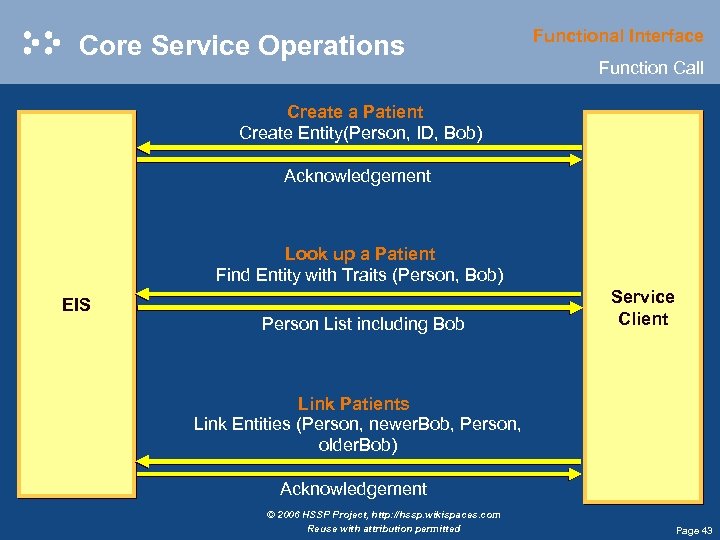 Core Service Operations Functional Interface Function Call Create a Patient Create Entity(Person, ID, Bob) Acknowledgement Look up a Patient Find Entity with Traits (Person, Bob) EIS Person List including Bob Service Client Link Patients Link Entities (Person, newer. Bob, Person, older. Bob) Acknowledgement © 2006 HSSP Project, http: //hssp. wikispaces. com Reuse with attribution permitted Page 43
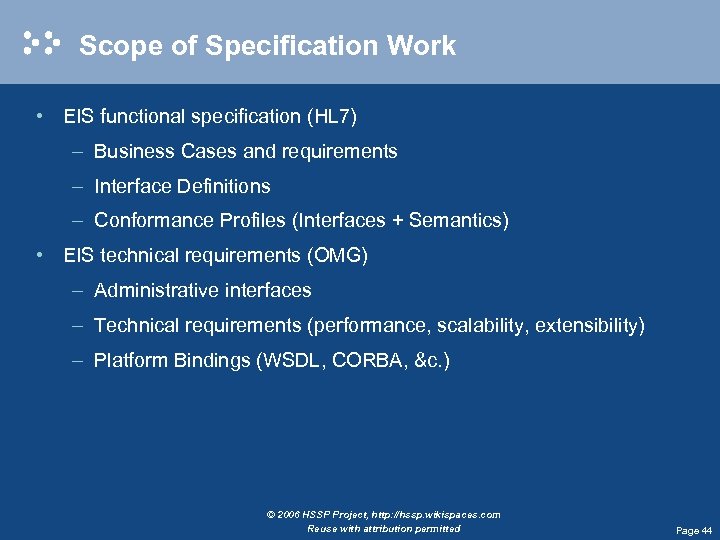 Scope of Specification Work • EIS functional specification (HL 7) – Business Cases and requirements – Interface Definitions – Conformance Profiles (Interfaces + Semantics) • EIS technical requirements (OMG) – Administrative interfaces – Technical requirements (performance, scalability, extensibility) – Platform Bindings (WSDL, CORBA, &c. ) © 2006 HSSP Project, http: //hssp. wikispaces. com Reuse with attribution permitted Page 44
 Retrieve, Locate, Update Service (RLUS) © 2006 HSSP Project, http: //hssp. wikispaces. com Reuse with attribution permitted Page 45
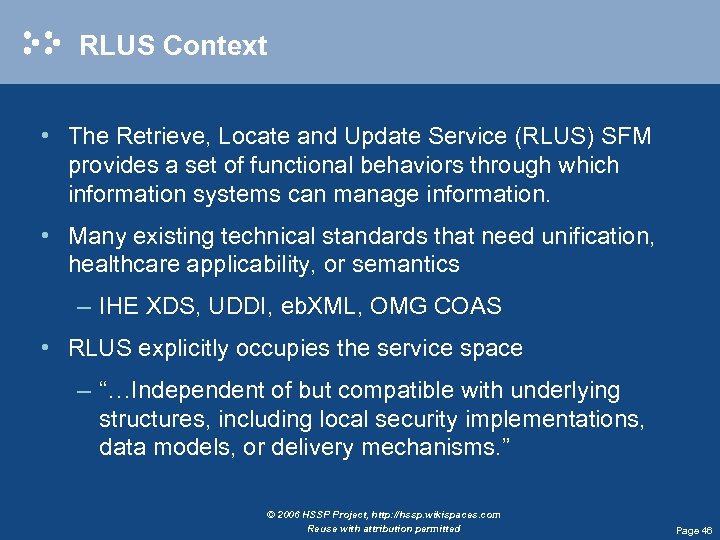 RLUS Context • The Retrieve, Locate and Update Service (RLUS) SFM provides a set of functional behaviors through which information systems can manage information. • Many existing technical standards that need unification, healthcare applicability, or semantics – IHE XDS, UDDI, eb. XML, OMG COAS • RLUS explicitly occupies the service space – “…Independent of but compatible with underlying structures, including local security implementations, data models, or delivery mechanisms. ” © 2006 HSSP Project, http: //hssp. wikispaces. com Reuse with attribution permitted Page 46
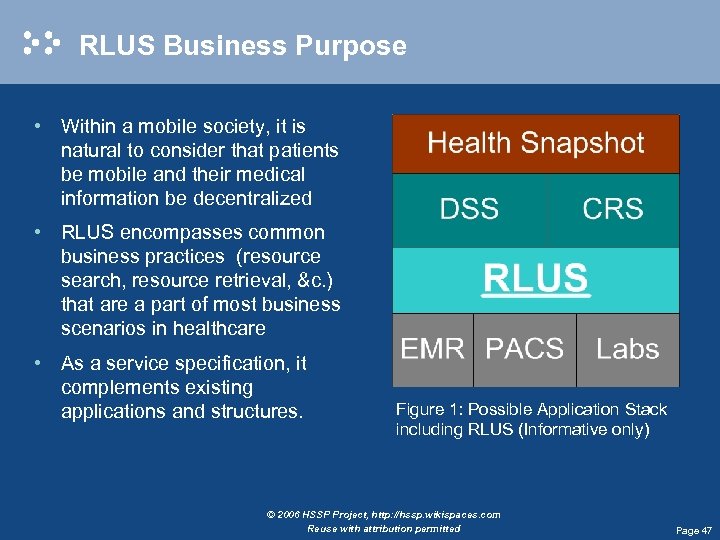 RLUS Business Purpose • Within a mobile society, it is natural to consider that patients be mobile and their medical information be decentralized • RLUS encompasses common business practices (resource search, resource retrieval, &c. ) that are a part of most business scenarios in healthcare • As a service specification, it complements existing applications and structures. Figure 1: Possible Application Stack including RLUS (Informative only) © 2006 HSSP Project, http: //hssp. wikispaces. com Reuse with attribution permitted Page 47
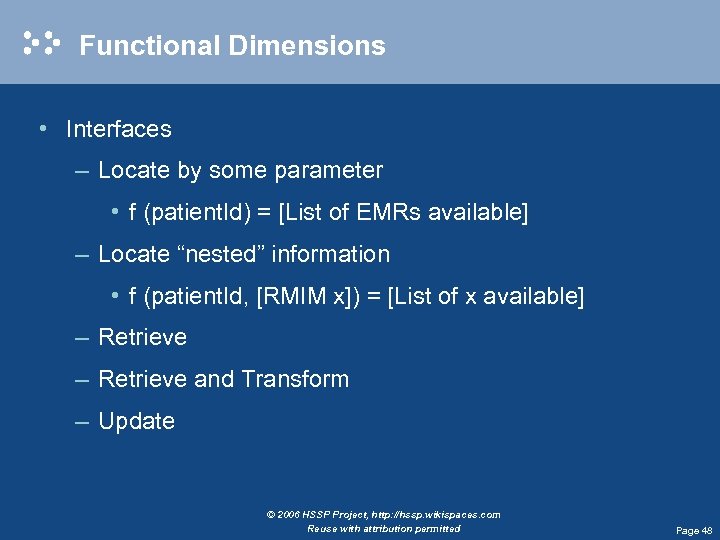 Functional Dimensions • Interfaces – Locate by some parameter • f (patient. Id) = [List of EMRs available] – Locate “nested” information • f (patient. Id, [RMIM x]) = [List of x available] – Retrieve and Transform – Update © 2006 HSSP Project, http: //hssp. wikispaces. com Reuse with attribution permitted Page 48
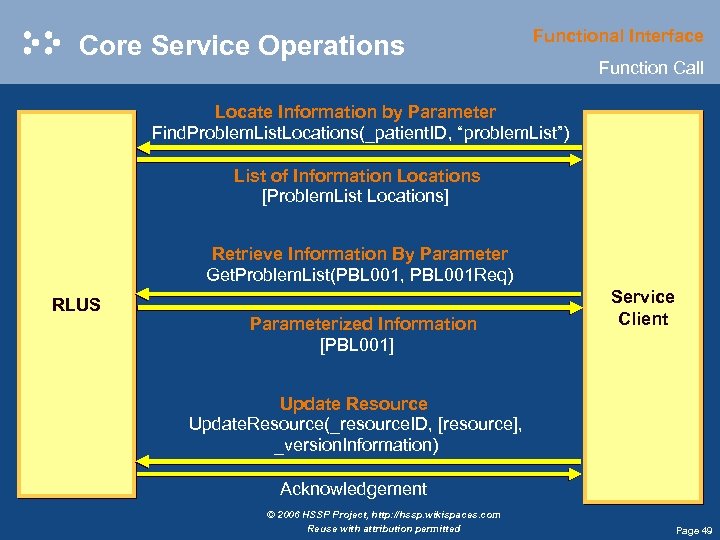 Core Service Operations Functional Interface Function Call Locate Information by Parameter Find. Problem. List. Locations(_patient. ID, “problem. List”) List of Information Locations [Problem. List Locations] Retrieve Information By Parameter Get. Problem. List(PBL 001, PBL 001 Req) RLUS Parameterized Information [PBL 001] Service Client Update Resource Update. Resource(_resource. ID, [resource], _version. Information) Acknowledgement © 2006 HSSP Project, http: //hssp. wikispaces. com Reuse with attribution permitted Page 49
 Decision Support Service (DSS) © 2006 HSSP Project, http: //hssp. wikispaces. com Reuse with attribution permitted Page 50
 DSS History • Based on Web service approach to clinical decision support developed at Duke University 1 • Project initiated within HL 7 Clinical Decision Support (CDS) Technical Committee (TC) in Sept. 2005 • Joint project between HL 7 CDS TC and Healthcare Services Specification Project (HSSP) 1 Kawamoto K and Lobach DF. Design, implementation, use, and preliminary evaluation of SEBASTIAN, a standardsbased Web service for clinical decision support. Proc AMIA Symp. 2005: 380 -384. © 2006 HSSP Project, http: //hssp. wikispaces. com Reuse with attribution permitted Page 51
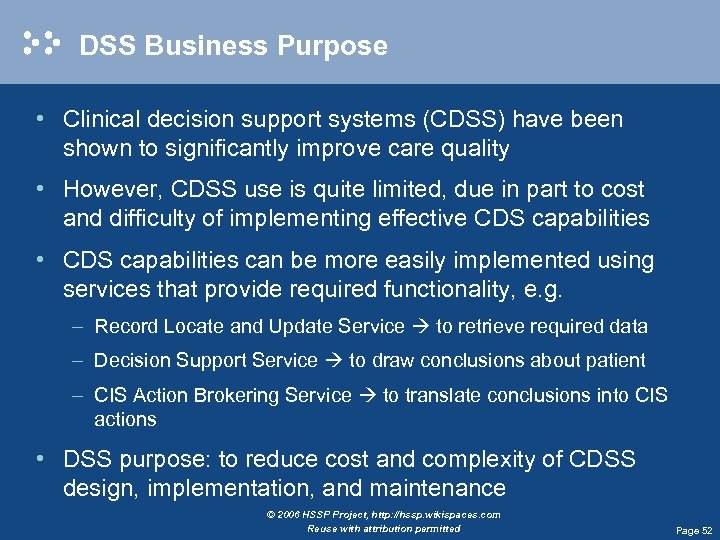 DSS Business Purpose • Clinical decision support systems (CDSS) have been shown to significantly improve care quality • However, CDSS use is quite limited, due in part to cost and difficulty of implementing effective CDS capabilities • CDS capabilities can be more easily implemented using services that provide required functionality, e. g. – Record Locate and Update Service to retrieve required data – Decision Support Service to draw conclusions about patient – CIS Action Brokering Service to translate conclusions into CIS actions • DSS purpose: to reduce cost and complexity of CDSS design, implementation, and maintenance © 2006 HSSP Project, http: //hssp. wikispaces. com Reuse with attribution permitted Page 52
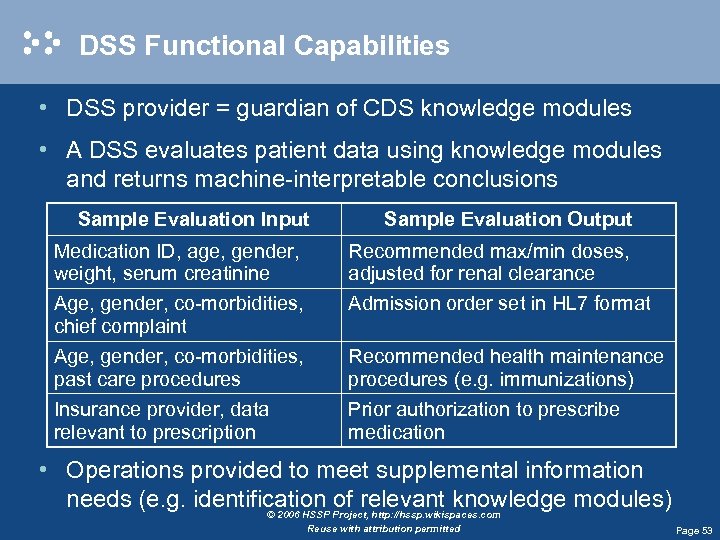 DSS Functional Capabilities • DSS provider = guardian of CDS knowledge modules • A DSS evaluates patient data using knowledge modules and returns machine-interpretable conclusions Sample Evaluation Input Sample Evaluation Output Medication ID, age, gender, weight, serum creatinine Recommended max/min doses, adjusted for renal clearance Age, gender, co-morbidities, chief complaint Age, gender, co-morbidities, past care procedures Admission order set in HL 7 format Insurance provider, data relevant to prescription Prior authorization to prescribe medication Recommended health maintenance procedures (e. g. immunizations) • Operations provided to meet supplemental information needs (e. g. identification Project, http: //hssp. wikispaces. com of relevant knowledge modules) © 2006 HSSP Reuse with attribution permitted Page 53
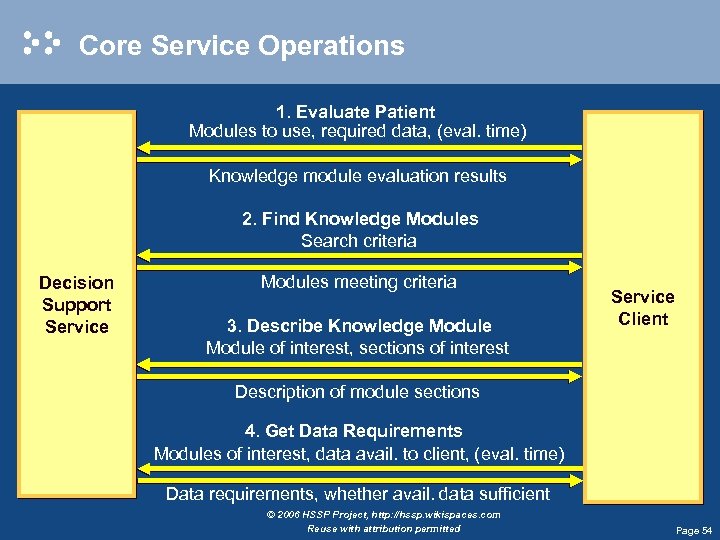 Core Service Operations 1. Evaluate Patient Modules to use, required data, (eval. time) Knowledge module evaluation results 2. Find Knowledge Modules Search criteria Decision Support Service Modules meeting criteria 3. Describe Knowledge Module of interest, sections of interest Service Client Description of module sections 4. Get Data Requirements Modules of interest, data avail. to client, (eval. time) Data requirements, whether avail. data sufficient © 2006 HSSP Project, http: //hssp. wikispaces. com Reuse with attribution permitted Page 54
 SOA 4 HL 7 © 2006 HSSP Project, http: //hssp. wikispaces. com Reuse with attribution permitted Page 55
 Problem Statement / The Challenge • Many organizations (including KP) are adopting SOA as their fundamental architecture for integration. • Most healthcare organizations use HL 7 V 2 messaging and will migrate to V 3 over time • Two conceptual viewpoints (both valid) – SOA based: Implementing a general SOA framework (common infrastructure, tools and approaches). “HL 7 is just another content type” – HL 7 Messaging based: Implementing an HL 7 based messaging architecture that can use different messaging and transports, including web services. – The first tends to lead to the conclusion that HL 7 should just define content. The second tends to lead to HL 7 defining the whole stack How do the worlds of SOA and HL 7 V 3 messaging intersect? How can we maximize the benefits of both approaches? How do we avoid internal developers and software vendors creating “stovepipe” services, functionally and technically ? • • • © 2006 HSSP Project, http: //hssp. wikispaces. com Reuse with attribution permitted Page 56
 Services and SOA • Some further comments/clarifications on Services and SOA – Services are NOT just “synchronous request-reply” SOA covers asynchronous and synchronous equally. Both have their place. – SOA is NOT just web services or even just technology Aspects of process, methodology and behavior are more important than technology. However, the unprecedented cooperation and alignment of many IT organizations has provided a uniquely widespread technology underpinning. – SOA is NOT just a “fad” Like messaging, SOA is part of the natural progression or evolution of the IT industry. The specific technologies used today will continue to evolve. It is really the culmination of many best practices that have evolved over the years. Personal view – combined with EDA, BPM and further “Semantic” based concepts, I don’t believe that concepts will actually evolve that much further. © 2006 HSSP Project, http: //hssp. wikispaces. com Reuse with attribution permitted Page 57
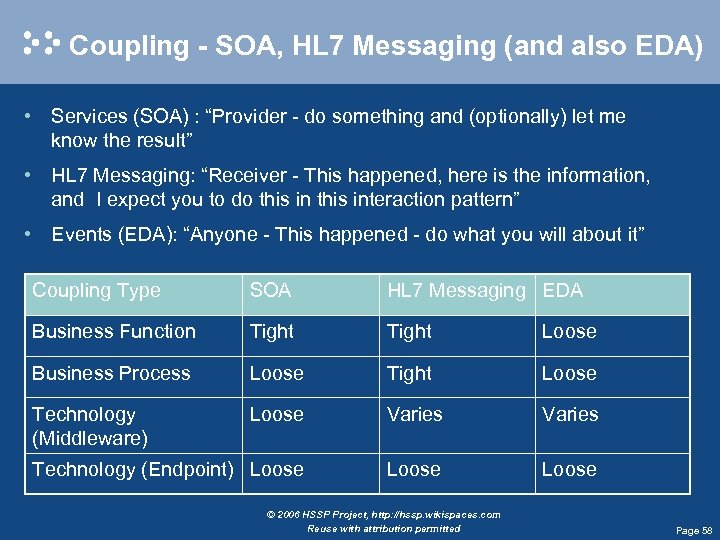 Coupling - SOA, HL 7 Messaging (and also EDA) • Services (SOA) : “Provider - do something and (optionally) let me know the result” • HL 7 Messaging: “Receiver - This happened, here is the information, and I expect you to do this interaction pattern” • Events (EDA): “Anyone - This happened - do what you will about it” Coupling Type SOA HL 7 Messaging EDA Business Function Tight Loose Business Process Loose Tight Loose Technology (Middleware) Loose Varies Technology (Endpoint) Loose © 2006 HSSP Project, http: //hssp. wikispaces. com Reuse with attribution permitted Page 58
 SOA and HL 7 Messaging • • • HL 7 WS Profile – Is good work, and enables HL 7 messages to be transported using SOAP – Does not provide a real SOA solution, it is messaging using some of the web service protocols. • The methodology is focused on message development • HL 7 Transmission wrappers overlap with generic SOA capabilities (security, reliable delivery, message identification, correlation etc. are not HL 7 specific concerns) SOA is a paradigm shift. – For example, use of dynamic process orchestration, service composition and policy based intermediary actions. SOA and Messaging both have their place, Not an either/or The choice of SOA and Messaging is basically orthogonal to semantic data issues (although granularity of payloads may vary) Many vendors are doing SOA anyway, so are providers and payers Applications may be “HL 7 Applications” or not, i. e. care about the full HL 7 stack or not, or may just be compatible or even transformable to the RIM © 2006 HSSP Project, http: //hssp. wikispaces. com Reuse with attribution permitted Page 59
 SOA 4 HL 7 Charter • Mission – Support the HL 7 mission to promote and create standards by defining a SOA approach for HL 7. The aim is to provide a means to define and implement services in a consistent, interoperable fashion. • Work Products / Deliverables – – Architecture Requirements - to ensure SOA benefits can be realized and interoperability maximized SOA Framework - leverage existing IT standards to enable services to be consistently identified, described and used in healthcare environments. This should also provide a consistent technical context for HSSP OMG RFP submissions. If possible, include both a “generic” SOA approach and a specific approach for web services. Methodology - extensions to the HSSP SDF methodology for creating service definitions and implementations. This should offer a consistent way to define and implement “interim” Services for HL 7 V 3 (and other healthcare as appropriate) content. NOT a replacement for HSSP Services V 3 Infrastructure Mapping - Define a mapping of current V 3 artifacts to the SOA framework. • Relationships with Other Groups – All work will be presented to, ©and HSSP Project, http: //hssp. wikispaces. com discussed with the Infrastructure and Messaging 2006 (INM) TC. As necessary, relationships with attribution permitted specific HL 7 domain Reuse may be formed with Page 60
 Progress to date • The following progress has been made to date – Initial discussions within INM and HSSP (through 2005). – Agreed with INM co-chairs that SOA SIG would produce proposals and also discuss at this meeting – Invited participation from interested parties – Several teleconferences have taken place – Project materials added to HSSP Wiki (http: //hssp. wikispaces. com/ – Defined and agreed project charter and principles – Started main deliverables - requirements , methodology and architecture – Reviewed approach in OMG HDTF / HSSP meeting at OMG St Louis © 2006 HSSP Project, http: //hssp. wikispaces. com Reuse with attribution permitted Page 61
 Plan • Current outline plan, subject to discussion in INM Out of Cycle meeting – Complete current planned deliverables – requirements, methodology, architecture (aim for end July) – Review within SOA SIG (Aug) – Bring to INM to get agreement on basic approach and discuss the way to bake into HL 7 V 3 standard (separate ITS or other mechanism? ) (Sep WG) – May ballot as “Informative” document (timing TBD) – Where appropriate, review with other HL 7 groups and IHE representatives – Then produce appropriate standards material for HL 7 ballot © 2006 HSSP Project, http: //hssp. wikispaces. com Reuse with attribution permitted Page 62
 References • HSSP Wiki • http: //hssp. wikispaces. com • HL 7 Website: • http: //www. hl 7. org • OMG Website: • http: //www. omg. org © 2006 HSSP Project, http: //hssp. wikispaces. com Reuse with attribution permitted Page 63
 Special Thanks • To all of the HSSP project team members that contributed valuable time and effort, but particularly – Ani Dutta, Veterans Health Administration – Barbara Eckman, IBM – Alan Honey, Kaiser-Permanente – Ken Kawamoto, M. D. , Duke University – John Koisch, OCTL Consulting – Josh Oh, EDS, Veterans Health Administration © 2006 HSSP Project, http: //hssp. wikispaces. com Reuse with attribution permitted Page 64
 Thank you! Ken Rubin, EDS +1 703 845 3277 desk +1 301 335 0534 mobile ken. rubin@eds. com © 2006 HSSP Project, http: //hssp. wikispaces. com Reuse with attribution permitted Page 65