


 Скачать презентацию Healthcare experiences of adults deaf since childhood Implications
10d1d4bfa53c65e99a8396634a14b0ee.ppt
- Количество слайдов: 38
 Healthcare experiences of adults deaf since childhood: Implications for people who work with deaf children Steven Barnett MD University of Rochester
 Take Home Messages • Childhood healthcare experiences influence adult perspectives • Adults report limited access to health information • Adults report limited access to healthcare communication • Disparities exist in research and health
 Acknowledgements • • AHRQ CDC/ATPM CDC PRC Bayer Institute for Health Care Communication • colleagues and collaborative partners
 Outline • Describe the population(s) • Research on healthcare and health • Implications
 Why health & healthcare? • Evidence of health disparities • Frequently overlooked group • “Rubella bulge”
 Research is limited • Prelingually deafened adults • Prevocationally deafened adults • Research conducted in ASL
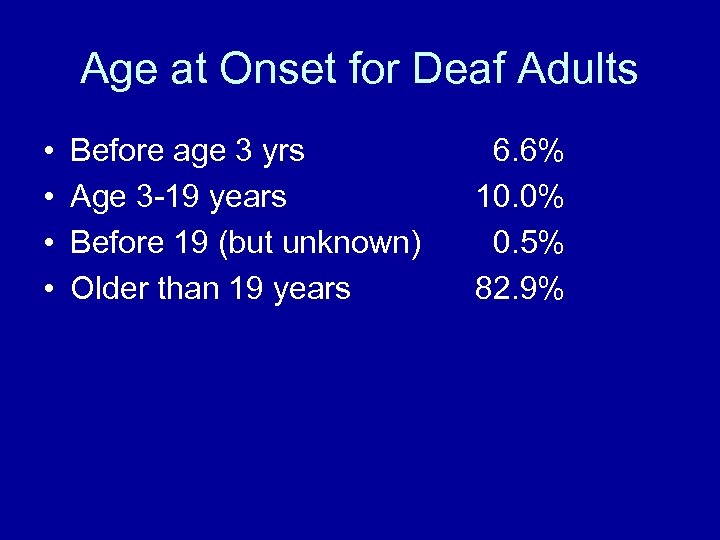 Age at Onset for Deaf Adults • • Before age 3 yrs Age 3 -19 years Before 19 (but unknown) Older than 19 years 6. 6% 10. 0% 0. 5% 82. 9%
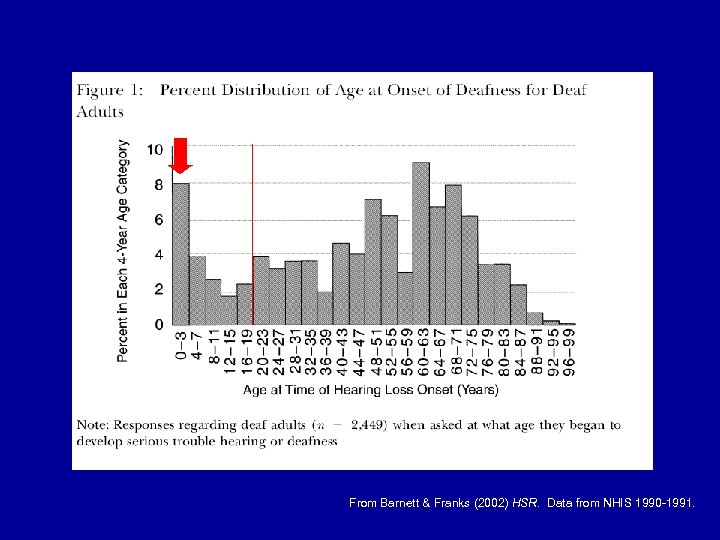 From Barnett & Franks (2002) HSR. Data from NHIS 1990 -1991.
 Research in ASL • US Census does not measure ASL use • Different definitions for “deaf” • Signed communication is not all ASL
 Adult ASL users • Most ASL users became deaf as children • Many adults deaf since childhood use ASL
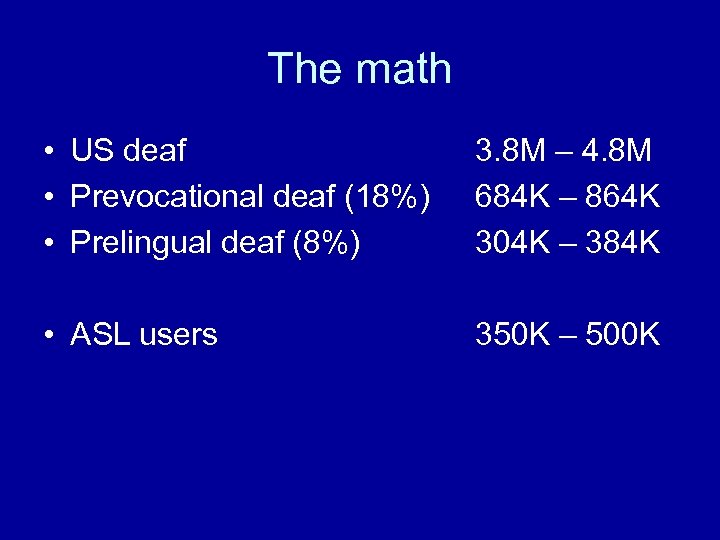 The math • US deaf • Prevocational deaf (18%) • Prelingual deaf (8%) 3. 8 M – 4. 8 M 684 K – 864 K 304 K – 384 K • ASL users 350 K – 500 K
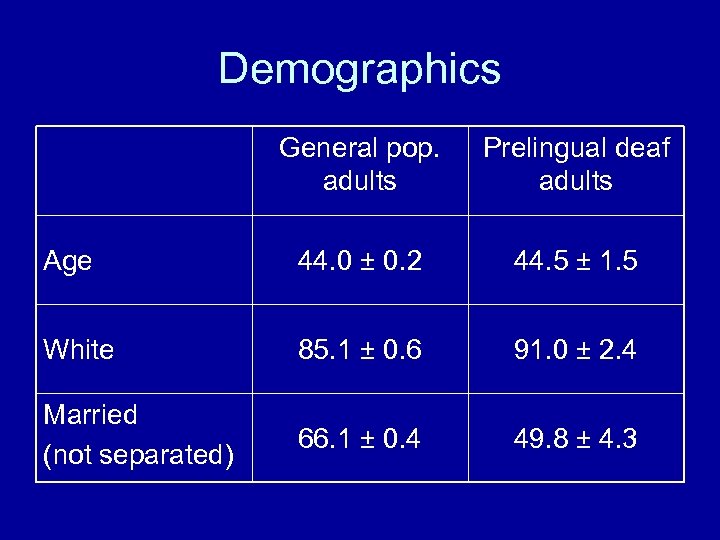 Demographics General pop. adults Prelingual deaf adults Age 44. 0 ± 0. 2 44. 5 ± 1. 5 White 85. 1 ± 0. 6 91. 0 ± 2. 4 Married (not separated) 66. 1 ± 0. 4 49. 8 ± 4. 3
 Demographics • Less education • Lower income • Downwardly mobile?
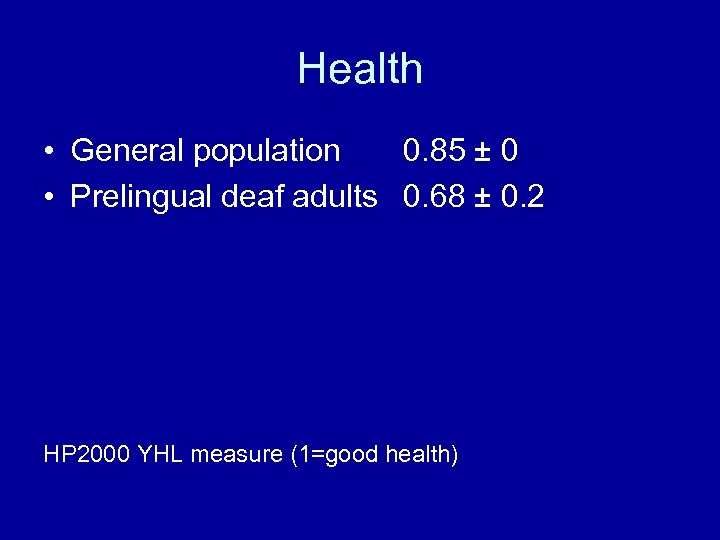 Health • General population 0. 85 ± 0 • Prelingual deaf adults 0. 68 ± 0. 2 HP 2000 YHL measure (1=good health)
 Healthcare services • Less likely to have seen a physician • Fewer physician visits • Similar to other groups with difficulties with healthcare communication
 Healthcare services Accessible facilities record more visits with deaf adults and their families • • NTID/RIT URMC Folsom Family Medicine Baltimore
 Health Insurance
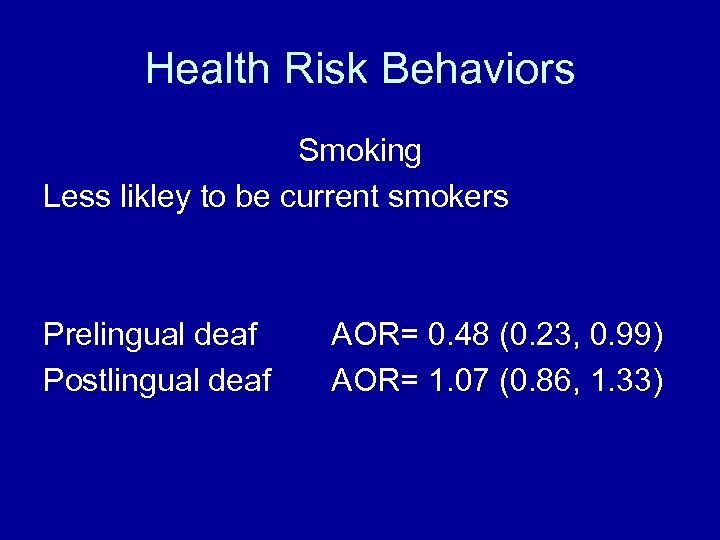 Health Risk Behaviors Smoking Less likley to be current smokers Prelingual deaf Postlingual deaf AOR= 0. 48 (0. 23, 0. 99) AOR= 1. 07 (0. 86, 1. 33)
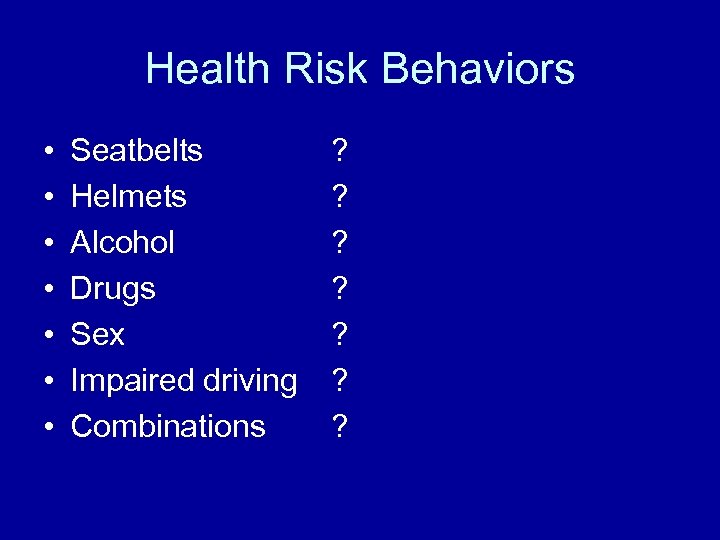 Health Risk Behaviors • • Seatbelts Helmets Alcohol Drugs Sex Impaired driving Combinations ? ? ? ?
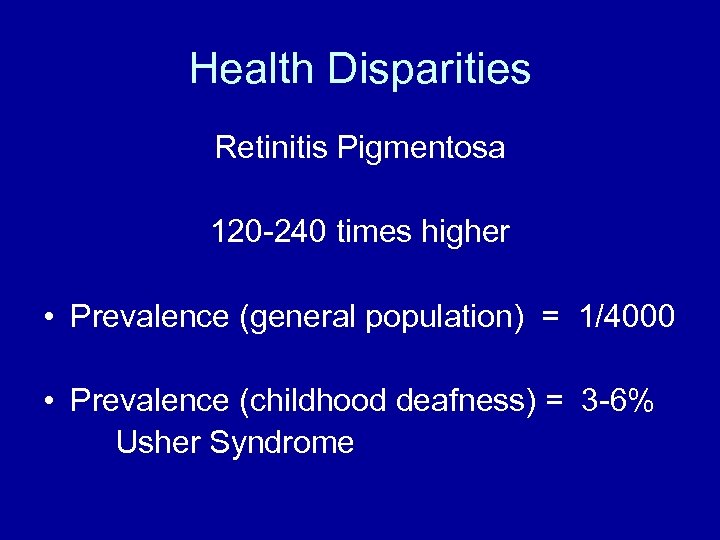 Health Disparities Retinitis Pigmentosa 120 -240 times higher • Prevalence (general population) = 1/4000 • Prevalence (childhood deafness) = 3 -6% Usher Syndrome
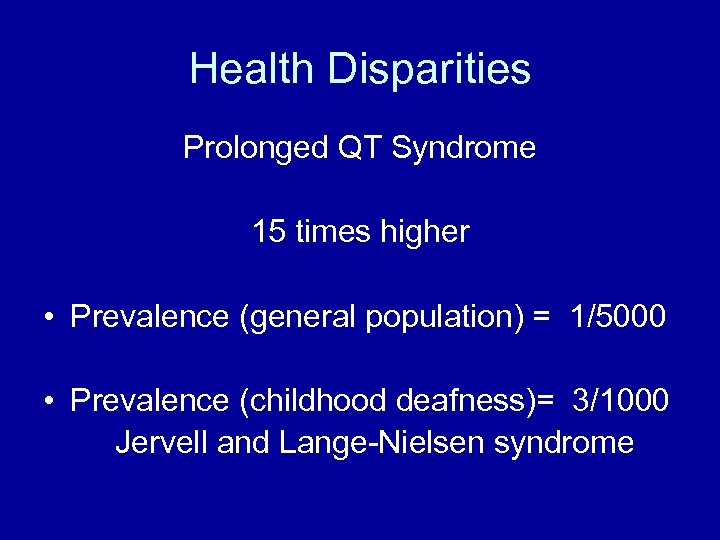 Health Disparities Prolonged QT Syndrome 15 times higher • Prevalence (general population) = 1/5000 • Prevalence (childhood deafness)= 3/1000 Jervell and Lange-Nielsen syndrome
 Health Disparities Diabetes • Prevalence (general population) = ~7% • Prevalence (childhood deafness) = ? Congenital rubella syndrome Mitochondrial inheritance Lifestyle issues
 Healthcare Communication Frustration • • Face masks Automated telephone systems Limited email and internet access Writing Interpreter services Direct communication Low satisfaction
 Healthcare Communication Self advocacy • Patients/families: often reluctant to request interpreter services • Physicians: patients often do not request interpreter services Learned behavior
 Healthcare relationships Trust • Communication • Life experience issue • Implications for self advocacy
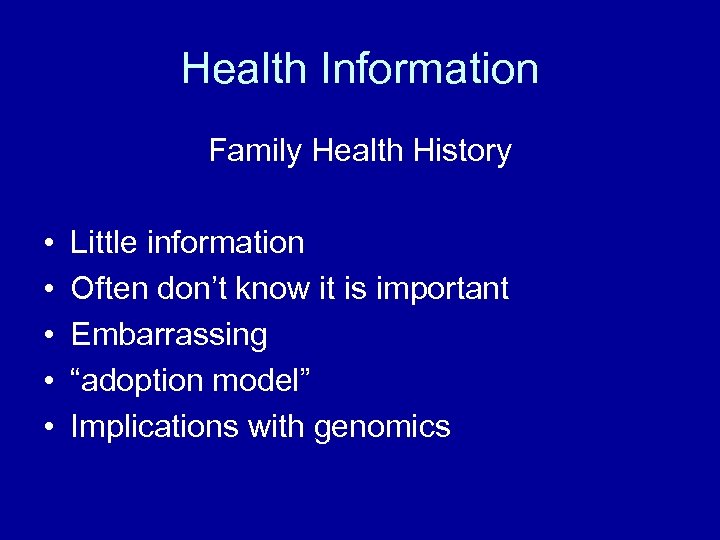 Health Information Family Health History • • • Little information Often don’t know it is important Embarrassing “adoption model” Implications with genomics
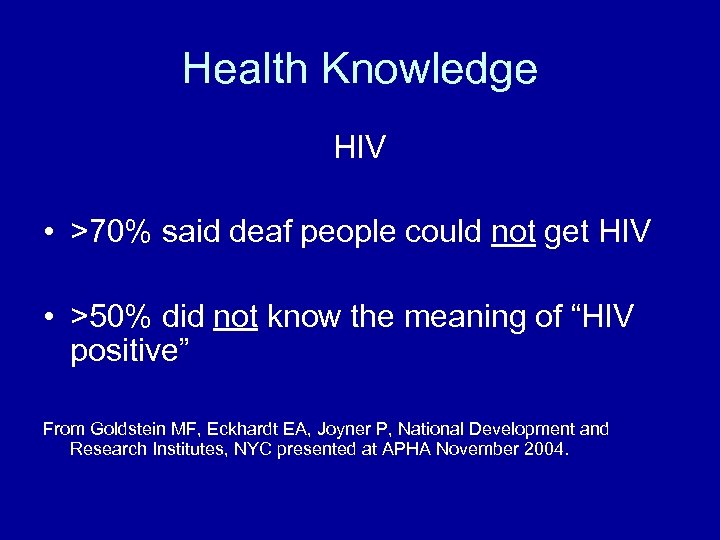 Health Knowledge HIV • >70% said deaf people could not get HIV • >50% did not know the meaning of “HIV positive” From Goldstein MF, Eckhardt EA, Joyner P, National Development and Research Institutes, NYC presented at APHA November 2004.
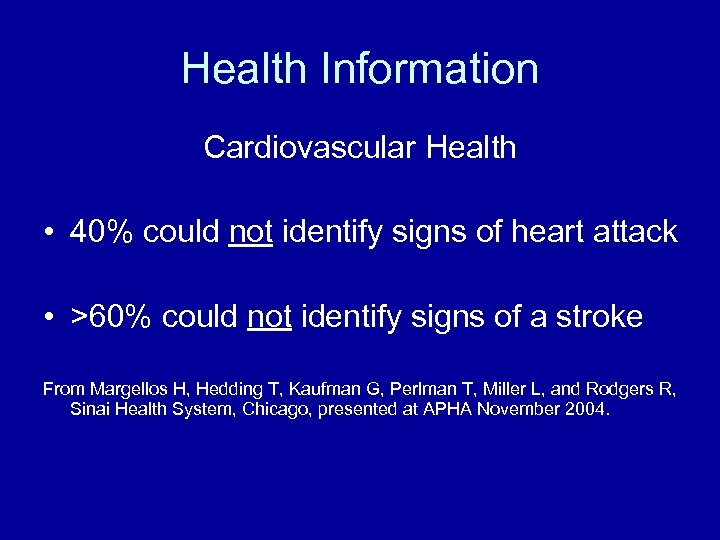 Health Information Cardiovascular Health • 40% could not identify signs of heart attack • >60% could not identify signs of a stroke From Margellos H, Hedding T, Kaufman G, Perlman T, Miller L, and Rodgers R, Sinai Health System, Chicago, presented at APHA November 2004.
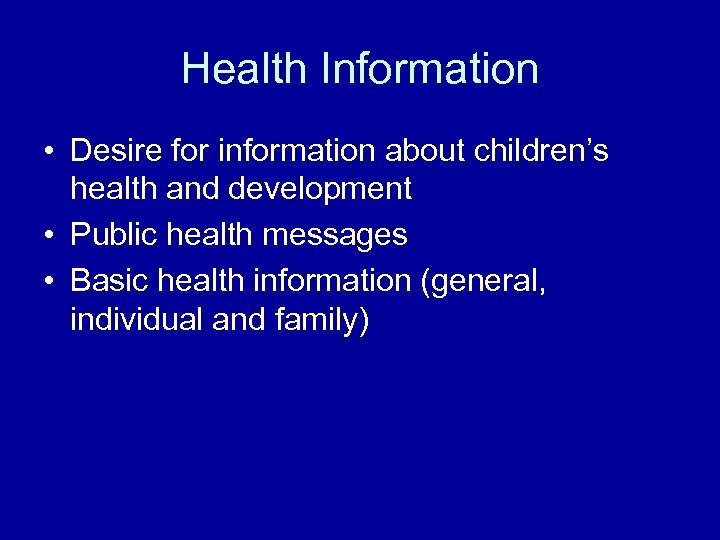 Health Information • Desire for information about children’s health and development • Public health messages • Basic health information (general, individual and family)
 Health Literacy • Associated with health outcomes • No tools for use with adults deaf since childhood
 Health Literacy • Rapid Estimate of Adult Literacy in Medicine • Modified REALM • 61 deaf adults, 48 had a college degree • 57 completed m-REALM • 38 scored in the HS grade level (highest)
 Promising Future • • Physicians with childhood onset deafness Agency for Healthcare Research & Quality CDC National Center for Deaf Health Research
 What to do Healthcare • Facilitate access to healthcare communication • Foster a positive relationship between a deaf child and his/her clinicians
 What to do Health Knowledge • Facilitate access to health information • Teach children family health history • Directed teaching
 What to do Foster Self Advocacy • Nurture self advocacy skills (self/families) • Access to adult deaf role models
 What to do Advocate • Encourage the realization of Healthy People 2010 goals on disparities in research and health for people with disabilities
 Take Home Messages • Childhood healthcare experiences influence adult perspectives • Adults report limited access to health information • Adults report limited access to healthcare communication • Disparities exist in research and health
 Steven Barnett, MD Assistant Professor, Department of Family Medicine Co-Associate Director, National Center for Deaf Health Research University of Rochester Family Medicine Research Programs 1381 South Avenue Rochester, NY 14620 tel: (585) 506 -9484 ext 110 tty: (585) 461 -4902 fax: (585) 473 -2245 Steven_Barnett@URMC. Rochester. edu Presented at the Early Hearing Detection and Intervention Conference, Atlanta (March 3, 2005).