 Скачать презентацию Health Well Being and Working Poverty Helen Masterman-Smith
375e69429351066e8810ec1f7b2bd27d.ppt
- Количество слайдов: 12



Health, Well Being and Working Poverty Helen Masterman-Smith and Jude Elton Centre for Work and Life University of South Australia Hawke Research Institute for Sustainable Societies
www. lowpayproject. com. au Ø Low Paid Services Employment in Australia: Dimensions, Causes, Effects and Responses Ø Funding: Australian Research Council, Liquor Hospitality Miscellaneous Workers Union, Brotherhood of St Laurence, SA Unions, Unions NSW, Victorian Trades and Labour Council Ø Research team: Barbara Pocock (Uni of SA), John Buchanan (Sydney Uni), Ian Watson (Sydney Uni), Iain Campbell (RMIT Uni), Susan Oakley (Adelaide Uni)
Changing workplace environments ‘Work’ as a fundamental social determinant of health – availability and quality… Ø Implications of Work. Choices for low paid? Ø AIRC President Giudice: ‘people with low skills, low bargaining power are headed for the five minimum conditions. . which will have an effect on their incomes. . This will be accompanied by a slowdown in the rate of growth of minimum wages - that’s what the Fair Pay Commission is for’ Ø ‘I can assure you it s going to affect our society’ Ø
The study Low paid workers: $14/hr - $530/wk - $26800/year Ø National research Ø l l l SA – childcare workers Vic - cleaners NSW - luxury accommodation workers Focus: workers, households, communities Ø Recruitment: LHMU, BSL, advertising Ø Larger project Ø l l 100 -200 participants (interviews/focus groups) HILDA analysis
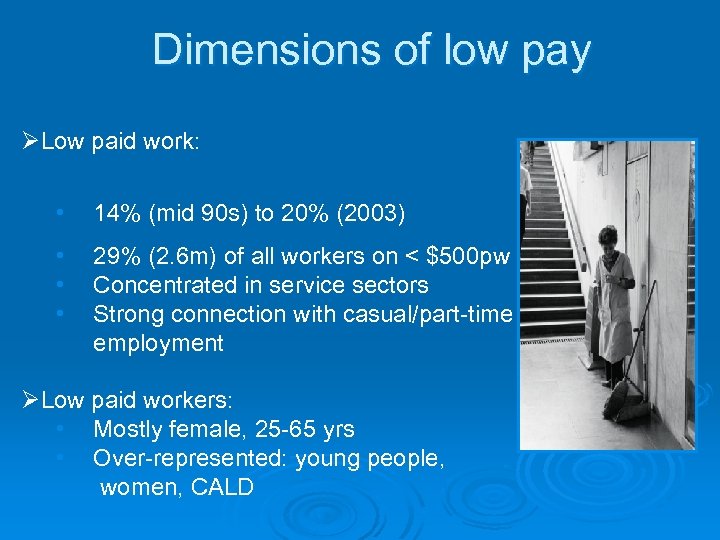
Dimensions of low pay ØLow paid work: • 14% (mid 90 s) to 20% (2003) • • • 29% (2. 6 m) of all workers on < $500 pw Concentrated in service sectors Strong connection with casual/part-time employment ØLow paid workers: • Mostly female, 25 -65 yrs • Over-represented: young people, women, CALD
Health on a low wage Ø Ø Not all low paid in poverty Working poor = time and income poverty l l Fewer benefits (health, travel), more costs (travel, training, equipment) Deep sense of struggle and deprivation • I only have incoming calls. . . my daughter’s rent pays the groceries. No luxuries. . I will live in a rented home for the rest of my life (Fay, 43, cleaner, Melbourne) l Tough on household relationships and social networks • I’ve been really stressed out… July was my shocking one. Kids couldn’t even look at me ‘cause I had so many bills … I had rego … I had everything… I have to find a full time job. I can’t cope any more. Well because the rent’s going up all the time too (Cathy, 40 s, lone parent of 2 children, cleaner, Adelaide) Ø Health treatment and prevention are a luxury
Individuals Ø Physical well being l l Workplace hazards – chemicals, sick children Endless work • Long hours/overwork/on-call • No retirement l I’m going to work til I can work. … I want to keep working and pay off my debts (John, 65, cleaner, Melbourne). • No rest or recreation Ø Emotional/mental well being l Depression, anxiety • Pressure for money. . I have no money, upset, start trouble. . I feel squashed, can’t relax (Paul, 47, cleaner, Melbourne) l Humiliation, shame, ‘a different world’ • ‘these people that have got a bit of money to flash… and I can’t even afford to buy myself a bloody meal … I got told by Centrelink the other day that I’m living beyond my means and I laughed… I don’t need her to tell me that. . . you feel like an absolute dickhead and a failure’ (Ebony, 29, mother of 3, childcare worker, Adelaide)
Households/Families Low paid workers often do long hours = families/households miss out on both time and $$s Ø Relationship pressures Ø l Ø Care commitments (Susan’s mum) l Ø … they always expect grandma to be able to feed them and have cakes and lollies and take them to places and that's where I get really upset that I can't (Diana, 50 s, cleaner, Adelaide) It’s not a very flexible job … I’ve got an elderly mother who needs to go to the doctors nearly every other Wednesday but I can’t do that anymore (Susan, 50 s, private nanny, Adelaide) Children go without • • • l Health care, dental, medicine School excursions, educational participation Sports participation Home heating Meals, good meals Clothing Transport for events Holidays Basic leisure Parental time Ebony buys … ‘home brand or the bargain of the week…it’s not …the leanest chicken or the leanest meat to actually promote good health. And also being running around heaps …often I have to get [the kids] lunch order …so sometimes it becomes a bit of an unorganised household which also becomes a bit more expensive which also creates not eating healthy and … not taking time out for yourself’ (Ebony, 20 s, mother of 3, child care worker)
Community Ø Many examples of withdrawal from social relationships, organisations, activities l Social world shrinks • . . I don’t go out and visit because its another 20 minute drive and I can’t afford that (Molly, childcare worker, Adelaide) • Catching up with friends, its rare now (Jenni, 20 s, childcare worker, Adelaide) Ø Community/social support networks stretched l Mutual aid/support networks struggling with diminishing resources • A lady was moving out over the road or they got thrown out or something and I had her and her kids come over and she asked me could she stay here for awhile and she was here two or three weeks, I've had that quite a few times (Diana, 50 s, single grandmother supporting grandchild, cleaner, Adelaide) l Capacity building undermined • I'm not doing it now because of this job but I was … involved [voluntarily in] taking kids to court and … sitting with them while they've got access to a parent. . . (Diana, 50 s, single grandmother supporting grandchild, cleaner, Adelaide) l Sick workers – public safety, burden on health care system • I’m probably likely to actually come into work feeling under the weather because you know you’ve got no sick leave or no TOIL [time of in lieu] or anything like that (Donna, 30 s, childcare worker, Adelaide)
Prevention Ø Financial constraints l Delaying treatment • I don’t go to the dentist. . I’m scared to go in case he finds something I can’t afford (Paula, 55, mother of 2, two cleaning jobs, Melbourne) l Cutting back on healthy/sufficient food and exercise • [After work] I haven’t recharged from the day yet and I don’t actually have the energy to do exercise and even eat right sometimes because you’re not really earning that much so you’re buying cheaper food I suppose and budgeting more (Kylie, 30 s, childcare worker, Sydney) l Ø Sports participation Time constraints - little control over work or non-work time • Because it’s a poor pay rate, you feel you need to work as much as you possibly can so you never want to make appointments, even on your day off, for medical, … breast screening … cervical cancer screening … pap smears, … And also if work rings up and wants you to work and you refuse… you’ll find you’re penalised when the next roster comes out … you’ve got less hours (Vicky, 50 s, childcare worker, Adelaide)
Help Seeking l Community services • ‘I’d probably be too proud’ (Charmaine, 40 s, cleaner, Adelaide) • ‘I found it hard to actually ring them up and to get to that point’ (Millie, 30 s, cleaner, Adelaide) l Welfare as a last resort: • ‘We never claim dole, anything … NEVER any one day claim unemployment’ (Mercedes, cleaner, immigrant, Melbourne) • ‘I don’t want to be known as one of those dole bludgers’ (Fay, 40 s, cleaner, Melbourne)
Stay tuned: 2008 Low pay book release In sum… Ø Ø Low pay = time and money poverty Good health and healthy household/community relationships are essential to surviving on a low wage Yet, low wages erode health, social connection and social fabric Work that is health promoting is l www. lowpayproject. com. au l l www. unisa. edu. au/hawkeinstitute/cwl/ l fairly paid = living wage family friendly conditions ensures workplace rights/citizenship meets ILO minimum standards
Скачать презентацию Health Well Being and Working Poverty Helen Masterman-Smith
375e69429351066e8810ec1f7b2bd27d.ppt