 Скачать презентацию Health System Performance Management quality for better or
584bb2a5d6f49a9ae63778bdfbab79c9.ppt
- Количество слайдов: 31



Health System Performance Management quality for better or for worse • Niek Klazinga, April 27 2010 • London LSE/NHS Confederation Dept Social Medicine
Reasons for international comparisons on performance related to quality of care • Accountability • Strategic decision making • Learning/improvement Dept Social Medicine
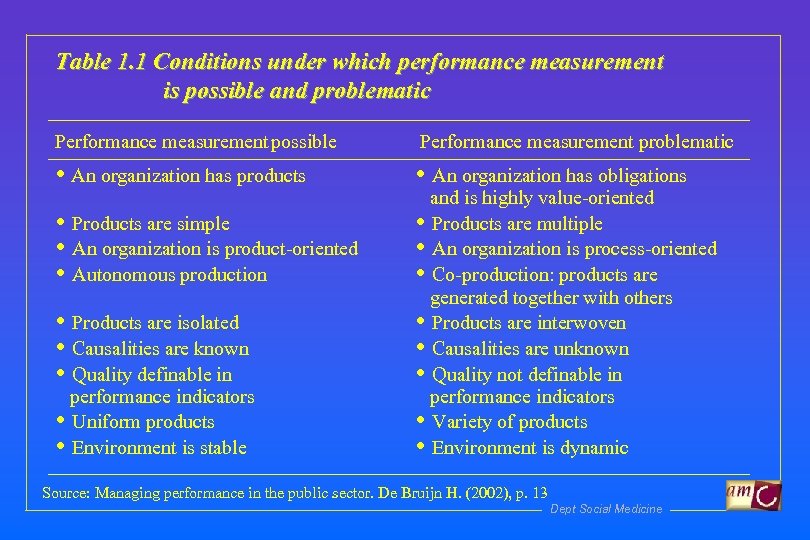
Table 1. 1 Conditions under which performance measurement is possible and problematic Performance measurement possible Performance measurement problematic An organization has products An organization has obligations Products are simple An organization is product-oriented Autonomous production Products are isolated Causalities are known Quality definable in performance indicators Uniform products Environment is stable and is highly value-oriented Products are multiple An organization is process-oriented Co-production: products are generated together with others Products are interwoven Causalities are unknown Quality not definable in performance indicators Variety of products Environment is dynamic Source: Managing performance in the public sector. De Bruijn H. (2002), p. 13 Dept Social Medicine
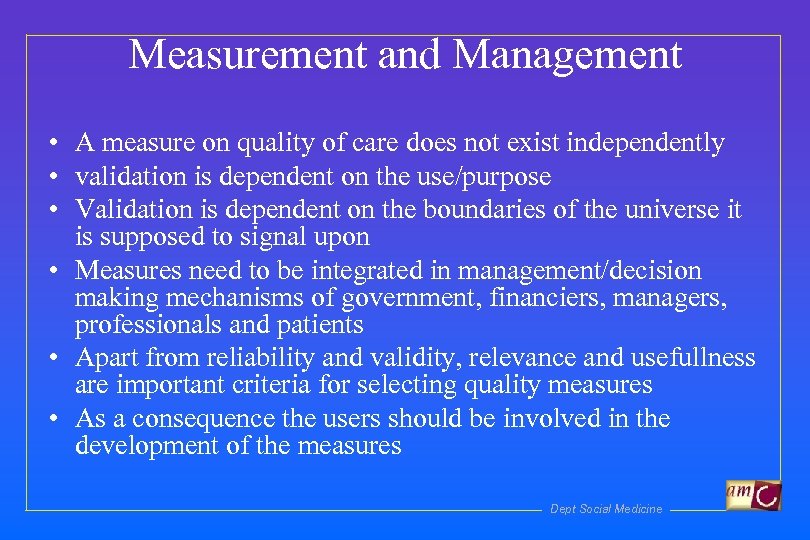
Measurement and Management • A measure on quality of care does not exist independently • validation is dependent on the use/purpose • Validation is dependent on the boundaries of the universe it is supposed to signal upon • Measures need to be integrated in management/decision making mechanisms of government, financiers, managers, professionals and patients • Apart from reliability and validity, relevance and usefullness are important criteria for selecting quality measures • As a consequence the users should be involved in the development of the measures Dept Social Medicine
Health systems performance management • Health Systems (scope , components and boundaries) • Performance (objectives on various dimensions such as health results, efficiency and equity – measurement challenges) • Management (heterogeneous national governance models, integration of performance indicators in management mechanisms) Dept Social Medicine

Related policies • • Health system sustainability Integrated care Prevention Patient Centered Care Equity Regulated market Incentive structures Dept Social Medicine
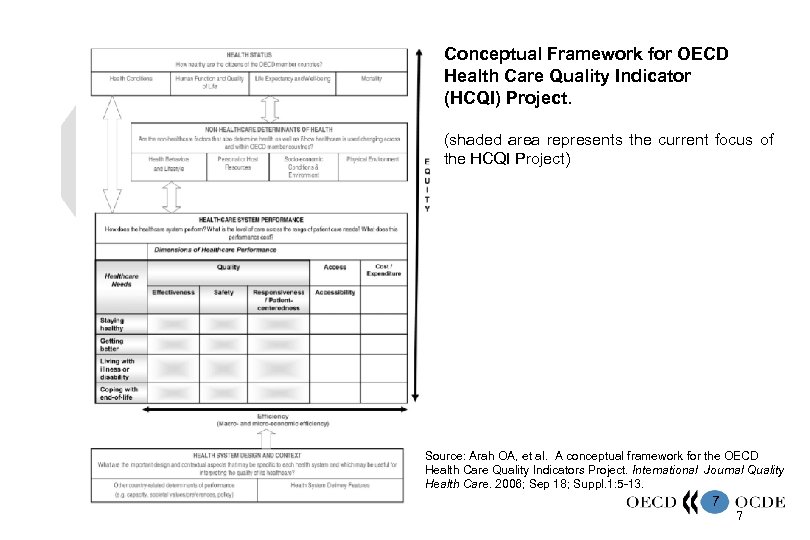
Conceptual Framework for OECD Health Care Quality Indicator (HCQI) Project. (shaded area represents the current focus of the HCQI Project) Source: Arah OA, et al. A conceptual framework for the OECD Health Care Quality Indicators Project. International Journal Quality Health Care. 2006; Sep 18; Suppl. 1: 5 -13. 7 7
Combining various rationalities • Public Health • Medicine • Management sciences • Economics • Societal / individual values Dept Social Medicine
Performance indicators and benchmarking related to mortality data - avoidable mortality (health system level) - standardized mortality rates (hospital level) - limitations of death statistics Dept Social Medicine
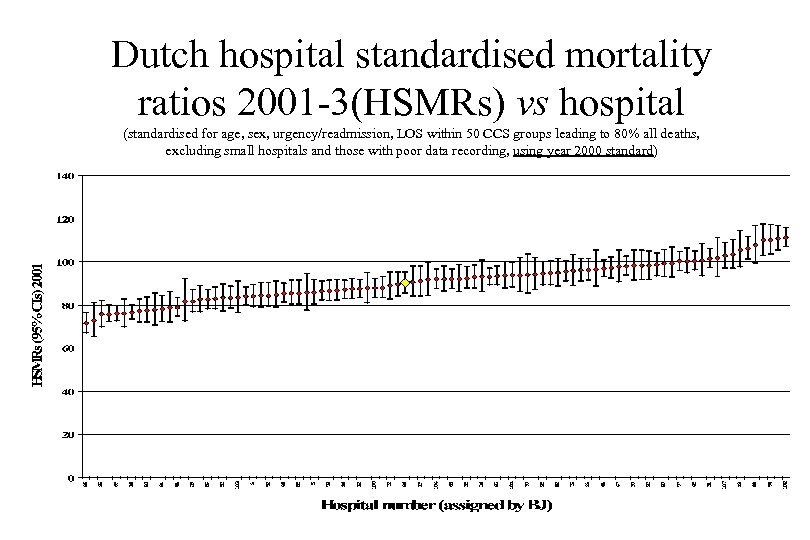
Dutch hospital standardised mortality ratios 2001 -3(HSMRs) vs hospital (standardised for age, sex, urgency/readmission, LOS within 50 CCS groups leading to 80% all deaths, excluding small hospitals and those with poor data recording, using year 2000 standard)
Performance indicators and benchmarking related to cancer care • CONCORD study • Eurocare • Limitations of cancer registries and limited possibilities for linking with other (administrative) data-bases Dept Social Medicine






Performance indicators and benchmarking on care delivered in hospitals PATH, OECD, many national projects ………… Limitations (administrative) data-bases - Quality of coding practices - Lack of (internationally) standardized procedure codes - Lack of coding of secondary diagnoses - Lack of present at admission coding - Lack of linking via UPI’s - Limitations Electronic Health Records Dept Social Medicine




Patient Safety Indicators • Indicators based on administrative databases • Adverse event reporting • Safety culture Dept Social Medicine
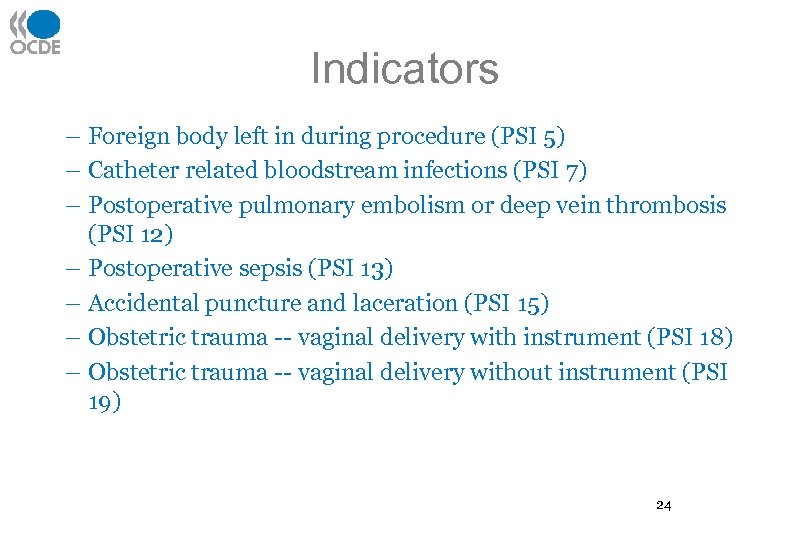
Indicators – Foreign body left in during procedure (PSI 5) – Catheter related bloodstream infections (PSI 7) – Postoperative pulmonary embolism or deep vein thrombosis (PSI 12) – Postoperative sepsis (PSI 13) – Accidental puncture and laceration (PSI 15) – Obstetric trauma -- vaginal delivery with instrument (PSI 18) – Obstetric trauma -- vaginal delivery without instrument (PSI 19) 24
Performance indicators in primary care • Avoidable hospital admissions • Lack of comprehensive administrative data-sets Dept Social Medicine
Avoidable hospital admission rates, 2007 Note: Data from Austria, Belgium, Italy, Poland, Switzerland the United States refer to 2006. Data from the Netherlands refer to 2005. 1. Data does not fully exclude day cases. 2. Data includes transfers from other hospitals and/or other units within the same hospitals, which marginally elevate the rates. 3. Data for CHF includes admissions for additional diagnosis codes, which marginally elevate the rate. Source: OECD Health Care Quality Indicators Database, 2009
Patient experiences • Service based surveys (CAHPS, Picker, CKZ) • Population based surveys (Eurobarometer, WHO, CWF) • Lack of standardization • Lack of research on validation • Lack of research on use Dept Social Medicine
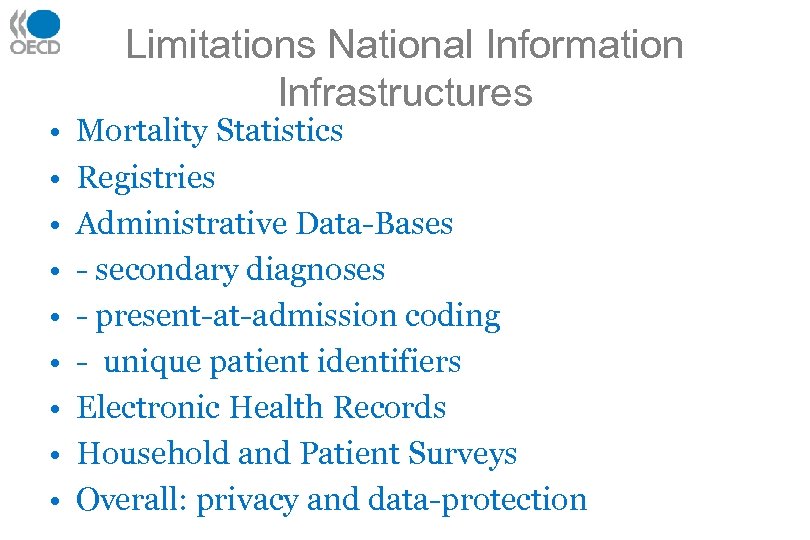
• • • Limitations National Information Infrastructures Mortality Statistics Registries Administrative Data-Bases - secondary diagnoses - present-at-admission coding - unique patient identifiers Electronic Health Records Household and Patient Surveys Overall: privacy and data-protection
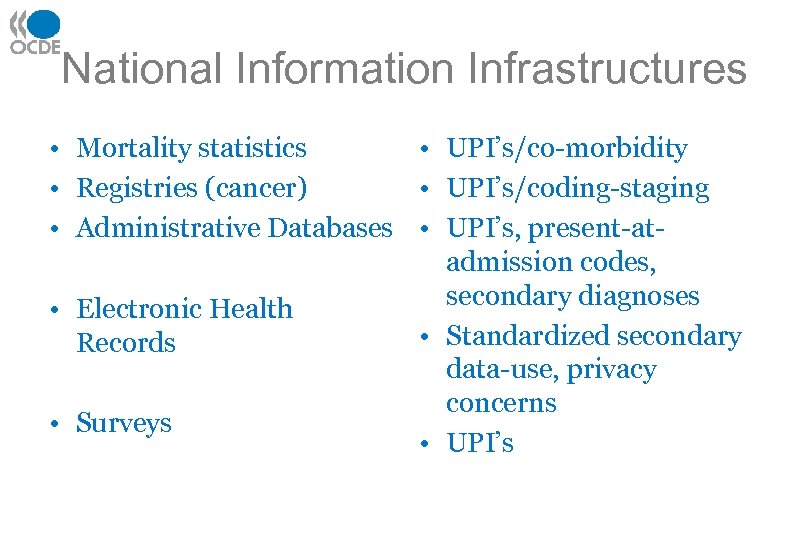
National Information Infrastructures • Mortality statistics • UPI’s/co-morbidity • Registries (cancer) • UPI’s/coding-staging • Administrative Databases • UPI’s, present-atadmission codes, secondary diagnoses • Electronic Health • Standardized secondary Records data-use, privacy concerns • Surveys • UPI’s
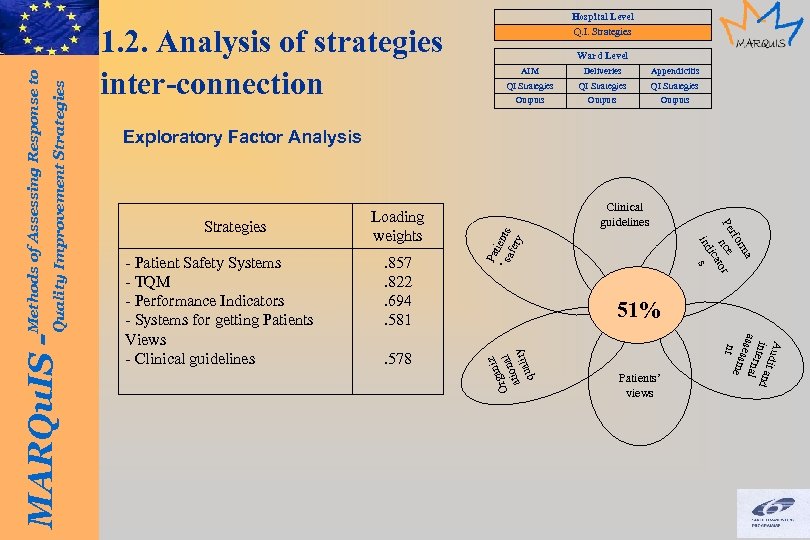
Ward Level AIM Deliveries Appendicitis QI Strategies Outputs Exploratory Factor Analysis . 857. 822. 694. 581. 578 Pat i ’ sa ents fety - Patient Safety Systems - TQM - Performance Indicators - Systems for getting Patients Views - Clinical guidelines 51% aniz Org nal atio ity l qua Strategies Loading weights Patients’ views Aud it inte and r asse nal ssm e nt MARQu. IS -Quality Improvement Strategies 1. 2. Analysis of strategies inter-connection Q. I. Strategies a rm rfo e Pe nc ator ic ind s Methods of Assessing Response to Hospital Level
Health System Performance Management • • • Whole system approach Sub-optimization Governance/stewardship Incentive structure Interconnection of strategies on performance indicators, guidelines, safety, TQM, patient experiences Dept Social Medicine
Скачать презентацию Health System Performance Management quality for better or
584bb2a5d6f49a9ae63778bdfbab79c9.ppt