


 Скачать презентацию Health system It is designed to meet the
65351d0da9fb1c6bf51b218b81bca4e9.ppt
- Количество слайдов: 49
 Health system It is designed to meet the health needs of the community, through the use of available knowledge and resources. Two major themes: It should meet the needs of entire population and not merely selected group. Primary health care
 Health care levels Three levels h h h Primary, Secondary and Tertiary
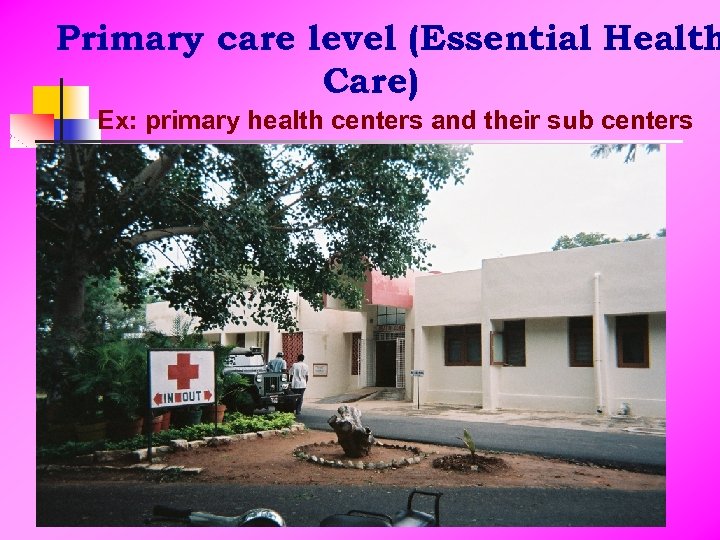 Primary care level (Essential Health Care) Ex: primary health centers and their sub centers
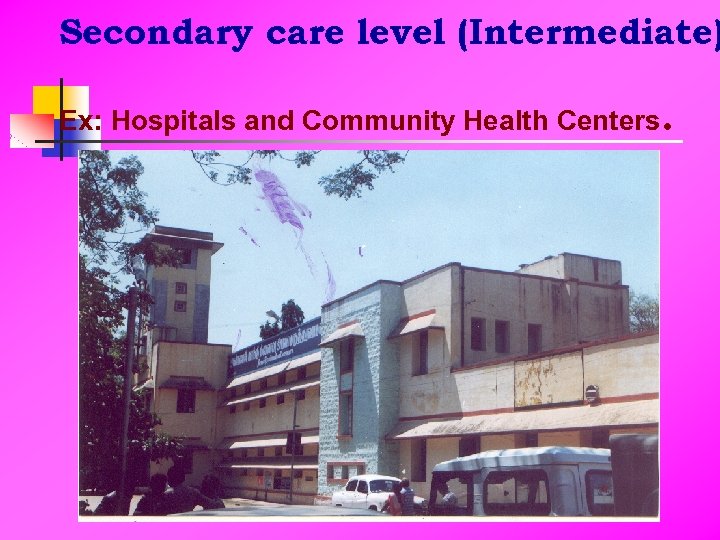 Secondary care level (Intermediate) Ex: Hospitals and Community Health Centers.
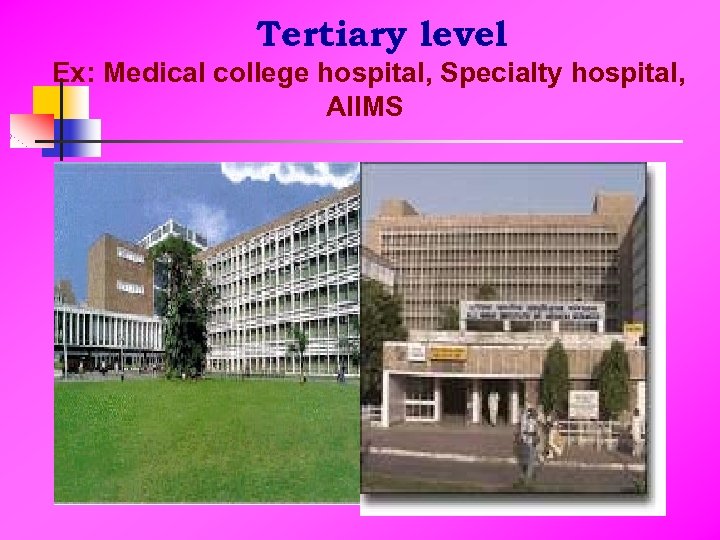 Tertiary level Ex: Medical college hospital, Specialty hospital, AIIMS
 Health Care System In India 1. Public health sector a) Primary healthcare Village level Primary health center Sub center b) Hospitals/ health center Community health center Rural hospital District hospital/ health center Specialist hospital Teaching hospital
 c) Health insurance scheme Employees state insurance Central government health scheme d) Other agencies Defense service Railways
 2. Private sector a) Private hospitals, poly clinics, nursing homes and dispensaries b) General practioners and clinics 3. Indigenous system of medicine a) Ayurveda and siddha b) Unani and tibbi c) Homoeopathy 4. Voluntary health agencies 5. National health programmes
 Health insurance Employees state insurance scheme Central government health scheme
 Employees state insurance scheme ^ Benefits in the contingency of sickness, maternity, employment injury and pension for defenders on the account of death of worker because of employment injury ^ Act covers employee-drawing wages not exceeding Rs 7, 500 per month
 Central government health scheme (CGHS) ^ First introduced in New Delhi in 1954 to provide comprehensive medical care to central government employees Facilities § Out patient care through dispensaries § Supply of necessary drugs § Laboratory and X-ray investigations § Domiciliary visit
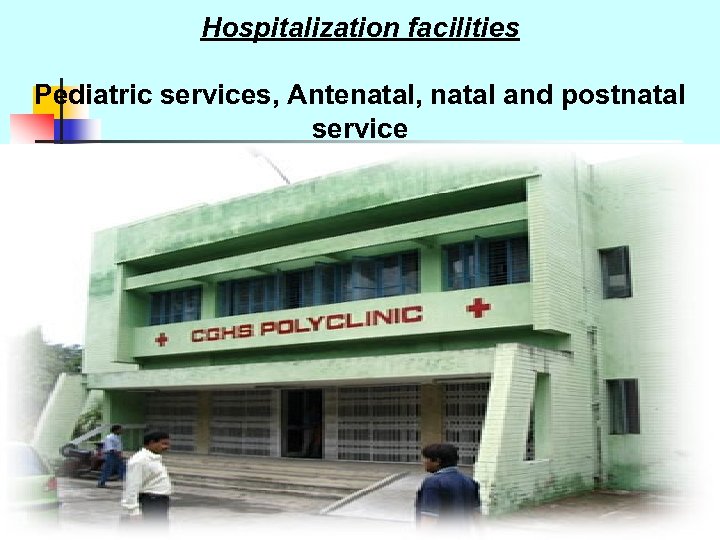 Hospitalization facilities Pediatric services, Antenatal, natal and postnatal service
 Other agencies Defense medical service Railways
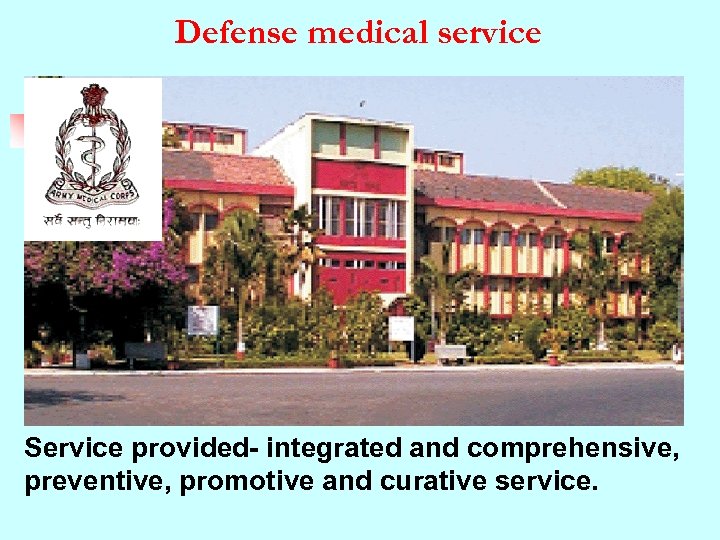 Defense medical service Service provided- integrated and comprehensive, preventive, promotive and curative service.
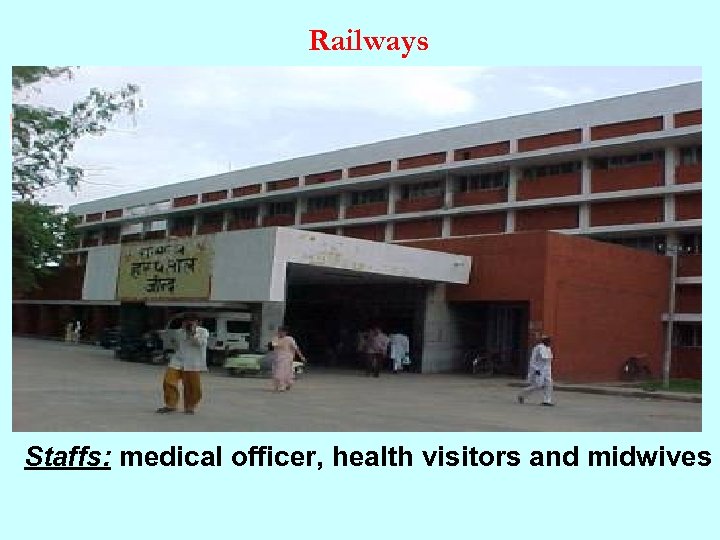 Railways Staffs: medical officer, health visitors and midwives
 Private agencies • As on 1992 there are 3. 92 lakh independent medical practitioners are there. • The doctors- population ration is 1: 2100, In that 70% are general practitioners who provide service mainly in urban areas. • They are not organized fully but M. C. I and D. C. I regulates some of the functions and activities.
 Indigenous system of medicine • Ayurveda, siddha, homoeopathy provide the bulk of medical service in rural areas. • There are 3. 37 lakhs of ayurveda professionals in that 90% practice in rural areas. • 1971 council of Indian medicine established
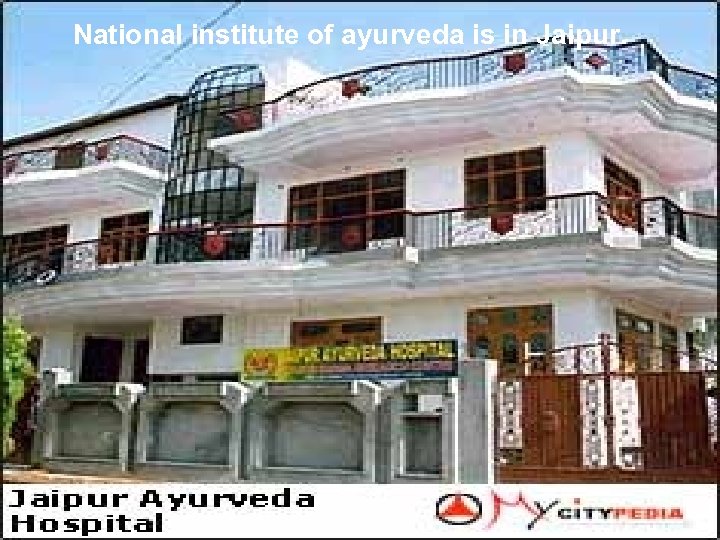 National institute of ayurveda is in Jaipur.
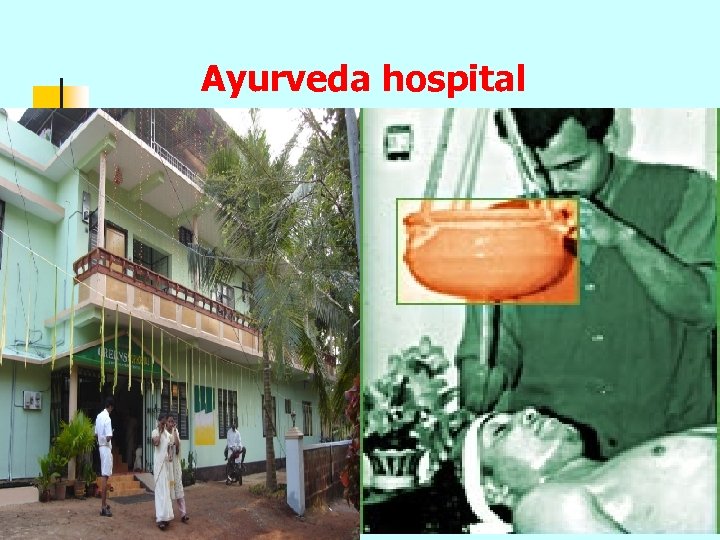 Ayurveda hospital
 Voluntary health agencies or N. G. O Functions: ^ Support the work of government agencies ^ Pioneering or research –Family planning programs. ^ Education ^ Demonstration – borehole latrines by Rockefeller foundations ^ Advancing health legislations
 Some of the Indian N. G. O v Indian Red Cross society v Hindkusht nivaran sangh v Indian council for child welfare v Tuberculosis association of India v Central social welfare board v Kasthurba memorial foundations v Family planning association of India
 v All India women’s conference v All India blind relief society v Professional bodies- IMA, IDA, All India licentiates associations, Nurses association v International agencies- W. H. O, UNICEF, CRY, CARE, ford foundation
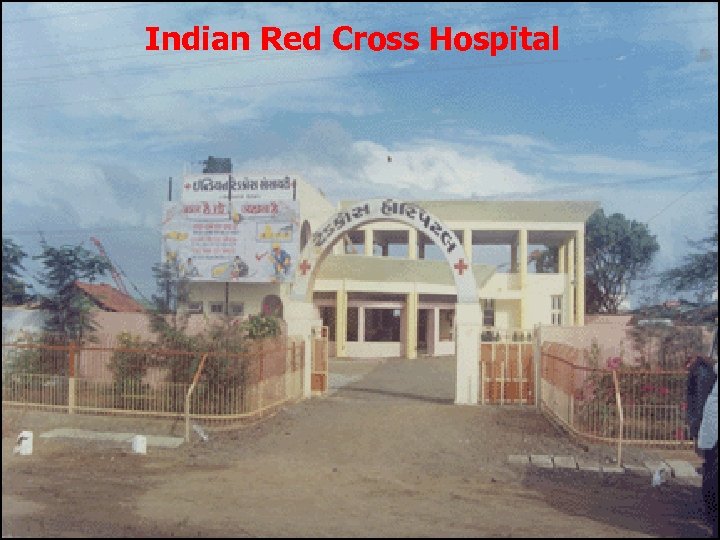 Indian Red Cross Hospital
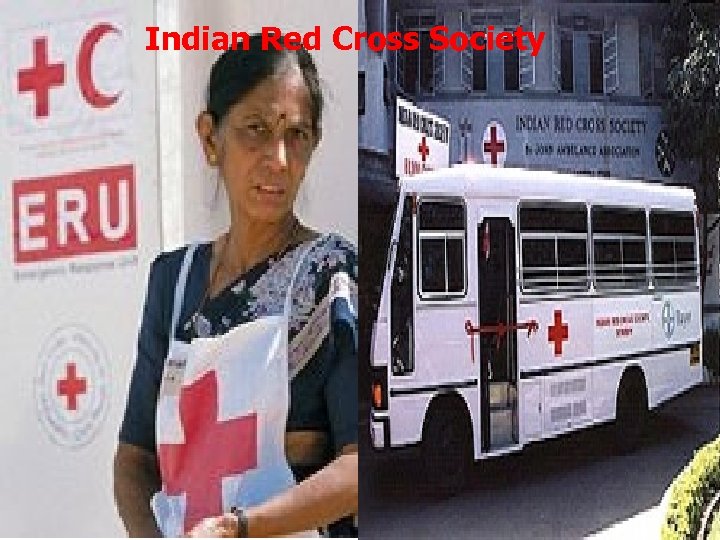 Indian Red Cross Society
 National health programs 1. National Aids Control Programme 2. National Leprosy Eradication Programme 3. Vector Borne Disease Control Programme 4. National T. B. Control Programme 5. National Programme for Control of Blindness 6. National Cancer Control Programme 7. National Iodine Deficiency Disorder Control Programme 8. Diseases Surveillance Programme for Communicable Diseases
 9. Mental Health Programme 10. Drug De-addiction Programme 11. Pilot Project for Hospital Waste Management in Govt. Hospitals 12. Financial assistance to the selected Government hospitals of various States for Emergency Care Centre in towns / cities on National Highways. 13. Central Govt. Health Scheme 14. National Cardio-Vascular Disease Control Programme 15. Scheme for Improvement of Medical Services 16. Health Promotion & Education Programme 17. Medical Care for Remote and Marginalised Tribal and Nomadic Communities
 18. National Programme for Control and Treatment of Occupational Diseases 19. Oral Health Care Scheme 20. Scheme for Medical Education 21. Prevention of Food Adulteration Programme 22. Centred Drug Standard Control Organistion (CDSCO) 23. Nursing Programme

 Center level State level District level
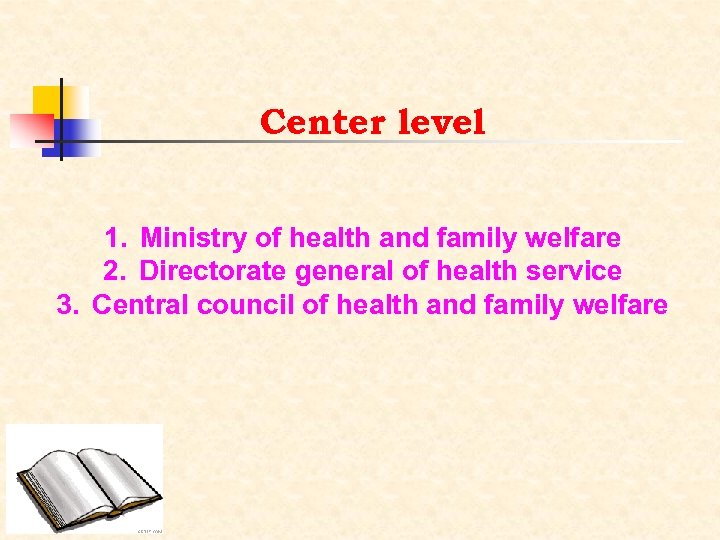 Center level 1. Ministry of health and family welfare 2. Directorate general of health service 3. Central council of health and family welfare
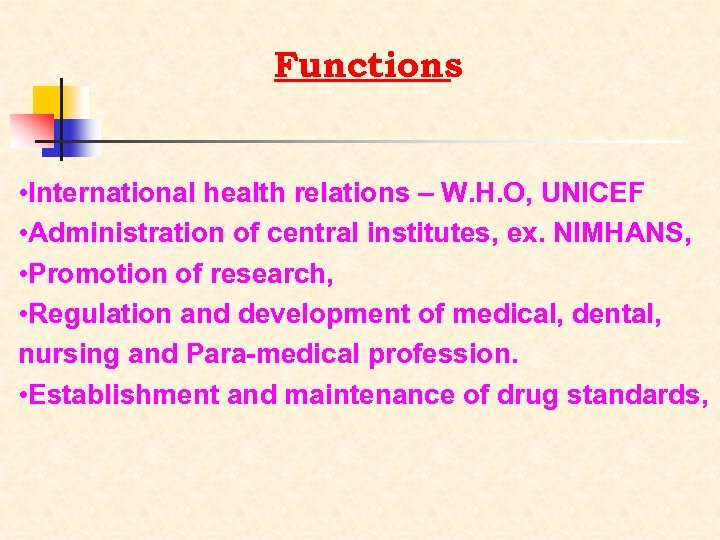 Functions • International health relations – W. H. O, UNICEF • Administration of central institutes, ex. NIMHANS, • Promotion of research, • Regulation and development of medical, dental, nursing and Para-medical profession. • Establishment and maintenance of drug standards,
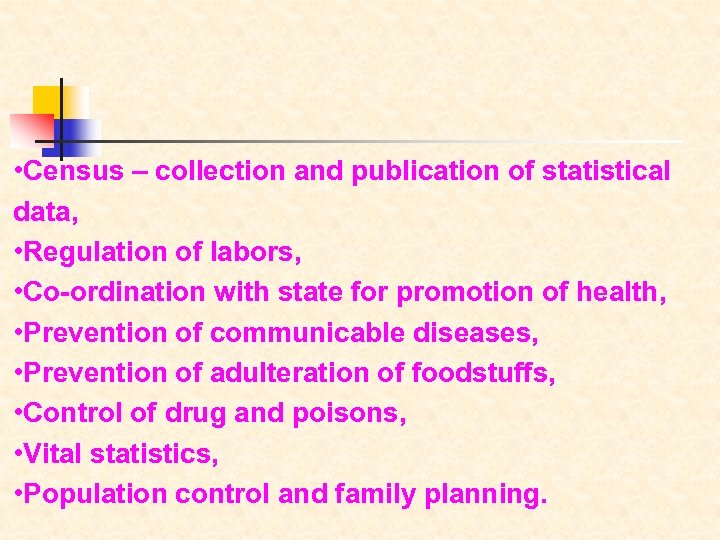 • Census – collection and publication of statistical data, • Regulation of labors, • Co-ordination with state for promotion of health, • Prevention of communicable diseases, • Prevention of adulteration of foodstuffs, • Control of drug and poisons, • Vital statistics, • Population control and family planning.
 Directorate general of health service Dr. R. K. Srivastava , Principal advisor to the union government in medical care and hospitals, public health and general administration, Functions – survey, planning, co-ordination, programming and appraisal of all health matters in the country.
 1. 2. 3. 4. International health relations – ports and airports Control of drug standard Medical store depot, P. G training – Eg. NIMHANS, National institute of health and family welfare, Delhi. 5. Medical education – lady hardinge, maulana azad, colleges at Goa and Pondicherry. 6. Medical research,
 7. CGHS 8. National health programmes, 9. Central health education bureau, 10. Health intelligence 11. National medical library
 Central council of health It was set up on 9 th August 1952 under article 263 for promotion co-ordinate and concerted action between center and states in implementation of all programmes and measures related to health of the nation.
 State level 1919 is the first milestone in state health administration when the states obtained autonomy, under the Montague- Chelmsford reforms from the central government. 1920 -21 all the states had created some form of public health organization. 1935 government of India act gave further autonomy to the state.
 State level administration Two levels: State ministry of health State health directorate
 State health directorate Two departments – Medical and Public health Headed by – Surgeon general Inspector general of civil hospitals Director of public health
 Director of health service is the chief technical advisor to the state government in medicine and public health. Director of health and family welfare is also there in some states due to the importance of family planning program. Few states have director of medical education in view of increases number of medical colleges.
 Deputy directors and assistant directors of two types – regional and functional, assist all the directors. Regional directors: Inspect all the branches of public health with in their jurisdiction, irrespective of their specialty. Functional directors: Usually specialist in a particular branch of public health like mother and child health, family planning, nutrition, tuberculosis and leprosy.
 District level Headed by collector Six different administrative areas 1. Subdivisions 2. Taluks 3. Community development blocks 4. Municipalities and corporations 5. Villages 6. Panchayats
 District Two or more subdivisions headed by assistant collector or sub-collector Each division is again divided to taluks headed by tehsildar; taluks contain 200 to 600 villages.
 Villages are again divided into blocks called community development blocks. Contains 100 villages with a population of 80, 000 to 1, 20, 000. Headed by block development officer
 In urban area: Town area committees – population between 5000 to 10, 000 Municipal boards - between 10, 000 to 2 lakhs Corporation - above 2 lakhs Town area – like panchayats, provide sanitary service.
 Municipal board Headed by president elected, term 3 -5 years Functions Construction and maintenance of roads Sanitation and drainage Street lighting Water supply Maintenance of hospital and dispensaries Education Registration of birth and death Corporation Headed by mayor elected Functions are similar to municipalities
 Status Of Health Care In India Since independence, we have created a vast public health infrastructure comprising of 1, 45, 000 Sub -centres, 23, 000 Public Health Centres (PHCs) and 3222 Community Health Centres (CHCs). However, it is estimated that this vast infrastructure is able to cater only to 20% of the population, while 80% of healthcare needs are still being provided by the private sector. Poor access to health leads to avoidable incidence of morbidity, mortality and out-of-pocket expenses, often leading to indebtedness. In rural areas especially, there are pockets of under-served populations where the vicious circle of poverty, malnutrition and poor health reinforce each other.
 Preventive medicine and public health – 2 nd Edition By Breet, J. Cassers Principles of Community medicine – 3 rd Edition by B. Sridhar Rao Essential preventive medicine – Op Ghai, Piyush Gupta A handbook of preventive and social medicine – Yashpal pedi www. who. org www. google. com Ministry of health and family welfare