


 Скачать презентацию Health System and Health System Strengthening in Nepal
335813b992bc3fabf5fbbf253e6ee343.ppt
- Количество слайдов: 20
 Health System and Health System Strengthening in Nepal Dr BR Marasini, MBBS, MPH Senior Health Administrator Ministry of Health and Population
 Background • The health system in Nepal is 122 years old and based on primary health care approach • Very different diseases in plain southern part and high mountain north parts • Health services are mixed –both government and non-government (for profit and not for profit)
 The Health Care Systems • Allopathic or modern medicine • Traditional medicine – Ayurveda and Amchi • Homeopathy • Unani • Other complimentary systems
 Health Service Delivery • Community based health services and interventions- immunization (mobile clinics every month), Vitamin A and albendazole distribution (twice a year) & primary health care out reach clinics (mobile clinics- every month) from local health facility • Female community health volunteers and mothers groups • Hospital and facility based services-general, specialized and mobile
 Health Service Organization • • • Sub health post Health post Primary health centre District hospital General hospitals- zonal and regional headquarters • National hospitals • NGO and Private health institutions
 Health Governance • Ministry of Health and Population • Three Departments - Health Services, Drug Administration and Ayurveda • Regulatory bodies- Medical Council, Nursing Council etc • Five Regional Health Directorates • 75 District Public/Health Offices • Facility level health/hospital management committees
 Human Resource for Health • • • 18 medical and five dental colleges Nursing colleges Pharmacy colleges Allied health professional colleges 80% positions of the public health facilities are now fulfilled • Fulfillment of vacant positions health personnel also initiated through local initiative
 Health Financing • Government of Nepal • Donors • Local bodies –increasing trend for last two years • International non-government organizations • 7. 2% budget in health sector in current financial year
 Infrastructure Development • Building of 700 (apprx. ) health facilities is under construction (new or expansion or major renovation) • More equipments and logistic support with better timely maintenance initiated • The main focus of infrastructure development is maternity services
 Major Policies and Initiatives • • • Health sector reform Sector wide approach Millennium development goal Poverty reduction Social inclusion Nepal health partnership compact and international health partnership plus • Global health initiative • Health System Funding Platform
 Major Programme Initiatives in Health Sector • Institutional delivery declared free with maternity incentive scheme • Introduction of Free Health Care (service charges abolished & essential drugs provided free) • Surgery of uterine prolapse • Cash support to poor patients suffering from cancer, heart disease, chronic kidney disease, Alzheimer's disease & Parkinson's disease
 Major Health Programme--- • Compulsory two year posting of physicians out side Kathmandu completing MBBS course in government scholarship • Community based neonatal care • Nutrition supplementation programme
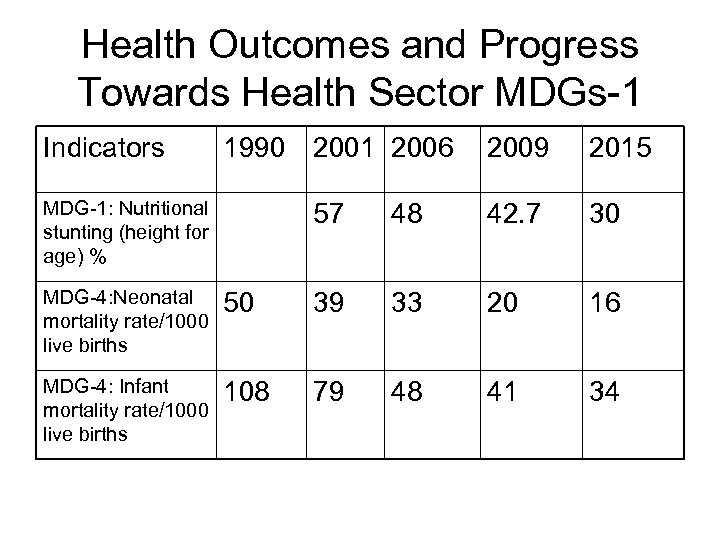 Health Outcomes and Progress Towards Health Sector MDGs-1 Indicators 1990 2001 2006 MDG-1: Nutritional stunting (height for age) % 2009 2015 57 48 42. 7 30 MDG-4: Neonatal mortality rate/1000 live births 50 39 33 20 16 MDG-4: Infant mortality rate/1000 live births 108 79 48 41 34
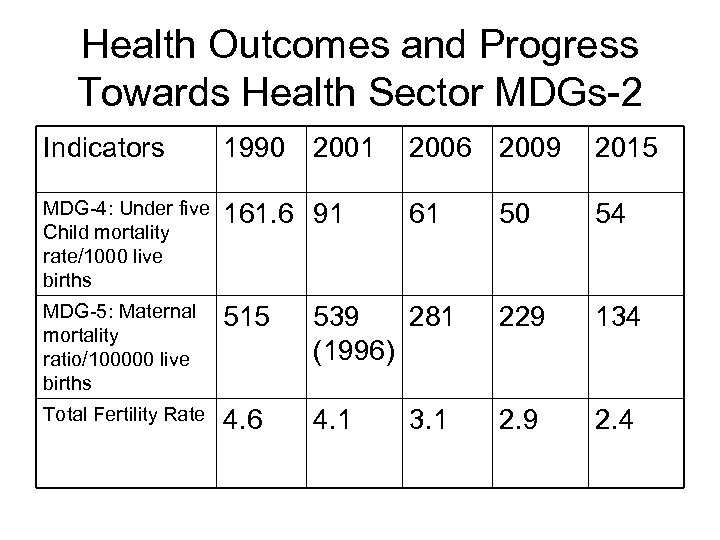 Health Outcomes and Progress Towards Health Sector MDGs-2 Indicators 1990 2001 2006 2009 2015 MDG-4: Under five Child mortality rate/1000 live births 161. 6 91 61 50 54 MDG-5: Maternal mortality ratio/100000 live births 515 539 281 (1996) 229 134 Total Fertility Rate 4. 6 4. 1 2. 9 2. 4 3. 1
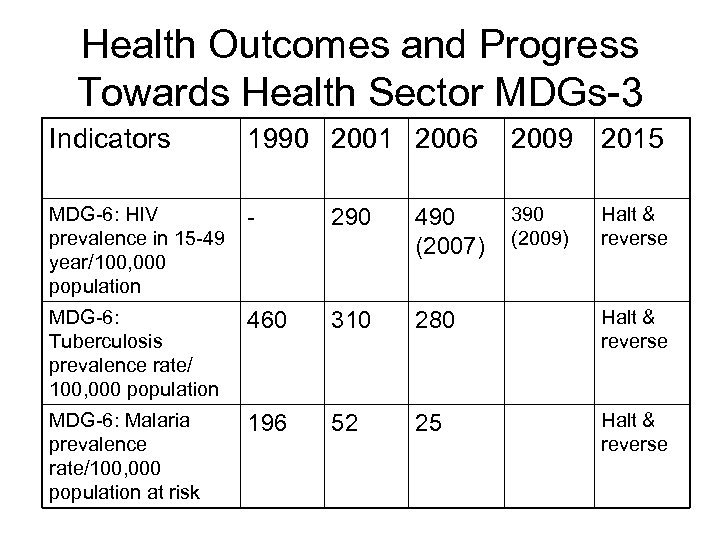 Health Outcomes and Progress Towards Health Sector MDGs-3 Indicators 1990 2001 2006 2009 2015 MDG-6: HIV prevalence in 15 -49 year/100, 000 population - 290 490 (2007) 390 (2009) MDG-6: Tuberculosis prevalence rate/ 100, 000 population 460 310 280 Halt & reverse MDG-6: Malaria prevalence rate/100, 000 population at risk 196 52 25 Halt & reverse
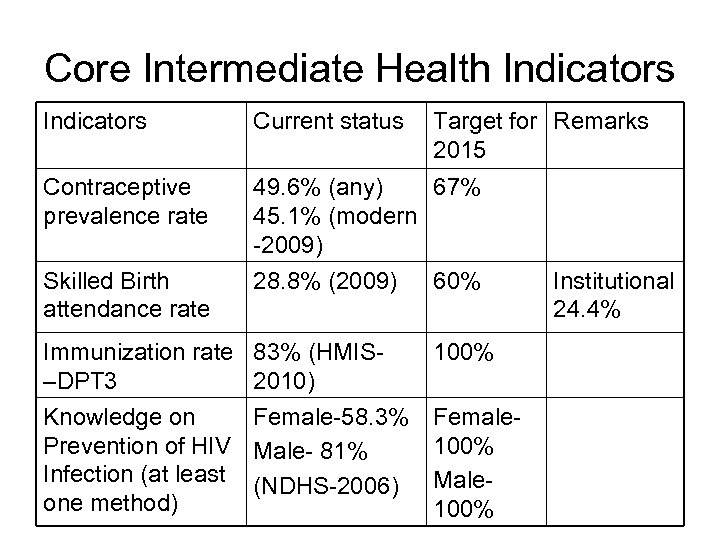 Core Intermediate Health Indicators Current status Contraceptive prevalence rate 49. 6% (any) 67% 45. 1% (modern -2009) 28. 8% (2009) 60% Skilled Birth attendance rate Target for Remarks 2015 Immunization rate 83% (HMIS–DPT 3 2010) 100% Knowledge on Female-58. 3% Prevention of HIV Male- 81% Infection (at least (NDHS-2006) one method) Female 100% Male 100% Institutional 24. 4%
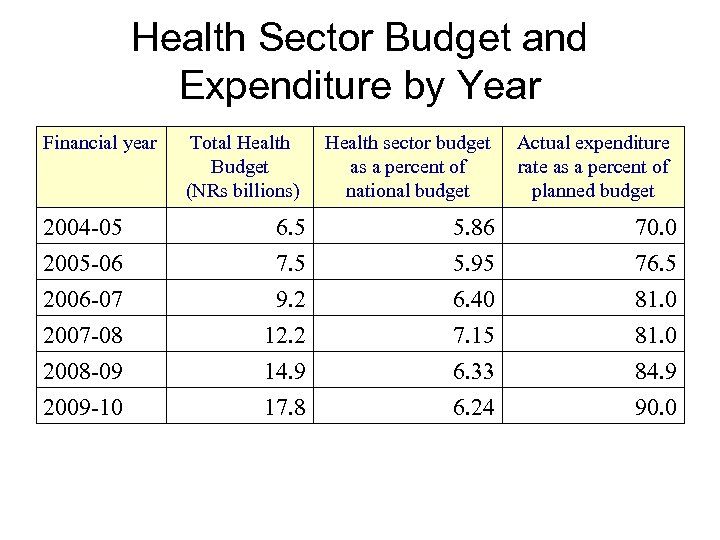 Health Sector Budget and Expenditure by Year Financial year Total Health Budget (NRs billions) Health sector budget as a percent of national budget Actual expenditure rate as a percent of planned budget 2004 -05 2005 -06 6. 5 7. 5 5. 86 5. 95 70. 0 76. 5 2006 -07 2007 -08 2008 -09 2009 -10 9. 2 12. 2 14. 9 17. 8 6. 40 7. 15 6. 33 6. 24 81. 0 84. 9 90. 0
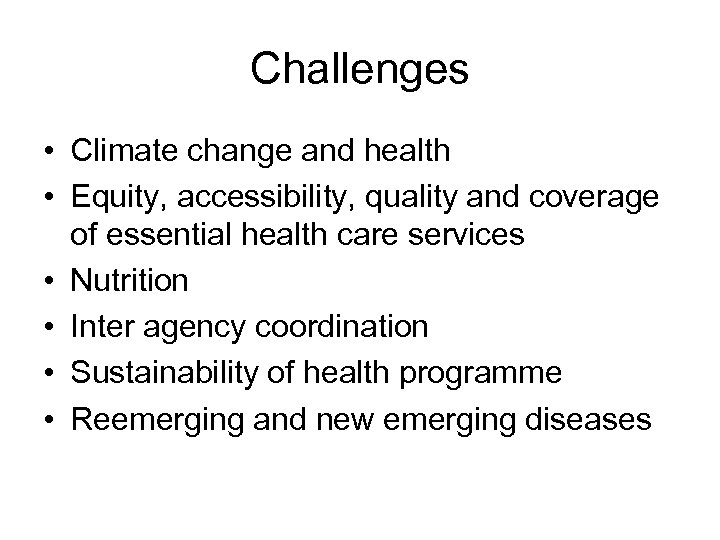 Challenges • Climate change and health • Equity, accessibility, quality and coverage of essential health care services • Nutrition • Inter agency coordination • Sustainability of health programme • Reemerging and new emerging diseases
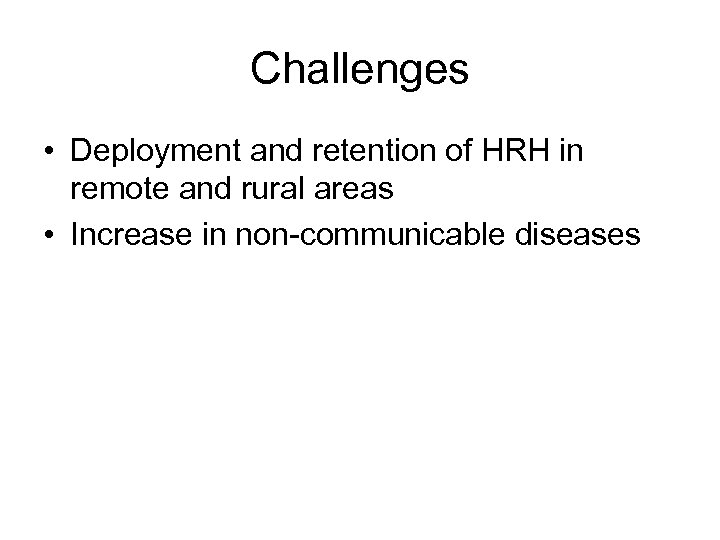 Challenges • Deployment and retention of HRH in remote and rural areas • Increase in non-communicable diseases
 Thanking you for your kind patience