


 Скачать презентацию Health Services and Data Collection among IDPs in
1e641bc3580dfc5c3eadc1a0360ab5b6.ppt
- Количество слайдов: 13
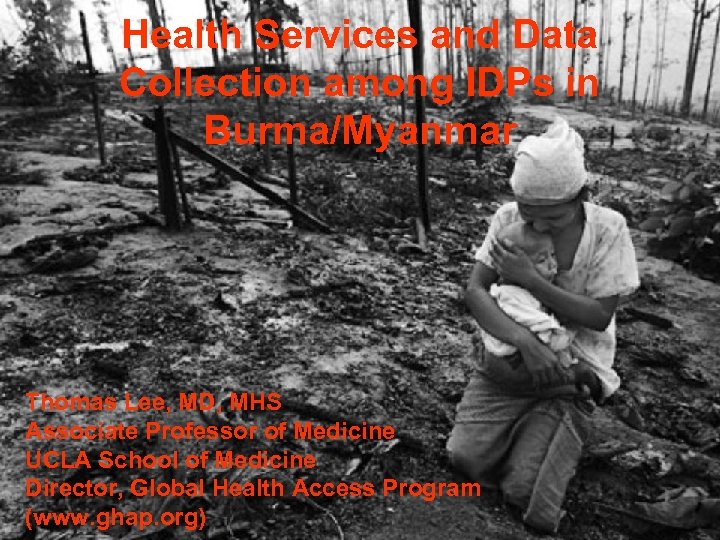 Health Services and Data Collection among IDPs in Burma/Myanmar Thomas Lee, MD, MHS Associate Professor of Medicine UCLA School of Medicine Director, Global Health Access Program (www. ghap. org)
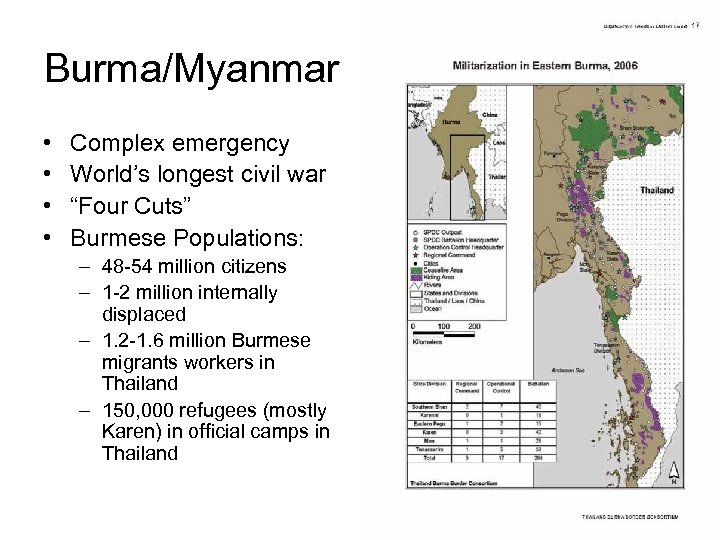 Burma/Myanmar • • Complex emergency World’s longest civil war “Four Cuts” Burmese Populations: – 48 -54 million citizens – 1 -2 million internally displaced – 1. 2 -1. 6 million Burmese migrants workers in Thailand – 150, 000 refugees (mostly Karen) in official camps in Thailand
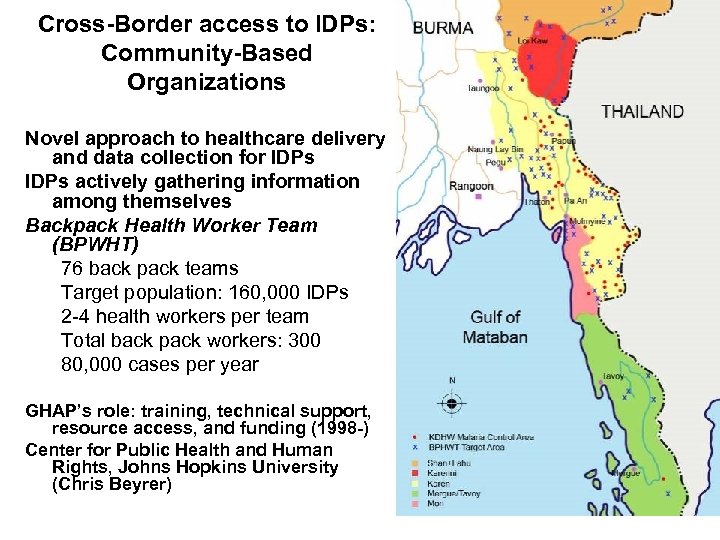 Cross-Border access to IDPs: Community-Based Organizations Novel approach to healthcare delivery and data collection for IDPs actively gathering information among themselves Backpack Health Worker Team (BPWHT) 76 back pack teams Target population: 160, 000 IDPs 2 -4 health workers per team Total back pack workers: 300 80, 000 cases per year GHAP’s role: training, technical support, resource access, and funding (1998 -) Center for Public Health and Human Rights, Johns Hopkins University (Chris Beyrer)
 Rapid Assessment Surveys Security concerns – – Days in village limited Displacement of entire village Selected cluster inaccessible Risk to health workers, but no one else possible Context demands simplicity – – Surveys by health workers during normal course of work Travel on foot up to one month 1 -2 page limit Training time limited, Interview time limited = Quantitative Household census, vital events Morbidity, RH, malaria, HIV KAP, etc.
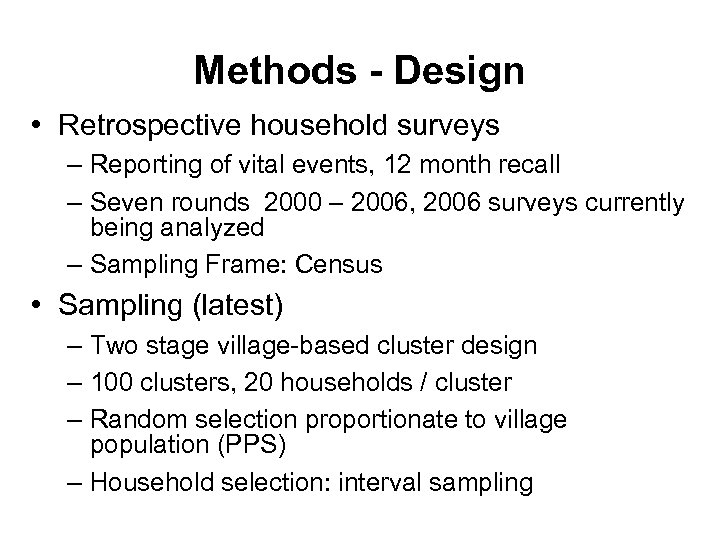 Methods - Design • Retrospective household surveys – Reporting of vital events, 12 month recall – Seven rounds 2000 – 2006, 2006 surveys currently being analyzed – Sampling Frame: Census • Sampling (latest) – Two stage village-based cluster design – 100 clusters, 20 households / cluster – Random selection proportionate to village population (PPS) – Household selection: interval sampling
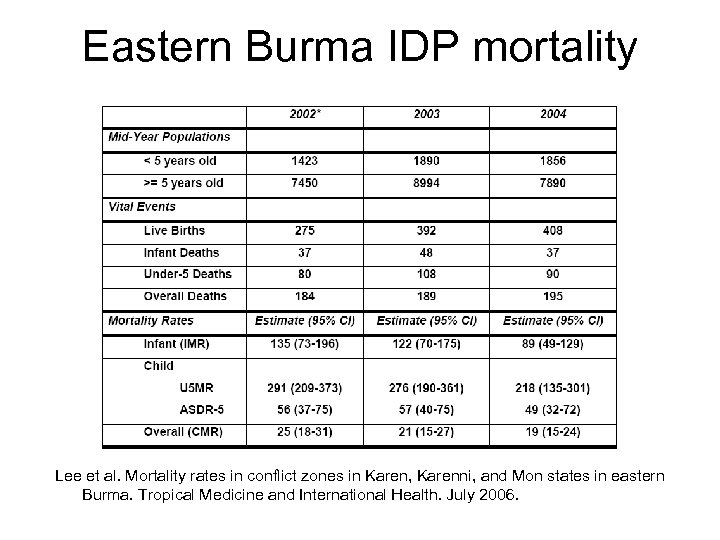 Eastern Burma IDP mortality Lee et al. Mortality rates in conflict zones in Karen, Karenni, and Mon states in eastern Burma. Tropical Medicine and International Health. July 2006.
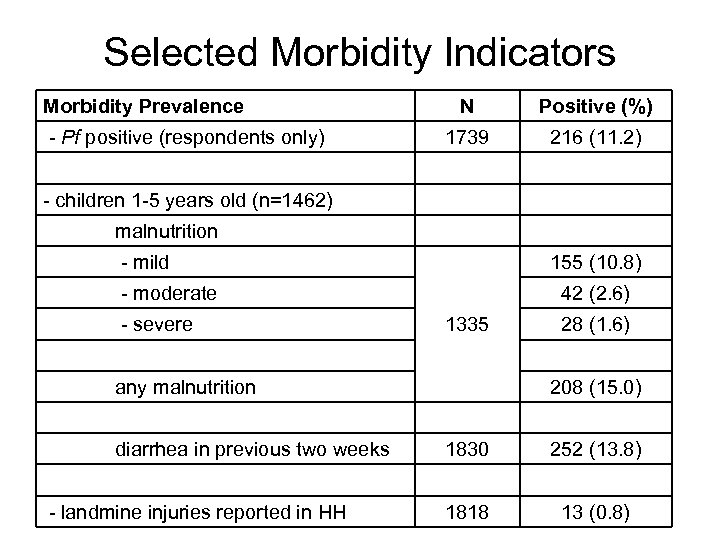 Selected Morbidity Indicators Morbidity Prevalence - Pf positive (respondents only) N Positive (%) 1739 216 (11. 2) - children 1 -5 years old (n=1462) malnutrition - mild 155 (10. 8) - moderate - severe 42 (2. 6) 1335 any malnutrition diarrhea in previous two weeks - landmine injuries reported in HH 28 (1. 6) 208 (15. 0) 1830 252 (13. 8) 1818 13 (0. 8)
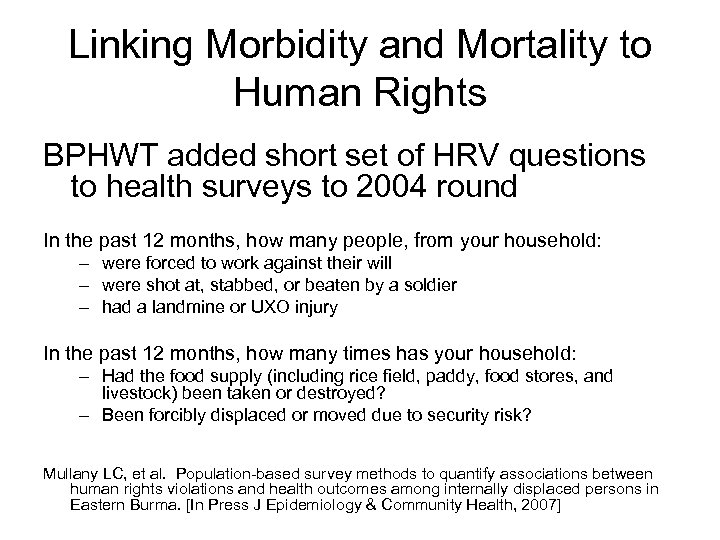 Linking Morbidity and Mortality to Human Rights BPHWT added short set of HRV questions to health surveys to 2004 round In the past 12 months, how many people, from your household: – were forced to work against their will – were shot at, stabbed, or beaten by a soldier – had a landmine or UXO injury In the past 12 months, how many times has your household: – Had the food supply (including rice field, paddy, food stores, and livestock) been taken or destroyed? – Been forcibly displaced or moved due to security risk? Mullany LC, et al. Population-based survey methods to quantify associations between human rights violations and health outcomes among internally displaced persons in Eastern Burma. [In Press J Epidemiology & Community Health, 2007]
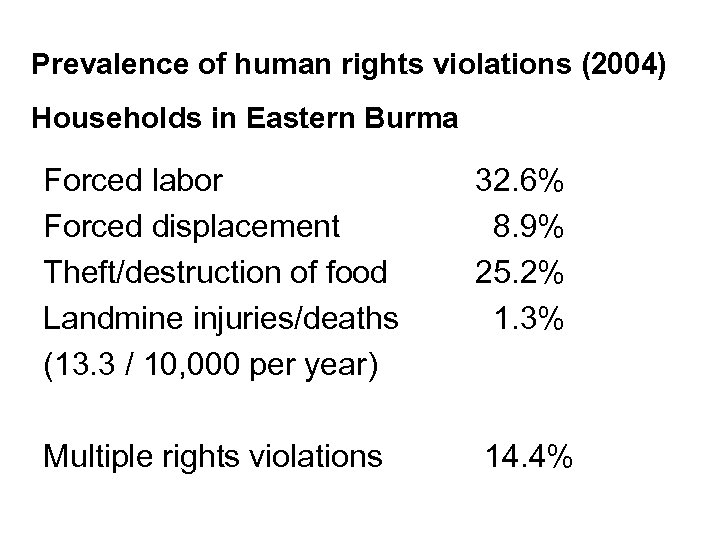 Prevalence of human rights violations (2004) Households in Eastern Burma Forced labor Forced displacement Theft/destruction of food Landmine injuries/deaths (13. 3 / 10, 000 per year) 32. 6% 8. 9% 25. 2% 1. 3% Multiple rights violations 14. 4%
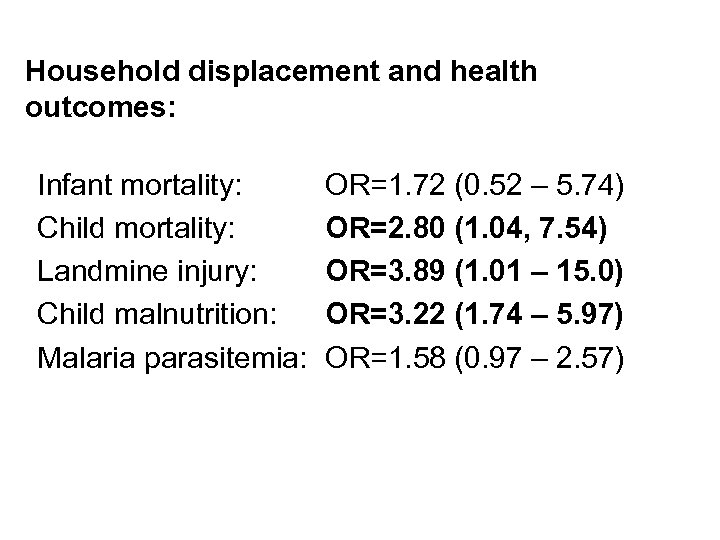 Household displacement and health outcomes: Infant mortality: Child mortality: Landmine injury: Child malnutrition: Malaria parasitemia: OR=1. 72 (0. 52 – 5. 74) OR=2. 80 (1. 04, 7. 54) OR=3. 89 (1. 01 – 15. 0) OR=3. 22 (1. 74 – 5. 97) OR=1. 58 (0. 97 – 2. 57)
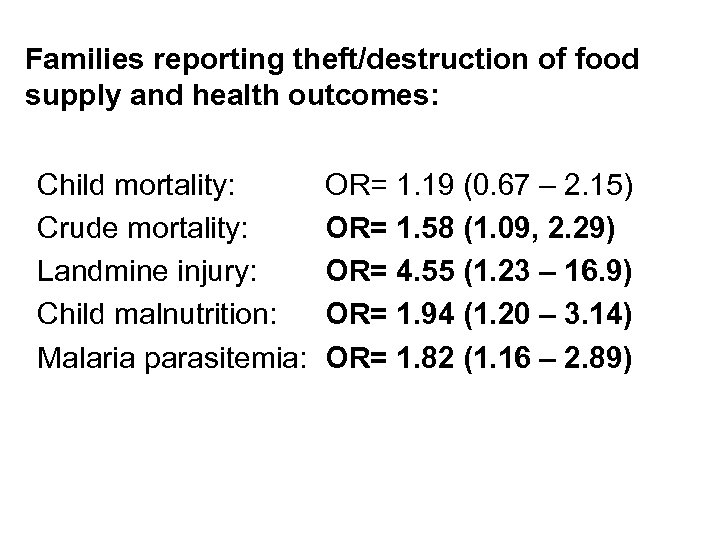 Families reporting theft/destruction of food supply and health outcomes: Child mortality: Crude mortality: Landmine injury: Child malnutrition: Malaria parasitemia: OR= 1. 19 (0. 67 – 2. 15) OR= 1. 58 (1. 09, 2. 29) OR= 4. 55 (1. 23 – 16. 9) OR= 1. 94 (1. 20 – 3. 14) OR= 1. 82 (1. 16 – 2. 89)
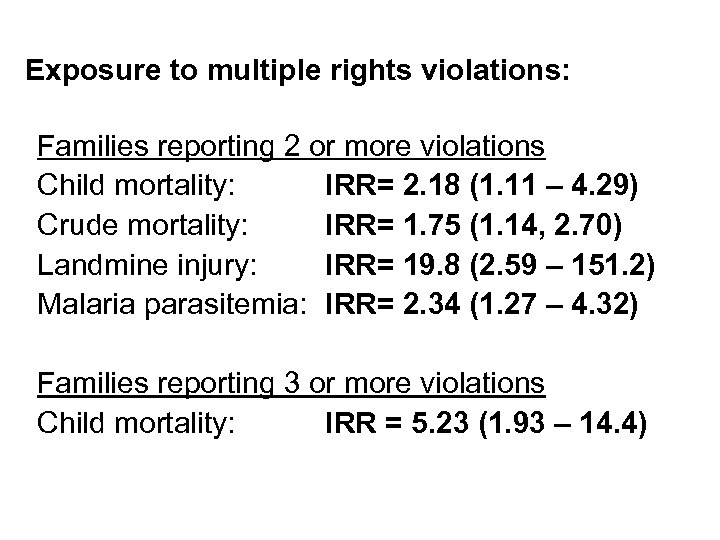 Exposure to multiple rights violations: Families reporting 2 or more violations Child mortality: IRR= 2. 18 (1. 11 – 4. 29) Crude mortality: IRR= 1. 75 (1. 14, 2. 70) Landmine injury: IRR= 19. 8 (2. 59 – 151. 2) Malaria parasitemia: IRR= 2. 34 (1. 27 – 4. 32) Families reporting 3 or more violations Child mortality: IRR = 5. 23 (1. 93 – 14. 4)
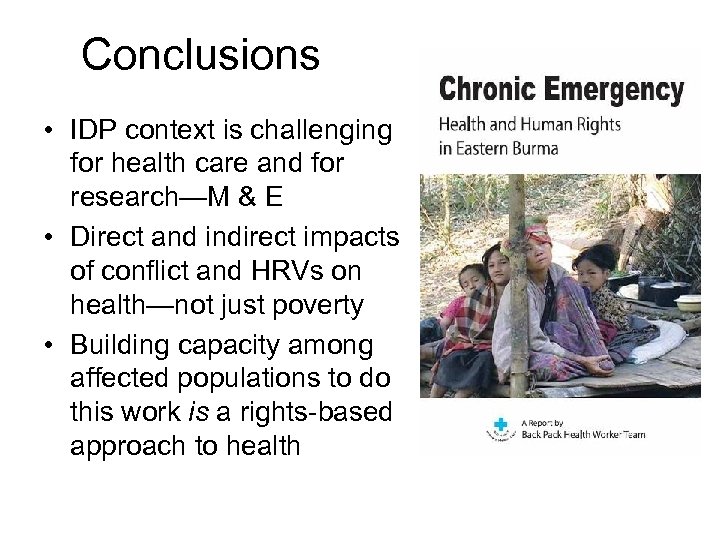 Conclusions • IDP context is challenging for health care and for research—M & E • Direct and indirect impacts of conflict and HRVs on health—not just poverty • Building capacity among affected populations to do this work is a rights-based approach to health