


 Скачать презентацию Health Sector Reform in South Africa focus
45e18d8aef6a25236022cfed1caa4755.ppt
- Количество слайдов: 40
 Health Sector Reform in South Africa ~ focus on the ‘Supply Side’ issues Dr Brian Ruff MB. BCh. ; FCP (SA) The BHF Southern African Conference 22 -25 July’ 07 Sun City
 Agenda • Introduction to health sector reform • Supply side issues • Possible responses ~ reform experiences The BHF Southern African Conference 22 -25 July’ 07 Sun City
 Agenda • Introduction to health sector reform • Supply side issues • Possible responses ~ reform experiences The BHF Southern African Conference 22 -25 July’ 07 Sun City
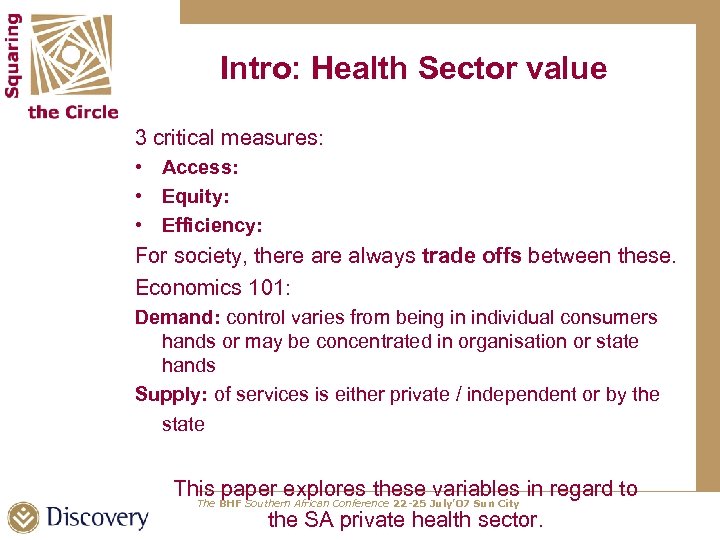 Intro: Health Sector value 3 critical measures: • Access: • Equity: • Efficiency: For society, there always trade offs between these. Economics 101: Demand: control varies from being in individual consumers hands or may be concentrated in organisation or state hands Supply: of services is either private / independent or by the state This BHF Southern African Conference 22 -25 July’ 07 Sun City in regard to paper explores these variables The the SA private health sector.
 Intro: Health Sector value Definitions: • Access: ability of a sick person to gain entrée to the system to establish a diagnosis & plan therapy. Also the ability to move between differing levels of the system i. e. primary care to specialist / highly specialised care. Funding is critical. • Equity: provision of the same care based purely on their medical problem – unaffected by income or influence. Success is achieved when the demand side is controlled by structures / processes ensure effective demand. I. e. : • Unnecessary care is denied (3 rd party funding issue) The BHF Southern African Conference 22 -25 July’ 07 Sun City • Necessary care is provided (both supplier induced
 Intro: Health Sector value Efficiency: two definitions concern us: • financial efficiency i. e. relative cost / price • quality They may be combined as ‘value’. On the Supply side, there are: • ‘trade offs’ between cost and quality • but in healthcare, over time, good quality is more cost effective than bad quality, since unresolved problems recur and incur new costs The BHF Southern African Conference 22 -25 July’ 07 Sun City
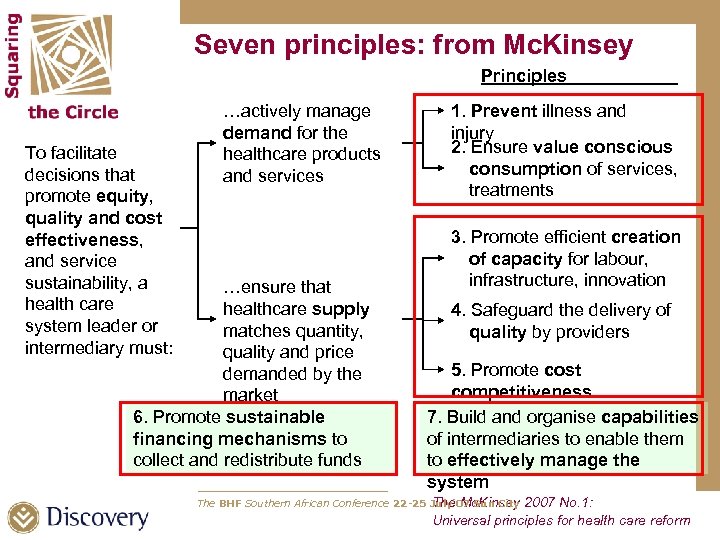 Seven principles: from Mc. Kinsey Principles To facilitate decisions that promote equity, quality and cost effectiveness, and service sustainability, a health care system leader or intermediary must: …actively manage demand for the healthcare products and services …ensure that healthcare supply matches quantity, quality and price demanded by the market 6. Promote sustainable financing mechanisms to collect and redistribute funds 1. Prevent illness and injury 2. Ensure value conscious consumption of services, treatments 3. Promote efficient creation of capacity for labour, infrastructure, innovation 4. Safeguard the delivery of quality by providers 5. Promote cost competitiveness 7. Build and organise capabilities of intermediaries to enable them to effectively manage the system The BHF Southern African Conference 22 -25 July’ 07 Sun City The Mc. Kinsey 2007 No. 1: Universal principles for health care reform
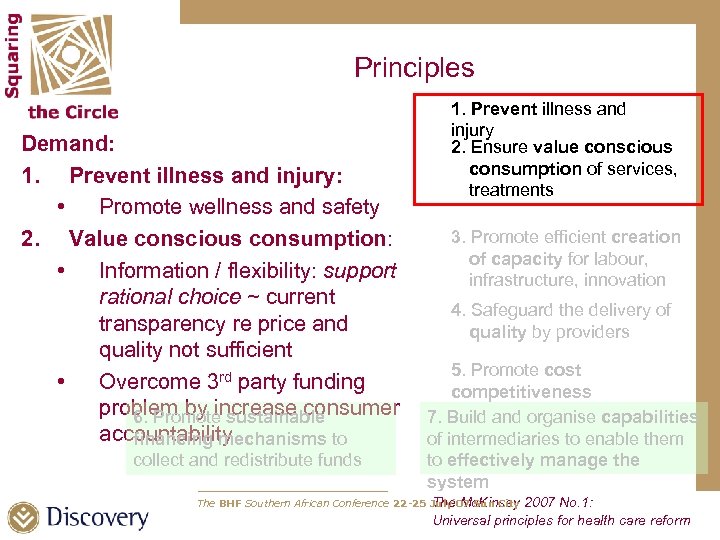 Principles Demand: 1. Prevent illness and injury: • Promote wellness and safety 2. Value conscious consumption: • Information / flexibility: support rational choice ~ current transparency re price and quality not sufficient • Overcome 3 rd party funding problem by increase consumer 6. Promote sustainable accountability financing mechanisms to collect and redistribute funds 1. Prevent illness and injury 2. Ensure value conscious consumption of services, treatments 3. Promote efficient creation of capacity for labour, infrastructure, innovation 4. Safeguard the delivery of quality by providers 5. Promote cost competitiveness 7. Build and organise capabilities of intermediaries to enable them to effectively manage the system The BHF Southern African Conference 22 -25 July’ 07 Sun City The Mc. Kinsey 2007 No. 1: Universal principles for health care reform
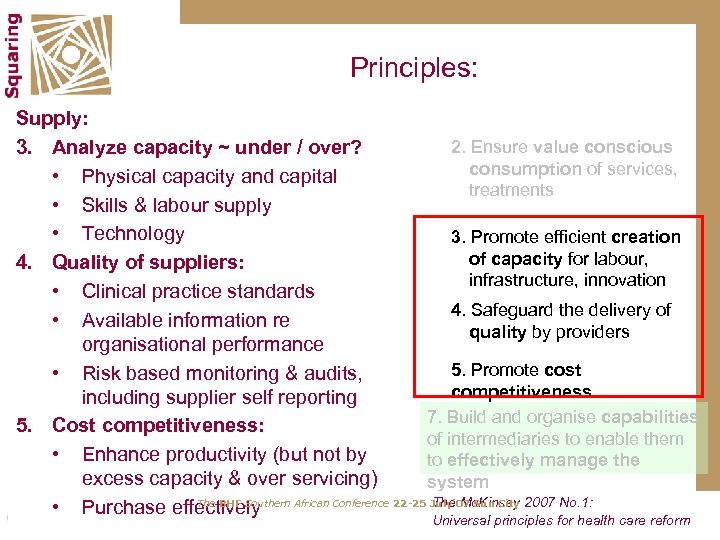 Principles: Supply: 2. Ensure value conscious 3. Analyze capacity ~ under / over? consumption of services, • Physical capacity and capital treatments • Skills & labour supply • Technology 3. Promote efficient creation of capacity for labour, 4. Quality of suppliers: infrastructure, innovation • Clinical practice standards 4. Safeguard the delivery of • Available information re quality by providers organisational performance 5. Promote cost • Risk based monitoring & audits, competitiveness including supplier self reporting 7. Build and organise capabilities 5. Cost competitiveness: of intermediaries to enable them • Enhance productivity (but not by to effectively manage the excess capacity & over servicing) system The BHF Southern African Conference 22 -25 July’ 07 Sun City 2007 No. 1: The Mc. Kinsey • Purchase effectively Universal principles for health care reform
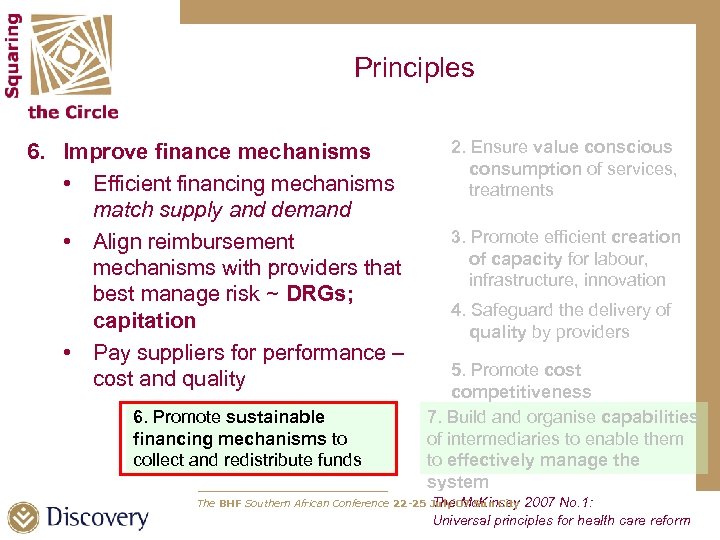 Principles 6. Improve finance mechanisms • Efficient financing mechanisms match supply and demand • Align reimbursement mechanisms with providers that best manage risk ~ DRGs; capitation • Pay suppliers for performance – cost and quality 6. Promote sustainable financing mechanisms to collect and redistribute funds 2. Ensure value conscious consumption of services, treatments 3. Promote efficient creation of capacity for labour, infrastructure, innovation 4. Safeguard the delivery of quality by providers 5. Promote cost competitiveness 7. Build and organise capabilities of intermediaries to enable them to effectively manage the system The BHF Southern African Conference 22 -25 July’ 07 Sun City The Mc. Kinsey 2007 No. 1: Universal principles for health care reform
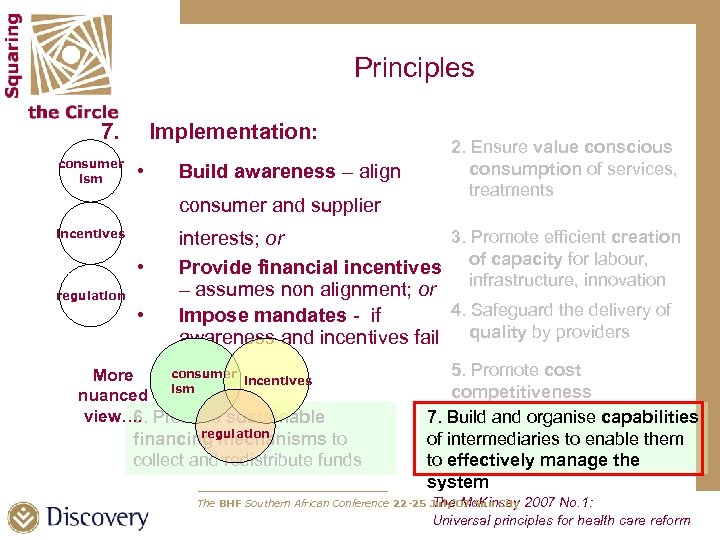 Principles 7. consumer ism Implementation: • Build awareness – align consumer and supplier incentives • regulation • 2. Ensure value conscious consumption of services, treatments 3. Promote efficient creation interests; or Provide financial incentives of capacity for labour, infrastructure, innovation – assumes non alignment; or 4. Safeguard the delivery of Impose mandates - if awareness and incentives fail quality by providers consumer More incentives ism nuanced view…. Promote sustainable 6. regulation financing mechanisms to collect and redistribute funds 5. Promote cost competitiveness 7. Build and organise capabilities of intermediaries to enable them to effectively manage the system The BHF Southern African Conference 22 -25 July’ 07 Sun City The Mc. Kinsey 2007 No. 1: Universal principles for health care reform
 Agenda • Introduction to health sector reform • Supply side issues • Possible responses ~ reform experiences The BHF Southern African Conference 22 -25 July’ 07 Sun City
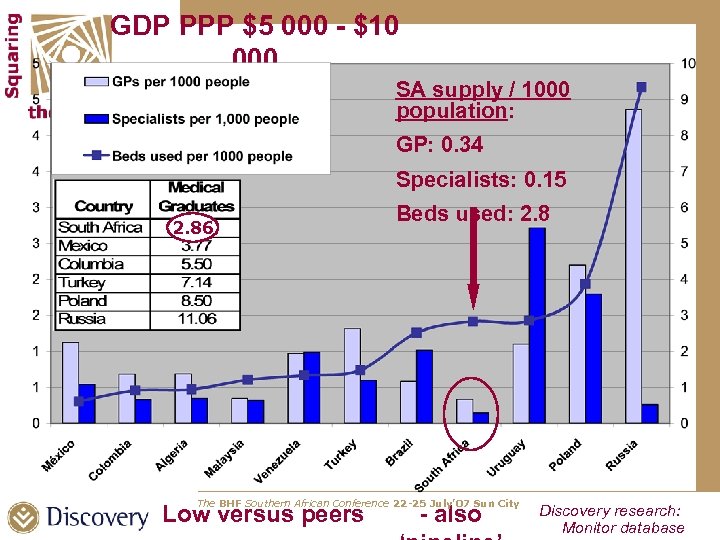 GDP PPP $5 000 - $10 000 SA supply / 1000 population: GP: 0. 34 Specialists: 0. 15 2. 86 Beds used: 2. 8 The BHF Southern African Conference 22 -25 July’ 07 Sun City Low versus peers - also Discovery research: Monitor database
 Medical Education The BHF Southern African Conference 22 -25 July’ 07 Sun City
 The supply of Medical Professionals in SA Nurses: • “Production of new nurses has failed to keep up with the increase in population, let alone with the shortages created by the emigration exodus and the need for new nurses as a result of the HIV pandemic. ” Medical Education: Medical schools enrolments unchanged: 1996 – 2003; except Limpopo ++ Demographics of 2003 enrolment: • Black 41%; White 34%; Indian 18%; Coloured 7% • 54. 6% female ~ worldwide phenomenon and issue re Specialisation: Ø Prof Carol Black; President of Royal College of Physicians: noted that female graduates tended to specialise in areas such as geriatrics and palliative care and avoid cardiology and gastro because of their long hours. Ø Others identified that women are deterred from hospital practice by its Doctors in a “inflexible training and practice” Divided Society The BHF Southern African Conference 22 -25 July’ 07 Sun City Ø UCT case study 2003: undergrad = 63%; MMed = 37%; (HSRC): Breier & Wildschut
 Structural issues The BHF Southern African Conference 22 -25 July’ 07 Sun City
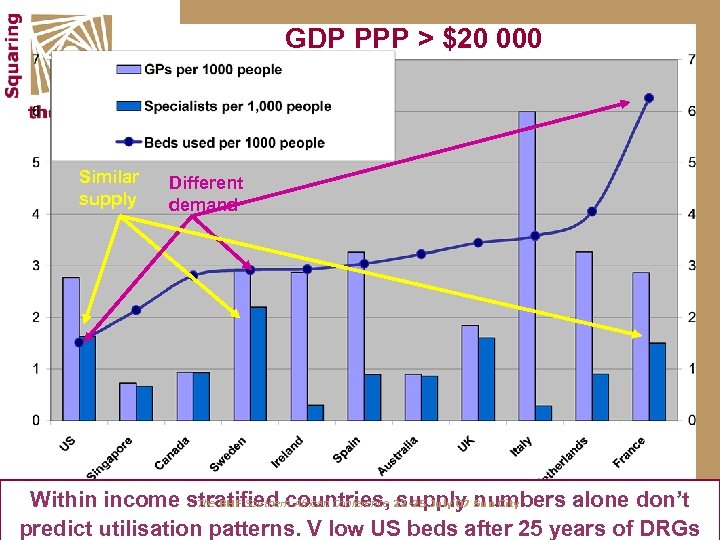 GDP PPP > $20 000 Similar supply Different demand Within income stratified countries, 22 -25 July’ 07 numbers aloneresearch: don’t The BHF Southern African Conference supply Sun City Discovery Monitor DRGs predict utilisation patterns. V low US beds after 25 years ofdatabase
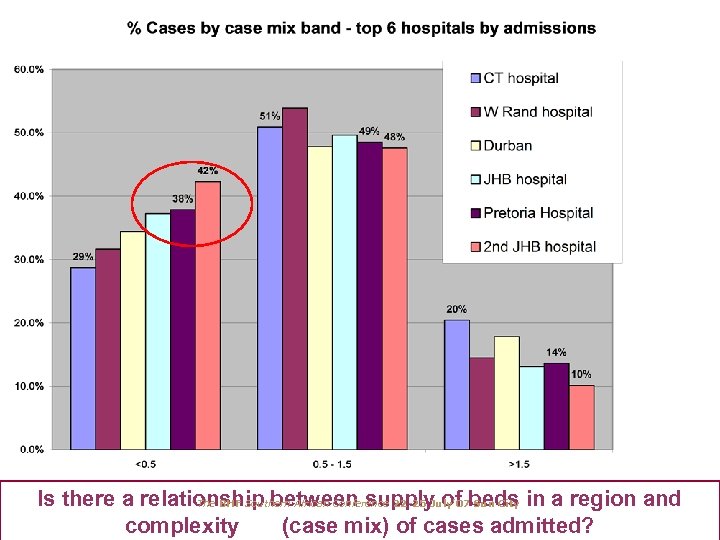 Is there a relationship between supply of beds in a region and The BHF Southern African Conference 22 -25 July’ 07 Sun City Discovery Health complexity (case mix) of cases admitted?
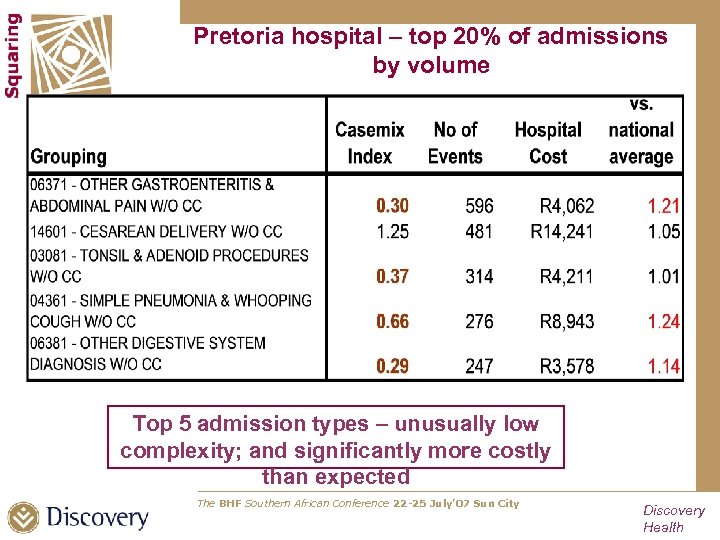 Pretoria hospital – top 20% of admissions by volume Top 5 admission types – unusually low complexity; and significantly more costly than expected The BHF Southern African Conference 22 -25 July’ 07 Sun City Discovery Health
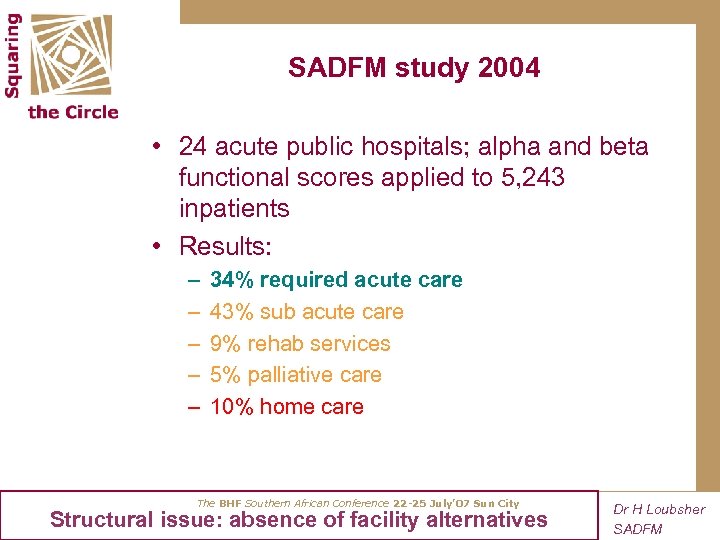 SADFM study 2004 • 24 acute public hospitals; alpha and beta functional scores applied to 5, 243 inpatients • Results: – – – 34% required acute care 43% sub acute care 9% rehab services 5% palliative care 10% home care The BHF Southern African Conference 22 -25 July’ 07 Sun City Structural issue: absence of facility alternatives Dr H Loubsher SADFM
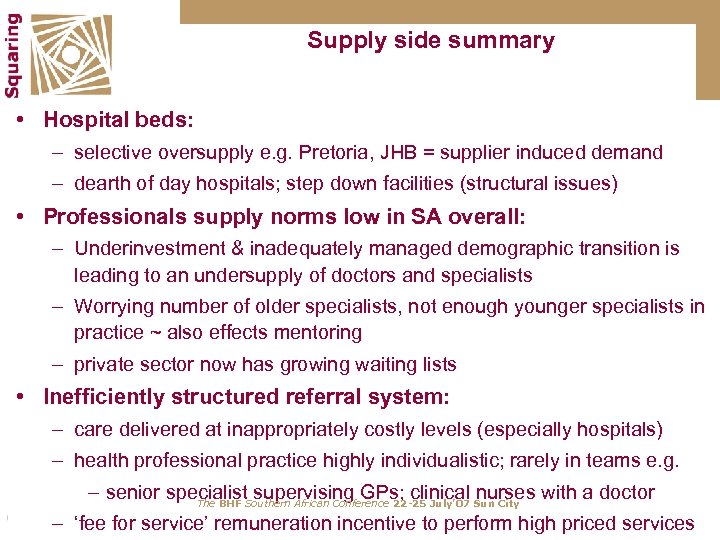 Supply side summary • Hospital beds: – selective oversupply e. g. Pretoria, JHB = supplier induced demand – dearth of day hospitals; step down facilities (structural issues) • Professionals supply norms low in SA overall: – Underinvestment & inadequately managed demographic transition is leading to an undersupply of doctors and specialists – Worrying number of older specialists, not enough younger specialists in practice ~ also effects mentoring – private sector now has growing waiting lists • Inefficiently structured referral system: – care delivered at inappropriately costly levels (especially hospitals) – health professional practice highly individualistic; rarely in teams e. g. – senior specialist. Southern African Conference 22 -25 July’ 07 Sun City with a doctor supervising GPs; clinical nurses The BHF – ‘fee for service’ remuneration incentive to perform high priced services
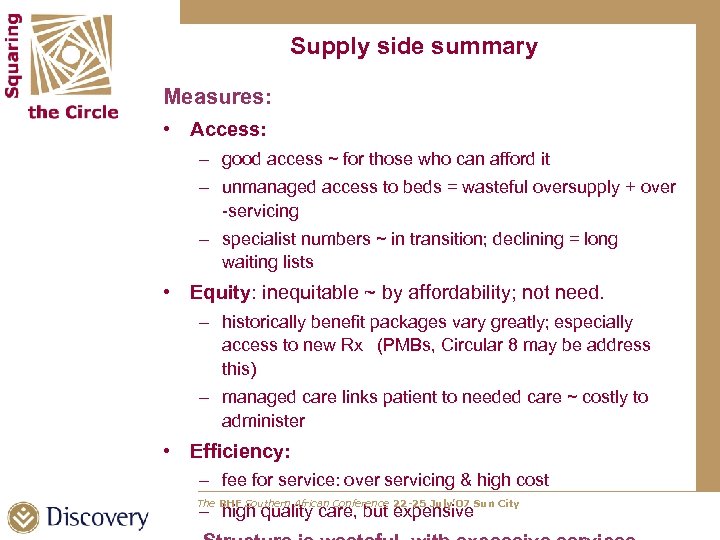 Supply side summary Measures: • Access: – good access ~ for those who can afford it – unmanaged access to beds = wasteful oversupply + over -servicing – specialist numbers ~ in transition; declining = long waiting lists • Equity: inequitable ~ by affordability; not need. – historically benefit packages vary greatly; especially access to new Rx (PMBs, Circular 8 may be address this) – managed care links patient to needed care ~ costly to administer • Efficiency: – fee for service: over servicing & high cost The BHF Southern African Conference 22 -25 July’ 07 Sun City – high quality care, but expensive
 Agenda • Introduction to health sector reform • Supply side issues • Possible responses ~ reform experiences The BHF Southern African Conference 22 -25 July’ 07 Sun City
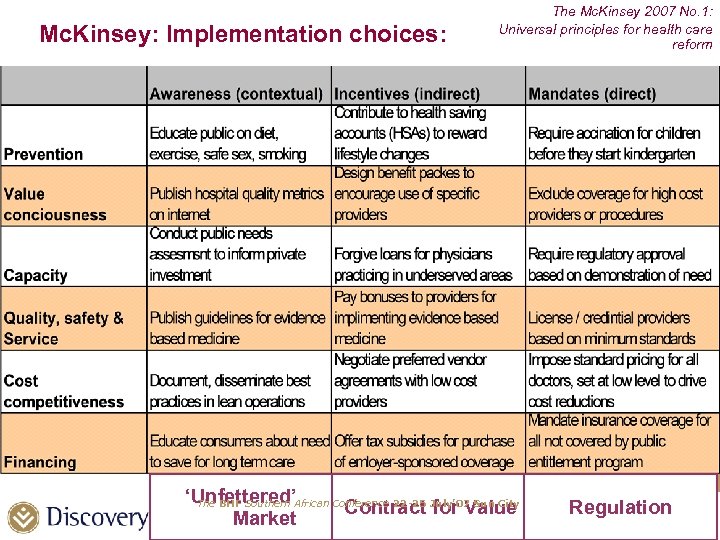 Mc. Kinsey: Implementation choices: The Mc. Kinsey 2007 No. 1: Universal principles for health care reform ‘Unfettered’African Conference 22 -25 July’ 07 Sun City The BHF Southern Contract for Value Market Regulation
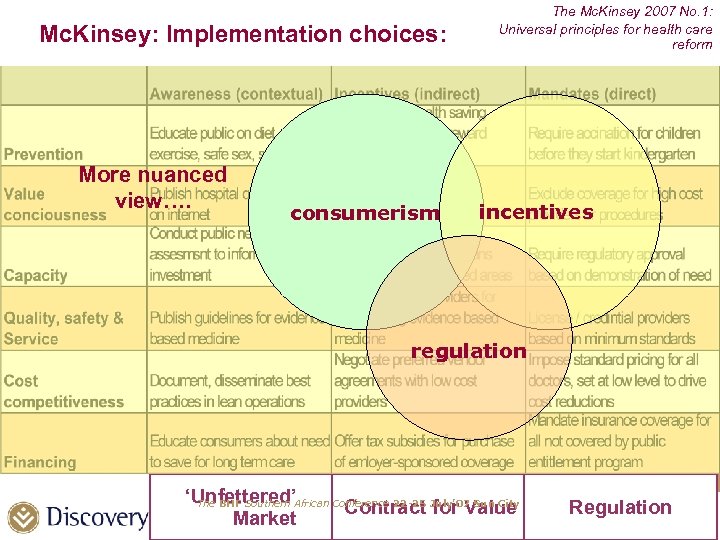 Mc. Kinsey: Implementation choices: More nuanced view…. consumerism The Mc. Kinsey 2007 No. 1: Universal principles for health care reform incentives regulation ‘Unfettered’African Conference 22 -25 July’ 07 Sun City The BHF Southern Contract for Value Market Regulation
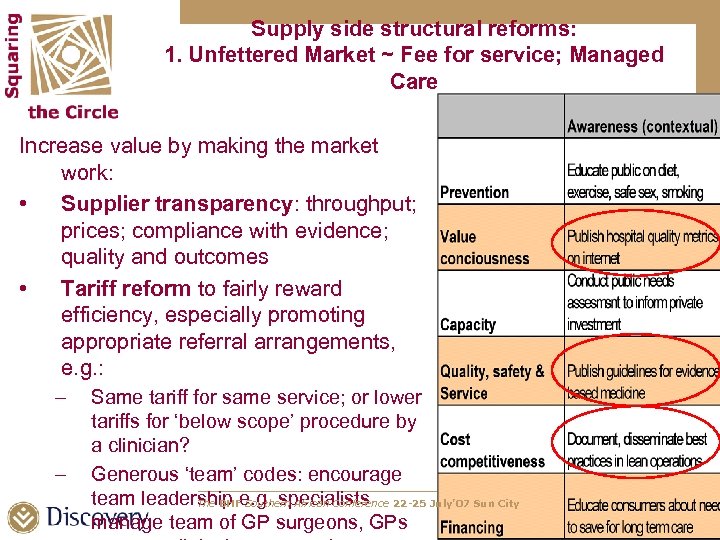 Supply side structural reforms: 1. Unfettered Market ~ Fee for service; Managed Care Increase value by making the market work: • Supplier transparency: throughput; prices; compliance with evidence; quality and outcomes • Tariff reform to fairly reward efficiency, especially promoting appropriate referral arrangements, e. g. : – – Same tariff for same service; or lower tariffs for ‘below scope’ procedure by a clinician? Generous ‘team’ codes: encourage team leadership e. g. specialists 22 -25 July’ 07 Sun City The BHF Southern African Conference manage team of GP surgeons, GPs
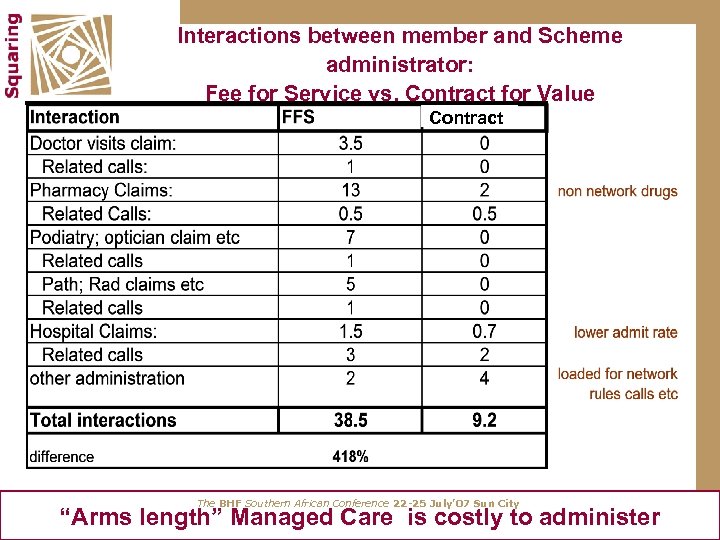 Interactions between member and Scheme administrator: Fee for Service vs. Contract for Value Contract The BHF Southern African Conference 22 -25 July’ 07 Sun City “Arms length” Managed Care is costly to annualised; administer expert opinion
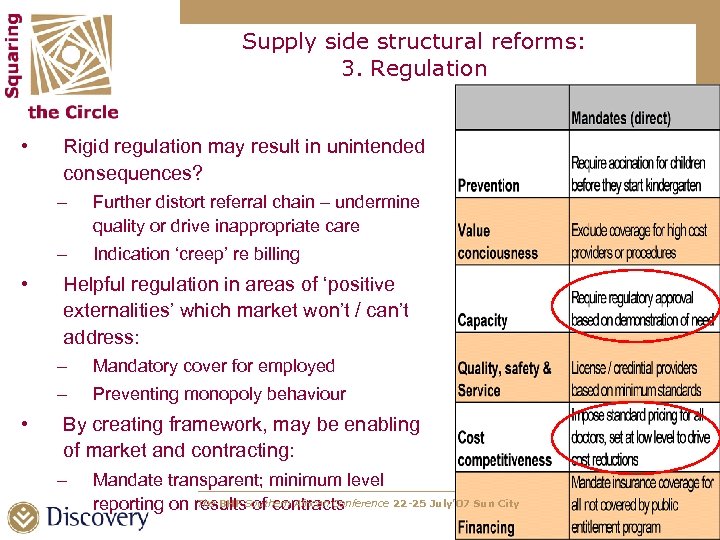 Supply side structural reforms: 3. Regulation • Rigid regulation may result in unintended consequences? – – • Further distort referral chain – undermine quality or drive inappropriate care Indication ‘creep’ re billing Helpful regulation in areas of ‘positive externalities’ which market won’t / can’t address: – – • Mandatory cover for employed Preventing monopoly behaviour By creating framework, may be enabling of market and contracting: – Mandate transparent; minimum level The BHF of contracts reporting on results. Southern African Conference 22 -25 July’ 07 Sun City
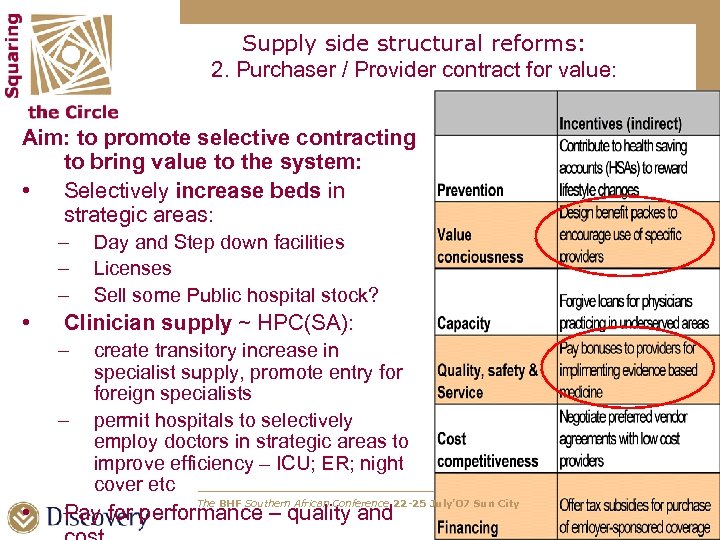 Supply side structural reforms: 2. Purchaser / Provider contract for value: Aim: to promote selective contracting to bring value to the system: • Selectively increase beds in strategic areas: – – – • Clinician supply ~ HPC(SA): – – • Day and Step down facilities Licenses Sell some Public hospital stock? create transitory increase in specialist supply, promote entry foreign specialists permit hospitals to selectively employ doctors in strategic areas to improve efficiency – ICU; ER; night cover etc The BHF Southern African Conference 22 -25 July’ 07 Sun City Pay for performance – quality and
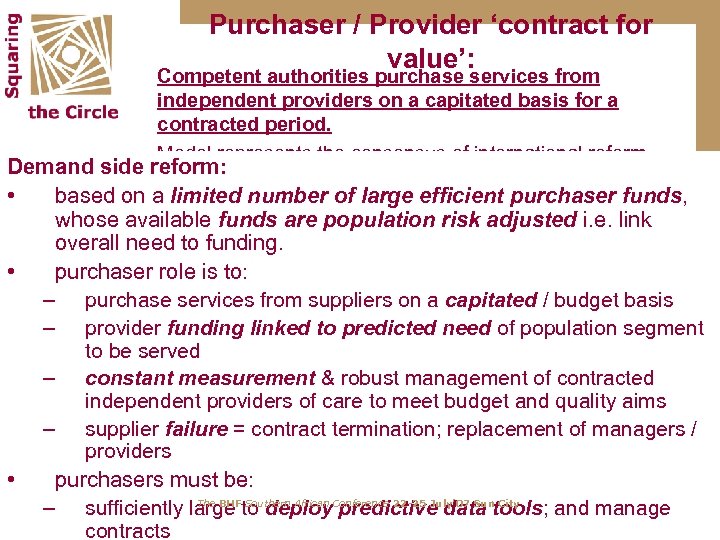 Purchaser / Provider ‘contract for value’: Competent authorities purchase services from independent providers on a capitated basis for a contracted period. Model represents the consensus of international reform Demand side reform: efforts. • • • based on a limited number of large efficient purchaser funds, whose available funds are population risk adjusted i. e. link overall need to funding. purchaser role is to: – purchase services from suppliers on a capitated / budget basis – provider funding linked to predicted need of population segment to be served – constant measurement & robust management of contracted independent providers of care to meet budget and quality aims – supplier failure = contract termination; replacement of managers / providers purchasers must be: The BHF Southern African – sufficiently large to deploy. Conference 22 -25 July’ 07 Suntools; and manage predictive data City contracts
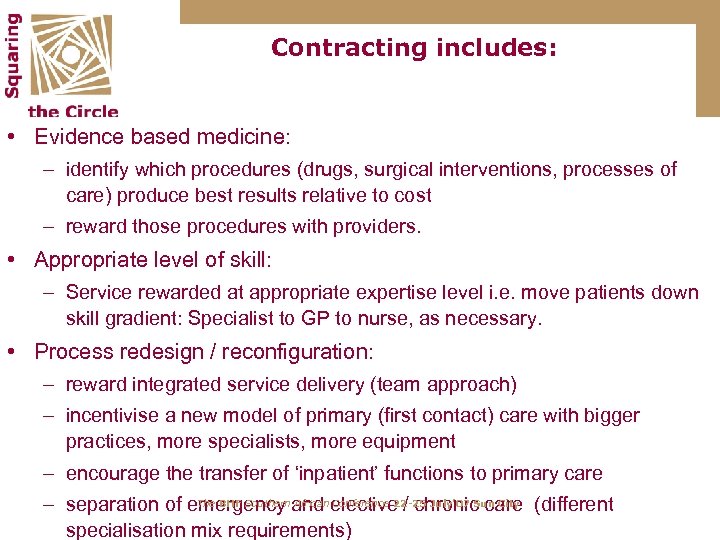 Contracting includes: • Evidence based medicine: – identify which procedures (drugs, surgical interventions, processes of care) produce best results relative to cost – reward those procedures with providers. • Appropriate level of skill: – Service rewarded at appropriate expertise level i. e. move patients down skill gradient: Specialist to GP to nurse, as necessary. • Process redesign / reconfiguration: – reward integrated service delivery (team approach) – incentivise a new model of primary (first contact) care with bigger practices, more specialists, more equipment – encourage the transfer of ‘inpatient’ functions to primary care The BHF Southern African Conference 22 -25 July’ 07 Sun City – separation of emergency and elective / chronic care (different specialisation mix requirements)
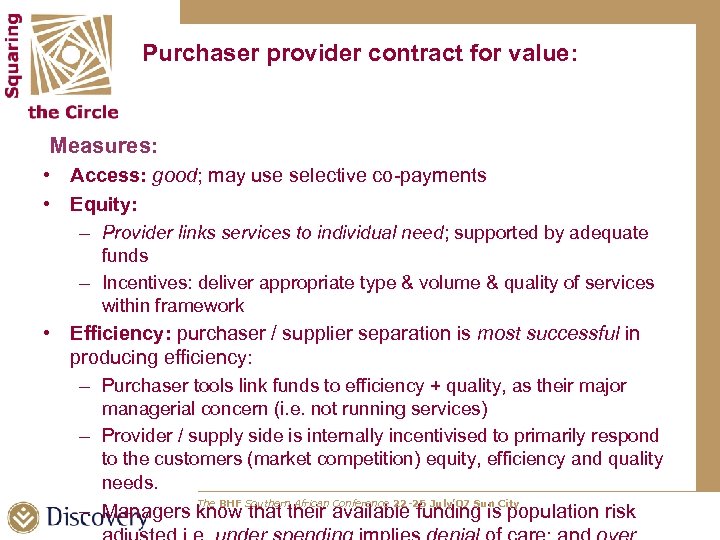 Purchaser provider contract for value: Measures: • Access: good; may use selective co-payments • Equity: – Provider links services to individual need; supported by adequate funds – Incentives: deliver appropriate type & volume & quality of services within framework • Efficiency: purchaser / supplier separation is most successful in producing efficiency: – Purchaser tools link funds to efficiency + quality, as their major managerial concern (i. e. not running services) – Provider / supply side is internally incentivised to primarily respond to the customers (market competition) equity, efficiency and quality needs. The BHF Southern African Conference 22 -25 July’ 07 Sun City – Managers know that their available funding is population risk
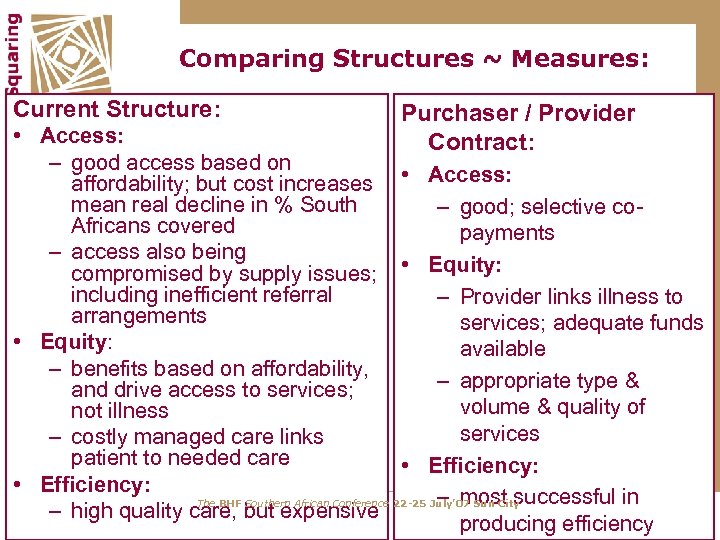 Comparing Structures ~ Measures: Current Structure: Purchaser / Provider Contract: • Access: – good access based on affordability; but cost increases • Access: mean real decline in % South – good; selective co. Africans covered payments – access also being compromised by supply issues; • Equity: including inefficient referral – Provider links illness to arrangements services; adequate funds • Equity: available – benefits based on affordability, – appropriate type & and drive access to services; volume & quality of not illness services – costly managed care links patient to needed care • Efficiency: – most successful in The BHF Southern African Conference 22 -25 July’ 07 Sun City – high quality care, but expensive producing efficiency
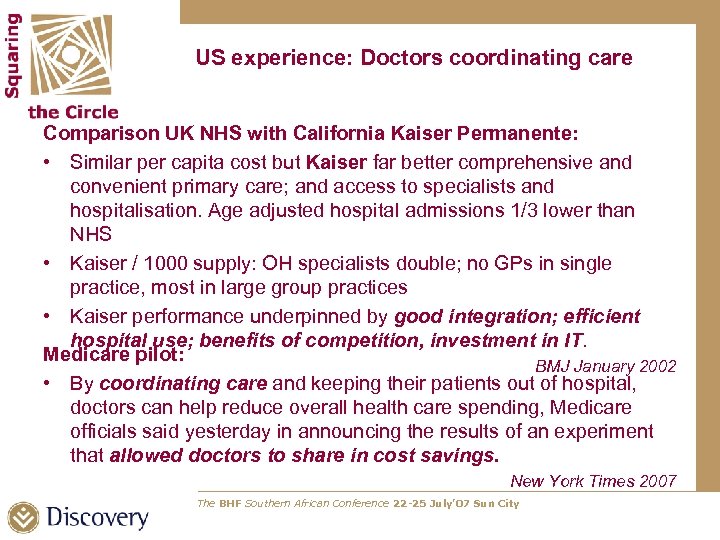 US experience: Doctors coordinating care Comparison UK NHS with California Kaiser Permanente: • Similar per capita cost but Kaiser far better comprehensive and convenient primary care; and access to specialists and hospitalisation. Age adjusted hospital admissions 1/3 lower than NHS • Kaiser / 1000 supply: OH specialists double; no GPs in single practice, most in large group practices • Kaiser performance underpinned by good integration; efficient hospital use; benefits of competition, investment in IT. Medicare pilot: BMJ January 2002 • By coordinating care and keeping their patients out of hospital, doctors can help reduce overall health care spending, Medicare officials said yesterday in announcing the results of an experiment that allowed doctors to share in cost savings. New York Times 2007 The BHF Southern African Conference 22 -25 July’ 07 Sun City
 Contracts Success factors in Contracts • Incentives provided by payment mechanisms • Adequacy of the accompanying monitoring and information systems • Readiness and suitability of the service; the market and the key actors Public Purchaser-Private provider Contracting for Health Services: Inter-American Development Bank Preconditions for market mechanisms in Hospitals: • Funding related to patients treated – incentive to be productive • Selective contracting i. e. feasible alternatives with capacity exists • Hospital information to measure cost and quality Anti-competitive issues include: – Mergers; planning licenses; system wide negotiation; joint hospital and physician negotiations; hospital exclusive / favoured supplier contracts The BHF Southern African Conference 22 -25 July’ 07 Sun City Competition in the provision of
 Risk adjusted purchasing: • DRG implementation by country: – – – USA 1983 Sweden 1985 Finland 1987 Portugal 1989 Canada 1990 UK 1992 Australia; Ireland 1993 Italy; Belgium 1995 France 1997 Denmark; Norway 1999 Singapore early 2000’s Netherlands; Germany; Japan 2003 • Others countries with pilots or investigations: – China; Russia; Brazil etc Analysing Changes in Health Financing Arrangements in High Income countries: Busse et al 2007 World bank HNP: The BHF Southern African Conference 22 -25 July’ 07 Sun City
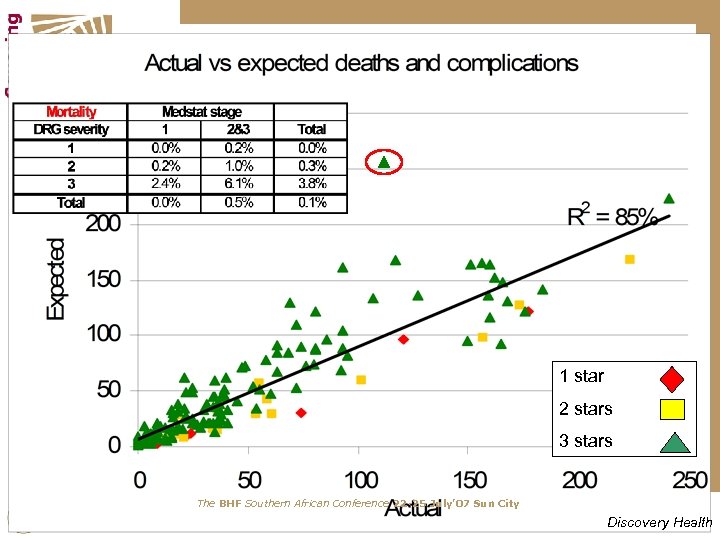 Predicting outcomes 1 star 2 stars 3 stars The BHF Southern African Conference 22 -25 July’ 07 Sun City Discovery Health
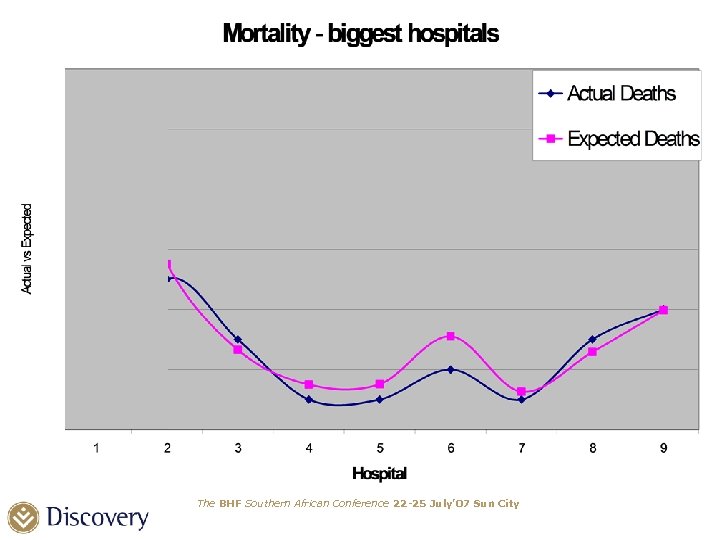 ? The BHF Southern African Conference 22 -25 July’ 07 Sun City
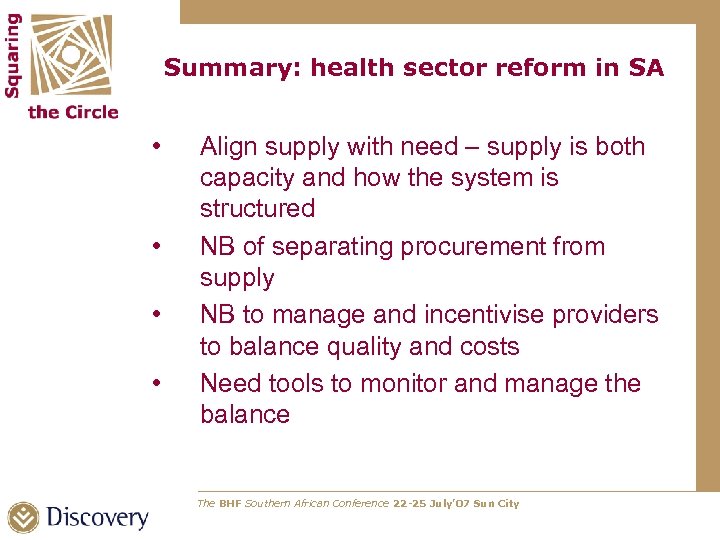 Summary: health sector reform in SA • • Align supply with need – supply is both capacity and how the system is structured NB of separating procurement from supply NB to manage and incentivise providers to balance quality and costs Need tools to monitor and manage the balance The BHF Southern African Conference 22 -25 July’ 07 Sun City
 Thank you The BHF Southern African Conference 22 -25 July’ 07 Sun City