


 Скачать презентацию HEALTH SAFETY SECURITY AT WORK MANAGING RISK
9ceeaec790a52e1afab25b725a9820db.ppt
- Количество слайдов: 102
 HEALTH, SAFETY & SECURITY AT WORK/ MANAGING RISK IN THE WORKPLACE PRESENTER: Naomi Jackson Forrester
 OBJECTIVES • KNOWLEDGE • To bring an awareness to both employees and employers of their roles & responsibilities as it relates to health & safety • Understand the factors that impact the occupational health and safety of employees
 OBJECTIVES PERFORMANCE Identify occupational illnesses Minimize unsafe acts by employees Formulate strategies to provide a safer environment for employees • ATTITUDE • Appreciate the supervisor’s role in safety • •
 QUIZ • Safety and accident prevention is the responsibility of whom? • Are work-related accidents are on the decline? • Should only major injuries and accidents in the office be reported? • Are injuries usually confined to “unsafe” industries like mining and construction?
 HEALTH, SAFETY & SECURITY AT WORK Definitions HEALTH- Soundness of body, mind and spirit. Free from illness, injury or pain. A state of complete physical, mental, and social wellbeing and not merely the absence of disease or infirmity. (WHO) SAFETY- Freedom from danger or risks
 HEALTH, SAFETY & SECURITY AT WORK Definitions SECURITY- Untroubled by danger; involves measures taken to protect against theft, espionage, unauthorised access and so on. HAZARD- a thing likely to cause injury, or a point of exposure to risk of accident, injury or loss.
 DEFINITION OF OCCUPATIONAL HEALTH AND SAFETY • The maintenance of a working environment, which is conducive to the health and safety of all employees and • takes into account the possible risks within the work environment to which employees may be exposed, either directly or indirectly.
 DEFINING A HEALTHY COMPANY The principles of a healthy company include: a safe working environment; healthy working practices; programs to promote health and to address psychosocial risk factors at the workplace; • health impact assessment for marketed products; • and contribution to health and social development in the community. (WHO Glossary of Health Promotion Terminology) • •
 • Activity- What are the hazards that may be identified within an organisation? • Each participant is required to identify at least (two) 2 hazards that may be found in their organisation. • These should be added to the class list
 The Work Environment • Other than the home it is the setting in which many people spend the largest amount of time • Contributes to good health and economic achievements • May expose many workers to health hazards: – – – – Injuries Respiratory and Cardiovascular diseases Cancer Musculoskeletal and Reproductive disorders Mental and neurological illnesses Eye damage and Hearing loss Communicable diseases
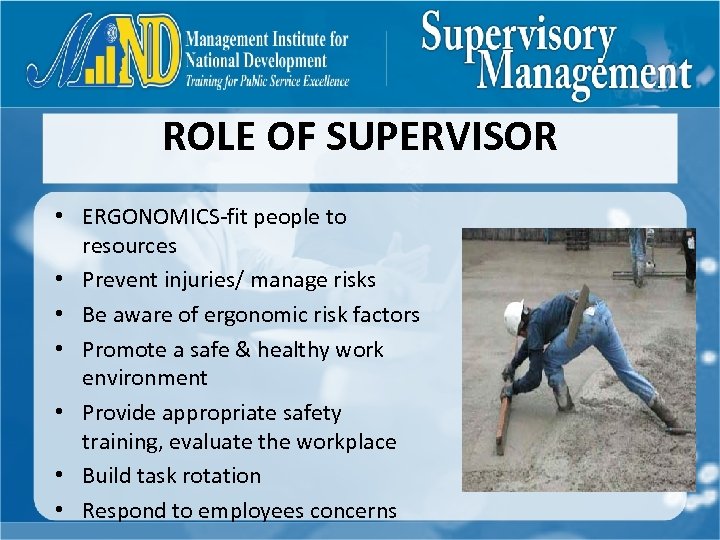 ROLE OF SUPERVISOR • ERGONOMICS-fit people to resources • Prevent injuries/ manage risks • Be aware of ergonomic risk factors • Promote a safe & healthy work environment • Provide appropriate safety training, evaluate the workplace • Build task rotation • Respond to employees concerns
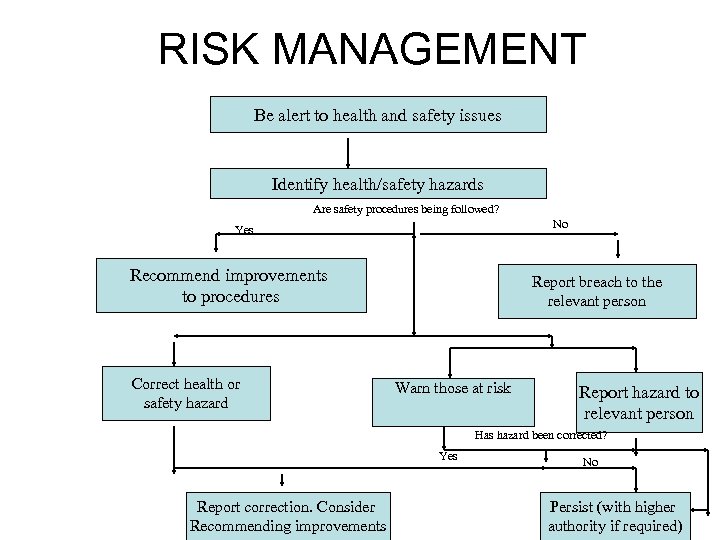 RISK MANAGEMENT Be alert to health and safety issues Identify health/safety hazards Are safety procedures being followed? No Yes Recommend improvements to procedures Correct health or safety hazard Report breach to the relevant person Warn those at risk Report hazard to relevant person Has hazard been corrected? Yes Report correction. Consider Recommending improvements No Persist (with higher authority if required)
 LEGAL ASPECTS • • • EMPLOYEES Take reasonable care to avoid injury to yourself and others Co-operate with your employer Use all equipment, safety devices etc. properly No Smoking No substance abuse • • • EMPLOYERS Safety Policy Produce a written statement of safety measures Consult safety representatives Appoint a safety committee
 DUTIES OF EMPLOYERS- The Work Environment • CLEANLINESS-Floors, furniture, bins • OVERCROWDING- 11 cubic metres • VENTILATION • TEMPERATURE • LIGHTING & WINDOWS • TOILETS & WASHING FACILITIES • DRINKING WATER • CLOTHING FACILITIES • SEATING • EATING FACILITIES • LIFTS, ESCALATORS TRAVELATORS • FLOORS, PASSAGES AND STAIRS • DOORS & GATES/TRAFFIC ROUTES • MACHINERY & EQUIPMENT • FIRE PRECAUTIONS • FIRST AID
 FURTHER CONSIDERATIONS • • • Chemicals Noise Computer Workstations Decor Office layout • • Heavy Lifting *Stress Evacuation Procedures Reporting procedures
 LEADING CAUSES OF ACCIDENTS THE JAMAICAN EXPERIENCE What are the leading causes of accidents in the Jamaican workplace? What laws exist to regulate health and safety in Jamaica? What guidelines/regulations exist in your organisation to govern health, safety and security matters?
 JAMAICA’S LEGAL STATUS • The main Act is entitled the Factories Act and its accompanying regulations are: • The Factories Regulations 1961 • The Building Operations and Works of Engineering Construction 1968 • The Ship and Docks Regulations 1968 • The Act and its associated Regulations covers industrial type establishments and activities in its application.
 JAMAICA’S LEGAL STATUS • On April 4, 2017, the Ministry has been succesful in tabling the new safety and health legislation entitled the Occupational Safety and Health Act, 2017. • This Act will be more far reaching in its jurisdiction than the present Act by covering all areas of economic activity on enactement.
 FRAMEWORK FOR OSH • There will be six elements • 1. Leadership and Employee Participation – Management Leadership – Employee Participation – Implementation – Contractor Safety
 FRAMEWORK FOR OSH • 2. Workplace Analysis – Survey and hazard analysis – Inspection – Hazard reporting • 3. Accident and record analysis – Accident investigation – Data analysis
 FRAMEWORK FOR OSH • 4. Hazard prevention and control – Hazard control – Maintenance – Medical and wellness programme • 5. Emergency Response – Emergency preparedness – First aid • 6. Safety and health training
 ACCIDENTS STATISTICS • ‘The Ministry of Labour and Social Security is reporting a decrease in workplace accidents last fiscal year. ’ • According to the Ministry’s annual report for 2014, there was a 30. 3 per cent drop in the number of reported accidents at workplaces when compared to 2013/14. • There were 383 reported accidents in the 2013/14 fiscal year compared to 267 last year.
 ACCIDENTS STATISTICS- Economic and Social Survey 2016 • There has been an increase in workplace accidents in Jamaica. • According to the report, 347 workplace accidents were reported to the Ministry of Labour last year. This was up from 280 in 2015. • The number of accidents which qualified for investigation by the Ministry increased to 206 from 168.
 ACCIDENTS STATISTICS- Economic and Social Survey 2016 • There were 179 accidents investigated up from 74 in 2015. • There were three job-related deaths during 2016 compared to four in the previous year. • 2, 423 inspections were conducted by the Ministry’s Occupational Health and Safety Department last year, up from 2, 260 in 2015. • The majority of inspections - registered factories, building sites as well as ships.
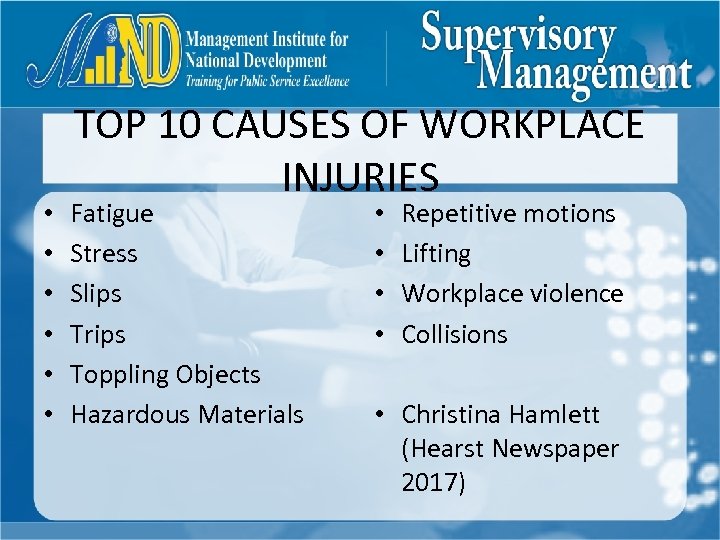 • • • TOP 10 CAUSES OF WORKPLACE INJURIES Fatigue Stress Slips Trips Toppling Objects Hazardous Materials • • Repetitive motions Lifting Workplace violence Collisions • Christina Hamlett (Hearst Newspaper 2017)
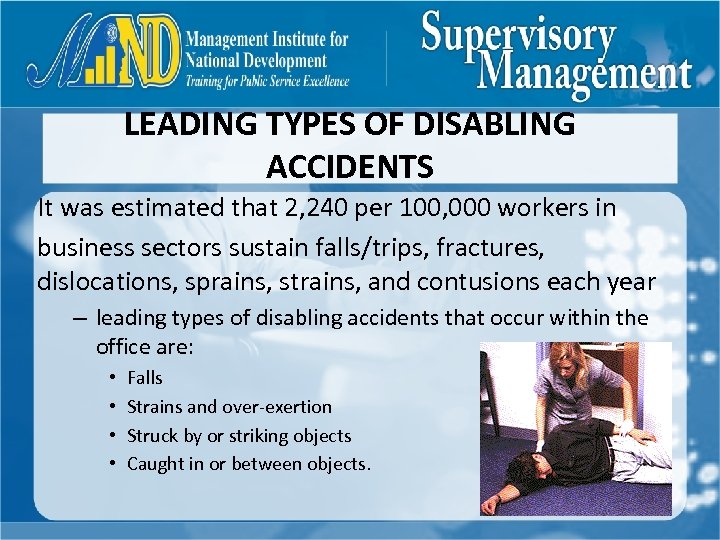 LEADING TYPES OF DISABLING ACCIDENTS It was estimated that 2, 240 per 100, 000 workers in business sectors sustain falls/trips, fractures, dislocations, sprains, strains, and contusions each year – leading types of disabling accidents that occur within the office are: • • Falls Strains and over-exertion Struck by or striking objects Caught in or between objects.
 LEADING TYPES OF DISABLING ACCIDENTS • Office workers are also injured as a result of – – foreign substances in the eye spilled hot liquids burns from fire and electric shock. • In recent years, illness has increased among the office worker population: – increased presence of environmental toxins within the office – to stress-producing factors associated with the automated office • respiratory problems, skin diseases, and stress-related conditions
 AREAS OF OCCUPATIONAL HEALTH AND SAFETY • • • Managing Indoor Air quality Chemicals and other Hazardous Substances Ergonomics Estate Management Emergency and Disaster Management
 CONCEPTS AND CONCERNS • • Building Related Illnesses Carcinogens Environmental Illness Hazardous Chemicals Health Indoor Air Quality Multiple Chemical Sensitivity Sick Building Syndrome
 OTHER CONCEPTS AND CONCERNS • • Acute Exposure Chronic Exposure Cumulative Exposure Ergonomics Green Building Musculoskeletal Injuries (MSI) Occupational Lung Disease
 SICK BUILDING SYNDROME • The term "sick building syndrome" (SBS) is used to describe situations in which building occupants experience acute health and comfort effects that appear to be linked to time spent in a building, but no specific illness or cause can be identified. • The complaints may be localized in a particular room or zone, or may be widespread throughout the building
 INDICATORS OF SBS • Building occupants complain of symptoms associated with acute discomfort, e. g. , headache; eye, nose, or throat irritation; dry cough; dry or itchy skin; dizziness and nausea; difficulty in concentrating; fatigue; and sensitivity to odors. • The cause of the symptoms is not known. • Most of the complainants report relief soon after leaving the building.
 BUILDING RELATED ILLNESS • The term "building related illness" (BRI) is used when symptoms of diagnosable illness are identified and can be attributed directly to airborne building contaminants.
 BRI • Indicators of BRI include: • Building occupants complain of symptoms such as cough; chest tightness; fever, chills; and muscle aches. • The symptoms can be clinically defined and have clearly identifiable causes. • Complainants may require prolonged recovery times after leaving the building.
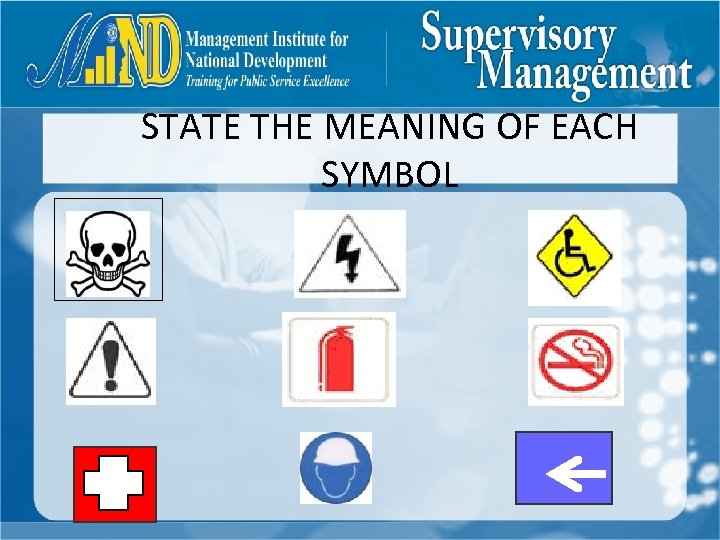 STATE THE MEANING OF EACH SYMBOL
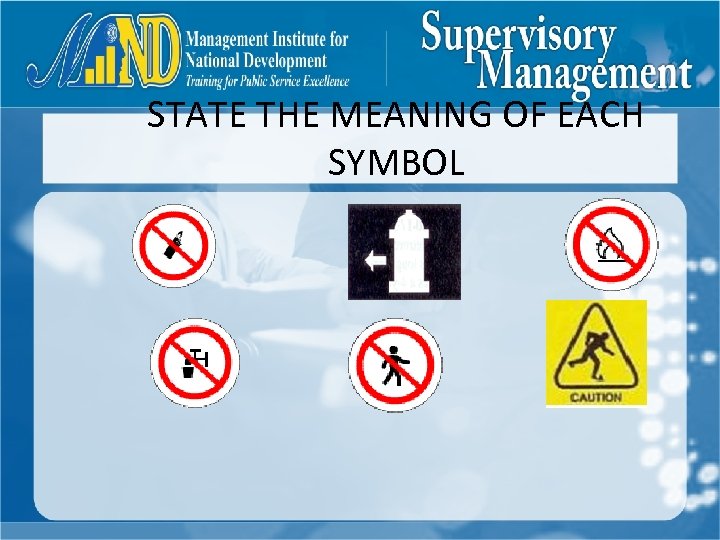 STATE THE MEANING OF EACH SYMBOL
 IMPORTANCE OF OCCUPATIONAL HEALTH AND SAFETY • Encompasses the social, mental and physical wellbeing of workers of all occupations • 75% of global workforce reside in developing countries • Workplace environmental hazards threaten a large proportion of the world population • 1. 1 million people per year are estimated to die from work-related injuries and diseases
 BENEFITS OF OCCUPATIONAL HEALTH AND SAFETY • Achievement of higher employee comfort and productivity • Reduced health insurance premiums • Reduction in lost working hours • Reduced costs associated with disaster clean up
 OCCUPATIONAL HEALTH AND SAFETY IN THE OFFICE • Exposure to chemical hazards from office machines and janitorial cleaning products • Poor indoor air quality • Poor lighting • Noise • Poorly designed furniture • Stress
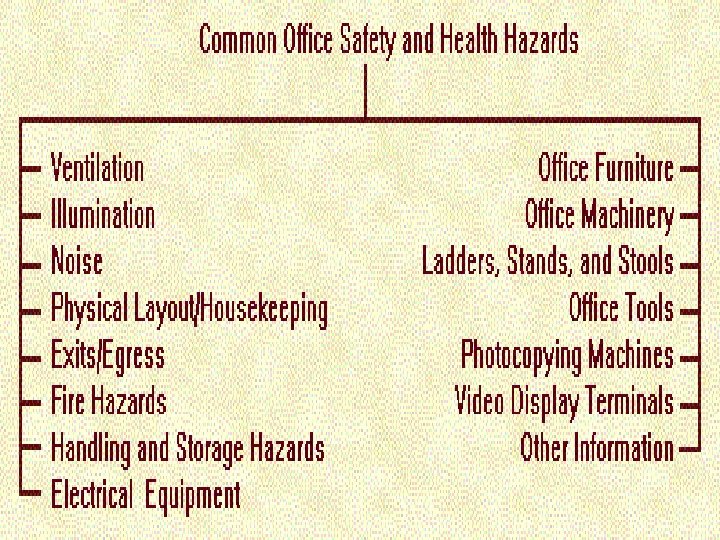
 COMMON OFFICE SAFETY AND HEALTH HAZARDS – VENTILATION • Sources of air pollution include: – Natural agents (e. g. , carbon monoxide, microorganisms, radon) • Synthetic chemicals – (e. g. , formaldehyde, cleaning fluids, cigarette smoke, asbestos). • An adequate office ventilation system which delivers quality indoor air and provides for comfortable humidity and temperature is a necessity.
 COMMON OFFICE SAFETY AND HEALTH HAZARDS – VENTILATION • Where printing or copying machines are present, an exhaust ventilation system which draws particulates and gases away from the employees' breathing zone should be present. Office machines and ventilation system components should be checked and maintained on a regular basis.
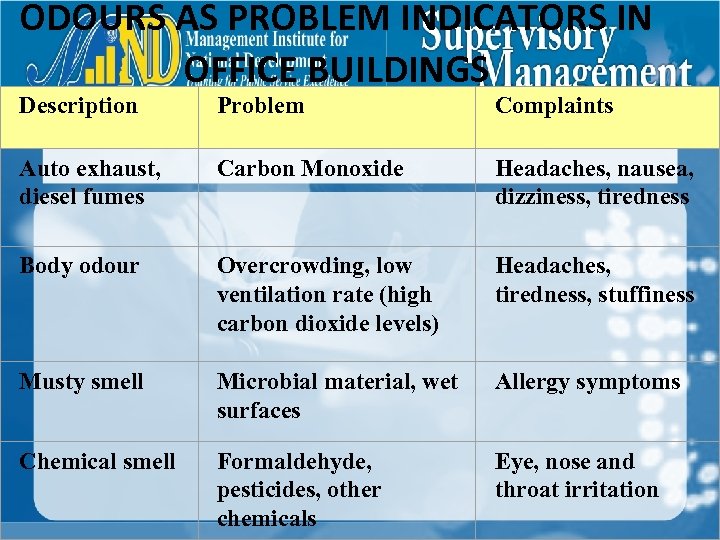 ODOURS AS PROBLEM INDICATORS IN OFFICE BUILDINGS Description Problem Complaints Auto exhaust, diesel fumes Carbon Monoxide Headaches, nausea, dizziness, tiredness Body odour Overcrowding, low ventilation rate (high carbon dioxide levels) Headaches, tiredness, stuffiness Musty smell Microbial material, wet surfaces Allergy symptoms Chemical smell Formaldehyde, pesticides, other chemicals Eye, nose and throat irritation
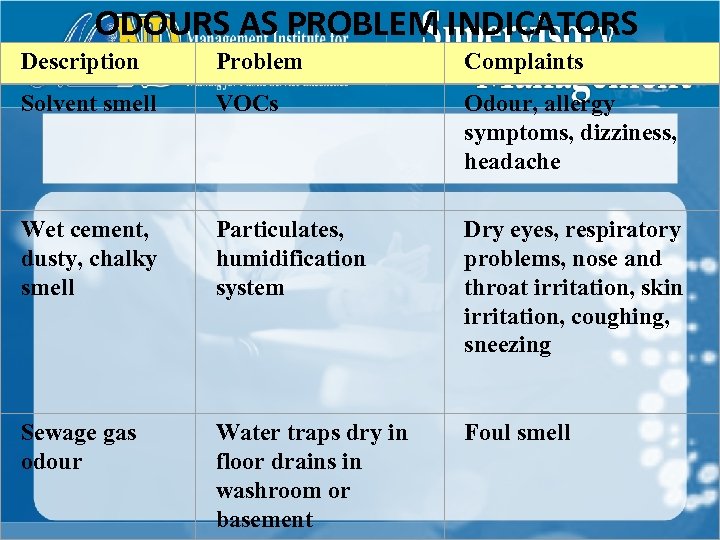 ODOURS AS PROBLEM INDICATORS Description Problem Complaints Solvent smell VOCs Odour, allergy symptoms, dizziness, headache Wet cement, dusty, chalky smell Particulates, humidification system Dry eyes, respiratory problems, nose and throat irritation, skin irritation, coughing, sneezing Sewage gas odour Water traps dry in floor drains in washroom or basement Foul smell
 COMMON OFFICE SAFETY AND HEALTH HAZARDS – ILLUMINATION • Lighting problems in the office cause: – Glare – Shadows – Visual problems (i. e. , eyestrain, fatigue, double-vision, etc. ). • Poor lighting also can be a contributing factor in accidents. • Controls to prevent poor lighting conditions include: – – Regular maintenance of the lighting system Light-colored dull finish on walls, ceilings, and floors to reduce glare Adjustable shades on windows Indirect lighting.
 COMMON OFFICE SAFETY AND HEALTH HAZARDS – NOISE In an office, workers can be subjected to many noise sources, such as: • Video display terminals • High-speed printers • Telephones • Human voices. Noise can produce tension and stress, as well as damage to hearing.
 COMMON OFFICE SAFETY AND HEALTH HAZARDS – NOISE Some of the numerous measures available to control unwanted noise include: • Place noisy machines in an enclosed space • Use carpeting, draperies, and acoustical ceiling tiles to muffle noise • Adjust telephone volume to its lowest level • Rearrange traffic routes within the office to reduce traffic within and between work areas.
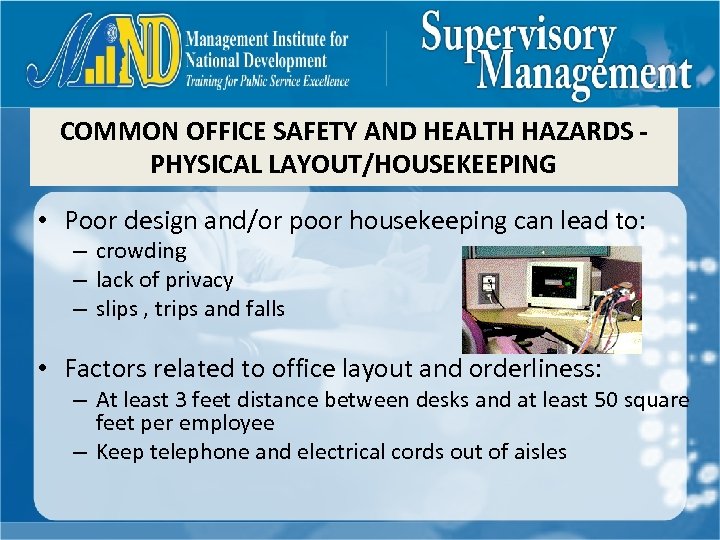 COMMON OFFICE SAFETY AND HEALTH HAZARDS PHYSICAL LAYOUT/HOUSEKEEPING • Poor design and/or poor housekeeping can lead to: – crowding – lack of privacy – slips , trips and falls • Factors related to office layout and orderliness: – At least 3 feet distance between desks and at least 50 square feet per employee – Keep telephone and electrical cords out of aisles
 COMMON OFFICE SAFETY AND HEALTH HAZARDS PHYSICAL LAYOUT/HOUSEKEEPING Factors related to office layout and orderliness: • Group employees who use the same machines • Office machines should be kept away from edges of desks and tables • Regular inspection, repair, and replacement of faulty carpets • Place mats inside building entrances • Proper placement of electrical, telephone, and computer wires.
 COMMON OFFICE SAFETY AND HEALTH HAZARDS - EXITS/EGRESS • Blocked or improperly planned means of egress can lead to injuries as a result of slips, trips, and falls. • If, during an emergency, employees become trapped due to improper egress, more serious injuries or fatalities may result.
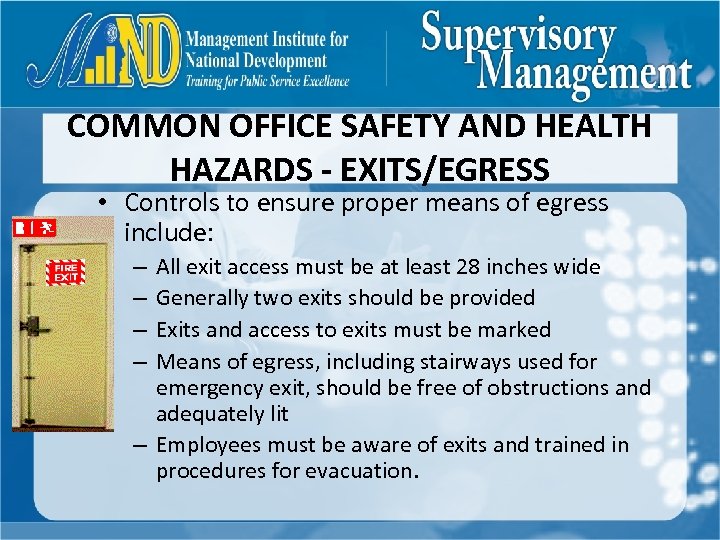 COMMON OFFICE SAFETY AND HEALTH HAZARDS - EXITS/EGRESS • Controls to ensure proper means of egress include: All exit access must be at least 28 inches wide Generally two exits should be provided Exits and access to exits must be marked Means of egress, including stairways used for emergency exit, should be free of obstructions and adequately lit – Employees must be aware of exits and trained in procedures for evacuation. – –
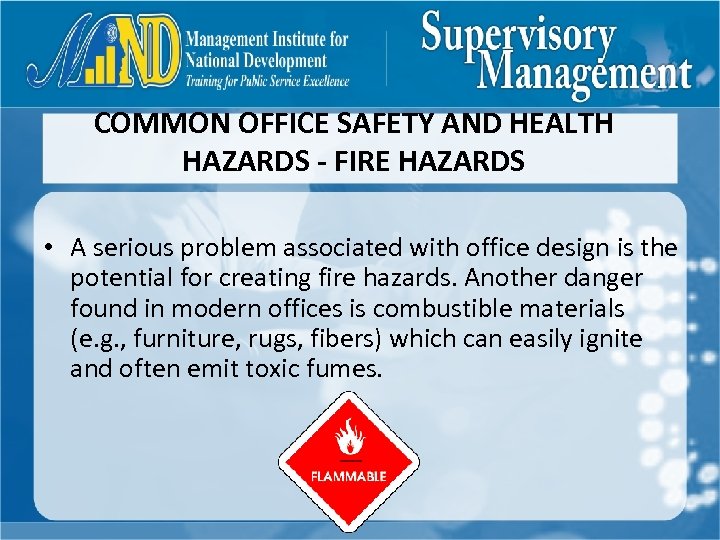 COMMON OFFICE SAFETY AND HEALTH HAZARDS - FIRE HAZARDS • A serious problem associated with office design is the potential for creating fire hazards. Another danger found in modern offices is combustible materials (e. g. , furniture, rugs, fibers) which can easily ignite and often emit toxic fumes.
 COMMON OFFICE SAFETY AND HEALTH HAZARDS - FIRE HAZARDS • A number of steps can be taken to reduce office fire hazards: • Store unused records/papers in fire resistant files or vaults • Use flame-retardant materials • Smoke only in designated areas and use proper ashtrays • Fire extinguishers and alarms should be conspicuously placed and accessible
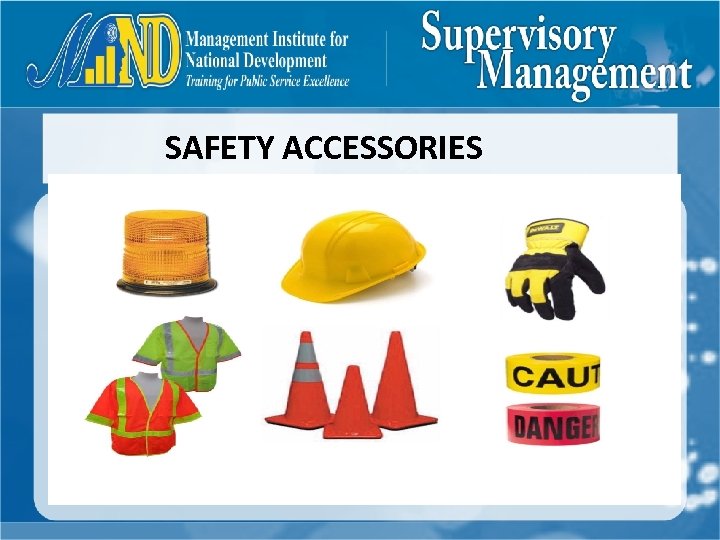 SAFETY ACCESSORIES
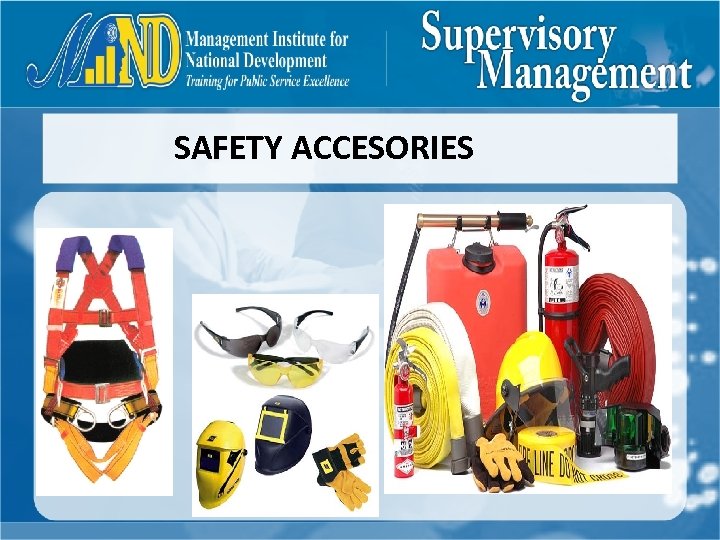 SAFETY ACCESORIES
 COMMON OFFICE SAFETY AND HEALTH HAZARDS HANDLING AND STORAGE HAZARDS • Improper lifting can cause musculoskeletal disorders such as: – sprains, strains, and inflamed joints • Office materials that are improperly stored can lead to: – objects falling on workers – poor visibility – fires. • Controls which can reduce handling and storage hazards: – Materials should not be stored on top of cabinets. – Heavy objects should be stored on lower shelves and materials stacked neatly.
 COMMON OFFICE SAFETY AND HEALTH HAZARDS HANDLING AND STORAGE HAZARDS • Controls which can reduce handling and storage hazards: Materials should be stored inside cabinets, files, or lockers whenever possible. Materials must not be stored in aisles, corners, or passageways. Fire equipment should remain unobstructed. Flammable and combustible materials must be identified and properly stored. Material Safety Data Sheets must be provided for each hazardous chemical identified. – An effective control program incorporating employee awareness and training and ergonomic design of work tasks can reduce back injuries. – – –
 COMMON OFFICE SAFETY AND HEALTH HAZARDS ELECTRICAL EQUIPMENT • Electrical accidents in an office usually occur as a result of: – faulty or defective equipment – unsafe installation – misuse of equipment • The following should be adhered to when installing or using electrical equipment: – Equipment must be properly grounded to prevent shock injuries – A sufficient number of outlets will prevent circuit overloading
 COMMON OFFICE SAFETY AND HEALTH HAZARDS - ELECTRICAL EQUIPMENT The following should be adhered to when installing or using electrical equipment: • Avoid the use of poorly maintained or non-approved equipment • Cords should not be dragged over nails, hooks, or other sharp objects • Receptacles should be installed and electric equipment maintained so that no live parts are exposed • Machines should be disconnected before cleaning or adjusting. Generally, machines and equipment should be locked or tagged out during maintenance.
 COMMON OFFICE SAFETY AND HEALTH HAZARDS OFFICE FURNITURE • Defective furniture or misuse of chairs or file cabinets by office workers can lead to serious injuries • Controls related to chairs and cabinets: – Chairs should be properly designed and regularly inspected for missing casters, shaky legs, and loose parts – Do not lean back in a chair with your feet on a desk
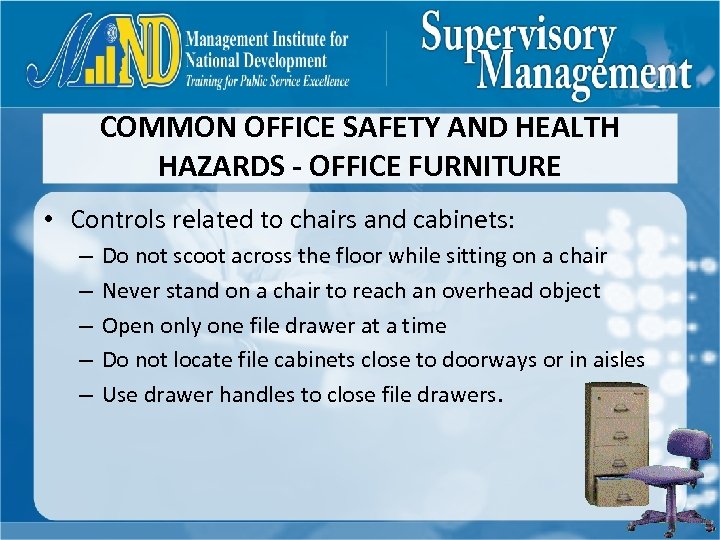 COMMON OFFICE SAFETY AND HEALTH HAZARDS - OFFICE FURNITURE • Controls related to chairs and cabinets: – – – Do not scoot across the floor while sitting on a chair Never stand on a chair to reach an overhead object Open only one file drawer at a time Do not locate file cabinets close to doorways or in aisles Use drawer handles to close file drawers.
 COMMON OFFICE SAFETY AND HEALTH HAZARDS - OFFICE MACHINERY • Machines with ingoing nip points or rotating parts can cause: – lacerations, abrasions, fractures, and amputations if not adequately guarded. • Machines such as conveyors, electric hole punches, and paper shredders with hazardous moving parts must be guarded so that office workers cannot contact the moving parts. • Fans must have substantial bases and fan blades must be properly guarded.
 COMMON OFFICE SAFETY AND HEALTH HAZARDS LADDERS, STANDS, AND STOOLS • Improper use of ladders, ladder stands, and stools can lead to falls. • The following controls will help reduce ladder related injuries: – Workers should always face the ladder when climbing up or down – Ladders should be inspected regularly to ensure they are in good condition – The top of a ladder should not be used as a step – Ladders must only be used when they are fully open and the spreaders are locked.
 COMMON OFFICE SAFETY AND HEALTH HAZARDS - OFFICE TOOLS Misuse of office tools, such as pens, pencils, paper, letter openers, scissors, and staplers, can cause cuts, punctures, and related infections.
 COMMON OFFICE SAFETY AND HEALTH HAZARDS - OFFICE TOOLS Injuries can be prevented by following precautions when using these materials: • Paper cutters - Keep blade closed when not in use. A guard should be provided and fingers should be kept clear • Staplers - Always use a staple remover. Never test a jammed stapler with your thumb • Pencils, pens, scissors, etc. - Store sharp objects in a drawer or with the point down. Never hand someone a sharp object point first.
 COMMON OFFICE SAFETY AND HEALTH HAZARDS PHOTOCOPYING MACHINES • Potential health hazards associated with photocopying machines include: – Toxic chemicals – Excessive noise – Intense light. – Source of indoor air pollution when used in offices that are not well ventilated.
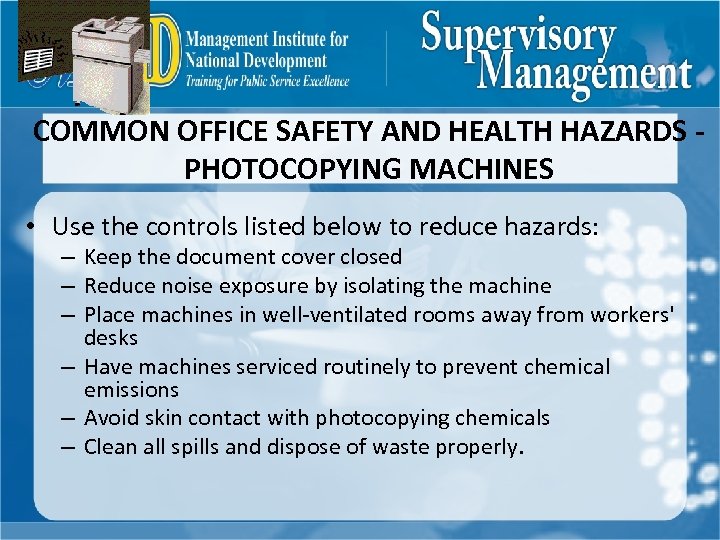 COMMON OFFICE SAFETY AND HEALTH HAZARDS PHOTOCOPYING MACHINES • Use the controls listed below to reduce hazards: – Keep the document cover closed – Reduce noise exposure by isolating the machine – Place machines in well-ventilated rooms away from workers' desks – Have machines serviced routinely to prevent chemical emissions – Avoid skin contact with photocopying chemicals – Clean all spills and dispose of waste properly.
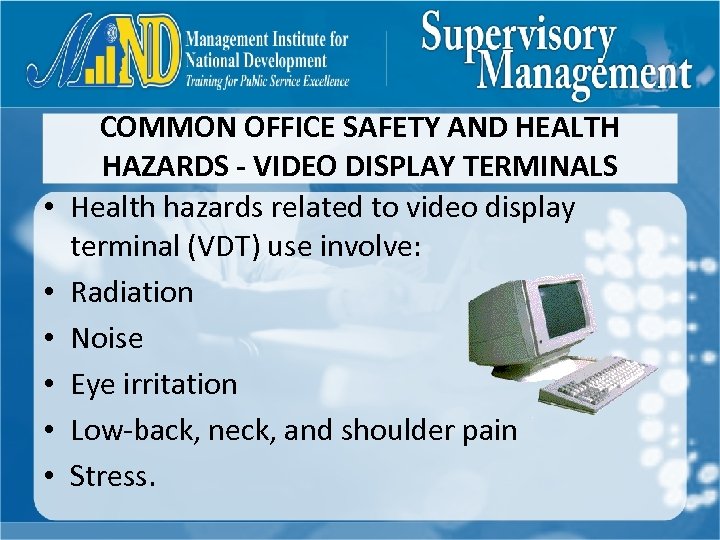 • • • COMMON OFFICE SAFETY AND HEALTH HAZARDS - VIDEO DISPLAY TERMINALS Health hazards related to video display terminal (VDT) use involve: Radiation Noise Eye irritation Low-back, neck, and shoulder pain Stress.
 COMMON OFFICE SAFETY AND HEALTH HAZARDS - OTHER INFORMATION • Safety in the office is critical. • Some people have difficulty implementing safety and health in their daily work activities. For this reason, it may be easier to learn from some examples and get guidance by following specific procedures. • These techniques help demonstrate and identify safe and unsafe work practices, and therefore reduce the number of hazards.
 WORKPLACE STRESS • Stress and the related physical & mental illnesses is now a primary cause of lost work hours. • Causes- work overload ( insufficient regular breaks, rest, exercise & non-work activities); – – – work ‘underload’-boredom; poor management style; isolation; bullying, harassment or discrimination; uncertainty & insecurity; personality factors and non-work factors- bereavement, illness, financial or relationship difficulties.
 WORKPLACE STRESS • Signs- irritability & mood swings; – sleeplessness; – skin & digestive disorders/other physical symptoms; – withdrawal; – substance abuse; – apathy; – changes in behaviour at work
 OCCUPATIONAL ILLNESS • Any abnormal condition or disorder caused by exposure to environmental factors associated with employment • Give some examples of occupational illnesses that you have experienced at your current or previous job.
 TECHNOLOGY-BASED ILLNESSES • New Health concerns – Sick building syndrome • Headaches and sniffles • Poor ventilation, dust fumes from on-site irritants • New computer emit chemical fumes – High levels of stress • Organization’s culture • Personality of employee
 TECHNOLOGY-BASED ILLNESSES • • • Repetitive Strain Injuries Visual dysfunction Musculoskeletal Problems Emotional Disturbances Psychosocial disturbances Illness at the work Site
 REPETITIVE STRAIN INJURIES • Fastest-growing health danger in the workplace • Greatest single cause of occupational illness • Occurs by doing same tasks continuously
 VISUAL DYSFUNCTION • Symptoms – Eye irritation – Visual fatigue – Blurred vision – Headaches – Chronic disorders • Causes – Poor design of visual display terminals – Poor design of the physical environment – Long intensive work intervals without adequate rest periods
 MUSCULOSKELETAL PROBLEMS • Symptoms – Pain or discomfort in various body parts – Carpal tunnel syndrome (CTS) • Compression of a nerve leading to wrist resulting in debilitating pain and muscle weakness – Tendinitis • Inflammation of muscles where they insert into the bones of the shoulders, arms and wrists
 MUSCULOSKELETAL PROBLEMS – Remedy • Ergonomically designed workstation to complement worker’s flexibility in assuming comfortable positions while sitting
 EMOTIONAL DISTURBANCE • Mood Disturbances – Anger, frustration, irritability, anxiety, depression • Psychosomatic Disorders – Gastrointestinal disturbances, muscle tension, psychic tension, heart palpitation, frequent perspiration as they work
 PSYCHOSOCIAL DISTURBANCES • Specific problems related to the work environment • Symptoms – Stress related to the job • The workload • Pace of work in the office • Poor or inadequate supervision • Causes – organizational, social and job design changes
 ILLNESSES AT THE WORK SITE • Direct working conditions – Carpal Tunnel Syndrome – Poor Ventilation – Back or eye strain – High blood pressure – Stress related headaches – Coronary problems • Technostress: - anxieties of dealing with wide range of technology (fear of having to learn new technology)
 ILLNESSES AT THE WORK SITE • Indirect working conditions – Personal actions off the job • Substance abuse problems • Obesity • Shortness of breath due to smoking • Sexually transmitted diseases
 HOW TO PREVENT ACCIDENTS • Reducing unsafe conditions – Design jobs to remove/reduce physical hazards – Have managers watch for hazards – Administrative controls • Job rotation to reduce long-term exposure to hazards – Provide protective clothing and equipment • Reliable, Durable, Comfortable, Easy to care for
 HOW TO PREVENT ACCIDENTS • Reducing unsafe conditions – Include employees in planning safety programmes – Reinforce appropriate behaviours • Recognition • Cash incentives – Address comfort issues • Ergonomics
 HOW TO PREVENT ACCIDENTS • Reducing unsafe conditions – Praise employees when they choose safe behaviours – Listen when employees offer suggestions, concerns or complaints – Be a good example by following safety rules and procedures – Visit plant areas regularly – Maintain open safety communications – Link managers’ bonuses to safety improvements
 REDUCING UNSAFE ACTS • Through Screening • Aim is to: – Isolate the trait that might predict accidents – Then screen candidates for this trait – Employee Reliability Inventory (ERI) • Measures emotional maturity, conscientiousness, safe job performance, courteous job performance – Ask related questions at job interview
 REDUCING UNSAFE ACTS • Through Training • Training must be provided for new employees • Training should include: – Instructions on safe practices and procedures – Potential hazards – Development of a safety-conscious attitude – How to perform job related tasks
 REDUCING UNSAFE ACTS • Through Motivation – Use Posters • Post safety and health records of departments to give recognition to group that prevented or minimized accidents – Use Incentive Programmes • Does these reduce injuries or injury reporting? – Designating program leadership and committees • Designate persons for monitoring, conducting training, etc.
 REDUCING UNSAFE ACTS – Use Positive Reinforcement • Highlighting organizational expectations – Use behaviour-based safety programmes – Educating through doing by supervisors – Establishing specific rules – Set up health promotion programmes and fitness centers – Have on-site health Centers and Employee Assistance Programmes
 WHAT IS AN OCCUPATIONAL HEALTH AND SAFETY PLAN? An Occupational Health and Safety Plan • demonstrates an organisation’s commitment • to health and safety in the workplace by providing a clearly written statement of intent • and plan of action for the prevention of accidents and occupational illness and injury.
 SAMPLE OBJECTIVES To develop in the workplace a collaborative approach to managing Occupational health and Safety between management and employees. To provide and maintain safe working procedures and operations. To ensure awareness of all potential workplace risks and hazards and to develop preventive strategies against these risks and hazard develop.
 SAMPLE OBJECTIVES To provide appropriate training to all staff to enable employees to work safely and effectively. To maintain a constant and continuing interest in the improvement of occupational health and safety performance and to provide the human and other resources necessary for the implementation and maintenance of the OHS Plan.
 BENEFITS OF A HEALTH & SAFETY PROGRAMME • Reduced health insurance and workers’ compensation insurance premiums • Reduced litigation costs to pursue injury claims • Less money paid out for lost work time • Fewer expenses involved in training and orienting new and replacement workers
 BENEFITS OF A HEALTH & SAFETY PROGRAMME • Less overtime pay for worker who remain at work while other are out due to illness • Greater productivity and quality when workers are well and performing on the job • Greater productivity, quality, and customer satisfaction stemming from high morale and pride when workers realize management is providing safe working conditions
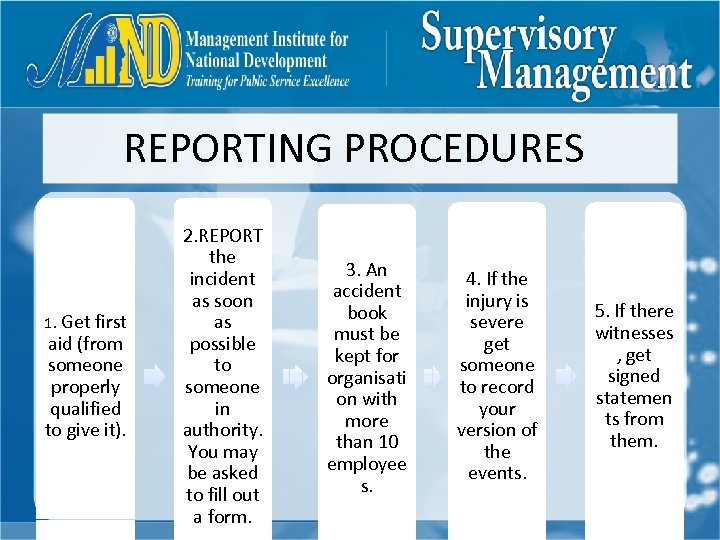 REPORTING PROCEDURES 1. Get first aid (from someone properly qualified to give it). 2. REPORT the incident as soon as possible to someone in authority. You may be asked to fill out a form. 3. An accident book must be kept for organisati on with more than 10 employee s. 4. If the injury is severe get someone to record your version of the events. 5. If there witnesses , get signed statemen ts from them.
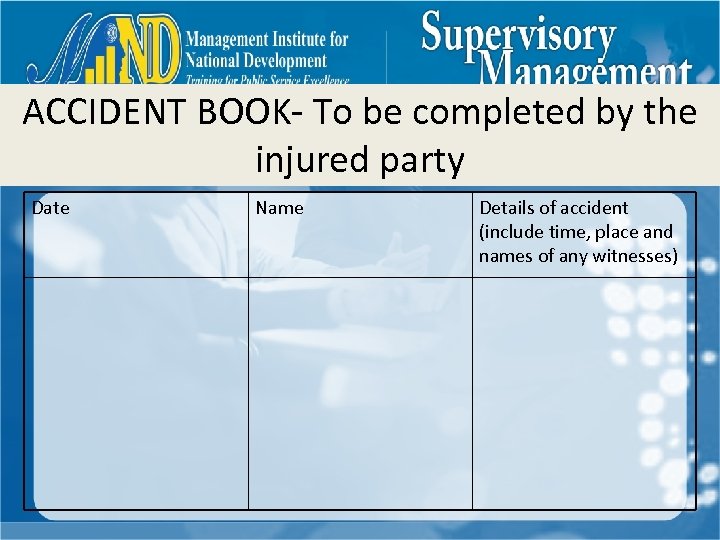 ACCIDENT BOOK- To be completed by the injured party Date Name Details of accident (include time, place and names of any witnesses)
 ACCIDENT BOOK- To be completed by first aid officer & safety officer First aid treatment Report to HSE Preventative action taken
 NOTIFIABLE ACCIDENTS AND DISEASES • A ‘reportable major injury’ includes fractured limbs (not fingers or toes); amputation; temporary or permanent loss of sight; burns; electrocution; chemical poisoning and injuries resulting in hospitalisation for more than 24 hours.
 NOTIFIABLE ACCIDENTS AND DISEASES • A ‘ reportable dangerous occurrence’ is a ‘near miss’ that might have caused major injuries: electrical short circuit causing fire or explosion; collapse of building structures or equipment; escape of radiation and vehicle collisions. • ‘Reportable disease’ include certain poisonings, occupational asthma, asbestosis, hepatitis and many others.
 SECURITY • Effective security is a combination of delay and alarm. • Delay-fence, outer doors, reception, other doors, lockable draws and cabinet • Alarm-electronic alarm and alertness of staff • What are the ‘at risk items/people’ exist in your organisation?
 VULNERABLE POINTS Public/open areas Points of entry & exit Isolated areas Ill-lit areas Reception areas Areas where ‘at-risk’ objects are concentrated-store rooms, file registers • Points of transit or storage • What are some devices for controlling access? • • •
 Duration: 20 minutes Thomas Weller is new to Jam. Food, a food manufacturing company and will work as a supervisor in the food processing unit. John Minto his manager informs him that there has been a number of accidents- strains (back & arm) cuts, falls. The factory is very noisy and some workers are falling ill each time they arrive at work. The union has been holding discussions for the company to pay the workers’ medical bills and some have been absent reporting stress. What advice and strategies would you provide for Mr. Weller in dealing with these matters?