


 Скачать презентацию Health Reform Key Issues Concerns and Opportunities for
4b80b243e99312f77b10d93faa6dc4c0.ppt
- Количество слайдов: 10
 Health Reform Key Issues, Concerns and Opportunities for MIGs and Medicaid
 Brief History q Senate Finance Committee Released a “Call to Action” (11/08) and a Series of White Papers Outlining Reform Proposals (4/09 -5/09); q Senate Health, Labor, Education and Pensions Committee Released Draft Bill to Overhaul Healthcare System (06/09); q House of Representatives Introduces Comprehensive Bill (07/09) – Bill is divided and sent to 3 committees; q Senate Finance Committee Introduces Legislation (10/09).
 Current Status q. House bill has been amended in committee, recombined and reintroduced to the full chamber; q. Senate Finance bill and HELP bill both cleared their committees and are currently being combined by Senate leadership; q. Floor debates expected to extend well into December, if not 2010; q. Still in contention – debates about policy are ongoing.
 Key Components of the Bill(s) q Medicaid Changes: ◙ Expand Medicaid to everyone under 133% (Senate) or 150% (House) of FPL; ◙ Current eligibility levels, procedures and methodologies are frozen with no sunset date indicated (House) or until 7/1/2013 (Senate); ◙ Restructures income calculation for many Medicaid beneficiaries (Senate) to IRS calculation – Elimination of income disregards; ◙ Mandatory increase to the provider rates Medicaid pays; ◙ Creates offices and demonstrations to increase coordination of care between Medicaid & Medicare.
 Key Components of the Bill(s) q Medicaid (continued): ◙ Removes asset test for many Medicaid categories, but not SSI, MBI, 1915(c), Medicare Savings (House); ◙ Removes asset test for people who have their income determined by IRS standards (Senate); ◙ Provides increased FMAP for long-term care expansion/restructuring; q CLASS Act (House + Senate): ◙ Creates a national, premium-funded, opt-out Long. Term Care insurance program. ◙ Eligibility for LTC Services done by ADLs, not income; ◙ Benefits provided in “Cash & Counseling” style.
 Key Components of the Bill(s) q. Private Insurance Reforms: ◙ “Community Rating” – no more than 2: 1 (house) or 6: 1 (senate) variation in premiums for individuals within a geographic area; ◙ Prohibits exclusion of pre-existing conditions; ◙ “Guaranteed Issue/Renewal” – no one can be denied coverage/dropped due to health conditions; ◙ Removes annual/lifetime limits on care; ◙ Required Benefits Package (Including Rehabilitation, Habilitation, MH treatment).
 Key Components of the Bill(s) q Individual mandate to buy insurance; q Establishment of “Exchange” ◙ Based on Massachusetts “Connector” model ◙ Provides centralized marketplace to compare insurance and purchase plans ◙ Federal government provides subsidies for people with low-to-moderate income to assist with the purchase of insurance q Public Plan/Co-ops ◙ Establishes public option (House/possibly Senate) or co-ops (Senate) to compete with private insurance.
 Potential Impact to People with Disabilities q. Positives: ◙ Greater availability of services in the private sector. ◙ No preexisting condition exclusion, denial of coverage or termination of coverage. ◙ Less premium variation. ◙ CLASS act – LTC without income/asset test. ◙ New Medicaid coverage for low-income people, including those with serious conditions that don’t meet SSA listings.
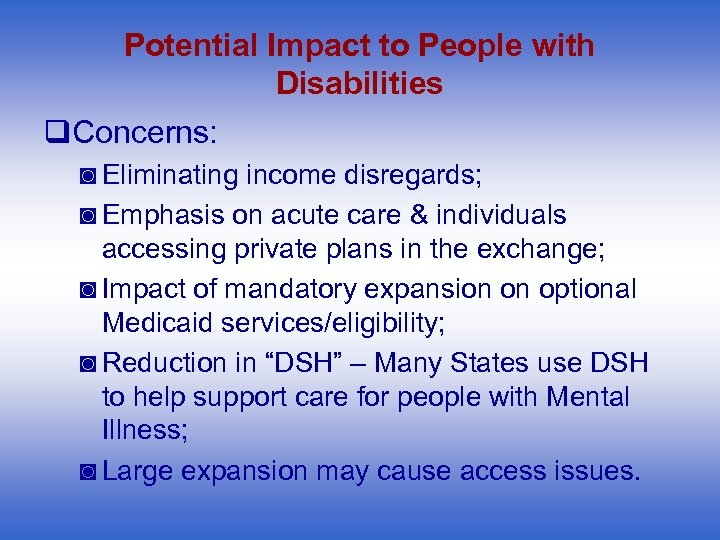 Potential Impact to People with Disabilities q. Concerns: ◙ Eliminating income disregards; ◙ Emphasis on acute care & individuals accessing private plans in the exchange; ◙ Impact of mandatory expansion on optional Medicaid services/eligibility; ◙ Reduction in “DSH” – Many States use DSH to help support care for people with Mental Illness; ◙ Large expansion may cause access issues.
 For More Information: q Center for Workers with Disabilities ◙ National Association of State Medicaid Directors ◙ 1133 19 th Street NW, Suite 400 Washington, DC 20036 q Staff contacts: ◙ Nanette Relave, Director ◘ nrelave@aphsa. org ◘ (202) 682 -0100 x 241 ◙ Damon Terzaghi, Policy Associate ◘ dterzaghi@aphsa. org ◘ (202) 682 -0100 x 265