


 Скачать презентацию HEALTH PSYCHOLOGY 3 rd Edition Marks Murray Evans
eba8470ab2fc19a3b0257cd349276549.ppt
- Количество слайдов: 32
 HEALTH PSYCHOLOGY 3 rd Edition Marks Murray Evans Estacio Chapter 17 Illness and Personality Los Angeles | London | New Delhi Singapore | Washington DC
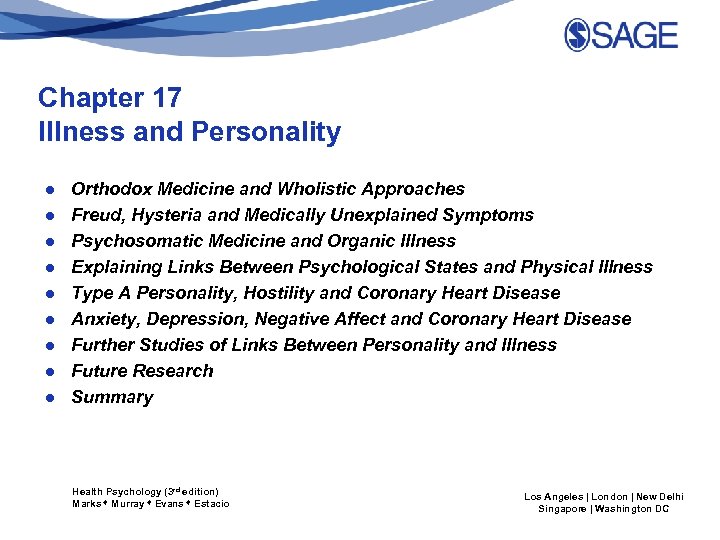 Chapter 17 Illness and Personality ● ● ● ● ● Orthodox Medicine and Wholistic Approaches Freud, Hysteria and Medically Unexplained Symptoms Psychosomatic Medicine and Organic Illness Explaining Links Between Psychological States and Physical Illness Type A Personality, Hostility and Coronary Heart Disease Anxiety, Depression, Negative Affect and Coronary Heart Disease Further Studies of Links Between Personality and Illness Future Research Summary Health Psychology (3 rd edition) Marks Murray Evans Estacio Los Angeles | London | New Delhi Singapore | Washington DC
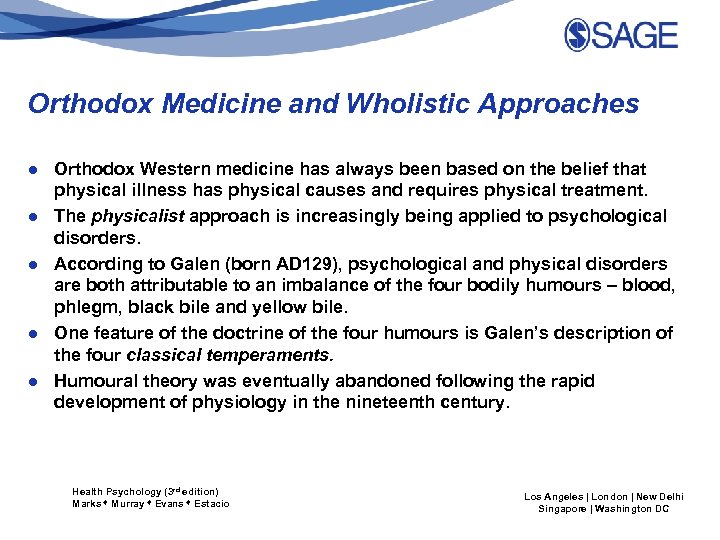 Orthodox Medicine and Wholistic Approaches ● Orthodox Western medicine has always been based on the belief that physical illness has physical causes and requires physical treatment. ● The physicalist approach is increasingly being applied to psychological disorders. ● According to Galen (born AD 129), psychological and physical disorders are both attributable to an imbalance of the four bodily humours – blood, phlegm, black bile and yellow bile. ● One feature of the doctrine of the four humours is Galen’s description of the four classical temperaments. ● Humoural theory was eventually abandoned following the rapid development of physiology in the nineteenth century. Health Psychology (3 rd edition) Marks Murray Evans Estacio Los Angeles | London | New Delhi Singapore | Washington DC
 Orthodox Medicine and Wholistic Approaches (continued) ● Concept of stress-related disease. ● Dogen (1200– 1253) ‘I suspect that the occurrence … forget about other things, illness will not arise. ’ (Dogen’s Shobogenzo Zuimonki quoted in Masunaga, 1972) Health Psychology (3 rd edition) Marks Murray Evans Estacio Los Angeles | London | New Delhi Singapore | Washington DC
 Freud, Hysteria and Medically Unexplained Symptoms Freud and Hysteria ● In the 1880 s, Freud was not inclined to propose psychological explanations for organic disorders. ● His psycho-analytic theories originated in the study of hysteria. ● By the end of the nineteenth century, it had become widely accepted that hysterical disorders are not restricted to women and that the causes are psychological rather than physiological. Health Psychology (3 rd edition) Marks Murray Evans Estacio Los Angeles | London | New Delhi Singapore | Washington DC
 Freud and Hysteria (continued) ● The term hysteria is not often used nowadays, having been largely replaced by psychosomatic (or somatoform) disorder. ● Sufferers from a variety of conditions are hostile to suggestions that these conditions may be psychological rather than organic in origin. Health Psychology (3 rd edition) Marks Murray Evans Estacio Los Angeles | London | New Delhi Singapore | Washington DC
 Medically Unexplained Symptoms ● Bass (2007): the currently fashionable terms replacing psychosomatic disorders are the relatively neutral functional somatic symptoms and medically unexplained symptoms. ● Account for nearly half of all primary care consultations. ● Only 10– 15% are subsequently shown to have an organic basis. Health Psychology (3 rd edition) Marks Murray Evans Estacio Los Angeles | London | New Delhi Singapore | Washington DC
 Medically Unexplained Symptoms (continued) ● Cognitive behavioural therapy is the most effective treatment. ● Brown (2004) attempts to integrate them into a modern neuropsychological theory. ● The main earlier explanations are based on the concepts of disassociation, conversion and somatisation. Health Psychology (3 rd edition) Marks Murray Evans Estacio Los Angeles | London | New Delhi Singapore | Washington DC
 Psychosomatic Medicine and Organic Illness ● From the 1920– 1950 s, Freud’s theories were applied to physical illness by theorists who developed the psychosomatic approach in psychoanalysis. ● George Groddeck believed that all illness is unconsciously motivated and has a meaning for the sufferer (Brown, 2004). ● Wilhelm Reich: repressed sexual feelings could cause a blocking of mysterious forms of organic energy leading to the development of cancer. Health Psychology (3 rd edition) Marks Murray Evans Estacio Los Angeles | London | New Delhi Singapore | Washington DC
 Psychosomatic Medicine and Organic Illness (continued) ● Franz Alexander: psychoanalytic theory with hypotheses about physiological mechanisms, principally those involving the autonomic nervous system (ANS). ● Sympathetic division of the ANS controls emotional arousal and the fight-or-flight emergency reactions of the organism. ● Parasympathetic division controls relaxation and the slowing down of functions activated by the sympathetic division. Health Psychology (3 rd edition) Marks Murray Evans Estacio Los Angeles | London | New Delhi Singapore | Washington DC
 Psychosomatic Medicine and Organic Illness (continued) ● Alexander’s theories led to the development in contemporary health psychology of the distinction between the Type A and Type B personalities. ● Assumed differential susceptibility to cardiovascular disease, and to recent related work on hostility and cardiovascular disease. Health Psychology (3 rd edition) Marks Murray Evans Estacio Los Angeles | London | New Delhi Singapore | Washington DC
 Explaining Links Between Psychosocial States and Physical Illness ● Psychosomatic approach in psychoanalysis failed to produce convincing evidence of causal connections between psychological characteristics and physical illness. ● Defect of being retrospective, seeking to ‘explain’ patients’ illnesses as ‘caused’ by psychological characteristics already known to the clinician. Health Psychology (3 rd edition) Marks Murray Evans Estacio Los Angeles | London | New Delhi Singapore | Washington DC
 Explaining Links Between Psychosocial States and Physical Illness (continued) ● Evidence is obtained from correlational investigations rather than true experiments and, as a consequence, findings are open to a wide range of interpretations. ● In the case of personality–illness correlations, it is possible to illustrate this by considering a range of important problems of interpretation. ● The issues are essentially logical in nature as summarized in the Table. Health Psychology (3 rd edition) Marks Murray Evans Estacio Los Angeles | London | New Delhi Singapore | Washington DC
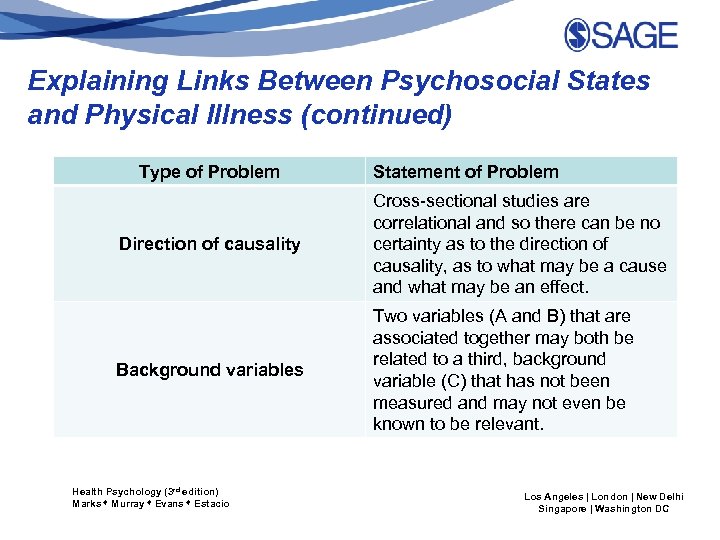 Explaining Links Between Psychosocial States and Physical Illness (continued) Type of Problem Statement of Problem Direction of causality Cross-sectional studies are correlational and so there can be no certainty as to the direction of causality, as to what may be a cause and what may be an effect. Background variables Two variables (A and B) that are associated together may both be related to a third, background variable (C) that has not been measured and may not even be known to be relevant. Health Psychology (3 rd edition) Marks Murray Evans Estacio Los Angeles | London | New Delhi Singapore | Washington DC
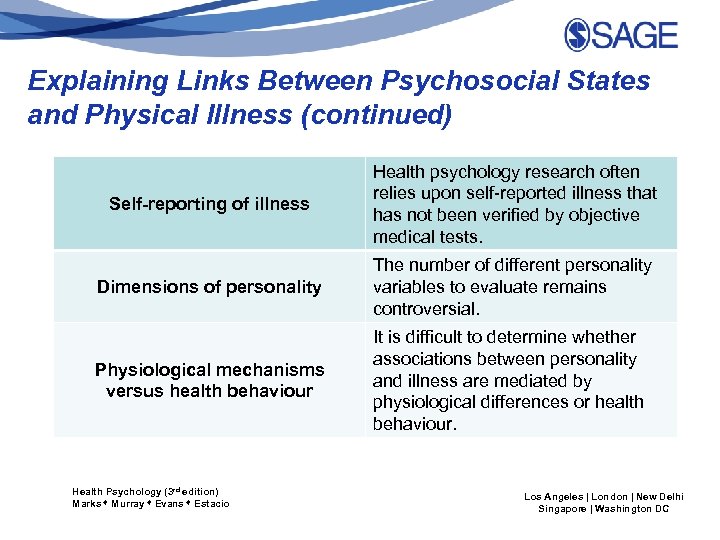 Explaining Links Between Psychosocial States and Physical Illness (continued) Self-reporting of illness Health psychology research often relies upon self-reported illness that has not been verified by objective medical tests. Dimensions of personality The number of different personality variables to evaluate remains controversial. Physiological mechanisms versus health behaviour It is difficult to determine whether associations between personality and illness are mediated by physiological differences or health behaviour. Health Psychology (3 rd edition) Marks Murray Evans Estacio Los Angeles | London | New Delhi Singapore | Washington DC
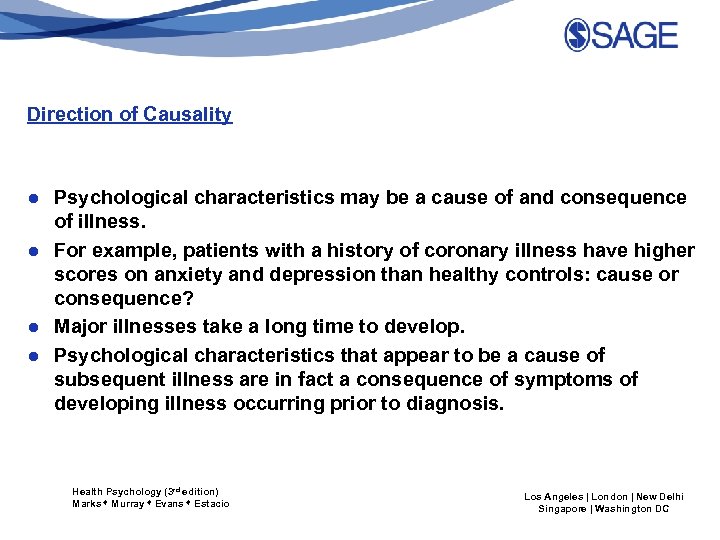 Direction of Causality ● Psychological characteristics may be a cause of and consequence of illness. ● For example, patients with a history of coronary illness have higher scores on anxiety and depression than healthy controls: cause or consequence? ● Major illnesses take a long time to develop. ● Psychological characteristics that appear to be a cause of subsequent illness are in fact a consequence of symptoms of developing illness occurring prior to diagnosis. Health Psychology (3 rd edition) Marks Murray Evans Estacio Los Angeles | London | New Delhi Singapore | Washington DC
 Background Variable ● A correlation may be found between two variables A and B when there is neither a direct effect of A on B, nor of B on A but because a background variable, C, has an effect on both. ● Galen’s explanation for the association between melancholy and breast cancer: Excess of black bile is the background variable that he hypothesized to be a cause of both melancholy and breast cancer. ● History of childhood illness that leaves them constitutionally weak and prone to further illness. Health Psychology (3 rd edition) Marks Murray Evans Estacio Los Angeles | London | New Delhi Singapore | Washington DC
 Self-reporting of Illness ● Stone & Costa (1990) and Cohen & Williamson (1991) – much health psychology research relies on self-reported illness rather than biologically verified disease. ● Reliance on self-reported illness is particularly unsatisfactory when considering research into links between personality and illness. ● Extensive evidence that psychological distress is associated with somatic complaints but not with organic disease. Health Psychology (3 rd edition) Marks Murray Evans Estacio Los Angeles | London | New Delhi Singapore | Washington DC
 Dimensions of Personality ● Three influential theories have been those of Eysenck, Cattell and Mc. Crae & Costa (2003). ● Eysenck’s extraversion and neuroticism, Cattell’s 16 dimensions, and Mc. Crae and Costa’s 5 dimensions. ● ‘Big Five’ personality traits. ● Similar items can often be included in tests that are supposed to be measuring different traits. ● Not surprisingly, scores for the same group of individuals given both tests may be highly inter-correlated. Health Psychology (3 rd edition) Marks Murray Evans Estacio Los Angeles | London | New Delhi Singapore | Washington DC
 Physiological Mechanisms Versus Health Behaviour ● Franz Alexander: physiological mechanisms linking personality to illness. ● Often involving differences in the functioning of the sympathetic and parasympathetic divisions of the ANS. ● Personality differences are often associated with differences in health behaviour (Suls & Rittenhouse, 1990; Miller et al. , 1996; Stone & Mc. Crae, 2007). Health Psychology (3 rd edition) Marks Murray Evans Estacio Los Angeles | London | New Delhi Singapore | Washington DC
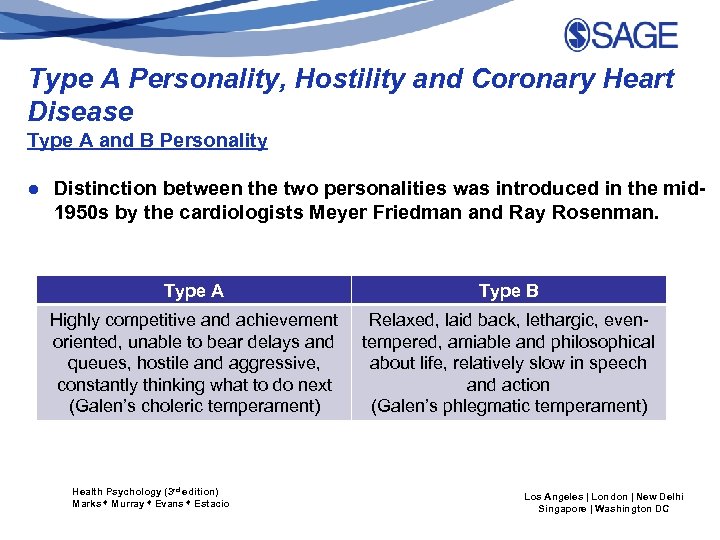 Type A Personality, Hostility and Coronary Heart Disease Type A and B Personality ● Distinction between the two personalities was introduced in the mid 1950 s by the cardiologists Meyer Friedman and Ray Rosenman. Type A Type B Highly competitive and achievement oriented, unable to bear delays and queues, hostile and aggressive, constantly thinking what to do next (Galen’s choleric temperament) Relaxed, laid back, lethargic, eventempered, amiable and philosophical about life, relatively slow in speech and action (Galen’s phlegmatic temperament) Health Psychology (3 rd edition) Marks Murray Evans Estacio Los Angeles | London | New Delhi Singapore | Washington DC
 Type A and B Personality (continued) ● By the early 1980 s, it was confidently asserted that Type A characteristics were as much a risk factor for heart disease as high blood pressure, high cholesterol levels and smoking. ● Subsequent research failed to support these early findings. ● Much further research continued to be published up to the late 1980 s, yielding few positive findings. ● Myrtek (2001) concludes that we can be confident that the Type A personality is not a risk factor for CHD. Health Psychology (3 rd edition) Marks Murray Evans Estacio Los Angeles | London | New Delhi Singapore | Washington DC
 Hostility ● Hostility is the key dimension of personality that is associated with CHD. ● Measures of Type A and B personalities often included subcomponents that could be separately analysed for their association with subsequent CHD. ● When this was done it emerged that there was only one component – anger or hostility. Health Psychology (3 rd edition) Marks Murray Evans Estacio Los Angeles | London | New Delhi Singapore | Washington DC
 Anxiety, Depression, Negative Affect and Coronary Heart Disease ● Researchers have often demonstrated that positive dispositions (e. g. optimism, high self-esteem, sense of coherence) are associated with good health. ● Negative dispositions (e. g. anxiety, depression, pessimistic explanatory style) are associated with poor health. ● Anxiety seems to predict sudden cardiac death rather more than other types of CHD, and phobic, panic-like anxiety is a particularly strong predictor. ● Depression is predictive of a wider range of CHD than anxiety. Health Psychology (3 rd edition) Marks Murray Evans Estacio Los Angeles | London | New Delhi Singapore | Washington DC
 Anxiety, Depression, Negative Affect and Coronary Heart Disease (continued) ● These findings for anxiety and depression should be considered alongside our earlier discussion of problems in interpreting personality–illness correlations. ● The relationship between emotional distress and illness is not restricted to heart disease. ● Depression was equally associated with all disease-related causes of death, not just CHD. Health Psychology (3 rd edition) Marks Murray Evans Estacio Los Angeles | London | New Delhi Singapore | Washington DC
 Further Studies of Link Between Personality and Illness ● Adler and Matthews’ (1994) depression and mortality from cancer study – no associations were found between depression and either cancer onset or mortality. ● Penninx et al. (1998) – significantly increased incidence of cancer for those who were diagnosed as suffering from chronic depression. ● Whooley and Browner (1998) – found no relationship between depression and cancer but a strong relationship with both cardiovascular disease and all other diseases. ● Negative findings have also been reported from follow-up studies of patients who have been treated for cancer. Health Psychology (3 rd edition) Marks Murray Evans Estacio Los Angeles | London | New Delhi Singapore | Washington DC
 Conscientiousness and Longevity ● Conscientiousness characteristic is associated with longevity. ● Kern and Friedman (2008) found a modest but significant correlation of 0. 11. ● Taylor et al. (2009) found an association with longevity of about the same size also for openness, another of the five factors, again for men but not for women. ● Bogg and Roberts (2004) found that conscientiousness-related traits were negatively related to all risky health-related behaviours and positively related to all beneficial health-related behaviours. Health Psychology (3 rd edition) Marks Murray Evans Estacio Los Angeles | London | New Delhi Singapore | Washington DC
 Sense of Coherence, Locus of Control and Self-efficacy ● Sense of coherence (Antonovsky, 1979) is described as the ability to perceive one’s world as meaningful and manageable. ● Surtees et al. (2003) found that a strong sense of coherence was associated with a 30% reduction in mortality from all causes and also more specifically for cardiovascular disease. ● The internal locus of control scale has much in common with the concept of self-efficacy (Bandura, 1977). ● Self-efficacy appears to be a rather better predictor of health behaviour and is perhaps the best predictor available (Schwarzer, 1992). Health Psychology (3 rd edition) Marks Murray Evans Estacio Los Angeles | London | New Delhi Singapore | Washington DC
 Future Research ● Studies to assess the role of psychological factors in medically unexplained conditions, such as chronic fatigue syndrome, including empirical testing of recent neuropsychological theories. ● Research to clarify the structure of personality with particular reference to health, in order to reduce or eliminate the problem of overlapping measures. ● Investigations to distinguish between personality variables that are associated with biologically verified illness, as distinct from those that are associated only with self-reported illness. ● Studies to establish which dimensions of personality are directly associated with health-relevant physiological variables, and to distinguish them from those that are primarily associated with health behaviours. Health Psychology (3 rd edition) Marks Murray Evans Estacio Los Angeles | London | New Delhi Singapore | Washington DC
 Future Research (continued) ● Outcome studies to assess the effectiveness of interventions designed to modify psychological characteristics that are suspected of being health hazardous. It would be particularly valuable to assess whether interventions can improve the prognosis for those already diagnosed as suffering from organic disease. In the case of anxiety and depression, interventions would obviously be worthwhile if they relieve these conditions, whether or not they influence health outcomes. ● Where personality variables are linked primarily to health behaviours, it would be useful to establish whether interventions designed to modify health behaviour (e. g. smoking cessation programmes) could be more effective if they took account of personality assessments of participants. Health Psychology (3 rd edition) Marks Murray Evans Estacio Los Angeles | London | New Delhi Singapore | Washington DC
 Summary ● ● From the Ancient Greeks to modern times orthodox medical practitioners have usually believed that there is a physical basis to all illness, including psychological disorders. In contrast to this, there has also been a wholistic tradition, which has placed an emphasis on the role of psychological factors. The modern history of psychological explanations for physical symptoms begins with Freud's theories of hysteria, physical symptoms of illness for which no organic basis could be discovered. These conditions are often referred to nowadays as ‘medically unexplained symptoms’, and recent theories about them have drawn on neuropsychological research and theories. The psychosomatic approach was developed by psychoanalysts who extended Freud's theories of hysteria to provide psychological explanations for the causation of organic disorders such as heart disease and cancer. Proponents of the psychosomatic approach generally failed to produce convincing evidence in support of their hypotheses. However, theories of Franz Alexander on the physiological mechanisms that could underlie the relationship between the psychology of the individual and organic disease have led to modern conceptions of the Type A personality, hostility and stress as contributors to coronary heart disease (CHD). Health Psychology (3 rd edition) Marks Murray Evans Estacio Los Angeles | London | New Delhi Singapore | Washington DC
 Summary (continued) ● ● ● Health psychologists have found it difficult to determine whether personality is associated with susceptibility to physical disease directly through physiological mechanisms, indirectly by way of health behaviour, or whether the data are best explained by statistical artefacts and flaws in the design of the studies from which they are obtained. Early indications that the Type A personality is a risk factor for CHD were not confirmed by later studies. Attention then shifted to hostility but this variable now seems only to be a weak predictor. Anxiety, especially phobic panic-like anxiety, and depression are both associated with an increased risk of CHD, although a number of different interpretations of these associations are possible. There is little clear-cut evidence to support the view that personality variables are associated with risk of cancer or of relapse following treatment. Interventions based on treatment for depression have not been shown to improve the survival chances of cancer sufferers. There is some recent evidence that conscientiousness and sense of coherence are associated with reduced risk of CHD and all-cause mortality. Internal locus of control is only weakly associated with positive health behaviours. Self-efficacy shows an overall stronger relationship. Health Psychology (3 rd edition) Marks Murray Evans Estacio Los Angeles | London | New Delhi Singapore | Washington DC