


 Скачать презентацию Health Productivity A Research Agenda from the
4f803c340b2e5ad2d1e2e268e4940365.ppt
- Количество слайдов: 26
 Health & Productivity: A Research Agenda from the Private Employer Sector: What Works. . What Doesn’t Kenneth Mitchell, Ph. D. . Chattanooga, TN Nuts and Bolts Research Methods Symposium UT College of Medicine Chattanooga September 29, 2006
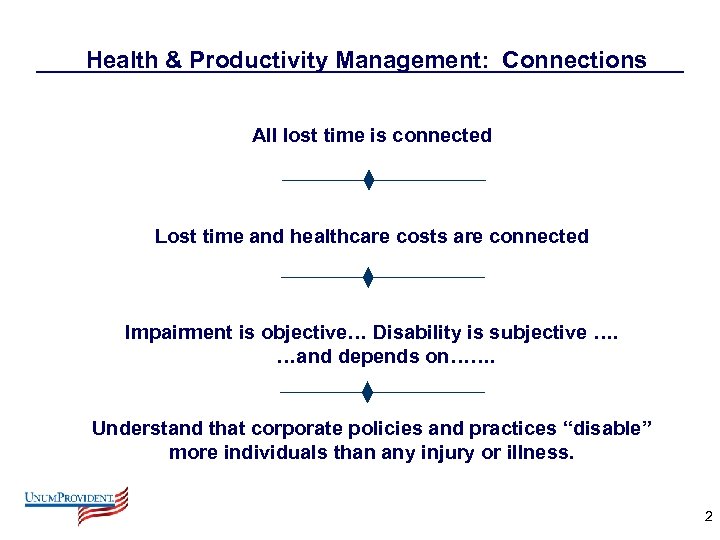 Health & Productivity Management: Connections All lost time is connected Lost time and healthcare costs are connected Impairment is objective… Disability is subjective …. …and depends on……. Understand that corporate policies and practices “disable” more individuals than any injury or illness. 2
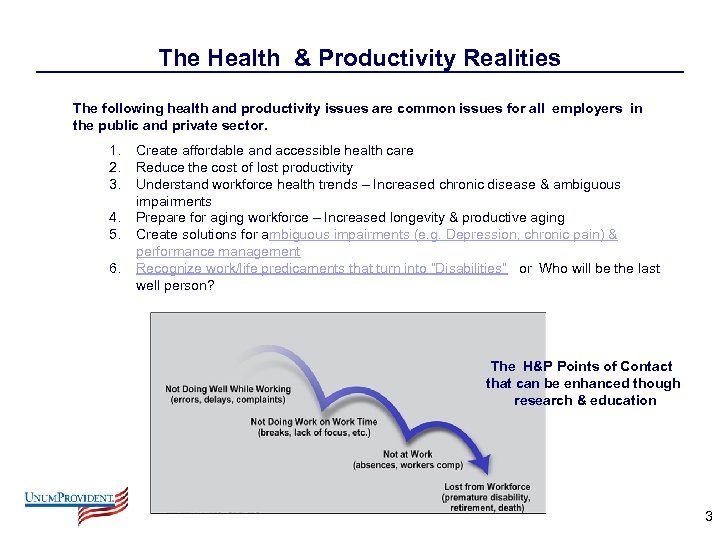 The Health & Productivity Realities The following health and productivity issues are common issues for all employers in the public and private sector. 1. 2. 3. 4. 5. 6. Create affordable and accessible health care Reduce the cost of lost productivity Understand workforce health trends – Increased chronic disease & ambiguous impairments Prepare for aging workforce – Increased longevity & productive aging Create solutions for ambiguous impairments (e. g. Depression, chronic pain) & performance management Recognize work/life predicaments that turn into “Disabilities” or Who will be the last well person? The H&P Points of Contact that can be enhanced though research & education 3
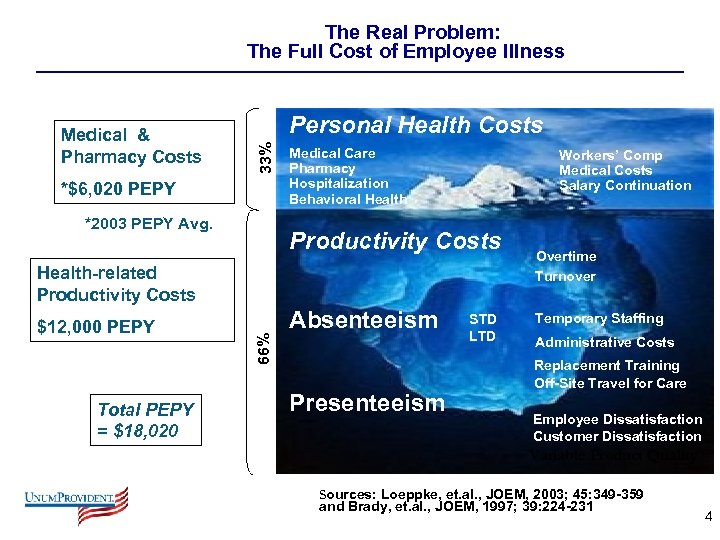 The Real Problem: The Full Cost of Employee Illness Personal Health Costs 33% Medical & Pharmacy Costs *$6, 020 PEPY *2003 PEPY Avg. Medical Care Pharmacy Hospitalization Behavioral Health Workers’ Comp Medical Costs Salary Continuation Productivity Costs $12, 000 PEPY Total PEPY = $18, 020 66% Health-related Productivity Costs Absenteeism Presenteeism STD LTD Overtime Turnover Temporary Staffing Administrative Costs Replacement Training Off-Site Travel for Care Employee Dissatisfaction Customer Dissatisfaction Variable Product Quality Sources: Loeppke, et. al. , JOEM, 2003; 45: 349 -359 and Brady, et. al. , JOEM, 1997; 39: 224 -231 4
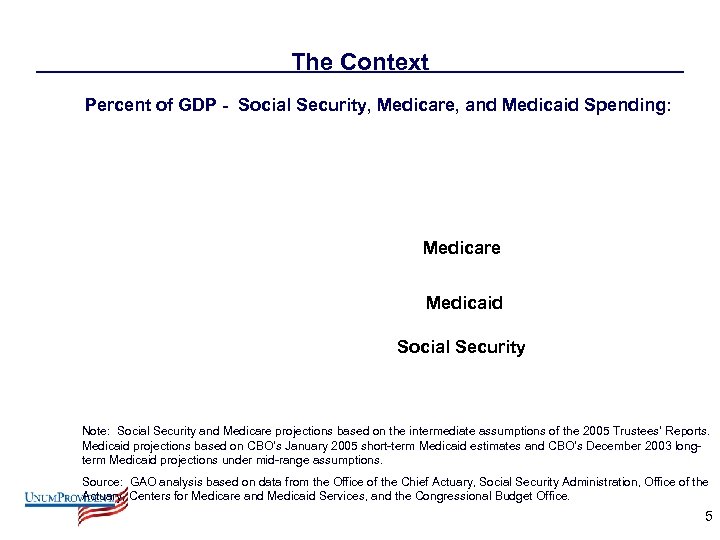 The Context Percent of GDP - Social Security, Medicare, and Medicaid Spending: Medicare Medicaid Social Security Note: Social Security and Medicare projections based on the intermediate assumptions of the 2005 Trustees’ Reports. Medicaid projections based on CBO’s January 2005 short-term Medicaid estimates and CBO’s December 2003 longterm Medicaid projections under mid-range assumptions. Source: GAO analysis based on data from the Office of the Chief Actuary, Social Security Administration, Office of the Actuary, Centers for Medicare and Medicaid Services, and the Congressional Budget Office. 5
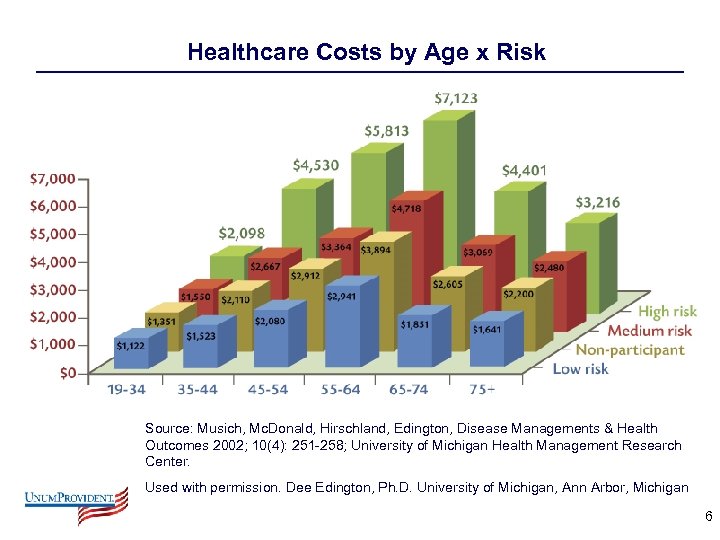 Healthcare Costs by Age x Risk Source: Musich, Mc. Donald, Hirschland, Edington, Disease Managements & Health Outcomes 2002; 10(4): 251 -258; University of Michigan Health Management Research Center. Used with permission. Dee Edington, Ph. D. University of Michigan, Ann Arbor, Michigan 6
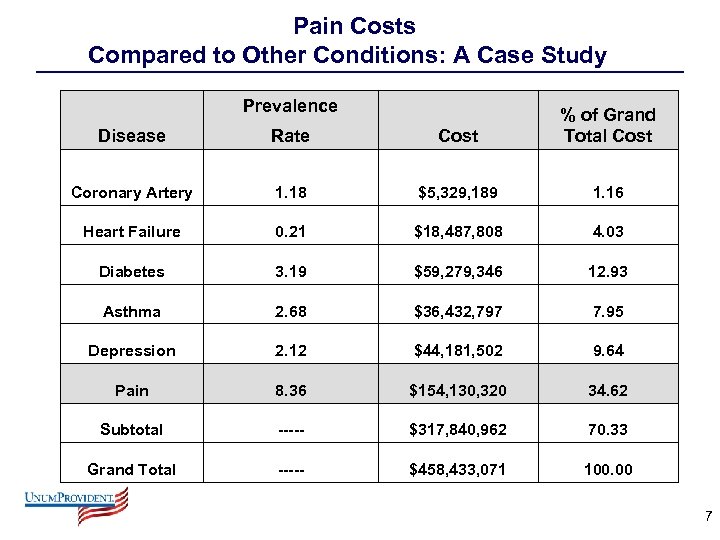 Pain Costs Compared to Other Conditions: A Case Study Prevalence Disease Rate Cost % of Grand Total Cost Coronary Artery 1. 18 $5, 329, 189 1. 16 Heart Failure 0. 21 $18, 487, 808 4. 03 Diabetes 3. 19 $59, 279, 346 12. 93 Asthma 2. 68 $36, 432, 797 7. 95 Depression 2. 12 $44, 181, 502 9. 64 Pain 8. 36 $154, 130, 320 34. 62 Subtotal ----- $317, 840, 962 70. 33 Grand Total ----- $458, 433, 071 100. 00 7
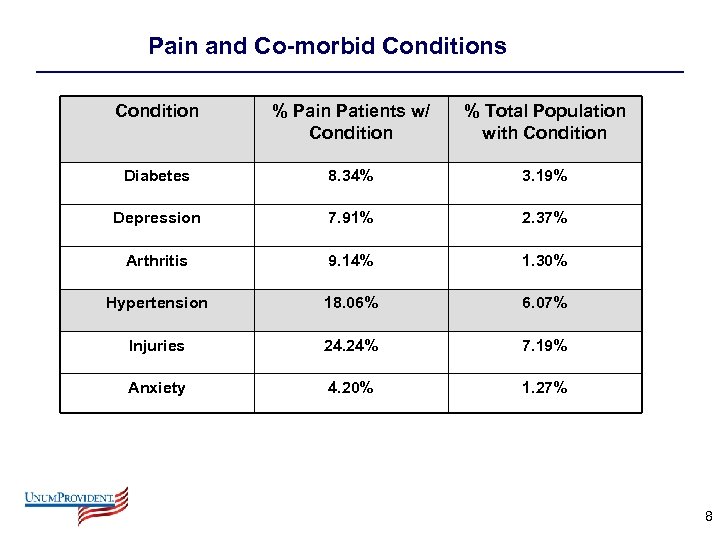 Pain and Co-morbid Conditions Condition % Pain Patients w/ Condition % Total Population with Condition Diabetes 8. 34% 3. 19% Depression 7. 91% 2. 37% Arthritis 9. 14% 1. 30% Hypertension 18. 06% 6. 07% Injuries 24. 24% 7. 19% Anxiety 4. 20% 1. 27% 8
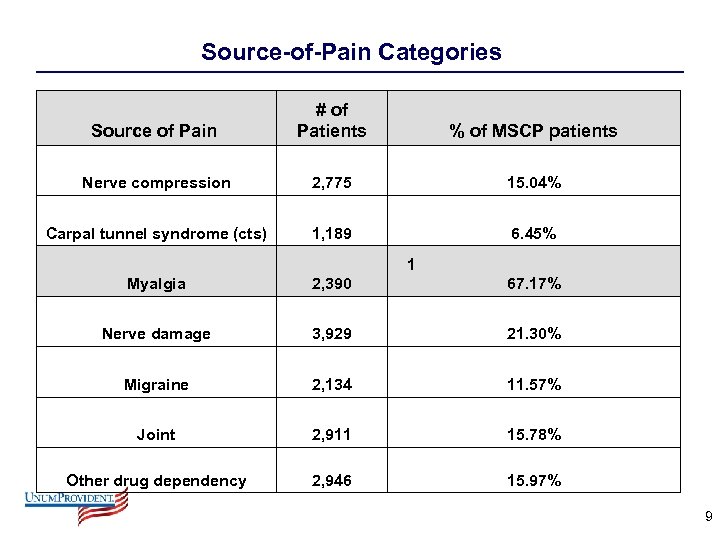 Source-of-Pain Categories Source of Pain # of Patients % of MSCP patients Nerve compression 2, 775 15. 04% Carpal tunnel syndrome (cts) 1, 189 6. 45% Myalgia 1 2, 390 67. 17% Nerve damage 3, 929 21. 30% Migraine 2, 134 11. 57% Joint 2, 911 15. 78% Other drug dependency 2, 946 15. 97% 9
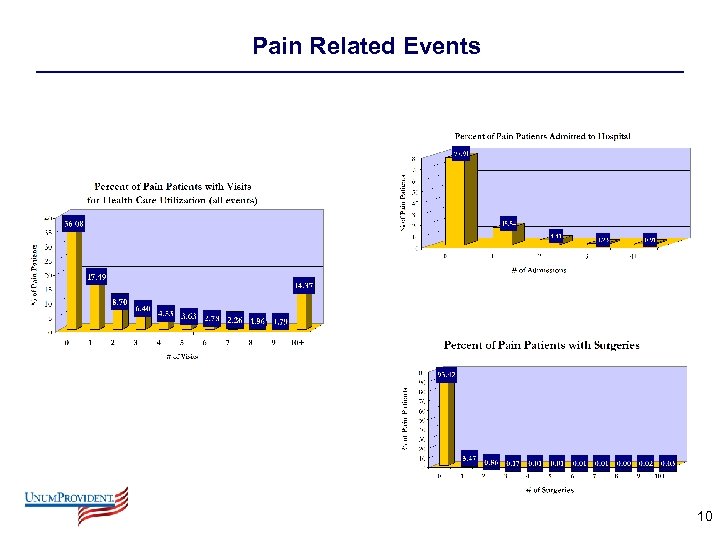 Pain Related Events 10
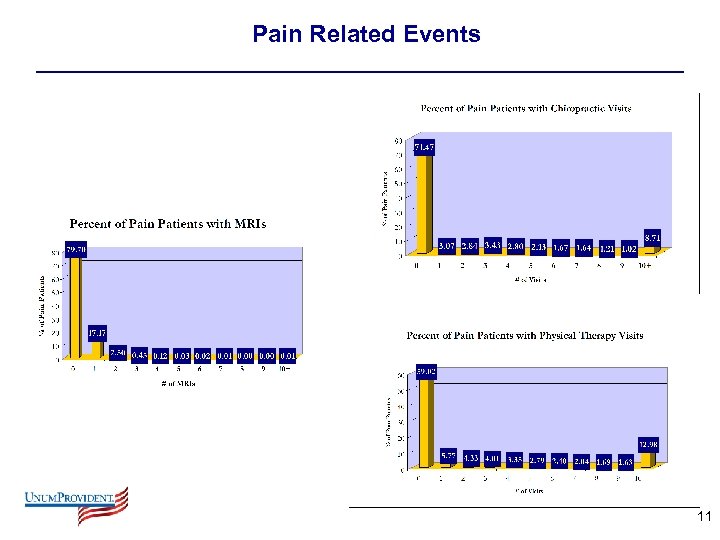 Pain Related Events 11
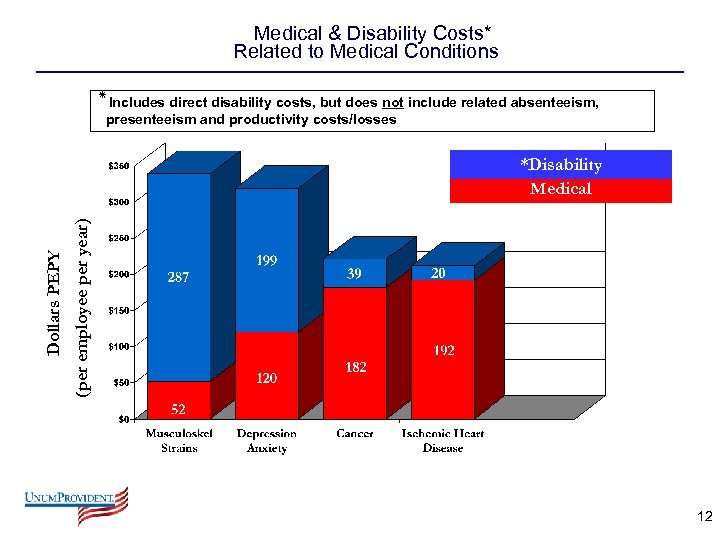 Medical & Disability Costs* Related to Medical Conditions ٭ Includes direct disability costs, but does not include related absenteeism, presenteeism and productivity costs/losses (per employee per year) Dollars PEPY *Disability Medical 12
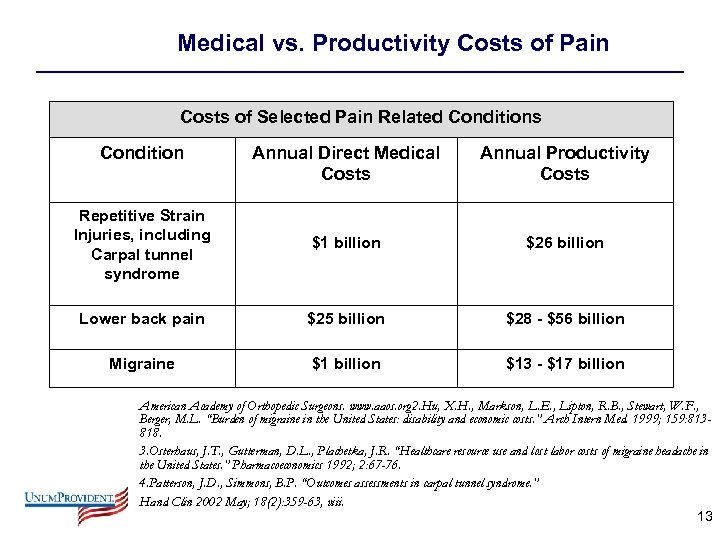 Medical vs. Productivity Costs of Pain Costs of Selected Pain Related Conditions Condition Annual Direct Medical Costs Annual Productivity Costs Repetitive Strain Injuries, including Carpal tunnel syndrome $1 billion $26 billion Lower back pain $25 billion $28 - $56 billion Migraine $1 billion $13 - $17 billion American Academy of Orthopedic Surgeons. www. aaos. org 2. Hu, X. H. , Markson, L. E. , Lipton, R. B. , Stewart, W. F. , Berger, M. L. “Burden of migraine in the United States: disability and economic costs. ” Arch Intern Med. 1999; 159: 813818. 3. Osterhaus, J. T. , Gutterman, D. L. , Plachetka, J. R. “Healthcare resource use and lost labor costs of migraine headache in the United States. ” Pharmacoeconomics 1992; 2: 67 -76. 4. Patterson, J. D. , Simmons, B. P. “Outcomes assessments in carpal tunnel syndrome. ” Hand Clin 2002 May; 18(2): 359 -63, viii. 13
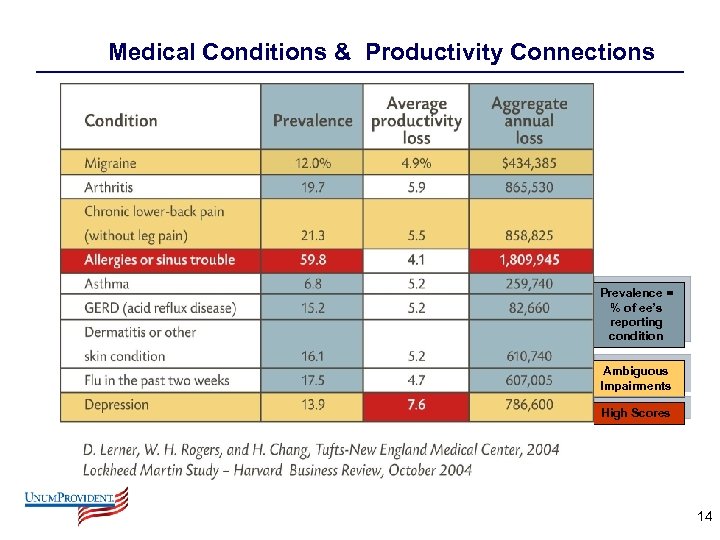 Medical Conditions & Productivity Connections Prevalence = % of ee’s reporting condition Ambiguous Impairments High Scores 14
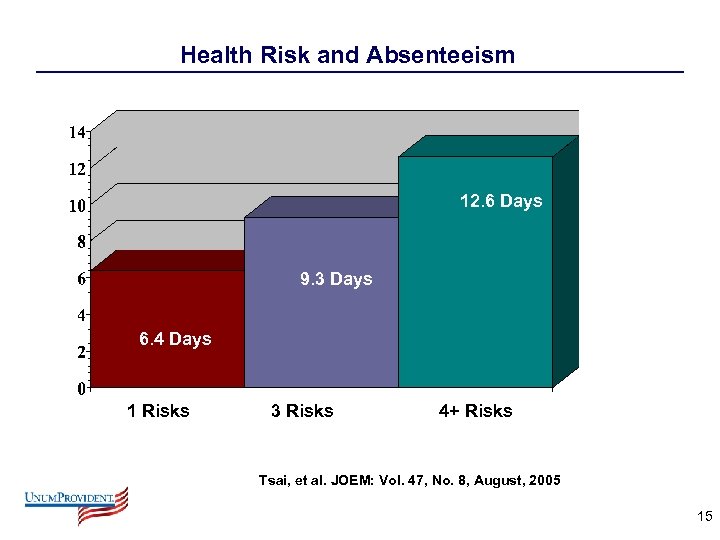 Health Risk and Absenteeism 12. 6 Days 9. 3 Days 6. 4 Days 1 Risks 3 Risks 4+ Risks Tsai, et al. JOEM: Vol. 47, No. 8, August, 2005 15
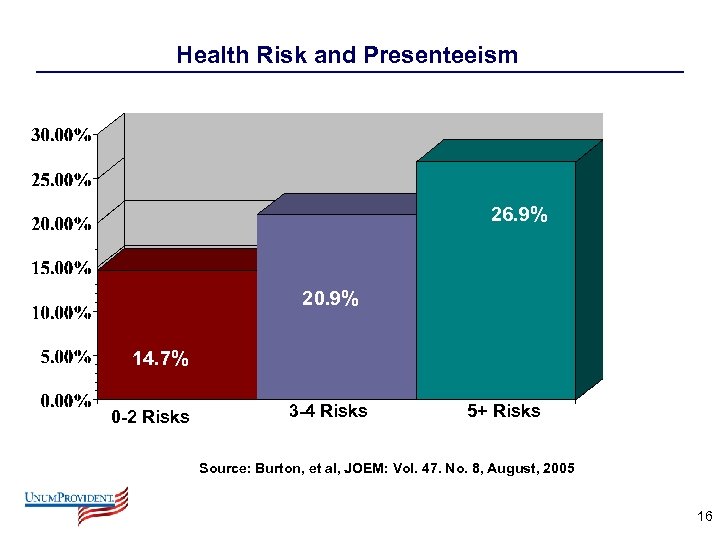 Health Risk and Presenteeism 26. 9% 20. 9% 14. 7% 0 -2 Risks 3 -4 Risks 5+ Risks Source: Burton, et al, JOEM: Vol. 47. No. 8, August, 2005 16
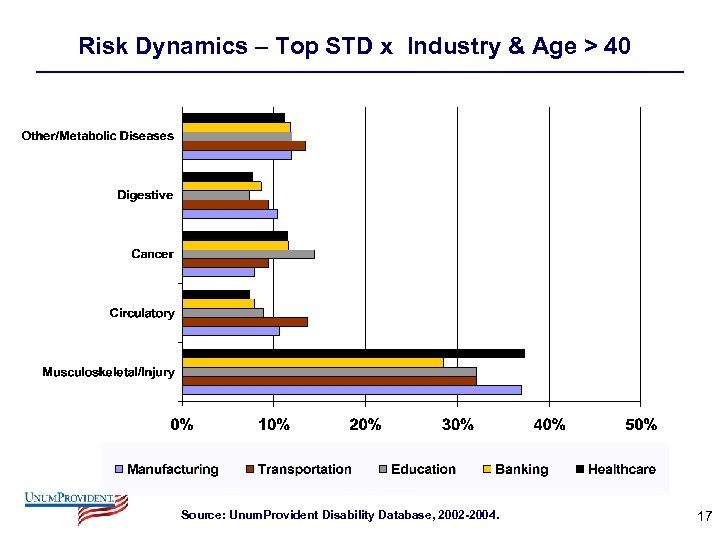 Risk Dynamics – Top STD x Industry & Age > 40 * Based on UPC STD Database/2004 Source: Unum. Provident Disability Database, 2002 -2004. 17
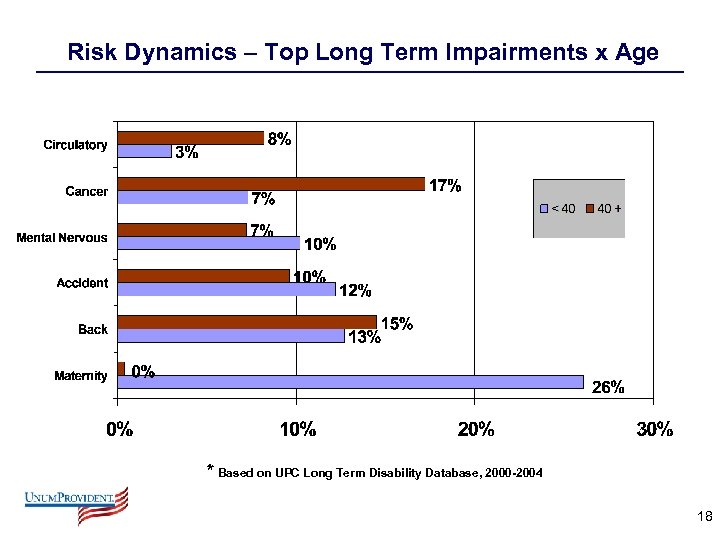 Risk Dynamics – Top Long Term Impairments x Age * Based on UPC Long Term Disability Database, 2000 -2004 18
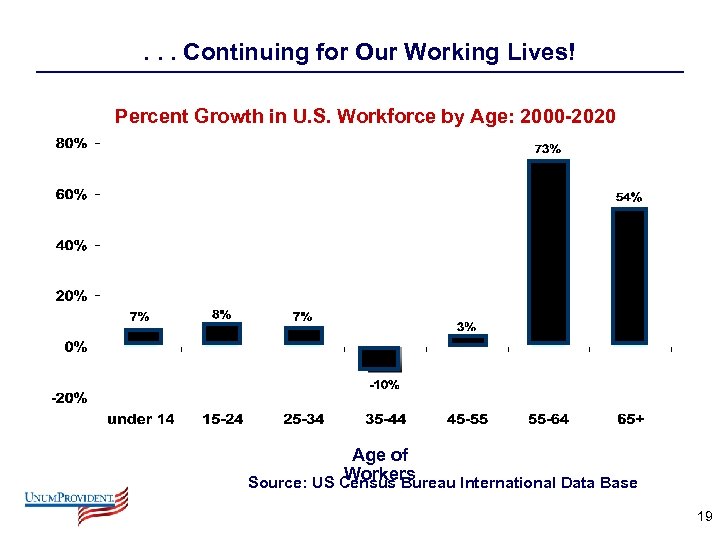 . . . Continuing for Our Working Lives! Percent Growth in U. S. Workforce by Age: 2000 -2020 Age of Workers Source: US Census Bureau International Data Base 19
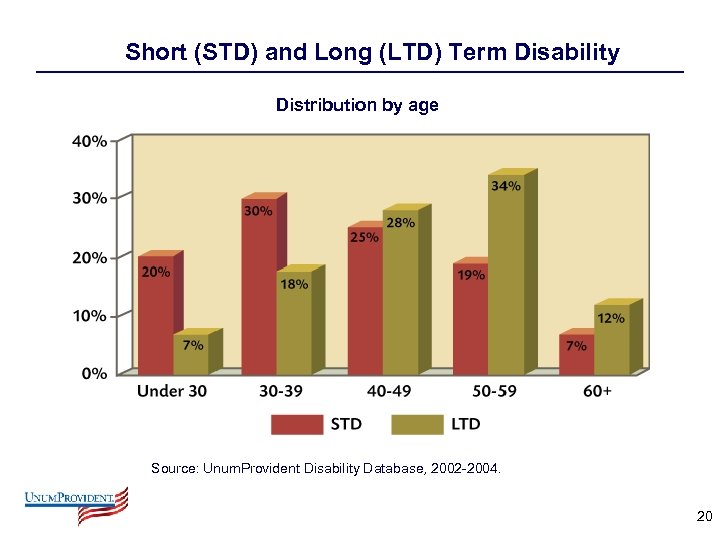 Short (STD) and Long (LTD) Term Disability Distribution by age Source: Unum. Provident Disability Database, 2002 -2004. 20
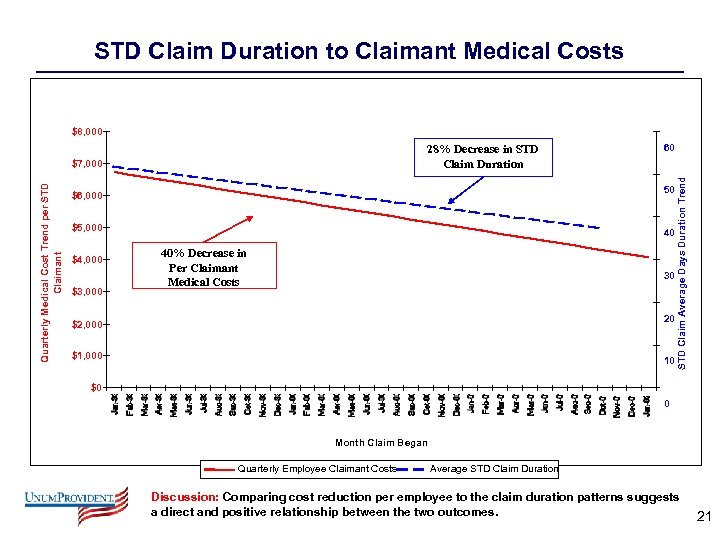 STD Claim Duration to Claimant Medical Costs $8, 000 Quarterly Medical Cost Trend per STD Claimant $7, 000 50 $6, 000 $5, 000 $4, 000 $3, 000 60 40 40% Decrease in Per Claimant Medical Costs 30 20 $2, 000 $1, 000 10 STD Claim Average Days Duration Trend 28% Decrease in STD Claim Duration $0 0 Month Claim Began Quarterly Employee Claimant Costs Average STD Claim Duration Discussion: Comparing cost reduction per employee to the claim duration patterns suggests a direct and positive relationship between the two outcomes. 21
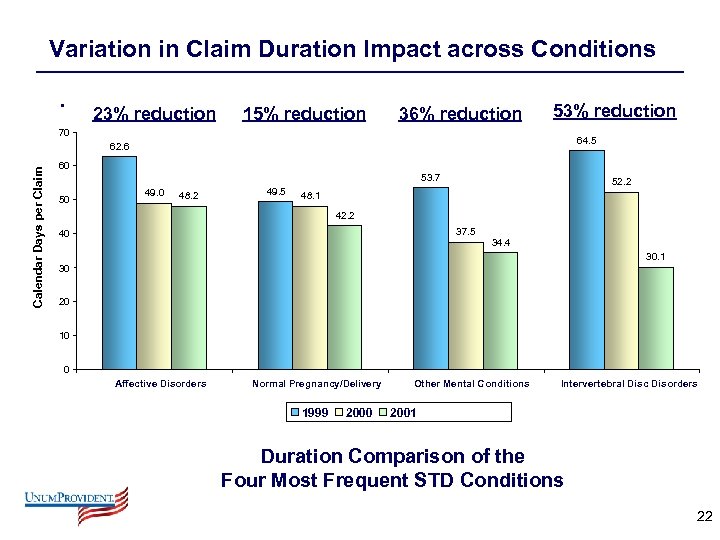 Variation in Claim Duration Impact across Conditions • 23% reduction 15% reduction 36% reduction 53% reduction 70 64. 5 Calendar Days per Claim 62. 6 60 53. 7 50 49. 0 48. 2 49. 5 52. 2 48. 1 42. 2 37. 5 40 34. 4 30. 1 30 20 10 0 Affective Disorders Normal Pregnancy/Delivery 1999 2000 Other Mental Conditions Intervertebral Disc Disorders 2001 Duration Comparison of the Four Most Frequent STD Conditions 22
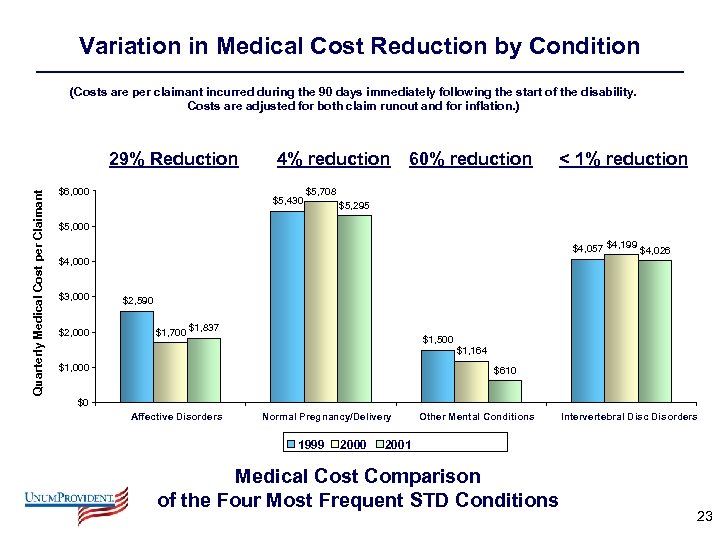 Variation in Medical Cost Reduction by Condition (Costs are per claimant incurred during the 90 days immediately following the start of the disability. Costs are adjusted for both claim runout and for inflation. ) Quarterly Medical Cost per Claimant 29% Reduction $6, 000 4% reduction $5, 430 60% reduction < 1% reduction $5, 708 $5, 295 $5, 000 $4, 057 $4, 199 $4, 026 $4, 000 $3, 000 $2, 590 $1, 700 $1, 837 $1, 500 $1, 164 $1, 000 $610 $0 Affective Disorders Normal Pregnancy/Delivery 1999 2000 Other Mental Conditions Intervertebral Disc Disorders 2001 Medical Cost Comparison of the Four Most Frequent STD Conditions 23
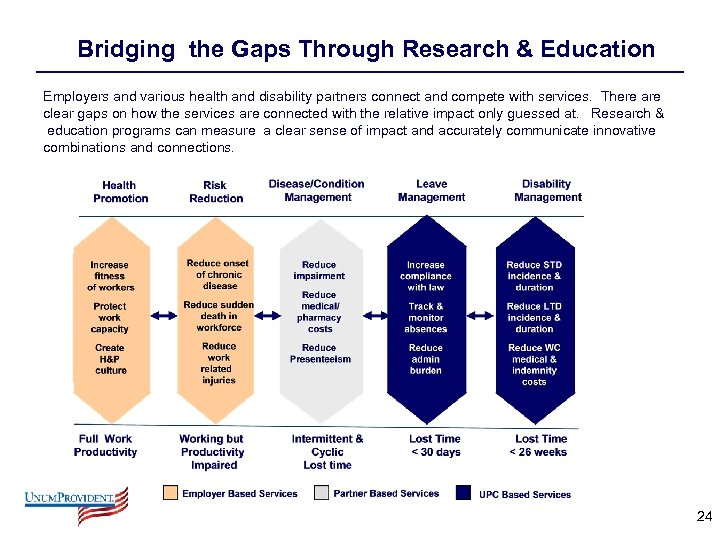 Bridging the Gaps Through Research & Education Employers and various health and disability partners connect and compete with services. There are clear gaps on how the services are connected with the relative impact only guessed at. Research & education programs can measure a clear sense of impact and accurately communicate innovative combinations and connections. 24
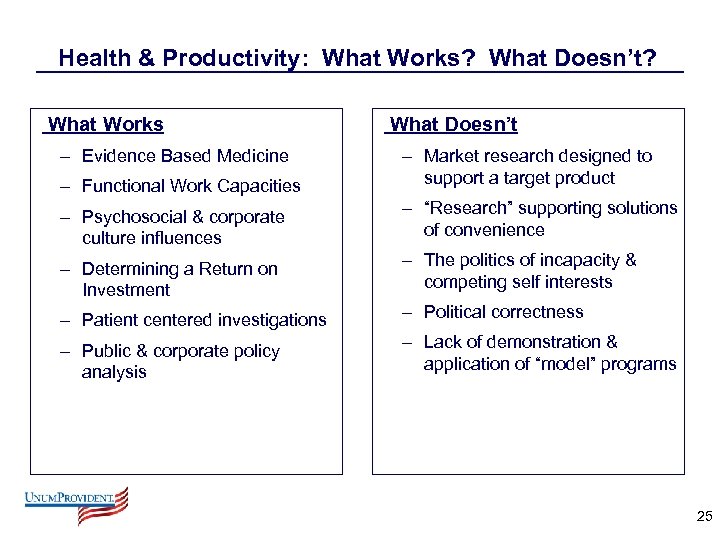 Health & Productivity: What Works? What Doesn’t? What Works – Evidence Based Medicine What Doesn’t – Functional Work Capacities – Market research designed to support a target product – Psychosocial & corporate culture influences – “Research” supporting solutions of convenience – Determining a Return on Investment – The politics of incapacity & competing self interests – Patient centered investigations – Political correctness – Public & corporate policy analysis – Lack of demonstration & application of “model” programs 25
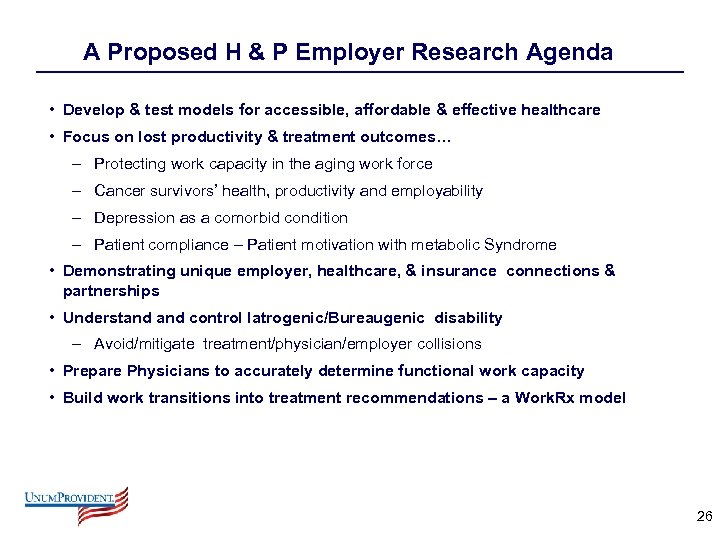 A Proposed H & P Employer Research Agenda • Develop & test models for accessible, affordable & effective healthcare • Focus on lost productivity & treatment outcomes… – Protecting work capacity in the aging work force – Cancer survivors’ health, productivity and employability – Depression as a comorbid condition – Patient compliance – Patient motivation with metabolic Syndrome • Demonstrating unique employer, healthcare, & insurance connections & partnerships • Understand control Iatrogenic/Bureaugenic disability – Avoid/mitigate treatment/physician/employer collisions • Prepare Physicians to accurately determine functional work capacity • Build work transitions into treatment recommendations – a Work. Rx model 26