


 Скачать презентацию Health Policy Networks Greater China within East Asia
ac6e62fd51e55d6ebaf91211fc557a72.ppt
- Количество слайдов: 11
 Health Policy Networks: Greater China within East Asia Gabriel M Leung School of Public Health Li Ka Shing Faculty of Medicine The University of Hong Kong
 Region-wide Contextual Challenges • Epidemiologic stage specific disease patterns: endocrine-related vs infection-related vs lifestyle-related cancers; diabetes; gastrointestinal conditions; tropical neglected diseases in addition to the big 3 (TB, HIV, malaria) • East Asia in general does not have a formal tradition of relying on evidence to make decisions – Partly because gov’t has no teeth as health care is mostly privately provided in many developing countries – Partly because there has been little public demand – Partly because the capacity to generate or even use evidence has been lacking – In more advanced economies in the region (TW, SK, JP) with social insurance, this can possibly be effected through technology assessment, standardised fee schedules or drug formularies but strong physician/provider lobby (eg Takemi legacy) – How can an Observatory, albeit supported by supranational agencies and sponsors, generate interest and buy-in from national gov’ts, vested interests, and the general public?
 Regional Heterogeneity • Within region/between countries – even after stratification by GDP because of different epidemiology and health system characteristics – health system typologies (HK: tax-financed with significant private penetration; CN: rural/urban divide, coop schemes, SHI, private OOP, etc; TW: SHI) – epidemiology (double burden) and health system development don’t move in tandem especially in rapidly transitioning economies – political boundaries and the issue of inclusiveness • Within country/small area variations – east (coastal) vs west (rural inland) CN – north vs south in TW • Regrouping of countries/territories based on dimensions other than geo-politics to achieve meaningful commonality
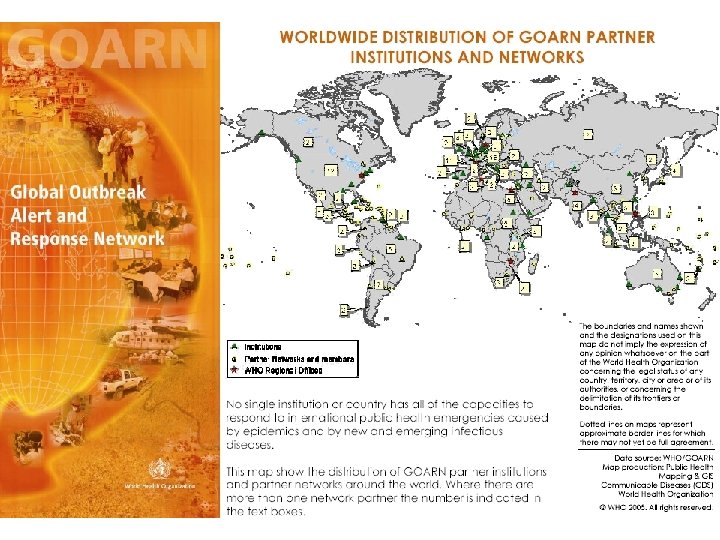
 Role of regional sentinel hubs or “sub-observatories” • “Harbinger” population with similar geo-ethnic characteristics – HK or TW for mainland CN • Cross-cutting leverage with other non-health supranational initiatives – substantive for cognate areas and opportunistic/logistic otherwise • How could observatories or networks of sentinel hubs best engage existing pockets of expertise and align them in parallel to working with governmental agencies and with each other? – Where do the funds come from?
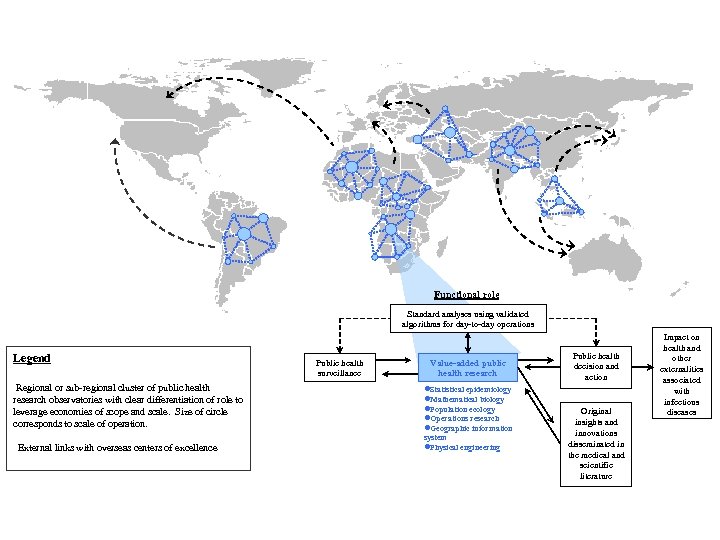 Functional role Standard analyses using validated algorithms for day-to-day operations Legend Regional or sub-regional cluster of public health research observatories with clear differentiation of role to leverage economies of scope and scale. Size of circle corresponds to scale of operation. External links with overseas centers of excellence Public health surveillance Value-added public health research l. Statistical epidemiology l. Mathematical biology l. Population ecology l. Operations research l. Geographic information system l. Physical engineering Public health decision and action Original insights and innovations disseminated in the medical and scientific literature Impact on health and other externalities associated with infectious diseases
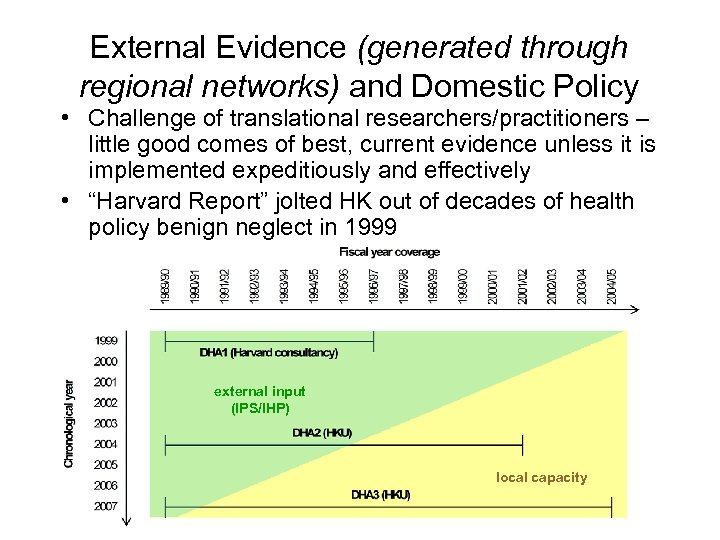 External Evidence (generated through regional networks) and Domestic Policy • Challenge of translational researchers/practitioners – little good comes of best, current evidence unless it is implemented expeditiously and effectively • “Harvard Report” jolted HK out of decades of health policy benign neglect in 1999 external input (IPS/IHP) local capacity
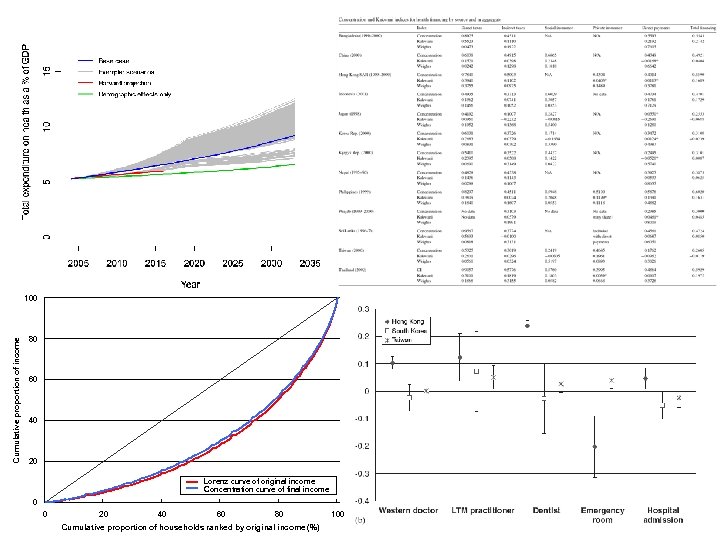 Cumulative proportion of income 100 80 60 40 20 Lorenz curve of original income Concentration curve of final income 0 0 20 40 60 80 Cumulative proportion of households ranked by original income (%) 100
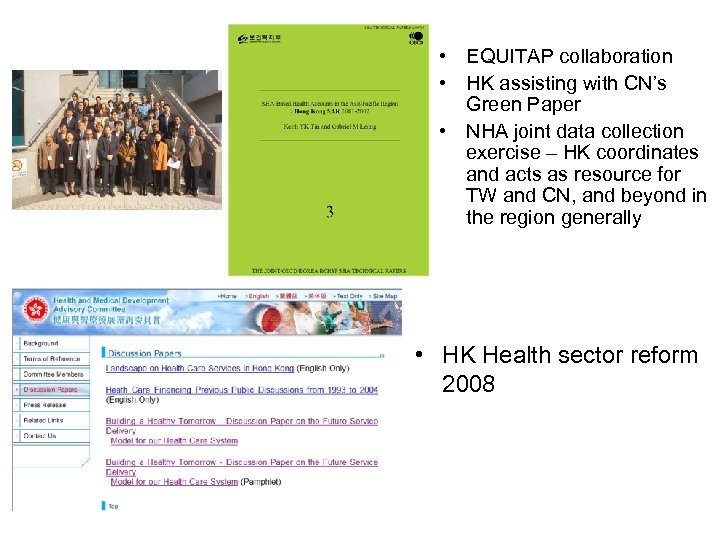 • EQUITAP collaboration • HK assisting with CN’s Green Paper • NHA joint data collection exercise – HK coordinates and acts as resource for TW and CN, and beyond in the region generally • HK Health sector reform 2008
 Critical Success Factors • Open, transparent process of engagement between equals • Multidirectional sharing of different skills • Competent, independent country partners trusted by their own gov’ts • Mutually rewarding • Properly resourced enterprise • Start with concrete projects (as opposed to grandiose visions) and build rapport and capacity (scale and scope) incrementally • Long term time horizon for payback