


 Скачать презентацию Health Plan Strategies for Managing Asthma Key Findings
94358dd0ab026e585a2feaefcd918a41.ppt
- Количество слайдов: 31
 Health Plan Strategies for Managing Asthma: Key Findings from AHIP’s Asthma Assessment May 23, 2017 U. S. Environmental Protection Agency Cooperative Agreement #XA-83576401
 Welcome and Introductions Chris Regal Senior Health Research Associate America’s Health Insurance Plans MODERATOR
 Housekeeping • Please place all phone lines on mute. • Use the chat features to ask questions. Questions will be addressed periodically throughout the webinar as well as at the end. • Slides will be made available and will be posted online at ahip. org/asthma.
 Three-year Initiative with EPA October 1, 2014 – September 30, 2017 • Identify and promote health plan best practices that align with the NIH EPR-3 asthma guidelines. • Accelerate efforts to assess and disseminate health plan interventions that help prevent the onset of asthma episodes related to indoor environmental triggers. • Compliment the EPA’s Indoor Environments Program priorities and goals of reducing environmental health risks by contaminants in indoor environments. AHIP. org/asthma
 Supporting Communities to Deliver Sustainable In-Home Environmental Asthma Interventions Tracey Mitchell, RRT, AE-C mitchell. tracey@epa. gov U. S. Environmental Protection Agency May 23, 2017
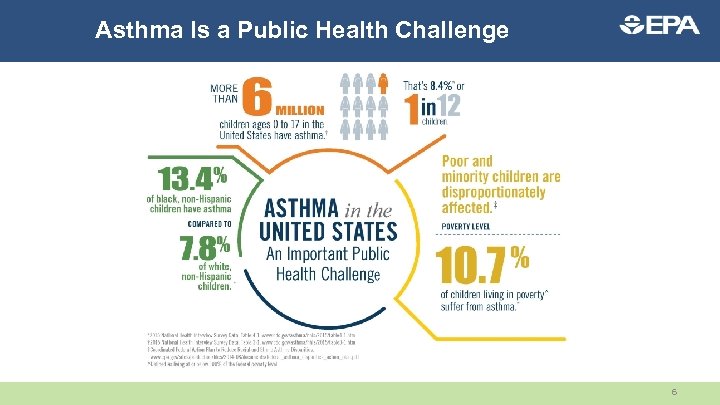 Asthma Is a Public Health Challenge 6
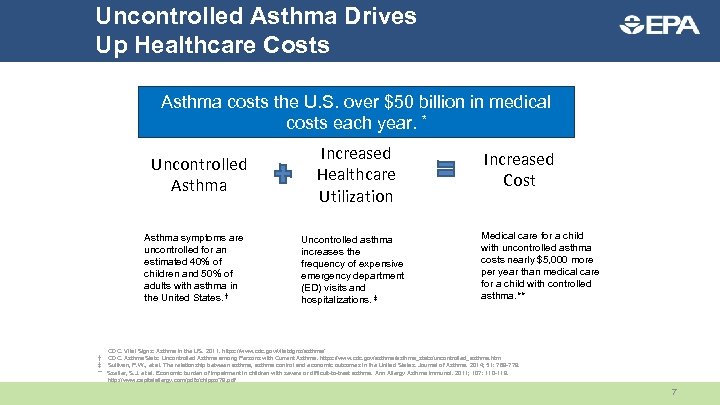 Uncontrolled Asthma Drives Up Healthcare Costs Asthma costs the U. S. over $50 billion in medical costs each year. * Uncontrolled Asthma symptoms are uncontrolled for an estimated 40% of children and 50% of adults with asthma in the United States. † Increased Healthcare Utilization Uncontrolled asthma increases the frequency of expensive emergency department (ED) visits and hospitalizations. ‡ Increased Cost Medical care for a child with uncontrolled asthma costs nearly $5, 000 more per year than medical care for a child with controlled asthma. ** CDC. Vital Signs: Asthma in the US. 2011. https: //www. cdc. gov/vitalsigns/asthma/ CDC. Asthma. Stats: Uncontrolled Asthma among Persons with Current Asthma. https: //www. cdc. gov/asthma_stats/uncontrolled_asthma. htm Sullivan, P. W. , et al. The relationship between asthma, asthma control and economic outcomes in the United States. Journal of Asthma. 2014; 51: 769 -779. ** Szefler, S. J. et al. Economic burden of impairment in children with severe or difficult-to-treat asthma. Ann Allergy Asthma Immunol. 2011; 107: 110 -119. http: //www. capitalallergy. com/pdfs/chipps/79. pdf † ‡ 7
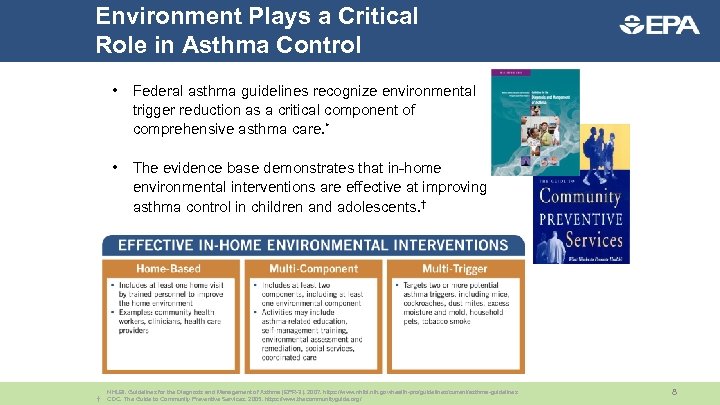 Environment Plays a Critical Role in Asthma Control • Federal asthma guidelines recognize environmental trigger reduction as a critical component of comprehensive asthma care. * • The evidence base demonstrates that in-home environmental interventions are effective at improving asthma control in children and adolescents. † † NHLBI. Guidelines for the Diagnosis and Management of Asthma (EPR-3). 2007. https: //www. nhlbi. nih. gov/health-pro/guidelines/current/asthma-guidelines CDC. The Guide to Community Preventive Services. 2005. https: //www. thecommunityguide. org/ 8
 EPA’s Unique Contributions • Technical expertise and tools to help address risks and develop services at the intersection of built environment – homes and schools – and health. • Focus on the up-front prevention of asthma attacks in the home environment. Good health starts at home. • Ability to convene stakeholders, synthesize cutting-edge learning, and translate it to the field through Asthma. Community. Network. org. • Immediate platform of 1000+ community programs leveraged by other feds, non-profits and states.
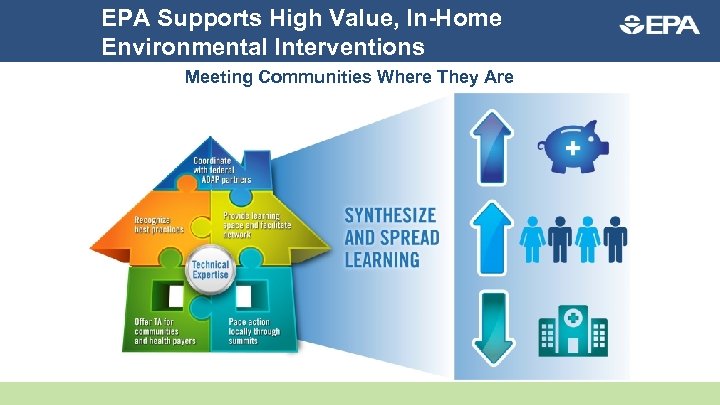 EPA Supports High Value, In-Home Environmental Interventions Meeting Communities Where They Are
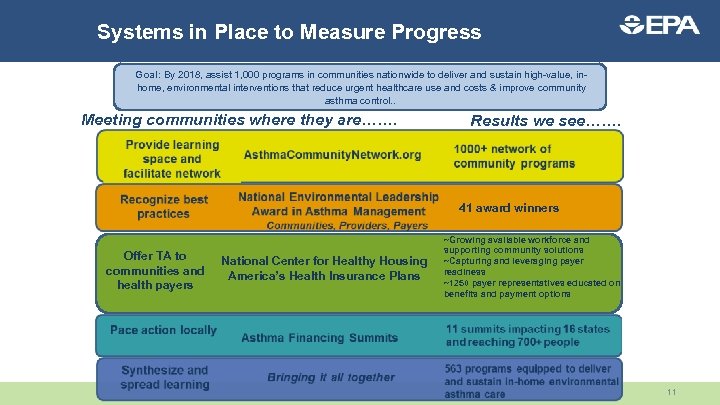 Systems in Place to Measure Progress Goal: By 2018, assist 1, 000 programs in communities nationwide to deliver and sustain high-value, inhome, environmental interventions that reduce urgent healthcare use and costs & improve community asthma control. . Meeting communities where they are……. Results we see……. 41 award winners Offer TA to communities and health payers National Center for Healthy Housing America’s Health Insurance Plans ~Growing available workforce and supporting community solutions ~Capturing and leveraging payer readiness ~1250 payer representatives educated on benefits and payment options 11
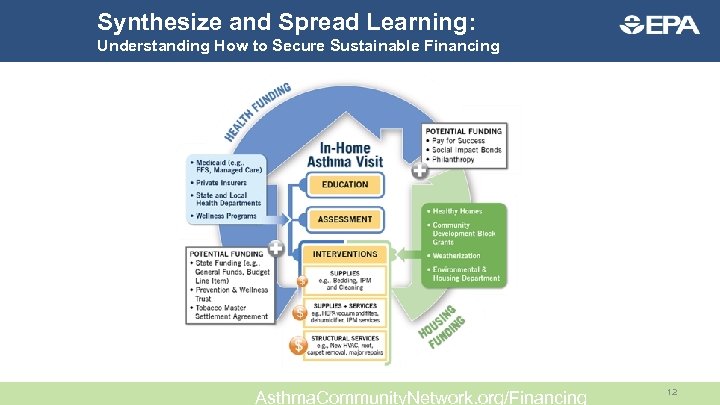 Synthesize and Spread Learning: Understanding How to Secure Sustainable Financing Asthma. Community. Network. org/Financing 12
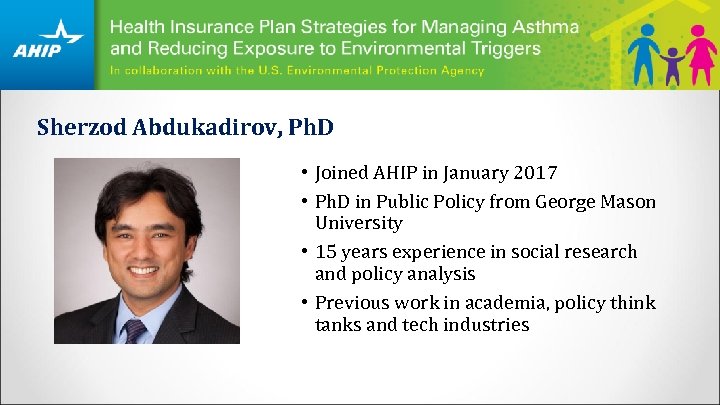 Sherzod Abdukadirov, Ph. D • Joined AHIP in January 2017 • Ph. D in Public Policy from George Mason University • 15 years experience in social research and policy analysis • Previous work in academia, policy think tanks and tech industries
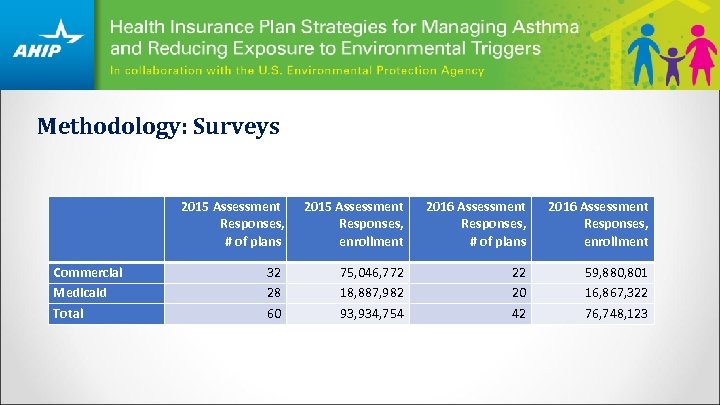 Methodology: Surveys Commercial Medicaid Total 2015 Assessment Responses, # of plans 2015 Assessment Responses, enrollment 2016 Assessment Responses, # of plans 2016 Assessment Responses, enrollment 32 28 60 75, 046, 772 18, 887, 982 93, 934, 754 22 20 42 59, 880, 801 16, 867, 322 76, 748, 123
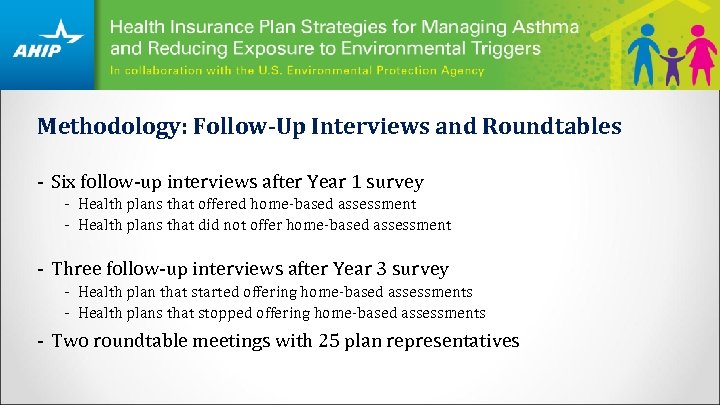 Methodology: Follow-Up Interviews and Roundtables - Six follow-up interviews after Year 1 survey - Health plans that offered home-based assessment - Health plans that did not offer home-based assessment - Three follow-up interviews after Year 3 survey - Health plan that started offering home-based assessments - Health plans that stopped offering home-based assessments - Two roundtable meetings with 25 plan representatives
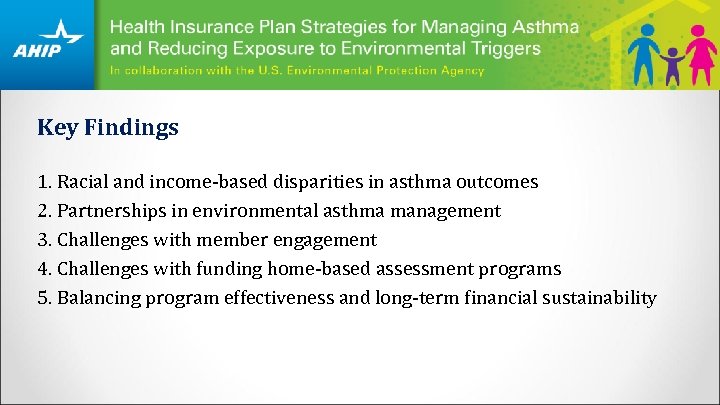 Key Findings 1. Racial and income-based disparities in asthma outcomes 2. Partnerships in environmental asthma management 3. Challenges with member engagement 4. Challenges with funding home-based assessment programs 5. Balancing program effectiveness and long-term financial sustainability
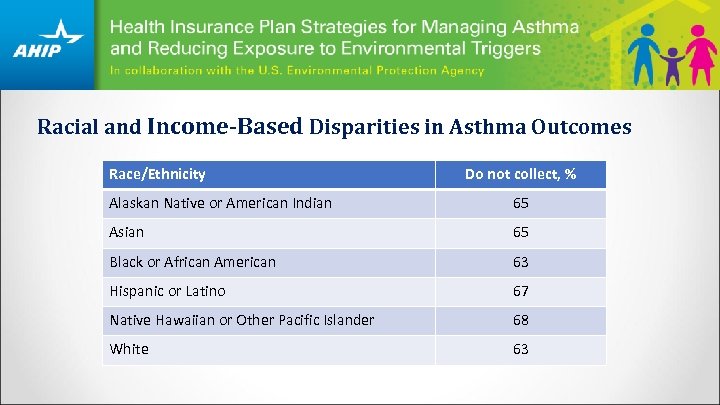 Racial and Income-Based Disparities in Asthma Outcomes Race/Ethnicity Do not collect, % Alaskan Native or American Indian 65 Asian 65 Black or African American 63 Hispanic or Latino 67 Native Hawaiian or Other Pacific Islander 68 White 63
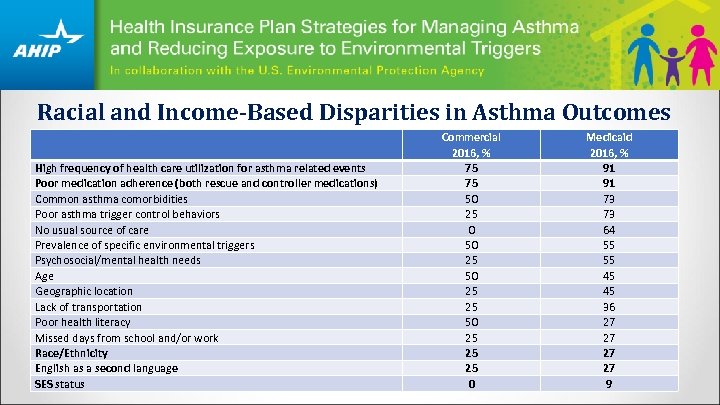 Racial and Income-Based Disparities in Asthma Outcomes High frequency of health care utilization for asthma related events Poor medication adherence (both rescue and controller medications) Common asthma comorbidities Poor asthma trigger control behaviors No usual source of care Prevalence of specific environmental triggers Psychosocial/mental health needs Age Geographic location Lack of transportation Poor health literacy Missed days from school and/or work Race/Ethnicity English as a second language SES status Commercial 2016, % 75 75 50 25 0 50 25 25 25 0 Medicaid 2016, % 91 91 73 73 64 55 55 45 45 36 27 27 9
 Racial and Income-Based Disparities in Asthma Outcomes
 Racial and Income-Based Disparities in Asthma Outcomes
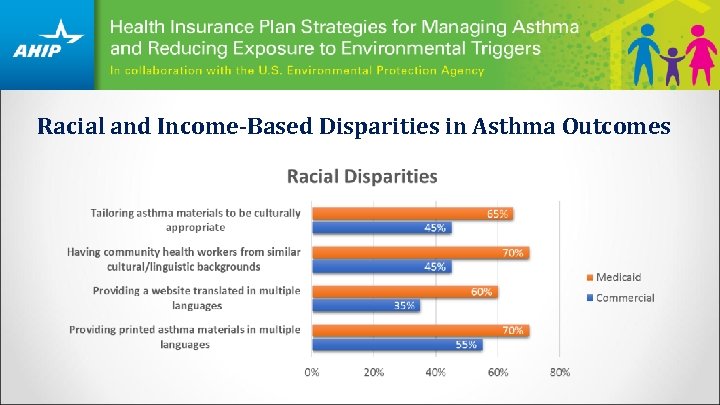 Racial and Income-Based Disparities in Asthma Outcomes
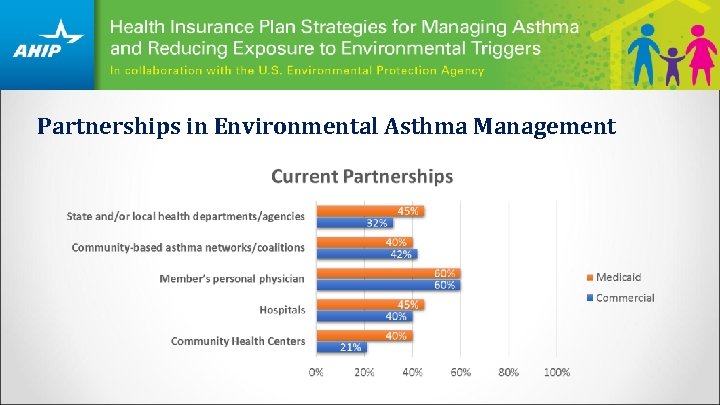 Partnerships in Environmental Asthma Management
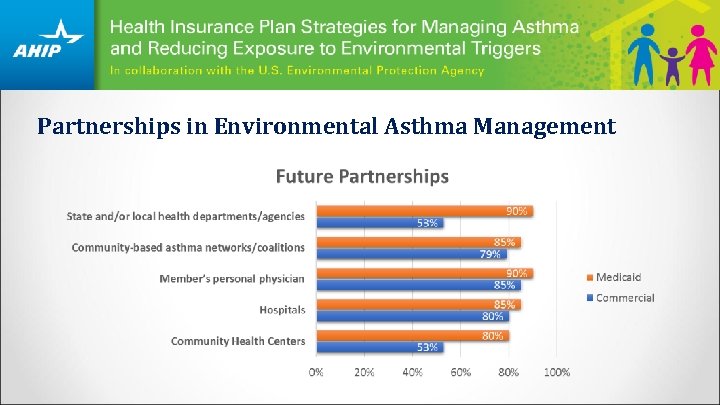 Partnerships in Environmental Asthma Management
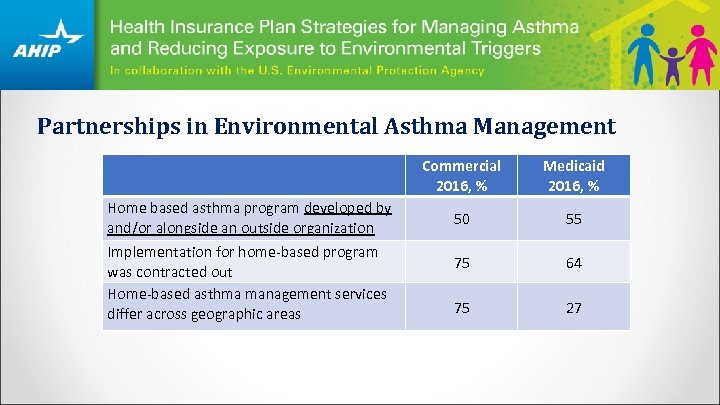 Partnerships in Environmental Asthma Management Commercial 2016, % Home based asthma program developed by and/or alongside an outside organization Implementation for home-based program was contracted out Home-based asthma management services differ across geographic areas Medicaid 2016, % 50 55 75 64 75 27
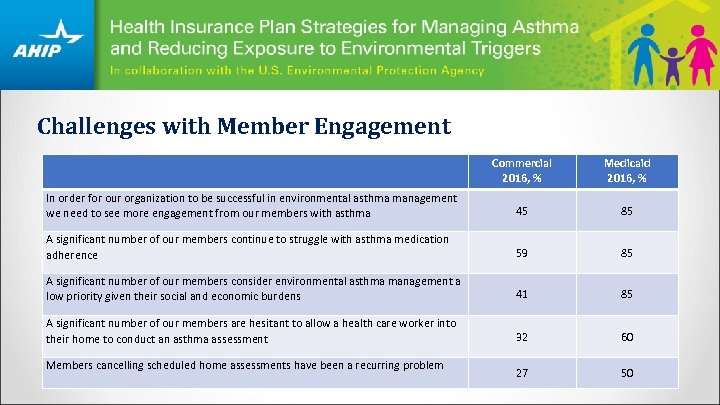 Challenges with Member Engagement Commercial 2016, % Medicaid 2016, % In order for our organization to be successful in environmental asthma management we need to see more engagement from our members with asthma 45 85 A significant number of our members continue to struggle with asthma medication adherence 59 85 A significant number of our members consider environmental asthma management a low priority given their social and economic burdens 41 85 A significant number of our members are hesitant to allow a health care worker into their home to conduct an asthma assessment 32 60 27 50 Members cancelling scheduled home assessments have been a recurring problem
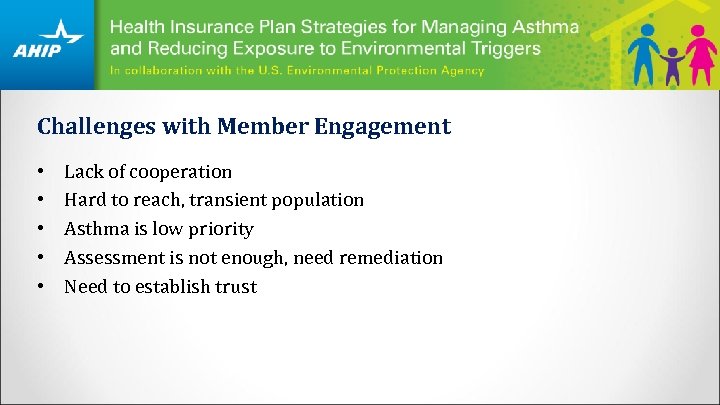 Challenges with Member Engagement • • • Lack of cooperation Hard to reach, transient population Asthma is low priority Assessment is not enough, need remediation Need to establish trust
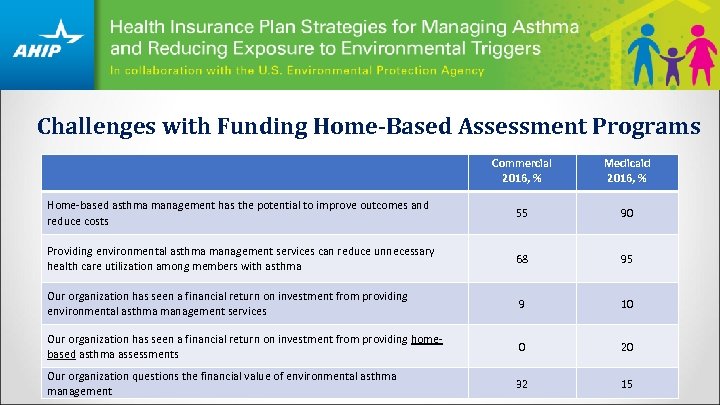 Challenges with Funding Home-Based Assessment Programs Commercial 2016, % Medicaid 2016, % Home-based asthma management has the potential to improve outcomes and reduce costs 55 90 Providing environmental asthma management services can reduce unnecessary health care utilization among members with asthma 68 95 Our organization has seen a financial return on investment from providing environmental asthma management services 9 10 Our organization has seen a financial return on investment from providing homebased asthma assessments 0 20 Our organization questions the financial value of environmental asthma management 32 15
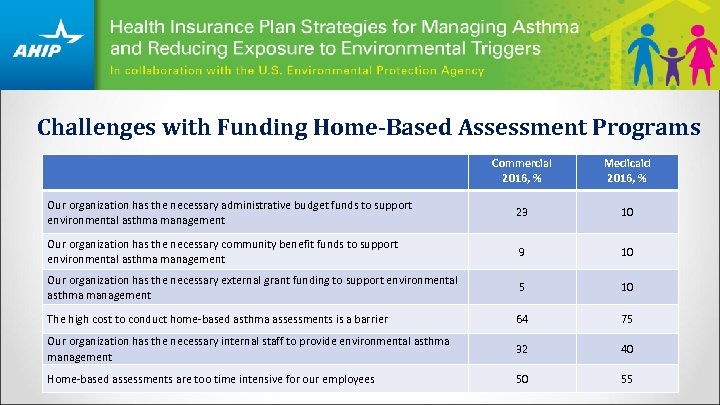 Challenges with Funding Home-Based Assessment Programs Commercial 2016, % Medicaid 2016, % Our organization has the necessary administrative budget funds to support environmental asthma management 23 10 Our organization has the necessary community benefit funds to support environmental asthma management 9 10 Our organization has the necessary external grant funding to support environmental asthma management 5 10 The high cost to conduct home-based asthma assessments is a barrier 64 75 Our organization has the necessary internal staff to provide environmental asthma management 32 40 Home-based assessments are too time intensive for our employees 50 55
 Program Effectiveness vs Financial Sustainability Option #1: Partner with external providers (e. g. visiting nurses) • Pros: • Can charge as medical expense • Financially sustainable • Cons: • Members may not trust nurses and may not let them into the home • Asthma is low priority for members
 Program Effectiveness vs Financial Sustainability Option #2: Develop in-house • Pros: • Can train/hire Community Health Workers • Can develop, capitalize on relationships • Can provide additional “goodies” to increase member engagement • Cons: • Cannot charge as a medical expense • Need external funding or have to charge against administrative funds • May be more difficult to achieve financial sustainability
 Questions? Visit us online at: www. ahip. org/asthma