 Скачать презентацию Health Occupations Job Skills Job Keeping Skills
9fe550a4f5196d31b4871ab6386d2416.ppt
- Количество слайдов: 35



Health Occupations Job Skills
Job Keeping Skills Characteristics of a good employee n Employers state deficiencies of employees n – – – – – Poor grammar Poor spelling Poor speech & math skills Lack of respect for work Lack of self-initiative Poor personal appearance Not accepting responsibility Excessive tardiness & poor attendance Inability to accept criticism
Job Keeping Skills n Use correct grammar at all times – Both written & spoken word – Ability judged based on communication – Poor grammar can indicate lack of education – Listen to how others speak – Use dictionary to check spelling – Spell check on computer
Job Keeping Skills n Report to work on time & when scheduled – 7 days a week, 365 days per year, 24 hours per day – Absence can cause major disruption to schedule – Strict rules about absenteeism
Job Keeping Skills n Be prepared to work upon arrival – Don’t socialize, make personal phone calls, talk about personal problems, bring kids to work, work in a sloppy manner – Develop good work ethic – Observe all legal & ethical responsibilities – Follow all policies & procedures – Recognize limitations, ask for help – Be willing to learn new things – Watch & learn
Job Keeping Skills n Practice teamwork – Be willing to work with others n Promote positive attitude – Creates good impression – Don’t concentrate on negatives only • Easy to criticize • Leads to negative attitude & poor morale – Concentrate on positive aspects • Look at rewards • Makes work more pleasant
Job Keeping Skills n Accept responsibility for actions – Take responsibility for mistakes & report them – Correct errors – Everyone will do something wrong at some time – Honesty is essential
Job Keeping Skills n Be willing to learn – Changes occur continuously – Staff development – New courses – Professional journals n Need good skills to keep your job – Courteous, responsible, enthusiastic, cooperative, reliable, punctual, & efficient
Letter of application Purpose is to obtain an interview n Must create good impression n Usually in response to job advertised n – Also send resume n Letter should be in correct form – – Computer printed on good quality paper Neat, complete, done in correct form Spelling & punctuation correct Employer’s first impression
Letter of application n Address letter to correct individual – Telephone agency to get info – Obtain correct spelling for name & title – If responding to box number, follow directions in advertisement – Can address letter to personnel direction or head of a particular department n Letter usually has 3 – 4 paragraphs
Paragraph 1 n State purpose for writing & express interest in position for which you are applying n State name & date of publication if responding to advertisement n If referred by another person, give that person’s name & title
Paragraph 2 n State why you feel you are qualified n May include why you want to work for this employer n Keep information brief because most information is included in resume
Paragraph 3 n State that resume is included n Point out 1 or 2 important features on your resume that will attract attention n If resume not included, state that one is available upon request
Paragraph 4 n Closes letter & request an interview n Include reference as to how employer can contact you n Include telephone number & times available n Add a thank you for considering the application
Resume n Record of information about an individual – Thorough but concise – Education, experience, abilities – Provides employer with basic information to make you appear qualified as an employee
Resume n Computer generated or typed – – – n Organized fashion Good quality paper Correct spelling & punctuation Straight & even margins Attractive style Format can vary – One page sufficient for recent high school graduate
Parts of a Resume n Personal identification – Name, address, phone number, email n Employment objective – Job desired, career goal, title for which you are applying n Educational background – Name & address of high school – Special courses or majors – List college or technical school first
Parts of a Resume n Work or employment history – Previous positions or employment – Start with most recent, work backwards – Name & address of employer, dates employed, job title, brief description of duties – Use action verbs to describe duties n Skills – Special knowledge, computer, & work skills – Specific & indicates qualifications & ability to perform job – Shows employer you are qualified if work experience is limited
Parts of a Resume n Other activities – Organizations of which you are a member, offices held, community activities, special awards received, volunteer work, hobbies, special interests – Keep brief – Include school, church, & community – Shows well-rounded, good citizenship, leadership – Write out full name of organization instead of identifying letters
Parts of a Resume n References – “references will be furnished on request” – Always have individual’s permission before using anyone as reference – List full name, title, address, & telephone number – Do not use relatives or high school friends – Seek professionals in your field, clergy, teachers, or other people in responsible positions n Honesty – Never give info that is a half truth – If you have A-B average, include that, otherwise omit
Parts of a Resume n List all info before preparing your resume – Select best format – Present your info in best possible way n Use correct size envelope for letter of application & resume – Don’t fold into small sections & put in undersized envelope – May want to use 9 x 12 envelope – don’t need to fold then – Buy standard business envelopes that match paper – Computer print or type envelope correctly & neatly
Career passport or portfolio Professional way to highlight knowledge, abilities, & skills n Contain following n – – – Introductory letter – background, education, goals Resume Skills & competency list Letters of recommendation Copies of work evaluations Documentation of mastering job-keeping skills • SCANS – Secretaries Commission on Acquiring Necessary Skills – Read, write, math, speak, listen – Thinking skills – reason, problem solving – Personal qualities – responsibility, self-initiative, honesty,
Portfolio n SCANS workplace competencies – Manage resources – time, money, space – Interpersonal skills – teamwork, teaching, cultural diversity – Utilize information – Comprehend systems – Use technologies Leadership & organizational abilities n Organize into neat binder n Use tab dividers to separate into sections n Correct grammar & punctuation n
Job Application n Used by employers to collect specific information – Vary from employer to employer – Most request similar info n Read entire form before completing it – – Note areas where info is to be placed Read instructions on completing form May need to type or use own handwriting May be able to scan into computer & complete there – On-line applications
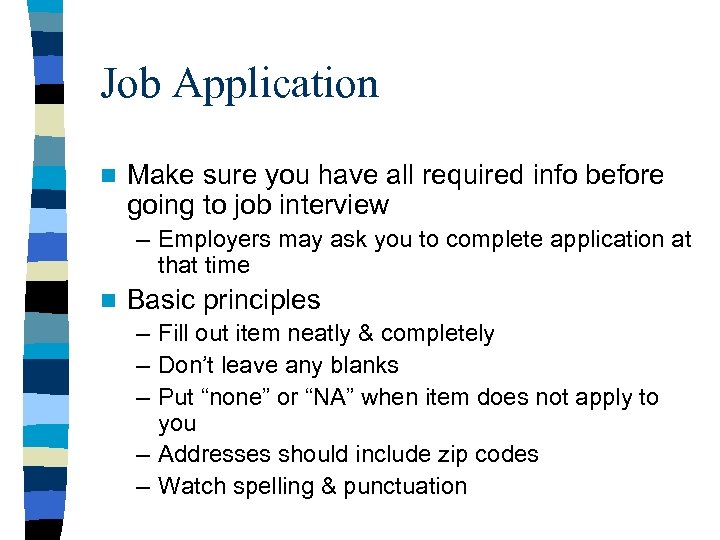
Job Application n Make sure you have all required info before going to job interview – Employers may ask you to complete application at that time n Basic principles – Fill out item neatly & completely – Don’t leave any blanks – Put “none” or “NA” when item does not apply to you – Addresses should include zip codes – Watch spelling & punctuation
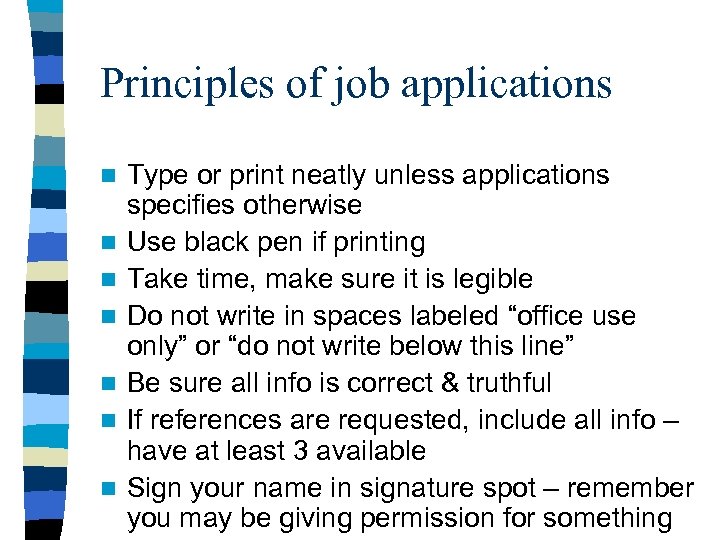
Principles of job applications n n n n Type or print neatly unless applications specifies otherwise Use black pen if printing Take time, make sure it is legible Do not write in spaces labeled “office use only” or “do not write below this line” Be sure all info is correct & truthful If references are requested, include all info – have at least 3 available Sign your name in signature spot – remember you may be giving permission for something
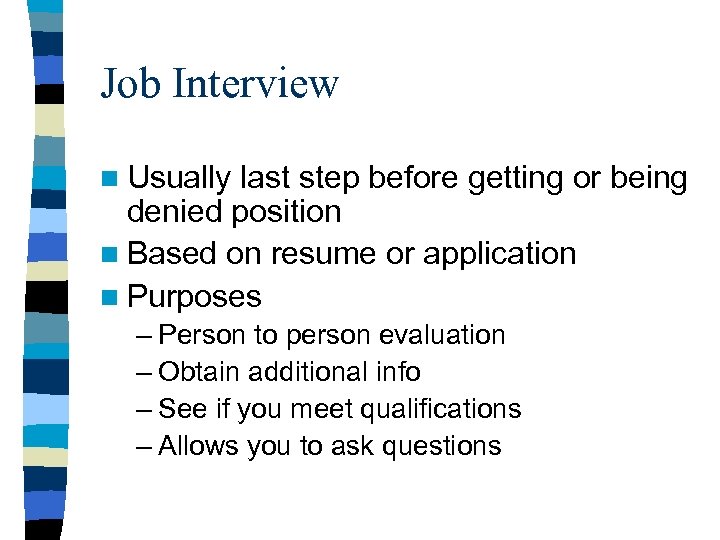
Job Interview n Usually last step before getting or being denied position n Based on resume or application n Purposes – Person to person evaluation – Obtain additional info – See if you meet qualifications – Allows you to ask questions
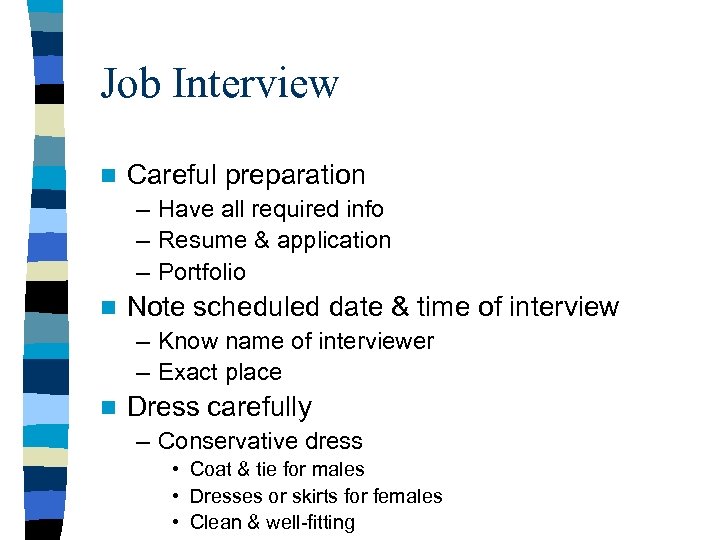
Job Interview n Careful preparation – Have all required info – Resume & application – Portfolio n Note scheduled date & time of interview – Know name of interviewer – Exact place n Dress carefully – Conservative dress • Coat & tie for males • Dresses or skirts for females • Clean & well-fitting
Job Interview n Check entire appearance – Hair – Nails – Clean-shaven – Conservative make-up, perfume – Teeth clean – Avoid excessive jewelry – Use good deoderant
Job Interview n Leave early – Arrive 5 – 10 minutes early – Allow time for traffic & complications n Observe following points – – – – Greet interviewer by name Introduce yourself Shake hands firmly Smile Remain standing until interviewer asks you to sit Good posture Use correct grammar, avoid slang
Job Interview n n n n Speak slowly & clearly Be polite Maintain eye contact Answer all questions thoroughly, don’t go into long explanations Don’t smoke, chew gum, eat candy during interview Smiles but don’t laugh excessively or giggle Be yourself Positive attitude
Job Interview n n n Listen closely to interviewer, don’t interrupt Avoid awkward habits Never discuss personal problems or finances Think before you respond Don’t immediately question about fringe benefits, salary, & insurance – usually mentioned before end of interview Questions – ask about job description, type of uniform, potential for career growth, continuing education programs, job orientation
Job Interview Don’t expect definite answer at end of interview n Thank employer as you leave n Never try to extend interview n Send a follow-up note or letter after interview n – – Thank employer Indicate you are still interested in position Suggest you are available for further questions Could be deciding factor if many equal applicants
Federal law n Prevents discrimination regards to age, cultural or ethnic background, marital status, parenthood, religion, race, & sex – Any questions that reflect discrimination don’t need to be answered – Employers are aware that this is illegal – You have right to refuse to answer this type of question – “I prefer not to answer that question” – “Can I ask you how this would affect the job we are discussing? ”
Proof of eligibility to work May need to complete an Employment Eligibility Verification Form I – 9 n Shows you are legally entitled to work in U. S. n Documents that prove your identity n – Birth certificates, passports, immigration cards – Photo I. d. like driver’s license n Employers must make copies of documents
Скачать презентацию Health Occupations Job Skills Job Keeping Skills
9fe550a4f5196d31b4871ab6386d2416.ppt