 Скачать презентацию Health Links Increasing EBI Implementation in Low-Wage Worksites
5a2f308c873542d028cc0993d65565c4.ppt
- Количество слайдов: 16



Health. Links: Increasing EBI Implementation in Low-Wage Worksites UW CPCRN Peggy Hannon February 15, 2012
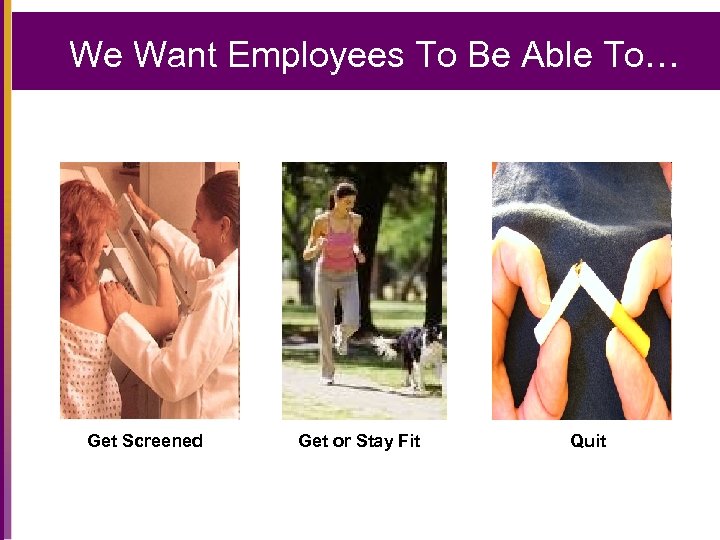
We Want Employees To Be Able To… Get Screened Get or Stay Fit Quit
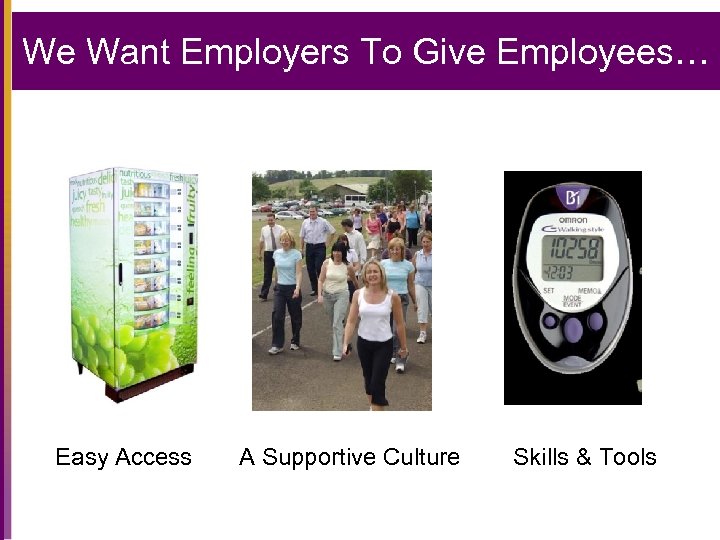
We Want Employers To Give Employees… Easy Access A Supportive Culture Skills & Tools
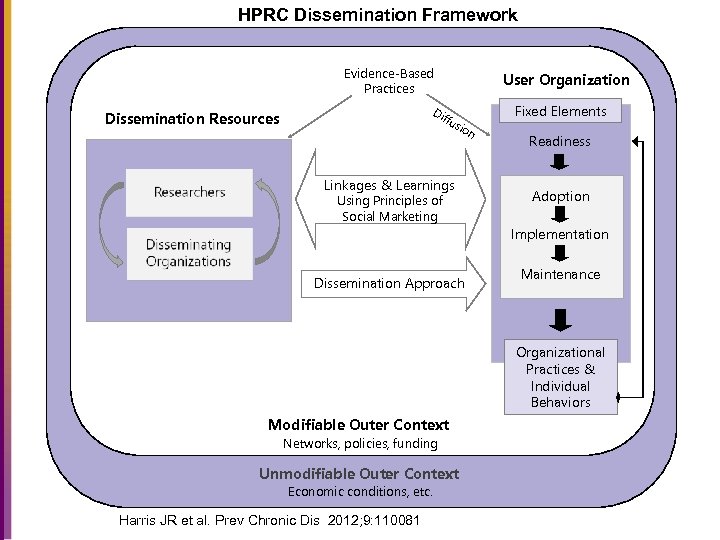
HPRC Dissemination Framework Evidence-Based Practices User Organization Dif Dissemination Resources fus ion Linkages & Learnings Using Principles of Social Marketing Dissemination Approach Fixed Elements Readiness Adoption Implementation Maintenance Organizational Practices & Individual Behaviors Modifiable Outer Context Networks, policies, funding Unmodifiable Outer Context Economic conditions, etc. Harris JR et al. Prev Chronic Dis 2012; 9: 110081
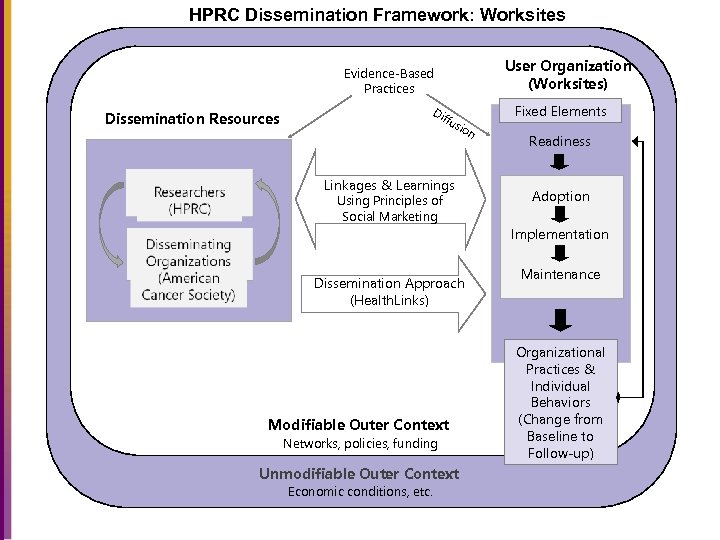
HPRC Dissemination Framework: Worksites User Organization (Worksites) Evidence-Based Practices Dissemination Resources Dif fus ion Linkages & Learnings Using Principles of Social Marketing Dissemination Approach (Health. Links) Modifiable Outer Context Networks, policies, funding Unmodifiable Outer Context Economic conditions, etc. Fixed Elements Readiness Adoption Implementation Maintenance Organizational Practices & Individual Behaviors (Change from Baseline to Follow-up)
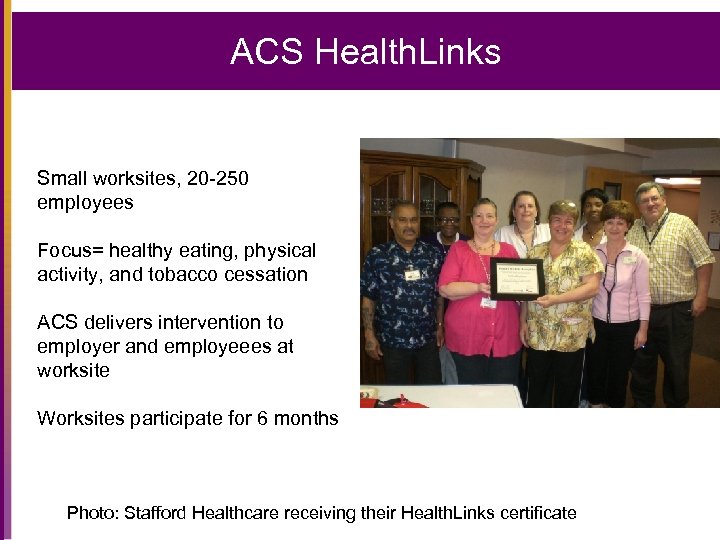
ACS Health. Links Small worksites, 20 -250 employees Focus= healthy eating, physical activity, and tobacco cessation ACS delivers intervention to employer and employeees at worksite Worksites participate for 6 months Photo: Stafford Healthcare receiving their Health. Links certificate
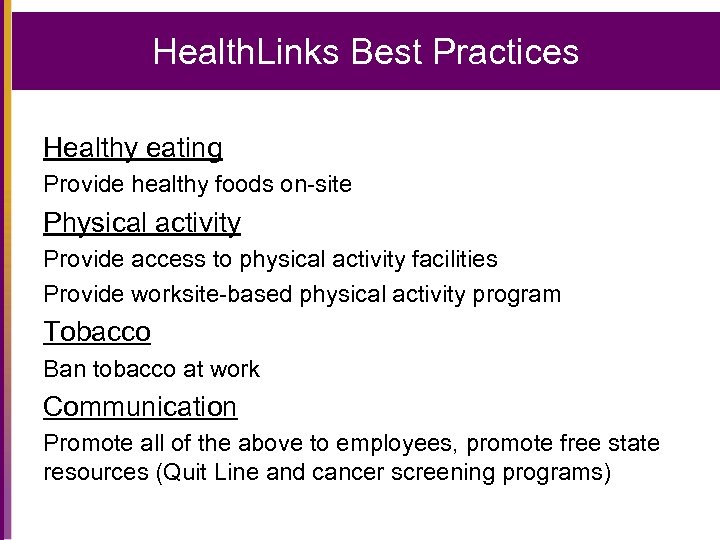
Health. Links Best Practices Healthy eating Provide healthy foods on-site Physical activity Provide access to physical activity facilities Provide worksite-based physical activity program Tobacco Ban tobacco at work Communication Promote all of the above to employees, promote free state resources (Quit Line and cancer screening programs)
Current Health. Links Project COMMUNITIES PUTTING PREVENTION TO WORK
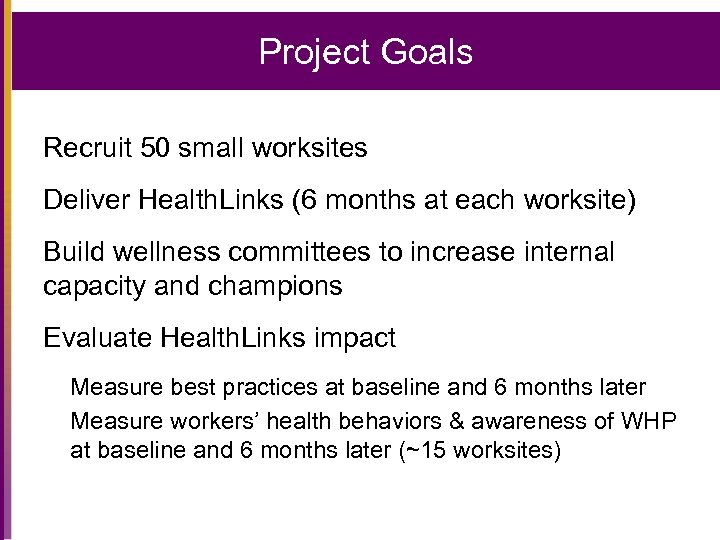
Project Goals Recruit 50 small worksites Deliver Health. Links (6 months at each worksite) Build wellness committees to increase internal capacity and champions Evaluate Health. Links impact Measure best practices at baseline and 6 months later Measure workers’ health behaviors & awareness of WHP at baseline and 6 months later (~15 worksites)
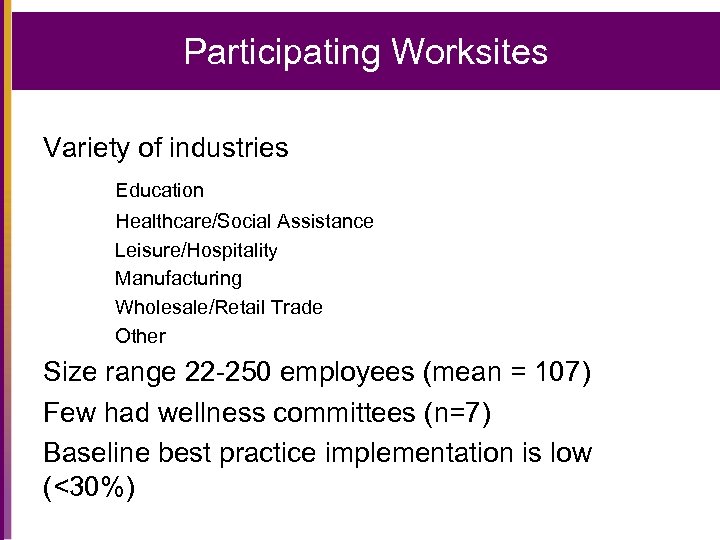
Participating Worksites Variety of industries Education Healthcare/Social Assistance Leisure/Hospitality Manufacturing Wholesale/Retail Trade Other Size range 22 -250 employees (mean = 107) Few had wellness committees (n=7) Baseline best practice implementation is low (<30%)
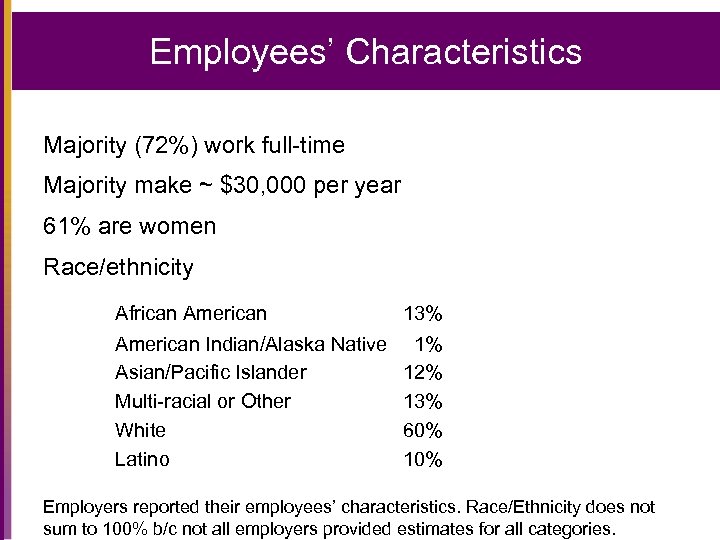
Employees’ Characteristics Majority (72%) work full-time Majority make ~ $30, 000 per year 61% are women Race/ethnicity African American 13% American Indian/Alaska Native Asian/Pacific Islander Multi-racial or Other White Latino 1% 12% 13% 60% 10% Employers reported their employees’ characteristics. Race/Ethnicity does not sum to 100% b/c not all employers provided estimates for all categories.
Lessons Learned Recruitment New challenges Strategies we tried Strategies that worked Implementation Measuring small changes Running with creativity
What’s Next? Community Transformation Grant, WA State Deliver Health. Links to worksites in rural WA counties Develop & pilot-test new Health. Links model, engaging ACS volunteers to provide implementation support Measure best practice implementation every 6 months
Partners American Cancer Society John Craft, Eustacia Mahoney, Patti Santiago, Erin Sheahan, Sara Teague Group Health Cooperative/GHRI David Grossman, Kevin Klein Public Health – Seattle & King County Elaine Cummins, Ryan Kellogg, Sarah Ross-Viles WA Department of Health Sue Grinnell, Pama Joyner, Sheila Pudists, Chris Zipperer
Acknowledgements Public Health-Seattle & King County (subcontracts via Communities Putting Prevention to Work, Centers for Disease Control and Prevention) University of Washington Health Promotion Research Center, a CDC Prevention Research Center, cooperative agreement U 48 DP 001911 Centers for Disease Control and Prevention (CDC) and the National Cancer Institute through the Cancer Prevention and Control Research Network, a network within the CDC's Prevention Research Centers Program, cooperative agreement U 48 DP 001911

Questions and Discussion Contact: Peggy Hannon peggyh@uw. edu 206 -616 -7859
Скачать презентацию Health Links Increasing EBI Implementation in Low-Wage Worksites
5a2f308c873542d028cc0993d65565c4.ppt