 Скачать презентацию HEALTH FRAMEWORK FOR CALIFORNIA The PUBLIC SCHOOLS Vision
1473a6f6d6ddc4a916449c626e9883d8.ppt
- Количество слайдов: 93



HEALTH FRAMEWORK FOR CALIFORNIA The PUBLIC SCHOOLS Vision: Health Literacy Healthy Schools Healthy People
THE VISION We need to make a national commitment to health education that is far greater then the routine and merely ceremonial attention we usually give it. We need to teach youngsters that they must take charge of their health. . . all of their lives. . . and we must do more than teach; we must set an example in the way we live. C Everett Koop, MD
HEALTH IN THE ACADEMIC ENVIRONMENT Our youth are confronted with a scope of health educational and social challenges not experienced by any other generation Educational institutions are in a unique and powerful position to improve health out comes for youths Schools represent the only public institution that can reach nearly all young people
Schools provide a setting in which Friendship networks develop Socialization occurs Norms that influence behavior are developed and reinforced This social support occurs before the health behaviors or most youth become habitual Educators are academically prepared to organize developmentally appropriate learning experiences to empower children to lead safer and healthier lives
Emphasis must be placed on developing lifelong, postitive health-related attitudes • Health education in the schools must be supported by a comprehensive schoolwide system to promote children's health and must be developed and sustained by collaborative efforts of school personnel, parents, school board members community leaders and health and social services agencies and providers.
Health Framework for California Public Schools • Health Literacy • The capacity of an individual to obtain interpret and understand basic health information and services ant the competence to use such information and services in ways which are health enhancing. • A health literate person understands scientifically based principles of health promotion and disease prevention, incorporates that knowledge into personal health related attitudes and behaviors and makes good health a personal priority.
Goal of this framework • Describe health education and schoolwide health promotion strategies that will help children and youths become health literate individuals with a lifelong commitment to healthy living.
A PROGRAM MODEL FOR BEST PRACTICES • The best approach to managing complex student health challenges rests in organizing all appropriate resources and expertise and activities into a model representing best practices.
Coordinated School Health System Components • Health Education – development, delivery, and evaluation of a planned, sequential curriculum for students in kindergarden through grade twelve and for parents and school staff and is designed to influence positively people's knowledge, attitudes, skills and behaviors related to health. – Physical education – Health Services – Nutrition services – Psychological and counseling services – A safe and healthy school environment – Health promotion
Commonly used terms • Health - State of complete physical, mental, and social well-being, not merely the absence of disease and infirmity • Health Literacy • Coordinated School health system - An organized set of policies procedures, and activities developed and implemented through a collaborative effort that includes parents, the school and the community. Designed to protect and promote the health and well being of students and staff.
A COORDINATED SCHOOL HEALTH PROGRAM • Provides the formal model around which the talents and efforts of many disciplines are coordinated to promote student health and school success • Consistent health promoting messages are delivered and reinforced across multiple communication channels in the school and throughout the community. • Rather than competing for limited resources the CSHP puts student health and achievement at the heart of the matter and provides an efficient and effective way to improve, protect and promote the wellbeing of students, families, and professionals in the education system
CSHP Model • Maximize the impact of all available expertise and resources directed toward risk reduction and health promotion • Conserve taxpayer dollars by reducing duplication of efforts • Maximize use of public facilities in the school and community to promote health • Enhance communication and collaboration across health promotion professionals in the schools and community • Address student health risks in the context of rather than in competition with the academic mission of the school
Documented Research – “the period prior to high school is the most crucial for shaping attitudes and behaviors”. – By the time students reach high school many already are engaging in risky behaviors or may at least have formed accepting attitudes toward these behaviors.
Trends in California are consistent with disturbing national findings. • Declining access to healthcare: – Increase risk of contracting infectious diseases and developing physical and mental disabilities. – Preventable – mumps, measles, rubella – CDC – reports alarming levels use of alcohol and other drugs – Weapon carrying – Early sexual activity and suicide.
Schools Role • Recognize the bi-directional connection between health and education – Children must be healthy in order to be educated and children must be educated in order to stay healthy Given the needs Schools must make health a priority in the curriculum and overall school program Basic patterns of healthy living are formed in childhood and adolescence,
Schools cannot be resonsible for meeting every need • But where the need directly affects learning, the school must meet the challenge. • So it is with health • For Health education to be made meaningful, systems must be in place that support effective health education and make health an important priority in school
Schools plan must be well planned, coherent, must be implemented consistently Supported by all adults in the school Components must be mutually supportive consistent with the overall goal of promoting and enhancing children's health literacy
Eight Components of a Coordinated School Health Program Health Education Physical Education Health Services Nutrition Services Psychological and counseling services Safe and Healthy School environment Health Promotion for the staff Parent and Community Involvement
California's Healthy Start Initiative • California State program established 1991 (education code section 8800 et seq) – Facilitate partnerships among local educational agencies, families and communities to benefit children and youths to reach their full potential
California's Healthy Start Initiative – Philosophy • Belief that educational success, physical health, emotional support and family and community strengths are inseparable • Each school community has its own combination of assets and needs. • Mix of support and services vary.
Health is a very broad concept and extends beyond a foundation defined by physical parameters
Joint Committee on Health Education clarifies Health is an integrated method of functioning which is oriented towards maximizing the potential of which the individual is capable.
Health • It requires that the individual maintain a continuum of balance and purposeful direction with the environment where he (she) is functioning. Need balance among Physical, emotional, social spiritual and vocational domains of health.
Emotional domain strong coping skills and express a full range feelings in socially acceptable ways. Communicate self-control and self acceptance
Social Domain Comfortable intimancy and connections with and communicating respect and tolerance for others view themselves and making meaningful contributions to family and community
Spiritual Domain Not just sacred terms Comfort withourselves and others Strength of our personal value system Capacity to integrate positive ethical and moral standards, such as integrity, honesty and trust, into their interactions. Pursue meaningful purpose for our life
Vocational Domain Collaborate with others on family community or professional projects Manifested in the degree to which one's work makes a positive impact on others or on the community.
Evaluate the quality of health the key is balance among the domains. As educators in our elementary and middle level schools it is important that you reflect on your own health across the five domains
Healthy People 1979 – report on health promotion and disease promotion Validated Americans were living longer and healthier lives than their counterparts who had lived 100 years earlier Despite the achievements the report documented that we still had premature death 50% due to factors beyond personal control 50% due to activities over which each of us could exercise significant personal control
As a result of Healthy People '79 Local, State and Federal have been committed to an ongoing broad and collaborative initiative focused on improving the health of all americans Original objectives targeted for achievement by 1990 Again some goals were met, some not; others surpassed.
Then Came Healthy People 2000 Several objectives specified a role for American Schools Integration of planned sequential school health education was targeted for at least 75% of the nations schools in Kindergarden through twelfth grade Again objectives not achieved and now Healthy people 2010
Specific 2010 agenda Increase the quality availability and effectiveness of educational and community based programs designed to prevent disease and improve quality of life
To reach these goals a systematic approach to promoting and protecting the nations health has been established Formal structure for Individual, organizations communities, state and federal collaboration, efficiency and effectiveness Eliminate duplication, reduce costs
Health in the Academic Environment The Co-ordinated health School program Your job will be to plan, coordinate and implement health promotion programming for individuals in the school community
Coordinated School Health System Components –Physical education –Health Services –Nutrition services –Psychological and counseling services –A safe and healthy school environment –Health promotion
Comprehensive School Health Education The starting point: table 1. 6 Quality education is grounded in activities that bridge domains of learning Cognitive, affective and psychomotor must reflect current accurate knowledge and incorporate developmentally appropriate learning materials and technological resources
More hours are needed to produce changes in the affective domain than in either of the other two domains 40 -50 hours of formal health education is necessary to produce stable improvements across all three domains in knowledge, attitude and skills
CDC 6 Problem priority areas Tobacco use Poor eating habits Alcohol and other drug risks Behaviors tht result in intentinal and unintentional injuries Physical activity Sexual behaviors that result in HIV & other sexually transmitted diseases or unintended pregnancy
The six problem priority areas are confirmed to be related to the leading causes of death and illness and death of americans
Knowing the CDC 6 Problem priority areas • gives you the foundation for you as curriculum developers and teachers to balance issues of teaching quality with realistic time constraints by organizing learning activities in these priority high risk areas.
• Problem of developing effective health education curricula • Pinpointing the structural elements and specific sources of authority has become more difficult. • The federal government provides only 7% of all dollars spent on publication in the US. • 2000 “no child left behind”
Education in the US • Education in US is grounded in decentralization – not controlled by the federal government • The education of our youth is the responsibility of each state • Determination of curricular topics reflect the unique interests and standards of each state.
• The education of our youth is the responsibility of each state • Determination of curricular topics reflect the unique interests and standards of each state.
US Constitution asserts education is the responsibility of each state • The governor is responsible for the budget and proposing initiatives • Legislature has final authority • Governors give lip service to improving education outcomes • Reality is compete for dollars • The scope of influence the state ED board varies
Local school districts must comply with laws • However the school board is responsible for establishing policies and practices for day to day operations. (15, 000 school boards operating in the US)
Understand the organization and sources of influence • While the structure may be cumbersome and confusing the public schools are designed to maximize input from taxpayers and concerned stakeholders.
Health Services Policies and Programs designed to assess the health status of children School Nurse support student health and learning by acting as a liaison among school, home and the medical community Nurses assume primary leadership for providing health servies the teacher is in the important postion to participate in initial observation and referral of any conditions evident in students
Providing School Health began in the early 20 th century as a way to improve academic outcomes for students. • Nurses worked to reduce absenteeism related to out breaks of communicable disease • Today get involved in more complex health related barriers to achievement (Asthma, child abuse & neglect, domestic and school violence, adolescent pregnancy & Parenting, Drug and ETOH abuse, Mental health, lack of insurance.
Require periodic health examinations Vision and Hearing (elementary school years measure height and wt. Coordinate measures to prevent communicable disease health protection via compliance with immunization mandates
Elements of Successful Health Education Goal: Help students develop the knowledge, skills, attitudes and behaviors needed for lifelong commitment to health.
CDC 6 Problem priority areas 1. Tobacco use 2. Poor eating habits 3. Alcohol and other drug risks 4. Behaviors tht result in intentinal and unintentional injuries 5. Physical activity 6. Sexual behaviors that result in HIV & other sexually transmitted diseases or unintended pregnancy
Creating a Positive Learning Climate Learning Centers have climates. . something you feel, something in the air. You sense it in the way people interact with each other, in how they listen and what they say The environment in which you offer the program can determine how effective you are as a teacher and leader of children Is it a nice place? Do kids feel safe there? Do they know what is expected of them?
Health Realization – Enhance the life of the individual by teaching the understanding of psychological principles of the mind, thought and consciousness and how these principles function to create our life experiences.
The Dimensions of Climate – creating an image that people recognize and trust (in business they call it branding) Values – Core concepts you want the kids to learn. Environment – physical aspects of your classroom Patterns of Action – expectations for interacting with each other People – what it is all about. A lot of people can help you do your job (Guest Speakers, parents other staff can provide a positive influence )
Culturally appropriate – attitudes, beliefs and values regarding health related topics may vary according to the ethnic and cultural makeup of the community. Effective health education should be based on awareness of the culture, background of the students within each classroom and the influence of culture on the information and skills to be taught. Make the curriculum accessible – not all students learn the same way, nor are they motivated by the same factors. Use a variety of strategies to provide the student with a common experimental base.
Take advantage of opportunities for active learning – every aspect of health education focuses on behaviors or choices and every topic presents opportunities for engagement and motivation. Provide students with opportunities to to be engaged in creating and construction what they learn rather than passively receiving factual information. Focus on mental and emotional health throughout – mental and emotional health are not separate content areas. Both are considered crucial to an individual’s motivation to act on health-related knowledge and use health-related skills.
Emphasize character development – Through the health education curriculum students learn strategies for making positive, healthy decisions based on such ethical principles as integrity, courage, responsibility and commitment Throughout the health education curriculum, moreover, the development of positive commitments to one’s own health and the health of the broader community and society is emphasized.
Use technology to embrace learning – in the classroom use technology based resources to practice skills example: develop personal health profile with a variety of health indicators – encourage them to set goals for improvement and monitor progress. Connect concepts in health education with other learning experiences. Children learn best when the curriculum is focused on meaning and thinking ie – growth and development influenced by nutrition Personal health habits play a role in spread of communicable disease. Use of alcohol, drugs tobacco increases risk of disease and injury.
Effective Implementation: Foster Health Literacy Present current and accurate content: All health related education is based on up-to-date scientific information. Recognize similarities and differences among students – many people face similar health-related issues and choices. Differences should be discussed, but care should be taken not to emphasize them to the point of divisiveness Emphasize not just health related information but importance of behavior – view the school as a safe laboratory for practicing and reinforcing new behaviors.
Guest Speaker Gabriela Maldonado Santa Clara Valley Health & Hospital System Department of Alcohol and Drug Services Health Realization
The Health Realization Services Division seeks to enhance the life fo the individual by teaching the understanding of the psychological Principles of Mind, Thought and Consciousness, and how these principles function to create our life experience. Through this educational process, individuals will realize their innate wisdom, and resiliency which will enable them to live healthier and more productive lives so that the community becomes a model of health and wellness.
Health Realization • Enhance the life of the individual by teaching the understanding of the psychological Principles of the mind thought and consciousness and how these principles function to create our life experience.
Health Realization • Individuals realize their innate wisdom and resiliency which will enable them to live healthier and more productive lives. • Based on fundamental principles that offer a simple explanation about how and why people function and behave as they do.
Physical Activity • We all have lots of excuses for not consistently participating in physical activity – despite research and even what we instinctly know of the benefits that are gained for all ages. • Your challenge is to organize a range of developmentally appropriate and well designed strategies to instill a sound foundation for maintaining health and promoting school success.
Research has demonstrated The way in which fitness activities are taught and reinforced contribute to student attitudes about the value of being active for a lifetime.
Research has documented that participation in a pattern of consistent activity results in: Building and maintaining healthy bones and muscle. Reduces feelings of depression and anxiety. Promotes psychological well being. Helps control weight. Builds lean muscle mass. Reduces body fat.
1996 Surgeon General report on physical activity and health concluded: Regular participation in moderate physical activity is an essential element of a healthy lifestyle for all americans.
More research needed. . . . However, the following specific benefits have been identified for school age children and youth who participate in regular physicial activity. Improved aerobic endurance & muscular strength Reduced risk for cardiovascular disease (decrease B/P and body mass index) Decrease body weight among obese youths Improved self esteem & self concept. Decrease anxiety and manifestations of stress. Increased bone mass density as a result of participation in weight bearing exercise.
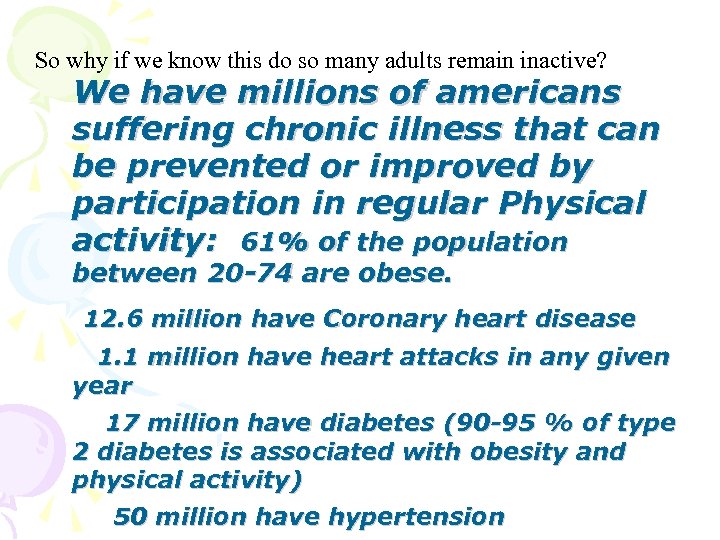
So why if we know this do so many adults remain inactive? We have millions of americans suffering chronic illness that can be prevented or improved by participation in regular Physical activity: 61% of the population between 20 -74 are obese. 12. 6 million have Coronary heart disease 1. 1 million have heart attacks in any given year 17 million have diabetes (90 -95 % of type 2 diabetes is associated with obesity and physical activity) 50 million have hypertension
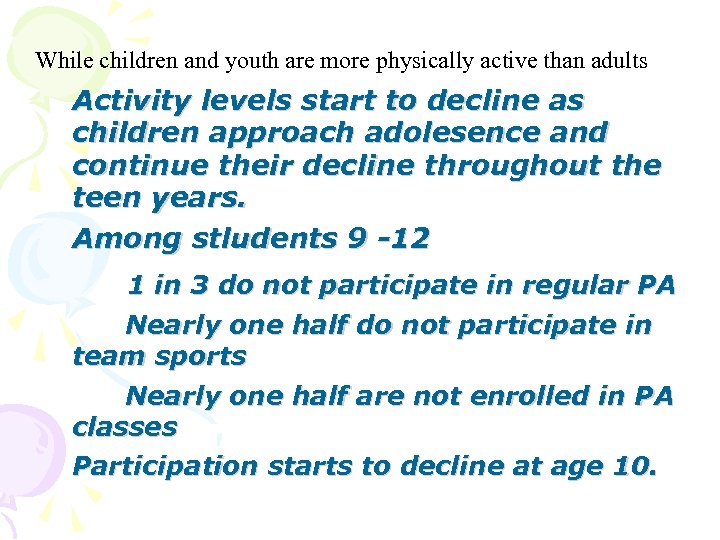
While children and youth are more physically active than adults Activity levels start to decline as children approach adolesence and continue their decline throughout the teen years. Among stludents 9 -12 1 in 3 do not participate in regular PA Nearly one half do not participate in team sports Nearly one half are not enrolled in PA classes Participation starts to decline at age 10.
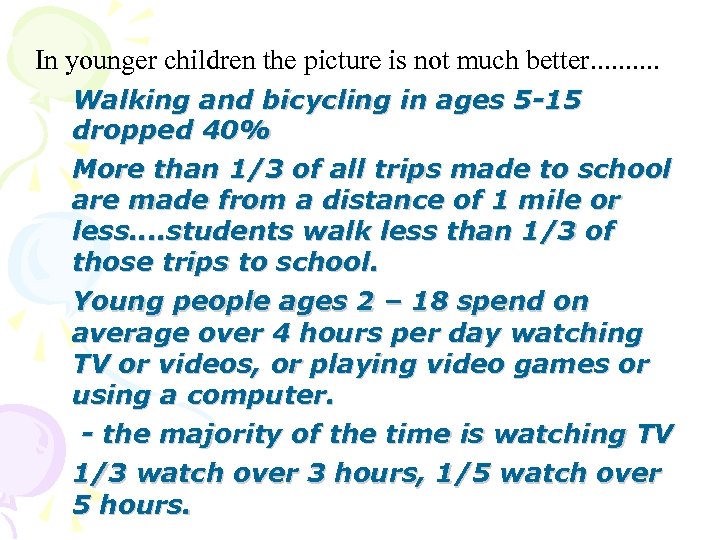
In younger children the picture is not much better. . Walking and bicycling in ages 5 -15 dropped 40% More than 1/3 of all trips made to school are made from a distance of 1 mile or less. . students walk less than 1/3 of those trips to school. Young people ages 2 – 18 spend on average over 4 hours per day watching TV or videos, or playing video games or using a computer. - the majority of the time is watching TV 1/3 watch over 3 hours, 1/5 watch over 5 hours.
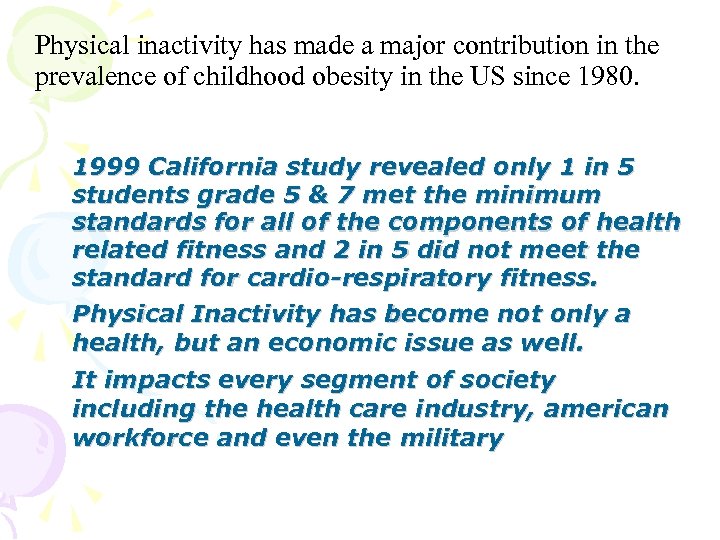
Physical inactivity has made a major contribution in the prevalence of childhood obesity in the US since 1980. 1999 California study revealed only 1 in 5 students grade 5 & 7 met the minimum standards for all of the components of health related fitness and 2 in 5 did not meet the standard for cardio-respiratory fitness. Physical Inactivity has become not only a health, but an economic issue as well. It impacts every segment of society including the health care industry, american workforce and even the military
Among youths 6 -17 yrs the number of hospital admissions for obesity-related illness tripled in the past 20 years - % of costly obesity – diabetes doubled - % of obesity related gallbladder disease tripled - Sleep apnea among young people increased 5 -fold. These pose severe economic burden in our society. . Cost of hospitalization = $1500 average per day
So what are we doing about this and what are healthy levels of physicial activity for young people? The international consenses conference on physical activity guidelines for adolesence has suggested: All adolescents be physically active daily, or nearly every day as part of play, games, sports, work, transportation, recreation and physical education or planned exercise in the context of family, school and community activities. Experts encourage – 3 or more sessions/week of activities that last 20 minutes at a time that require moderate to vigorous levels of exertion.
Growing body of literature confirms – participation in PA is associated with improved academic outcomes for students -improved concentration -better scores on math, reading and writing skills tests -reduced disruptive behaviors -improved attitudes towards self & school
Statement by California State superintendent of public instruction>. . . Every student in California should have a quality physical education experiences from kindergarden to high school. Given the national focus on improving proficiency test outcomes for students I don't believe a change in schools programming and policy are going to happen in the near future
But we do know active learning has advantages over sedentary learning As classroom teachers you are encouraged to: >Integrate a blend of sitting and moving into daily class room practice >Engage students in greater variety of postures and movement during classroom instructions >Encourage students to use their bodies to learn >Incorporate role play as a way to dramatize key concepts >Take stand stretch breaks every 20 minutes to energize the class.
So what are the Barriers? >Patterns of housing have centered in the use of the automobile rather than walking and bicycling >Concerns for safety >Appealing Technology (video games) enable a sedentary lifestyle among children >Schools have cut recess programs and reduced requirements for participation in PE. >In some districts unreasonable teacher student ratios >Budget constraints for development and maintenance of facilities (parks & rec centers close to homes)
For teachers – recognition of the issues is critical as is the understanding of the scientific literature to understand the terminology of PA and fitness. PA = movement produced by skeletal muscles resulting in expenditure of energy. Exercise is a subset of PA that is planned, structured, repetitive and is done with the purpose of improving or maintaining physical fitness
Physical fitness includes a set of attributes that are either health related or motor skill related Health related elements of physical fitness >Cardio-respiratory (aerobic) endurance, muscular strength and endurance, flexibility and body composition >Motor skills = balance, agility, power, reaction time, speed and coordination.
Specific forms of PA & Exercise >Walking >bicycling >Unstructured play activities >organized sports >dancing >Household chores >Physicial tasks associated with after school jobs
PA Pyramid Level 1 =Daily lifestyle activities require involvement of large muscles of the body Do most days of the week Accumulate 30 + minutes
Level 2 Aerobic exercise = 3 -5 days/week, 20 – 60 minutes Flexibility exercise = 2 -3 days/week, hold each pose for 10 -20 seconds Strength exercise – 2 -3 days/week, 8 -10 exercises, 1 set 8 – 12 reps
Level 3 Recreational Activities – 2 -3 days/week
Level 4 Do sparingly Has some benefits in stress reduction and relaxation Not necessary to abstain if it does not interfere with other physicial activities
As a fromalized part of the co-ordinated School Health Education Program Schools and communities have the potential to improve the health of school age children and students by providing instruction programming and servies to promote life long PA Since students spend a large percent of their waking hours at school. . a formalized physical education curriculium, planned recess and short activity periods supplemented by a range of opportunities for activity throughout the school is essential
In recent years research has confirmed the health benefits of a lifelong commitment to physical activity Activities should conform to the shorter attention span of children Children need frequent periods of rest following bursts of activity Feelings of success and accomplishment are an important foundation for an ongoing commitment to participation in PA Exercising with parents and other family members can reinforce a commitment to exercise participation
Class Activity Using Table 11. 2 (p 270) The CDC recommendations (p 272/73) NHES Learning and assessment strategies develop a program of fitness evaluation for children in an elementary class.
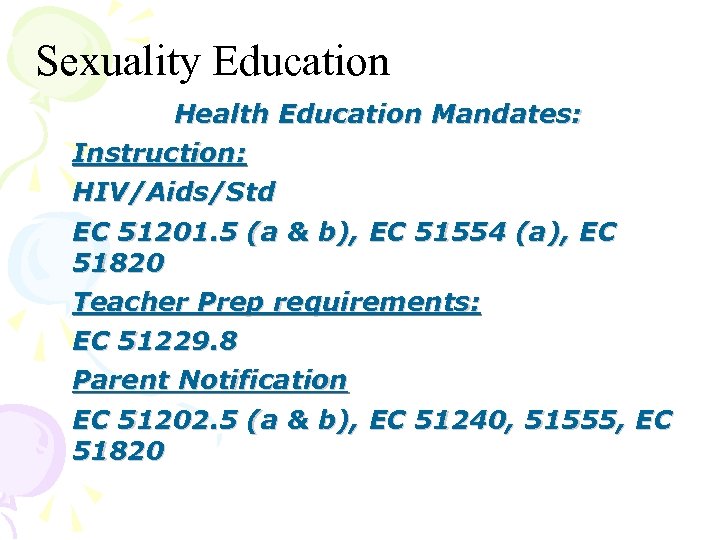
Sexuality Education Health Education Mandates: Instruction: HIV/Aids/Std EC 51201. 5 (a & b), EC 51554 (a), EC 51820 Teacher Prep requirements: EC 51229. 8 Parent Notification EC 51202. 5 (a & b), EC 51240, 51555, EC 51820
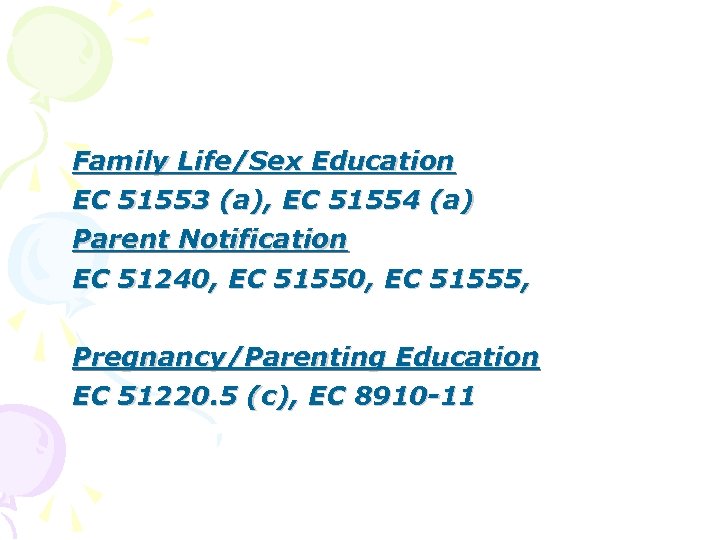
Family Life/Sex Education EC 51553 (a), EC 51554 (a) Parent Notification EC 51240, EC 51555, Pregnancy/Parenting Education EC 51220. 5 (c), EC 8910 -11
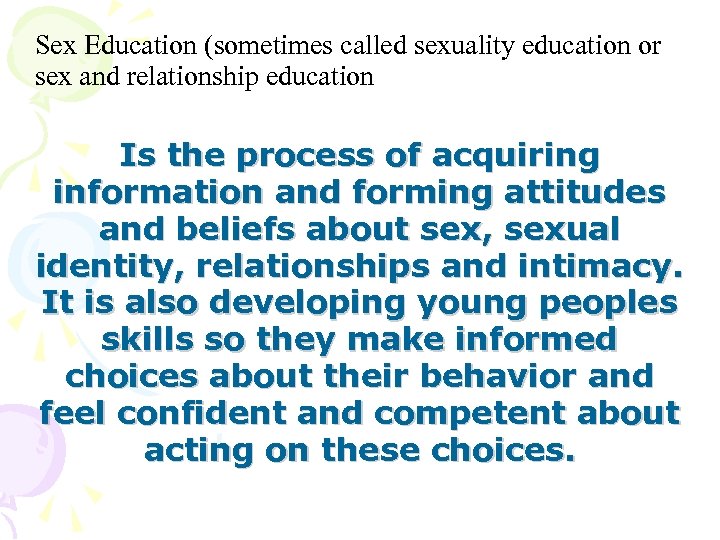
Sex Education (sometimes called sexuality education or sex and relationship education Is the process of acquiring information and forming attitudes and beliefs about sex, sexual identity, relationships and intimacy. It is also developing young peoples skills so they make informed choices about their behavior and feel confident and competent about acting on these choices.
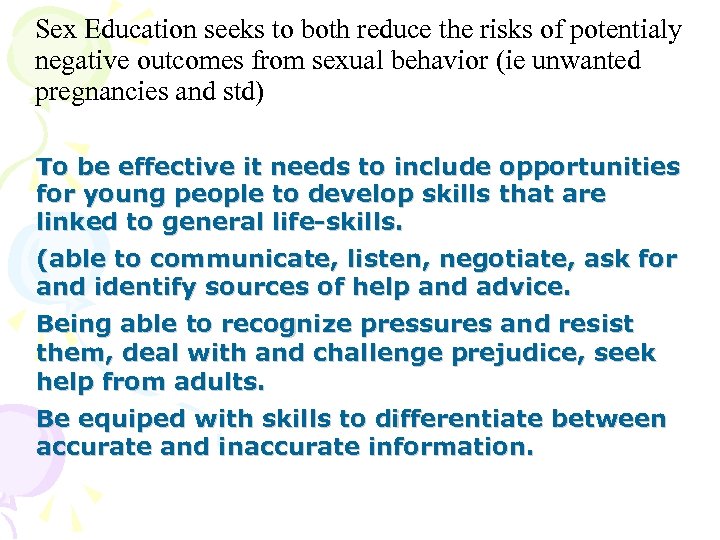
Sex Education seeks to both reduce the risks of potentialy negative outcomes from sexual behavior (ie unwanted pregnancies and std) To be effective it needs to include opportunities for young people to develop skills that are linked to general life-skills. (able to communicate, listen, negotiate, ask for and identify sources of help and advice. Being able to recognize pressures and resist them, deal with and challenge prejudice, seek help from adults. Be equiped with skills to differentiate between accurate and inaccurate information.
Forming attitudes and beliefs You must be comfortable with your beliefs and not let them influence negatively the messages you provide.
Скачать презентацию HEALTH FRAMEWORK FOR CALIFORNIA The PUBLIC SCHOOLS Vision
1473a6f6d6ddc4a916449c626e9883d8.ppt