 Скачать презентацию Health Economics and Antimicrobial Resistance Richard Smith Reader
38a2a523bee3d1b93493e6aa5c09a241.ppt
- Количество слайдов: 46



Health Economics (and Antimicrobial Resistance) Richard Smith Reader in Health Economics School of Medicine, Health Policy and Practice University of East Anglia School of Medicine, Health Policy & Practice, University of East Anglia
Economics is about … n Limited resources n Unlimited “wants” n Choosing between which ‘wants’ we can ‘afford’ given our resource ‘budget’ School of Medicine, Health Policy & Practice, University of East Anglia
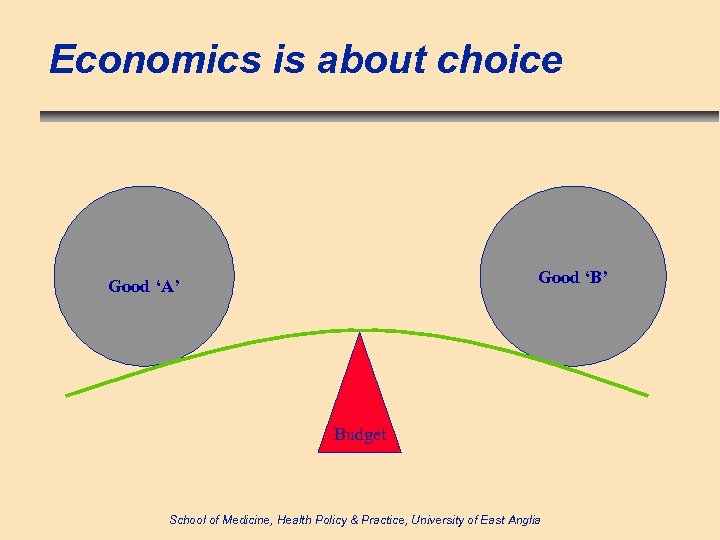
Economics is about choice Good ‘B’ Good ‘A’ Budget School of Medicine, Health Policy & Practice, University of East Anglia
Opportunity cost “The value of forgone benefit which could be obtained from a resource in its nextbest alternative use. ” School of Medicine, Health Policy & Practice, University of East Anglia
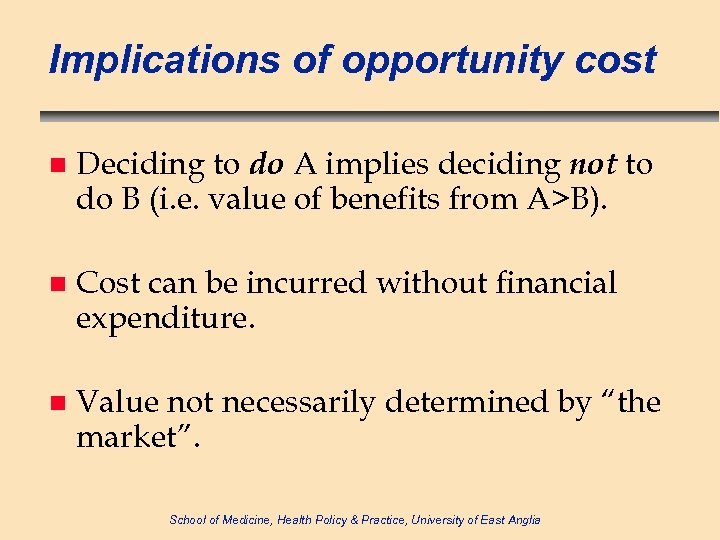
Implications of opportunity cost n Deciding to do A implies deciding not to do B (i. e. value of benefits from A>B). n Cost can be incurred without financial expenditure. n Value not necessarily determined by “the market”. School of Medicine, Health Policy & Practice, University of East Anglia
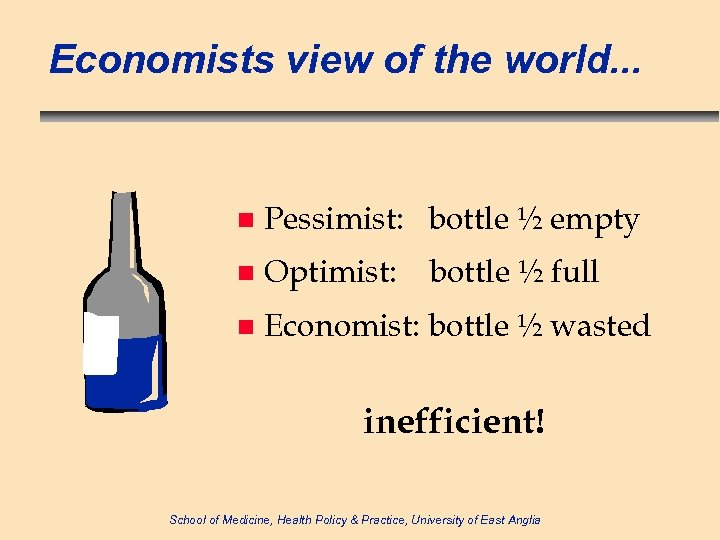
Economists view of the world. . . n Pessimist: bottle ½ empty n Optimist: n Economist: bottle ½ wasted bottle ½ full inefficient! School of Medicine, Health Policy & Practice, University of East Anglia
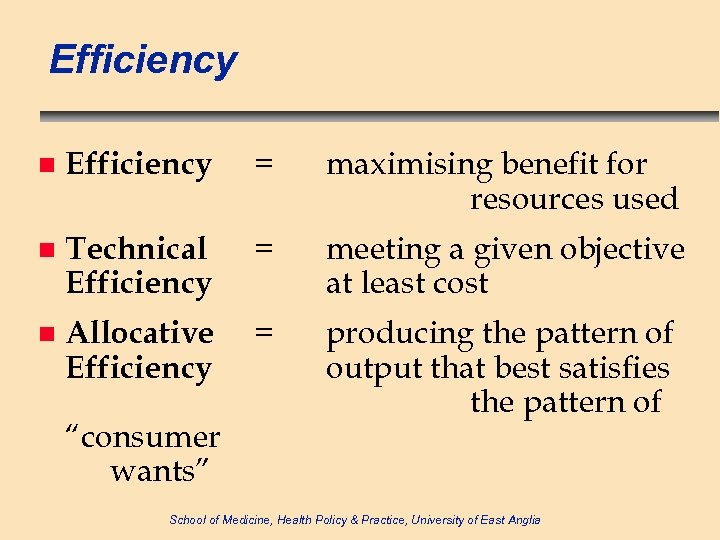
Efficiency n Efficiency = maximising benefit for resources used n Technical Efficiency = meeting a given objective at least cost n Allocative Efficiency = producing the pattern of output that best satisfies the pattern of “consumer wants” School of Medicine, Health Policy & Practice, University of East Anglia
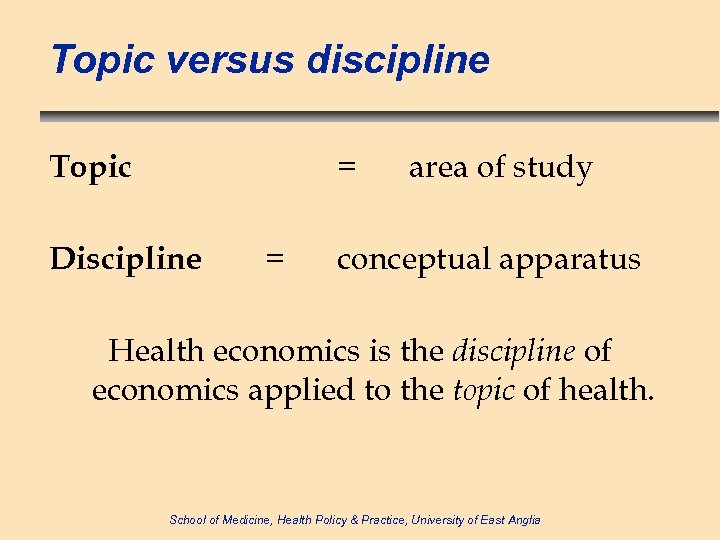
Topic versus discipline = Topic Discipline = area of study conceptual apparatus Health economics is the discipline of economics applied to the topic of health. School of Medicine, Health Policy & Practice, University of East Anglia
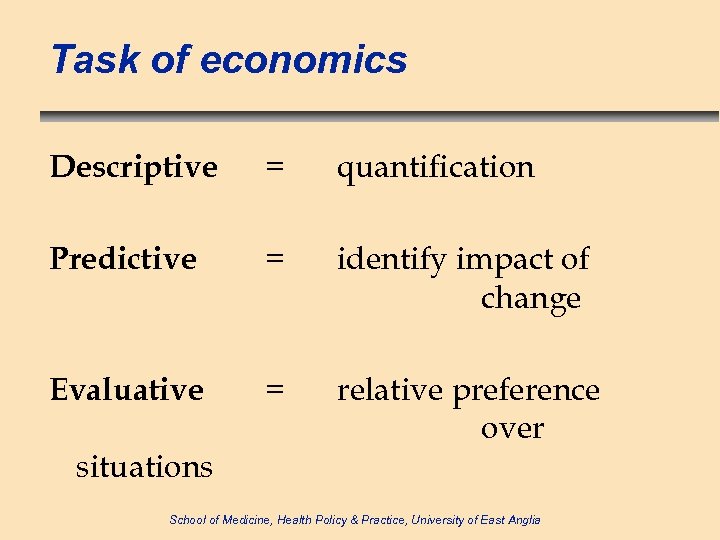
Task of economics Descriptive = quantification Predictive = identify impact of change Evaluative = relative preference over situations School of Medicine, Health Policy & Practice, University of East Anglia
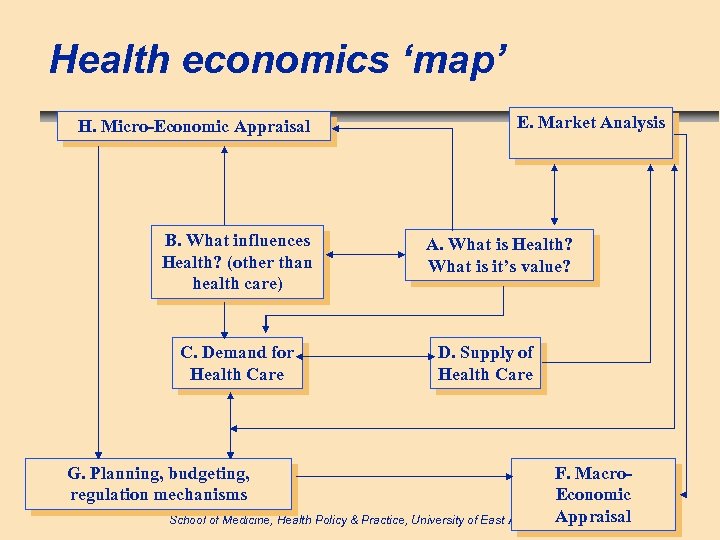
Health economics ‘map’ H. Micro-Economic Appraisal B. What influences Health? (other than health care) C. Demand for Health Care E. Market Analysis A. What is Health? What is it’s value? D. Supply of Health Care G. Planning, budgeting, regulation mechanisms School of Medicine, Health Policy & Practice, University of East Anglia F. Macro. Economic Appraisal
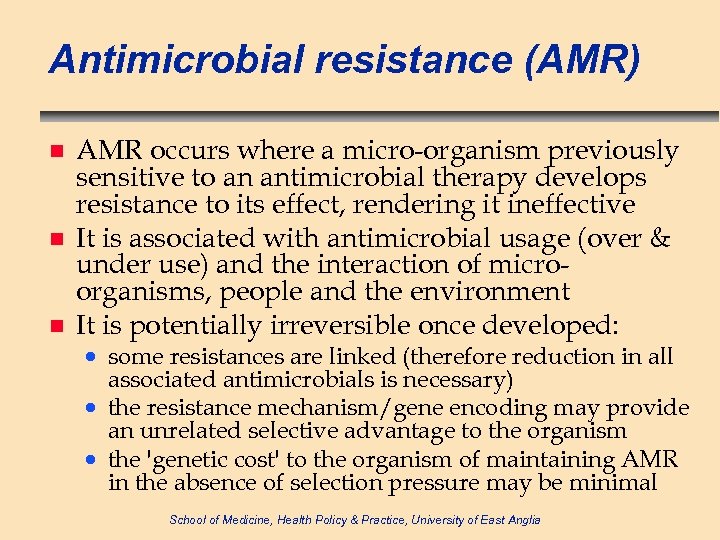
Antimicrobial resistance (AMR) n n n AMR occurs where a micro-organism previously sensitive to an antimicrobial therapy develops resistance to its effect, rendering it ineffective It is associated with antimicrobial usage (over & under use) and the interaction of microorganisms, people and the environment It is potentially irreversible once developed: · some resistances are linked (therefore reduction in all associated antimicrobials is necessary) · the resistance mechanism/gene encoding may provide an unrelated selective advantage to the organism · the 'genetic cost' to the organism of maintaining AMR in the absence of selection pressure may be minimal School of Medicine, Health Policy & Practice, University of East Anglia
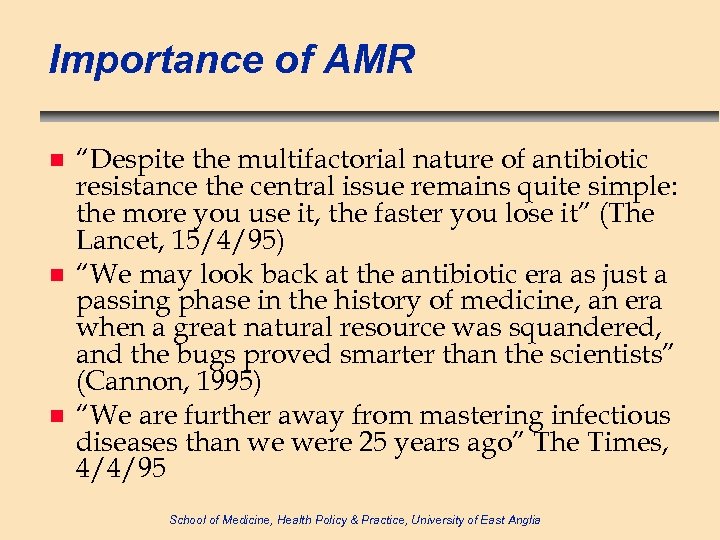
Importance of AMR n n n “Despite the multifactorial nature of antibiotic resistance the central issue remains quite simple: the more you use it, the faster you lose it” (The Lancet, 15/4/95) “We may look back at the antibiotic era as just a passing phase in the history of medicine, an era when a great natural resource was squandered, and the bugs proved smarter than the scientists” (Cannon, 1995) “We are further away from mastering infectious diseases than we were 25 years ago” The Times, 4/4/95 School of Medicine, Health Policy & Practice, University of East Anglia
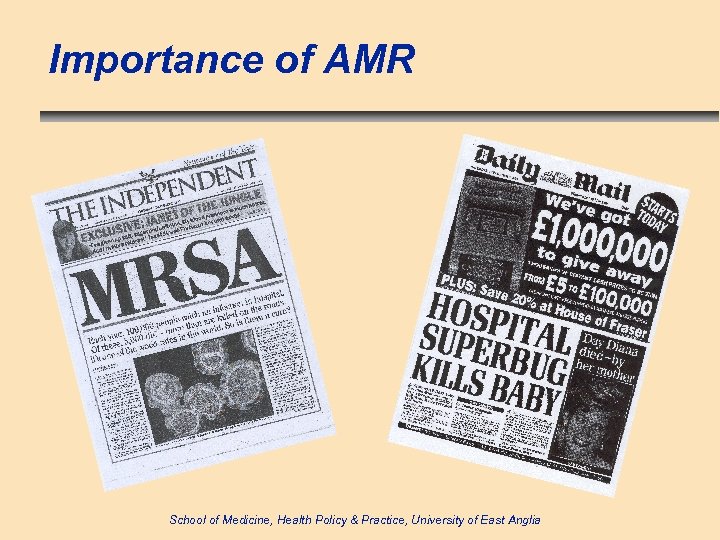
Importance of AMR School of Medicine, Health Policy & Practice, University of East Anglia
Application of economics to AMR Economic conceptualisation of AMR n Cost of resistance - country, hospital, disease n Micro-economic evaluation of strategies to contain AMR n Macro-economic evaluation of impact of AMR and strategies to contain AMR n School of Medicine, Health Policy & Practice, University of East Anglia
Economic conceptualisation of AMR Externality = Effect on those other than the immediate consumer (crosssectional & temporal ext. ) Resistance = Negative externality (i. e. cost) associated with consumption of antimicrobials now Implication = Sub-optimal (over) School of Medicine, consumption Health Policy & Practice, University of East Anglia of
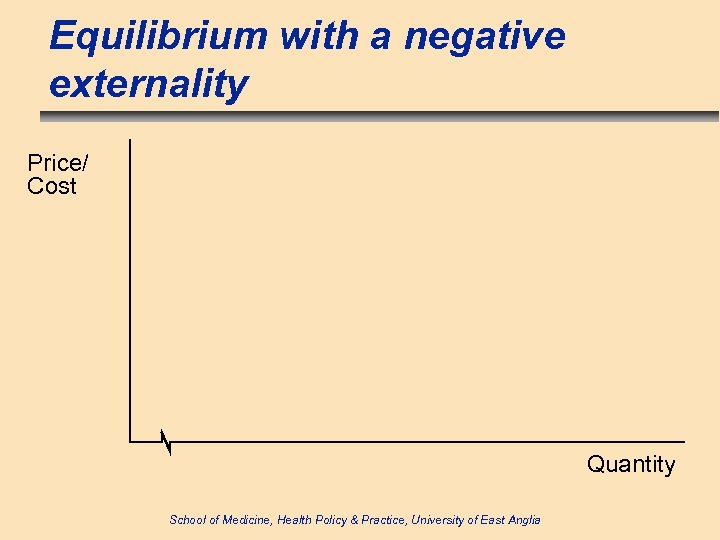
Equilibrium with a negative externality Price/ Cost Quantity School of Medicine, Health Policy & Practice, University of East Anglia
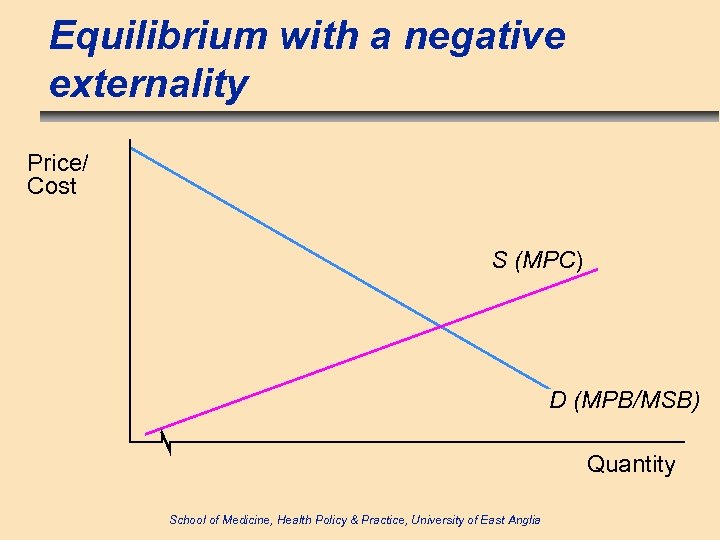
Equilibrium with a negative externality Price/ Cost S (MPC) D (MPB/MSB) Quantity School of Medicine, Health Policy & Practice, University of East Anglia
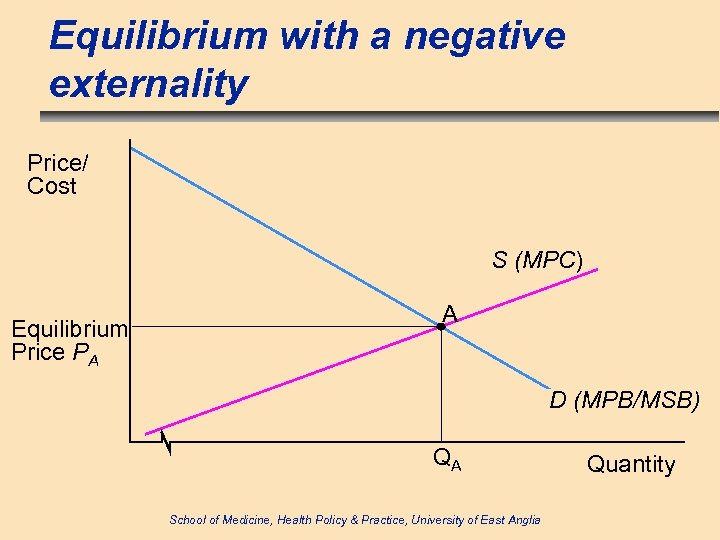
Equilibrium with a negative externality Price/ Cost S (MPC) Equilibrium Price PA A D (MPB/MSB) QA School of Medicine, Health Policy & Practice, University of East Anglia Quantity
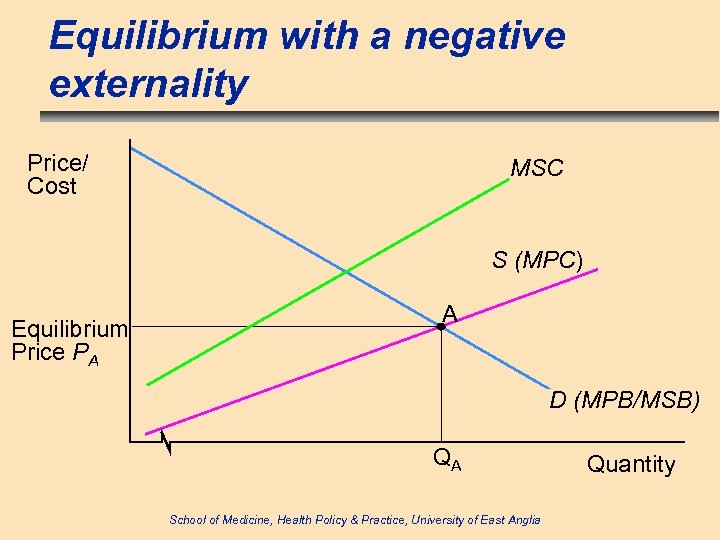
Equilibrium with a negative externality Price/ Cost MSC S (MPC) Equilibrium Price PA A D (MPB/MSB) QA School of Medicine, Health Policy & Practice, University of East Anglia Quantity
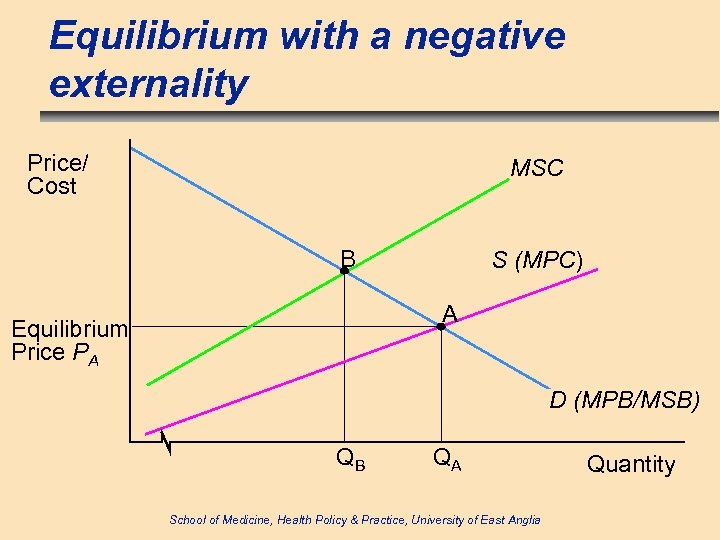
Equilibrium with a negative externality Price/ Cost MSC B S (MPC) A Equilibrium Price PA D (MPB/MSB) QB QA School of Medicine, Health Policy & Practice, University of East Anglia Quantity
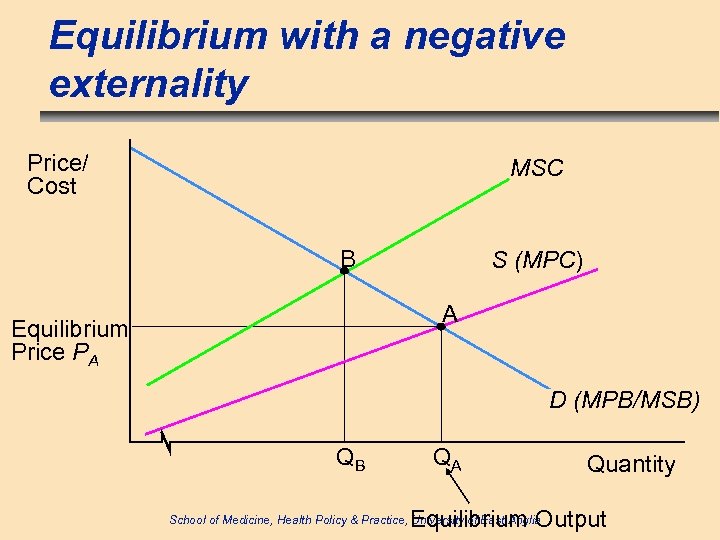
Equilibrium with a negative externality Price/ Cost MSC B S (MPC) A Equilibrium Price PA D (MPB/MSB) QB QA Quantity Equilibrium Output School of Medicine, Health Policy & Practice, University of East Anglia
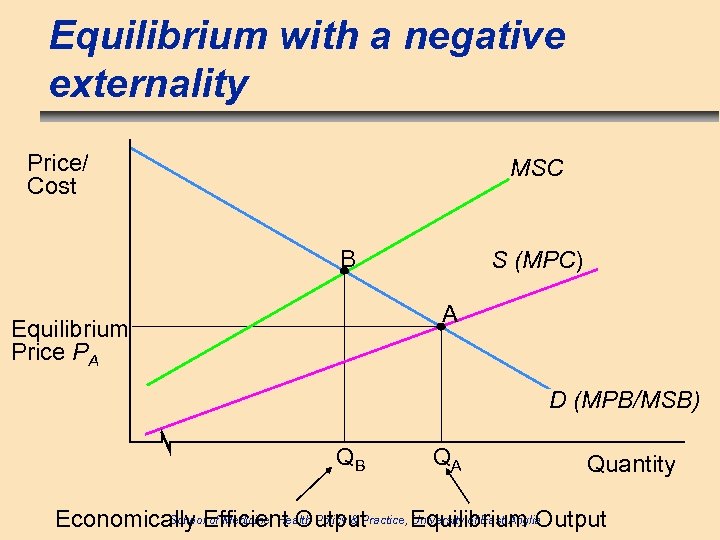
Equilibrium with a negative externality Price/ Cost MSC B S (MPC) A Equilibrium Price PA D (MPB/MSB) QB QA Quantity School of Medicine, Health Policy & Practice, Equilibrium Output University of East Anglia Economically Efficient Output
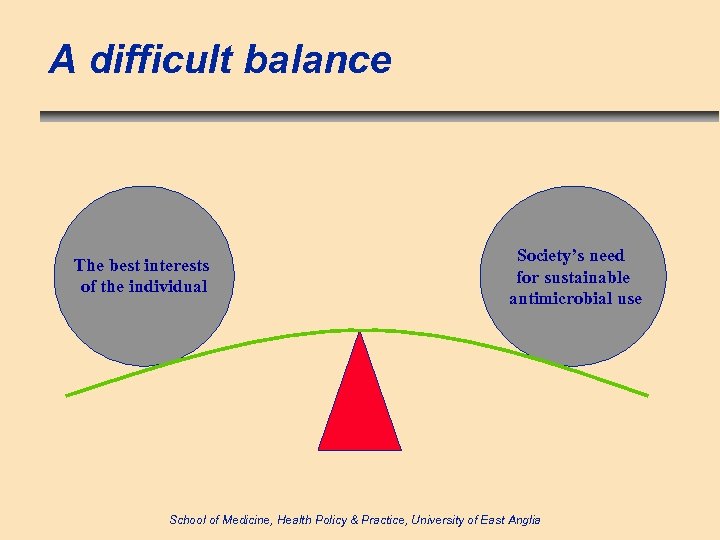
A difficult balance The best interests of the individual Society’s need for sustainable antimicrobial use School of Medicine, Health Policy & Practice, University of East Anglia
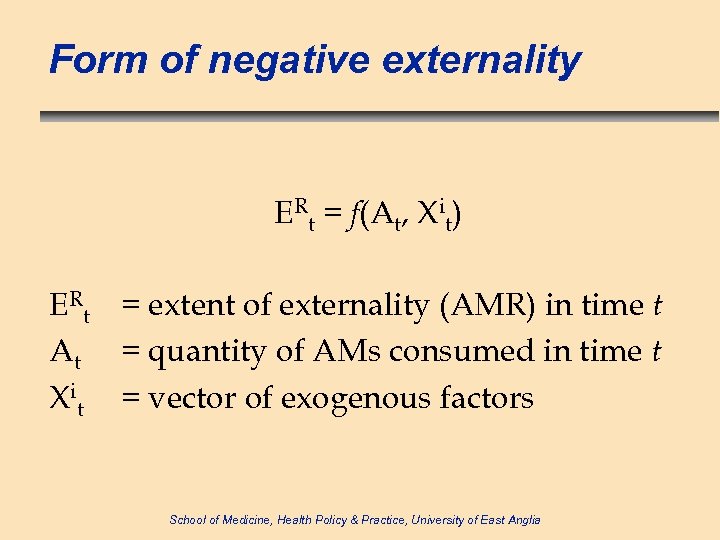
Form of negative externality ERt = f(At, Xit) ERt = extent of externality (AMR) in time t At = quantity of AMs consumed in time t Xit = vector of exogenous factors School of Medicine, Health Policy & Practice, University of East Anglia
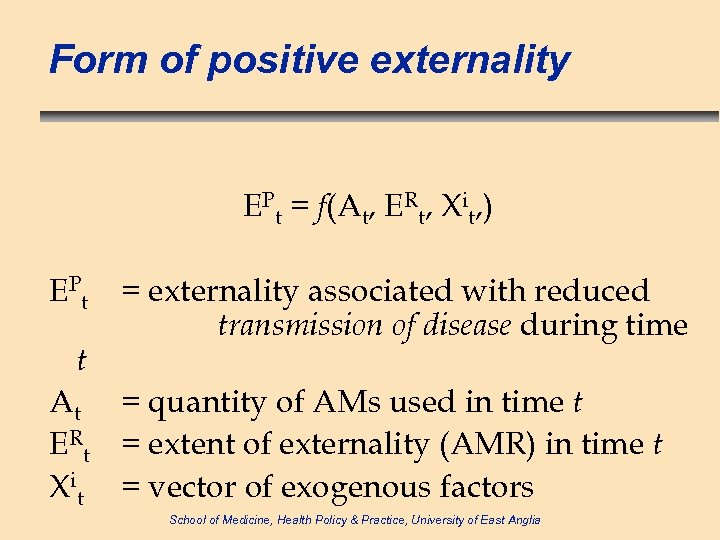
Form of positive externality EPt = f(At, ERt, Xit, ) E Pt t = externality associated with reduced transmission of disease during time At = quantity of AMs used in time t ERt = extent of externality (AMR) in time t Xit = vector of exogenous factors School of Medicine, Health Policy & Practice, University of East Anglia
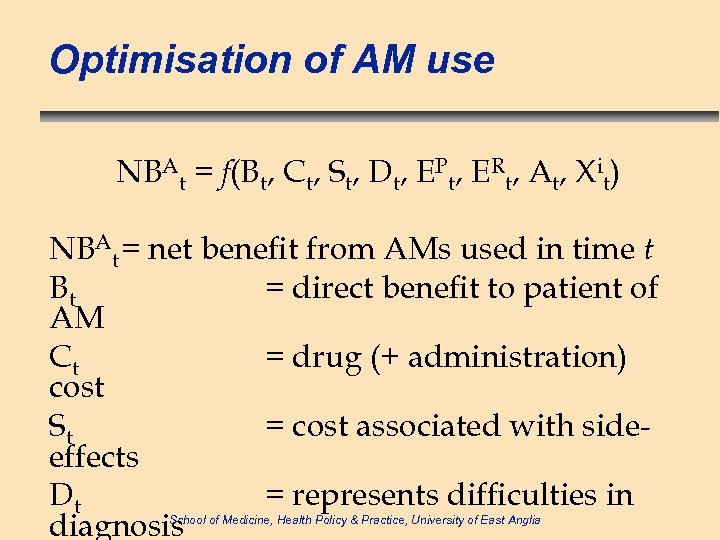
Optimisation of AM use NBAt = f(Bt, Ct, St, Dt, EPt, ERt, At, Xit) NBAt = net benefit from AMs used in time t Bt = direct benefit to patient of AM Ct = drug (+ administration) cost St = cost associated with sideeffects Dt = represents difficulties in diagnosis School of Medicine, Health Policy & Practice, University of East Anglia
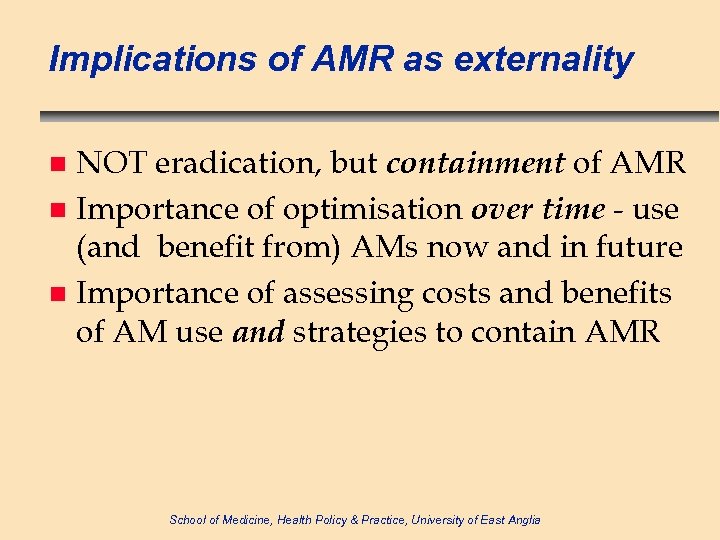
Implications of AMR as externality NOT eradication, but containment of AMR n Importance of optimisation over time - use (and benefit from) AMs now and in future n Importance of assessing costs and benefits of AM use and strategies to contain AMR n School of Medicine, Health Policy & Practice, University of East Anglia
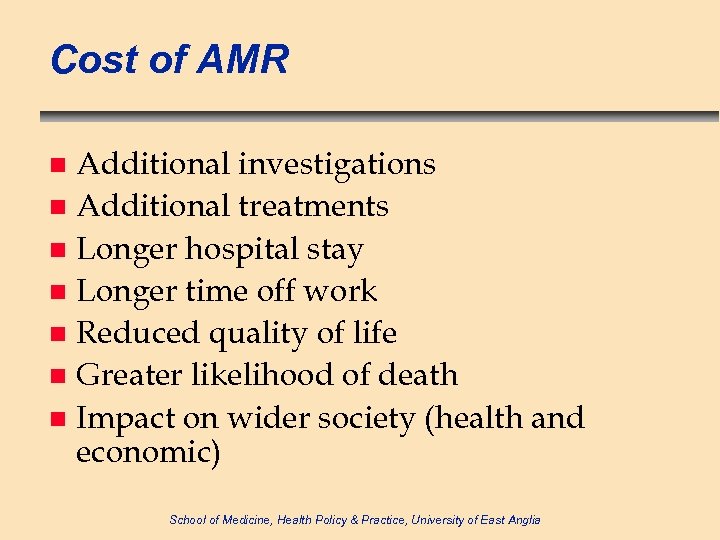
Cost of AMR Additional investigations n Additional treatments n Longer hospital stay n Longer time off work n Reduced quality of life n Greater likelihood of death n Impact on wider society (health and economic) n School of Medicine, Health Policy & Practice, University of East Anglia
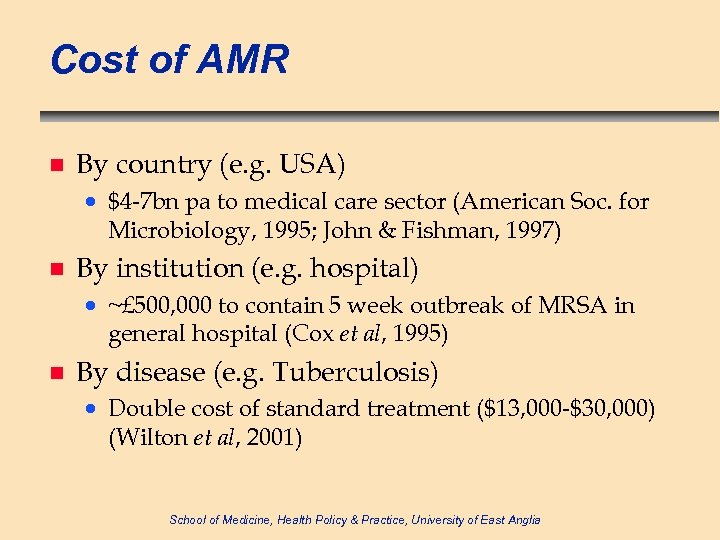
Cost of AMR n By country (e. g. USA) · $4 -7 bn pa to medical care sector (American Soc. for Microbiology, 1995; John & Fishman, 1997) n By institution (e. g. hospital) · ~£ 500, 000 to contain 5 week outbreak of MRSA in general hospital (Cox et al, 1995) n By disease (e. g. Tuberculosis) · Double cost of standard treatment ($13, 000 -$30, 000) (Wilton et al, 2001) School of Medicine, Health Policy & Practice, University of East Anglia
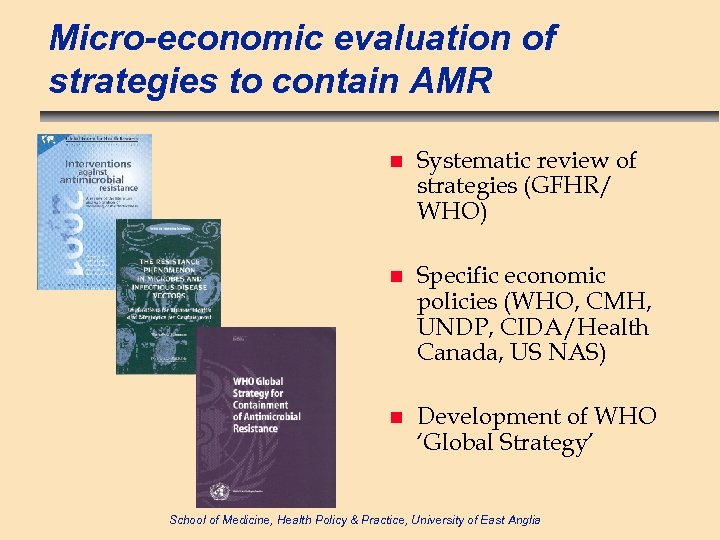
Micro-economic evaluation of strategies to contain AMR n Systematic review of strategies (GFHR/ WHO) n Specific economic policies (WHO, CMH, UNDP, CIDA/Health Canada, US NAS) n Development of WHO ‘Global Strategy’ School of Medicine, Health Policy & Practice, University of East Anglia
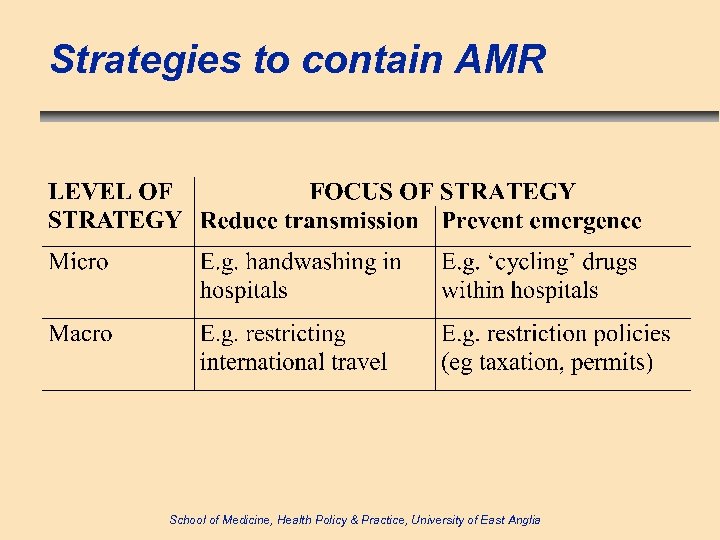
Strategies to contain AMR School of Medicine, Health Policy & Practice, University of East Anglia
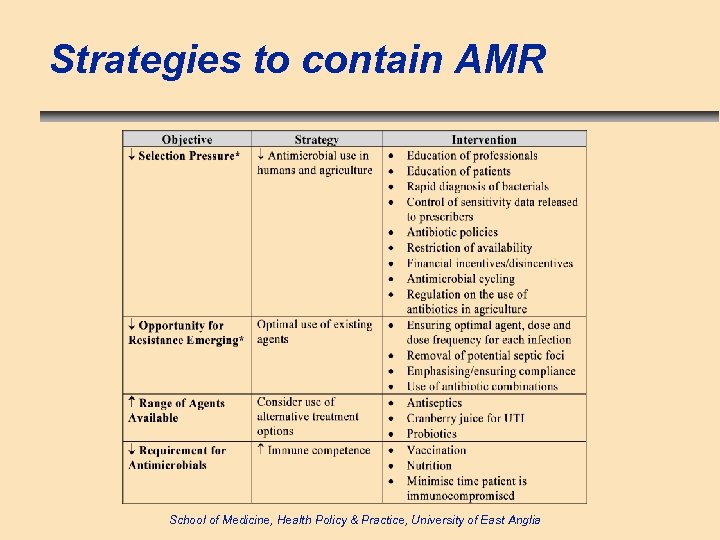
Strategies to contain AMR School of Medicine, Health Policy & Practice, University of East Anglia
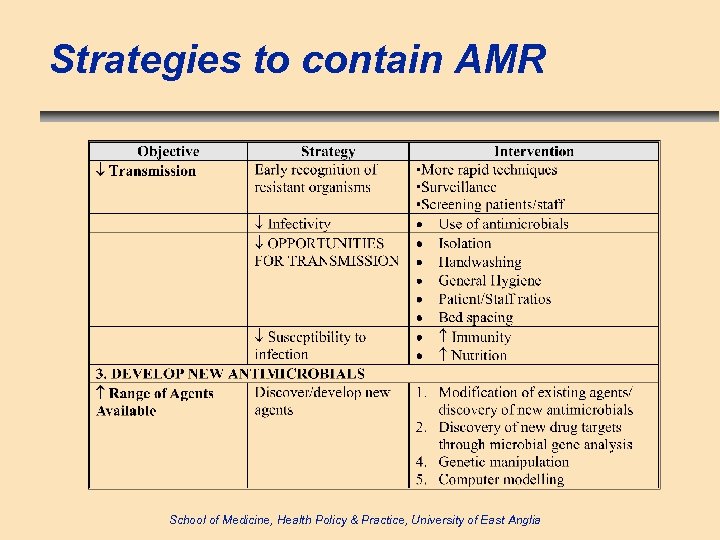
Strategies to contain AMR School of Medicine, Health Policy & Practice, University of East Anglia
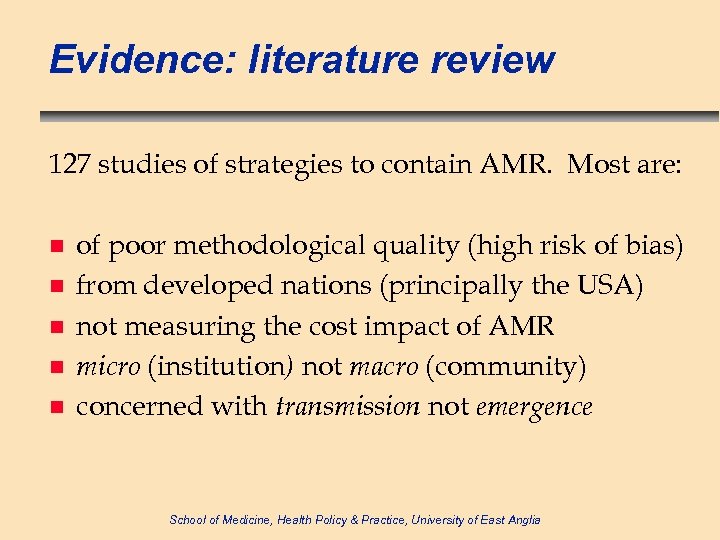
Evidence: literature review 127 studies of strategies to contain AMR. Most are: n n n of poor methodological quality (high risk of bias) from developed nations (principally the USA) not measuring the cost impact of AMR micro (institution) not macro (community) concerned with transmission not emergence School of Medicine, Health Policy & Practice, University of East Anglia
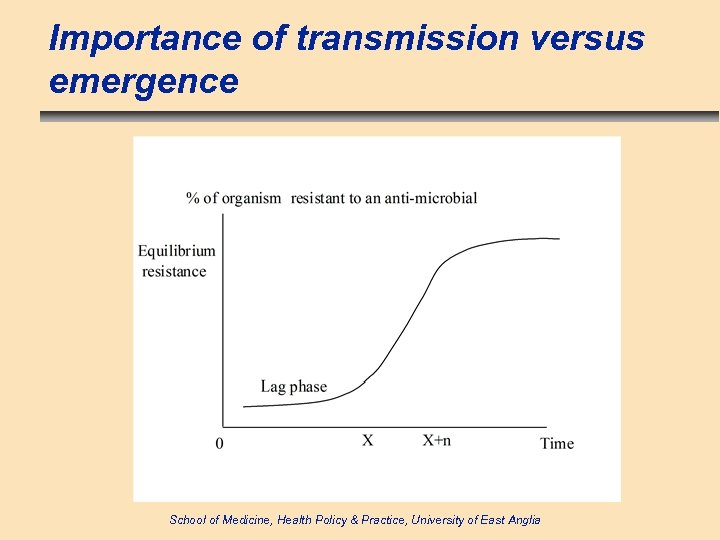
Importance of transmission versus emergence School of Medicine, Health Policy & Practice, University of East Anglia
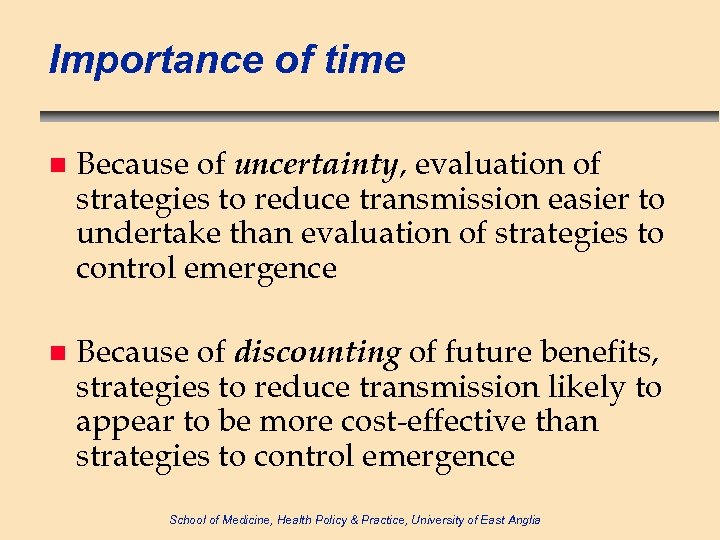
Importance of time n Because of uncertainty, evaluation of strategies to reduce transmission easier to undertake than evaluation of strategies to control emergence n Because of discounting of future benefits, strategies to reduce transmission likely to appear to be more cost-effective than strategies to control emergence School of Medicine, Health Policy & Practice, University of East Anglia
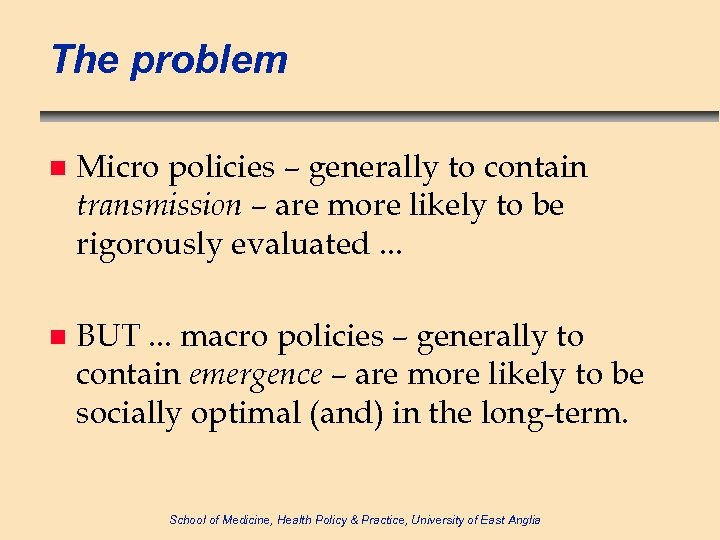
The problem n Micro policies – generally to contain transmission – are more likely to be rigorously evaluated. . . n BUT. . . macro policies – generally to contain emergence – are more likely to be socially optimal (and) in the long-term. School of Medicine, Health Policy & Practice, University of East Anglia
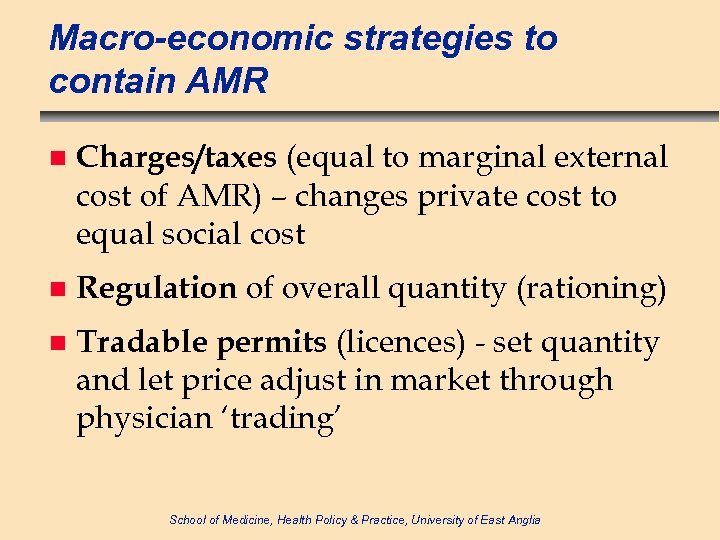
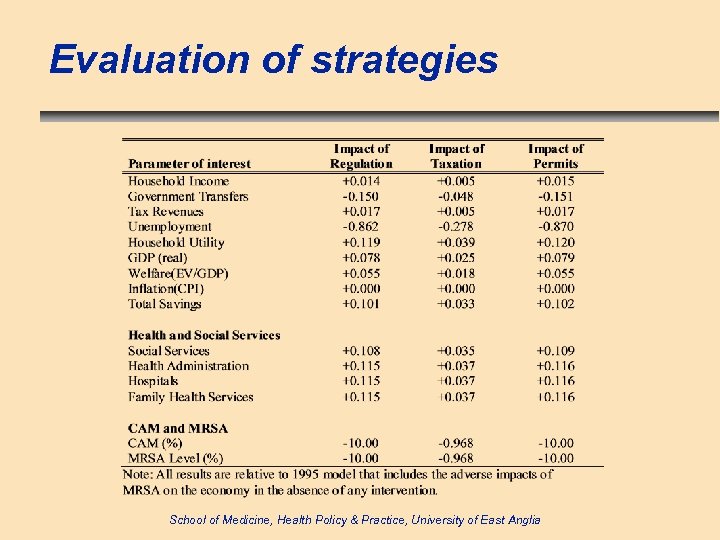
Macro-economic strategies to contain AMR n Charges/taxes (equal to marginal external cost of AMR) – changes private cost to equal social cost n Regulation of overall quantity (rationing) n Tradable permits (licences) - set quantity and let price adjust in market through physician ‘trading’ School of Medicine, Health Policy & Practice, University of East Anglia
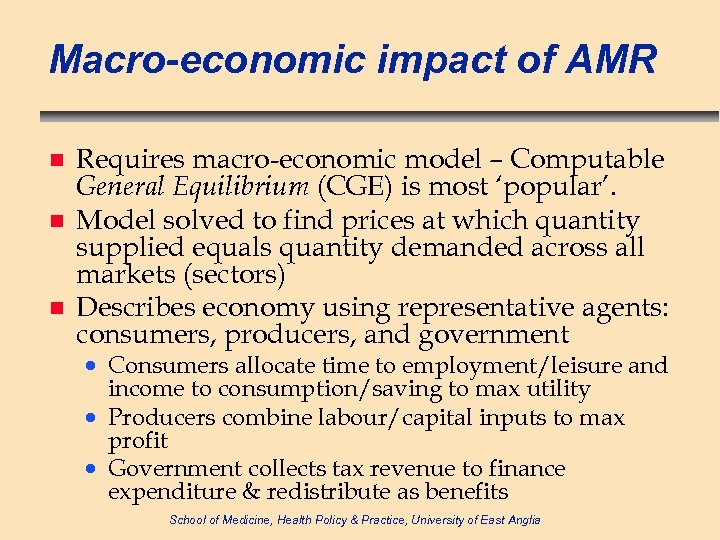
Macro-economic impact of AMR n n n Requires macro-economic model – Computable General Equilibrium (CGE) is most ‘popular’. Model solved to find prices at which quantity supplied equals quantity demanded across all markets (sectors) Describes economy using representative agents: consumers, producers, and government · Consumers allocate time to employment/leisure and income to consumption/saving to max utility · Producers combine labour/capital inputs to max profit · Government collects tax revenue to finance expenditure & redistribute as benefits School of Medicine, Health Policy & Practice, University of East Anglia
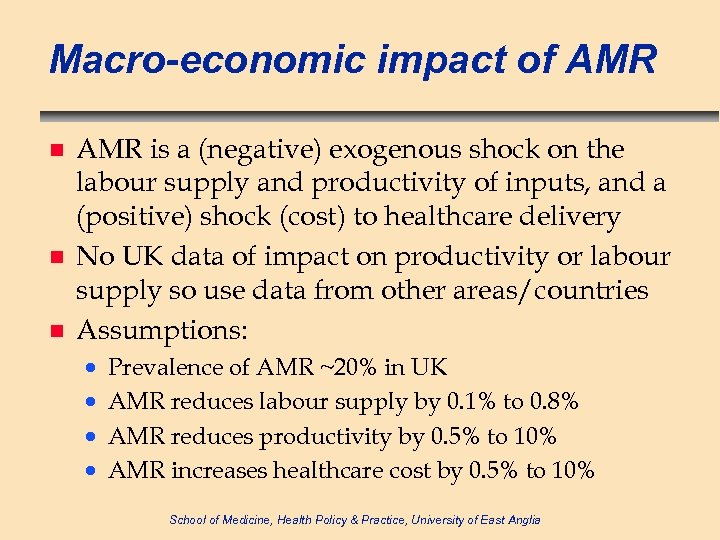
Macro-economic impact of AMR n n n AMR is a (negative) exogenous shock on the labour supply and productivity of inputs, and a (positive) shock (cost) to healthcare delivery No UK data of impact on productivity or labour supply so use data from other areas/countries Assumptions: · · Prevalence of AMR ~20% in UK AMR reduces labour supply by 0. 1% to 0. 8% AMR reduces productivity by 0. 5% to 10% AMR increases healthcare cost by 0. 5% to 10% School of Medicine, Health Policy & Practice, University of East Anglia
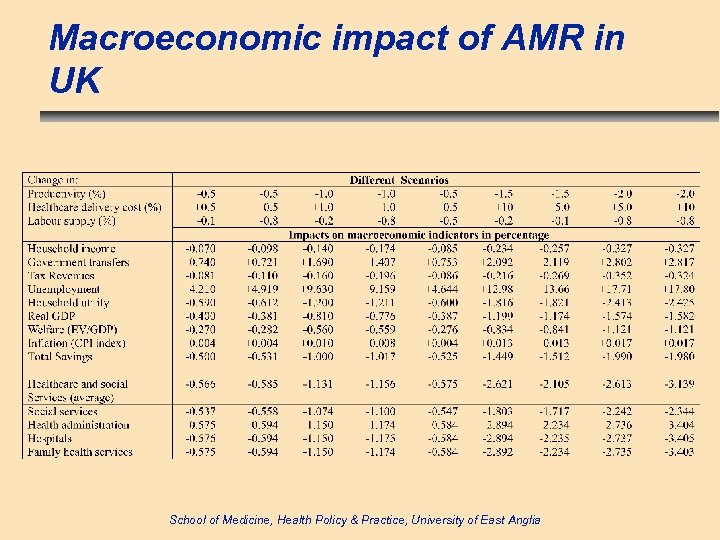
Macroeconomic impact of AMR in UK School of Medicine, Health Policy & Practice, University of East Anglia
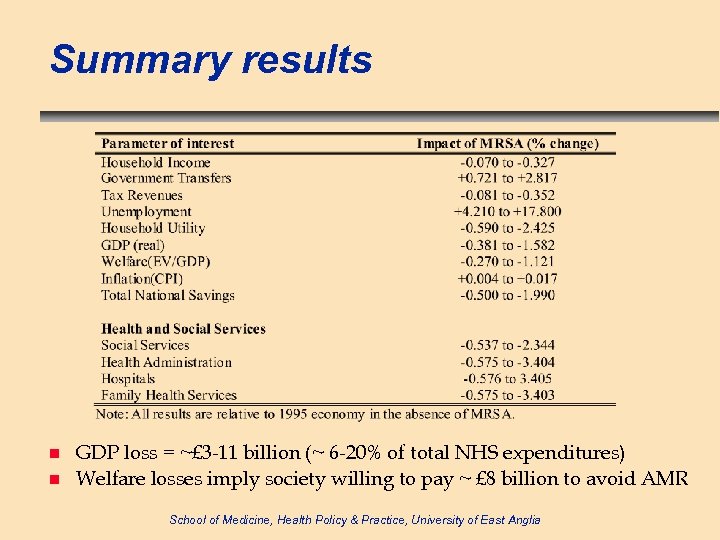
Summary results n n GDP loss = ~£ 3 -11 billion (~ 6 -20% of total NHS expenditures) Welfare losses imply society willing to pay ~ £ 8 billion to avoid AMR School of Medicine, Health Policy & Practice, University of East Anglia
Evaluation of strategies School of Medicine, Health Policy & Practice, University of East Anglia
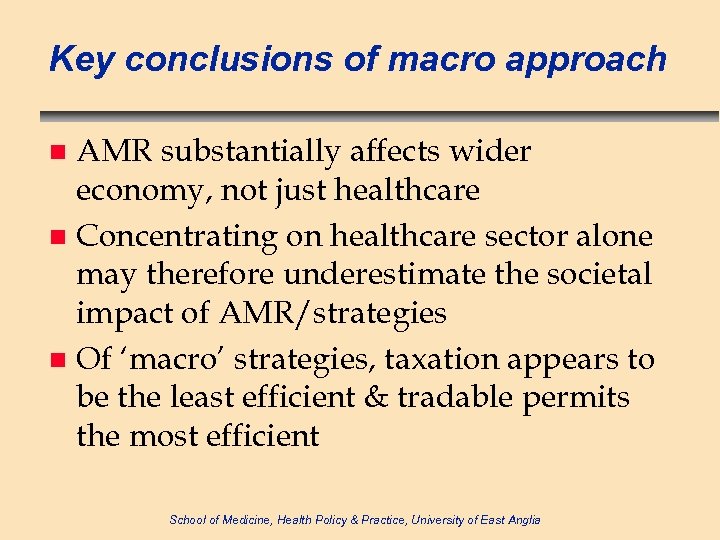
Key conclusions of macro approach AMR substantially affects wider economy, not just healthcare n Concentrating on healthcare sector alone may therefore underestimate the societal impact of AMR/strategies n Of ‘macro’ strategies, taxation appears to be the least efficient & tradable permits the most efficient n School of Medicine, Health Policy & Practice, University of East Anglia
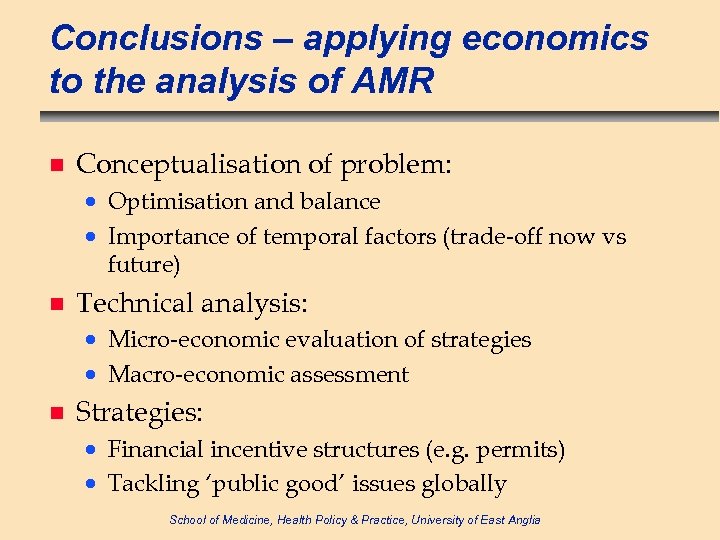
Conclusions – applying economics to the analysis of AMR n Conceptualisation of problem: · Optimisation and balance · Importance of temporal factors (trade-off now vs future) n Technical analysis: · Micro-economic evaluation of strategies · Macro-economic assessment n Strategies: · Financial incentive structures (e. g. permits) · Tackling ‘public good’ issues globally School of Medicine, Health Policy & Practice, University of East Anglia

Further references n Externality & micro-economic evaluation: · Coast J, Smith RD, Miller MR. Superbugs: should antimicrobial resistance be included as a cost in economic evaluation? Health Economics, 1996; 5: 217 -226. · Coast J, Smith RD, Karcher AM, Wilton P, Millar MR. Superbugs II: How should economic evaluation be conducted for interventions which aim to reduce antimicrobial resistance? Health Economics, 2002; 11(7): 637 -647. · Wilton P, Smith RD, Coast J, Millar MR. Strategies to contain the emergence of antimicrobial resistance: a systematic review of effectiveness and costeffectiveness. Journal of Health Services Research and Policy, 2002; 7(2): 111 -117. n Macro policies & macro-economic analysis: · Coast J, Smith RD, Millar MR. An economic perspective on policy for antimicrobial resistance. Social Science and Medicine, 1998; 46: 29 -38. · Smith RD, Coast J. Controlling antimicrobial resistance: a proposed transferable permit market. Health Policy, 1998; 43: 219 -32. · Smith RD, Coast J. Antimicrobial resistance: a global response. Bulletin of the World Health Organisation, 2002; 80: 126 -133. · Smith RD, Coast J. Resisting resistance: thinking strategically about antimicrobial resistance. Georgetown Journal of International Affairs, 2003; IV(1): 135 -141. · Yago M, Smith RD, Coast J, Millar MR. Assessing the macroeconomic impact of a healthcare problem: the application of computable general equilibrium analysis to antimicrobial resistance. Journal of Health Economics (in press). School of Medicine, Health Policy & Practice, University of East Anglia
Скачать презентацию Health Economics and Antimicrobial Resistance Richard Smith Reader
38a2a523bee3d1b93493e6aa5c09a241.ppt