


 Скачать презентацию Health Care Reform Overview Oklahoma Hospital Association May
23a0576327106be6abae7f5700a4a6a3.ppt
- Количество слайдов: 62
 Health Care Reform Overview Oklahoma Hospital Association May 6, 2010 For audio: 888 -567 -1602 Password: “Reform” Updated Oct. 23, 2012
 OHA Member Update
 Agenda Introduction Craig W. Jones, FACHE, President Medicare Payment & Compliance Rick Snyder, VP/Finance & Information Services Quality & Delivery Systems Reform La. Wanna Halstead, VP/Quality & Clinical Initiatives Medicaid Expansion Buffy Heater, Oklahoma Health Care Authority Insurance Reforms and “Other” Patti Davis, Executive VP Summary and Questions Craig W. Jones Questions: Webinar “chat” , or Email: oha@okoha. com, or Operator assisted at end
 Health Care Reform “It is probably not as bad as the Republicans would have you to believe or as good as the Democrats would like you to believe” Rep. Dr. Doug Cox
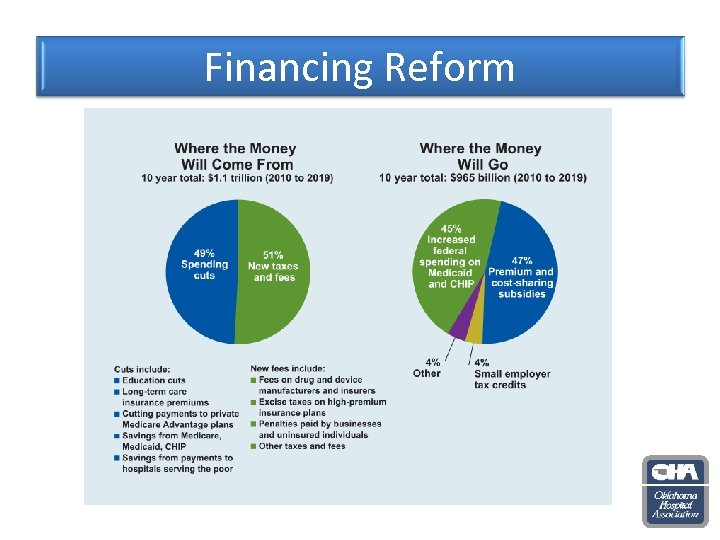 Financing Reform
 Hospital and Health System Provisions Medicare Payment Rick Snyder, FHFMA Vice President, Finance & Information Services
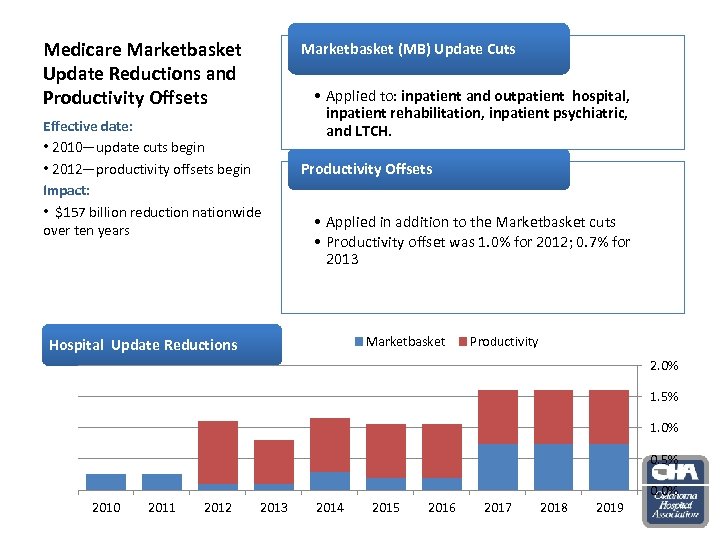 Medicare Marketbasket Update Reductions and Productivity Offsets Marketbasket (MB) Update Cuts Effective date: • 2010—update cuts begin • 2012—productivity offsets begin Impact: • $157 billion reduction nationwide over ten years • Applied to: inpatient and outpatient hospital, inpatient rehabilitation, inpatient psychiatric, and LTCH. Productivity Offsets • Applied in addition to the Marketbasket cuts • Productivity offset was 1. 0% for 2012; 0. 7% for 2013 Marketbasket Hospital Update Reductions Productivity 2. 0% 1. 5% 1. 0% 0. 5% 0. 0% 2010 2011 2012 2013 2014 2015 2016 2017 2018 2019
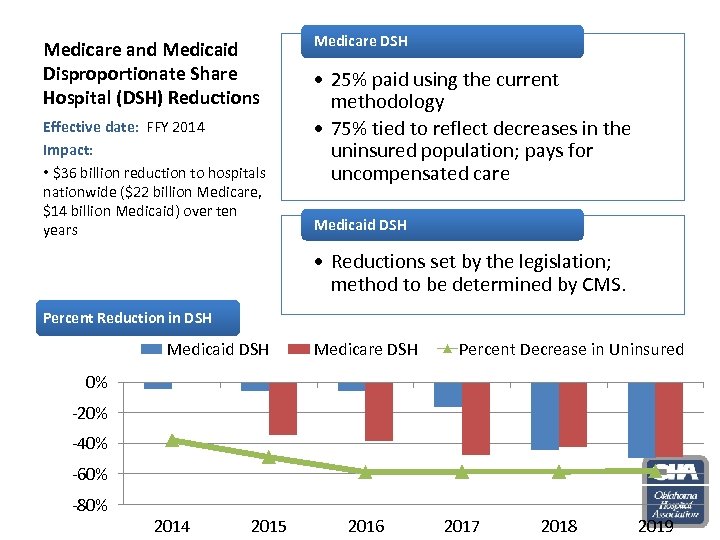 Medicare and Medicaid Disproportionate Share Hospital (DSH) Reductions Effective date: FFY 2014 Impact: • $36 billion reduction to hospitals nationwide ($22 billion Medicare, $14 billion Medicaid) over ten years Medicare DSH • 25% paid using the current methodology • 75% tied to reflect decreases in the uninsured population; pays for uncompensated care Medicaid DSH • Reductions set by the legislation; method to be determined by CMS. Percent Reduction in DSH Medicaid DSH Medicare DSH Percent Decrease in Uninsured 0% -20% -40% -60% -80% 2014 2015 2016 2017 2018 2019
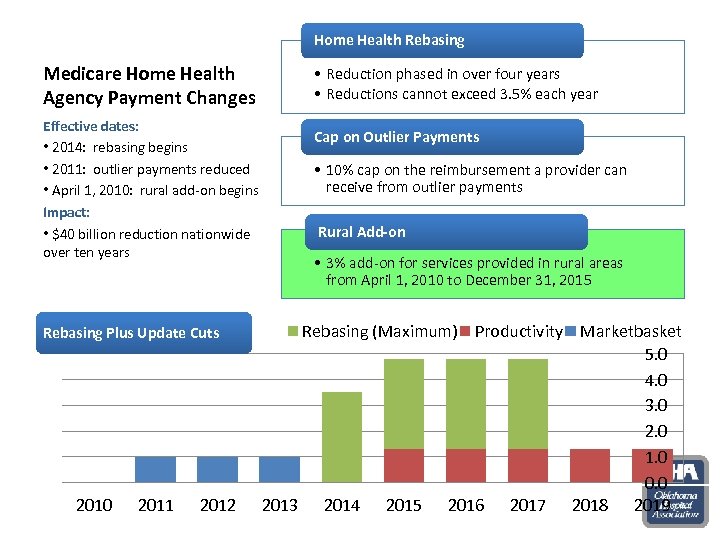 Home Health Rebasing Medicare Home Health Agency Payment Changes Effective dates: • 2014: rebasing begins • 2011: outlier payments reduced • April 1, 2010: rural add-on begins Impact: • $40 billion reduction nationwide over ten years Rebasing Plus Update Cuts 2010 2011 2012 • Reduction phased in over four years • Reductions cannot exceed 3. 5% each year Cap on Outlier Payments • 10% cap on the reimbursement a provider can receive from outlier payments Rural Add-on • 3% add-on for services provided in rural areas from April 1, 2010 to December 31, 2015 Rebasing (Maximum) Productivity Marketbasket 5. 0 4. 0 3. 0 2. 0 1. 0 0. 0 2013 2014 2015 2016 2017 2018 2019
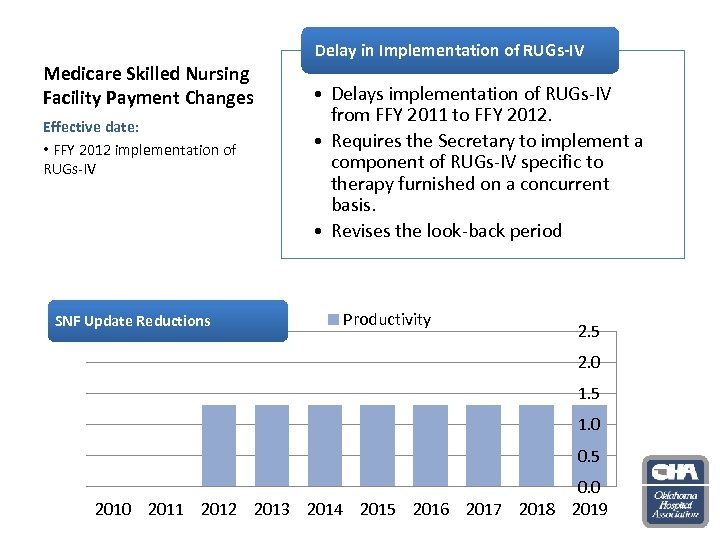 Delay in Implementation of RUGs-IV Medicare Skilled Nursing Facility Payment Changes Effective date: • FFY 2012 implementation of RUGs-IV SNF Update Reductions • Delays implementation of RUGs-IV from FFY 2011 to FFY 2012. • Requires the Secretary to implement a component of RUGs-IV specific to therapy furnished on a concurrent basis. • Revises the look-back period Productivity 2. 5 2. 0 1. 5 1. 0 0. 5 0. 0 2011 2012 2013 2014 2015 2016 2017 2018 2019
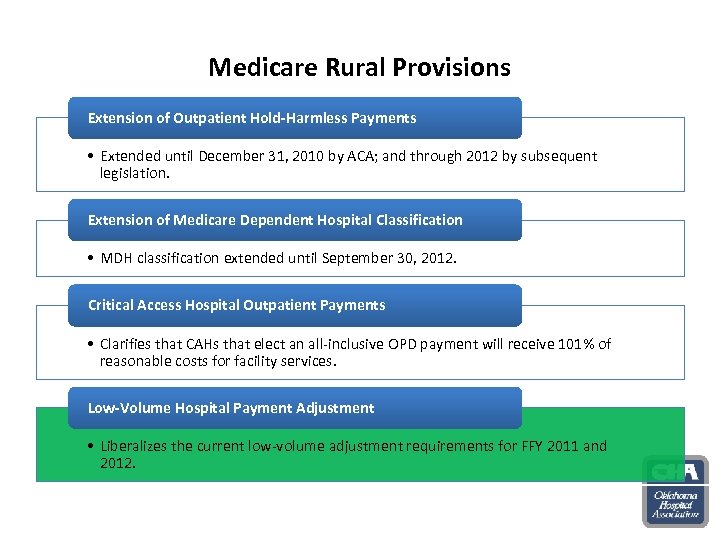 Medicare Rural Provisions Extension of Outpatient Hold-Harmless Payments • Extended until December 31, 2010 by ACA; and through 2012 by subsequent legislation. Extension of Medicare Dependent Hospital Classification • MDH classification extended until September 30, 2012. Critical Access Hospital Outpatient Payments • Clarifies that CAHs that elect an all-inclusive OPD payment will receive 101% of reasonable costs for facility services. Low-Volume Hospital Payment Adjustment • Liberalizes the current low-volume adjustment requirements for FFY 2011 and 2012.
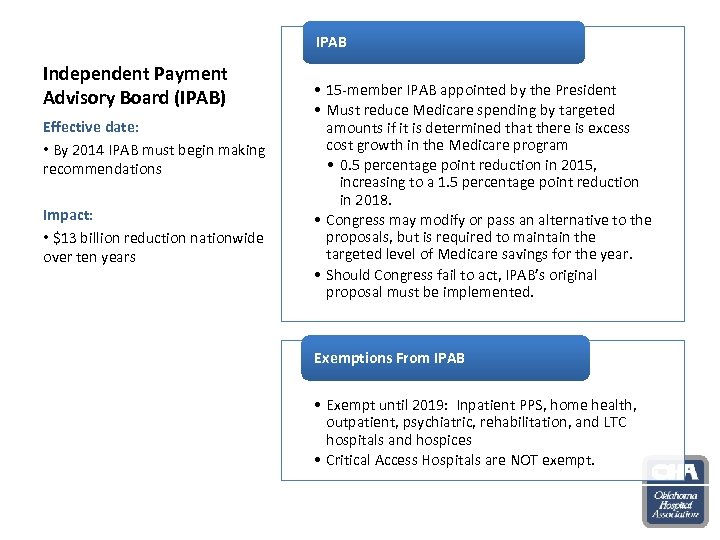 IPAB Independent Payment Advisory Board (IPAB) Effective date: • By 2014 IPAB must begin making recommendations Impact: • $13 billion reduction nationwide over ten years • 15 -member IPAB appointed by the President • Must reduce Medicare spending by targeted amounts if it is determined that there is excess cost growth in the Medicare program • 0. 5 percentage point reduction in 2015, increasing to a 1. 5 percentage point reduction in 2018. • Congress may modify or pass an alternative to the proposals, but is required to maintain the targeted level of Medicare savings for the year. • Should Congress fail to act, IPAB’s original proposal must be implemented. Exemptions From IPAB • Exempt until 2019: Inpatient PPS, home health, outpatient, psychiatric, rehabilitation, and LTC hospitals and hospices • Critical Access Hospitals are NOT exempt.
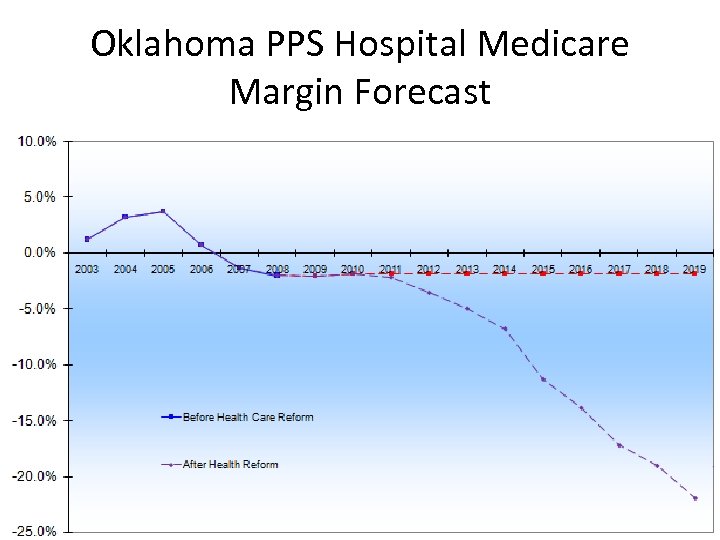 Oklahoma PPS Hospital Medicare Margin Forecast
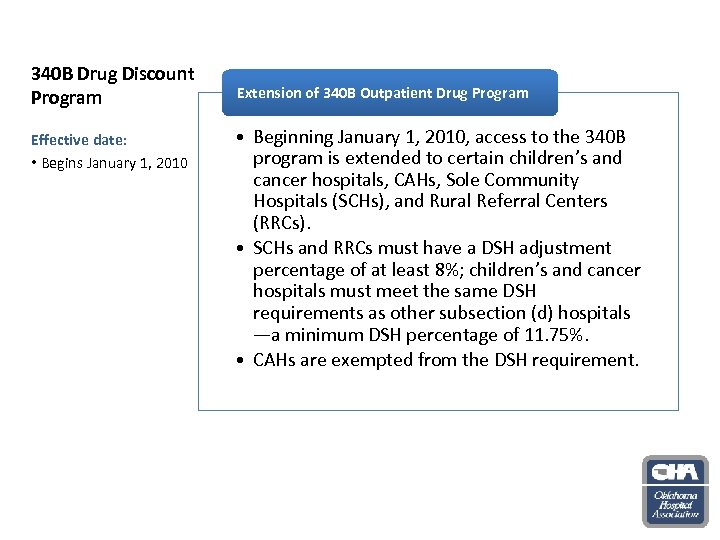 340 B Drug Discount Program Effective date: • Begins January 1, 2010 Extension of 340 B Outpatient Drug Program • Beginning January 1, 2010, access to the 340 B program is extended to certain children’s and cancer hospitals, CAHs, Sole Community Hospitals (SCHs), and Rural Referral Centers (RRCs). • SCHs and RRCs must have a DSH adjustment percentage of at least 8%; children’s and cancer hospitals must meet the same DSH requirements as other subsection (d) hospitals —a minimum DSH percentage of 11. 75%. • CAHs are exempted from the DSH requirement.
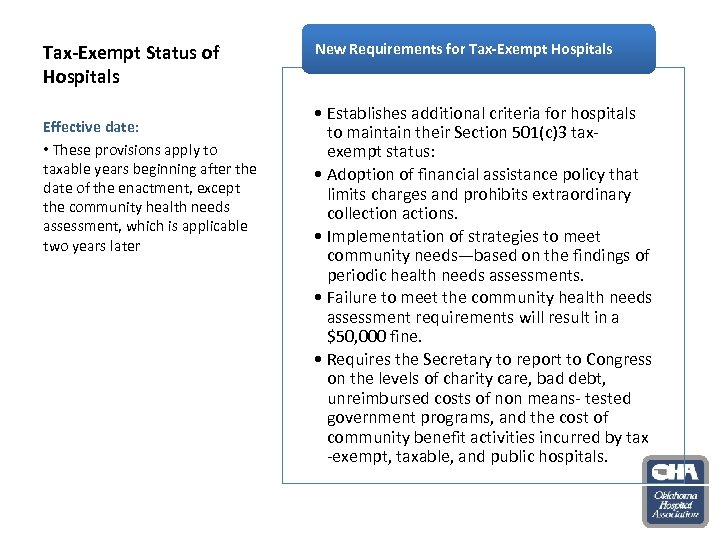 Tax-Exempt Status of Hospitals Effective date: • These provisions apply to taxable years beginning after the date of the enactment, except the community health needs assessment, which is applicable two years later New Requirements for Tax-Exempt Hospitals • Establishes additional criteria for hospitals to maintain their Section 501(c)3 taxexempt status: • Adoption of financial assistance policy that limits charges and prohibits extraordinary collection actions. • Implementation of strategies to meet community needs—based on the findings of periodic health needs assessments. • Failure to meet the community health needs assessment requirements will result in a $50, 000 fine. • Requires the Secretary to report to Congress on the levels of charity care, bad debt, unreimbursed costs of non means- tested government programs, and the cost of community benefit activities incurred by tax -exempt, taxable, and public hospitals.
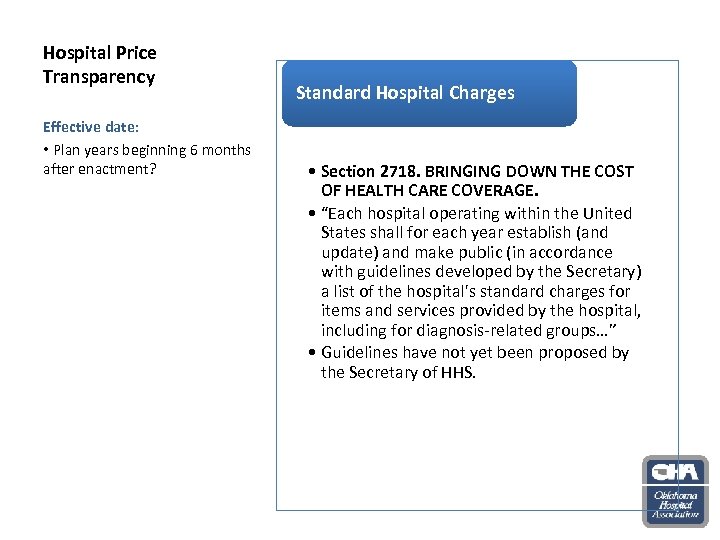 Hospital Price Transparency Effective date: • Plan years beginning 6 months after enactment? Standard Hospital Charges • Section 2718. BRINGING DOWN THE COST OF HEALTH CARE COVERAGE. • “Each hospital operating within the United States shall for each year establish (and update) and make public (in accordance with guidelines developed by the Secretary) a list of the hospital's standard charges for items and services provided by the hospital, including for diagnosis-related groups…” • Guidelines have not yet been proposed by the Secretary of HHS.
 Quality and Delivery Systems Reform La. Wanna Halstead, RN, MPH Vice President/Quality & Clinical Initiatives
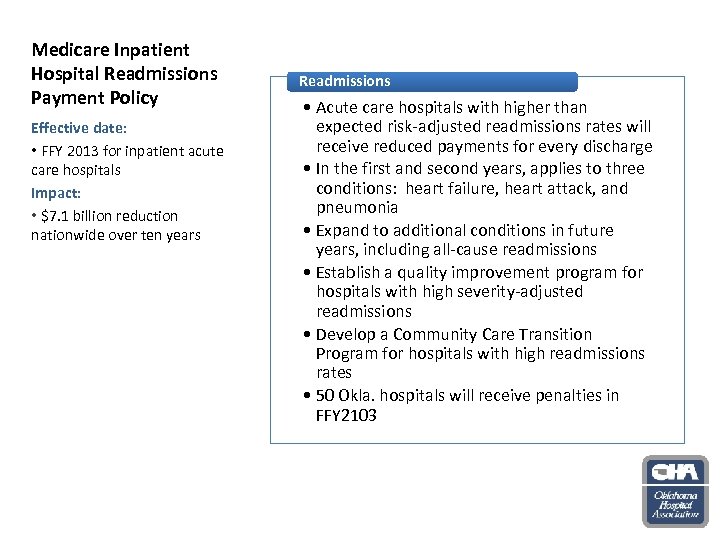 Medicare Inpatient Hospital Readmissions Payment Policy Effective date: • FFY 2013 for inpatient acute care hospitals Impact: • $7. 1 billion reduction nationwide over ten years Readmissions • Acute care hospitals with higher than expected risk-adjusted readmissions rates will receive reduced payments for every discharge • In the first and second years, applies to three conditions: heart failure, heart attack, and pneumonia • Expand to additional conditions in future years, including all-cause readmissions • Establish a quality improvement program for hospitals with high severity-adjusted readmissions • Develop a Community Care Transition Program for hospitals with high readmissions rates • 50 Okla. hospitals will receive penalties in FFY 2103
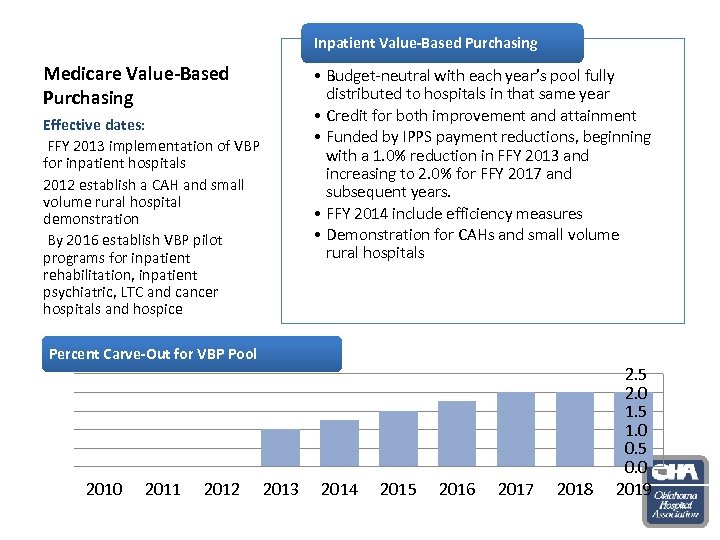 Inpatient Value-Based Purchasing Medicare Value-Based Purchasing Effective dates: FFY 2013 implementation of VBP for inpatient hospitals 2012 establish a CAH and small volume rural hospital demonstration By 2016 establish VBP pilot programs for inpatient rehabilitation, inpatient psychiatric, LTC and cancer hospitals and hospice • Budget-neutral with each year’s pool fully distributed to hospitals in that same year • Credit for both improvement and attainment • Funded by IPPS payment reductions, beginning with a 1. 0% reduction in FFY 2013 and increasing to 2. 0% for FFY 2017 and subsequent years. • FFY 2014 include efficiency measures • Demonstration for CAHs and small volume rural hospitals Percent Carve-Out for VBP Pool 2010 2011 2012 2013 2014 2015 2016 2017 2018 2. 5 2. 0 1. 5 1. 0 0. 5 0. 0 2019
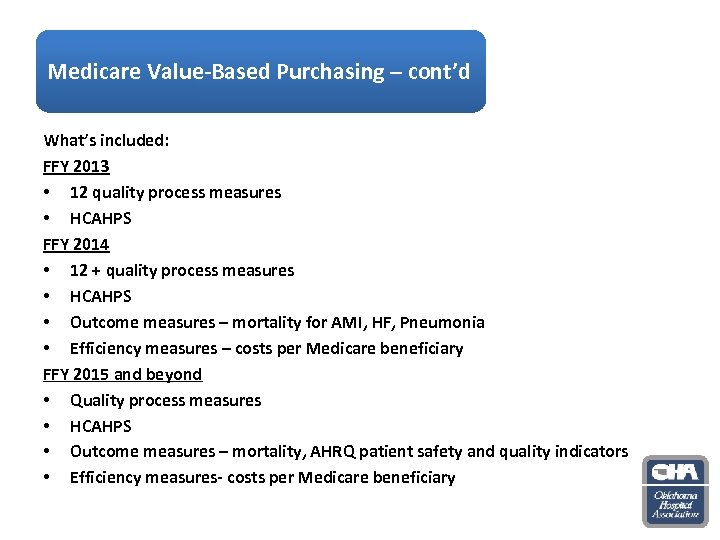 Medicare Value-Based Purchasing – cont’d What’s included: FFY 2013 • 12 quality process measures • HCAHPS FFY 2014 • 12 + quality process measures • HCAHPS • Outcome measures – mortality for AMI, HF, Pneumonia • Efficiency measures – costs per Medicare beneficiary FFY 2015 and beyond • Quality process measures • HCAHPS • Outcome measures – mortality, AHRQ patient safety and quality indicators • Efficiency measures- costs per Medicare beneficiary
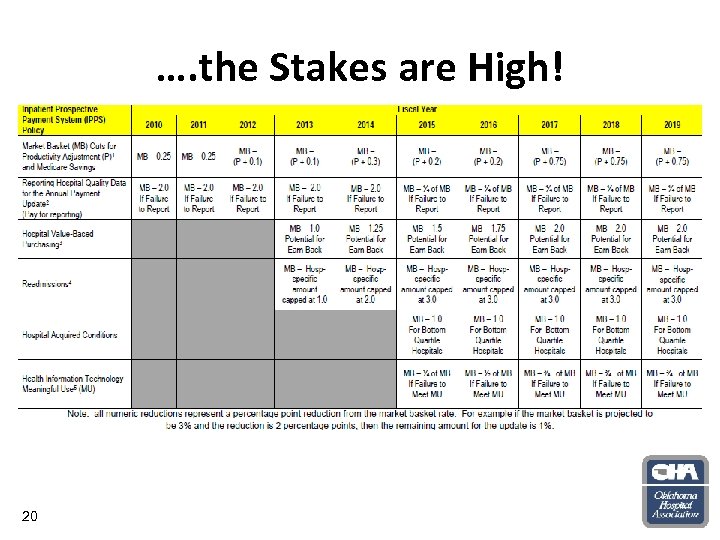 …. the Stakes are High! 20
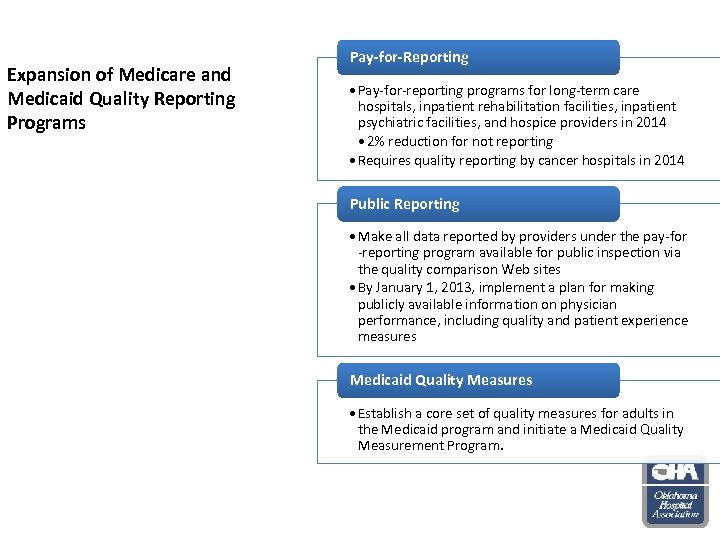 Expansion of Medicare and Medicaid Quality Reporting Programs Pay-for-Reporting • Pay-for-reporting programs for long-term care hospitals, inpatient rehabilitation facilities, inpatient psychiatric facilities, and hospice providers in 2014 • 2% reduction for not reporting • Requires quality reporting by cancer hospitals in 2014 Public Reporting • Make all data reported by providers under the pay-for -reporting program available for public inspection via the quality comparison Web sites • By January 1, 2013, implement a plan for making publicly available information on physician performance, including quality and patient experience measures Medicaid Quality Measures • Establish a core set of quality measures for adults in the Medicaid program and initiate a Medicaid Quality Measurement Program.
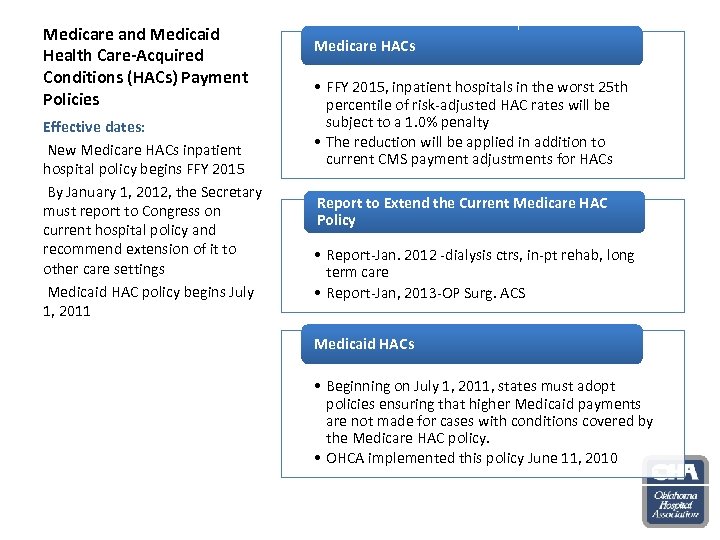 Medicare and Medicaid Health Care-Acquired Conditions (HACs) Payment Policies Effective dates: New Medicare HACs inpatient hospital policy begins FFY 2015 By January 1, 2012, the Secretary must report to Congress on current hospital policy and recommend extension of it to other care settings Medicaid HAC policy begins July 1, 2011 Medicare HACs • FFY 2015, inpatient hospitals in the worst 25 th percentile of risk-adjusted HAC rates will be subject to a 1. 0% penalty • The reduction will be applied in addition to current CMS payment adjustments for HACs Report to Extend the Current Medicare HAC Policy • Report-Jan. 2012 -dialysis ctrs, in-pt rehab, long term care • Report-Jan, 2013 -OP Surg. ACS Medicaid HACs • Beginning on July 1, 2011, states must adopt policies ensuring that higher Medicaid payments are not made for cases with conditions covered by the Medicare HAC policy. • OHCA implemented this policy June 11, 2010
 Current Hospital Acquired Conditions § § § § § Blood incompatibility Air embolism Stage III and IV pressure ulcers Falls and trauma Manifestations of poor glycemic control DVT and PE with certain procedures Catheter-associated urinary tract infections Vascular catheter-associated infection Surgical site infection with certain procedures Foreign body retention
 Geographic Variation in Medicare Spending Effective dates: Efficiency measures to be added to inpatient hospital VBP by FFY 2014 Temporary payment increases to hospitals beginning FFY 2011 Use of Efficiency Measures in VBP • Include efficiency measures in the inpatient hospital, budget-neutral, valuebased purchasing (VBP) program by FFY 2014 • Medicare spending per beneficiary adjusted for age, sex, race, severity of illness, and other factors Temporary, Increased Payments to Hospitals in Low Spending Counties Secretary Sebelius will commission an Institute of Medicine (IOM) study on Medicare hospital wage index and the establishment of a value index adjustment. • Beginning in 2011, provides $400 million in new funding over two years to hospitals in counties in the lowest quartile of Medicare Part A and Part B spending per enrollee • Spending adjusted for age, sex, and race
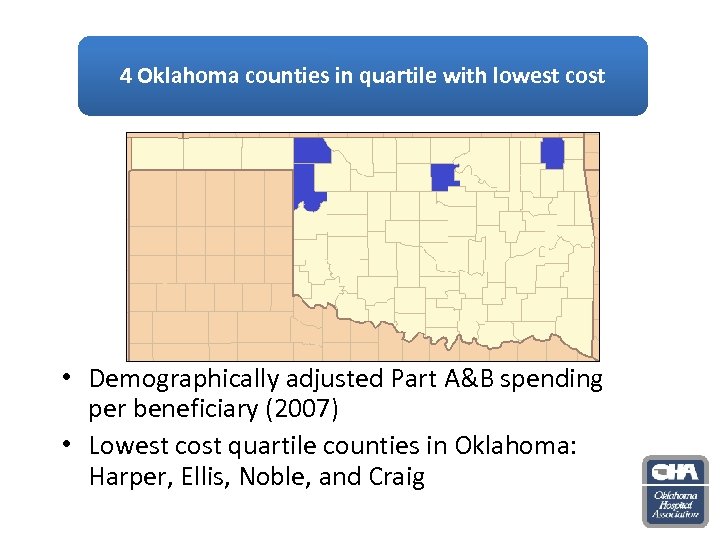 4 Oklahoma counties in quartile with lowest cost • Demographically adjusted Part A&B spending per beneficiary (2007) • Lowest cost quartile counties in Oklahoma: Harper, Ellis, Noble, and Craig
 Medicare Payment Bundling Pilot Effective dates: By January 1, 2013 By 2016, CMS must report results of pilot, making recommendations to Congress for its expansion Payment Bundling Pilot • Voluntary, five-year program • Bundle payments for ten conditions • Cover three days prior to hospital admission to 30 days following discharge • Include: • acute care inpatient; • outpatient, including ED; • physician services in and out of the hospital; and • post-acute care • Secretary will develop bundled payment rates and will test payments based on bids. • Payments cannot exceed what would otherwise be paid for the same services under current Medicare. • After January 1, 2016, the Secretary may expand the program
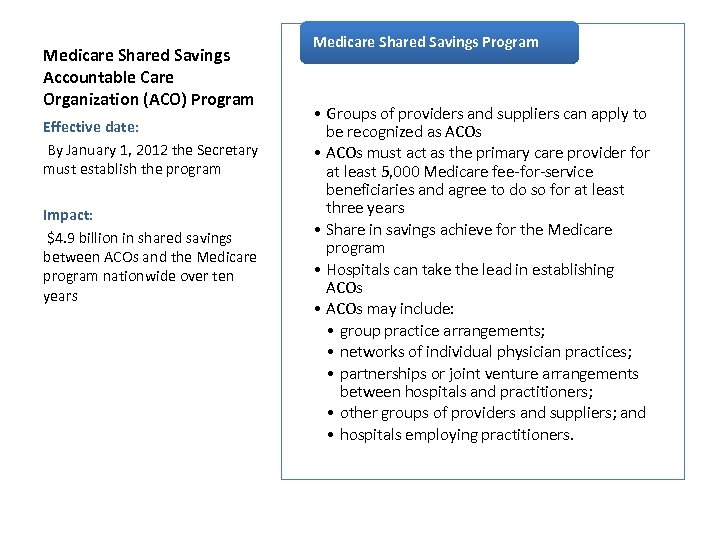 Medicare Shared Savings Accountable Care Organization (ACO) Program Effective date: By January 1, 2012 the Secretary must establish the program Impact: $4. 9 billion in shared savings between ACOs and the Medicare program nationwide over ten years Medicare Shared Savings Program • Groups of providers and suppliers can apply to be recognized as ACOs • ACOs must act as the primary care provider for at least 5, 000 Medicare fee-for-service beneficiaries and agree to do so for at least three years • Share in savings achieve for the Medicare program • Hospitals can take the lead in establishing ACOs • ACOs may include: • group practice arrangements; • networks of individual physician practices; • partnerships or joint venture arrangements between hospitals and practitioners; • other groups of providers and suppliers; and • hospitals employing practitioners.
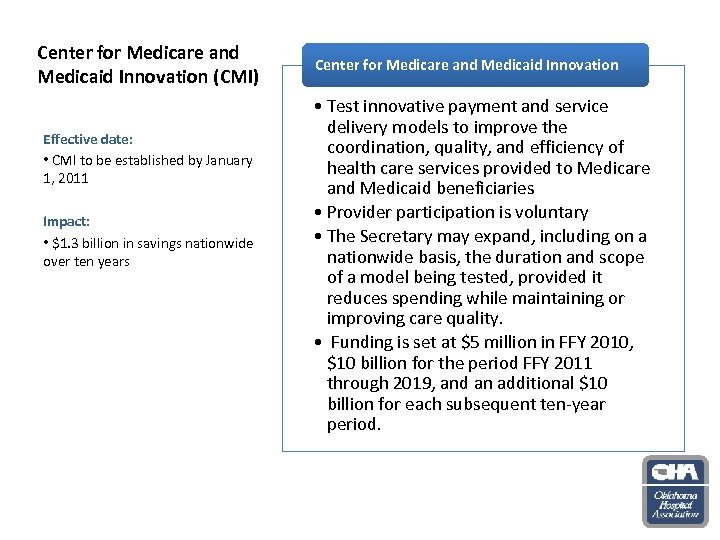 Center for Medicare and Medicaid Innovation (CMI) Effective date: • CMI to be established by January 1, 2011 Impact: • $1. 3 billion in savings nationwide over ten years Center for Medicare and Medicaid Innovation • Test innovative payment and service delivery models to improve the coordination, quality, and efficiency of health care services provided to Medicare and Medicaid beneficiaries • Provider participation is voluntary • The Secretary may expand, including on a nationwide basis, the duration and scope of a model being tested, provided it reduces spending while maintaining or improving care quality. • Funding is set at $5 million in FFY 2010, $10 billion for the period FFY 2011 through 2019, and an additional $10 billion for each subsequent ten-year period.
 Health Care Reform: What We Know Today Buffy Heater, MPH Planning & Development Manager Oklahoma Health Care Authority Presented to OHA Members May 6, 2010
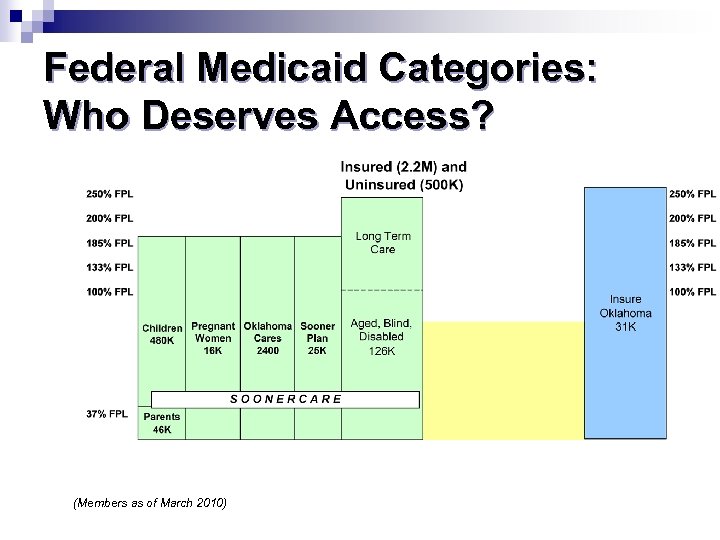 Federal Medicaid Categories: Who Deserves Access? (Members as of March 2010)
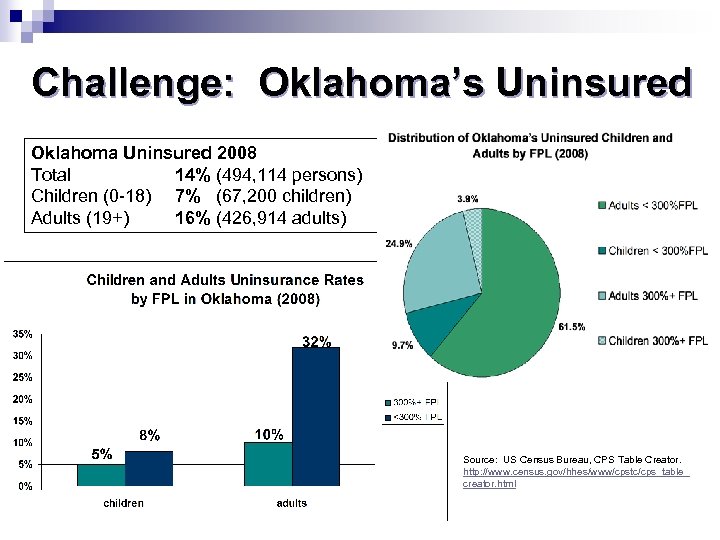 Challenge: Oklahoma’s Uninsured Oklahoma Uninsured 2008 Total 14% (494, 114 persons) Children (0 -18) 7% (67, 200 children) Adults (19+) 16% (426, 914 adults) Source: US Census Bureau, CPS Table Creator. http: //www. census. gov/hhes/www/cpstc/cps_table_ creator. html
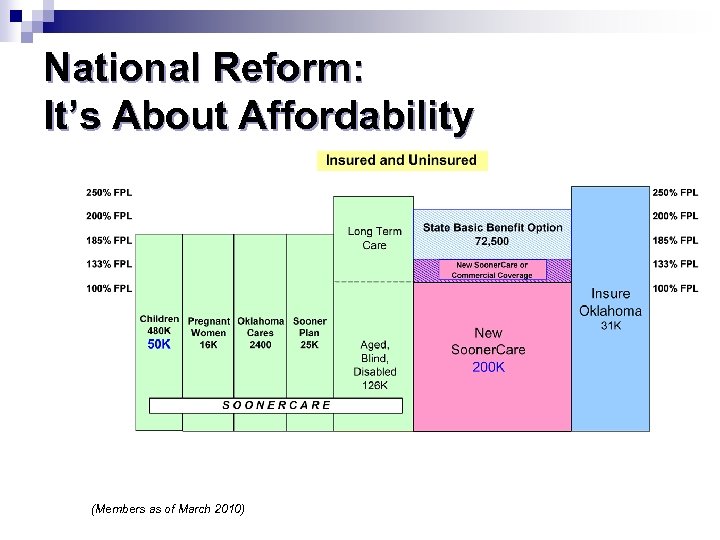 National Reform: It’s About Affordability (Members as of March 2010)
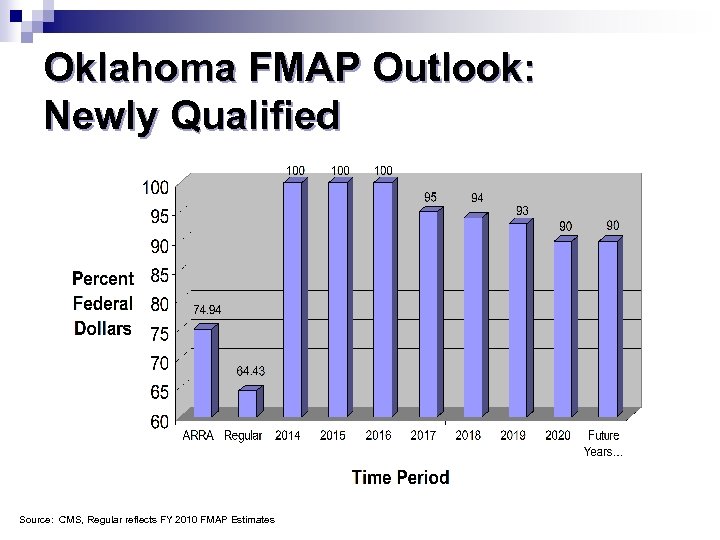 Oklahoma FMAP Outlook: Newly Qualified Source: CMS, Regular reflects FY 2010 FMAP Estimates
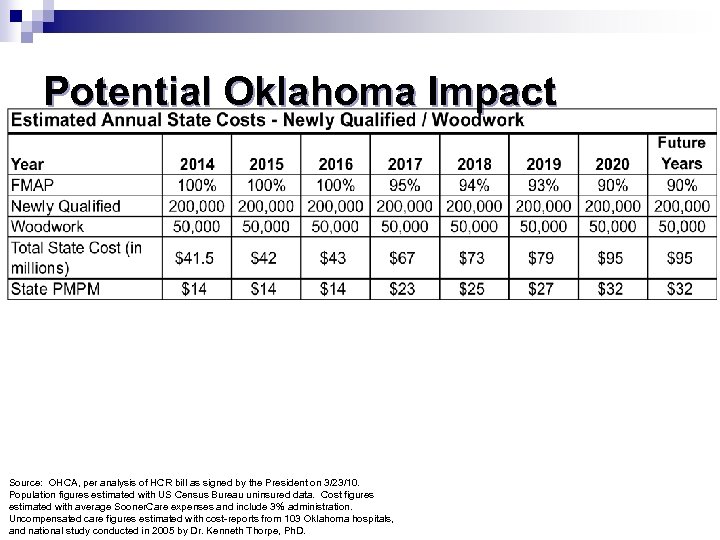 Potential Oklahoma Impact Source: OHCA, per analysis of HCR bill as signed by the President on 3/23/10. Population figures estimated with US Census Bureau uninsured data. Cost figures estimated with average Sooner. Care expenses and include 3% administration. Uncompensated care figures estimated with cost-reports from 103 Oklahoma hospitals, and national study conducted in 2005 by Dr. Kenneth Thorpe, Ph. D.
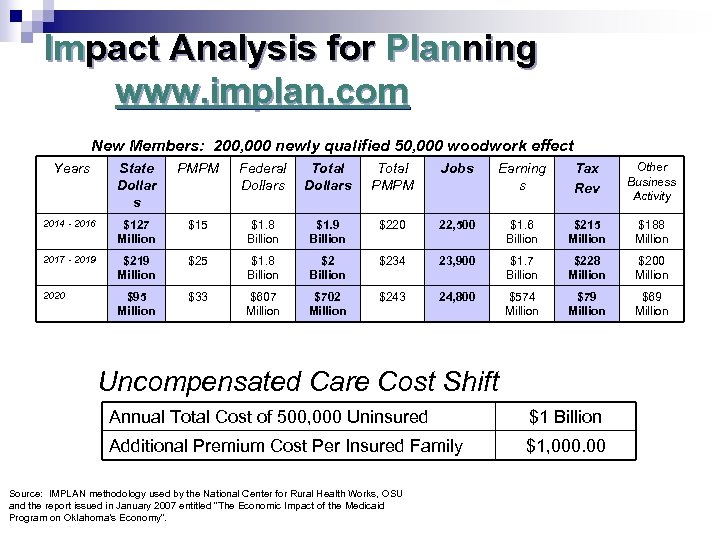 Impact Analysis for Planning www. implan. com New Members: 200, 000 newly qualified 50, 000 woodwork effect Years State Dollar s PMPM Federal Dollars Total PMPM Jobs Earning s Tax Rev Other Business Activity 2014 - 2016 $127 Million $15 $1. 8 Billion $1. 9 Billion $220 22, 500 $1. 6 Billion $215 Million $188 Million 2017 - 2019 $219 Million $25 $1. 8 Billion $234 23, 900 $1. 7 Billion $228 Million $200 Million 2020 $95 Million $33 $607 Million $702 Million $243 24, 800 $574 Million $79 Million $69 Million Uncompensated Care Cost Shift Annual Total Cost of 500, 000 Uninsured $1 Billion Additional Premium Cost Per Insured Family $1, 000. 00 Source: IMPLAN methodology used by the National Center for Rural Health Works, OSU and the report issued in January 2007 entitled “The Economic Impact of the Medicaid Program on Oklahoma’s Economy”.
 Insurance Reforms Patti Davis Executive Vice President Oklahoma Hospital Association
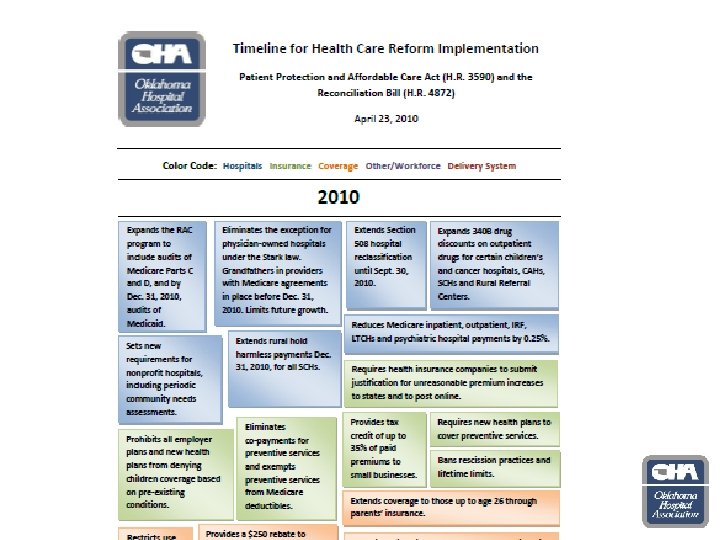
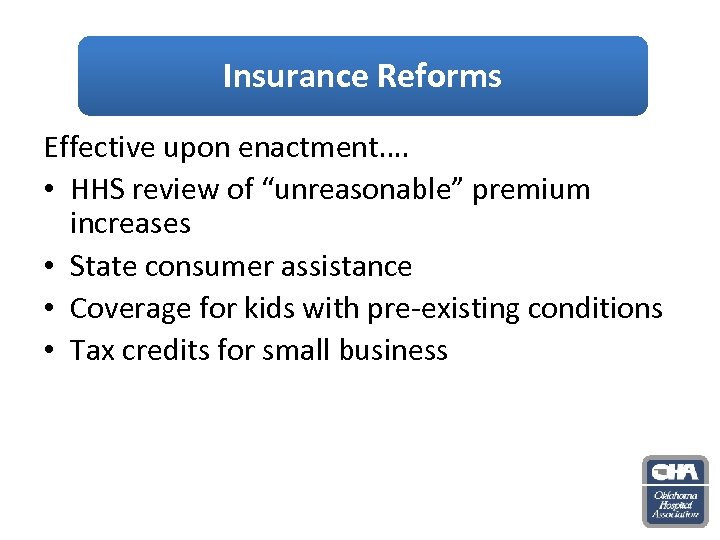 Insurance Reforms Effective upon enactment…. • HHS review of “unreasonable” premium increases • State consumer assistance • Coverage for kids with pre-existing conditions • Tax credits for small business
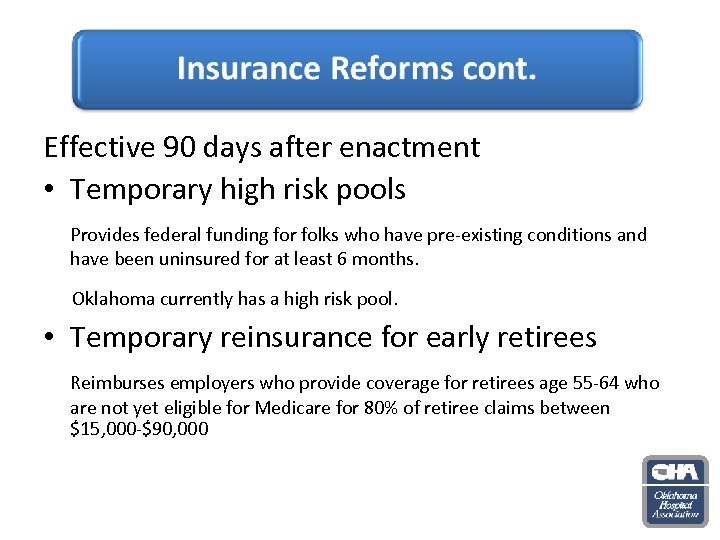 Effective 90 days after enactment • Temporary high risk pools Provides federal funding for folks who have pre-existing conditions and have been uninsured for at least 6 months. Oklahoma currently has a high risk pool. • Temporary reinsurance for early retirees Reimburses employers who provide coverage for retirees age 55 -64 who are not yet eligible for Medicare for 80% of retiree claims between $15, 000 -$90, 000
 Insurance Reforms cont. Effective 6 months after enactment • Coverage for preventive services without cost sharing • Prohibition against unwarranted recissions • Prohibition of lifetime dollar limits • Prohibition of preauthorization for emergency treatment • Adult dependent coverage to age 26
 Insurance Reforms Cont. Insurance Reforms cont. Effective 12/31/10 • Transparency of medical loss ratios Effective 2011 • Administrative simplification • Rebates for excess medical loss ratios • Prohibits OTC drugs from reimbursements on HSA/FSA • Long Term Care (Class Act)
 Insurance Reforms cont. 2013 • Limit on FSA $2500 2014 • Individual mandate penalty starts-phased in • Individual incentives/premium credits/subsidies begin • Employer mandate Employers with 50+ employees must offer coverage or face a penalty • Employer incentive-small business tax credit
 Insurance Market Reforms 2014 • Guaranteed Issue, Renewability, Pre-existing conditions • Fair premium rating • Excessive waiting periods prohibited • Essential benefits and cost sharing limits • Premium discounts, rebates, wellness promotion
 Essential Benefit Requirements • Benefit package=full range of services, including: -IP, OP, and ER services -Rehab, mental health and substance abuse -Maternity/newborn care -Prevention/wellness services -Chronic disease management -Prescription drugs
 State Based Insurance Exchanges Beginning in 2014 • • • Essential health benefit plan Benefit tiers with 4 different cost sharing levels Catastrophic plan options for 20 s. Guarantee Issue Prohibition on annual dollar limits Reinsurance pool for high dollar claims
 Function of State Exchanges • Facilitate and manage enrollment • Management of tax based premium subsidy and eligibility determinations • Will also enroll eligible individuals in Medicaid or CHIP or other programs • Establish a Navigator program for education and enrollment • Empowering consumer choice
 Additional Features Sale of insurance across state lines Health Care Co-Ops State waiver of individual mandates Hospitals with more than 50 beds will have to participate in PSO • No coverage for abortion services • No coverage for illegal immigrants • •
 Tax on High Cost Plans (Effective 2018) Effective 2018 • “Cadillac Plans” — 40% excise tax assessed on high cost employer sponsored health coverage • “High cost” —$10, 200 individual/$27, 500 family annual premiums
 Premium Tax Credits For Individuals and Families • Eligibility 133 -400% federal poverty limits • Tied to sliding scale • Out-of-pocket costs also capped and tied to income on sliding scale • Streamlined enrollment process
 Small Employers Tax Credits Small businesses are eligible for subsidies to offer insurance and have access to exchanges -Employers with 10 or fewer employees who earn, on average, less that $25 K per year can get 50% tax credit -Employers with 25 or fewer employees who earn, on average, less than $50 K can receive partial tax credit -This provision is in two phases with different tax credit amounts
 Large Employers • “Free Rider Assessments”-begins in 2014, businesses with 50 or more employees will be fined if their employees purchase health care coverage through the new exchanges and receive federal help to pay premiums • Penalty for noncompliance: Lesser of $3, 000 for each employee who receives a premium credit or $750 per each full time employee • Employers with more than 200 employees will have to have an auto enrollment for health plans • Free choice vouchers
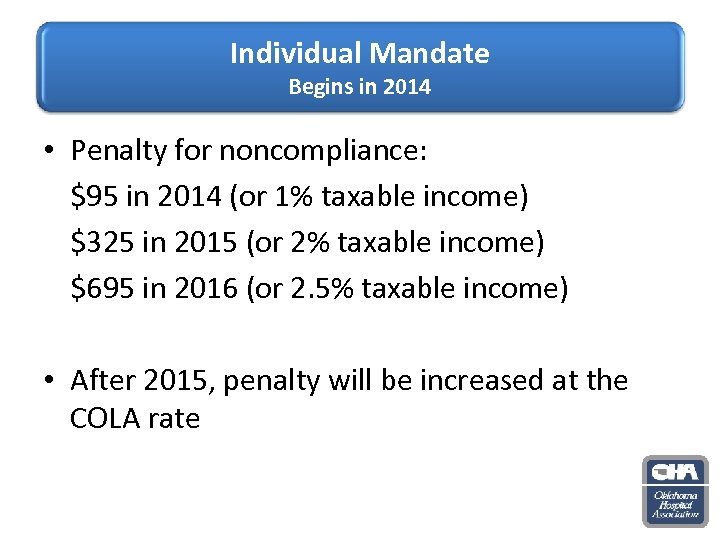 Individual Mandate Begins in 2014 • Penalty for noncompliance: $95 in 2014 (or 1% taxable income) $325 in 2015 (or 2% taxable income) $695 in 2016 (or 2. 5% taxable income) • After 2015, penalty will be increased at the COLA rate
 Physician Provisions
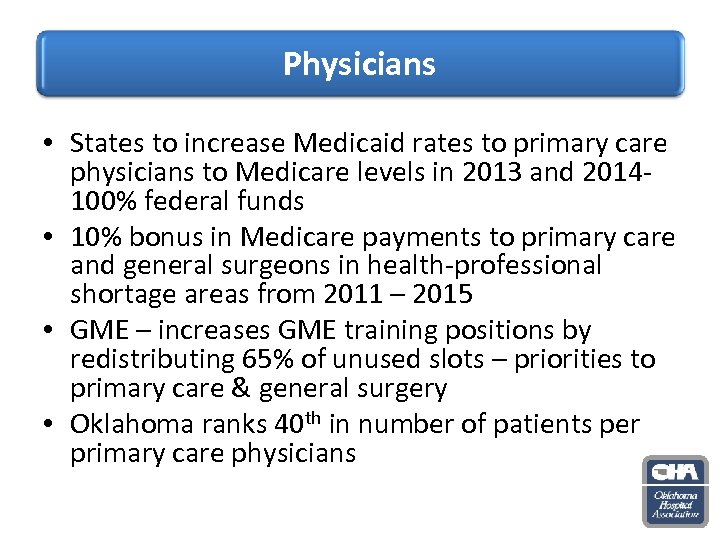 Physicians • States to increase Medicaid rates to primary care physicians to Medicare levels in 2013 and 2014100% federal funds • 10% bonus in Medicare payments to primary care and general surgeons in health-professional shortage areas from 2011 – 2015 • GME – increases GME training positions by redistributing 65% of unused slots – priorities to primary care & general surgery • Oklahoma ranks 40 th in number of patients per primary care physicians
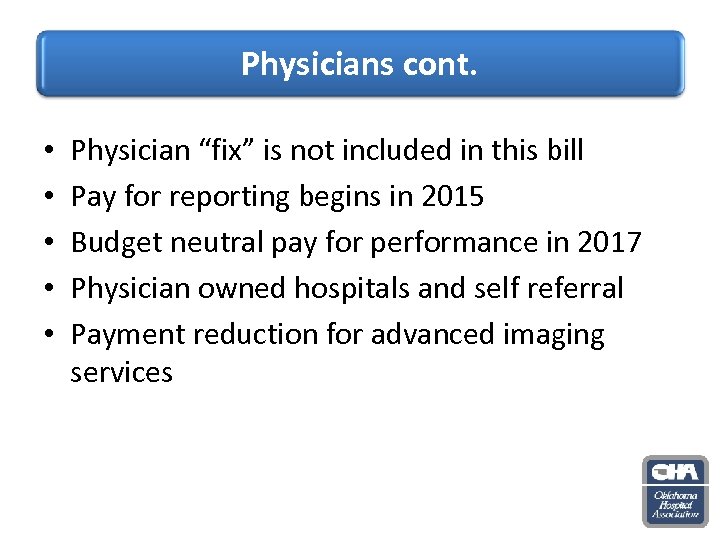 Physicians cont. • • • Physician “fix” is not included in this bill Pay for reporting begins in 2015 Budget neutral pay for performance in 2017 Physician owned hospitals and self referral Payment reduction for advanced imaging services
 Workforce Provisions • State health care workforce grants • Numerous repayment programs and scholarships for physicians, dentists and allied health care workers • Loans for nurses to increase teaching faculty
 Other Provisions • Medical malpractice grants • Comparative effectiveness research • Wellness and preventive care • Emergency room and trauma • Nutritional information requirements
 Oklahoma Impact of Health Care Reform Pain vs. Gain • 319, 000 could qualify for premium tax credits to help them buy insurance • 575, 000 seniors would receive free preventive services • 102, 000 seniors would benefit from the donut hole provisions • 45, 000 small businesses could receive small business tax credit for premiums • 600, 000 could get affordable insurance through the exchanges
 Resources • • • American Hospital Assn: www. aha. org Federal government: www. healthreform. gov Kaiser Family Foundation: http: //healthreform. kff. org AARP: www. aarp. org Robert Wood Johnson Found. : www. rwjf. org/healthreform/ Library of Congress: HR 3590 http: //thomas. loc. gov/cgi-bin/bdquery/z? d 111: HR 03590: HR 4872 http: //thomas. loc. gov/cgi-bin/bdquery/z? d 111: H. R. 4872:
 Questions? • Webinar “chat” • Operator assisted • Email: oha@okoha. com