 Скачать презентацию Health Care Costs 101 Paul B Ginsburg Ph
5f74774d32e7b7a92f128395c5cd993a.ppt
- Количество слайдов: 15



Health Care Costs 101 Paul B. Ginsburg, Ph. D. Presentation to Association of Health Care Journalists, March 28, 2008
Center for Studying Health System Change (HSC) § Analyzing local and national changes in financing and delivery of health care • Surveys of households, physicians • Site visits to 12 representative metropolitan areas § Active dissemination program • Following in policy world, media, industry, researchers, educators • www. hschange. org § Funding from foundations and government agencies • Longtime support from Robert Wood Johnson Foundation
Why We Need to Focus on Costs § Rising costs undermining mechanisms to finance health care • Private insurance - Premiums growing faster than earnings § Affordability problem moving into middle class • Public insurance - Increasing share of state and federal budgets - Revenue growth in rough proportion to income § But costs of Medicare and Medicaid rising appreciably faster § Results: crowd-out, higher taxes, deficits § Continuation of current trends will lead to more uneven access to care
Different Measures of Costs § National health expenditures (NHE) • By payer and payee • Comprehensive § Health insurance premiums • Employer and employee contributions • Differences between premiums and NHE - Privately insured vs. entire population - Benefit buy downs - Underwriting cycle
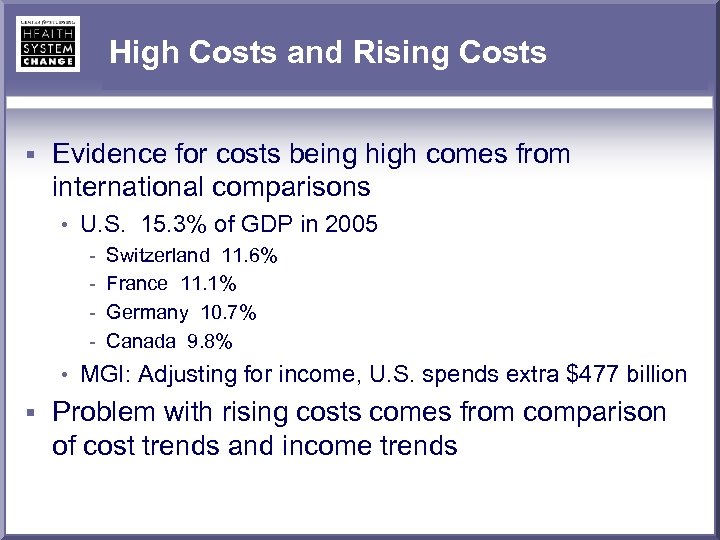
High Costs and Rising Costs § Evidence for costs being high comes from international comparisons • U. S. 15. 3% of GDP in 2005 - Switzerland 11. 6% France 11. 1% Germany 10. 7% Canada 9. 8% • MGI: Adjusting for income, U. S. spends extra $477 billion § Problem with rising costs comes from comparison of cost trends and income trends
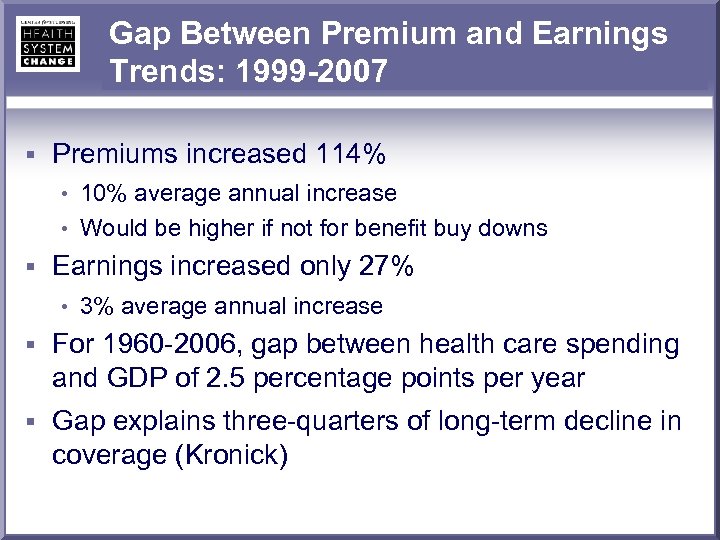
Gap Between Premium and Earnings Trends: 1999 -2007 § Premiums increased 114% • 10% average annual increase • Would be higher if not for benefit buy downs § Earnings increased only 27% • 3% average annual increase § For 1960 -2006, gap between health care spending and GDP of 2. 5 percentage points per year § Gap explains three-quarters of long-term decline in coverage (Kronick)
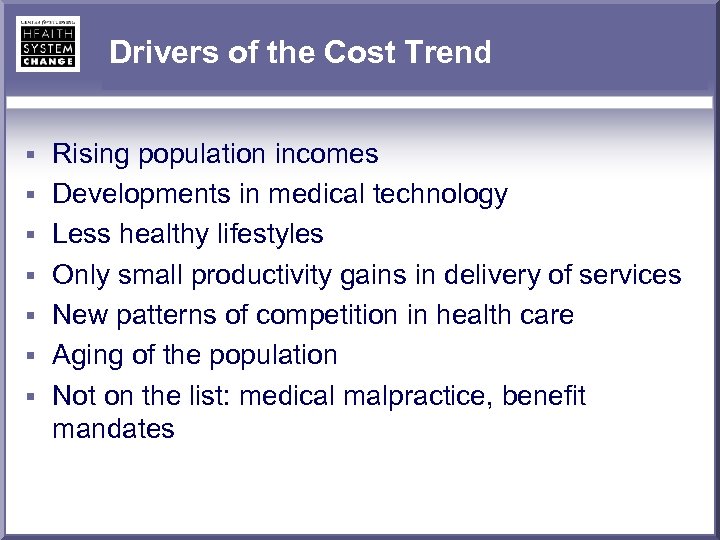
Drivers of the Cost Trend § Rising population incomes § Developments in medical technology § Less healthy lifestyles § Only small productivity gains in delivery of services § New patterns of competition in health care § Aging of the population § Not on the list: medical malpractice, benefit mandates
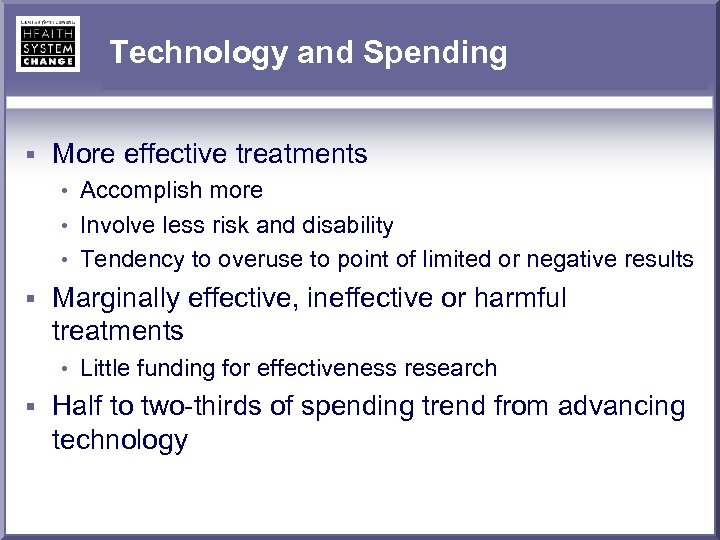
Technology and Spending § More effective treatments • Accomplish more • Involve less risk and disability • Tendency to overuse to point of limited or negative results § Marginally effective, ineffective or harmful treatments • Little funding for effectiveness research § Half to two-thirds of spending trend from advancing technology
Less Healthy Lifestyles § Obesity playing significant role in spending growth • Higher impact in future expected - Continuing increase in obesity - Higher relative spending than in past § Declining smoking has held down cost trend • But still contributes to costs being high
Limited Productivity Gains § Prosperity of American economy comes from substantial gains in productivity • Trend came late to services but now substantial • Much less in health care § Lack of the right incentives for health care providers • Only incentives on costs per unit • Few incentives to - Produce episodes of treatment more efficiently - Produce better health efficiently § Evidence of wide variation in efficiency of medical care
Role of Aging Often Overstated § Aging contributes about a half percentage point per year to spending • The most sophisticated studies get even lower numbers § Distinct from the financing challenge • Sharp increase in Medicare spending begins in 2011 § Contradiction between consistent research findings and popular opinion • Many would like us to believe that rising spending mostly from aging - Implication that we must accept it
Why Containing Costs is Hard § Role of influentials • Rising costs not a threat to their access • Cost containment might be a threat • For employers, retention of skilled workers trumps health care cost savings § All spending is someone’s income • Increasingly effective lobbying to protect incomes § Fragmented delivery system • Barrier to shifting from piecework industry to one that takes responsibility for patients/populations
Political Leaders Afraid to Lead § “Costs can be contained without sacrifice” • Claims of large savings through reducing waste • Today’s painless solutions: - Quality reporting and P 4 P - Health IT - Effectiveness research • All emphasize quality improvement over cost containment § Containing costs will include pain • Getting less care—some of value • Less income for providers
Issues in Devising Cost-Containment Strategies § Importance of equity • Services available to low-income persons • Degree of variation by ability to pay § Public’s tolerance of administrative controls • By governments • By insurers or providers § Confidence in potential of markets in health care
How Much Can the U. S. Afford? § Near term/intermediate term • Threat of financing systems failing—slowly § Long term • Even lower growth rates in relation to GDP lead to implausible results - Smaller spending/GDP gap will be achieved § Some combination of more efficient delivery and more difficult access to care § Success on the former will determine magnitude of the latter
Скачать презентацию Health Care Costs 101 Paul B Ginsburg Ph
5f74774d32e7b7a92f128395c5cd993a.ppt