


 Скачать презентацию Health and Air Quality Applications Team Meeting John
067ac6cf0e52efa24b5bf59e507be177.ppt
- Количество слайдов: 22
 Health and Air Quality Applications Team Meeting John A. Haynes, MS Program Manager, Health and Air Quality Applied Sciences Program Earth Science Division Science Mission Directorate NASA Washington, DC USA jhaynes@nasa. gov 1
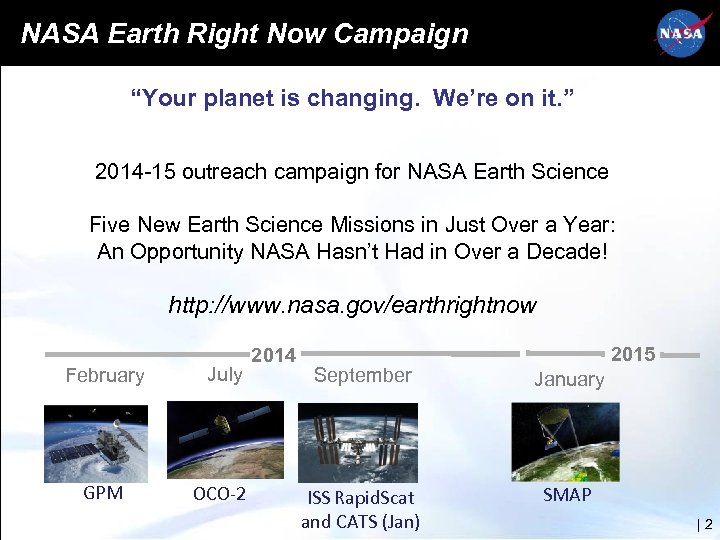 NASA Earth Right Now Campaign “Your planet is changing. We’re on it. ” 2014 -15 outreach campaign for NASA Earth Science Five New Earth Science Missions in Just Over a Year: An Opportunity NASA Hasn’t Had in Over a Decade! http: //www. nasa. gov/earthrightnow February July GPM OCO-2 2014 2015 September January ISS Rapid. Scat and CATS (Jan) SMAP | 2
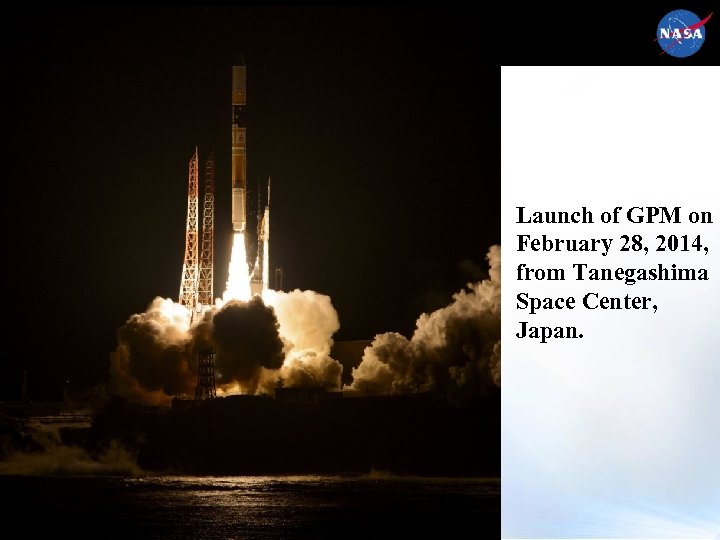 Launch of GPM on February 28, 2014, from Tanegashima Space Center, Japan.
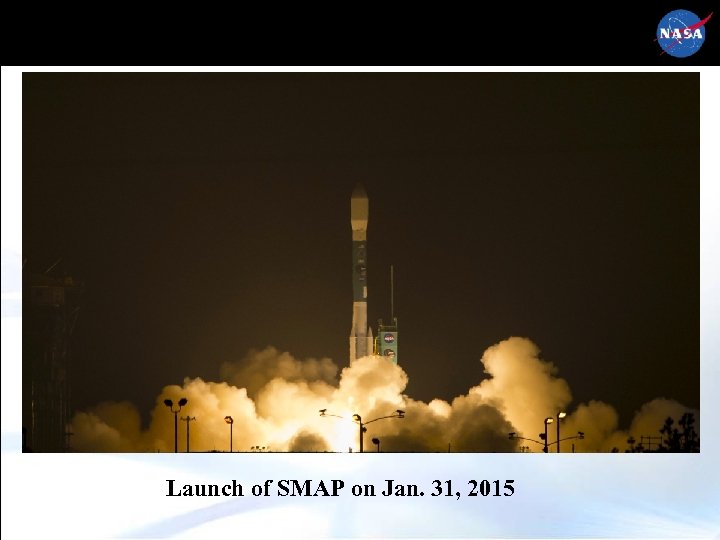 Launch of SMAP on Jan. 31, 2015
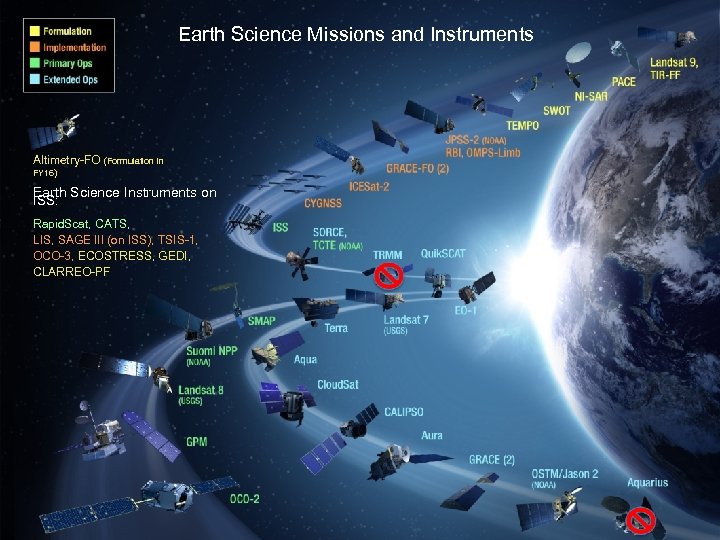 Earth Science Missions and Instruments Altimetry-FO (Formulation in FY 16) Earth Science Instruments on ISS: Rapid. Scat, CATS, LIS, SAGE III (on ISS), TSIS-1, OCO-3, ECOSTRESS, GEDI, CLARREO-PF
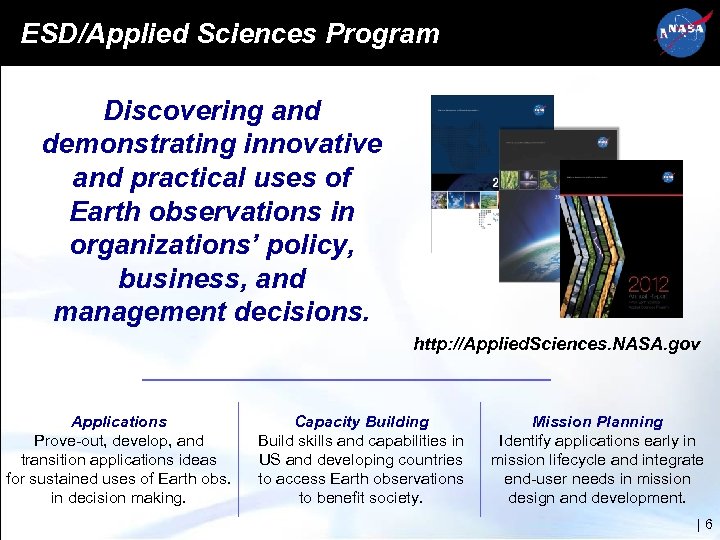 ESD/Applied Sciences Program Discovering and demonstrating innovative and practical uses of Earth observations in organizations’ policy, business, and management decisions. http: //Applied. Sciences. NASA. gov Applications Prove-out, develop, and transition applications ideas for sustained uses of Earth obs. in decision making. Capacity Building Build skills and capabilities in US and developing countries to access Earth observations to benefit society. Mission Planning Identify applications early in mission lifecycle and integrate end-user needs in mission design and development. | 6
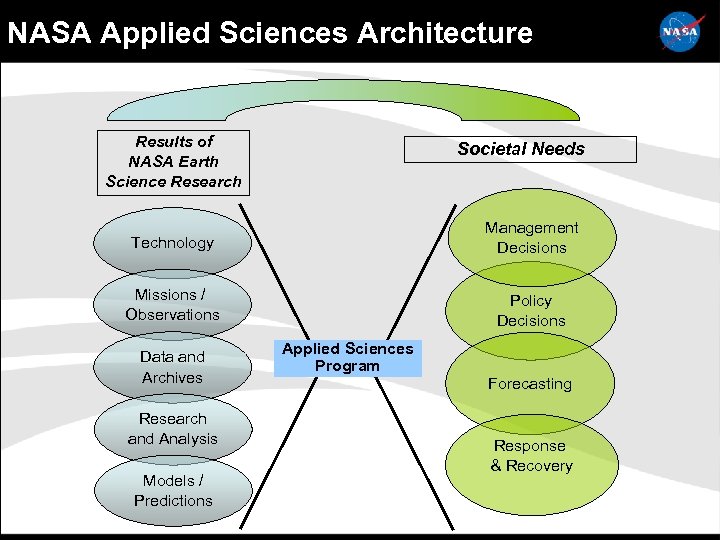 NASA Applied Sciences Architecture Results of NASA Earth Science Research Societal Needs Technology Management Decisions Missions / Observations Policy Decisions Data and Archives Research and Analysis Models / Predictions Applied Sciences Program Forecasting Response & Recovery
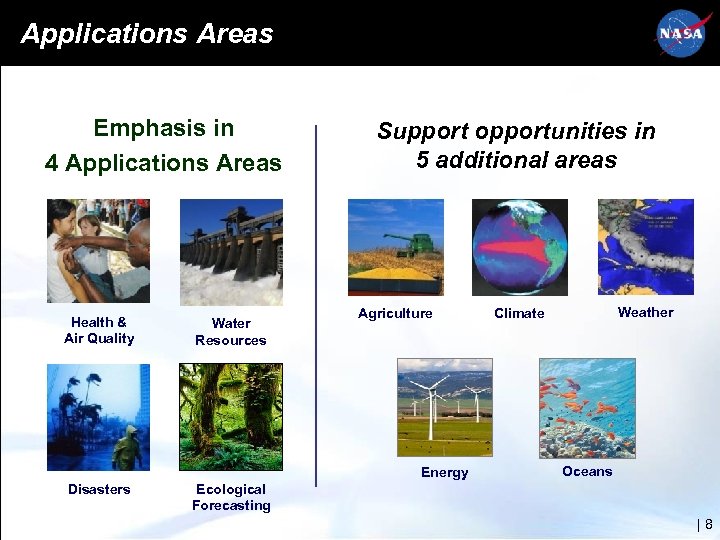 Applications Areas Emphasis in 4 Applications Areas Health & Air Quality Water Resources Support opportunities in 5 additional areas Agriculture Energy Disasters Weather Climate Oceans Ecological Forecasting | 8
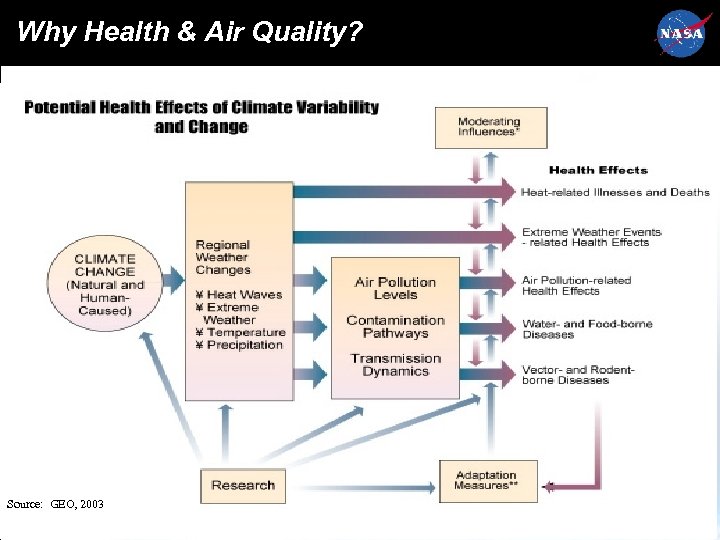 Why Health & Air Quality? Source: GEO, 2003 9 Patz et al. , 2000 http: //www. usgcrp. gov/usgcrp/Library/nationalassessment/healthimages. htm
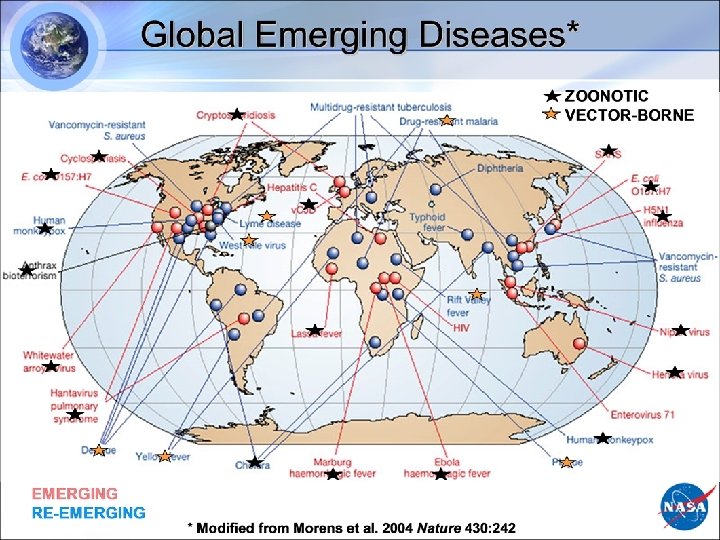 10
10
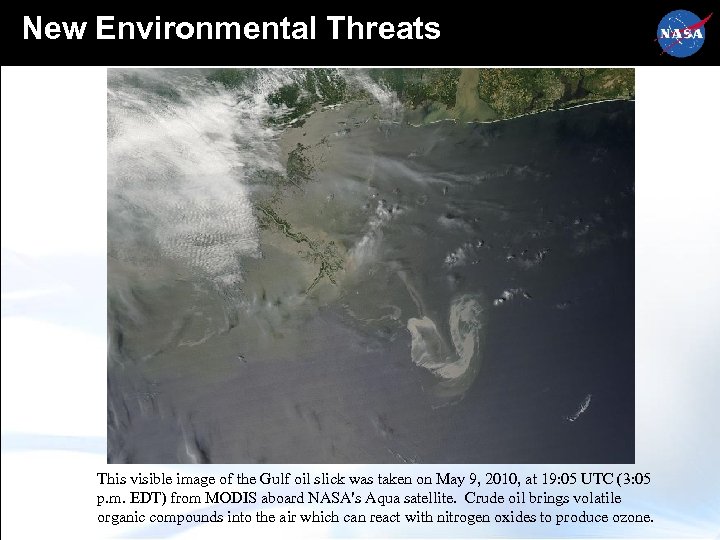 New Environmental Threats This visible image of the Gulf oil slick was taken on May 9, 2010, at 19: 05 UTC (3: 05 p. m. EDT) from MODIS aboard NASA's Aqua satellite. Crude oil brings volatile organic compounds into the air which can react with nitrogen oxides to produce ozone.
 Health & Air Quality Objectives: • NASA’s Health & Air Quality Applications Area supports the use of Earth observations in air quality management and public health, particularly regarding infectious disease and environmental health issues. • The area promotes uses of Earth observing data and models regarding implementation of air quality standards, policy, and regulations for economic and human welfare. • The area addresses issues of toxic and pathogenic exposure and health-related hazards and their effects for risk characterization and mitigation. • The Health & Air Quality Applications Area also addresses effects of climate change on public health and air quality to support managers and policy makers in their planning and preparations.
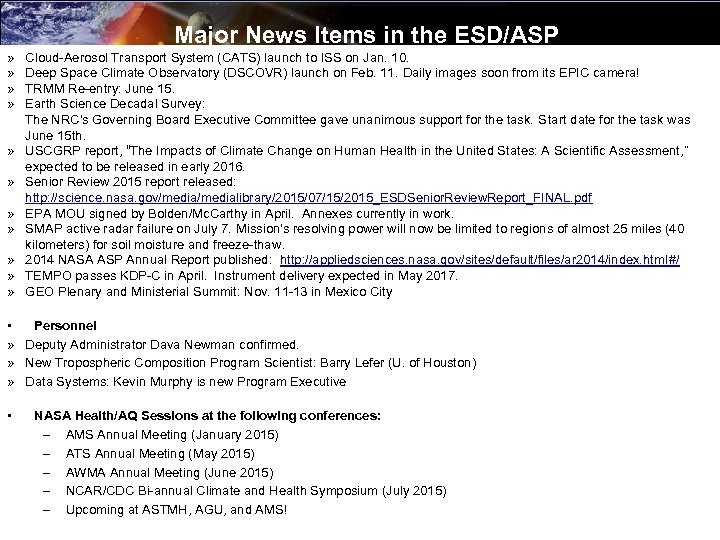 Major News Items in the ESD/ASP » » » Cloud-Aerosol Transport System (CATS) launch to ISS on Jan. 10. Deep Space Climate Observatory (DSCOVR) launch on Feb. 11. Daily images soon from its EPIC camera! TRMM Re-entry: June 15. Earth Science Decadal Survey: The NRC's Governing Board Executive Committee gave unanimous support for the task. S tart date for the task was June 15 th. USCGRP report, “The Impacts of Climate Change on Human Health in the United States: A Scientific Assessment, ” expected to be released in early 2016. Senior Review 2015 report released: http: //science. nasa. gov/medialibrary/2015/07/15/2015_ESDSenior. Review. Report_FINAL. pdf EPA MOU signed by Bolden/Mc. Carthy in April. Annexes currently in work. SMAP active radar failure on July 7. Mission's resolving power will now be limited to regions of almost 25 miles (40 kilometers) for soil moisture and freeze-thaw. 2014 NASA ASP Annual Report published: http: //appliedsciences. nasa. gov/sites/default/files/ar 2014/index. html#/ TEMPO passes KDP-C in April. Instrument delivery expected in May 2017. GEO Plenary and Ministerial Summit: Nov. 11 -13 in Mexico City • Personnel » Deputy Administrator Dava Newman confirmed. » New Tropospheric Composition Program Scientist: Barry Lefer (U. of Houston) » Data Systems: Kevin Murphy is new Program Executive • NASA Health/AQ Sessions at the following conferences: – AMS Annual Meeting (January 2015) – ATS Annual Meeting (May 2015) – AWMA Annual Meeting (June 2015) – NCAR/CDC Bi-annual Climate and Health Symposium (July 2015) – Upcoming at ASTMH, AGU, and AMS!
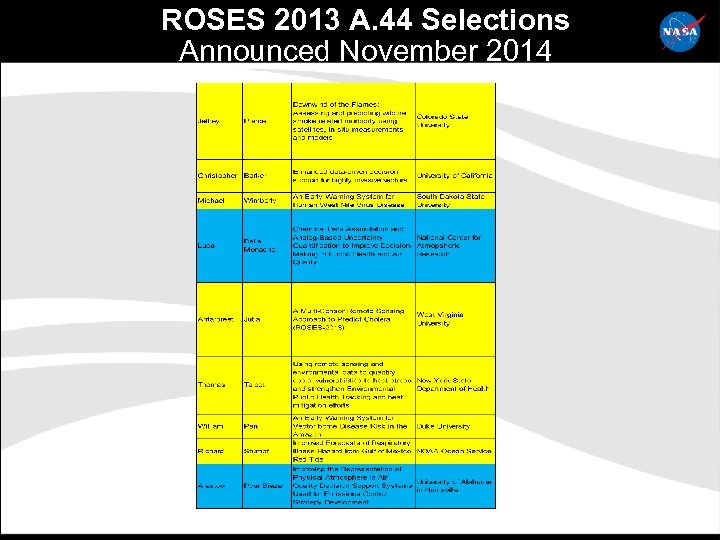 ROSES 2013 A. 44 Selections Announced November 2014
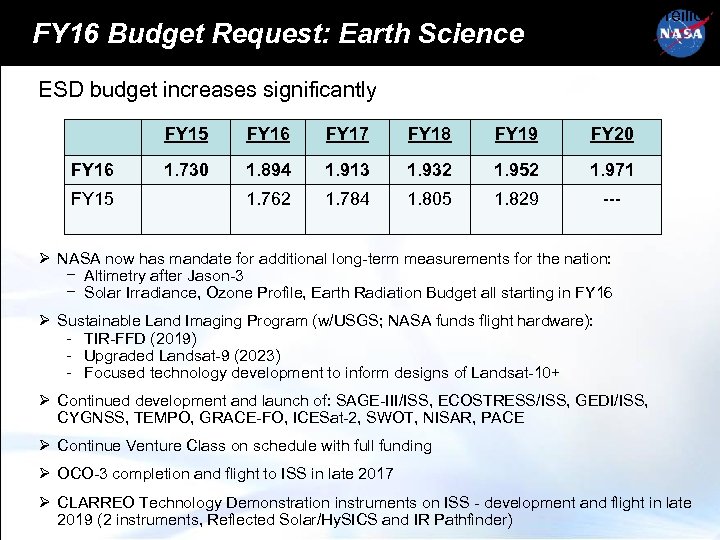 Freilich FY 16 Budget Request: Earth Science ESD budget increases significantly FY 15 FY 16 FY 17 FY 18 FY 19 FY 20 1. 730 1. 894 1. 913 1. 932 1. 952 1. 971 1. 762 1. 784 1. 805 1. 829 --- Ø NASA now has mandate for additional long-term measurements for the nation: − Altimetry after Jason-3 − Solar Irradiance, Ozone Profile, Earth Radiation Budget all starting in FY 16 Ø Sustainable Land Imaging Program (w/USGS; NASA funds flight hardware): - TIR-FFD (2019) - Upgraded Landsat-9 (2023) - Focused technology development to inform designs of Landsat-10+ Ø Continued development and launch of: SAGE-III/ISS, ECOSTRESS/ISS, GEDI/ISS, CYGNSS, TEMPO, GRACE-FO, ICESat-2, SWOT, NISAR, PACE Ø Continue Venture Class on schedule with full funding Ø OCO-3 completion and flight to ISS in late 2017 Ø CLARREO Technology Demonstration instruments on ISS - development and flight in late 2019 (2 instruments, Reflected Solar/Hy. SICS and IR Pathfinder)
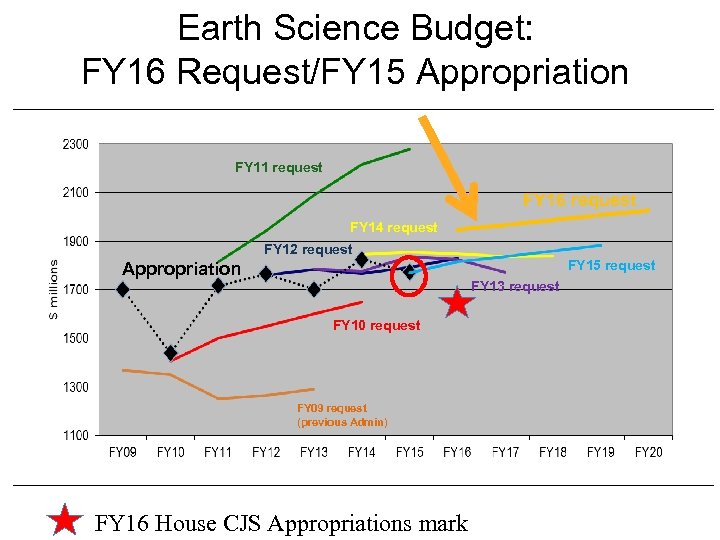 Earth Science Budget: FY 16 Request/FY 15 Appropriation FY 11 request FY 16 request FY 14 request FY 12 request FY 15 request Appropriation FY 13 request FY 10 request FY 09 request (previous Admin) FY 16 House CJS Appropriations mark
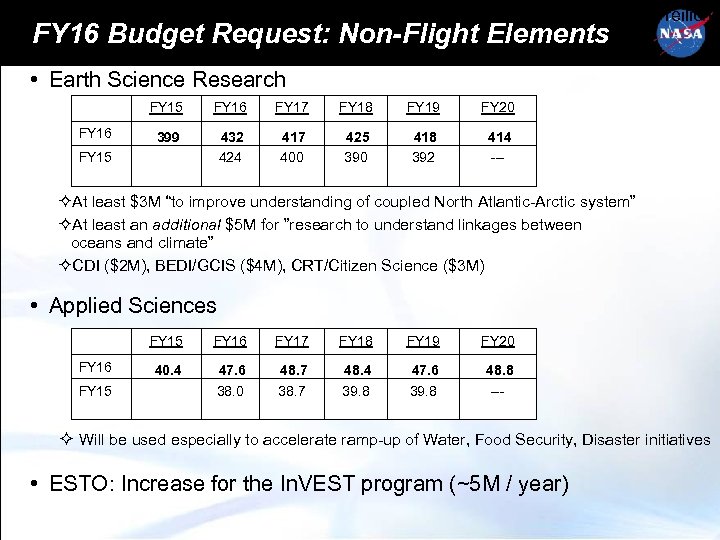 FY 16 Budget Request: Non-Flight Elements Freilich • Earth Science Research FY 15 FY 16 FY 17 FY 18 FY 19 FY 20 399 432 424 417 400 425 390 418 392 414 --- FY 15 At least $3 M “to improve understanding of coupled North Atlantic-Arctic system” At least an additional $5 M for ”research to understand linkages between oceans and climate” CDI ($2 M), BEDI/GCIS ($4 M), CRT/Citizen Science ($3 M) • Applied Sciences FY 15 FY 16 FY 17 FY 18 FY 19 FY 20 40. 4 47. 6 38. 0 48. 7 38. 7 48. 4 39. 8 47. 6 39. 8 48. 8 --- Will be used especially to accelerate ramp-up of Water, Food Security, Disaster initiatives • ESTO: Increase for the In. VEST program (~5 M / year)
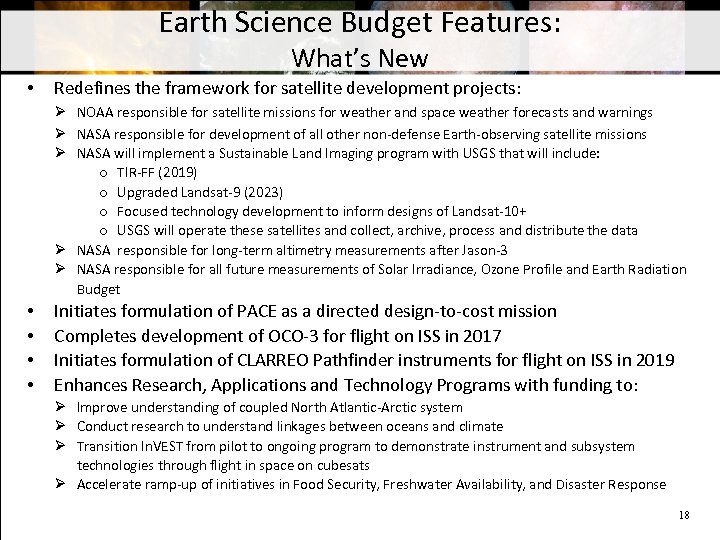 Earth Science Budget Features: What’s New • Redefines the framework for satellite development projects: Ø NOAA responsible for satellite missions for weather and space weather forecasts and warnings Ø NASA responsible for development of all other non-defense Earth-observing satellite missions Ø NASA will implement a Sustainable Land Imaging program with USGS that will include: o TIR-FF (2019) o Upgraded Landsat-9 (2023) o Focused technology development to inform designs of Landsat-10+ o USGS will operate these satellites and collect, archive, process and distribute the data Ø NASA responsible for long-term altimetry measurements after Jason-3 Ø NASA responsible for all future measurements of Solar Irradiance, Ozone Profile and Earth Radiation Budget • • Initiates formulation of PACE as a directed design-to-cost mission Completes development of OCO-3 for flight on ISS in 2017 Initiates formulation of CLARREO Pathfinder instruments for flight on ISS in 2019 Enhances Research, Applications and Technology Programs with funding to: Ø Improve understanding of coupled North Atlantic-Arctic system Ø Conduct research to understand linkages between oceans and climate Ø Transition In. VEST from pilot to ongoing program to demonstrate instrument and subsystem technologies through flight in space on cubesats Ø Accelerate ramp-up of initiatives in Food Security, Freshwater Availability, and Disaster Response 18
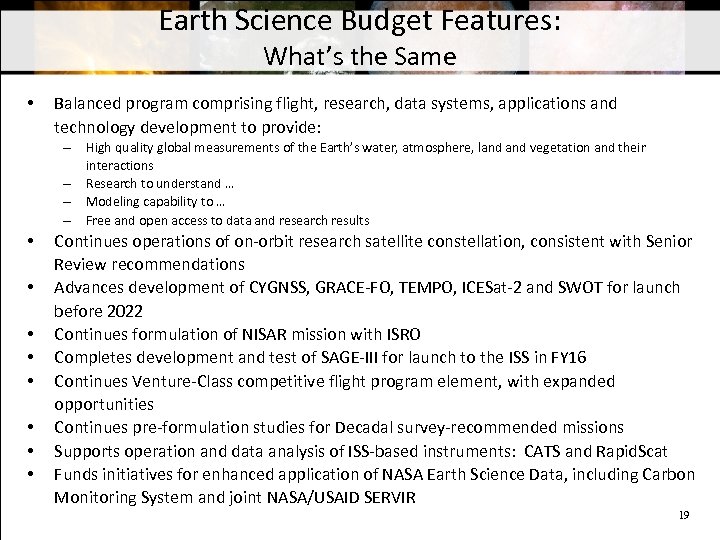 Earth Science Budget Features: What’s the Same • Balanced program comprising flight, research, data systems, applications and technology development to provide: – High quality global measurements of the Earth’s water, atmosphere, land vegetation and their interactions – Research to understand … – Modeling capability to … – Free and open access to data and research results • • Continues operations of on-orbit research satellite constellation, consistent with Senior Review recommendations Advances development of CYGNSS, GRACE-FO, TEMPO, ICESat-2 and SWOT for launch before 2022 Continues formulation of NISAR mission with ISRO Completes development and test of SAGE-III for launch to the ISS in FY 16 Continues Venture-Class competitive flight program element, with expanded opportunities Continues pre-formulation studies for Decadal survey-recommended missions Supports operation and data analysis of ISS-based instruments: CATS and Rapid. Scat Funds initiatives for enhanced application of NASA Earth Science Data, including Carbon Monitoring System and joint NASA/USAID SERVIR 19
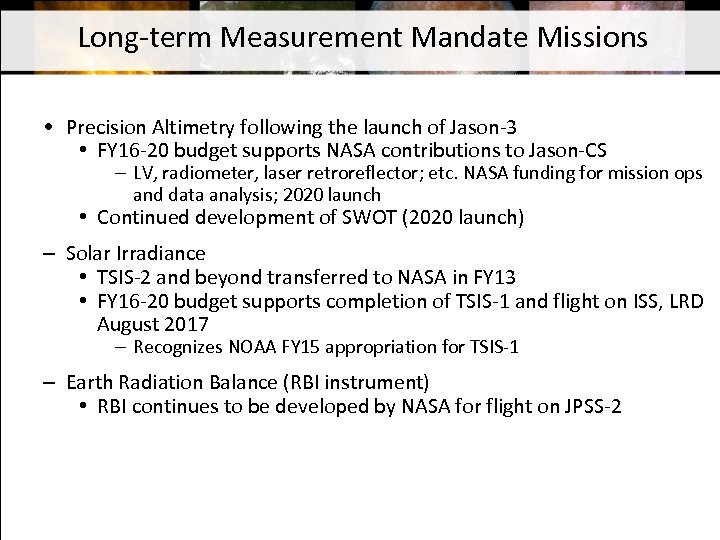 Long-term Measurement Mandate Missions • Precision Altimetry following the launch of Jason-3 • FY 16 -20 budget supports NASA contributions to Jason-CS – LV, radiometer, laser retroreflector; etc. NASA funding for mission ops and data analysis; 2020 launch • Continued development of SWOT (2020 launch) – Solar Irradiance • TSIS-2 and beyond transferred to NASA in FY 13 • FY 16 -20 budget supports completion of TSIS-1 and flight on ISS, LRD August 2017 – Recognizes NOAA FY 15 appropriation for TSIS-1 – Earth Radiation Balance (RBI instrument) • RBI continues to be developed by NASA for flight on JPSS-2
 Call for Socio-Economic Impact Analysis Proposals • Call for proposals sent on August 10, 2015. • Proposals due on October 30, 2015. Proposals should be sent directly to the PM. Do NOT use NASA NSPIRES. • Proposal should indicate the value of an impact analysis to your project, as well as provide a detailed plan on how this analysis would be accomplished. This proposal should include key people, including people in addition to the original proposal, who may need to be obtained in order to insure success. These key people with appropriate expertise are encouraged to be from the fields of statistics and/or economics. If the original proposal contained a section on an impact assessment, then this proposal should expand on that original statement of interest and provide a more complete plan and approach. • One time funds of $250 K will be granted as a budget supplemental for two projects.
 National Aeronautics and Space Administration Questions: John Haynes, Program Manager Health & Air Quality Applications NASA Headquarters / Earth Science JHaynes@nasa. gov http: //Applied. Sciences. NASA. gov