


 Скачать презентацию HEA Reauthorization 101 Presenters M Seamus Harreys Northeastern
86c086e7b41509ffe34fb69c8896de5d.ppt
- Количество слайдов: 45
 HEA Reauthorization 101 Presenters M. Seamus Harreys, Northeastern University Bernie Pekala, Boston College Eileen O’Leary, Stonehill College Scott Prince, MEFA
 Agenda l History l Review of the Higher Education Act l Legislation – Reauthorization – Appropriation l Resources and Actions
 Federal Aid & Reauthorization History M. Seamus Harreys Northeastern University
 A history review. . . l l l l l The first recorded scholarship High stakes of higher education 1862: The Morrill Act WWII: The GI Bill 1965: Higher Education Act 1972 -1998: Reauthorizations 1978: Middle Income Student Assistance Act 1992: Student Right to Know/Campus Security 1997: Taxpayer Relief Act
 Higher Education Act of 1965 l “This act means that a high school senior anywhere in this great land of ours can apply to any college or university in any of the 50 states and not be turned away because his family is poor” – President Johnson, 1965
 Review of The Higher Education Act Bernie Pekala Boston College
 Hierarchy l Some rules take precedence over others: – Laws – Regs – Dear Colleague/Dear Partner Letters – Private letters – Verbal guidance
 TITLE I: GENERAL PROVISIONS PART A – Definitions. Sec. 101(a), 101(b) and 102 offer definitions of Institution of Higher Education (IHE) l PART B – Other Provisions. Including Antidiscrimination, protection of student speech and association rights (fraternity issue), disclosure of foreign gifts, binge drinking, drug and alcohol abuse prevention. l PART C – Cost of Higher Education. NCES study and web-based college cost information system. l PART D – Administrative Provisions for Delivery of Student Financial Assistance. Creation of FSA – the performance based organization (PBO) for student aid. l
 TITLE II: TEACHER QUALITY ENHANCEMENT GRANTS FOR STATES AND PARTNERSHIP l Created in 1998, this grant program supports teacher quality grants to states, to partnerships of local education agencies and Institutions of Higher Education and to support the recruitment of teachers. l Title II also contains the institutional and state teacher reporting and accountability requirements.
 TITLE III-INSTITUTIONAL AID l This title offers assistance to developing institutions and those with historic federal ties. Funding for these programs, particularly those targeted to moderately identifiable groups of institutions, is growing. Not in this title, but similar, is the program supporting Hispanic-Serving Institutions (HSI’s) in Title V. l PART A –Strengthening Institutions. – Strengthening Tribally-Controlled (Sec. 316). – Strengthening Alaska Native and Native-Hawaiian Serving (Sec. 317). l PART B –Strengthening HBCU’s. – Strengthening Historically Black Graduate Institutions (Sec. 326). PART C –Endowment Challenge Grants for Part A or B institutions l PART D –HBCU Capital Financing. l PART E –Minority Science and Engineering Improvement. l
 TITLE IV—STUDENT ASSISTANCE l l l l PART A — Grants to Students In Attendance at Institutions of Higher Education PART B — Federal Family Education Loan Program PART C — Federal Work-Study Programs PART D — William D. Ford Federal Direct Loan Program PART E — Federal Perkins Loans PART F — Need Analysis PART G — General Provisions Relating to Student Assistance Programs PART H — Program Integrity
 TITLE IV —STUDENT ASSISTANCE IN DEPTH Title IV is home to the majority of federal student aid and student assistance programs and many of the related requirements. l Part A –Grants to Students – Subpart 1: Federal Pell Grants. – Subpart 2: Early Outreach & Student Services Programs l Chapter 1: Federal TRIO programs–six programs that support the progress of first-generation, at-risk students toward college & completion of their degrees. – – – Sec. 402 B – Talent Search Sec. 402 C – Upward Bound Sec. 402 D – Student Support Services Sec. 402 E – Mc. Nair, Post baccalaureate Achievement Sec. 402 F – Educational Opportunity Centers Sec. 402 G – Staff Development Activities
 TITLE IV —STUDENT ASSISTANCE IN DEPTH Part A –Grants to Students-Continued l Subpart 2 (cont. ) – l l l Chapter 2 – GEAR UP – supports state grants and grants to partnerships for early intervention services and scholarships for cohorts of students beginning in middle school. Subpart 3 – Federal Supplemental Educational Opportunity Grants (FSEOG) – a campus-based aid program (with a 25 percent matching requirement) to provide supplemental grants to the most needy Pell recipients. Subpart 4 – Leveraging Educational Assistance Partnership (LEAP, formerly SSIG) provides matching grants to states to encourage state funding of grant assistance. Subpart 5 – Students from Migrant and Seasonal Farmworker Families. Subpart 6 – Robert C. Byrd Honors Scholarship program –scholarships for meritorious students from each state. Subpart 7 – Child Care Access program –grant program to support programs providing on campus childcare services to students and their children. Subpart 8 – Learning Anytime Anywhere Partnerships – grant program to support the development of distance education programs.
 TITLE IV —STUDENT ASSISTANCE IN DEPTH l Part B – Federal Family Education Loan Program (FFELP) – This part authorizes the FFELP programs: l l Stafford Subsidized Loans, Stafford Unsubsidized Loans, PLUS loans for parents and consolidation loans. Federal Direct Student Loans (FDSL) are authorized in Part D. Part B establishes all the terms and conditions for borrowers from interest rates to deferments and forbearance and details the roles and responsibilities of the various players in the FFELP programs (lenders, guaranty agencies, secondary markets, etc. ). Part C – Federal Work-Study Program (FWS)
 TITLE IV —STUDENT ASSISTANCE IN DEPTH l Part D – William D. Ford Federal Direct Loan Program (FDSL) – This part authorizes the Direct Loan programs: l l l Subsidized Direct Student Loans, Unsubsidized Direct Student Loans, Direct PLUS loans for parents and consolidation loans. Part D establishes all the terms and conditions for borrowers from interest rates to deferments and forbearance and details the roles and responsibilities of the various players in the FDSL program. Part E – Federal Perkins Loans
 TITLE IV —STUDENT ASSISTANCE IN DEPTH l Part G – General Provisions relating to Student Assistance Programs (hodgepodge) includes: Definition of academic year The master calendar Provisions related to the FAFSA Student eligibility Refunds Institutional information reporting and dissemination requirements – National Student Loan Data – – –
 TITLE IV —STUDENT ASSISTANCE IN DEPTH l Part l H – Program Integrity This part identifies the role of the triad –the states, the accrediting agencies and the federal government –in ensuring program integrity at IHE’s participating in federal student aid programs. – Subpart 1 – State Role (Licensing) – Subpart 2 – Accrediting Agency Recognition (Accreditation) – Subpart 3 – Federal Eligibility and Certification Procedures
 OTHER HEA--RELATED PROGRAMS, NOT IN THE HEA l Olympic Scholarships, Title XV, Part E of HEA of 1992 l l Study of Market Mechanisms in Federal Loan Program, Sec. 801 of HEA of 1998 l l Authorizes a program to offer financial assistance to Olympic Athletes pursuing postsecondary education. Authorized comprehensive study of federal loan programs and alternate market based mechanisms of delivering these loans. Community Scholarship Mobilization (Dollars for Scholars), Sec. 811 of HEA of 1998 l Supports the efforts of a local community scholarship initiative.
 OTHER HEA--RELATED PROGRAMS, NOT IN THE HEA l State Grants for Workplace and Community Transition Incarcerated Youth Offenders, Section 821 of HEA of 1998 l l Grants to Combat Violent Crimes Against Women on Campuses, Sec. 826 of 1998 HEA l l Support grants to states for education and training of youth offenders. Support grants from Attorney General to IHE’s to assist in combating violent crimes against women through effective security, victim services, and partnerships with other agencies. Web-based Education Commission, Sec. 851 of 1998 HEA l Established a commission to examine distance education.
 TITLE V —DEVELOPING INSTITUTIONS l PART A — Hispanic-Serving Institutions l New in 1998, this title authorizes a program providing federal support to institutions serving high populations of Hispanic students.
 TITLE VI —INTERNATIONAL EDUCATION PROGRAMS l Supports centers, programs and fellowships at IHE’s in foreign languages, area studies and other international studies. Several discrete programs divide up these funds. l PART A – International and Foreign Language Studies l PART B – Business and International Education Programs l PART C – Institute for International Public Policy
 TITLE VII —GRADUATE AND POSTSECONDARY IMPROVEMENT POSTSECONDARY PROGRAMS l PART A – Graduate Programs l PART B – Fund for Improvement of Post Secondary Education (FIPSE) l PART C – Urban Community Service l PART D – Demonstration Projects to Ensure Students with Disabilities Receive a Quality Higher Education
 Legislative Process Reauthorization Eileen O’Leary Stonehill College
 HEA Reauthorization Primary law is Higher Education Act l Reauthorization is required each 5 -6 years l Most recent reauthorization: Oct 7, 1998 l Note: HEA can change as a result of other laws. l – Labor-HHS-Education appropriations bills – Work Incentives Improvement Act of 1999 – Laws not directly related to FFELP can cause big changes. l l E-sign law Gramm-Leach-Bliley (privacy act)
 Primer on legislative process. . . l How a Bill Becomes a Law
 Bill Is Introduced into the House or the Senate l l H. R. 100 S. 103
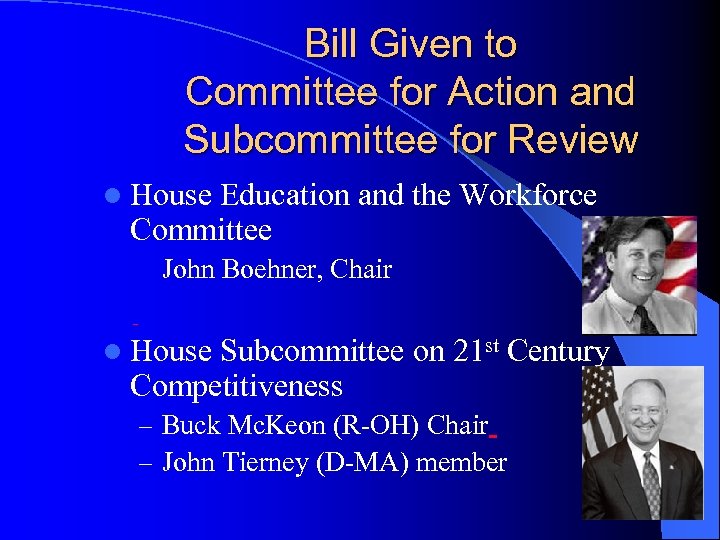 Bill Given to Committee for Action and Subcommittee for Review l House Education and the Workforce Committee John Boehner, Chair l House Subcommittee on 21 st Century Competitiveness – Buck Mc. Keon (R-OH) Chair – John Tierney (D-MA) member
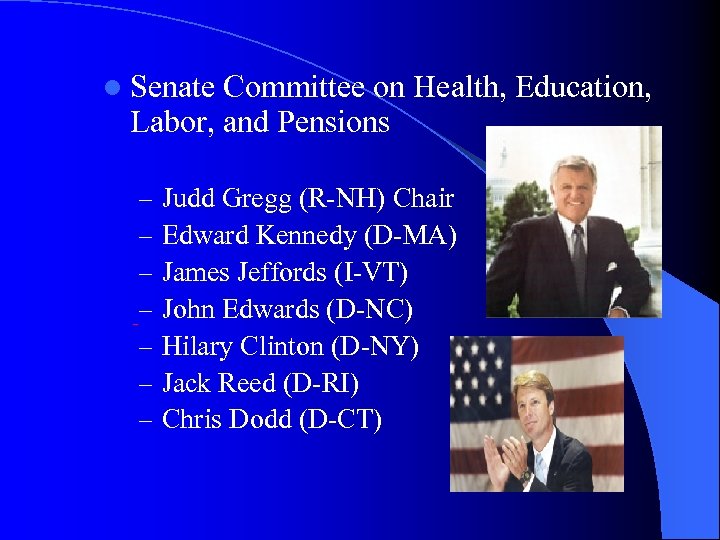 l Senate Committee on Health, Education, Labor, and Pensions – – – – Judd Gregg (R-NH) Chair Edward Kennedy (D-MA) James Jeffords (I-VT) John Edwards (D-NC) Hilary Clinton (D-NY) Jack Reed (D-RI) Chris Dodd (D-CT)
 l MARKUP
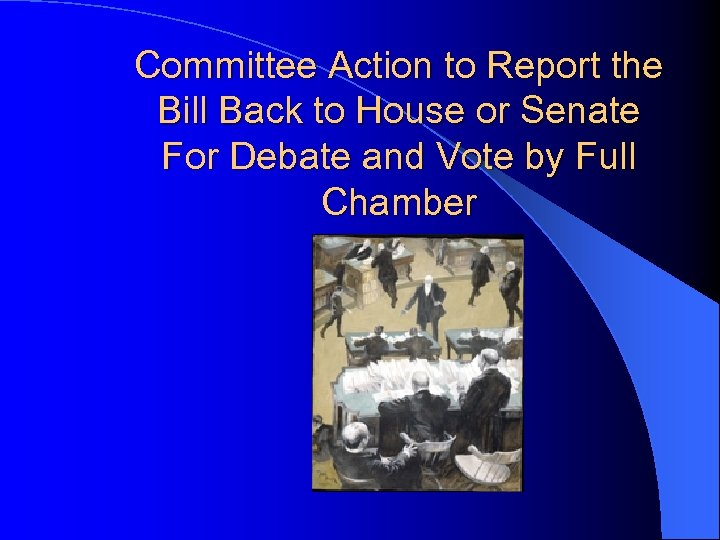 Committee Action to Report the Bill Back to House or Senate For Debate and Vote by Full Chamber
 If Passed in Originating Chamber… l Bill is sent to other Chamber and entire process is repeated there.
 If the Bill Passes in the Second Chamber… l With no changes to original bill – – Its on to the President for his signature!
 If the Bill Passes in the Second Chamber with changes… – The bill goes to Conference Committee (consisting of members of both Houses) for deliberation, consensus – Back to each House for separate votes on the amended bill (with no changes allowed) – If it passes in each House, l Its on to the President for his signature!
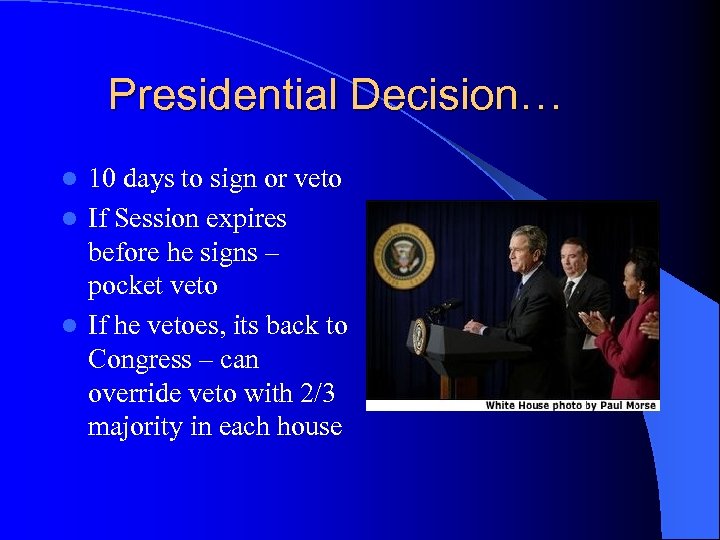 Presidential Decision… 10 days to sign or veto l If Session expires before he signs – pocket veto l If he vetoes, its back to Congress – can override veto with 2/3 majority in each house l
 The Regulatory Process l Once, the bill is signed into law – Negotiated rulemaking begins – Representatives from many organizations hammer out regulatory language
 Legislative Process Appropriations
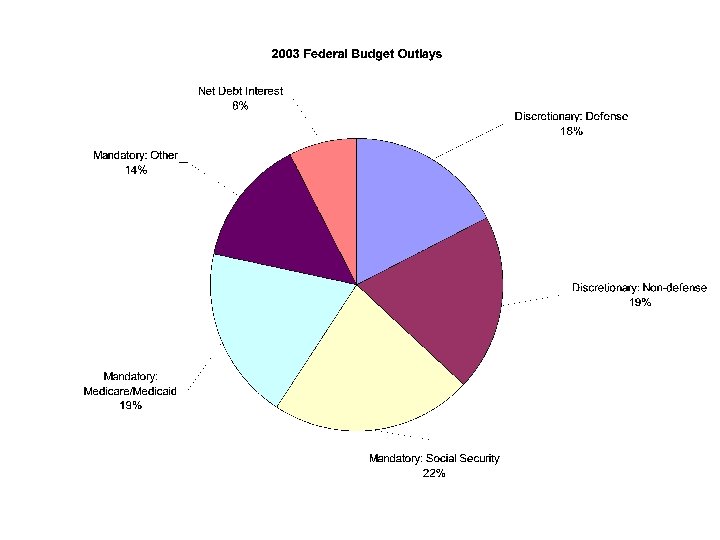
 l Funding – Authorization vs. Appropriation
 Resources and Actions Scott Prince MEFA
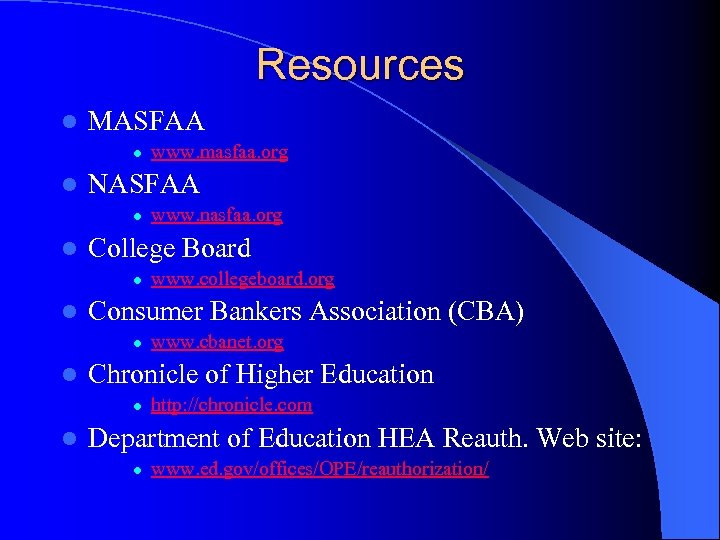 Resources l MASFAA l l NASFAA l l www. cbanet. org Chronicle of Higher Education l l www. collegeboard. org Consumer Bankers Association (CBA) l l www. nasfaa. org College Board l l www. masfaa. org http: //chronicle. com Department of Education HEA Reauth. Web site: l www. ed. gov/offices/OPE/reauthorization/
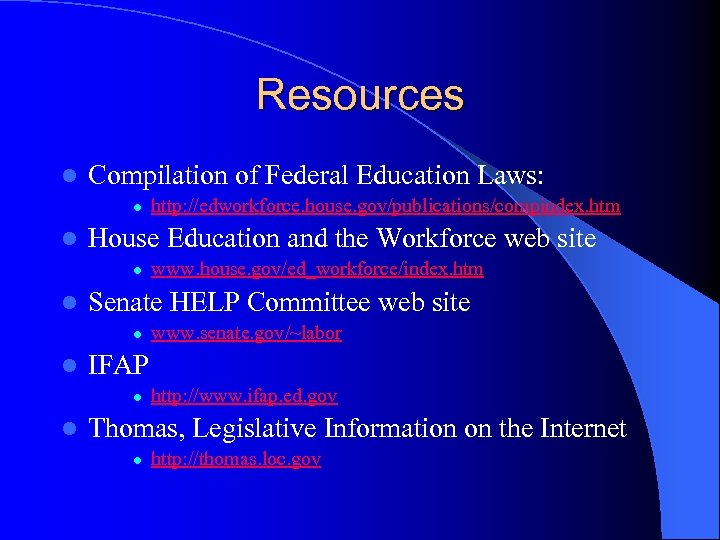 Resources l Compilation of Federal Education Laws: l l House Education and the Workforce web site l l www. senate. gov/~labor IFAP l l www. house. gov/ed_workforce/index. htm Senate HELP Committee web site l l http: //edworkforce. house. gov/publications/compindex. htm http: //www. ifap. ed. gov Thomas, Legislative Information on the Internet l http: //thomas. loc. gov
 The choices. . . Reactive? Proactive?
 Take the time to speak your mind – Write, e-mail, call, visit congressional delegates – Invite them to visit your campus – Provide feedback – Contact local media; write letters to editor – Share information with students and parents, and your institutional administration
 Questions & Comments Reauthorization Panel 4: 00 Today Jane Oates Senior Education Advisor to Senator Kennedy Larry Zaglaniczny, NASFAA Director for Congressional Relations
 Reauthorization 101