


 Скачать презентацию HD Ratio for IPv 4 RIPE 48 May
ab813998748ebf5fb18ea4439daba09d.ppt
- Количество слайдов: 23
 HD Ratio for IPv 4 RIPE 48 May 2004 Amsterdam 1
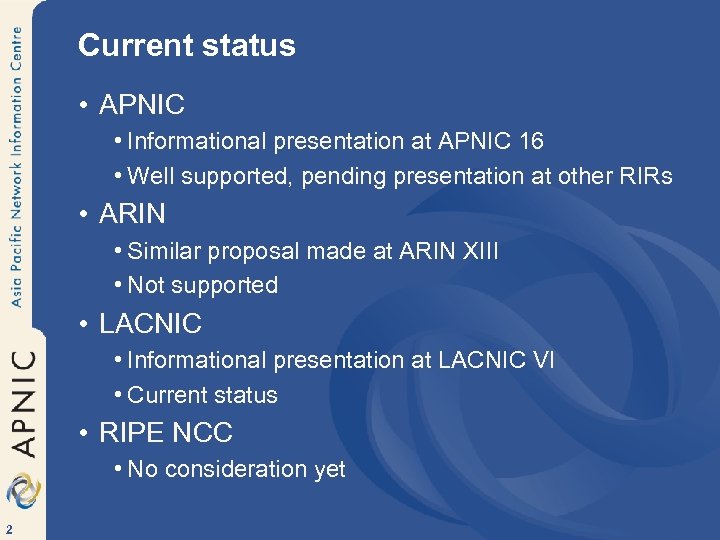 Current status • APNIC • Informational presentation at APNIC 16 • Well supported, pending presentation at other RIRs • ARIN • Similar proposal made at ARIN XIII • Not supported • LACNIC • Informational presentation at LACNIC VI • Current status • RIPE NCC • No consideration yet 2
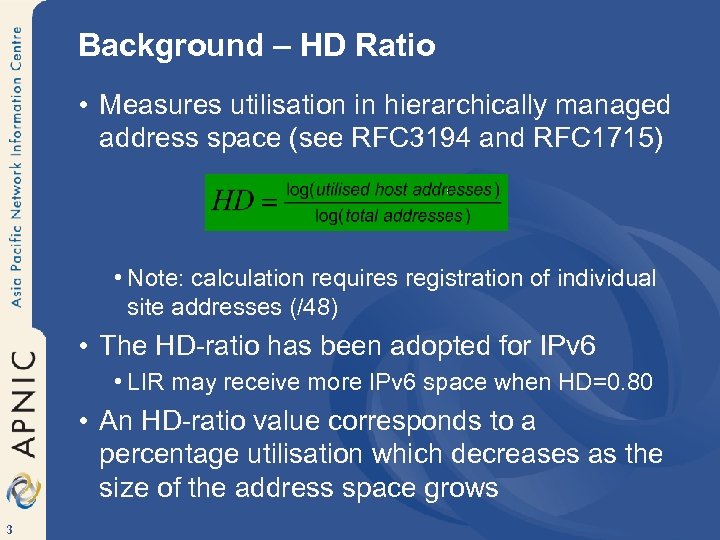 Background – HD Ratio • Measures utilisation in hierarchically managed address space (see RFC 3194 and RFC 1715) • Note: calculation requires registration of individual site addresses (/48) • The HD-ratio has been adopted for IPv 6 • LIR may receive more IPv 6 space when HD=0. 80 • An HD-ratio value corresponds to a percentage utilisation which decreases as the size of the address space grows 3
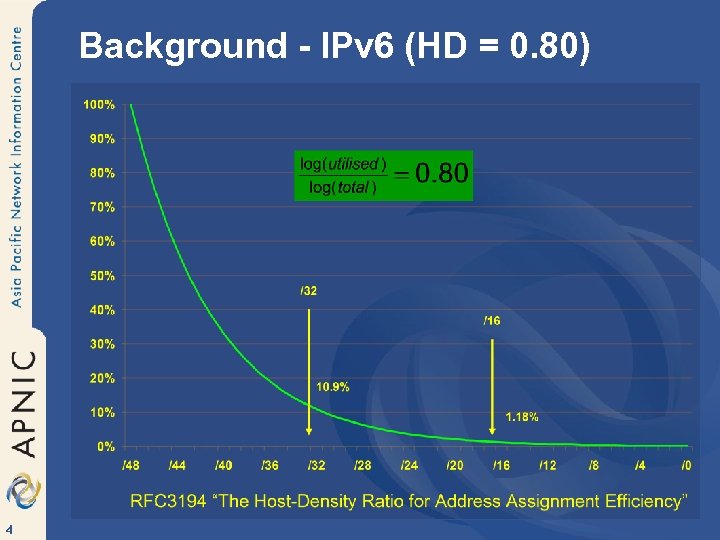 Background - IPv 6 (HD = 0. 80) 4
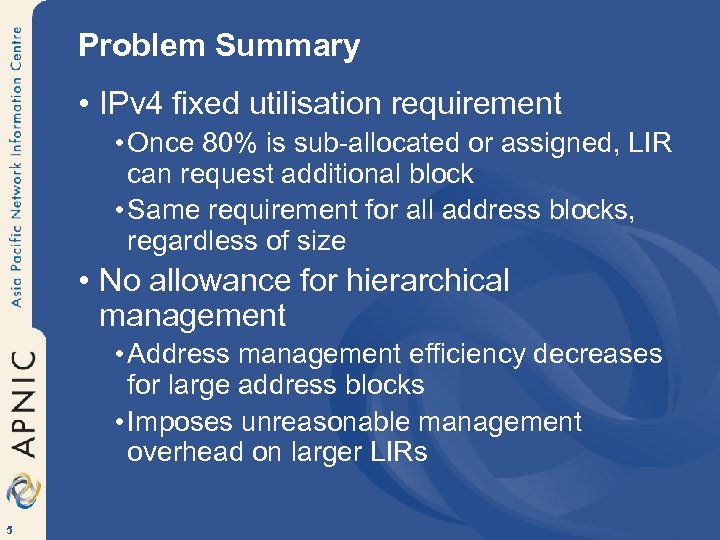 Problem Summary • IPv 4 fixed utilisation requirement • Once 80% is sub-allocated or assigned, LIR can request additional block • Same requirement for all address blocks, regardless of size • No allowance for hierarchical management • Address management efficiency decreases for large address blocks • Imposes unreasonable management overhead on larger LIRs 5
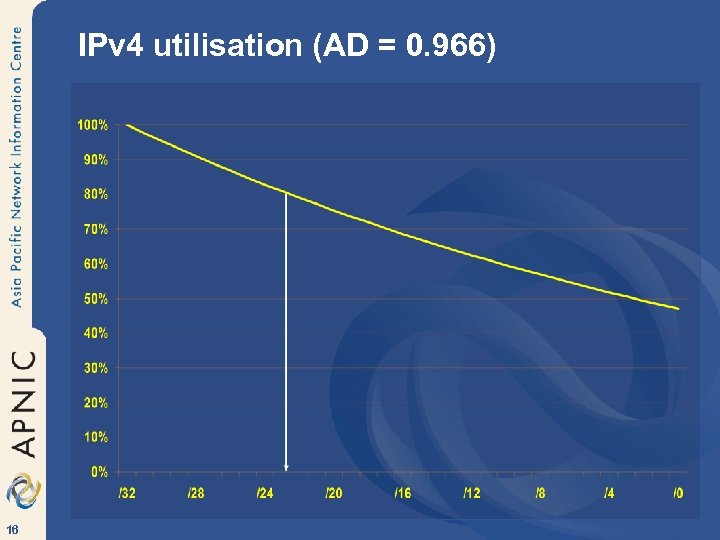
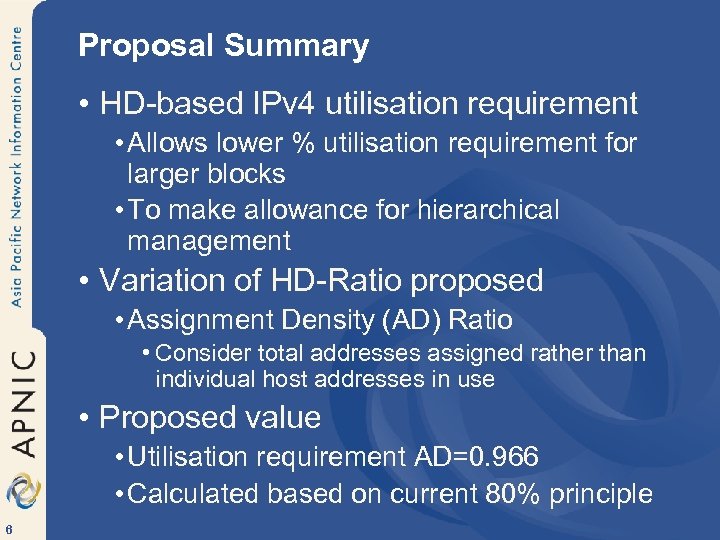 Proposal Summary • HD-based IPv 4 utilisation requirement • Allows lower % utilisation requirement for larger blocks • To make allowance for hierarchical management • Variation of HD-Ratio proposed • Assignment Density (AD) Ratio • Consider total addresses assigned rather than individual host addresses in use • Proposed value • Utilisation requirement AD=0. 966 • Calculated based on current 80% principle 6
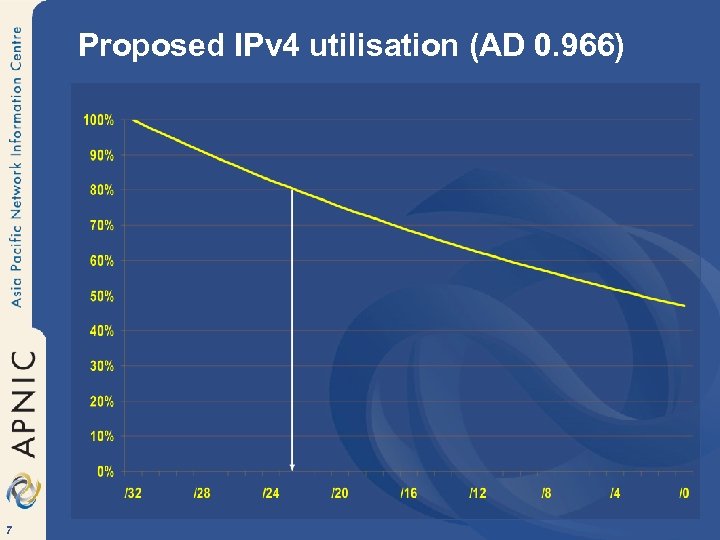 Proposed IPv 4 utilisation (AD 0. 966) 7
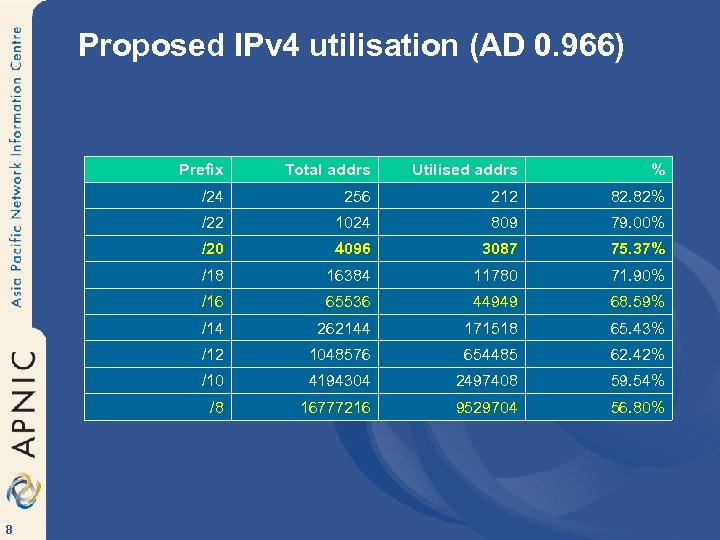 Proposed IPv 4 utilisation (AD 0. 966) Prefix Utilised addrs % /24 256 212 82. 82% /22 1024 809 79. 00% /20 4096 3087 75. 37% /18 16384 11780 71. 90% /16 65536 44949 68. 59% /14 262144 171518 65. 43% /12 1048576 654485 62. 42% /10 4194304 2497408 59. 54% /8 8 Total addrs 16777216 9529704 56. 80%
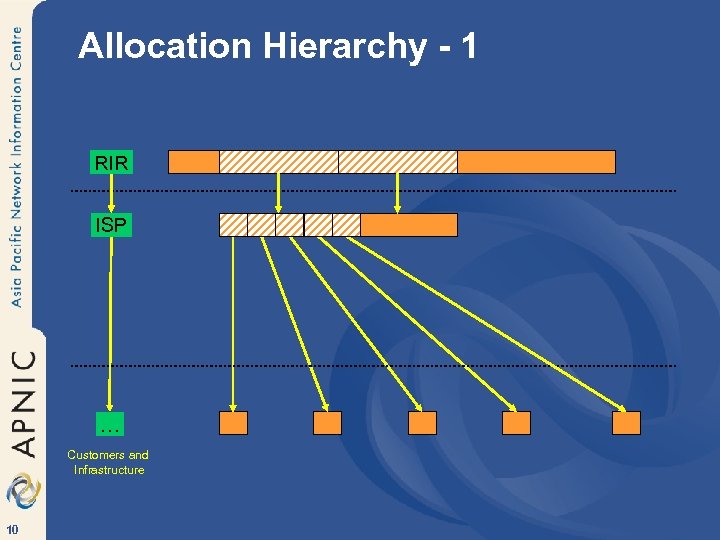
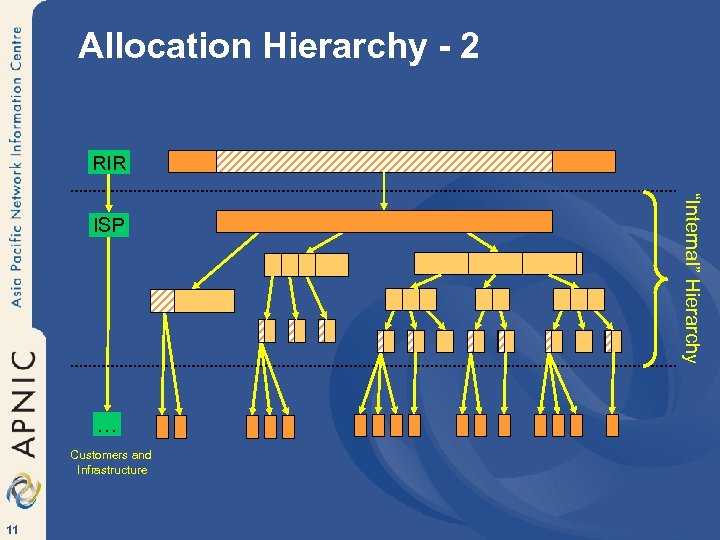
 Justification 9
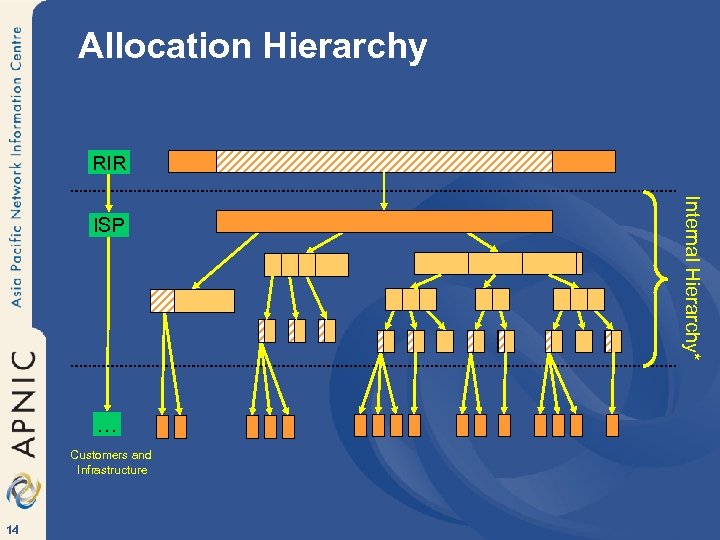
 Allocation Hierarchy - 1 RIR ISP … Customers and Infrastructure 10
 Allocation Hierarchy - 2 RIR … Customers and Infrastructure 11 “Internal” Hierarchy ISP
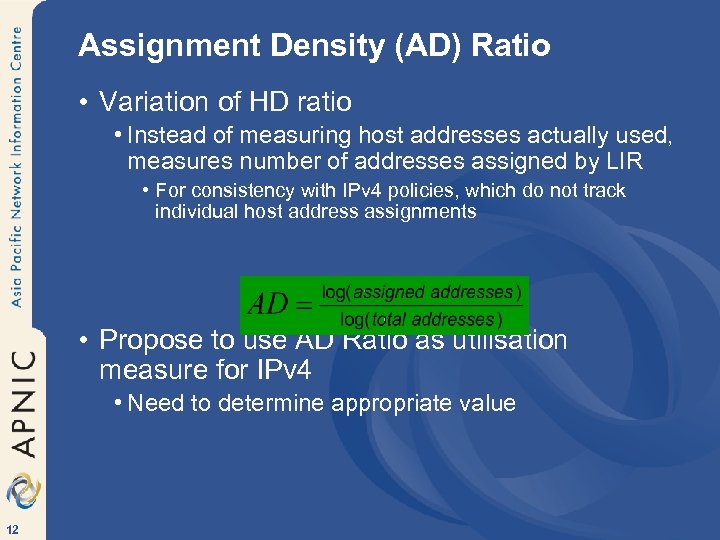 Assignment Density (AD) Ratio • Variation of HD ratio • Instead of measuring host addresses actually used, measures number of addresses assigned by LIR • For consistency with IPv 4 policies, which do not track individual host address assignments • Propose to use AD Ratio as utilisation measure for IPv 4 • Need to determine appropriate value 12
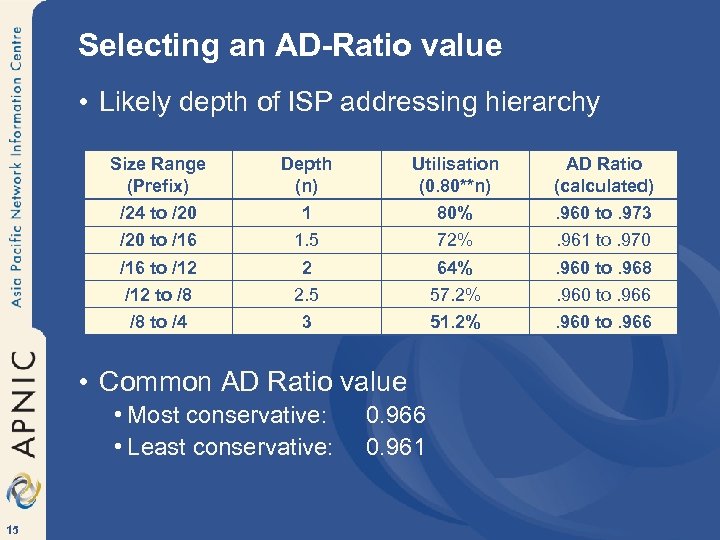
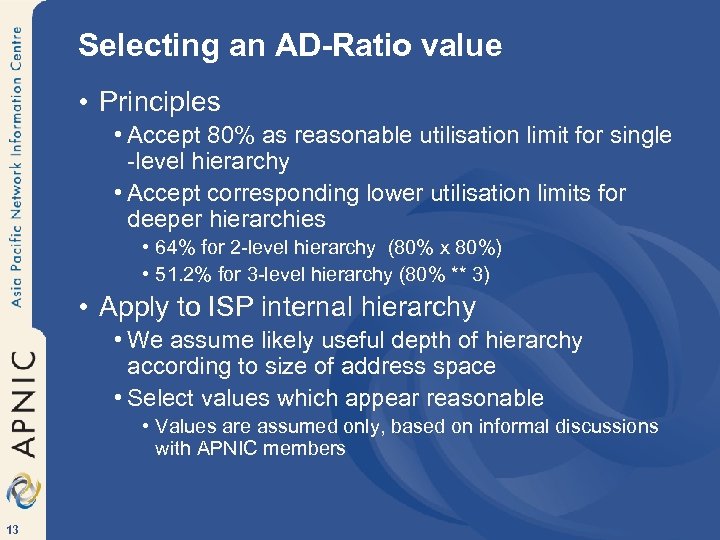 Selecting an AD-Ratio value • Principles • Accept 80% as reasonable utilisation limit for single -level hierarchy • Accept corresponding lower utilisation limits for deeper hierarchies • 64% for 2 -level hierarchy (80% x 80%) • 51. 2% for 3 -level hierarchy (80% ** 3) • Apply to ISP internal hierarchy • We assume likely useful depth of hierarchy according to size of address space • Select values which appear reasonable • Values are assumed only, based on informal discussions with APNIC members 13
 Allocation Hierarchy RIR … Customers and Infrastructure 14 Internal Hierarchy* ISP
 Selecting an AD-Ratio value • Likely depth of ISP addressing hierarchy Size Range (Prefix) Depth (n) Utilisation (0. 80**n) AD Ratio (calculated) /24 to /20 1 80% . 960 to. 973 /20 to /16 1. 5 72% . 961 to. 970 /16 to /12 2 64% . 960 to. 968 /12 to /8 2. 5 57. 2% . 960 to. 966 /8 to /4 3 51. 2% . 960 to. 966 • Common AD Ratio value • Most conservative: • Least conservative: 15 0. 966 0. 961
 IPv 4 utilisation (AD = 0. 966) 16
 Impact 17
 Impacts • Administrative • LIR needs to incorporate new method of calculating utilisation in procedures • LIR would need to register infrastructure assignments/sub-allocations • RIRs Secretariat update internal policies, procedures and documentation • Address space consumption • Initial impact • Ongoing impact 18
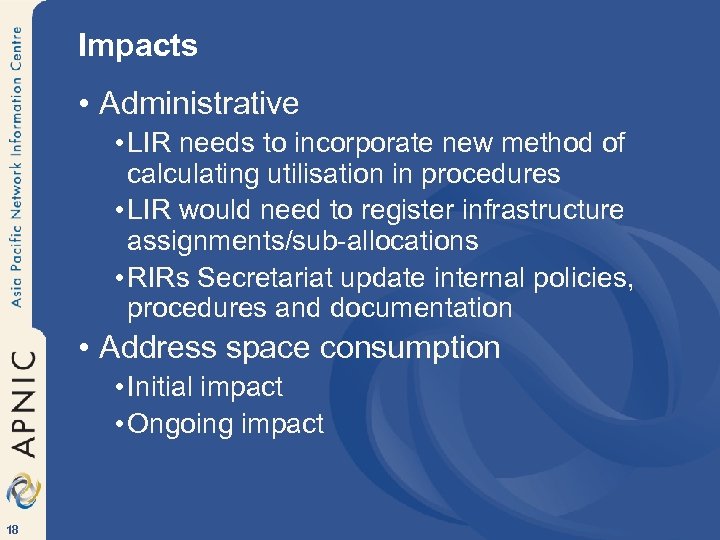
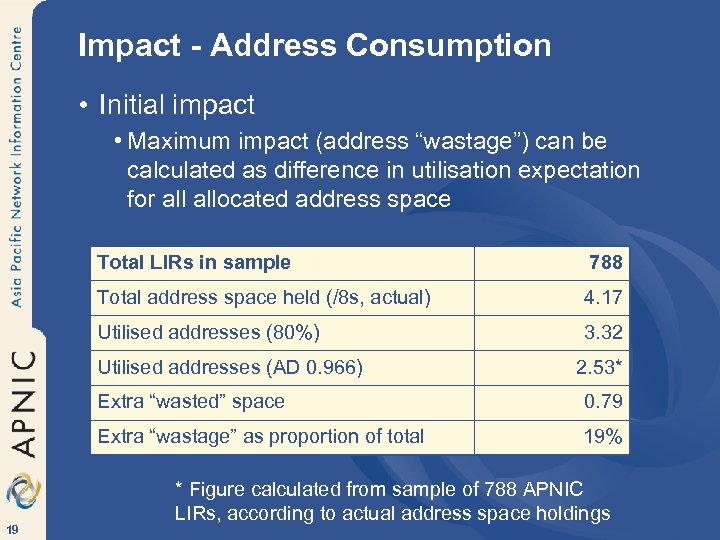 Impact - Address Consumption • Initial impact • Maximum impact (address “wastage”) can be calculated as difference in utilisation expectation for allocated address space Total LIRs in sample 788 Total address space held (/8 s, actual) 4. 17 Utilised addresses (80%) 3. 32 Utilised addresses (AD 0. 966) 2. 53* Extra “wasted” space Extra “wastage” as proportion of total 19 0. 79 19% * Figure calculated from sample of 788 APNIC LIRs, according to actual address space holdings
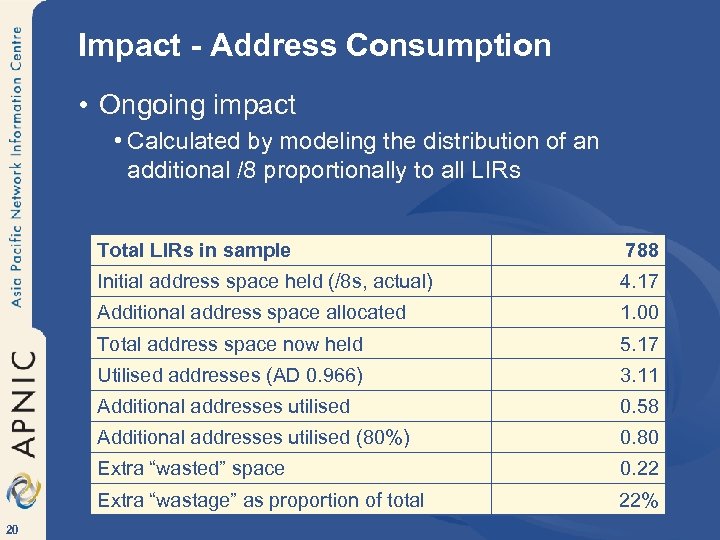 Impact - Address Consumption • Ongoing impact • Calculated by modeling the distribution of an additional /8 proportionally to all LIRs Total LIRs in sample Initial address space held (/8 s, actual) 4. 17 Additional address space allocated 1. 00 Total address space now held 5. 17 Utilised addresses (AD 0. 966) 3. 11 Additional addresses utilised 0. 58 Additional addresses utilised (80%) 0. 80 Extra “wasted” space 0. 22 Extra “wastage” as proportion of total 20 788 22%
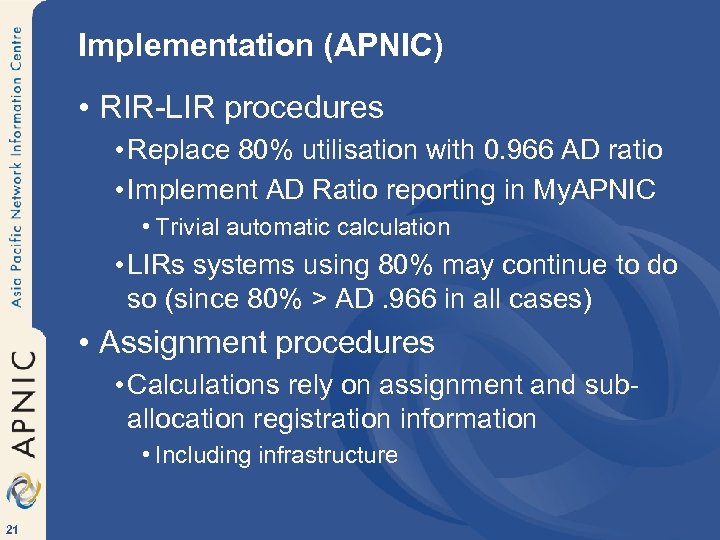 Implementation (APNIC) • RIR-LIR procedures • Replace 80% utilisation with 0. 966 AD ratio • Implement AD Ratio reporting in My. APNIC • Trivial automatic calculation • LIRs systems using 80% may continue to do so (since 80% > AD. 966 in all cases) • Assignment procedures • Calculations rely on assignment and suballocation registration information • Including infrastructure 21
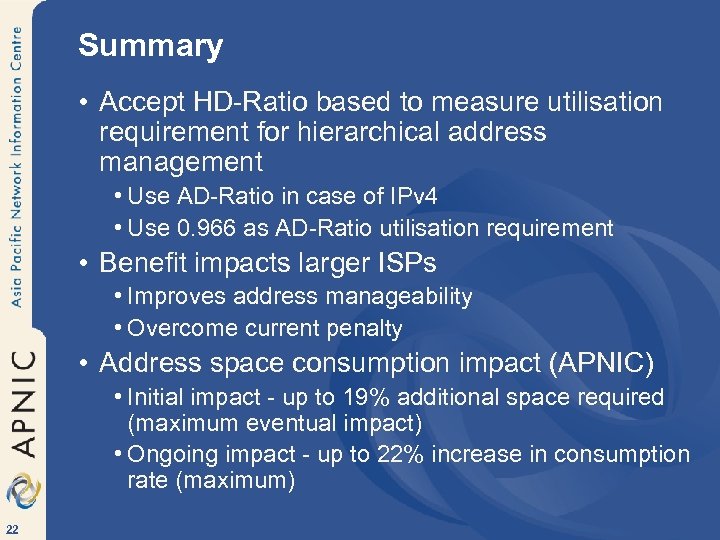 Summary • Accept HD-Ratio based to measure utilisation requirement for hierarchical address management • Use AD-Ratio in case of IPv 4 • Use 0. 966 as AD-Ratio utilisation requirement • Benefit impacts larger ISPs • Improves address manageability • Overcome current penalty • Address space consumption impact (APNIC) • Initial impact - up to 19% additional space required (maximum eventual impact) • Ongoing impact - up to 22% increase in consumption rate (maximum) 22
 Thanks Questions? 23