


 Скачать презентацию HC 70 A SAS 70 A Winter
78f4e0b745e583242e1cace335db8117.ppt
- Количество слайдов: 92
 HC 70 A & SAS 70 A Winter 2010 Genetic Engineering in Medicine, Agriculture, and Law Professors Bob Goldberg & John Harada Lecture 9 Science & The Constitution: Regulating Science & Genetic Engineering
 TEXT READING Chapters 12 & 13
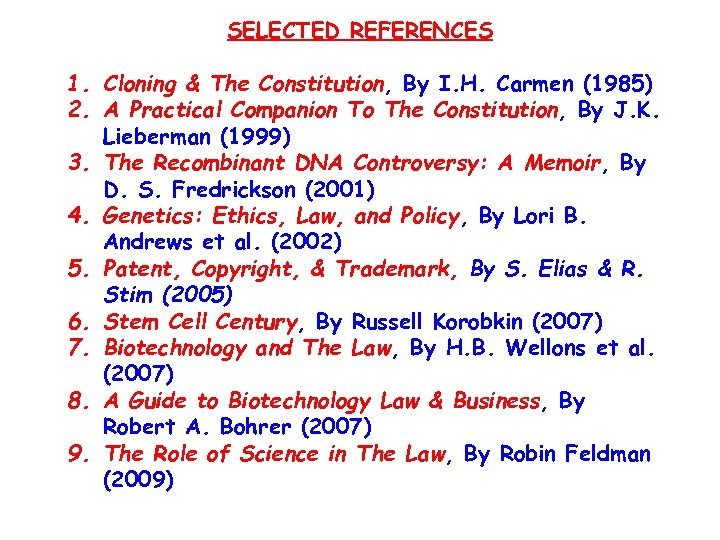 SELECTED REFERENCES 1. Cloning & The Constitution, By I. H. Carmen (1985) 2. A Practical Companion To The Constitution, By J. K. Lieberman (1999) 3. The Recombinant DNA Controversy: A Memoir, By D. S. Fredrickson (2001) 4. Genetics: Ethics, Law, and Policy, By Lori B. Andrews et al. (2002) 5. Patent, Copyright, & Trademark, By S. Elias & R. Stim (2005) 6. Stem Cell Century, By Russell Korobkin (2007) 7. Biotechnology and The Law, By H. B. Wellons et al. (2007) 8. A Guide to Biotechnology Law & Business, By Robert A. Bohrer (2007) 9. The Role of Science in The Law, By Robin Feldman (2009)
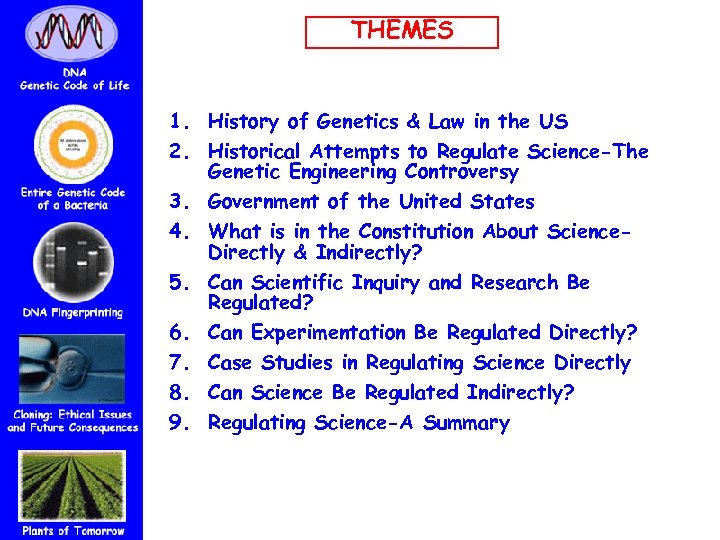 THEMES 1. History of Genetics & Law in the US 2. Historical Attempts to Regulate Science-The Genetic Engineering Controversy 3. Government of the United States 4. What is in the Constitution About Science. Directly & Indirectly? 5. Can Scientific Inquiry and Research Be Regulated? 6. Can Experimentation Be Regulated Directly? 7. Case Studies in Regulating Science Directly 8. Can Science Be Regulated Indirectly? 9. Regulating Science-A Summary
 “Laws and institutions must go hand in hand with the progress of the human mind. As that becomes more developed, more enlightened, as new discoveries are made, new truths disclosed, and manners and opinions change with the change of circumstances, institutions must advance also, and keep pace with the times. ” Thomas Jefferson, July 12, 1810
 What is the History of The Relationship Between Genetics & the Law in the United States?
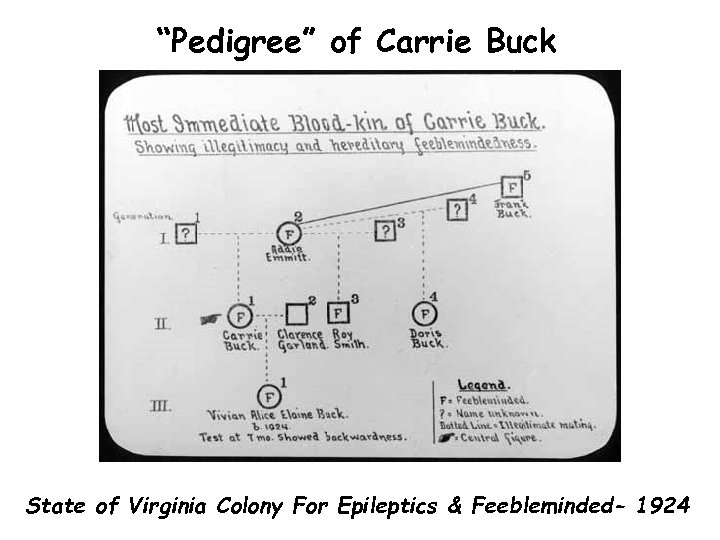 “Pedigree” of Carrie Buck State of Virginia Colony For Epileptics & Feebleminded- 1924
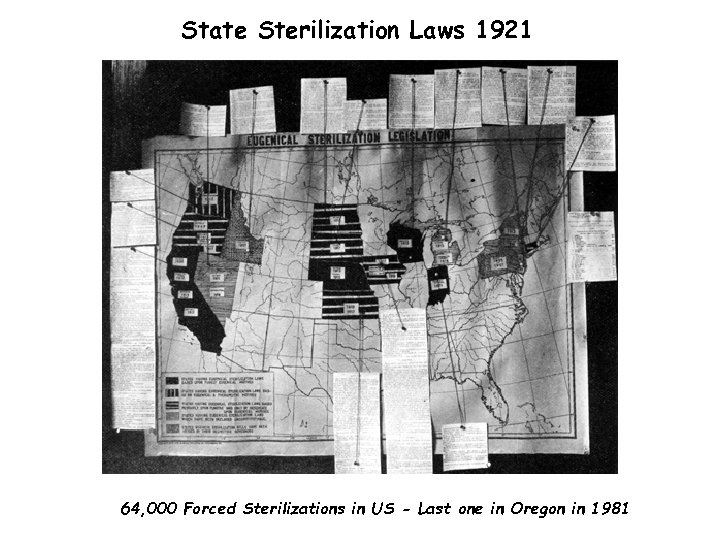 State Sterilization Laws 1921 64, 000 Forced Sterilizations in US - Last one in Oregon in 1981
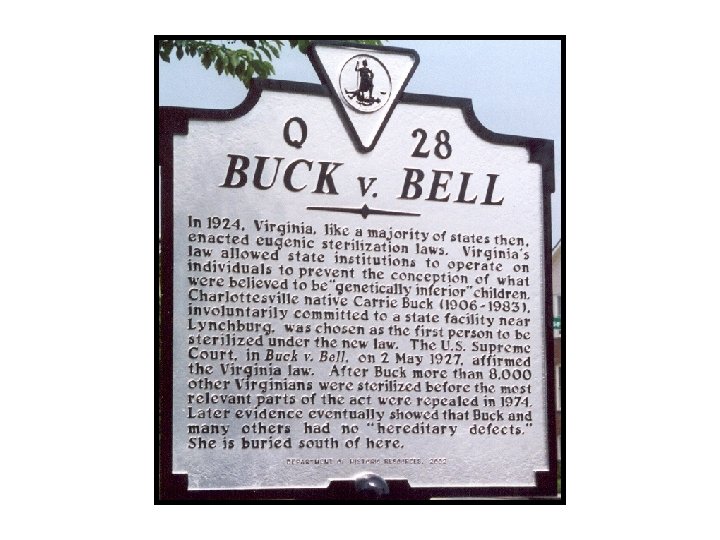
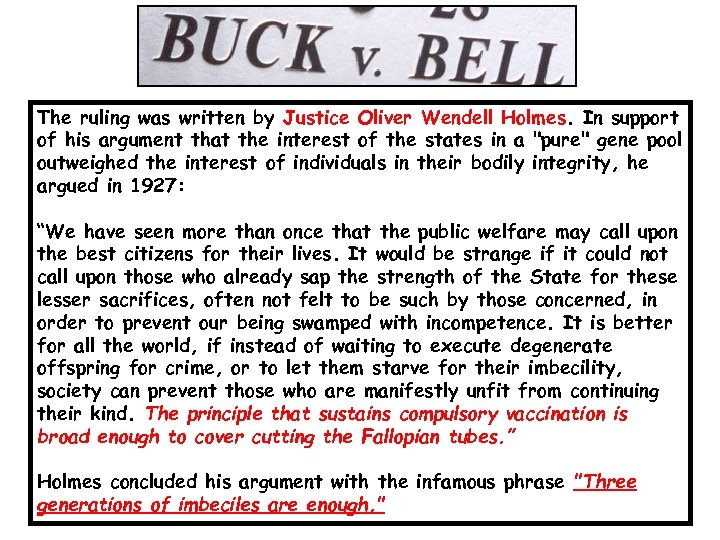 The ruling was written by Justice Oliver Wendell Holmes. In support of his argument that the interest of the states in a "pure" gene pool outweighed the interest of individuals in their bodily integrity, he argued in 1927: “We have seen more than once that the public welfare may call upon the best citizens for their lives. It would be strange if it could not call upon those who already sap the strength of the State for these lesser sacrifices, often not felt to be such by those concerned, in order to prevent our being swamped with incompetence. It is better for all the world, if instead of waiting to execute degenerate offspring for crime, or to let them starve for their imbecility, society can prevent those who are manifestly unfit from continuing their kind. The principle that sustains compulsory vaccination is broad enough to cover cutting the Fallopian tubes. ” Holmes concluded his argument with the infamous phrase "Three generations of imbeciles are enough. "
 The Law Impacts Science in Many Ways………
 Attempts to Regulate Science Are Not New! Trial of Galileo - 1633
 Lysenko and Genetics in Soviet Union 1930 -1950 s
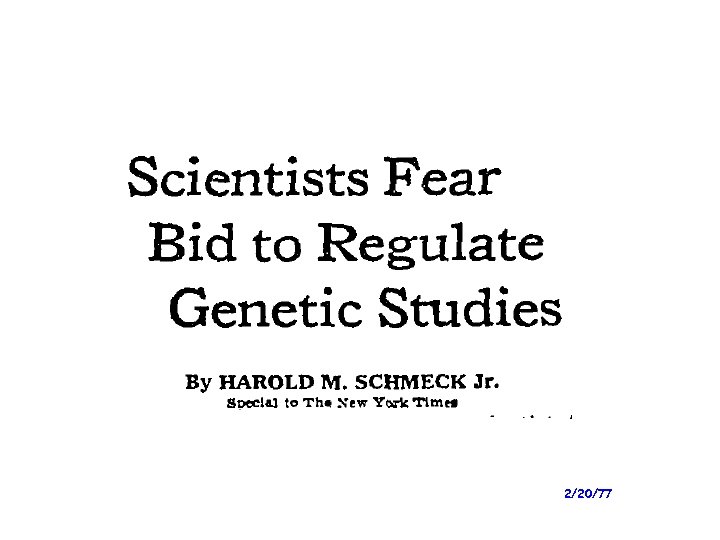
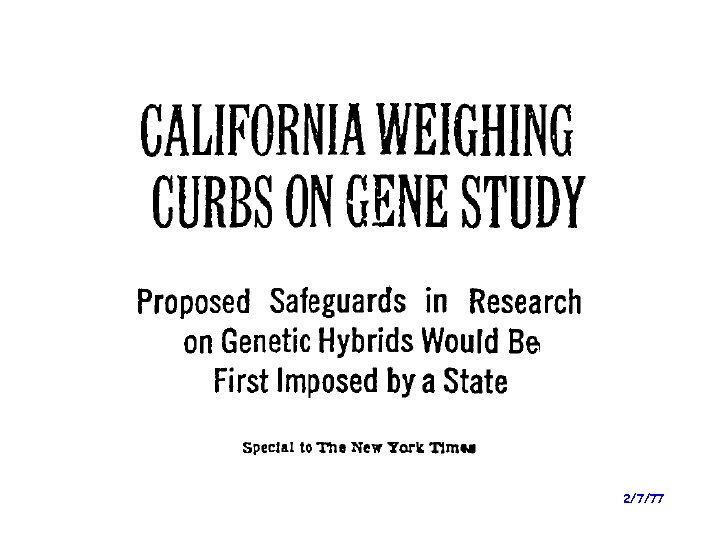
 Attempts to Regulate Genetic Engineering at the Local, State, & Federal Levels The Genetic Engineering Controversy: 1974 -1986
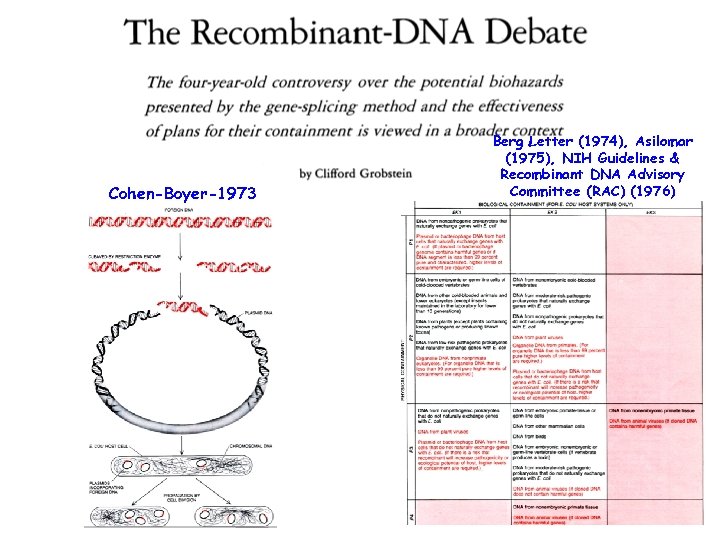 Cohen-Boyer-1973 Berg Letter (1974), Asilomar (1975), NIH Guidelines & Recombinant DNA Advisory Committee (RAC) (1976)
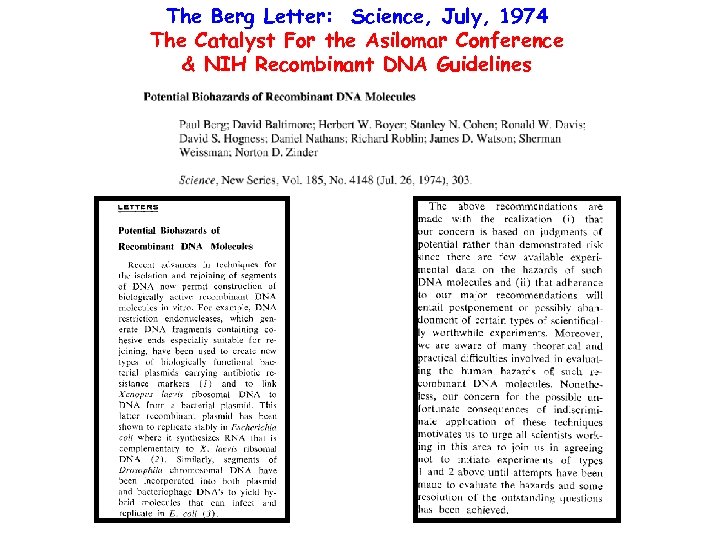 The Berg Letter: Science, July, 1974 The Catalyst For the Asilomar Conference & NIH Recombinant DNA Guidelines
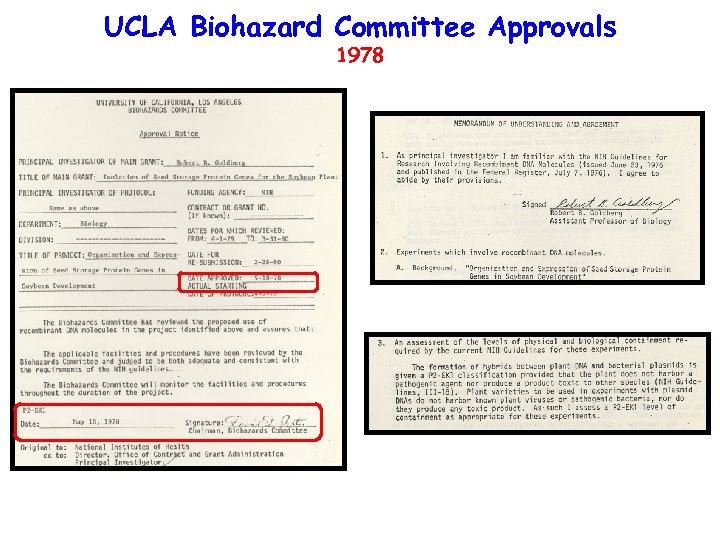
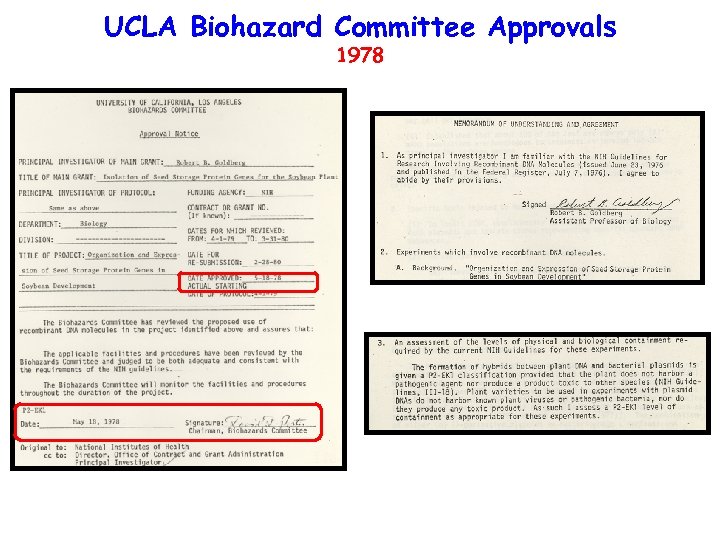 UCLA Biohazard Committee Approvals 1978
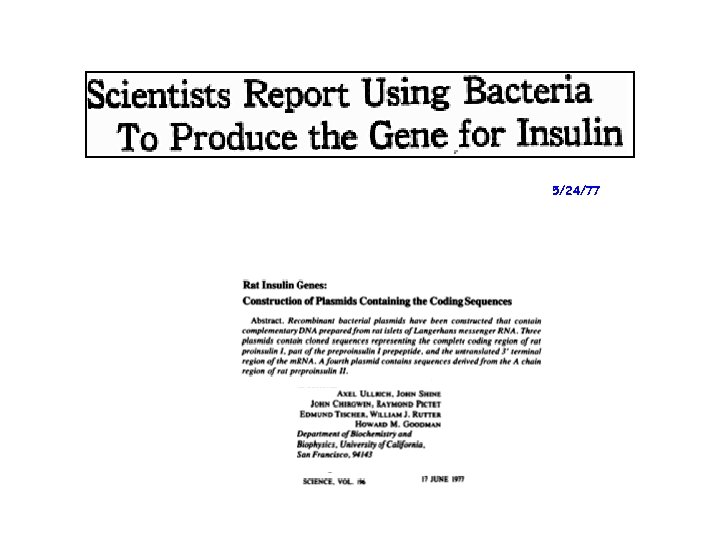 5/24/77
 2/20/77
 “Threats of diseases and monsters that could be brought about by recombinant DNA…. . gene splicing should be banned within the city limits. ” 1/17/77
 2/7/77
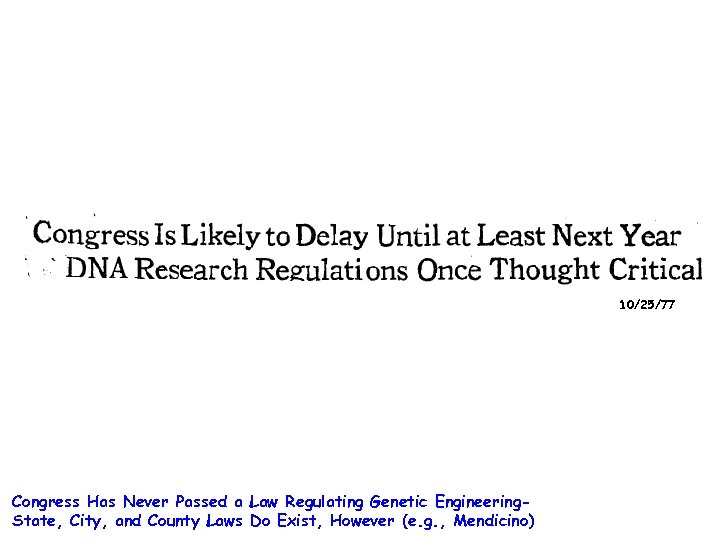 10/25/77 Congress Has Never Passed a Law Regulating Genetic Engineering. State, City, and County Laws Do Exist, However (e. g. , Mendicino)
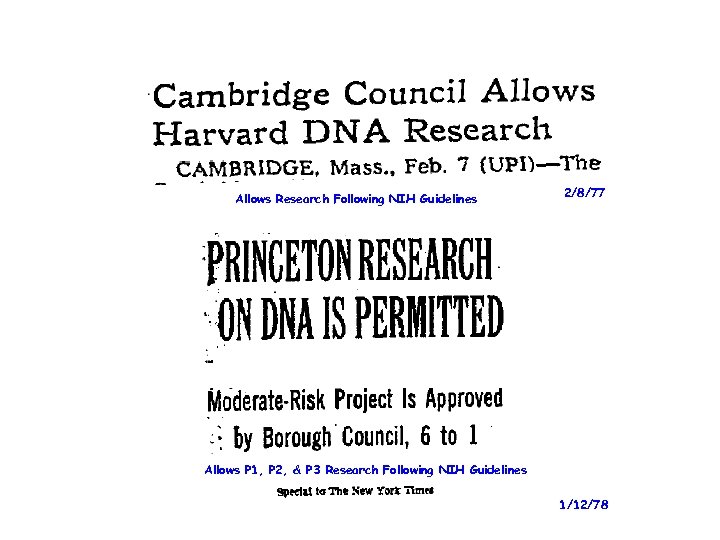 Allows Research Following NIH Guidelines 2/8/77 Allows P 1, P 2, & P 3 Research Following NIH Guidelines 1/12/78
 Should There Be Laws Regulating Science? a. Yes b. No
 What About Recent Attempts to Regulate Science at the Local, State, & Federal Levels?
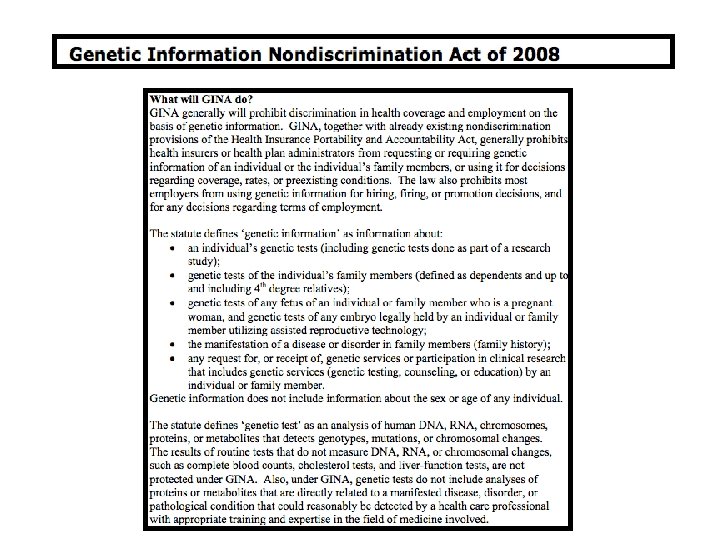
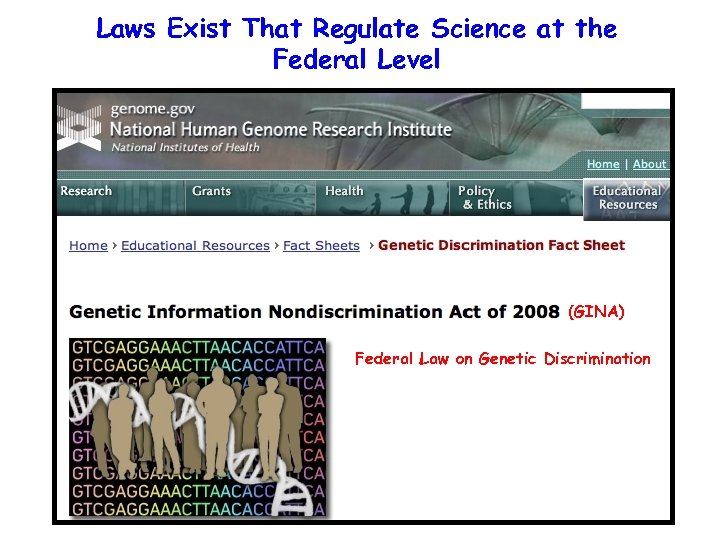 Laws Exist That Regulate Science at the Federal Level (GINA) Federal Law on Genetic Discrimination
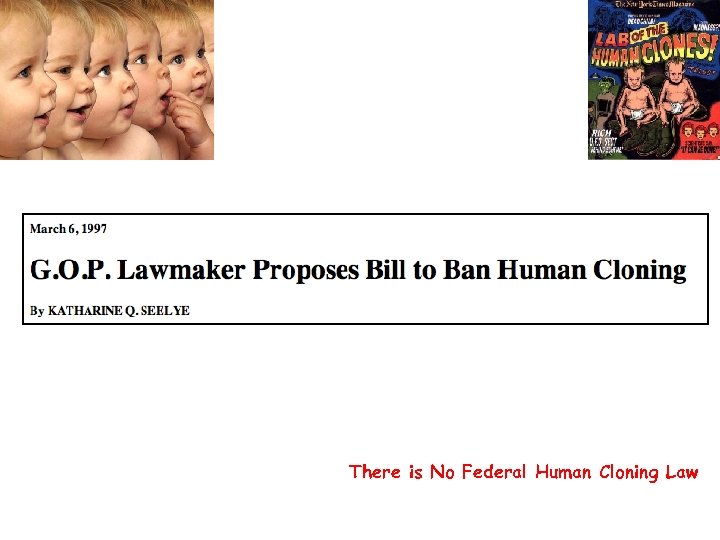 There is No Federal Human Cloning Law
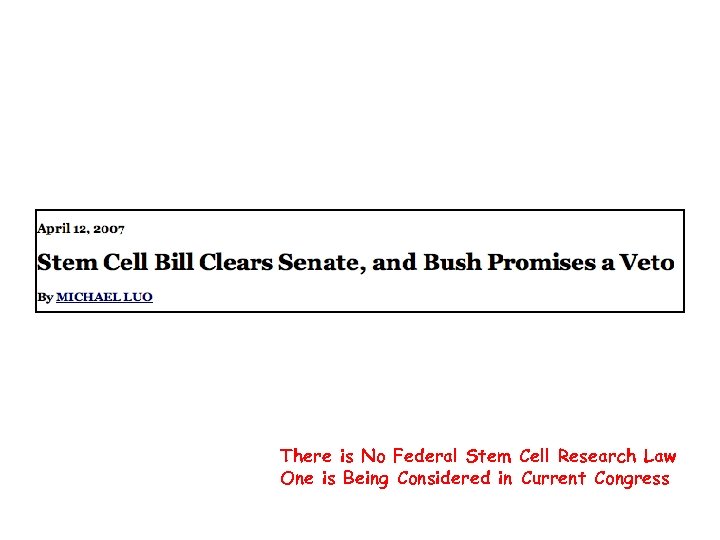 There is No Federal Stem Cell Research Law One is Being Considered in Current Congress
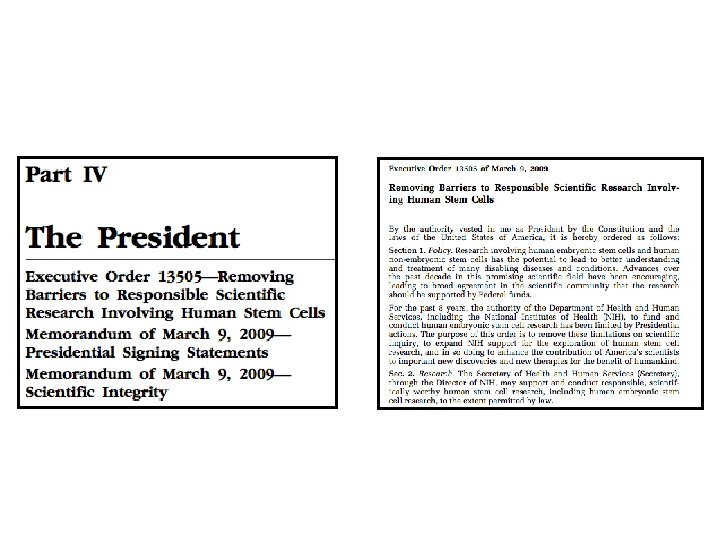
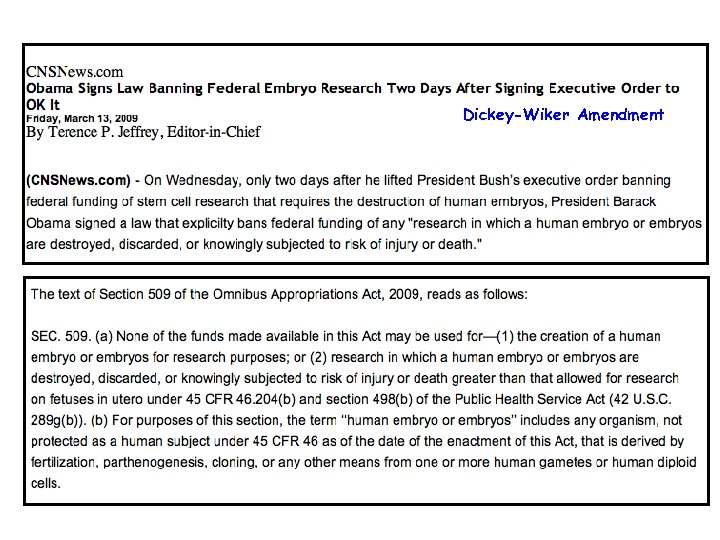 Dickey-Wiker Amendment
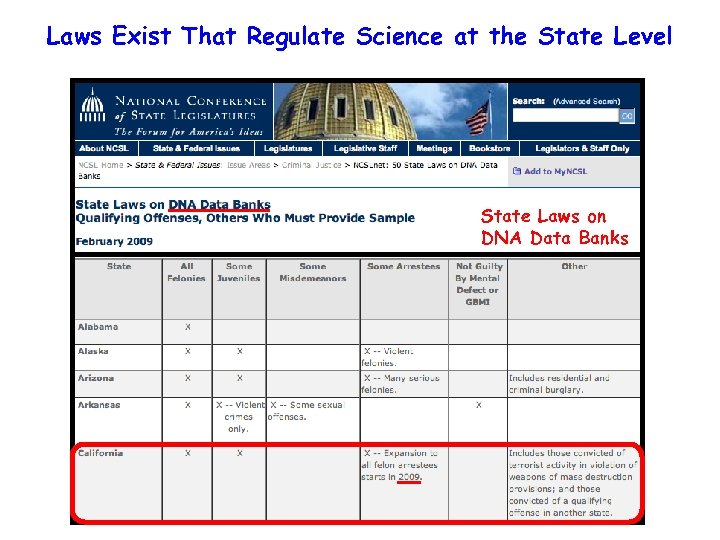 Laws Exist That Regulate Science at the State Level State Laws on DNA Data Banks
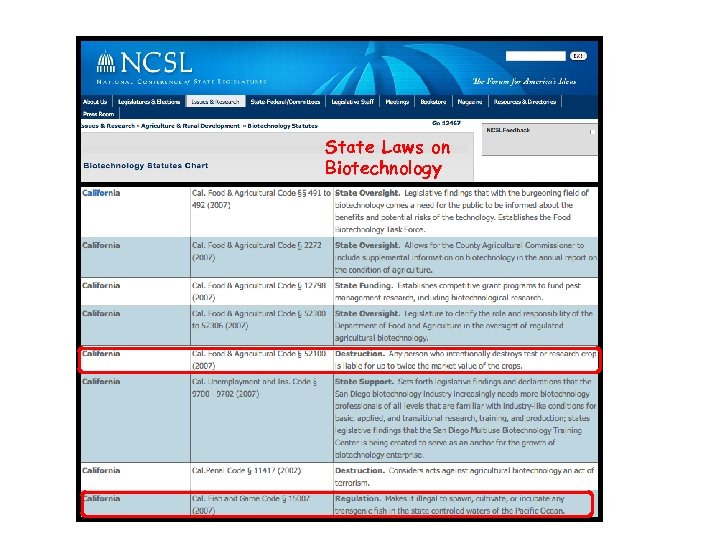 State Laws on Biotechnology
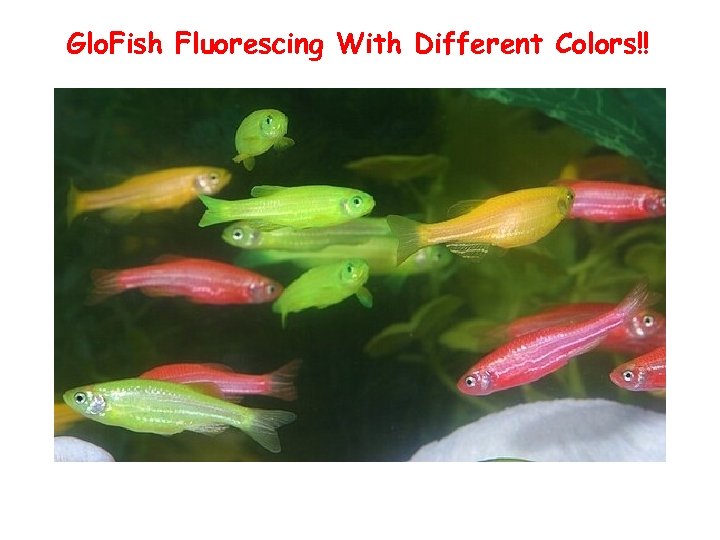 Glo. Fish Fluorescing With Different Colors!!
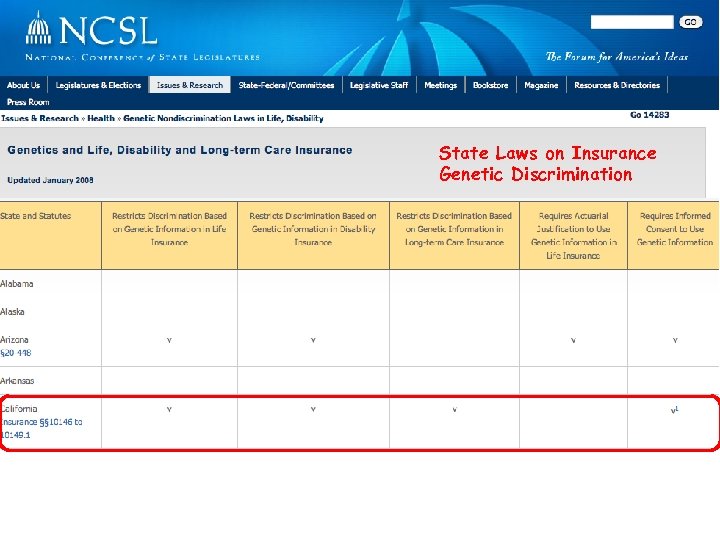 State Laws on Insurance Genetic Discrimination
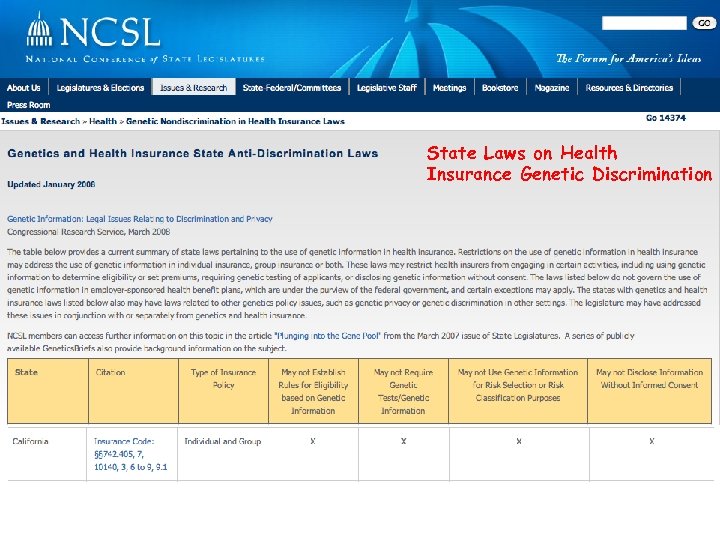 State Laws on Health Insurance Genetic Discrimination
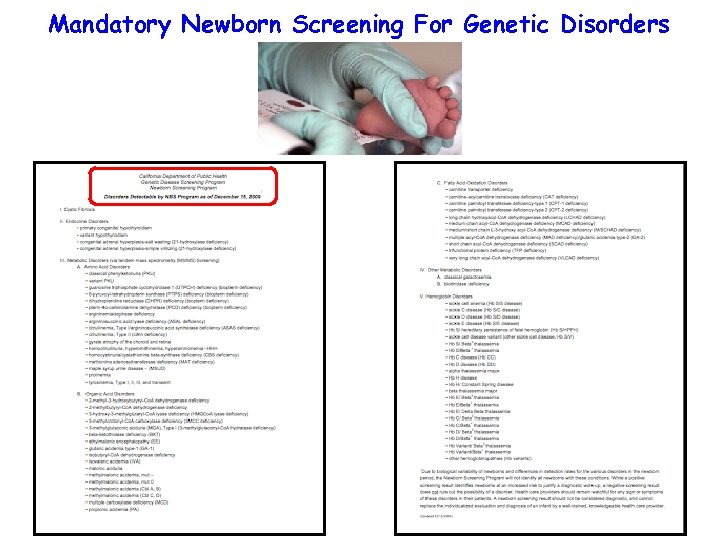 Mandatory Newborn Screening For Genetic Disorders
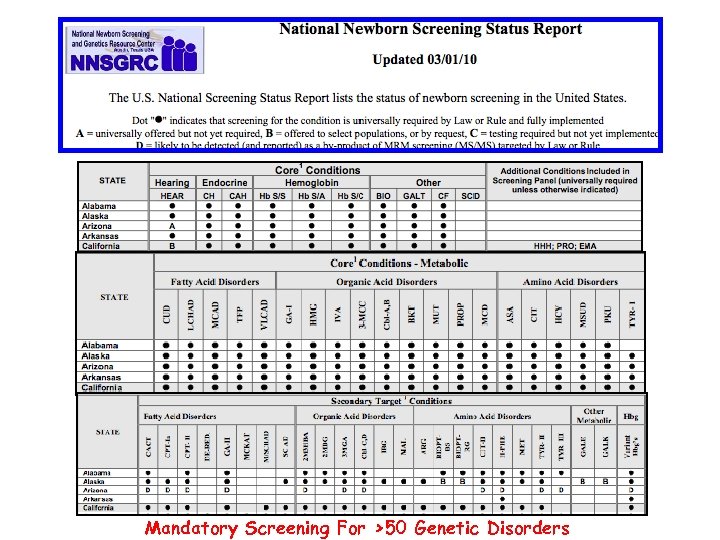 Mandatory Screening For >50 Genetic Disorders
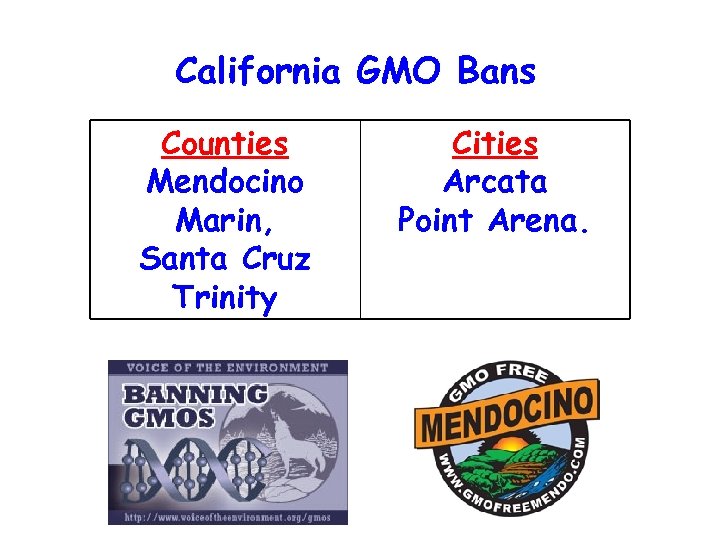 California GMO Bans Counties Mendocino Marin, Santa Cruz Trinity Cities Arcata Point Arena.
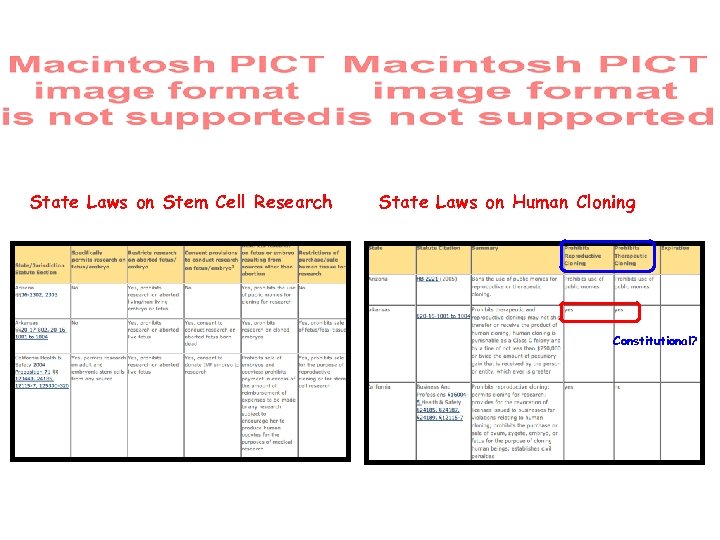 State Laws on Stem Cell Research State Laws on Human Cloning Constitutional?
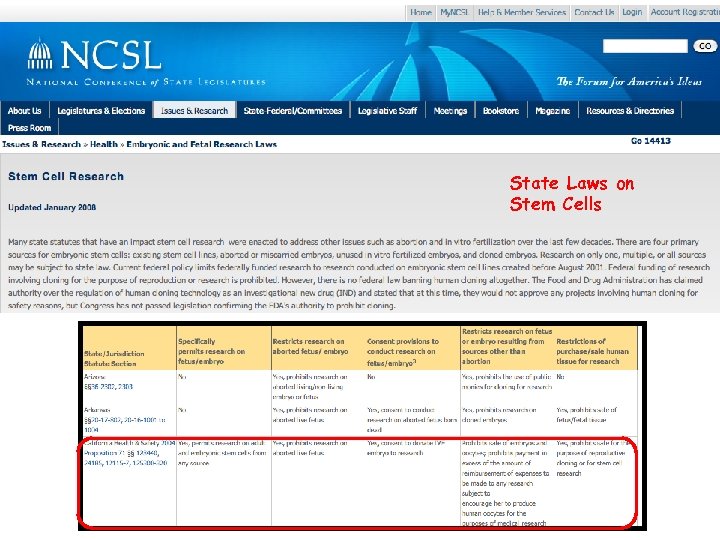 State Laws on Stem Cells
 What About Other Legal Issues Dealing With Genetic Engineering?
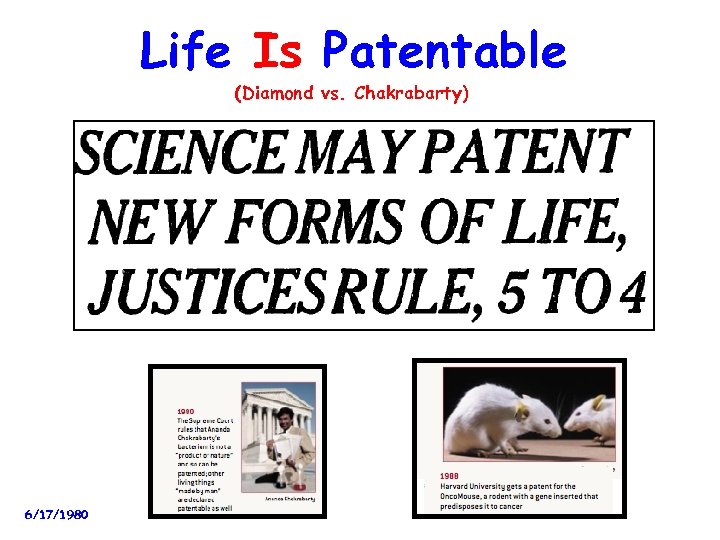 Life Is Patentable (Diamond vs. Chakrabarty) 6/17/1980
 Should Patenting a Genetically Engineered Mouse Be Permitted? a. Yes b. No
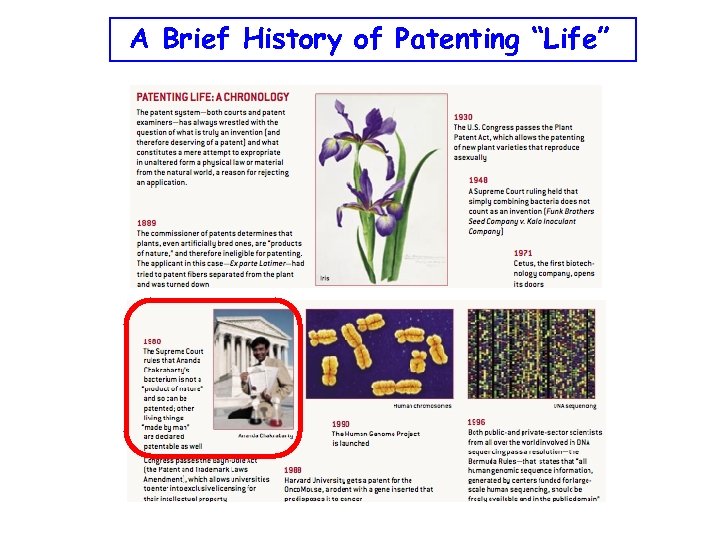 A Brief History of Patenting “Life”
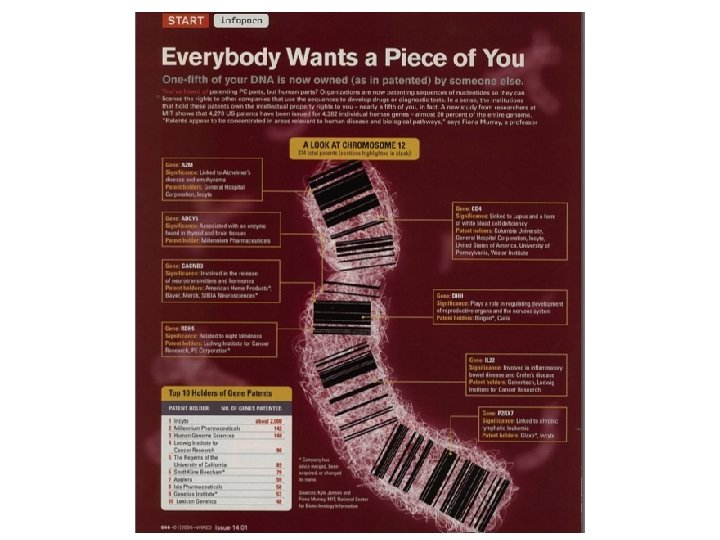
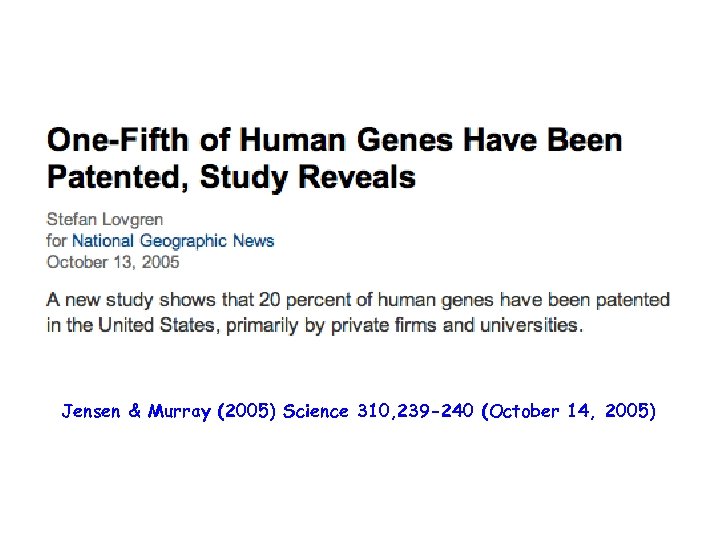 Jensen & Murray (2005) Science 310, 239 -240 (October 14, 2005)
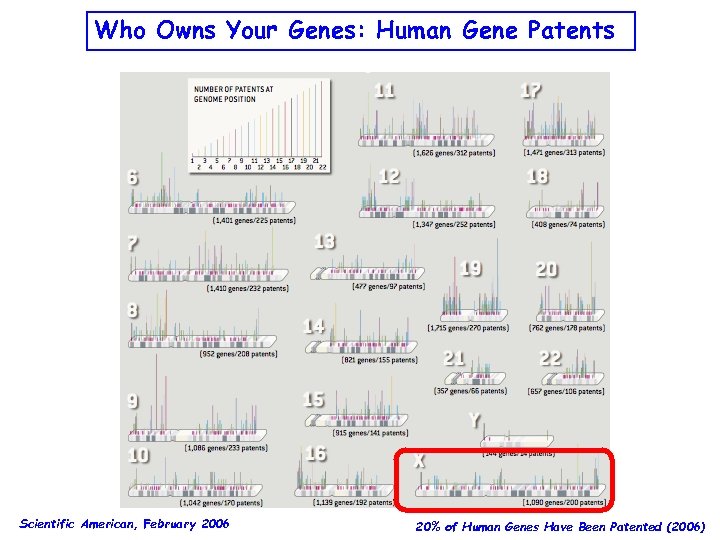 Who Owns Your Genes: Human Gene Patents Scientific American, February 2006 20% of Human Genes Have Been Patented (2006)
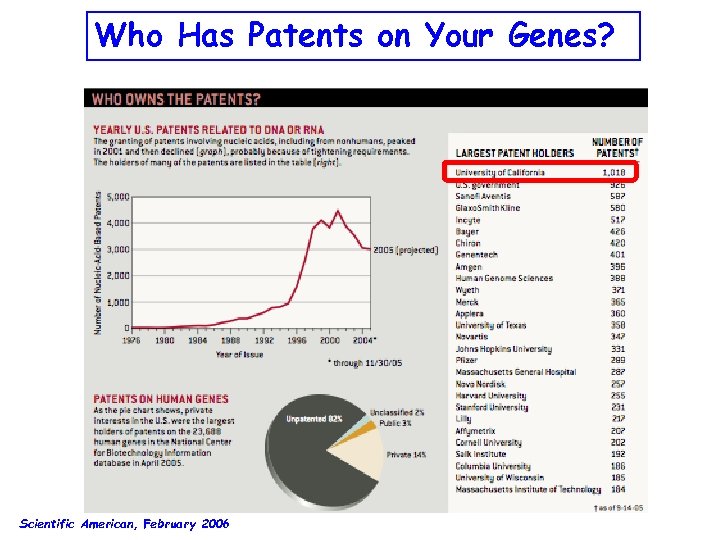 Who Has Patents on Your Genes? Scientific American, February 2006
 The Genes in Your Chromosomes Can Be Patented? a. Yes b. No
 Genes Can Be Patented? a. Yes b. No
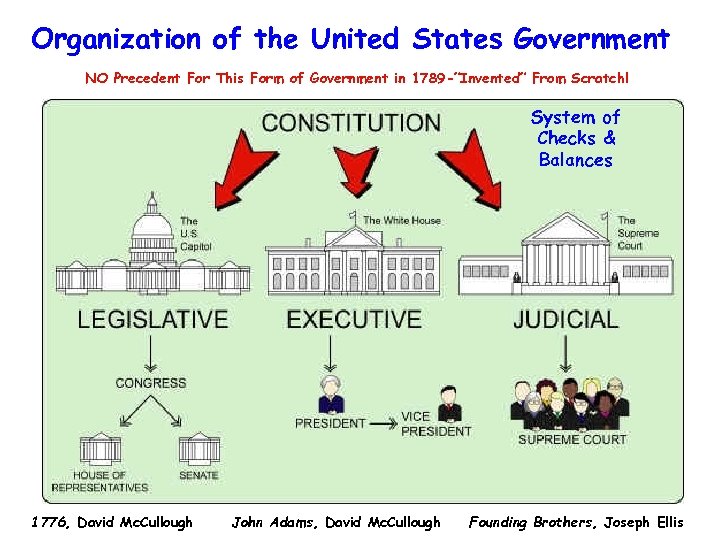 Organization of the United States Government NO Precedent For This Form of Government in 1789 -”Invented” From Scratch! System of Checks & Balances 1776, David Mc. Cullough John Adams, David Mc. Cullough Founding Brothers, Joseph Ellis
 Chief Justice John Marshall Activist Judges? Voting Rights, Civil Rights, Age & Gender Discrimination Affirmative Action, etc,
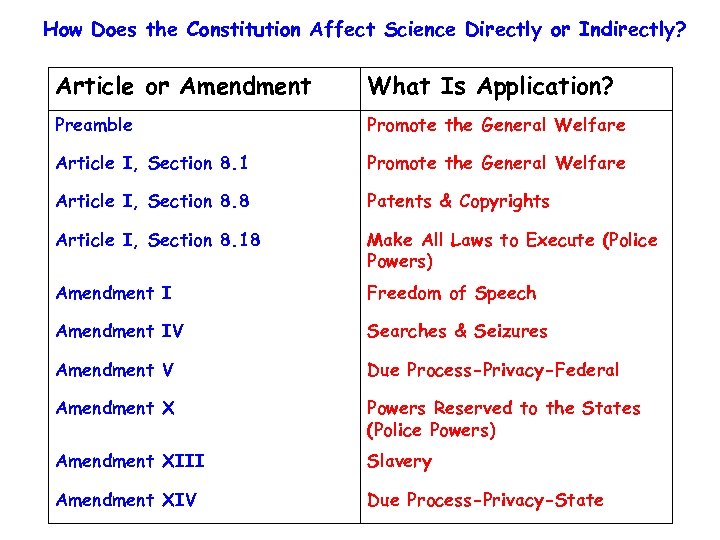 How Does the Constitution Affect Science Directly or Indirectly? Article or Amendment What Is Application? Preamble Promote the General Welfare Article I, Section 8. 1 Promote the General Welfare Article I, Section 8. 8 Patents & Copyrights Article I, Section 8. 18 Make All Laws to Execute (Police Powers) Amendment I Freedom of Speech Amendment IV Searches & Seizures Amendment V Due Process-Privacy-Federal Amendment X Powers Reserved to the States (Police Powers) Amendment XIII Slavery Amendment XIV Due Process-Privacy-State
 What Does the Constitution Say Directly About Science? Is the Word “Science” in the Constitution?
![1. Article I - Section 8. 8 The Congress shall have the Power: [8]](https://present5.com/presentation/78f4e0b745e583242e1cace335db8117/image-57.jpg "1. Article I - Section 8. 8 The Congress shall have the Power: [8]") 1. Article I - Section 8. 8 The Congress shall have the Power: [8] “To Promote the Progress of Science and the useful Arts, by securing for limited Times to Authors and Inventors the exclusive Right to their Writings and Discoveries” Keyword: Inventors not Science. Wanted to Promote Economic Development & Promote a National Economics Policy Grounded in Property Rights. That is, Entrepreneurship! PATENTS!!
1. Article I - Section 8. 8 The Congress shall have the Power: [8] “To Promote the Progress of Science and the useful Arts, by securing for limited Times to Authors and Inventors the exclusive Right to their Writings and Discoveries” Keyword: Inventors not Science. Wanted to Promote Economic Development & Promote a National Economics Policy Grounded in Property Rights. That is, Entrepreneurship! PATENTS!!
![2. Article I - Section 8. 18 The Congress shall have the Power: [18]](https://present5.com/presentation/78f4e0b745e583242e1cace335db8117/image-58.jpg "2. Article I - Section 8. 18 The Congress shall have the Power: [18]") 2. Article I - Section 8. 18 The Congress shall have the Power: [18] “To make all Laws which shall be necessary and proper for carrying into Execution the forgoing Powers, and all other Powers vested by this Constitution in the Government of the United States, or in any Department of Officer thereof. Key Concept: Congress Established Patent and Trademark Office (USPTO) and Intellectual Property laws
2. Article I - Section 8. 18 The Congress shall have the Power: [18] “To make all Laws which shall be necessary and proper for carrying into Execution the forgoing Powers, and all other Powers vested by this Constitution in the Government of the United States, or in any Department of Officer thereof. Key Concept: Congress Established Patent and Trademark Office (USPTO) and Intellectual Property laws
 How Does the Constitution Deal Indirectly With Science? Without Using the Word Science or Mentioning the Progress of Science and Discoveries?
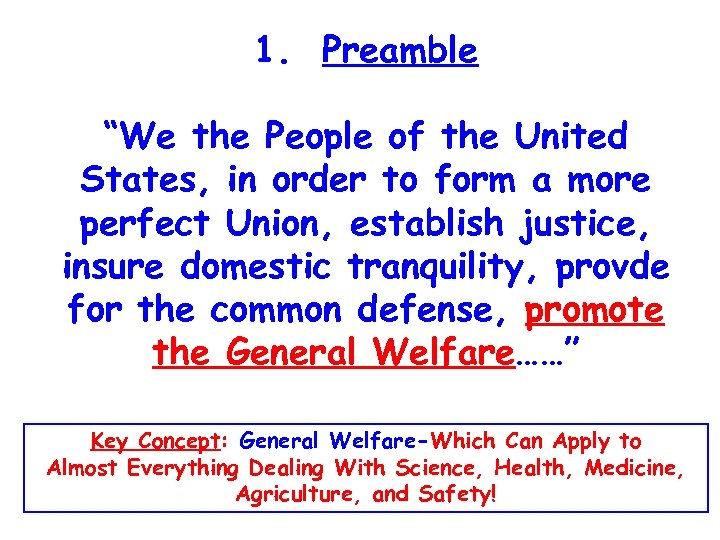 1. Preamble “We the People of the United States, in order to form a more perfect Union, establish justice, insure domestic tranquility, provde for the common defense, promote the General Welfare……” Key Concept: General Welfare-Which Can Apply to Almost Everything Dealing With Science, Health, Medicine, Agriculture, and Safety!
![2. Article I - Section 8. 1 The Congress shall have the Power: [1]](https://present5.com/presentation/78f4e0b745e583242e1cace335db8117/image-61.jpg "2. Article I - Section 8. 1 The Congress shall have the Power: [1]") 2. Article I - Section 8. 1 The Congress shall have the Power: [1] “To lay and collect Taxes, Duties, Imposts, and Excises, to pay the Debts and provide for the common Defense and general Welfare of the United States; but all Duties, Imposts, and Excises shall be uniform throughout the United States” Key Concept: Provide For the General Welfare-Which Can Apply to Almost Everything Dealing With Science, Health, Medicine, Agriculture, and Safety!
2. Article I - Section 8. 1 The Congress shall have the Power: [1] “To lay and collect Taxes, Duties, Imposts, and Excises, to pay the Debts and provide for the common Defense and general Welfare of the United States; but all Duties, Imposts, and Excises shall be uniform throughout the United States” Key Concept: Provide For the General Welfare-Which Can Apply to Almost Everything Dealing With Science, Health, Medicine, Agriculture, and Safety!
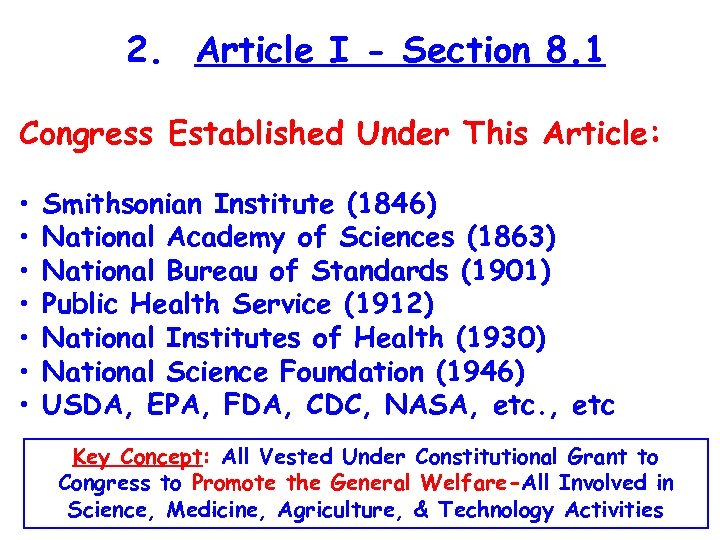 2. Article I - Section 8. 1 Congress Established Under This Article: • • Smithsonian Institute (1846) National Academy of Sciences (1863) National Bureau of Standards (1901) Public Health Service (1912) National Institutes of Health (1930) National Science Foundation (1946) USDA, EPA, FDA, CDC, NASA, etc Key Concept: All Vested Under Constitutional Grant to Congress to Promote the General Welfare-All Involved in Science, Medicine, Agriculture, & Technology Activities
 3. Amendment I Freedom of Speech and Expression: “Congress shall make no Law respecting an establishment of religion, prohibiting the free exercise thereof; or abridging freedom of speech, or of the press, of the right of the people peacefully to assemble, and to petition the Government for a redress of grievances. ” Key Concepts: Freedom to Think About Science, Publish, and Discuss Science in Meetings and Laboratories
 4. Amendment IV Searches and Seizures: “The right of the people to secure their persons, houses, papers, and effects, against unreasonable searches and seizures, shall not be violated, and no warrants shall issue, but upon probable cause, supported by Oath or affirmation, and particularly describing the place to be searched and the persons or things to be seized” Key Concepts: Right Against Unreasonable Searches to Your Own “Body Parts, ” Science Writings, and Experimental Materials
 4. Amendment V Due Process: “No Person shall be held to answer for a capital, or otherwise infamous crime, unless on presentment or indictment of a Grand jury, except in cases arising in the land or navel forces, or in the Militia, when in actual service in time of War or public danger; nor shall any person be a subject for the same offense to be twice put in jeopardy of life and limb, nor shall be compelled in any criminal case to be a witness against himself. Nor be deprived of Life, liberty, or property, without due process of law; nor shall any property be taken for public use without just compensation. ” Key Concepts: Right to Life & Liberty=Privacy=Reproductive Rights Medical Treatment (Refusal/Acceptance)
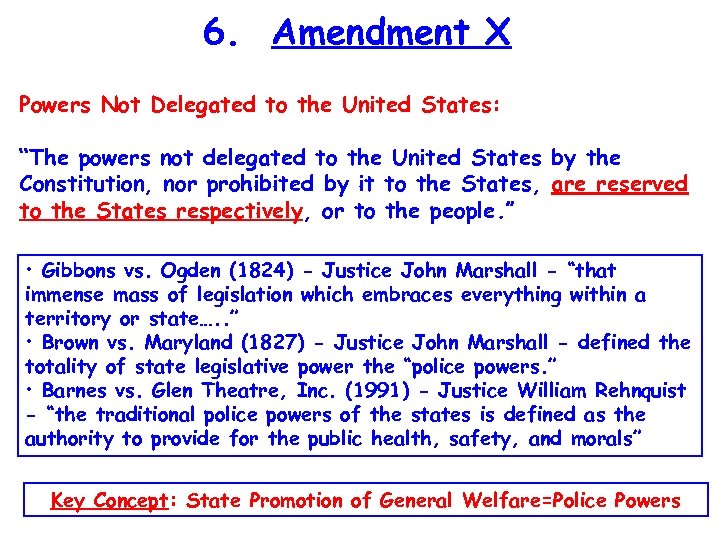 6. Amendment X Powers Not Delegated to the United States: “The powers not delegated to the United States by the Constitution, nor prohibited by it to the States, are reserved to the States respectively, or to the people. ” • Gibbons vs. Ogden (1824) - Justice John Marshall - “that immense mass of legislation which embraces everything within a territory or state…. . ” • Brown vs. Maryland (1827) - Justice John Marshall - defined the totality of state legislative power the “police powers. ” • Barnes vs. Glen Theatre, Inc. (1991) - Justice William Rehnquist - “the traditional police powers of the states is defined as the authority to provide for the public health, safety, and morals” Key Concept: State Promotion of General Welfare=Police Powers
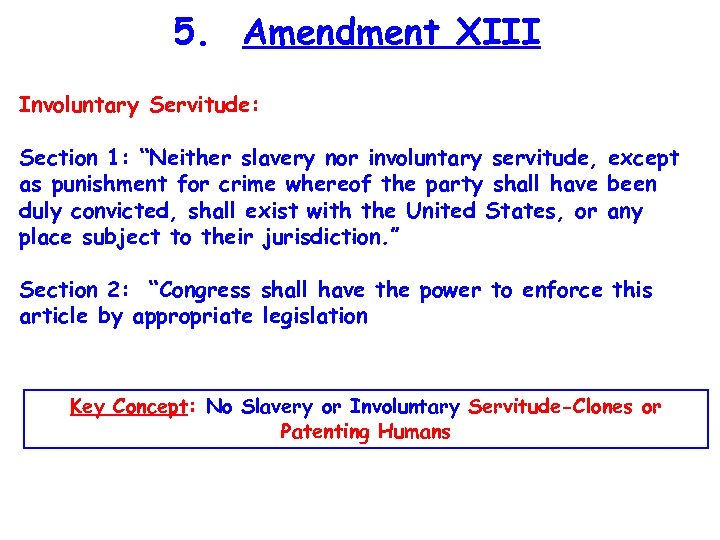 5. Amendment XIII Involuntary Servitude: Section 1: “Neither slavery nor involuntary servitude, except as punishment for crime whereof the party shall have been duly convicted, shall exist with the United States, or any place subject to their jurisdiction. ” Section 2: “Congress shall have the power to enforce this article by appropriate legislation Key Concept: No Slavery or Involuntary Servitude-Clones or Patenting Humans
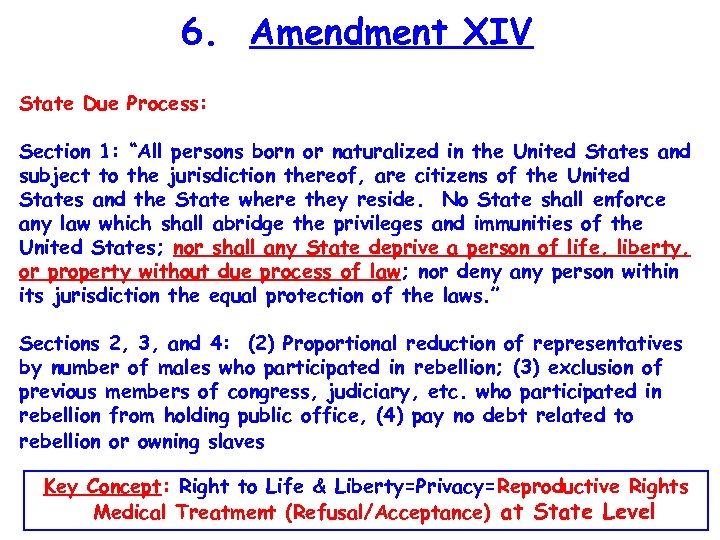 6. Amendment XIV State Due Process: Section 1: “All persons born or naturalized in the United States and subject to the jurisdiction thereof, are citizens of the United States and the State where they reside. No State shall enforce any law which shall abridge the privileges and immunities of the United States; nor shall any State deprive a person of life, liberty, or property without due process of law; nor deny any person within its jurisdiction the equal protection of the laws. ” Sections 2, 3, and 4: (2) Proportional reduction of representatives by number of males who participated in rebellion; (3) exclusion of previous members of congress, judiciary, etc. who participated in rebellion from holding public office, (4) pay no debt related to rebellion or owning slaves Key Concept: Right to Life & Liberty=Privacy=Reproductive Rights Medical Treatment (Refusal/Acceptance) at State Level
 How Do These Articles and Amendments Apply to Science?
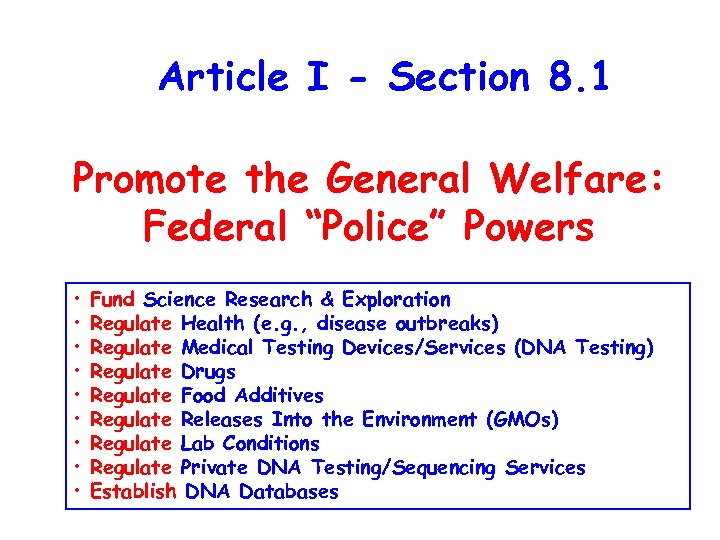 Article I - Section 8. 1 Promote the General Welfare: Federal “Police” Powers • • • Fund Science Research & Exploration Regulate Health (e. g. , disease outbreaks) Regulate Medical Testing Devices/Services (DNA Testing) Regulate Drugs Regulate Food Additives Regulate Releases Into the Environment (GMOs) Regulate Lab Conditions Regulate Private DNA Testing/Sequencing Services Establish DNA Databases
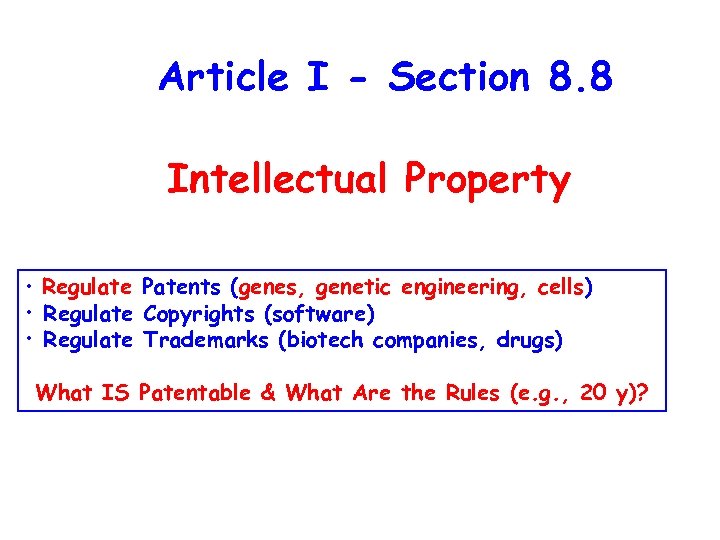 Article I - Section 8. 8 Intellectual Property • Regulate Patents (genes, genetic engineering, cells) • Regulate Copyrights (software) • Regulate Trademarks (biotech companies, drugs) What IS Patentable & What Are the Rules (e. g. , 20 y)?
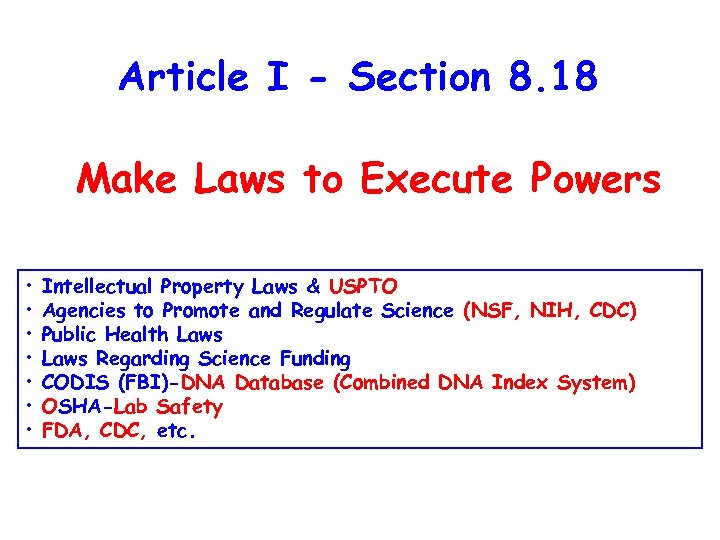 Article I - Section 8. 18 Make Laws to Execute Powers • • Intellectual Property Laws & USPTO Agencies to Promote and Regulate Science (NSF, NIH, CDC) Public Health Laws Regarding Science Funding CODIS (FBI)-DNA Database (Combined DNA Index System) OSHA-Lab Safety FDA, CDC, etc.
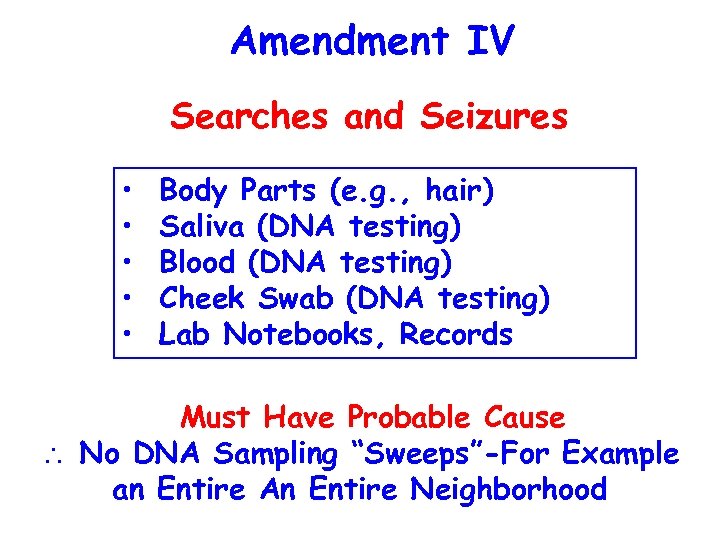 Amendment IV Searches and Seizures • • • Body Parts (e. g. , hair) Saliva (DNA testing) Blood (DNA testing) Cheek Swab (DNA testing) Lab Notebooks, Records Must Have Probable Cause No DNA Sampling “Sweeps”-For Example an Entire An Entire Neighborhood
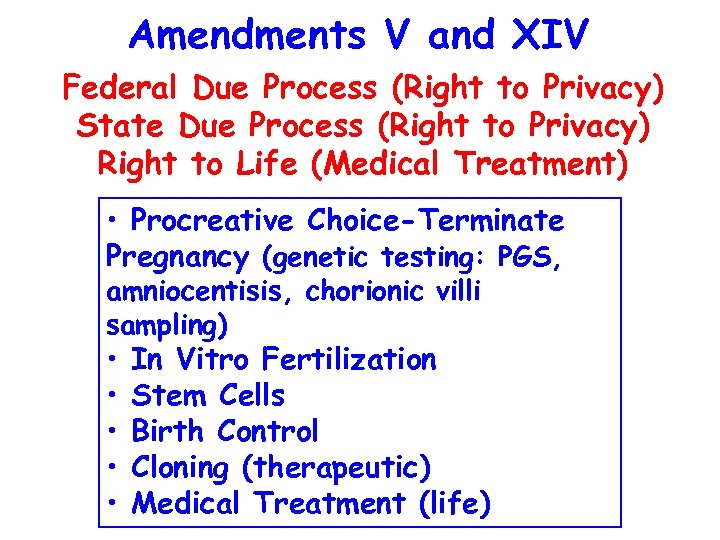 Amendments V and XIV Federal Due Process (Right to Privacy) State Due Process (Right to Privacy) Right to Life (Medical Treatment) • Procreative Choice-Terminate Pregnancy (genetic testing: PGS, amniocentisis, chorionic villi sampling) • • • In Vitro Fertilization Stem Cells Birth Control Cloning (therapeutic) Medical Treatment (life)
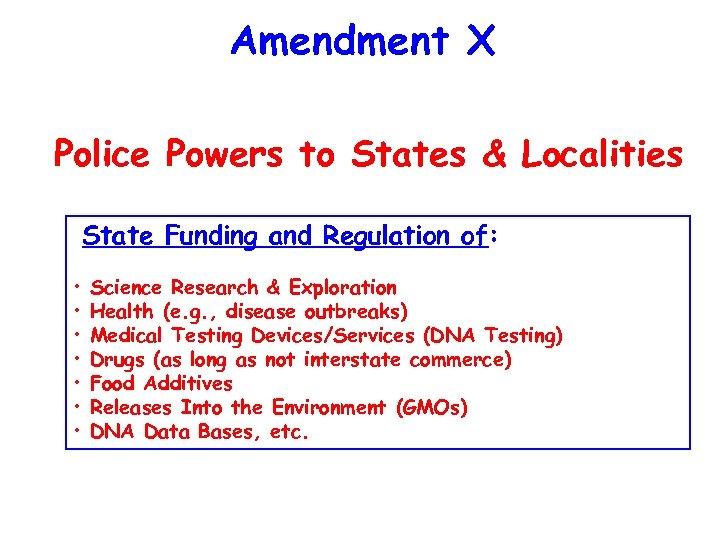 Amendment X Police Powers to States & Localities State Funding and Regulation of: • • Science Research & Exploration Health (e. g. , disease outbreaks) Medical Testing Devices/Services (DNA Testing) Drugs (as long as not interstate commerce) Food Additives Releases Into the Environment (GMOs) DNA Data Bases, etc.
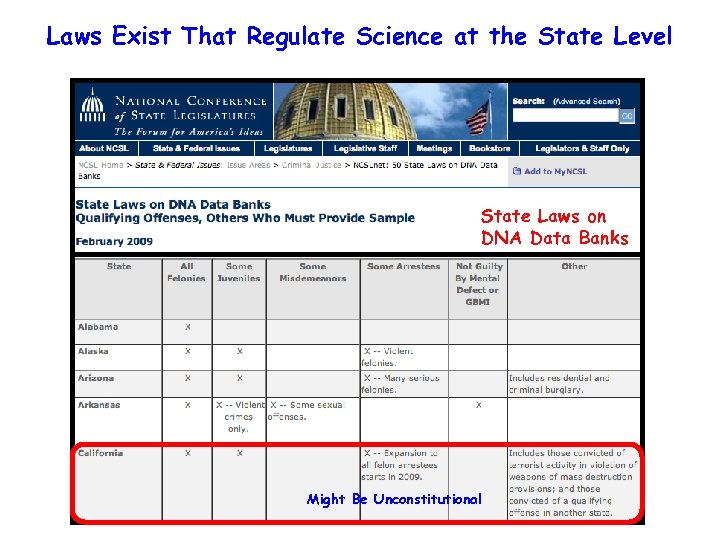 Laws Exist That Regulate Science at the State Level State Laws on DNA Data Banks Might Be Unconstitutional
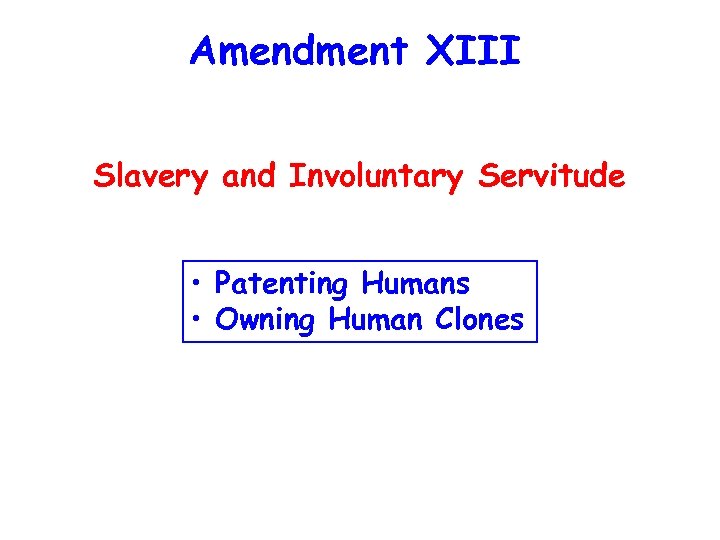 Amendment XIII Slavery and Involuntary Servitude • Patenting Humans • Owning Human Clones
 Can Scientific Inquiry and Research Be Regulated?
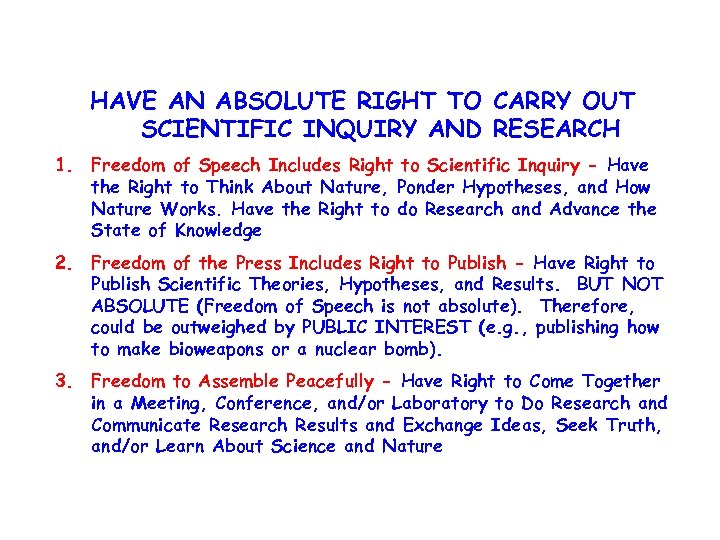 HAVE AN ABSOLUTE RIGHT TO CARRY OUT SCIENTIFIC INQUIRY AND RESEARCH 1. Freedom of Speech Includes Right to Scientific Inquiry - Have the Right to Think About Nature, Ponder Hypotheses, and How Nature Works. Have the Right to do Research and Advance the State of Knowledge 2. Freedom of the Press Includes Right to Publish - Have Right to Publish Scientific Theories, Hypotheses, and Results. BUT NOT ABSOLUTE (Freedom of Speech is not absolute). Therefore, could be outweighed by PUBLIC INTEREST (e. g. , publishing how to make bioweapons or a nuclear bomb). 3. Freedom to Assemble Peacefully - Have Right to Come Together in a Meeting, Conference, and/or Laboratory to Do Research and Communicate Research Results and Exchange Ideas, Seek Truth, and/or Learn About Science and Nature
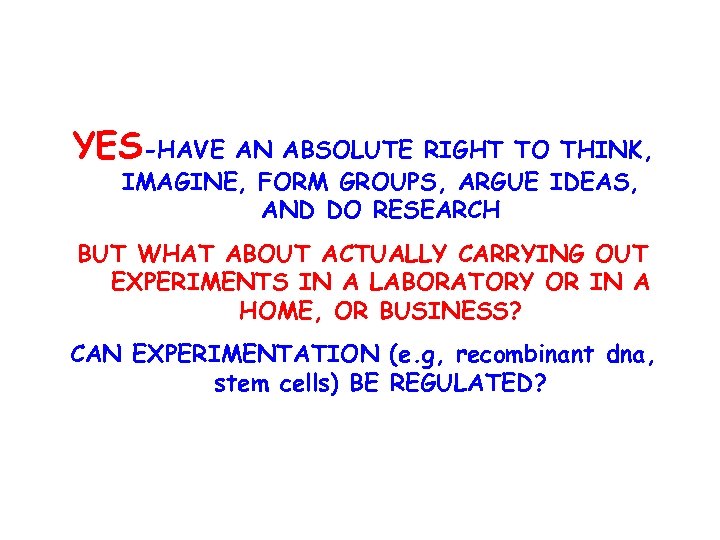 YES-HAVE AN ABSOLUTE RIGHT TO THINK, IMAGINE, FORM GROUPS, ARGUE IDEAS, AND DO RESEARCH BUT WHAT ABOUT ACTUALLY CARRYING OUT EXPERIMENTS IN A LABORATORY OR IN A HOME, OR BUSINESS? CAN EXPERIMENTATION (e. g, recombinant dna, stem cells) BE REGULATED?
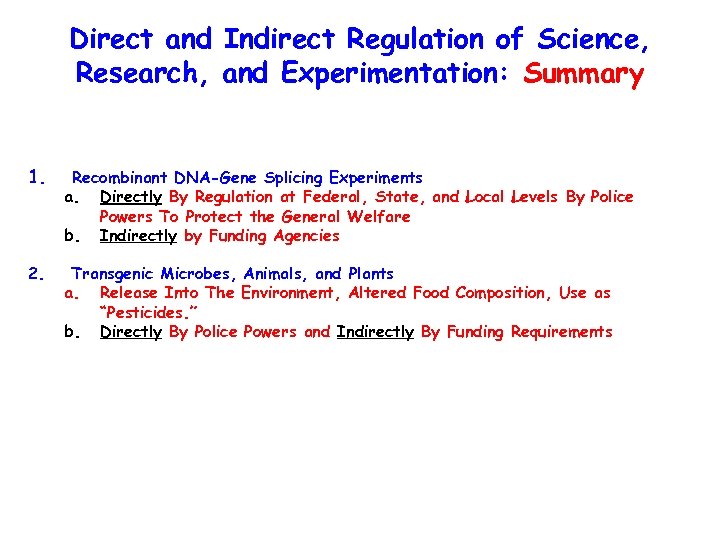
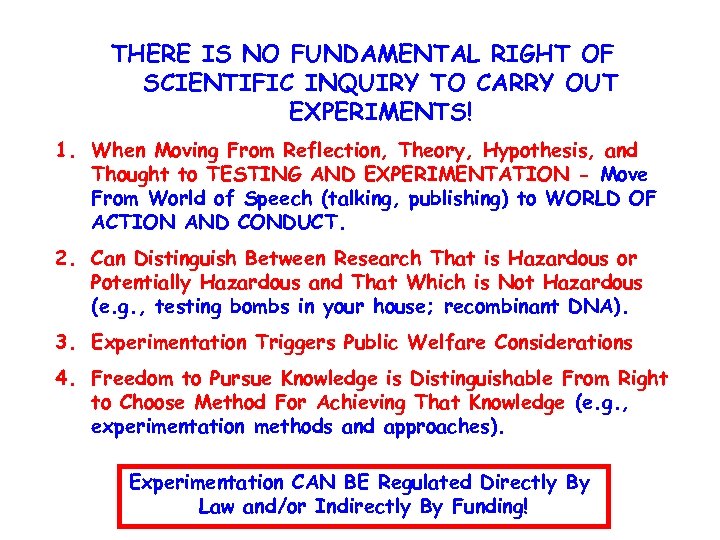 THERE IS NO FUNDAMENTAL RIGHT OF SCIENTIFIC INQUIRY TO CARRY OUT EXPERIMENTS! 1. When Moving From Reflection, Theory, Hypothesis, and Thought to TESTING AND EXPERIMENTATION - Move From World of Speech (talking, publishing) to WORLD OF ACTION AND CONDUCT. 2. Can Distinguish Between Research That is Hazardous or Potentially Hazardous and That Which is Not Hazardous (e. g. , testing bombs in your house; recombinant DNA). 3. Experimentation Triggers Public Welfare Considerations 4. Freedom to Pursue Knowledge is Distinguishable From Right to Choose Method For Achieving That Knowledge (e. g. , experimentation methods and approaches). Experimentation CAN BE Regulated Directly By Law and/or Indirectly By Funding!
 How Can Genetic Engineering Be Regulated Directly?
 Police Powers of Federal, State, and Local Governments-To Promote the General Welfare-Can Regulate Experimentation. “If Inherently Hazardous to Protect the Welfare of the Public and/or an Individual”
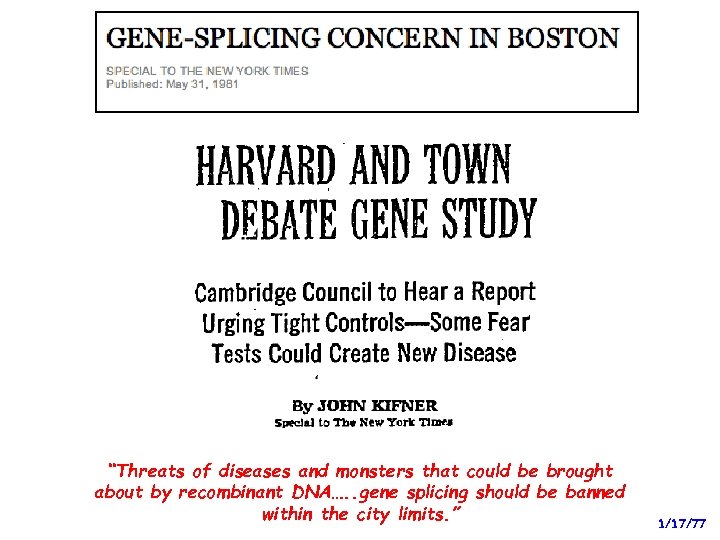
 Case #1 -Recombinant DNA Cambridge, MA. City Council-1977 • Facts: Cambridge City Council Tried to Ban All Recombinant DNA Experiments in the City of Cambridge, Including Harvard University. “Threats of diseases and monsters that could be brought about by recombinant DNA…. . gene splicing should be banned within the city limits. ” • Outcome: After a Heated Debate, the Cambridge Experimental Review Board (CERB) Recommended Going Forward With Recombinant DNA Under NIH Guidelines. “A citizen’s jury (CERB) of lay people and scientists came to a sensible conclusion, and that was the ordinance that passed. ”
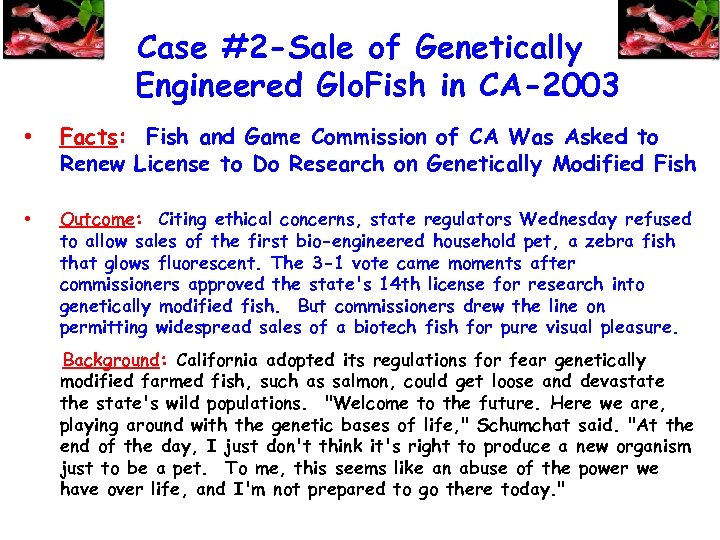 Case #2 -Sale of Genetically Engineered Glo. Fish in CA-2003 • Facts: Fish and Game Commission of CA Was Asked to Renew License to Do Research on Genetically Modified Fish • Outcome: Citing ethical concerns, state regulators Wednesday refused to allow sales of the first bio-engineered household pet, a zebra fish that glows fluorescent. The 3 -1 vote came moments after commissioners approved the state's 14 th license for research into genetically modified fish. But commissioners drew the line on permitting widespread sales of a biotech fish for pure visual pleasure. Background: California adopted its regulations for fear genetically modified farmed fish, such as salmon, could get loose and devastate the state's wild populations. "Welcome to the future. Here we are, playing around with the genetic bases of life, " Schumchat said. "At the end of the day, I just don't think it's right to produce a new organism just to be a pet. To me, this seems like an abuse of the power we have over life, and I'm not prepared to go there today. "
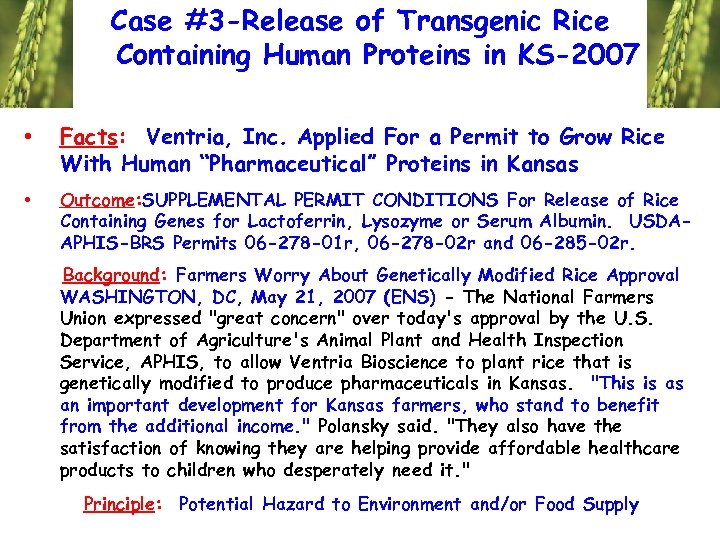 Case #3 -Release of Transgenic Rice Containing Human Proteins in KS-2007 • Facts: Ventria, Inc. Applied For a Permit to Grow Rice With Human “Pharmaceutical” Proteins in Kansas • Outcome: SUPPLEMENTAL PERMIT CONDITIONS For Release of Rice Containing Genes for Lactoferrin, Lysozyme or Serum Albumin. USDAAPHIS-BRS Permits 06 -278 -01 r, 06 -278 -02 r and 06 -285 -02 r. Background: Farmers Worry About Genetically Modified Rice Approval WASHINGTON, DC, May 21, 2007 (ENS) - The National Farmers Union expressed "great concern" over today's approval by the U. S. Department of Agriculture's Animal Plant and Health Inspection Service, APHIS, to allow Ventria Bioscience to plant rice that is genetically modified to produce pharmaceuticals in Kansas. "This is as an important development for Kansas farmers, who stand to benefit from the additional income. " Polansky said. "They also have the satisfaction of knowing they are helping provide affordable healthcare products to children who desperately need it. " Principle: Potential Hazard to Environment and/or Food Supply
 Case #4 Bioterrorism: Congressional Legislation to Improve Public Health Preparedness and Response Capacity-2002 • Facts: To Protect Nation From Bioterrorism Attacks After 9/11 and Anthrax “Attacks” on Congress • Outcome: Bioterrorism Preparedness Act of 2002 Background: Funds For Research on Pathogens To Uncover Knowledge Required to Counteract Bioweapons’ Attacks (e. g. , anitbiotics, vaccines). Registration of all human pathogens and pathogen researcch in US Laboratories. Principle: Public Safety/Welfare Risk
 Can Think But Can’t Always Act!
 How Can Genetic Engineering Be Regulated Indirectly?
 Regulate Through Power of Funding and Research $ 1. No Constitutional Right to Obtain Funding For Research at Federal, State, and Local Levels a. Federal Embryonic Stem Cell Research Restricted b. Must Apply For Grants Which Are Merit-Based and Peer-Reviewed 2. Must Abide By Conditions of Funding Agencies to Obtain Research $ a. Recombinant DNA Guidelines b. Human Institutional Review Boards (IRBs) c. Release of GMOs Into the Environment (EPA)
 UCLA Biohazard Committee Approvals 1978
 Direct and Indirect Regulation of Science, Research, and Experimentation: Summary 1. Recombinant DNA-Gene Splicing Experiments a. Directly By Regulation at Federal, State, and Local Levels By Police Powers To Protect the General Welfare b. Indirectly by Funding Agencies 2. Transgenic Microbes, Animals, and Plants a. Release Into The Environment, Altered Food Composition, Use as “Pesticides. ” b. Directly By Police Powers and Indirectly By Funding Requirements