 Скачать презентацию HB Nominal Quantities and the status of
c324d1d5ca7fd0f7bcd6296831a02d20.ppt
- Количество слайдов: 15



HB Nominal Quantities and the status of ℮ June 2010 © MMX H J Burnett FTSI MCQI CPD www. howardburnett. com 1
HB • Specified Nominal Quantities Member States may not, on grounds of nominal quantities, refuse, prohibit or restrict the placing on the market of prepacked products, • Member States which currently prescribe mandatory nominal quantities for • Milk, butter, dried pasta and coffee can continue until 11 October 2012 • Sugar can continue until 11 October 2013 June 2010 © MMX H J Burnett FTSI MCQI CPD www. howardburnett. com 2
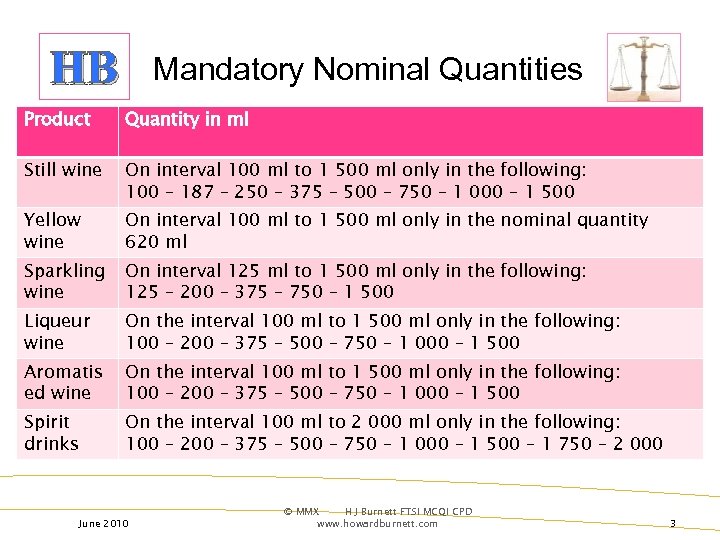
HB Mandatory Nominal Quantities Product Quantity in ml Still wine On interval 100 ml to 1 500 ml only in the following: 100 – 187 – 250 – 375 – 500 – 750 – 1 000 – 1 500 Yellow wine On interval 100 ml to 1 500 ml only in the nominal quantity 620 ml Sparkling wine On interval 125 ml to 1 500 ml only in the following: 125 – 200 – 375 – 750 – 1 500 Liqueur wine On the interval 100 ml to 1 500 ml only in the following: 100 – 200 – 375 – 500 – 750 – 1 000 – 1 500 Aromatis ed wine On the interval 100 ml to 1 500 ml only in the following: 100 – 200 – 375 – 500 – 750 – 1 000 – 1 500 Spirit drinks On the interval 100 ml to 2 000 ml only in the following: 100 – 200 – 375 – 500 – 750 – 1 000 – 1 500 – 1 750 – 2 000 June 2010 © MMX H J Burnett FTSI MCQI CPD www. howardburnett. com 3
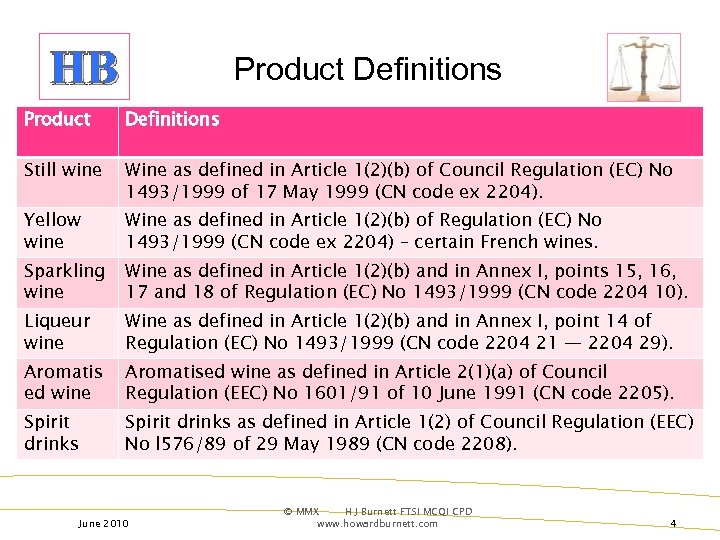
HB Product Definitions Still wine Wine as defined in Article 1(2)(b) of Council Regulation (EC) No 1493/1999 of 17 May 1999 (CN code ex 2204). Yellow wine Wine as defined in Article 1(2)(b) of Regulation (EC) No 1493/1999 (CN code ex 2204) – certain French wines. Sparkling wine Wine as defined in Article 1(2)(b) and in Annex I, points 15, 16, 17 and 18 of Regulation (EC) No 1493/1999 (CN code 2204 10). Liqueur wine Wine as defined in Article 1(2)(b) and in Annex I, point 14 of Regulation (EC) No 1493/1999 (CN code 2204 21 — 2204 29). Aromatis ed wine Aromatised wine as defined in Article 2(1)(a) of Council Regulation (EEC) No 1601/91 of 10 June 1991 (CN code 2205). Spirit drinks as defined in Article 1(2) of Council Regulation (EEC) No l 576/89 of 29 May 1989 (CN code 2208). June 2010 © MMX H J Burnett FTSI MCQI CPD www. howardburnett. com 4
HB Mandatory Nominal Quantities • These mandatory nominal quantities apply, whether or not the prepackages are ℮ marked • Outside the intervals for these products, any quantity can be prepackaged The mandatory nominal quantities do not apply to which are sold in duty-free shops for consumption outside the European Union. June 2010 © MMX H J Burnett FTSI MCQI CPD www. howardburnett. com 5
HB Multipacks of wines & spirits Where a multipack consists of two or more individual prepackages, the mandatory nominal quantities apply to each of the prepackages ◦ For example a box of 6 x 750 ml Where a prepackage is made up of two or more individual packages which are not intended to be sold individually, the nominal quantities listed in section 1 of the Annex shall apply to the prepackage. ◦ For example (3 x 125 ml =) 375 ml still wine June 2010 © MMX H J Burnett FTSI MCQI CPD www. howardburnett. com 6
HB Aerosol Dispensers The Directive 75/324/EEC requires aerosol dispensers to be marked with both weight and volume of its contents, Directive 2007/45/EC gives a derogation that they need not be marked with the nominal weight of their contents, but must also be marked with the capacity of the container. These requirements apply, whether or not the prepackages are ℮ marked. June 2010 © MMX H J Burnett FTSI MCQI CPD www. howardburnett. com 7
HB Aerosol Dispensers Label June 2010 © MMX H J Burnett FTSI MCQI CPD www. howardburnett. com 8
HB Status of ℮ When applied in a country that has implemented Directive 76/211/EEC as amended ◦ Free movement of the prepackages within the EEA without further checking for quantity When applied outside the EEA ◦ There is no non compliance, for example wine from South Africa bearing the ℮ mark ◦ When prepackages first enter the EEA the importer within the EEA has the responsibility to ensure the prepackages meet the requirements. June 2010 © MMX H J Burnett FTSI MCQI CPD www. howardburnett. com 9
HB Questions on the status of ℮ What are the possibilities for exporting non “℮” marked prepackages on the EU market? ‘℮’ and non ‘℮’ marked goods from candidate countries are treated the same on entering the EU. The importer is responsible for ensuring requirements are met. Once inside the EU the ‘e’ marked goods will have free access to all the market. Non ‘℮’ marked goods are treated as nonharmonised products within the EU. June 2010 © MMX H J Burnett FTSI MCQI CPD www. howardburnett. com 10
HB Questions on the status of ℮ Are potential candidate countries and candidate countries entitled to use the “℮” mark on prepacked products for export on the EU market? Yes, as any packer in a third country (a country outside the EU). The importer within the EU will have to ensure that the prepackages meet the requirements of the Directives. June 2010 © MMX H J Burnett FTSI MCQI CPD www. howardburnett. com 11
HB Importer ‘Importer’ is not defined in the Directive for ℮ marked goods. WELMEC 6. 5 states “ an importer is someone who brings prepackages into the EEA, therefore movement within the EEA does not involve import / export for the purposes of the Directive. “ Decision 768/2008 – for new legislation ‘importer’ shall mean any natural or legal person established within the Community who places a product from a third country on the Community market June 2010 © MMX H J Burnett FTSI MCQI CPD www. howardburnett. com 12
HB Non-harmonised requirements European Court judgements – generally what is legally produced and marketed in one country must be acceptable in other EU countries. ◦ Principle established in Case 120/78, ‘Cassis de Dijon’ Regulation (EC) 764/2008, Chapter 1 ◦ Improving free movement of goods Procedure includes the competent authority communicating with the economic operator (importer) if there are objections. June 2010 © MMX H J Burnett FTSI MCQI CPD www. howardburnett. com 13
HB International recommendations for prepackages Useful for exporting to non-EU countries International recommended requirements are the same for goods 5 g to 10 kg & 5 ml to 10 L. Recommendations extend to include 0 to 50 kg and 0 to 50 L, length, area and number Marking requirements (being reviewed) ◦ Principle display panel ◦ Aerosols weight of product & propellant expelled ◦ Packaging is all that is left over after used, except that naturally in the product (for example, skin on a banana) June 2010 © MMX H J Burnett FTSI MCQI CPD www. howardburnett. com 14
HB Any Questions? • No mandatory nominal quantities except as permitted for milk, butter, dried pasta, coffee & sugar for the specified periods • Mandatory nominal quantities for wines and spirits • Aerosol dispenser markings • Status of ℮ mark • International recommendations • ask@howardburnett. com June 2010 © MMX H J Burnett FTSI MCQI CPD www. howardburnett. com 15
Скачать презентацию HB Nominal Quantities and the status of
c324d1d5ca7fd0f7bcd6296831a02d20.ppt