 Скачать презентацию HAZUS-MH and Technological Hazards Dr Jawhar Bouabid DTI
d3bb0321372db79b6f20e86fa5da5603.ppt
- Количество слайдов: 29



HAZUS-MH and Technological Hazards Dr. Jawhar Bouabid, DTI November 4, 2002
Outline n Introduction n Overview of HAZUS-MH Methodology n HAZUS-MH Walkthrough n HAZUS-MH and Technological Hazards November 4, 2002 FEMA HQ 2
Introduction
![Introduction [1] n HAZUS-MH is the cutting-edge software model at the Federal Emergency Management](https://present5.com/presentation/d3bb0321372db79b6f20e86fa5da5603/image-4.jpg "Introduction [1] n HAZUS-MH is the cutting-edge software model at the Federal Emergency Management")
Introduction [1] n HAZUS-MH is the cutting-edge software model at the Federal Emergency Management Agency (FEMA) for estimating losses that may occur if disasters (floods, earthquakes and hurricanes) happen n HAZUS-MH allows users to run what-if scenarios n Results from HAZUS-MH provides decision makers with necessary information to: Ø Assess level of readiness and preparedness to deal with a disaster in a given region within the U. S. (before the disaster hits) November 4, 2002 FEMA HQ 4
![Introduction [2] Ø Decide on how to allocate resources for most effective and efficient](https://present5.com/presentation/d3bb0321372db79b6f20e86fa5da5603/image-5.jpg "Introduction [2] Ø Decide on how to allocate resources for most effective and efficient")
Introduction [2] Ø Decide on how to allocate resources for most effective and efficient response and recovery when a disaster hits a certain region Ø Prioritize the mitigation measures that need to be implemented to reduce future losses n HAZUS-MH is still evolving to include additional hazards: airborne toxic releases, dam failures, etc… n For more information on HAZUS, please visit: WWW. FEMA. GOV/HAZUS November 4, 2002 FEMA HQ 5
Overview of HAZUS-MH
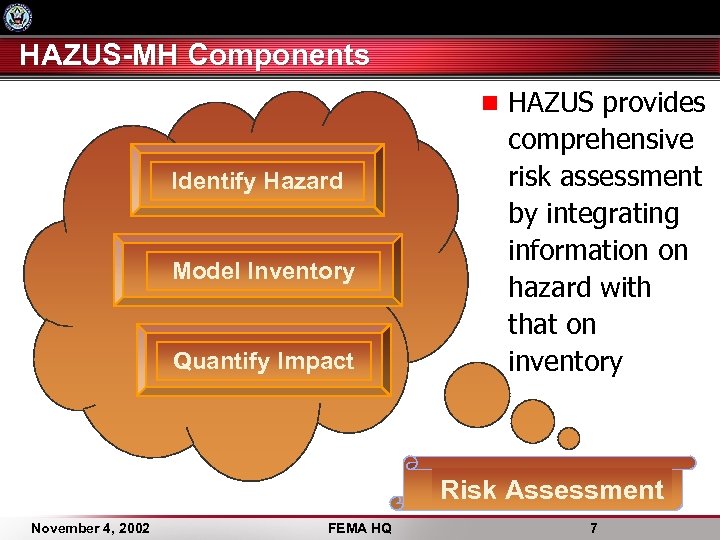
HAZUS-MH Components n HAZUS provides Identify Hazard Model Inventory Quantify Impact comprehensive risk assessment by integrating information on hazard with that on inventory Risk Assessment November 4, 2002 FEMA HQ 7
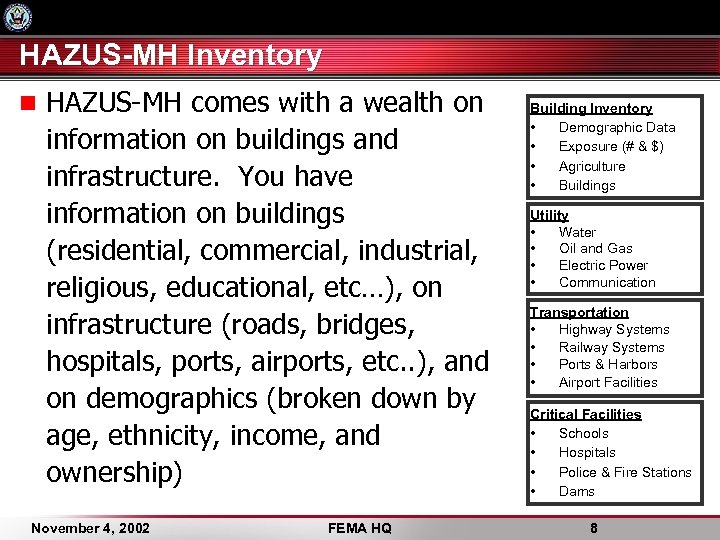
HAZUS-MH Inventory n HAZUS-MH comes with a wealth on information on buildings and infrastructure. You have information on buildings (residential, commercial, industrial, religious, educational, etc…), on infrastructure (roads, bridges, hospitals, ports, airports, etc. . ), and on demographics (broken down by age, ethnicity, income, and ownership) November 4, 2002 FEMA HQ Building Inventory • Demographic Data • Exposure (# & $) • Agriculture • Buildings Utility • Water • Oil and Gas • Electric Power • Communication Transportation • Highway Systems • Railway Systems • Ports & Harbors • Airport Facilities Critical Facilities • Schools • Hospitals • Police & Fire Stations • Dams 8
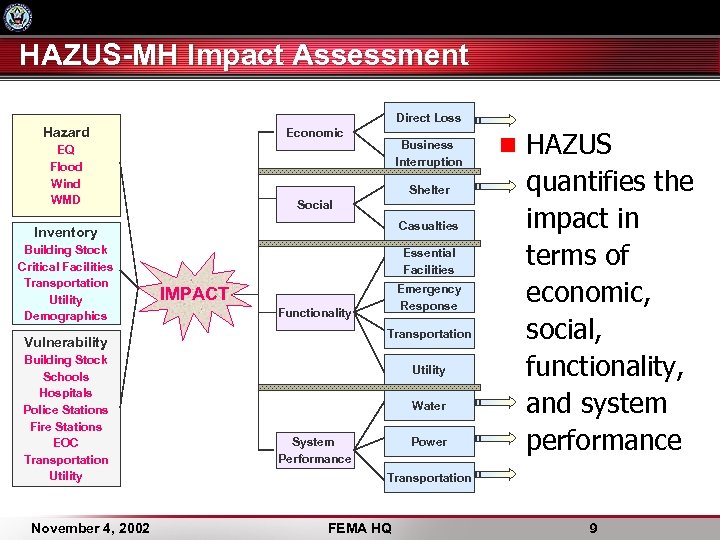
HAZUS-MH Impact Assessment Direct Loss Hazard Economic EQ Flood Wind WMD Business Interruption Shelter Social Inventory Casualties Building Stock Critical Facilities Transportation Utility Demographics Essential Facilities Functionality Transportation Vulnerability Building Stock Schools Hospitals Police Stations Fire Stations EOC Transportation Utility November 4, 2002 Emergency Response IMPACT Utility Water Power System Performance n HAZUS quantifies the impact in terms of economic, social, functionality, and system performance Transportation FEMA HQ 9
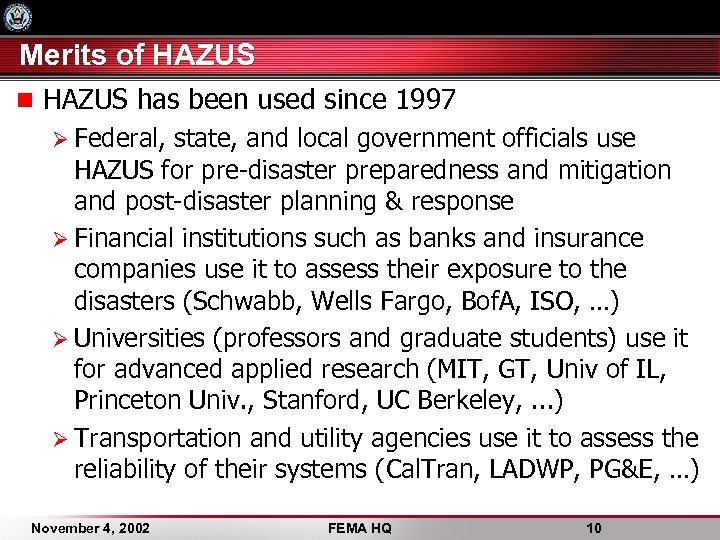
Merits of HAZUS n HAZUS has been used since 1997 Ø Federal, state, and local government officials use HAZUS for pre-disaster preparedness and mitigation and post-disaster planning & response Ø Financial institutions such as banks and insurance companies use it to assess their exposure to the disasters (Schwabb, Wells Fargo, Bof. A, ISO, …) Ø Universities (professors and graduate students) use it for advanced applied research (MIT, GT, Univ of IL, Princeton Univ. , Stanford, UC Berkeley, . . . ) Ø Transportation and utility agencies use it to assess the reliability of their systems (Cal. Tran, LADWP, PG&E, …) November 4, 2002 FEMA HQ 10
HAZUS-MH Walkthrough
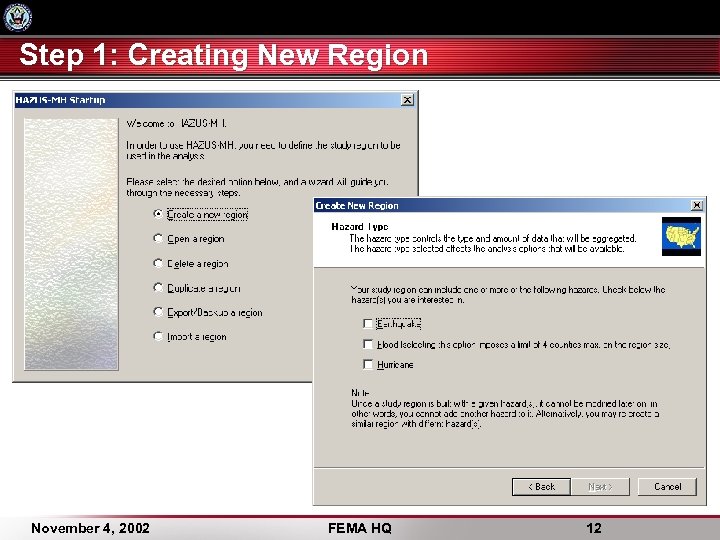
Step 1: Creating New Region November 4, 2002 FEMA HQ 12
![Step 1: Creating New Region [2] November 4, 2002 FEMA HQ 13](https://present5.com/presentation/d3bb0321372db79b6f20e86fa5da5603/image-13.jpg "Step 1: Creating New Region [2] November 4, 2002 FEMA HQ 13")
Step 1: Creating New Region [2] November 4, 2002 FEMA HQ 13
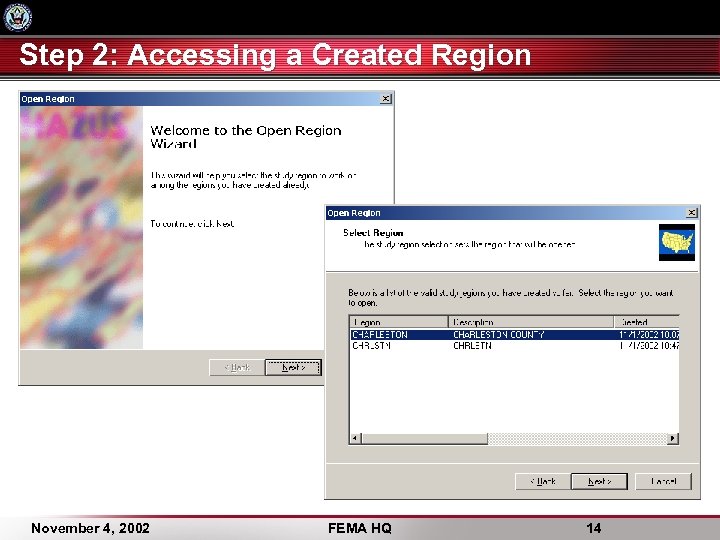
Step 2: Accessing a Created Region November 4, 2002 FEMA HQ 14
![Step 2: Accessing a Created Region [2] November 4, 2002 FEMA HQ 15](https://present5.com/presentation/d3bb0321372db79b6f20e86fa5da5603/image-15.jpg "Step 2: Accessing a Created Region [2] November 4, 2002 FEMA HQ 15")
Step 2: Accessing a Created Region [2] November 4, 2002 FEMA HQ 15
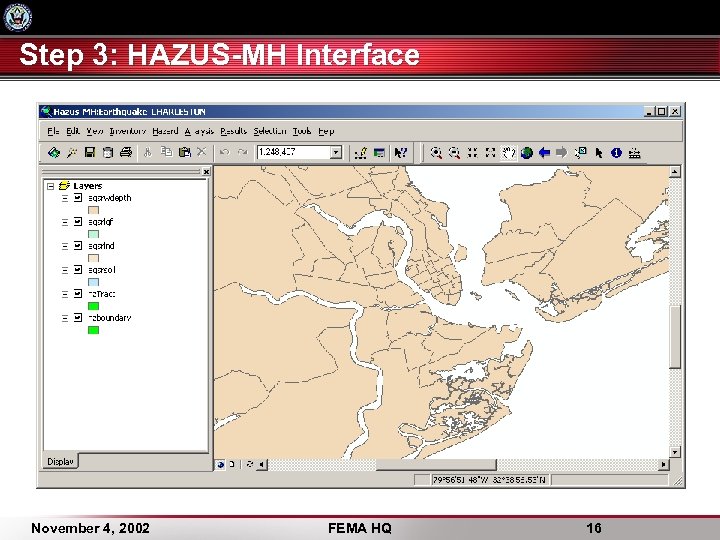
Step 3: HAZUS-MH Interface November 4, 2002 FEMA HQ 16
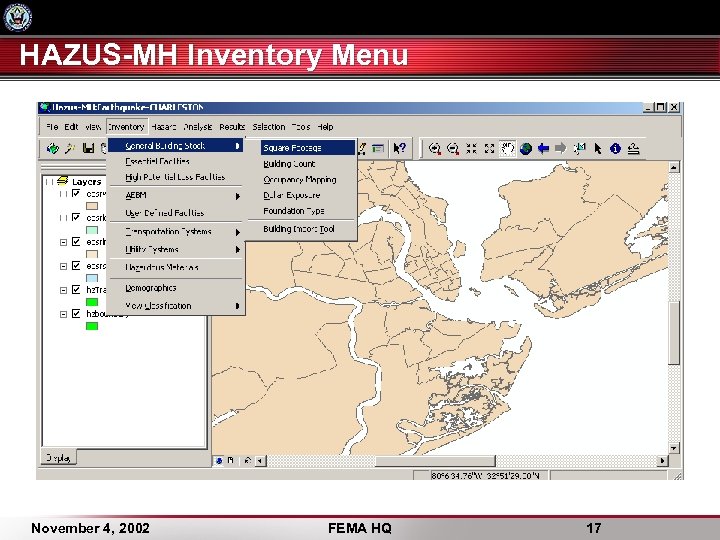
HAZUS-MH Inventory Menu November 4, 2002 FEMA HQ 17
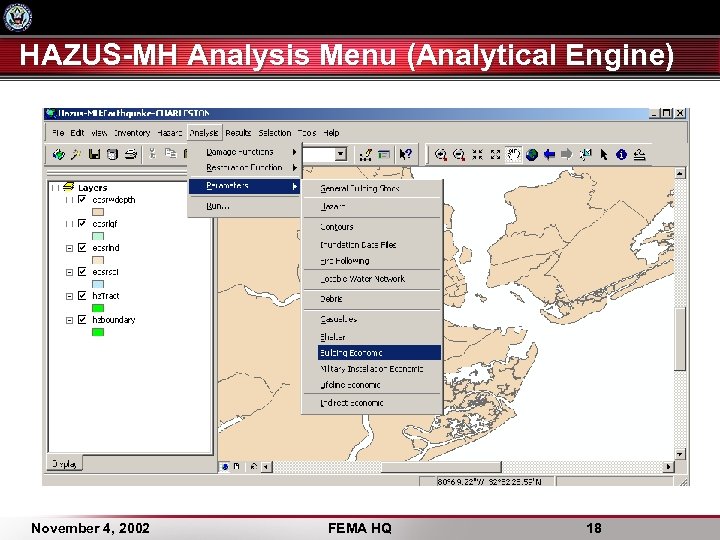
HAZUS-MH Analysis Menu (Analytical Engine) November 4, 2002 FEMA HQ 18
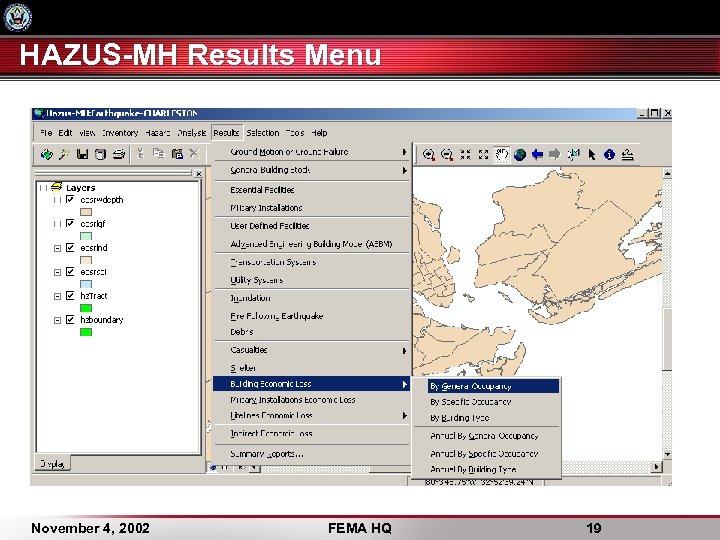
HAZUS-MH Results Menu November 4, 2002 FEMA HQ 19
HAZUS-MH and Technological Hazards
Technological Hazards n Chemical, Biological, Radiological (Dirty Bomb), Nuclear and Explosive Threats (CBRNE) Ø ALOHA (Areal Locations of Hazardous Atmospheres) predicts rates of chemical releases and displays a “footprint” plot of the area downwind of a release where concentrations may exceed certain threshold levels. Ø ALOHA plume can be combined with HAZUS-MH exposure profiles and demographic data to estimate # people & buildings/facilities affected by release. November 4, 2002 FEMA HQ 21
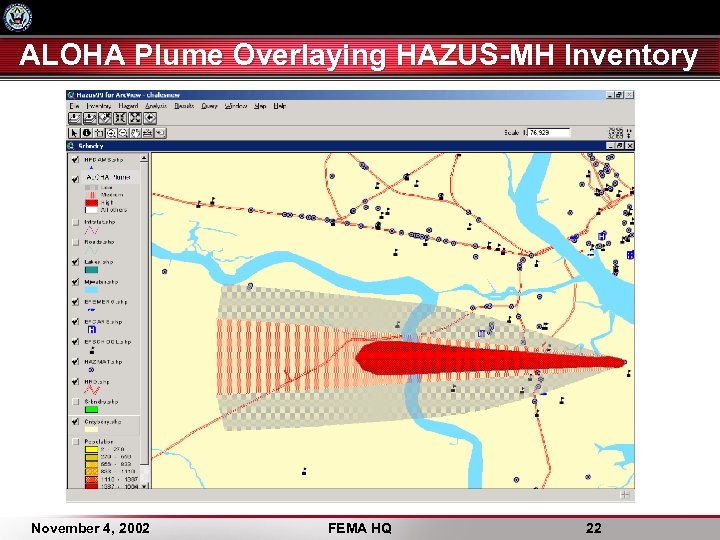
ALOHA Plume Overlaying HAZUS-MH Inventory November 4, 2002 FEMA HQ 22
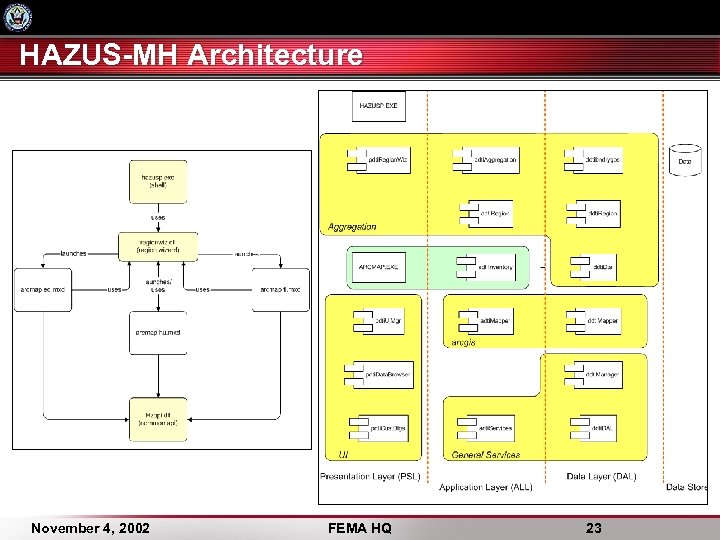
HAZUS-MH Architecture November 4, 2002 FEMA HQ 23
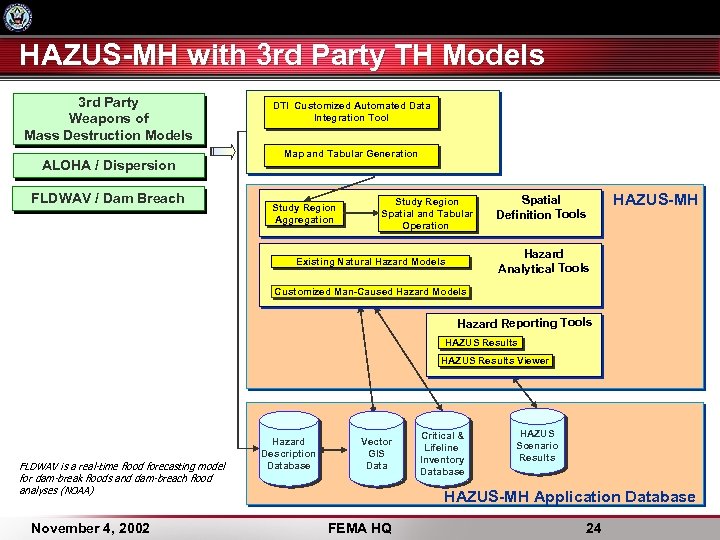
HAZUS-MH with 3 rd Party TH Models 3 rd Party Weapons of Mass Destruction Models ALOHA / Dispersion FLDWAV / Dam Breach DTI Customized Automated Data Integration Tool Map and Tabular Generation Study Region Aggregation Study Region Spatial and Tabular Operation Spatial Definition Tools HAZUS-MH Hazard Analytical Tools Existing Natural Hazard Models Customized Man-Caused Hazard Models Hazard Reporting Tools HAZUS Results Viewer FLDWAV is a real-time flood forecasting model for dam-break floods and dam-breach flood analyses (NOAA) November 4, 2002 Hazard Description Database Vector GIS Data Critical & Lifeline Inventory Database HAZUS Scenario Results HAZUS-MH Application Database FEMA HQ 24
![Modeling Technological Hazards: [1] Profiling Hazard Application Mode Hazard Duration Extent of Effects Mitigation](https://present5.com/presentation/d3bb0321372db79b6f20e86fa5da5603/image-25.jpg "Modeling Technological Hazards: [1] Profiling Hazard Application Mode Hazard Duration Extent of Effects Mitigation")
Modeling Technological Hazards: [1] Profiling Hazard Application Mode Hazard Duration Extent of Effects Mitigation Issues or Conditions Conventional Bomb Detonation Instantaneous; secondary devices may extend duration Determined by type, location, and quantity of explosive Ease of access to targets; use of structures/vegetation for shielding Chemical Agent Liquid/Aerosol May extend for days or weeks Contamination may be carried by persons, vehicles, wind or water Weather conditions; shape of buildings and terrain; shielding and other mitigation techniques Biological Agent Liquid or solid contaminants can be dispersed using aerosol or munitions Hours to years, depending on the agent Widespread, depending on the agent used. Altitude above ground of release; weather conditions; other factors November 4, 2002 FEMA HQ 25
![Modeling TH: [2] Understanding Vulnerability n Inherent Vulnerability (components) Ø Visibility Ø Utility Ø](https://present5.com/presentation/d3bb0321372db79b6f20e86fa5da5603/image-26.jpg "Modeling TH: [2] Understanding Vulnerability n Inherent Vulnerability (components) Ø Visibility Ø Utility Ø")
Modeling TH: [2] Understanding Vulnerability n Inherent Vulnerability (components) Ø Visibility Ø Utility Ø Assess ability Ø WMD Hazard Ø Potential For Collateral Damage Ø Occupancy n Tactical Vulnerability (components) Ø Site Perimeter Ø Building Envelope Ø Facility Interior November 4, 2002 FEMA HQ 26
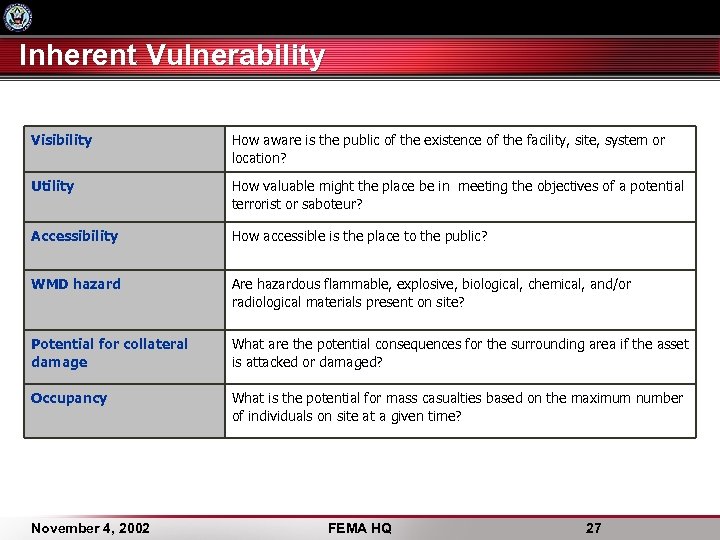
Inherent Vulnerability Visibility How aware is the public of the existence of the facility, site, system or location? Utility How valuable might the place be in meeting the objectives of a potential terrorist or saboteur? Accessibility How accessible is the place to the public? WMD hazard Are hazardous flammable, explosive, biological, chemical, and/or radiological materials present on site? Potential for collateral damage What are the potential consequences for the surrounding area if the asset is attacked or damaged? Occupancy What is the potential for mass casualties based on the maximum number of individuals on site at a given time? November 4, 2002 FEMA HQ 27
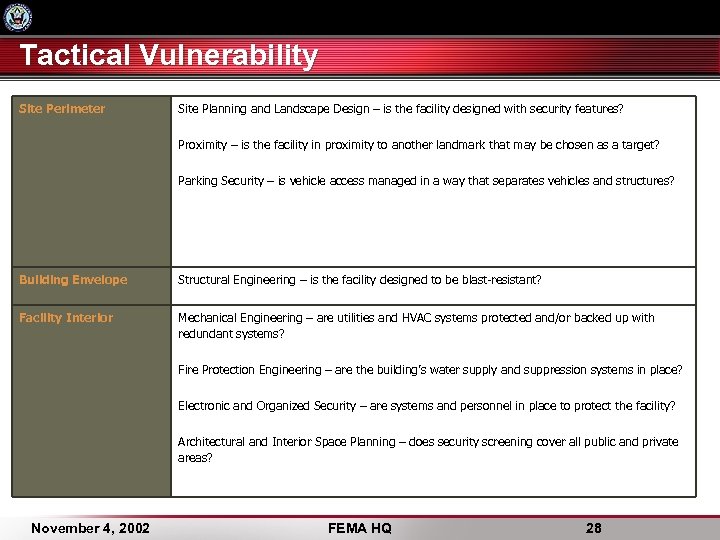
Tactical Vulnerability Site Perimeter Site Planning and Landscape Design – is the facility designed with security features? Proximity – is the facility in proximity to another landmark that may be chosen as a target? Parking Security – is vehicle access managed in a way that separates vehicles and structures? Building Envelope Structural Engineering – is the facility designed to be blast-resistant? Facility Interior Mechanical Engineering – are utilities and HVAC systems protected and/or backed up with redundant systems? Fire Protection Engineering – are the building’s water supply and suppression systems in place? Electronic and Organized Security – are systems and personnel in place to protect the facility? Architectural and Interior Space Planning – does security screening cover all public and private areas? November 4, 2002 FEMA HQ 28
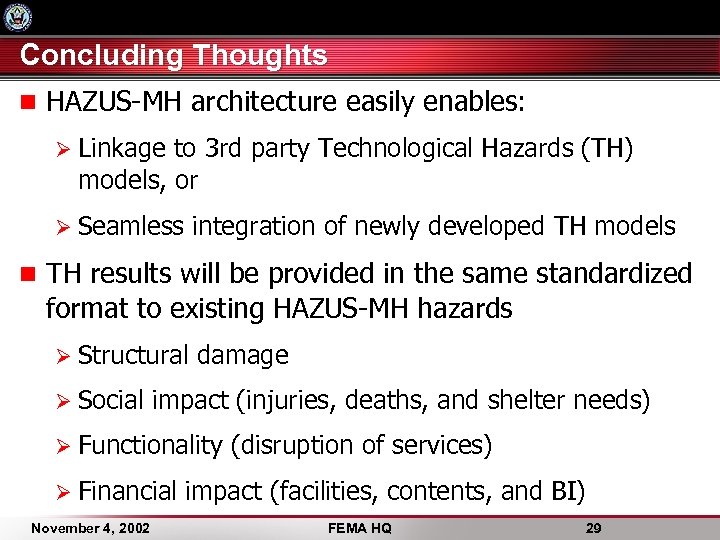
Concluding Thoughts n HAZUS-MH architecture easily enables: Ø Linkage to 3 rd party Technological Hazards (TH) models, or Ø Seamless integration of newly developed TH models n TH results will be provided in the same standardized format to existing HAZUS-MH hazards Ø Structural damage Ø Social impact (injuries, deaths, and shelter needs) Ø Functionality (disruption of services) Ø Financial impact (facilities, contents, and BI) November 4, 2002 FEMA HQ 29
Скачать презентацию HAZUS-MH and Technological Hazards Dr Jawhar Bouabid DTI
d3bb0321372db79b6f20e86fa5da5603.ppt