


 Скачать презентацию Hawaiian Creole English HCE Chae Yim Ling 455
7e6f2177c6e1597dc0e9326782fef4b3.ppt
- Количество слайдов: 22
 Hawaiian Creole English (HCE) Chae Yim Ling. 455
 Contents: o o o Introduction First Contact History Introduction to Pidgin Development of Hawaiian Creole English o o o Pronunciation Grammar HCE Today Issues with HCE Bibliography Media
 Introduction o o o Classified as Hawaiian Creole English (HCE) but still referred to as Pidgin. 600, 000 people speak HCE today. Primarily English, but other languages are involved as well. (Chinese, Japanese, Portuguese, Korean, etc. . )
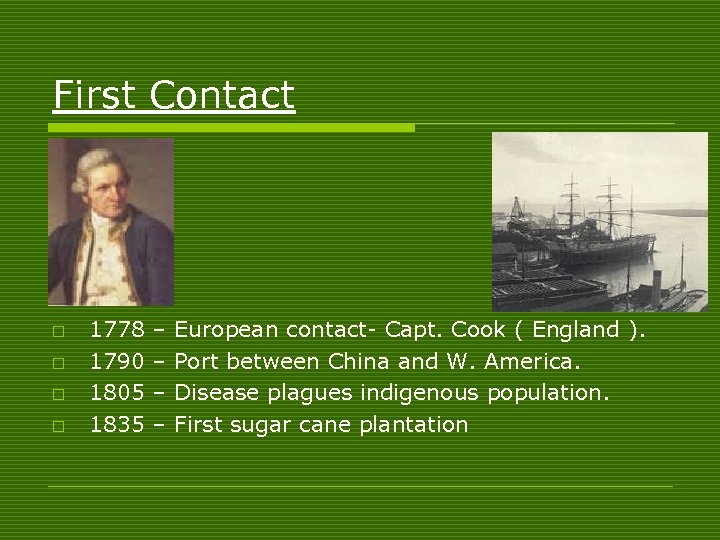 First Contact o o 1778 1790 1805 1835 – – European contact- Capt. Cook ( England ). Port between China and W. America. Disease plagues indigenous population. First sugar cane plantation
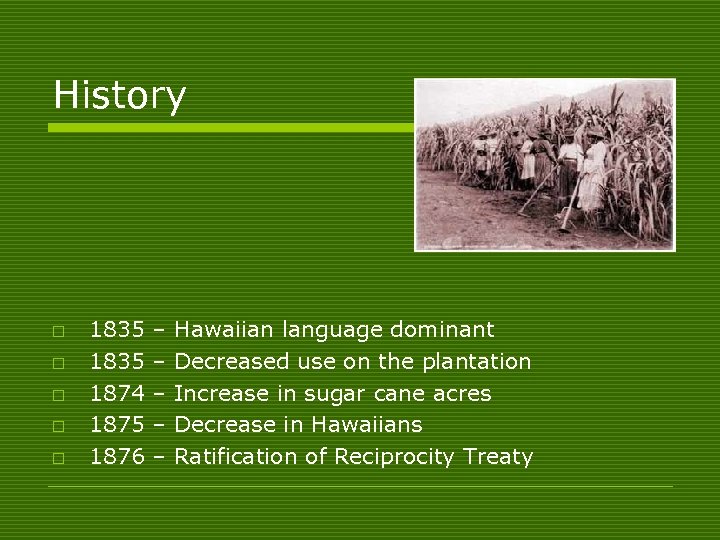 History o o o 1835 1874 1875 1876 – – – Hawaiian language dominant Decreased use on the plantation Increase in sugar cane acres Decrease in Hawaiians Ratification of Reciprocity Treaty
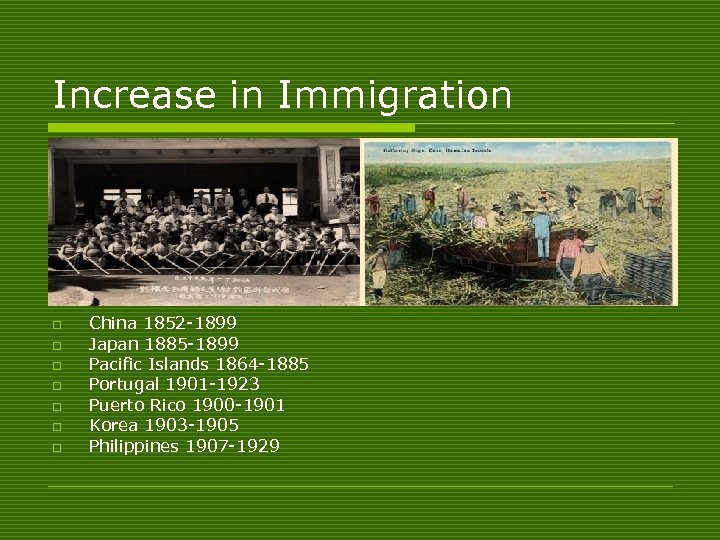 Increase in Immigration o o o o China 1852 -1899 Japan 1885 -1899 Pacific Islands 1864 -1885 Portugal 1901 -1923 Puerto Rico 1900 -1901 Korea 1903 -1905 Philippines 1907 -1929
 Development of Hawaiian Pidgin English (HPE) o o o Change from Hawaiian to English. 1878 -1888 Increase in English Schools and decrease in Hawaiian Schools. Gradual replacement of Hawaiians on plantation. Intermarriage with other races. Continued decline in Hawaiian population.
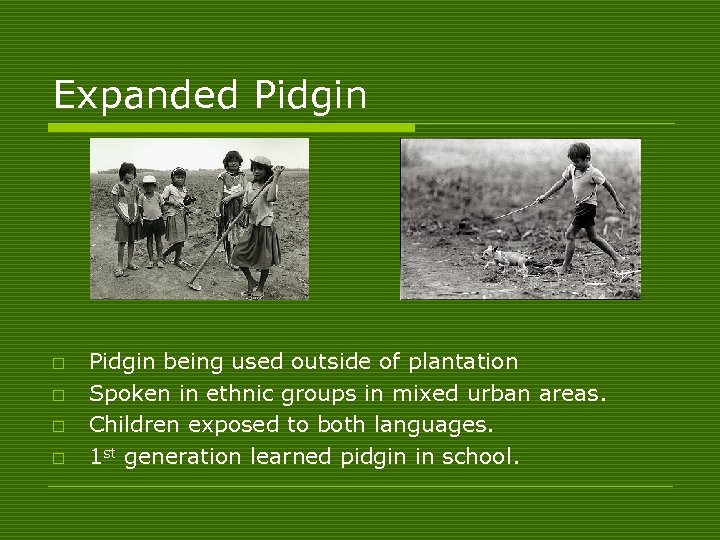 Expanded Pidgin o o Pidgin being used outside of plantation Spoken in ethnic groups in mixed urban areas. Children exposed to both languages. 1 st generation learned pidgin in school.
 Development of Hawaiian Creole English (HCE) o o Spoke only Hawaiian Pidgin English to 2 nd Generation. Hawaiian Pidgin English acquired as first language. No longer a Pidgin but Creole. Established around 1905 -1920
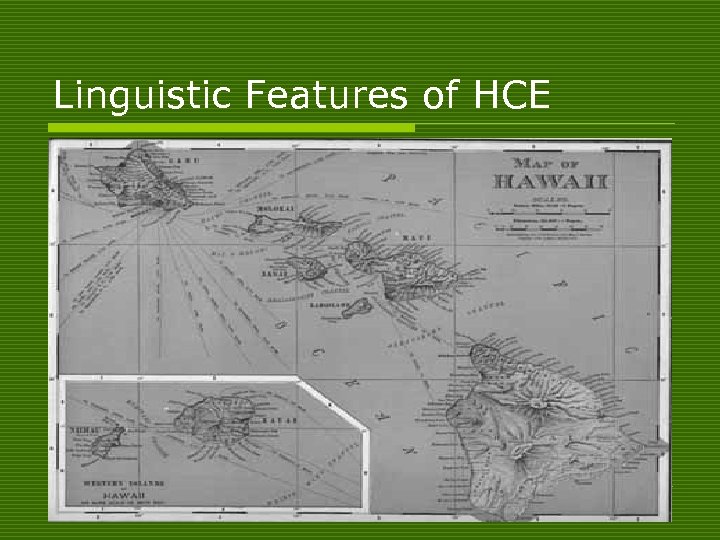 Linguistic Features of HCE
 Pronunciation Voiced and unvoiced ‘th’ No ‘th’ sounds. HCE substitutes with ‘t’ or ‘d’ sounds. Ex. tink ‘think’ , bot ‘both’, and fada ‘father’
 Pronunciation Pidgin is non-rhotic. Ex. car is often pronounced cah, and letter is pronounced letta. In the place of ‘r’ at the end of vowels in English, HCE has syllable ‘a’ followed by ‘i’, ‘u’, ‘o’, ‘ai’, or ‘e’. Ex. Dia (deer), pua (poor), stoa (store), faia (fire), and waelfea (welfare).
 Pronunciation The sound l at the end of a word is often pronounced o or ol. Ex. mental is often pronounced mento; people is pronounced peepo.
 Grammatical English "to be" (i. e. the copula) are omitted when referring to inherent qualities of an object or person. Ex. Da house big. When the verb "to be" refers to a temporary state or location, the word stay is often used. Ex. Da cup stay on top da table. n The cup is on the table.
 Grammatical To express past tense, Pidgin uses wen (went) in front of the verb. Ex. n n Jesus wen cry. (DJB, John 11: 35) Jesus cried.
 Grammatical To express future tense, Pidgin uses gon , goin (going) in front of the verb. Ex. n n God goin do plenny good kine stuff fo him. (DJB, Mark 11: 9) God is going to do a lot of good things for him.
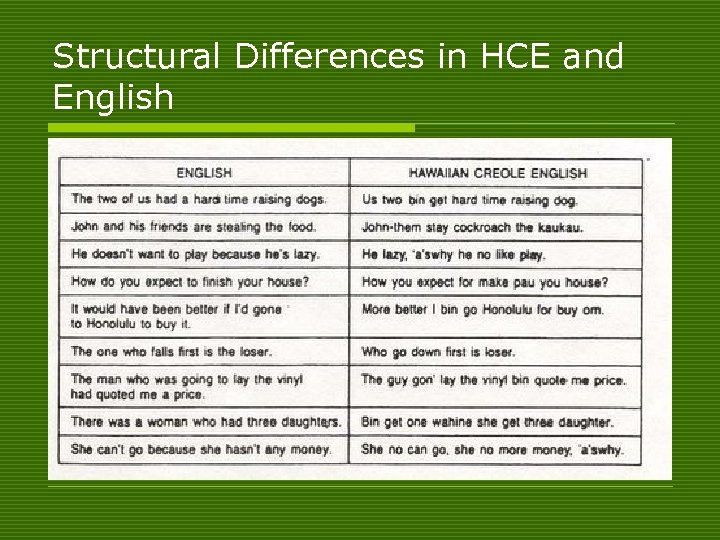 Structural Differences in HCE and English
 Today o o 600, 000 people speak HCE KCCNFM 100 radio plays regular HCE programs and music. http: //kccnfm 100. com/ Many authors using pidgin : Eric Chock, Lisa Kanae, Darrell Lum, Milton Murayama, Ed Sakamoto, Gary Pak, Lee Tonouchi, and Lois-Ann Yamanaka. Translation of the New Testament (Da Jesus Book) www. pidginbible. org
 Issues with HCE o o o Blamed for poor education test scores. Not college level (Just casual talk) Ebonics (English words mean different things in Pidgin ex. Cockaroach (steal away) ) Associated with lower class (stigmatized as inferior). Substandard or broken english
 Hawaiian Automotive 101 with George Nitta o o o Radio show Other links: http: //www. extremehawaii. com/pidgin/vocab/
 Bibliography o o Sakoda, K and Siegel, J (2003) “Pidgin Grammar. ” Bess Press : Honolulu. Romaine, S (1998) “Pidgin and Creole Languages. ” Cambridge: Cambridge. Reinecke, J (1975) “Bibliography of Pidgin and Creole. ” Univ. of Hawaii Press: Honolulu. Grimes, B. F (2000) “Da Jesus Book. ” Islander Group: Honolulu. Websites: http: //si. unm. edu/linguistics/pidgin www. uhh. hawaii. edu/ ~ronald/230/Creoles. htm http: //en. wikipedia. org/wiki/Hawaiian_Pidgin
 Da End