


 Скачать презентацию Have a Nice Day Rock in the 1970
aa9d2118e02568a78aba2ecc43b149fa.ppt
- Количество слайдов: 19
 Have a Nice Day Rock in the 1970 s
 Rhythm in late ‘ 60 s-early ‘ 70 s • Polyrhythmic • Sixteen-beat style beat • Syncopated bass lines, guitar riffs • Percussiveness emphasized through various techniques – Choked guitar sound - removes pitch – “Slapped” bass – Short vocal phrases
 Last Days of Motown • Motown dominance of charts wanes after 1971 • No single “Motown sound” • Biggest hit makers those who defy or expand “sound of young America”
 Stevie Wonder (1950 - ) • Signed by Berry Gordy at age 12; billed as “Little Stevie Wonder” • Rebels against Motown formula when contract re-negotiated in 1971
 Stevie Wonder - Style • Dense, polyrhythmic textures – On early albums, Wonder plays all instruments – Extensive use of synthesizer • • Long, syncopated riffs as foundation Latin, reggae, and jazz rhythms prominent
 Superstition • Sixteen-beat style beat • Strongly accented backbeats • Each 16 -bar verse divided into 2 parts – – – First half: Drums, bass, guitar, synthesizer Second half: Horn line added; jazz flavor Locally end-weighted • Verses harmonically static – built on pentatonic scale • Bridge harmonically active • Leads to hook (serves as refrain)
 Gospel/Soul • • Fusion of soul, gospel, and pop Personified in Al Green – “Voice of soul in the ‘ 70 s” – Started as gospel singer – Retains gospel traits in secular, romantic songs • Melismas, range of tone colors, techniques • Vocal virtuosity replaces rhythmic drive, lyric message • Ex. Tired of Being Alone
 Philadelphia Soul • Philadelphia International Records (PIR) founded in early ‘ 70 s by Kenny Gamble and Leon Huff • Closely associated with Philadelphia dance scene
 Philadelphia Sound • Heavily produced – thick, “Wall of sound” textures • Tight studio band - MFSB – Mother, Father, Sister, Brother • Riff-driven • Hard, rock-style timekeeping with 16 beat style beat • Ex. The O'Jays, Back Stabbers
 FUNK • Fusion of soul, acid rock, and James Brown • Riff-driven polyrhythmic structure – Over minimal harmonies or pentatonic scale • Backbeat avoided in favor of accenting each beat of bar – “Flat four” beat – Key defining characteristic of funk • Ex. Sly and the Family Stone, “Thank You (Falletinme Be Mice Elf Again)”
 Thank You (Falettinme Be Mice Elf Again) • Primarily 8 bar sections – Some have lyrics on each repetition – Others serve as refrain (“Thank you, falettin me…”) • Polyrhythms; separate patterns of – Guitar – Bass – Various percussion • Great deal of rhythmic layering
 Parliament and Funkadelic • Premiere funk bands of 70 s, led by George Clinton • Motown roots evident – Glimpses of doo-wop, Brill Building sounds • Also influence from art rock – Mixed meters – Sophisticated jazz rhythms – Shifting patterns of accents • Thick, polyrhythmic textures • Ex. Up for the Down Stroke
 Mainstream Rock • Less spontaneity, more focus on finding mainstream audience • Multi-Platinum hits of the mid 1970 s – Platinum record – 1 million copies sold – Peter Frampton - Frampton Comes Alive – Fleetwood Mac – Rumors • Reveal the amount of money that could be made from rock music
 Pop Rock • Most glam rock • Some singer/songwriters – Paul Simon – Billy Joel • Groups and artists that might be classified as pop or rock – Elton John – Wings – Rod Stewart – Fleetwood Mac
 Elton John – Tiny Dancer • Lyric dominates • Verse-transition-refrain – 2 part verse, each AABA • End weighting through gradual addition of instruments, new tone colors • Subtle sixteen-beat rhythmic foundation
 Jazz-Rock Fusion • Rock bands influenced by jazz rhythmic and harmonic sophistication • Often jazz players in group • Exs. • Blood, Sweat, and Tears • Chicago • Steely Dan • Ex. Blood, Sweat, and Tears, Spinning Wheel
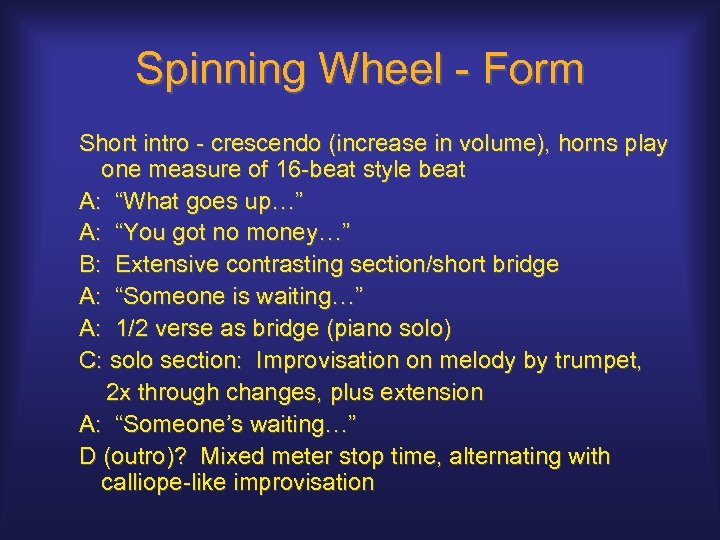 Spinning Wheel - Form Short intro - crescendo (increase in volume), horns play one measure of 16 -beat style beat A: “What goes up…” A: “You got no money…” B: Extensive contrasting section/short bridge A: “Someone is waiting…” A: 1/2 verse as bridge (piano solo) C: solo section: Improvisation on melody by trumpet, 2 x through changes, plus extension A: “Someone’s waiting…” D (outro)? Mixed meter stop time, alternating with calliope-like improvisation
 “Blue-eyed soul” • White groups influenced by gospel and soul – Doobie Brothers – Dr. John • Ex. Doobie Brothers, Takin' it To the Streets
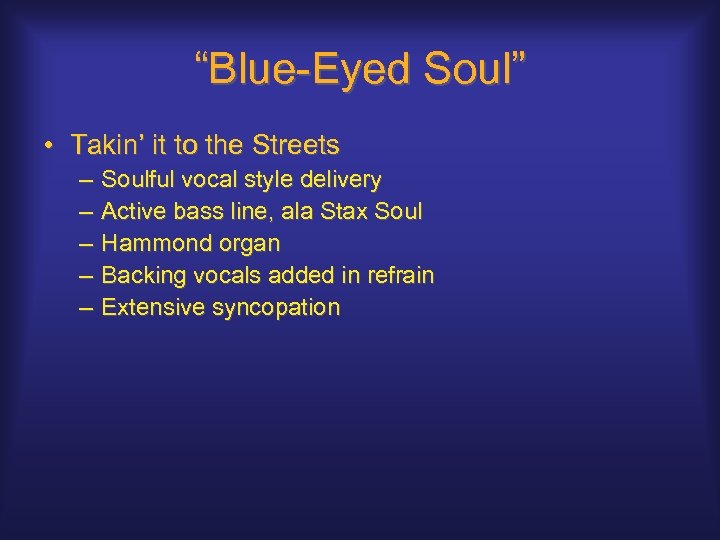 “Blue-Eyed Soul” • Takin’ it to the Streets – – – Soulful vocal style delivery Active bass line, ala Stax Soul Hammond organ Backing vocals added in refrain Extensive syncopation