


 Скачать презентацию Harvard Projects 1 Dynamics of Oceanic Motions ARR
bd1cc2fe463effa02a5a9130f3fbd52d.ppt
- Количество слайдов: 12
 Harvard Projects 1. Dynamics of Oceanic Motions (ARR) 2. Physical and Interdisciplinary Regional Ocean Dynamics and Modeling Systems (PFJL) 3. MURI-ASAP (Adaptive Sampling And Predictions) 4. PLUSNET: Persistent Littoral Undersea Surveillance Network 5. AWACS: Autonomous Wide Aperture Cluster for Surveillance 6. Pending: - Interdisciplinary Modeling and Dynamics of Archipelago Straits
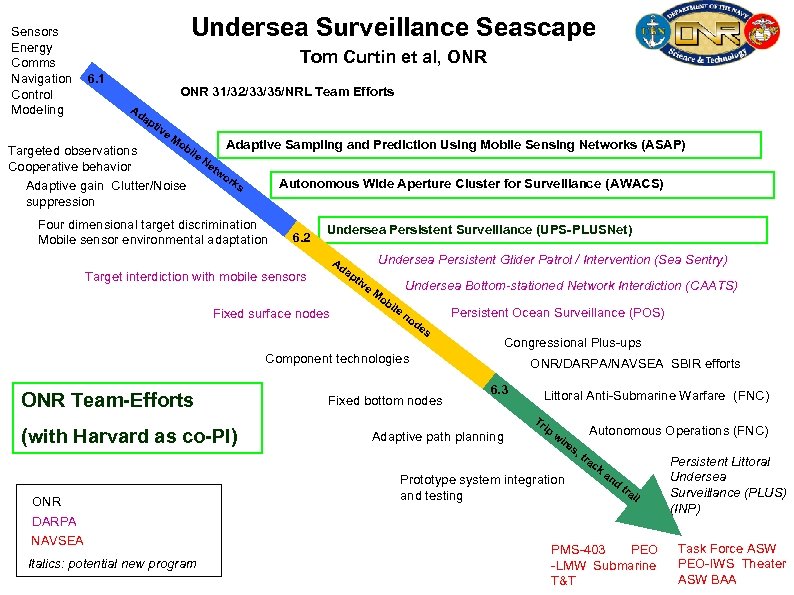 Sensors Energy Comms Navigation Control Modeling Undersea Surveillance Seascape Tom Curtin et al, ONR 6. 1 ONR 31/32/33/35/NRL Team Efforts Ad ap Targeted observations Cooperative behavior tiv e. M ob ile Adaptive gain Clutter/Noise suppression Adaptive Sampling and Prediction Using Mobile Sensing Networks (ASAP) Ne tw or ks Autonomous Wide Aperture Cluster for Surveillance (AWACS) Four dimensional target discrimination Mobile sensor environmental adaptation 6. 2 Undersea Persistent Surveillance (UPS-PLUSNet) Undersea Persistent Glider Patrol / Intervention (Sea Sentry) Ad a pt Target interdiction with mobile sensors Fixed surface nodes iv e Undersea Bottom-stationed Network Interdiction (CAATS) M ob ile no de Persistent Ocean Surveillance (POS) s Congressional Plus-ups Component technologies ONR Team-Efforts (with Harvard as co-PI) ONR DARPA NAVSEA Italics: potential new program Fixed bottom nodes ONR/DARPA/NAVSEA SBIR efforts 6. 3 Adaptive path planning Littoral Anti-Submarine Warfare (FNC) Tr ip wi re Prototype system integration and testing Autonomous Operations (FNC) s, tra ck an d tra il PMS-403 PEO -LMW Submarine T&T Persistent Littoral Undersea Surveillance (PLUS) (INP) Task Force ASW PEO-IWS Theater ASW BAA
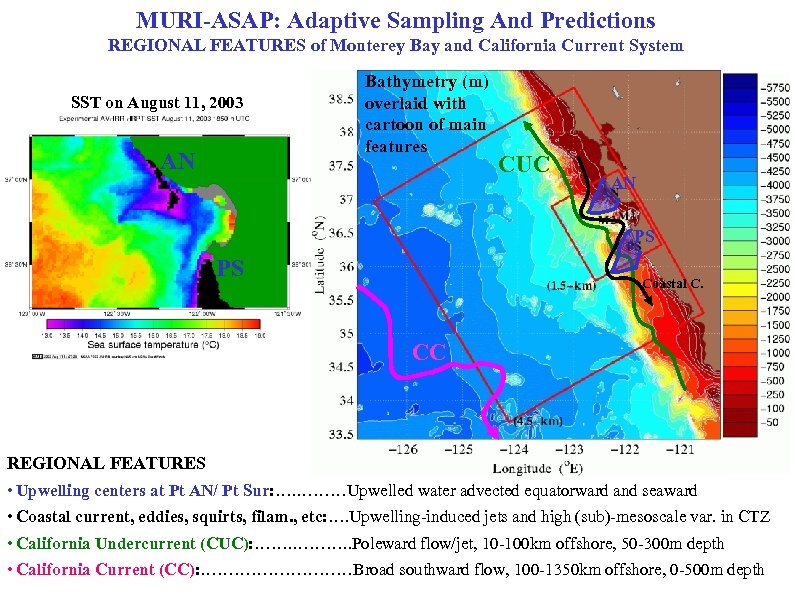 MURI-ASAP: Adaptive Sampling And Predictions REGIONAL FEATURES of Monterey Bay and California Current System SST on August 11, 2003 AN Bathymetry (m) HOPS with overlaid –Nested Domains cartoon of main features CUC AN PS PS Coastal C. CC REGIONAL FEATURES • Upwelling centers at Pt AN/ Pt Sur: …. ………Upwelled water advected equatorward and seaward • Coastal current, eddies, squirts, filam. , etc: …. Upwelling-induced jets and high (sub)-mesoscale var. in CTZ • California Undercurrent (CUC): ……. ………. . Poleward flow/jet, 10 -100 km offshore, 50 -300 m depth • California Current (CC): ……………Broad southward flow, 100 -1350 km offshore, 0 -500 m depth
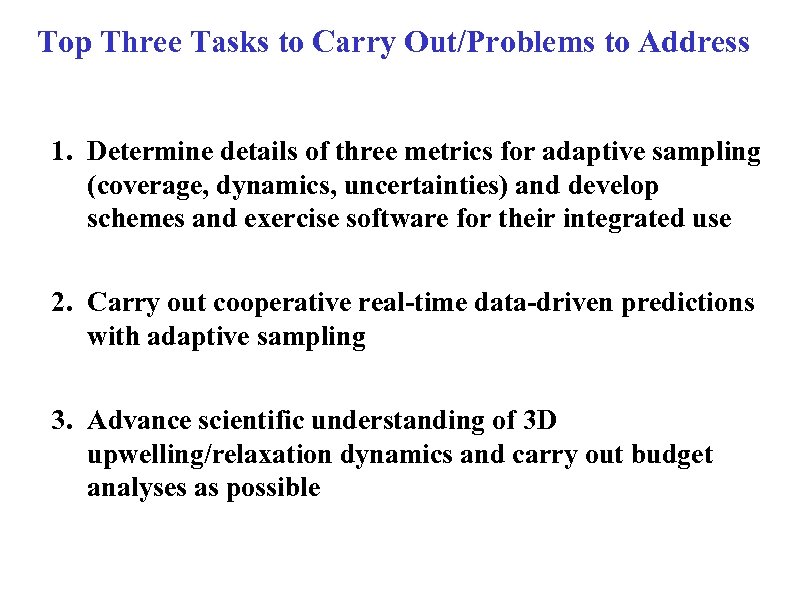 Top Three Tasks to Carry Out/Problems to Address 1. Determine details of three metrics for adaptive sampling (coverage, dynamics, uncertainties) and develop schemes and exercise software for their integrated use 2. Carry out cooperative real-time data-driven predictions with adaptive sampling 3. Advance scientific understanding of 3 D upwelling/relaxation dynamics and carry out budget analyses as possible
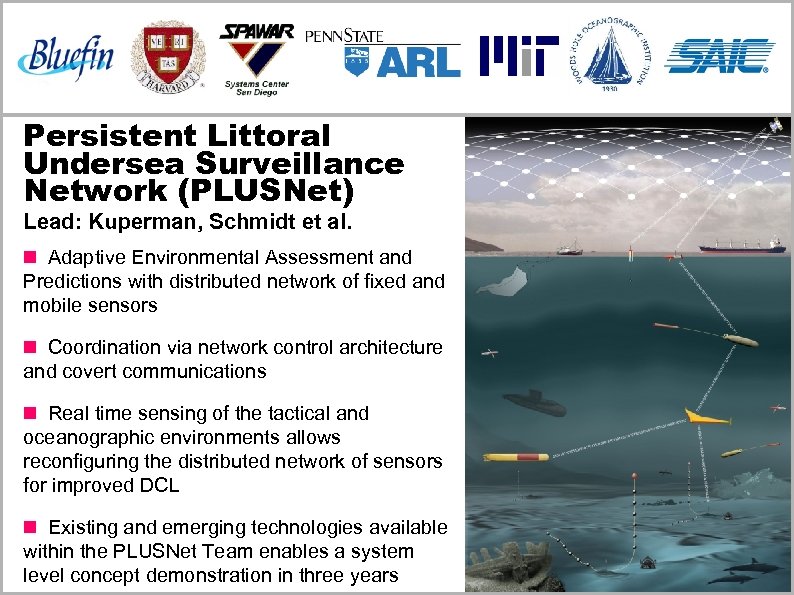 Persistent Littoral Undersea Surveillance Network (PLUSNet) Lead: Kuperman, Schmidt et al. n Adaptive Environmental Assessment and Predictions with distributed network of fixed and mobile sensors n Coordination via network control architecture and covert communications n Real time sensing of the tactical and oceanographic environments allows reconfiguring the distributed network of sensors for improved DCL n Existing and emerging technologies available within the PLUSNet Team enables a system level concept demonstration in three years
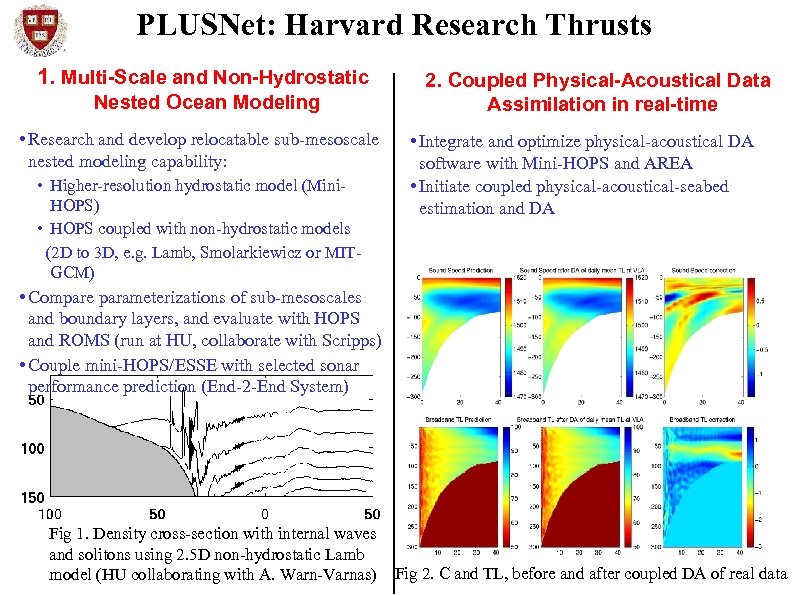 PLUSNet: Harvard Research Thrusts 1. Multi-Scale and Non-Hydrostatic Nested Ocean Modeling • Research and develop relocatable sub-mesoscale nested modeling capability: • Higher-resolution hydrostatic model (Mini. HOPS) • HOPS coupled with non-hydrostatic models (2 D to 3 D, e. g. Lamb, Smolarkiewicz or MITGCM) • Compare parameterizations of sub-mesoscales and boundary layers, and evaluate with HOPS and ROMS (run at HU, collaborate with Scripps) • Couple mini-HOPS/ESSE with selected sonar performance prediction (End-2 -End System) Fig 1. Density cross-section with internal waves and solitons using 2. 5 D non-hydrostatic Lamb model (HU collaborating with A. Warn-Varnas) 2. Coupled Physical-Acoustical Data Assimilation in real-time • Integrate and optimize physical-acoustical DA software with Mini-HOPS and AREA • Initiate coupled physical-acoustical-seabed estimation and DA Fig 2. C and TL, before and after coupled DA of real data
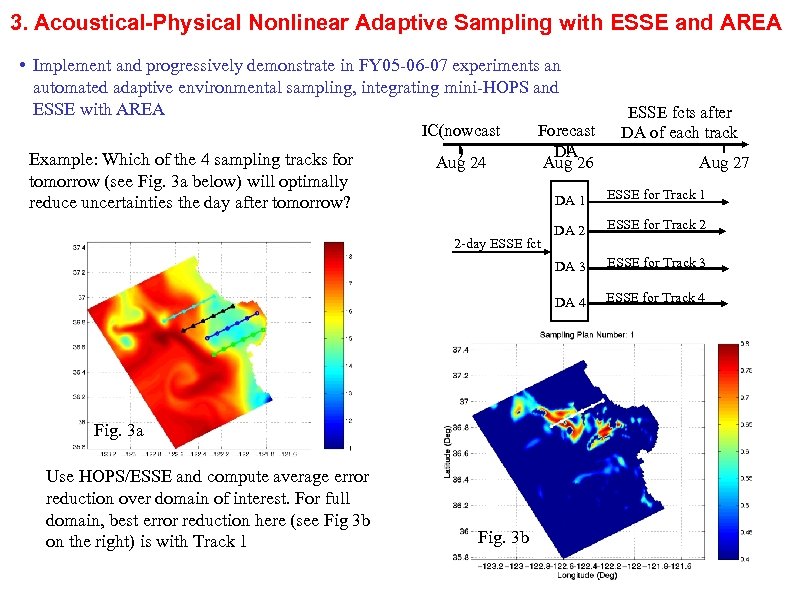 3. Acoustical-Physical Nonlinear Adaptive Sampling with ESSE and AREA • Implement and progressively demonstrate in FY 05 -06 -07 experiments an automated adaptive environmental sampling, integrating mini-HOPS and ESSE with AREA Example: Which of the 4 sampling tracks for tomorrow (see Fig. 3 a below) will optimally reduce uncertainties the day after tomorrow? IC(nowcast ) Aug 24 Forecast DA Aug 26 ESSE fcts after DA of each track Aug 27 DA 1 Use HOPS/ESSE and compute average error reduction over domain of interest. For full domain, best error reduction here (see Fig 3 b on the right) is with Track 1 Fig. 3 b ESSE for Track 2 ESSE for Track 3 DA 4 Fig. 3 a DA 2 DA 3 2 -day ESSE fct ESSE for Track 1 ESSE for Track 4
 AWACS: Modeling Set-Up for Ocean Dynamics (Middle Atlantic Bight Shelfbreak Front – Hudson Canyon): Pierre Lermusiaux, Pat Haley, Oleg Logoutov Division of Engineering and Applied Sciences, Harvard University Present Collaborators: Glen Gawarkiewicz Phil Abbot Kevin Heaney C-S Chiu http: //www. deas. harvard. edu/~pierrel 1. 2. 3. 4. HU Research Goals and Objectives Modeling Domains and Bathymetry Tidal Forcing for 2 -Way nested simulation with new free-surface HOPS Report of ASAP – AWACS Meeting (Princeton, June 24, 2005) AWACS Team Meeting January 11 -12, 2006
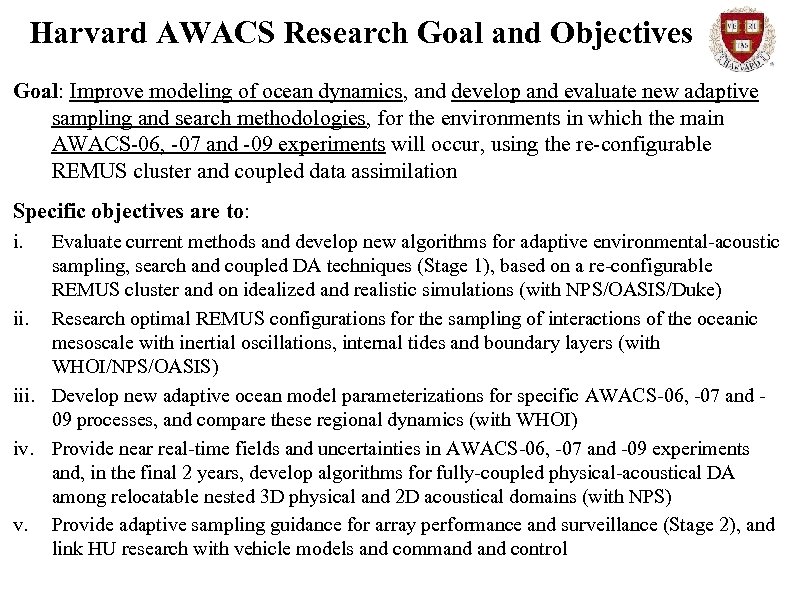 Harvard AWACS Research Goal and Objectives Goal: Improve modeling of ocean dynamics, and develop and evaluate new adaptive sampling and search methodologies, for the environments in which the main AWACS-06, -07 and -09 experiments will occur, using the re-configurable REMUS cluster and coupled data assimilation Specific objectives are to: i. Evaluate current methods and develop new algorithms for adaptive environmental-acoustic sampling, search and coupled DA techniques (Stage 1), based on a re-configurable REMUS cluster and on idealized and realistic simulations (with NPS/OASIS/Duke) ii. Research optimal REMUS configurations for the sampling of interactions of the oceanic mesoscale with inertial oscillations, internal tides and boundary layers (with WHOI/NPS/OASIS) iii. Develop new adaptive ocean model parameterizations for specific AWACS-06, -07 and 09 processes, and compare these regional dynamics (with WHOI) iv. Provide near real-time fields and uncertainties in AWACS-06, -07 and -09 experiments and, in the final 2 years, develop algorithms for fully-coupled physical-acoustical DA among relocatable nested 3 D physical and 2 D acoustical domains (with NPS) v. Provide adaptive sampling guidance for array performance and surveillance (Stage 2), and link HU research with vehicle models and command control
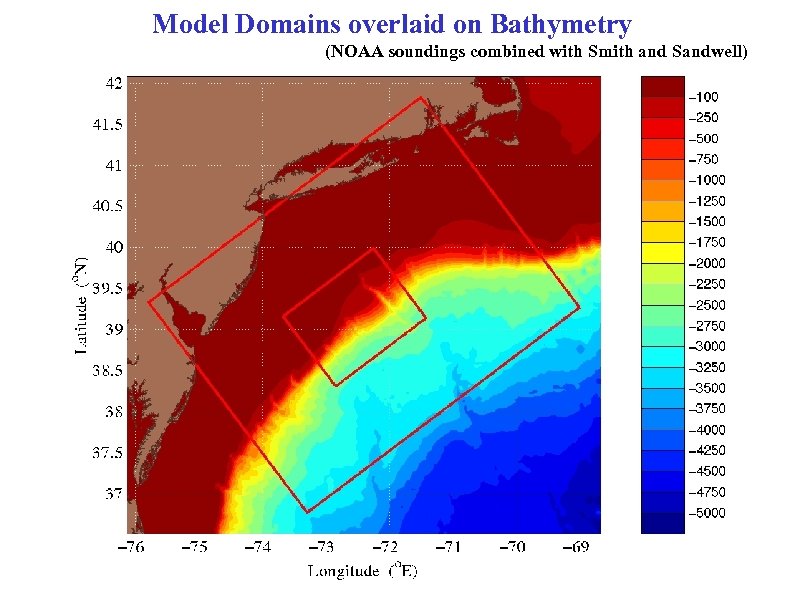 Model Domains overlaid on Bathymetry (NOAA soundings combined with Smith and Sandwell)
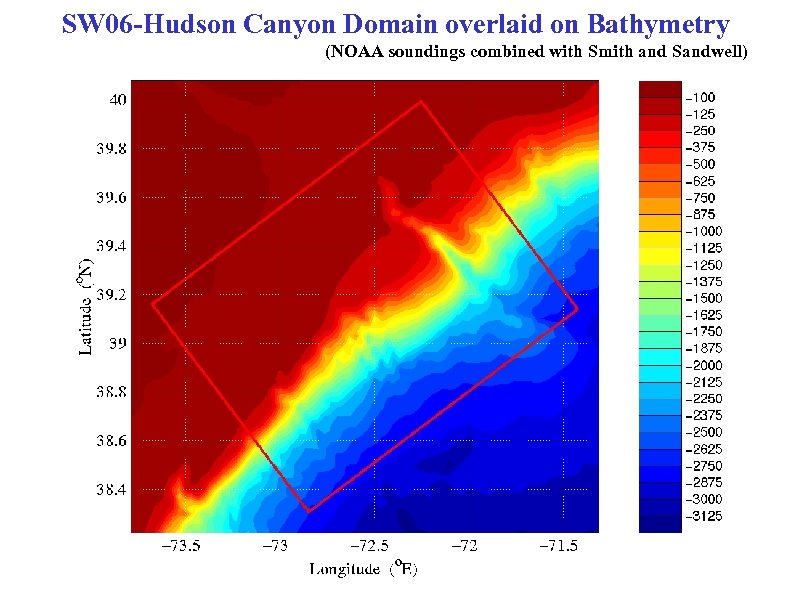 SW 06 -Hudson Canyon Domain overlaid on Bathymetry (NOAA soundings combined with Smith and Sandwell)
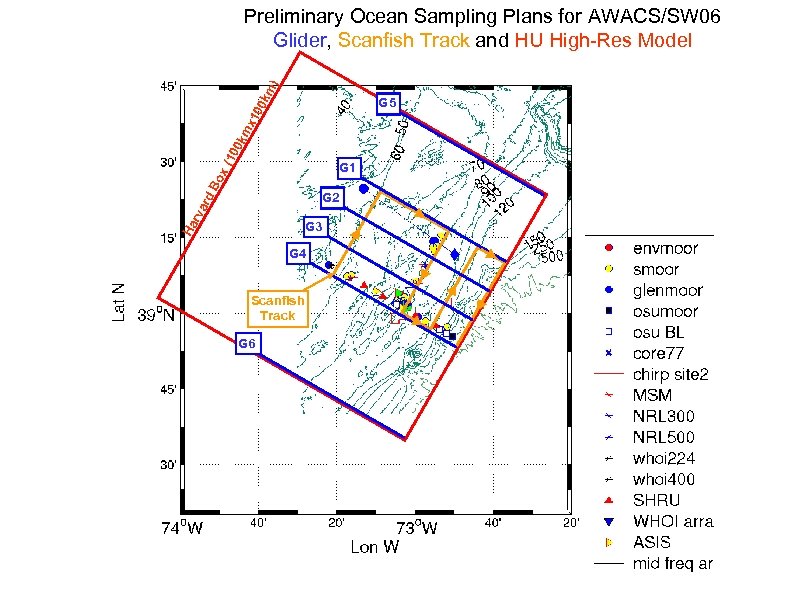 km ) Preliminary Ocean Sampling Plans for AWACS/SW 06 Glider, Scanfish Track and HU High-Res Model (10 0 k m x 1 00 G 5 Bo x G 1 rva rd G 2 Ha G 3 G 4 Scanfish Track G 6