



 Harry S. Truman rd 33 (1884 – 1972), U. S. president (1945 – 60), made the crucial decision to use the atomic bomb to end World War II in the Pacific
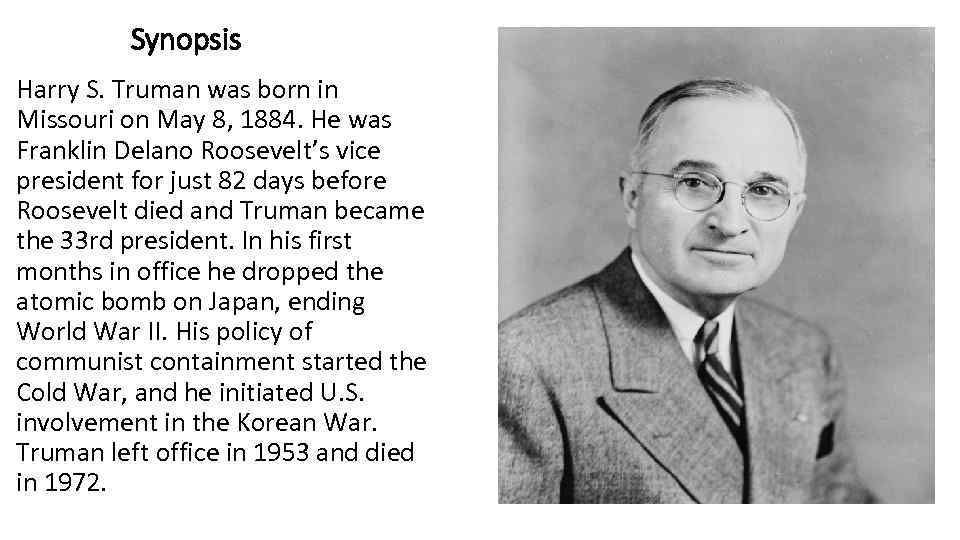 Synopsis Harry S. Truman was born in Missouri on May 8, 1884. He was Franklin Delano Roosevelt’s vice president for just 82 days before Roosevelt died and Truman became the 33 rd president. In his first months in office he dropped the atomic bomb on Japan, ending World War II. His policy of communist containment started the Cold War, and he initiated U. S. involvement in the Korean War. Truman left office in 1953 and died in 1972.
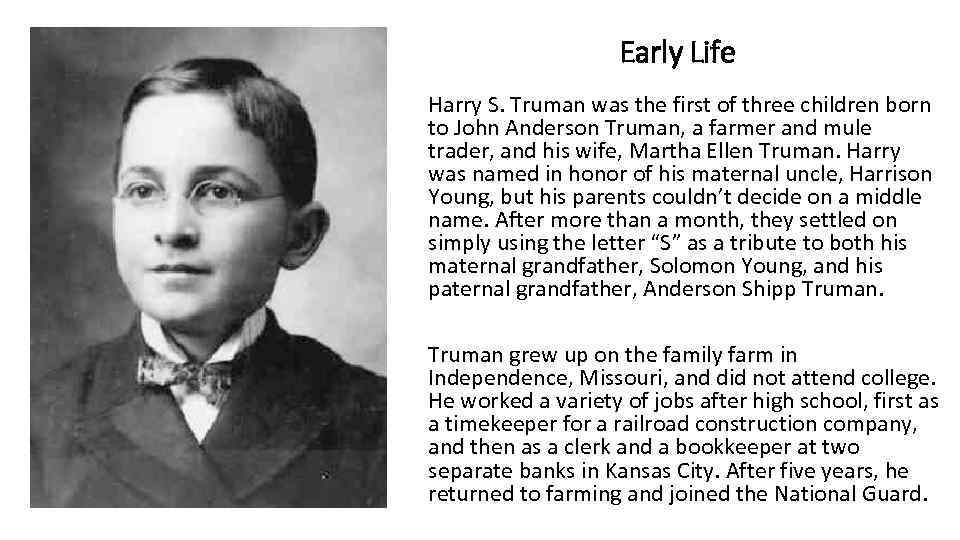 Early Life Harry S. Truman was the first of three children born to John Anderson Truman, a farmer and mule trader, and his wife, Martha Ellen Truman. Harry was named in honor of his maternal uncle, Harrison Young, but his parents couldn’t decide on a middle name. After more than a month, they settled on simply using the letter “S” as a tribute to both his maternal grandfather, Solomon Young, and his paternal grandfather, Anderson Shipp Truman grew up on the family farm in Independence, Missouri, and did not attend college. He worked a variety of jobs after high school, first as a timekeeper for a railroad construction company, and then as a clerk and a bookkeeper at two separate banks in Kansas City. After five years, he returned to farming and joined the National Guard.
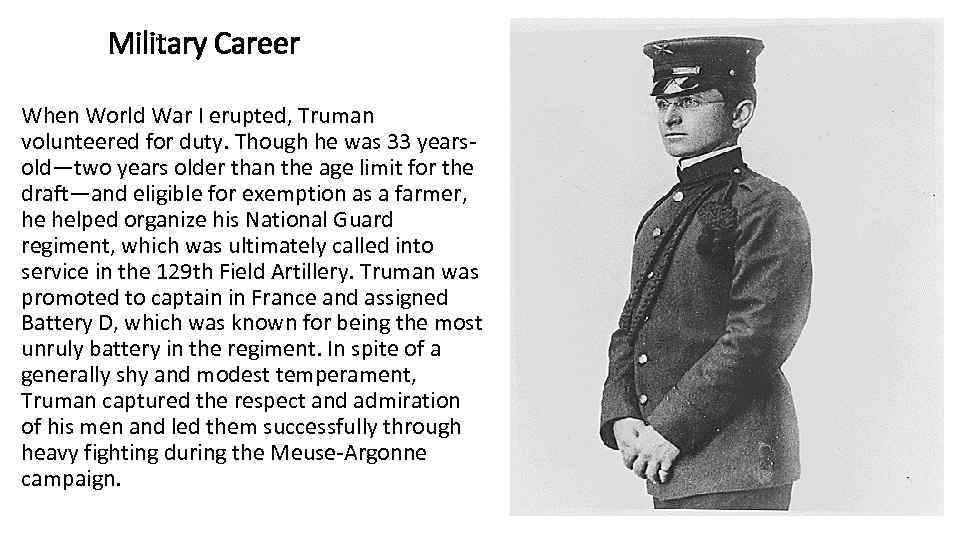 Military Career When World War I erupted, Truman volunteered for duty. Though he was 33 yearsold—two years older than the age limit for the draft—and eligible for exemption as a farmer, he helped organize his National Guard regiment, which was ultimately called into service in the 129 th Field Artillery. Truman was promoted to captain in France and assigned Battery D, which was known for being the most unruly battery in the regiment. In spite of a generally shy and modest temperament, Truman captured the respect and admiration of his men and led them successfully through heavy fighting during the Meuse-Argonne campaign.
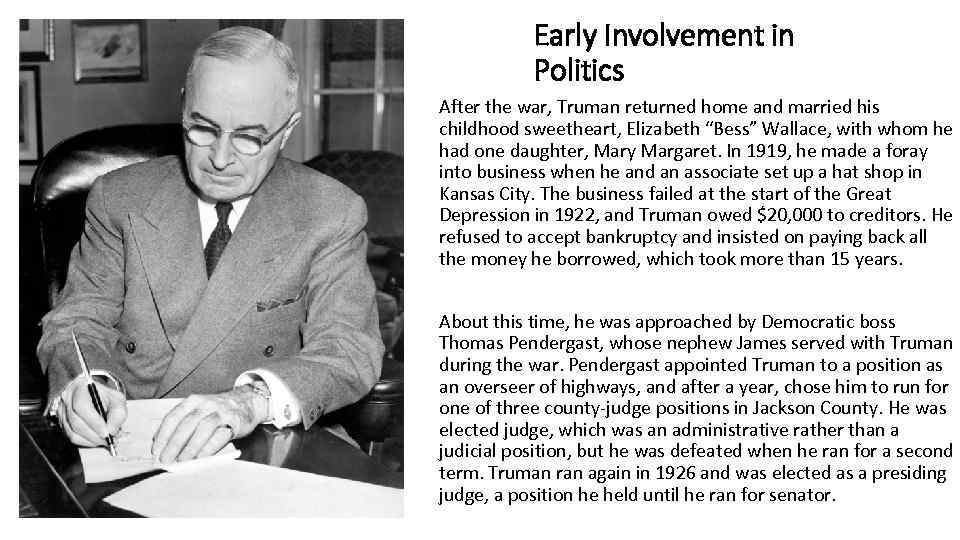 Early Involvement in Politics After the war, Truman returned home and married his childhood sweetheart, Elizabeth “Bess” Wallace, with whom he had one daughter, Mary Margaret. In 1919, he made a foray into business when he and an associate set up a hat shop in Kansas City. The business failed at the start of the Great Depression in 1922, and Truman owed $20, 000 to creditors. He refused to accept bankruptcy and insisted on paying back all the money he borrowed, which took more than 15 years. About this time, he was approached by Democratic boss Thomas Pendergast, whose nephew James served with Truman during the war. Pendergast appointed Truman to a position as an overseer of highways, and after a year, chose him to run for one of three county-judge positions in Jackson County. He was elected judge, which was an administrative rather than a judicial position, but he was defeated when he ran for a second term. Truman ran again in 1926 and was elected as a presiding judge, a position he held until he ran for senator.
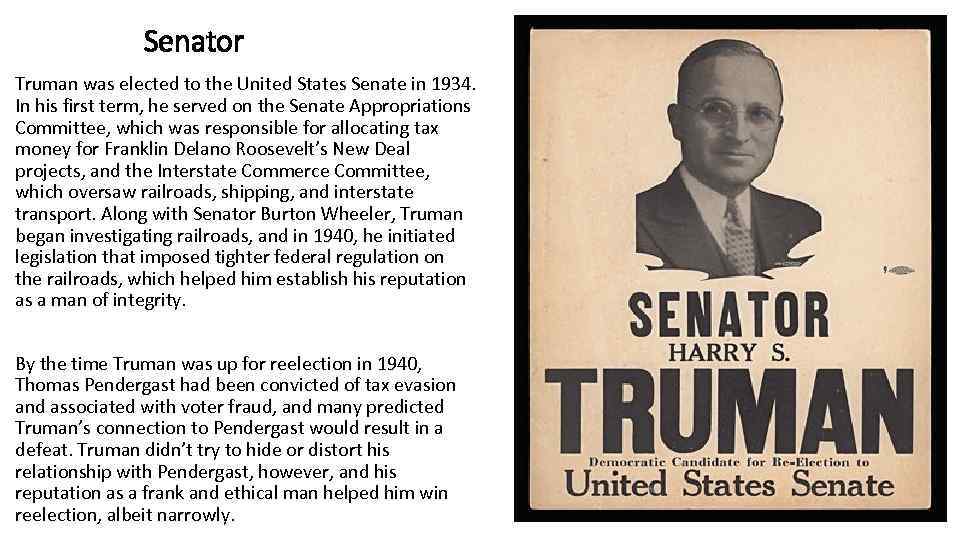 Senator Truman was elected to the United States Senate in 1934. In his first term, he served on the Senate Appropriations Committee, which was responsible for allocating tax money for Franklin Delano Roosevelt’s New Deal projects, and the Interstate Commerce Committee, which oversaw railroads, shipping, and interstate transport. Along with Senator Burton Wheeler, Truman began investigating railroads, and in 1940, he initiated legislation that imposed tighter federal regulation on the railroads, which helped him establish his reputation as a man of integrity. By the time Truman was up for reelection in 1940, Thomas Pendergast had been convicted of tax evasion and associated with voter fraud, and many predicted Truman’s connection to Pendergast would result in a defeat. Truman didn’t try to hide or distort his relationship with Pendergast, however, and his reputation as a frank and ethical man helped him win reelection, albeit narrowly.
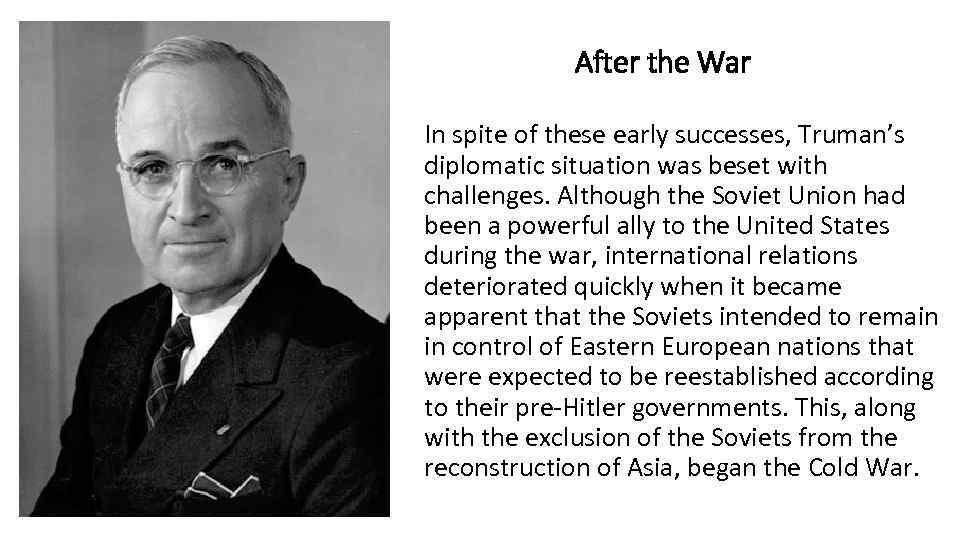 After the War In spite of these early successes, Truman’s diplomatic situation was beset with challenges. Although the Soviet Union had been a powerful ally to the United States during the war, international relations deteriorated quickly when it became apparent that the Soviets intended to remain in control of Eastern European nations that were expected to be reestablished according to their pre-Hitler governments. This, along with the exclusion of the Soviets from the reconstruction of Asia, began the Cold War.
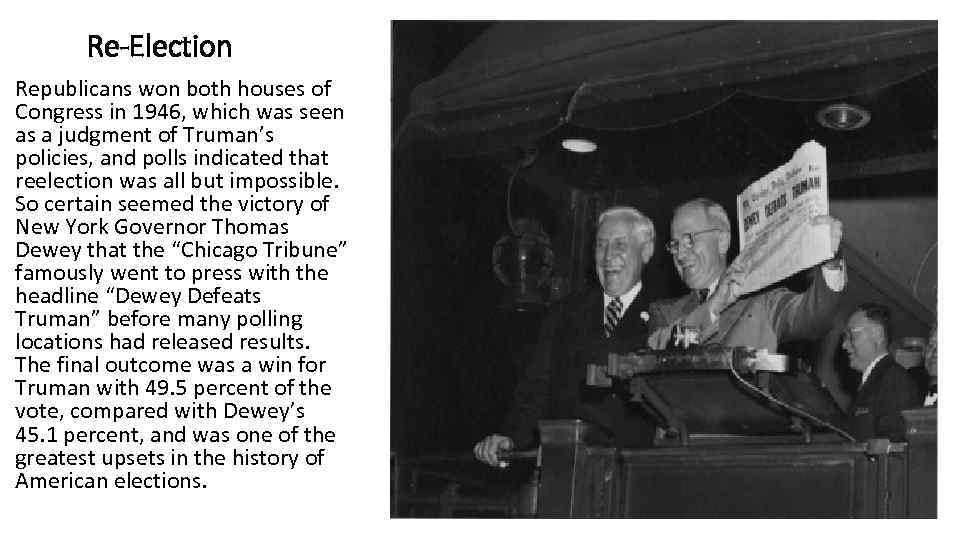 Re-Election Republicans won both houses of Congress in 1946, which was seen as a judgment of Truman’s policies, and polls indicated that reelection was all but impossible. So certain seemed the victory of New York Governor Thomas Dewey that the “Chicago Tribune” famously went to press with the headline “Dewey Defeats Truman” before many polling locations had released results. The final outcome was a win for Truman with 49. 5 percent of the vote, compared with Dewey’s 45. 1 percent, and was one of the greatest upsets in the history of American elections.
 Post-Presidency In March of 1952, Truman announced that he would not run for reelection. He gave his support to Governor Adlai Stevenson, the democratic nominee, though Stevenson was distancing himself from the president because of his poor approval rating. After retiring from the presidency, Truman returned to Independence, Missouri, where he wrote his memoirs, oversaw the construction of his presidential library and took long walks. He died on December 26, 1972, and is buried next to Bess in the courtyard of the Truman Library