


 Скачать презентацию Hardware vs Software Great Example Data Compression l
33d74c844b1566037d0e7cc5b010eab1.ppt
- Количество слайдов: 17
 Hardware vs. Software Great Example: Data Compression l This lecture has a theme: – – Hardware/Devices are getting bigger, meaner, and faster, but Sometimes clever software can make even more of a difference. Designing clever software is often much more cost effective and turn around time is faster. We’ll look at one clever piece of software that beat the hardware
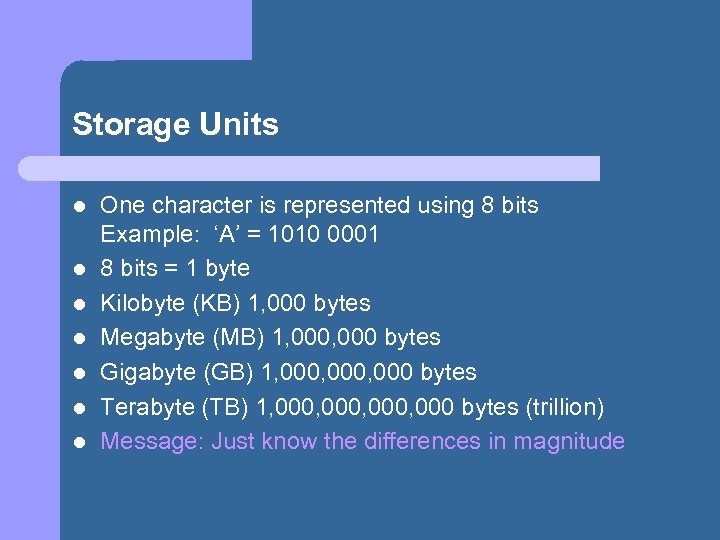 Storage Units l l l l One character is represented using 8 bits Example: ‘A’ = 1010 0001 8 bits = 1 byte Kilobyte (KB) 1, 000 bytes Megabyte (MB) 1, 000 bytes Gigabyte (GB) 1, 000, 000 bytes Terabyte (TB) 1, 000, 000 bytes (trillion) Message: Just know the differences in magnitude
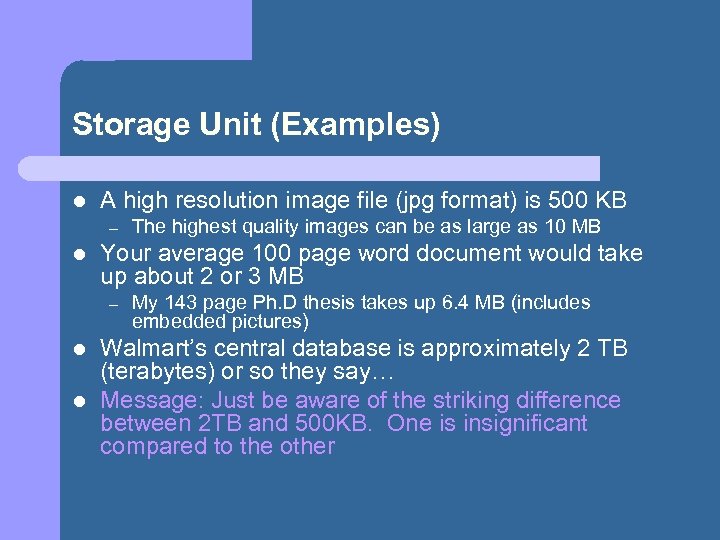 Storage Unit (Examples) l A high resolution image file (jpg format) is 500 KB – l Your average 100 page word document would take up about 2 or 3 MB – l l The highest quality images can be as large as 10 MB My 143 page Ph. D thesis takes up 6. 4 MB (includes embedded pictures) Walmart’s central database is approximately 2 TB (terabytes) or so they say… Message: Just be aware of the striking difference between 2 TB and 500 KB. One is insignificant compared to the other
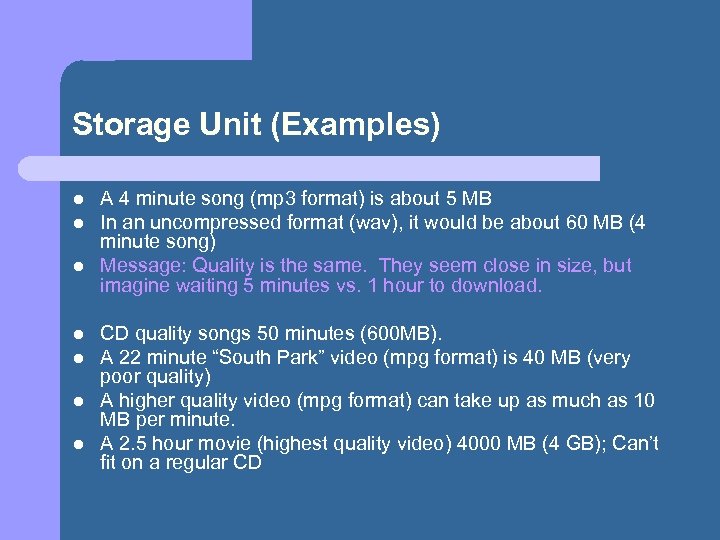 Storage Unit (Examples) l l l l A 4 minute song (mp 3 format) is about 5 MB In an uncompressed format (wav), it would be about 60 MB (4 minute song) Message: Quality is the same. They seem close in size, but imagine waiting 5 minutes vs. 1 hour to download. CD quality songs 50 minutes (600 MB). A 22 minute “South Park” video (mpg format) is 40 MB (very poor quality) A higher quality video (mpg format) can take up as much as 10 MB per minute. A 2. 5 hour movie (highest quality video) 4000 MB (4 GB); Can’t fit on a regular CD
 Storage Unit (Examples) l l l CD quality songs 50 minutes (600 MB). A 22 minute “South Park” video (mpg format) is 40 MB (very poor quality) A higher quality video (mpg format) can take up as much as 10 MB per minute. A 2. 5 hour movie (highest quality video) 4000 MB (4 GB); Can’t fit on a regular CD Message: DVD’s emerged out of necessity to store video. If there was a way to compress it on a CD…?
 Storage Devices l l l 3. 5 Floppy (soon to be obsolete) 1. 4 MB Zip disk: 250 MB + CD ROM 700 MB+ DVD 5 GB + Hard disks 80 GB+ Special disk racks that can hold up to 500 GB in a standard tower case. Message: There is a correspondence between the size of data and where its stored.
 The Real Problem: Transmission not Storage l l 1. 2. Storage devices have kept up with the demand to store larger and larger databases. and to store larger and larger media formats The real problem is transmitting these large files over an Internet that has severe limitations. The solution comes in two forms: Compression algorithms for files that can not be split. Fancy software and new protocols for delivering only the parts of the data that need to be sent.
 Types of Computers Historically, there are have been 5 different types of computers 1. Supercomputers (once a hot area, now 90% of the companies are out of business) 1. 2. Mainframe (still going strong, go figure? ) 1. 3. 4. Generic components, cheap (in many ways), prone to crash Workstations are PC’s but with expensive components 1. 6. Highly fault tolerant, supports multiple users, never shuts off Minicomputers are really just smaller mainframes Microcomputers are PC’s and laptops 1. 5. Custom multiple processors, complex architecture, Cray/SGI was the big player The buzz in the early 90’s, much better memory architecture than PC’s (Sun, SGI, HP, DEC, were the players), 1 year, 244 days and counting…. Message: Nowadays, there is very little difference between the average home computer and the average computer used in business.
 Processors 1. 2. 3. 4. 5. 6. 7. l 8086 Intel Processor (1980) 5 MHz 8 bit 80286 Intel Processor (1984) 8 MHz 20 time faster 16 bit 386 Processor (1988) 20 MHz 32 bit 486 Processor (1991) 66 MHz 32 bit Pentium (would have been 586) 200 MHz 64 bit (bought one in 1994 for $2400) Pentium 4 (2002) 2 GHz $1500 Pentium 4 (2003) 3. 2 GHz $1000 Message: There a lot of messages here.
 Processors l l Is Intel the only manufacturer of processors? No! IBM probably sells more processors but they are for other devices: cell phones, lab instruments, cars, etc. Other processor manufacturers: – – – Apple (Mac) Motorola AMD Sun Microsystems Patriot Scientific Message: Computing is not just about PC’s
 Processor Speed l l l 1 MHz means that the processor cycles (i. e. , processed an instruction 1, 000 times per second). However, this is a very basic instruction. Adding two numbers sometimes can require as many as 4 or 5 basic instructions In theory, a 2 GHz processor should be able to perform 2 billion instructions in just one second. In practice, it’ll do around 400 to 500 million Why?
 Memory Two kinds of memory: Storage and RAM l Storage: Hard Disk, CDRW, Zip disk, floppy l RAM (Random Access Memory): Memory chips used to store working programs and data. l RAM is much faster than storage l Faster means the stored data can be delivered to the processor in less time. Message: Memory is currently the processing bottleneck. The memory can not deliver instructions to the processor fast enough. l
 Miniaturization l l l The key to making processors and memory faster is to make them smaller Smaller things are closer together. Thus, it takes less time for the signal to travel from one component to another. Also, if your “wires” are very small you can connect thousands or millions of wires in a small space (bandwidth) In about 6 -7 years, we will reach a critical limit where it will be very hard to make things smaller. Currently, the big buzz is nanocell computers; the processor and its connections are built with units that are as small as a molecule (several atoms).
 Where are things going l l l Mobile computing Computers in everything: beepers, phones, cars, even the fridge How about a mini computer in your credit card? – l Its already in development Computers will be part of everything – – X 10 Part of a new house, just like plumbing
 Theme l l Even though processors are getting so fast and so cheap, we can NOT count on this to continue indefinitely. There are two main issues: 1. 2. We might hit a physical brick wall in terms of physical limitations on miniaturization There is a need to put computer-like processors in devices that need to be l l very small very cheap
 Theme l Thus, the industry is eventually going to have to look into clever ways of making programs – – l more efficient more reliable Thus, there is a need for better – – software engineering more efficient integration of hardware and software.
 Homework l l Skim through pages 38 -60. but concentrate on 41 -53 (read these pages more carefully) Read 110 -114. Next, we are going to study one detailed example of compression.