 Скачать презентацию Hard Choices Ahead Strumpshaw 30 th September 2003
13c9a1421176f6be09e6a51d0f88a7cd.ppt
- Количество слайдов: 60



Hard Choices Ahead Strumpshaw 30 th September 2003 Keith Tovey M. A. , Ph. D, CEng, MICE Energy Science Director: Low Carbon Innovation Centre School of Environmental Sciences
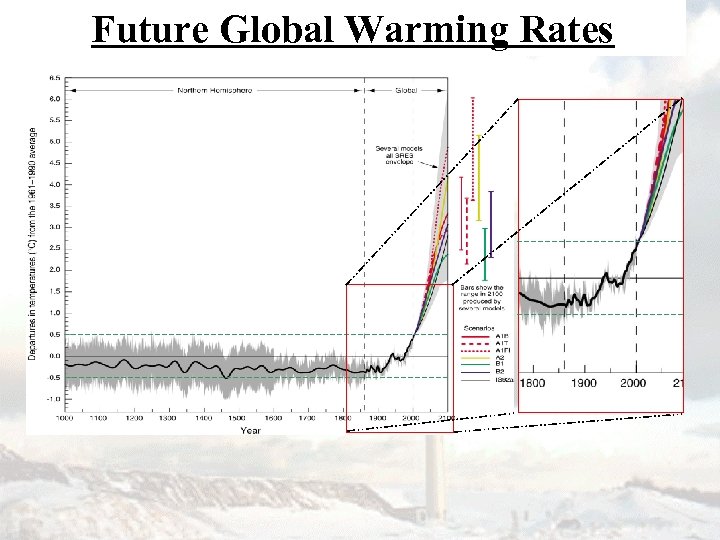
Future Global Warming Rates
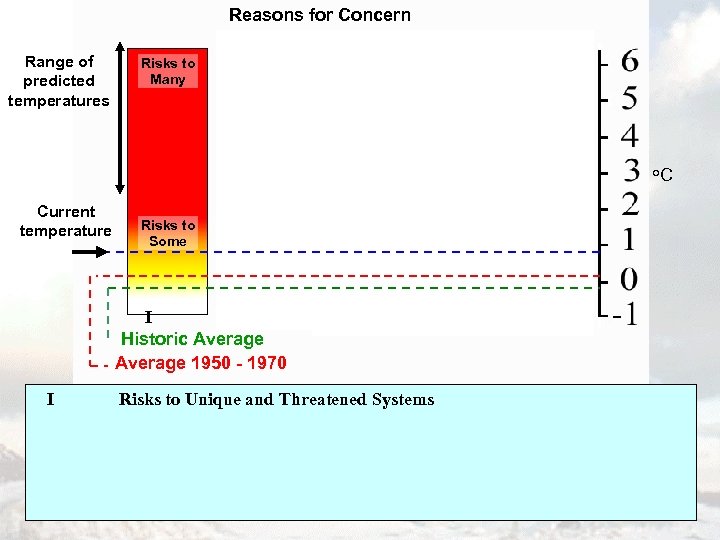
Reasons for Concern Range of predicted temperatures Current temperature Risks to Many Risks to Some Large Increase I II Historic Average 1950 - 1970 I II IV V Negative for most Regions Negative for some Regions III Net Negative for all markets most Some positive/ some negative Most people adversely affected IV Risks to Unique and Threatened Systems Risks from Extreme Climatic Events Distribution of Impacts Aggregate Impacts Risks from Future Large Scale Discontinuities Higher Risk o. C Very Low Risk V
Local impacts • Norfolk in that part of the UK which is likely to be most impacted. • Re-distribution of rainfall; lower summer rainfall. • Maybe more flooding in winter • Landscape/agriculture changes Regionally/Globally More severe weather droughts; floods; crop failures etc.
Government Response • Energy White Paper – aspiration for 60% cut in CO 2 emissions by 2050 • Will require unprecedented partnership activity in local communities to ensure on track by 2020 s (– but no indication of how this will be undertaken) “There will be much more local generation, in part from medium to small local/community power plant, fuelled by locally grown biomass, from locally generated waste, and from local wind sources. These will feed local distributed networks, which can sell excess capacity into the grid. ’’ - Energy White Paper: February 2003
The CRed ambition To engage, enthuse and empower a large, diverse community to debate, plan and execute a programme to reduce carbon emissions by up to 60% by 2025 • Can a local community take on the responsibility for starting to confront the challenge of climate change and make a difference? • Or will it continue to be - someone/somewhere else? • Can we encourage politicians/officials to be bolder on our behalf? • “exemplar for the world”
The CRed Community • • Participatory/inclusive Partnerships Modes of participation (targets/methods) Matrix of modes of participation = representative of real -world complexity • Spark imaginations • Centred on Norwich/Norfolk, but links across the region, country, the world….
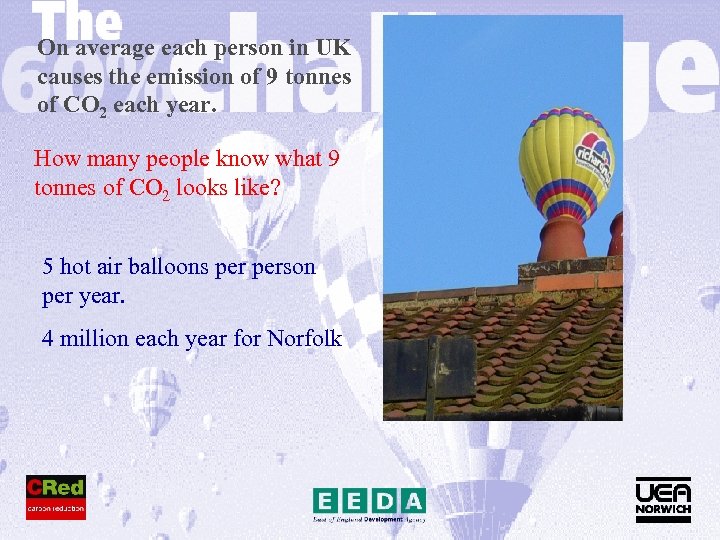
On average each person in UK causes the emission of 9 tonnes of CO 2 each year. How many people know what 9 tonnes of CO 2 looks like? 5 hot air balloons person per year. 4 million each year for Norfolk
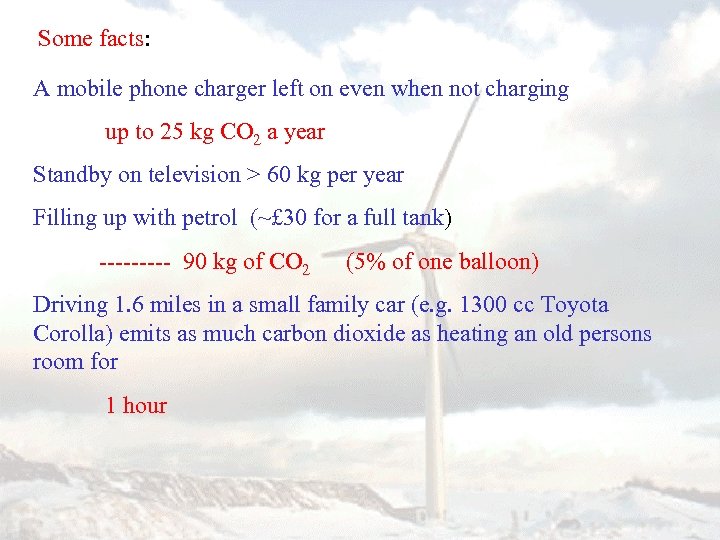
Some facts: A mobile phone charger left on even when not charging up to 25 kg CO 2 a year Standby on television > 60 kg per year Filling up with petrol (~£ 30 for a full tank) ----- 90 kg of CO 2 (5% of one balloon) Driving 1. 6 miles in a small family car (e. g. 1300 cc Toyota Corolla) emits as much carbon dioxide as heating an old persons room for 1 hour

How to use your to Cred beat global warming University aims to shame ministers into tougher action Ian Sample, science correspondent - Wednesday August 27, 2003 A group of scientists in East Anglia has launched an ambitious campaign to tackle threat of global warming in an effort to shame ministers into stronger action on climate change. The task they have set themselves is formidable: to slash the region's emissions of carbon dioxide in half the time the government believes is possible. At first glance, the project, known as Cred, for carbon reduction, might easily be dismissed as well-meaning nonsense. But the team behind it, Keith Tovey and his colleagues at the University of East Anglia, belong to the most prestigious environmental science department in the country. "If anyone is going to do this, they will, " said Dennis Thouless whose Norwich-based company, Global Commodities, collects used cooking oil from local businesses and turns it into fuel. The Cred project was set up in response to the government's white paper on energy, published in February. "The government pledged that they would be pushing to reduce carbon dioxide emissions by 60% by the year 2050, " Dr Tovey said. "It looked impressive and sounded good, but didn't give any clues on how to do it. To put it bluntly, there were too many agendas being thrown around. " The result was a statement of high intention that lacked any practical guidance. Growing frustration at the government's dithering has spurred Dr Tovey's team into action. They have taken the government's stated target of 60% reduction in carbon dioxide emissions, which according to the royal commission on environmental pollution is vital to avoid the adverse effects of climate change, and pledged that East Anglia would meet it in half the time. "If we can show that the people here can achieve this target by 2025, we can turn around and say to everybody else, 'What's your excuse? '" Dr Tovey said. Enthusiasm for the project has snowballed. Local businesses have submitted themselves to scrutiny, to see how much electricity they are wasting. School children have had crash courses in saving energy. Night classes have been set up to teach people the fine art of making solar cells that, strapped to their roofs, will give hot water. Others have gone step further and installed silicon-based panels on their roofs that convert sunlight into electricity. Dr Tovey is talking to the Diocese of Norwich to try to get the Anglican church on board. "East Anglia has more than 600 churches, " he said. "Because churches are all built running east to west, it means they've got a huge area of roof that's facing south, so they're perfect for catching the sun. " "It would be very hard not to agree with the aims of the Cred project, " said the Rev Jan Mac. Farlane, the Bishop of Norwich's chaplain. "And if there's a possibility of generating some income, why not? " But Dr Tovey knows that slashing carbon dioxide in East Anglia will have little impact on global climate change. The people of East Anglia produce 6. 5 m tonnes of carbon dioxide a year, Enthusiasm for the project has snowballed. Local businesses have submitted themselves to scrutiny, to see how much electricity they are wasting. School children have had crash courses in saving energy. Night classes have been set up to teach people the fine art of making solar cells that, strapped to their roofs, will give hot water. Others have gone step further and installed silicon-based panels on their roofs that convert sunlight into electricity. Dr Tovey is talking to the Diocese of Norwich to try to get the Anglican church on board. "East Anglia has more than 600 churches, " he said. "Because churches are all built running east to west, it means they've got a huge area of roof that's facing south, so they're perfect for catching the sun. " "It would be very hard not to agree with the aims of the Cred project, " said the Rev Jan Mac. Farlane, the Bishop of Norwich's chaplain. "And if there's a possibility of generating some income, why not? "
Ida-Anglia näitab maailmale eeskuju süsihappegaasierituse piiramisel 27/08/03 07: 49: 56 Arni Alandi Rühm Suurbritannia Ida-Anglia teadlasi algatas suurejoonelise kampaania tulemaks toime üleilmse kliimasoojenemise ohuga ning häbistamaks ministreid, kes kliimamuutuse ärahoidmiseks liiga vähe ette on võtnud. Teadlased on endale püstitanud aukartustäratava ülesande: vähendada piirkonna süsihappegaasi õhkupaiskamist poole lühema aja jooksul valitsuse määratud graafikust. Esmapilgul võib Credi nime kandev projekt tunduda mittemidagiütleva mõttetusena. Ühendkuningriigi teadlased usuvad, et nii see siiski pole, sest projekti taga seisavad väga väärikad ja tunnustatud teadlased. Ida-Anglia ülikooli keskkonnateaduste õppetooli peetakse parimaks omataoliseks kogu Suurbritannias. Kateedrit juhivad Keith Tovey ja tema kolleegid. “Kui keegi nii julge lubaduse täitmisega hakkama saab, siis just Tovey rühm” on Dennis Thouless, firma Global Commodities juht, kindel. Thoulessi firma kogub kohalikelt ettevõtteilt kasutatud toiduõli, et seda autokütuseks töödelda. Cred loodi vastusena valitsuse veebruaris välja antud “valgele energeetikapaberile”. Dokumendis tõotab valitsus vähendada süsihappegaasieritust 2050. aastaks 60 protsendi võrra.
Effet de serre : East Anglia montre l’exemple lundi 15 septembre 2003, par collecte CND R. E. Un groupe de scientifiques de l’université d’East Anglia, à l’Est de l’Angleterre, a lancé une campagne pour accélérer la réduction des émissions de dioxyde de carbone de la région. Baptisée CRed (pour Carbon Reduction Project), cette initiative ambitionne d’aller deux fois plus vite que les prévisions gouvernementales. Le projet a été lancé en réaction au livre blanc sur l’énergie publié en février dans lequel le gouvernement s’était fixé comme objectif une diminution de 60% des émissions de ce polluant d’ici 2050. Les responsables de CRed veulent y parvenir dès 2025. Pour cela, Keith Tovey et ses collègues ont réussi à mobiliser entreprises locales et particuliers pour faire des économies d’énergie et installer des panneaux photovoltaïques sur les toits. La prochaine étape consiste à rallier l’Eglise anglicane à leur cause. Exposées plein sud, les églises ont en effet de larges toitures qui peuvent capter l’énergie du soleil. Or, la région d’East Anglia compte plus de 600 chapelles. Si les scientifiques sont conscients du peu d’impact sur le changement climatique de leur action, ils comptent cependant provoquer d’autres initiatives. Une délégation japonaise est déjà intéressée par le projet.
ecologia e ambiente SULL’EFFETTO SERRA L’EAST ANGLIA DA’ L’ESEMPIO dalla redazione di Bruxelles, 15 settembre - Un gruppo di scienziati dell’università di East Anglia (Inghilterra) ha lanciato una campagna per accelerare la riduzione delle emissioni di anidride carbonica della regione. Battezzato CRed (Carbon Reduction Project), l’iniziativa ha l’ambizione di andare due volte più veloce delle previsioni governative. Il progetto (http: //www. cred-uk. org/index. aspx) è stato lanciato il reazione al Libro Bianco sull’energia pubblicato in febbraio nel quale il governo britannico aveva fissato come obiettivo una diminuzione del 60% delle emissioni di CO 2 entro il 2025. Per riuscire nell’impresa, Keith Tovey e i suoi colleghi sono riusciti a mobilitare le aziende locali e i cittadini per avviare programmi di efficienza e risparmio energetico e installare pannelli fotovoltaici. La prossima tappa consiste nel convincere la Chiesa anglicana a dar loro il suo sostegno. Esposte in pieno sud, le chiese hanno infatti grandi tetti che sono ideali per installare impianti che captano energia solare, e nella regione di East Anglia ci sono più di 600 tra chiese e cappelle. Benché gli scienziati siano coscienti dello scarso impatto della loro iniziativa sul cambiamento climatico, contano tuttavia di promuovere altre iniziative. Una delegazione giapponese si è già interessata al progetto. Indice ecologia e ambiente
The Times: Weather Eye: September 22, 2003 - Paul Simons THE Right Rev John Oliver, the Bishop of Hereford, is promoting a novel idea to help to cut the UK’s carbon dioxide emissions — he would like to use church roofs for solar panels in order to generate electricity. “Most churches were built with roofs with a north-south aspect, which is ideal for catching sunlight, ” he explains. Aesthetic considerations are helped by photovoltaic solar cells that can be made to look like roof slates.
Some Facts: • Photo Voltaic Cells are becoming progressively cheaper • Efficiencies of collectors are improving • Grants of up to 70% of capital cost are available • Photo voltaic cells can be manufactured in a variety of forms - even made to look like tiles - or made in the form which can be rolled out for easy installation. • They can be easily connected to the Grid and sell surplus electricity while allowing import when no solar energy is available.
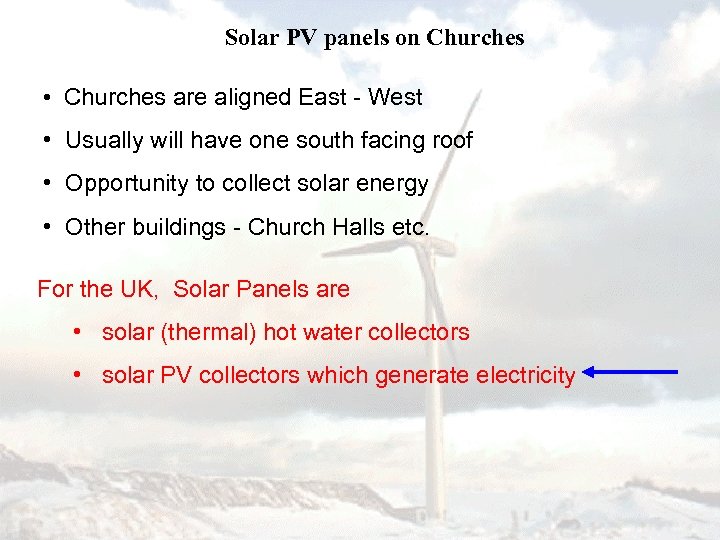
Solar PV panels on Churches • Churches are aligned East - West • Usually will have one south facing roof • Opportunity to collect solar energy • Other buildings - Church Halls etc. For the UK, Solar Panels are • solar (thermal) hot water collectors • solar PV collectors which generate electricity
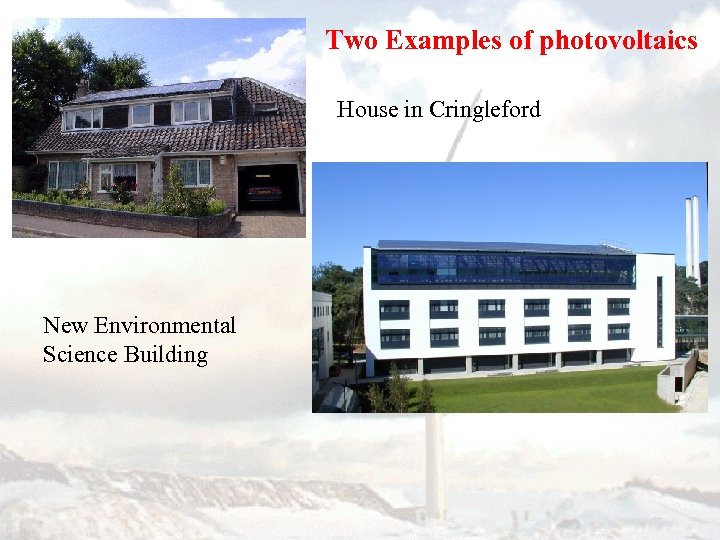
Two Examples of photovoltaics House in Cringleford New Environmental Science Building
How might such a project be funded? • They are expensive, but are about to improve in efficiency and come down in price. • There are grants available 50+% towards cost • For community buildings, there is the possibility to tap funds now available from the Landfill Tax. • On average, 1 sq m will provide about 100 k. Wh of electricity each year
How might income for such a project be obtained? • “Rent a Roof” scheme • Net Electricity use • Sell all electricity to obtain Renewable Obligation Certificates (“ROCs”)
Wind Energy • Each Wind Turbine the size of Swaffham will supply electricity for about 1000 homes. • Each turbine will save around 1700 tonnes of carbon dioxide • Economics of Wind Energy makes it the most attractive renewable option. New Approach: Community Initiative promoted by the community for the community
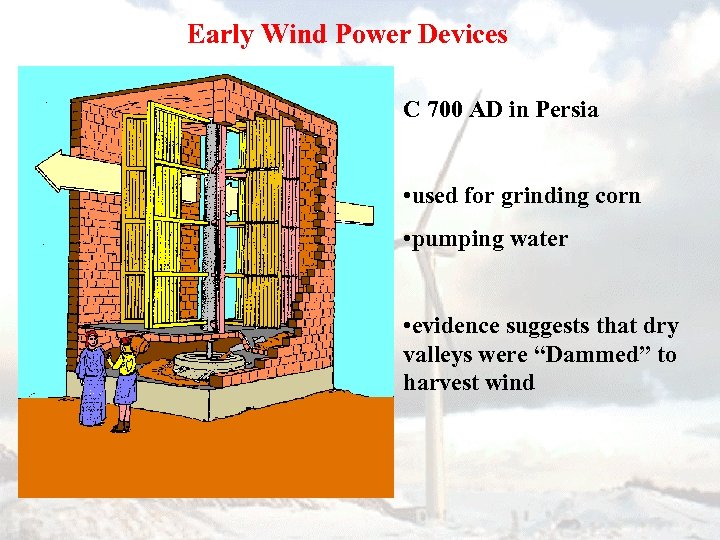
Early Wind Power Devices C 700 AD in Persia • used for grinding corn • pumping water • evidence suggests that dry valleys were “Dammed” to harvest wind
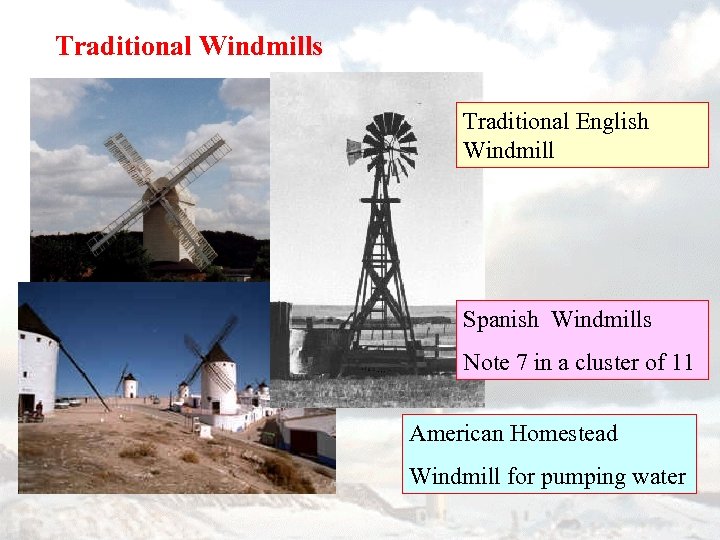
Traditional Windmills Traditional English Windmill Spanish Windmills Note 7 in a cluster of 11 American Homestead Windmill for pumping water
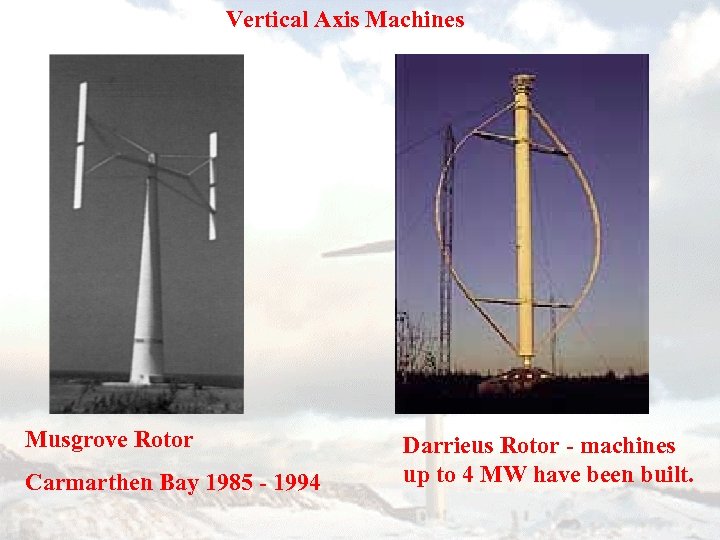
Vertical Axis Machines Musgrove Rotor Carmarthen Bay 1985 - 1994 Darrieus Rotor - machines up to 4 MW have been built.
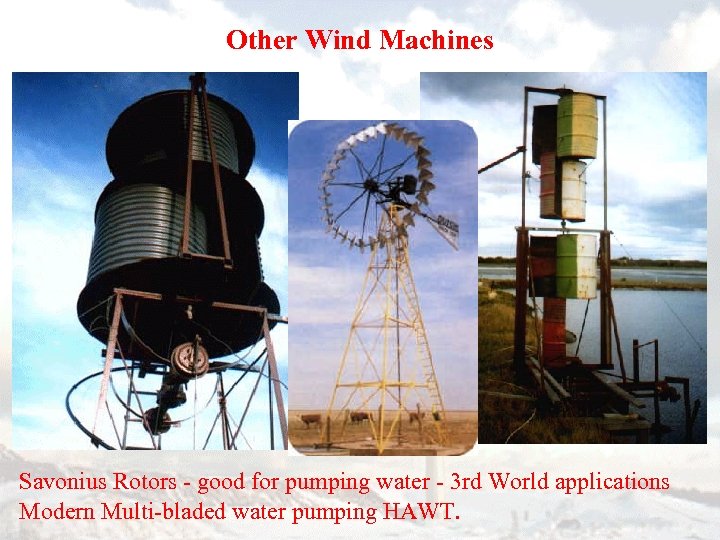
Other Wind Machines Savonius Rotors - good for pumping water - 3 rd World applications Modern Multi-bladed water pumping HAWT.
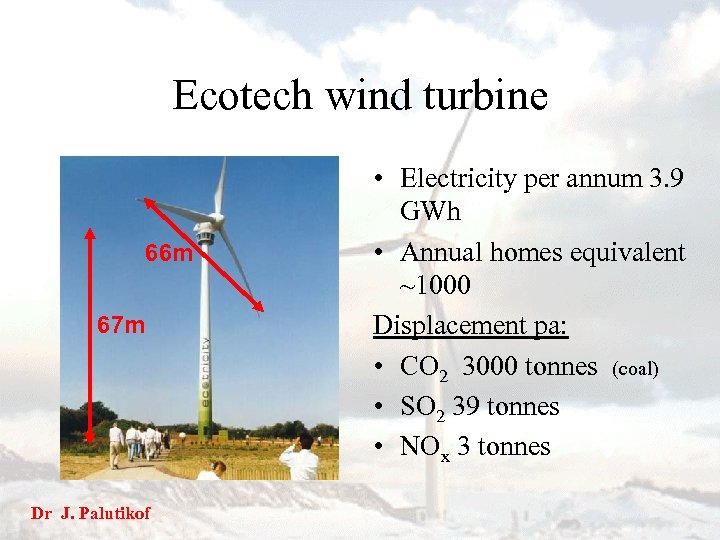
Ecotech wind turbine 66 m 67 m Dr J. Palutikof • Electricity per annum 3. 9 GWh • Annual homes equivalent ~1000 Displacement pa: • CO 2 3000 tonnes (coal) • SO 2 39 tonnes • NOx 3 tonnes
How are we going to meet these demands for electricity in the future? The Energy Review indicates 10% by renewables by 2010 and 20% by 2020. “In order to get more than 10% of electricity from renewables by 2010 and 20% by 2020, build rates for the leading options would need to be at levels never before seen in the UK. Onshore and offshore wind would need to be installed at a rate of between 1 -2 GW per year “(i. e. 1000 - 1500 turbines the size of Swaffham every year). “However, 1. 5 GW and 1. 6 GW of onshore wind was built in Germany in 1999 and 2000 respectively, and a further 1. 2 GW was installed in 2001. Build rates of 1 GW per year were also seen Spain in 2000, and 600 MW in Denmark in the same year. ”
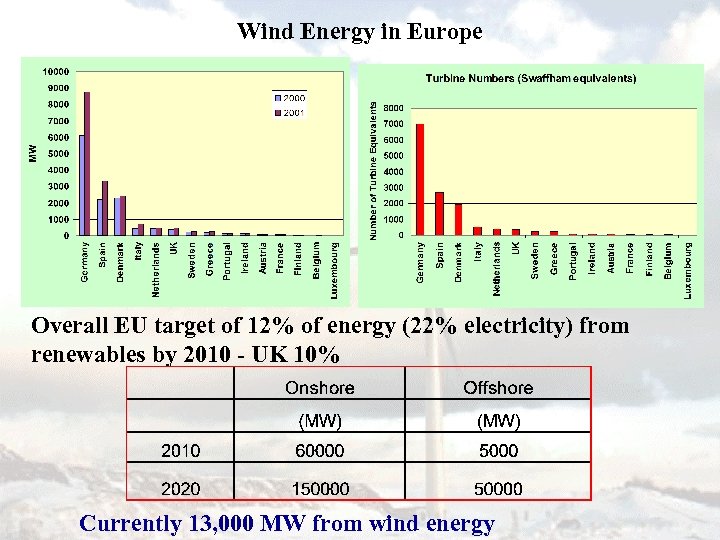
Wind Energy in Europe Overall EU target of 12% of energy (22% electricity) from renewables by 2010 - UK 10% Currently 13, 000 MW from wind energy
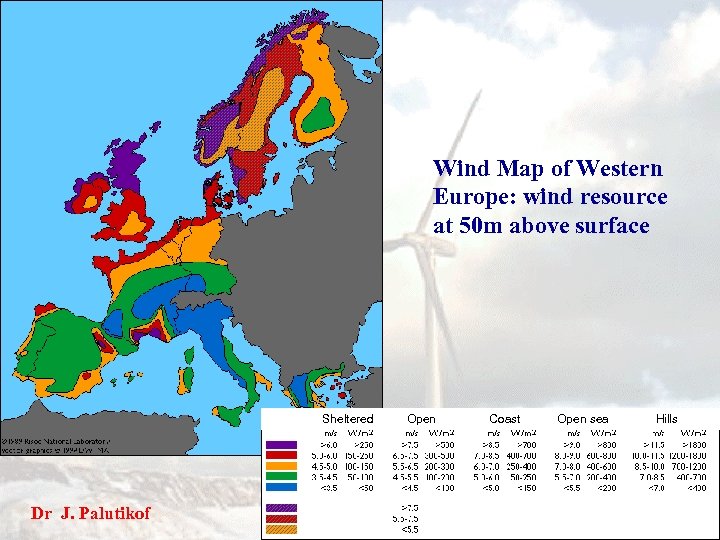
Wind Map of Western Europe: wind resource at 50 m above surface Sheltered Dr J. Palutikof Open Coast Open sea Hills
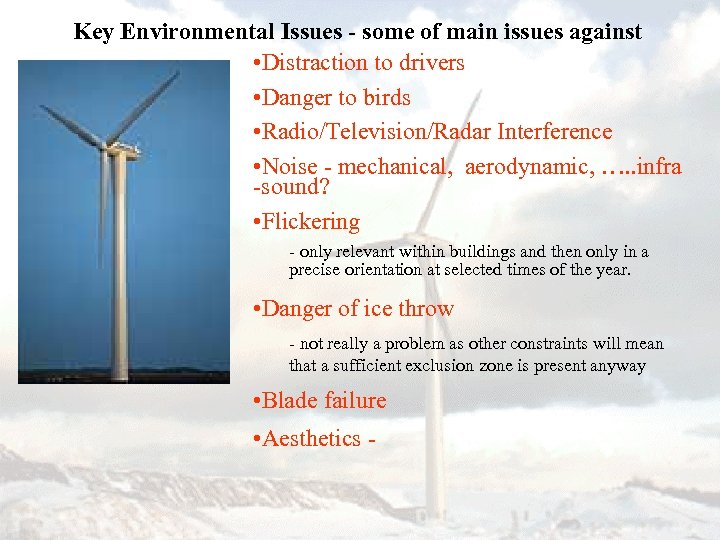
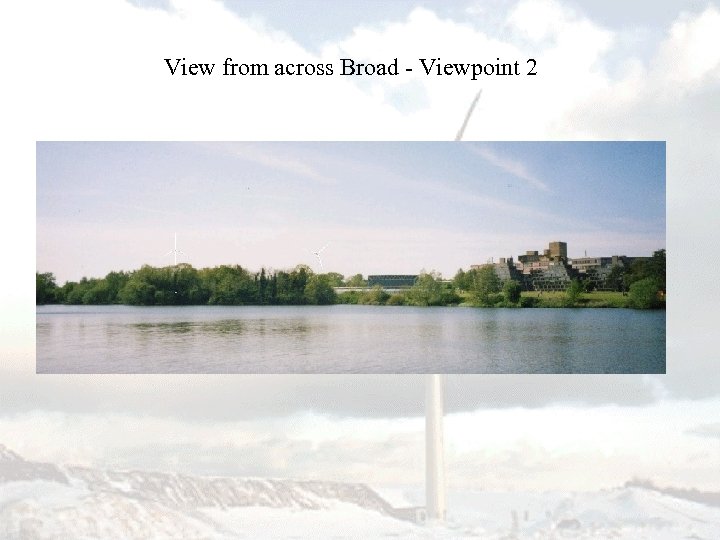
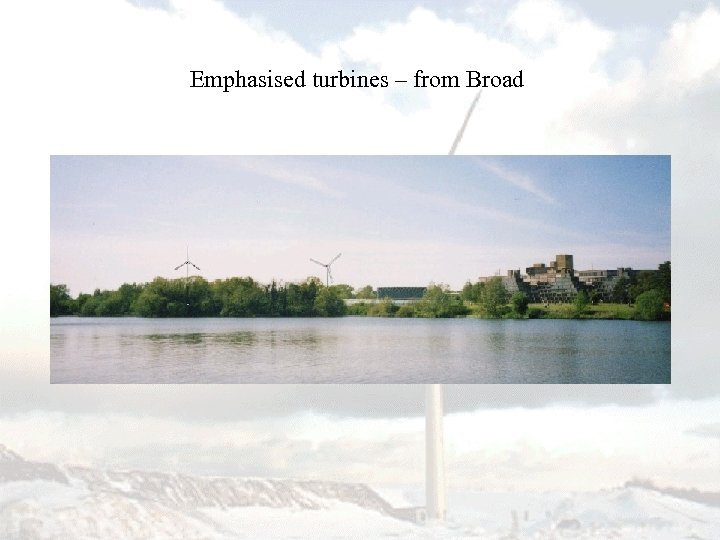
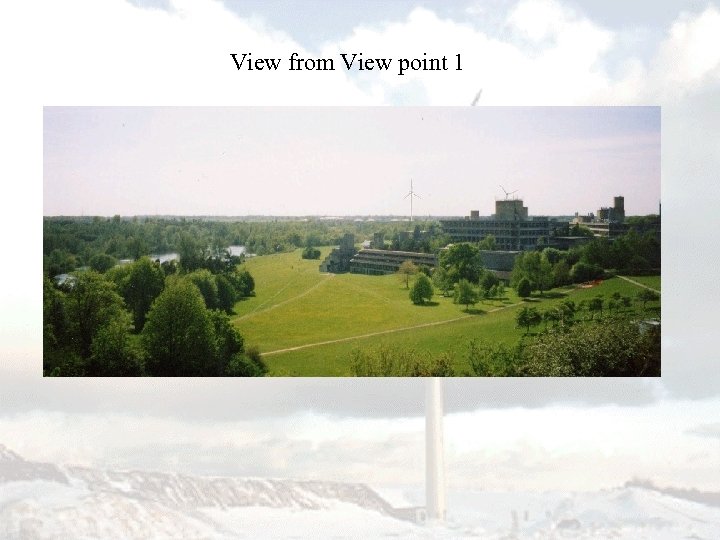
Key Environmental Issues - some of main issues against • Distraction to drivers • Danger to birds • Radio/Television/Radar Interference • Noise - mechanical, aerodynamic, …. . infra -sound? • Flickering - only relevant within buildings and then only in a precise orientation at selected times of the year. • Danger of ice throw - not really a problem as other constraints will mean that a sufficient exclusion zone is present anyway • Blade failure • Aesthetics -
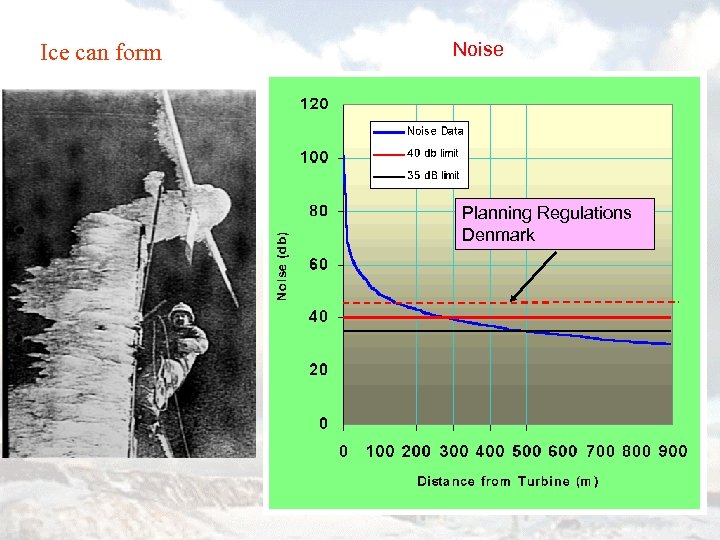
Ice can form Noise Planning Regulations Denmark
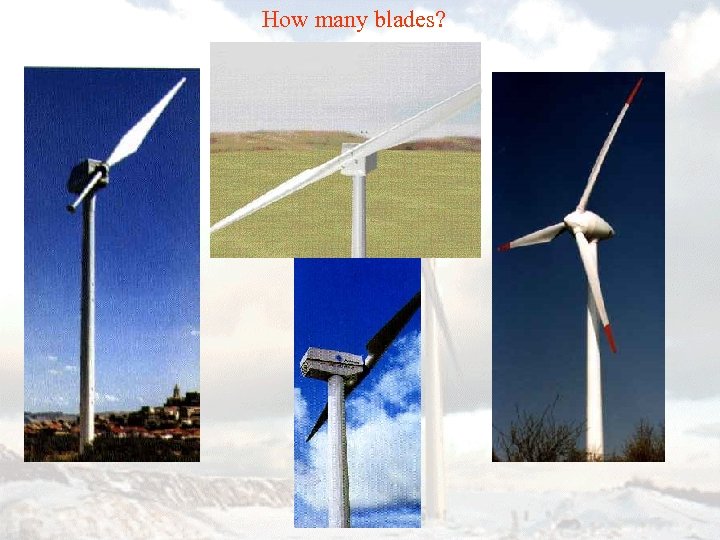
How many blades?
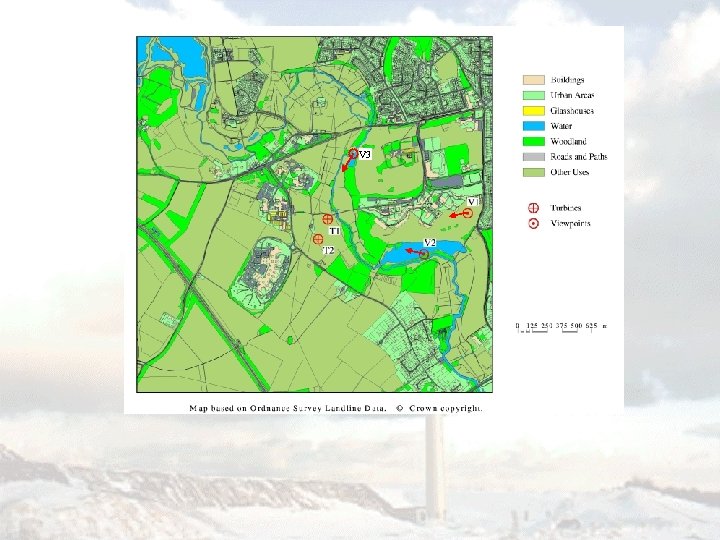
V 3
View from across Broad - Viewpoint 2
Emphasised turbines – from Broad
View from View point 1
Offshore wind energy - A solution? • It’s expensive • Maintenance is problematic BUT Wind speeds are high Resource is enormous Visual intrusion is less than for onshore
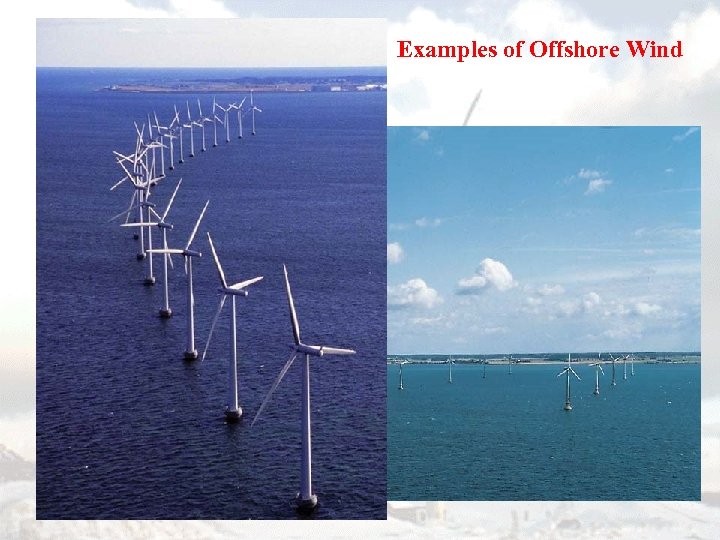
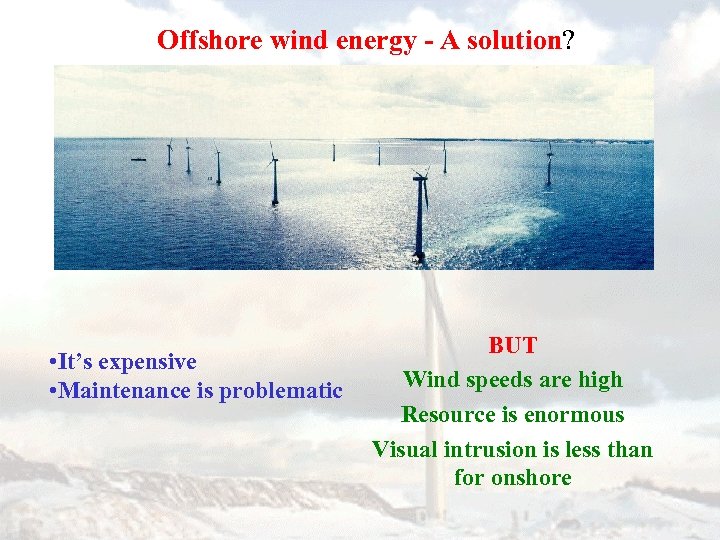
Examples of Offshore Wind
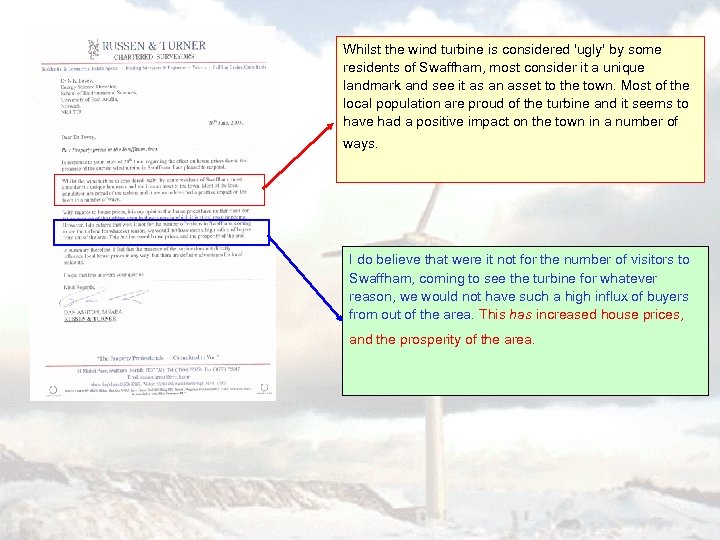
Whilst the wind turbine is considered 'ugly' by some residents of Swaffham, most consider it a unique landmark and see it as an asset to the town. Most of the local population are proud of the turbine and it seems to have had a positive impact on the town in a number of ways. I do believe that were it not for the number of visitors to Swaffham, coming to see the turbine for whatever reason, we would not have such a high influx of buyers from out of the area. This has increased house prices, and the prosperity of the area.
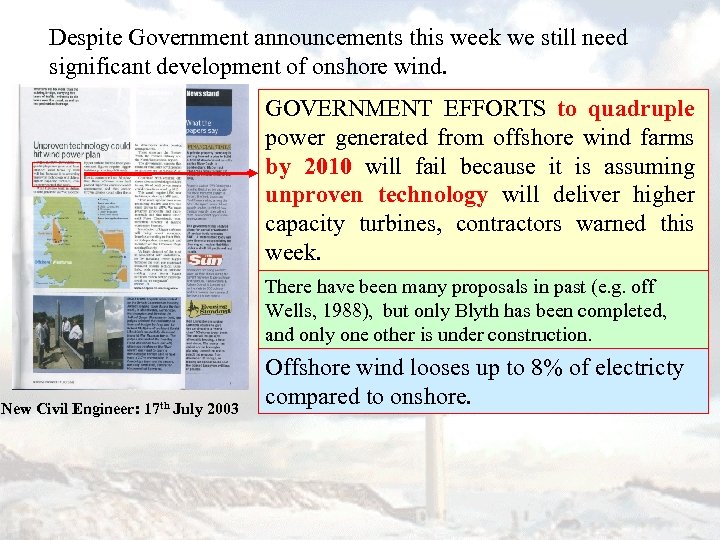
Despite Government announcements this week we still need significant development of onshore wind. GOVERNMENT EFFORTS to quadruple power generated from offshore wind farms by 2010 will fail because it is assuming unproven technology will deliver higher capacity turbines, contractors warned this week. There have been many proposals in past (e. g. off Wells, 1988), but only Blyth has been completed, and only one other is under construction. New Civil Engineer: 17 th July 2003 Offshore wind looses up to 8% of electricty compared to onshore.
We have difficult choices to make
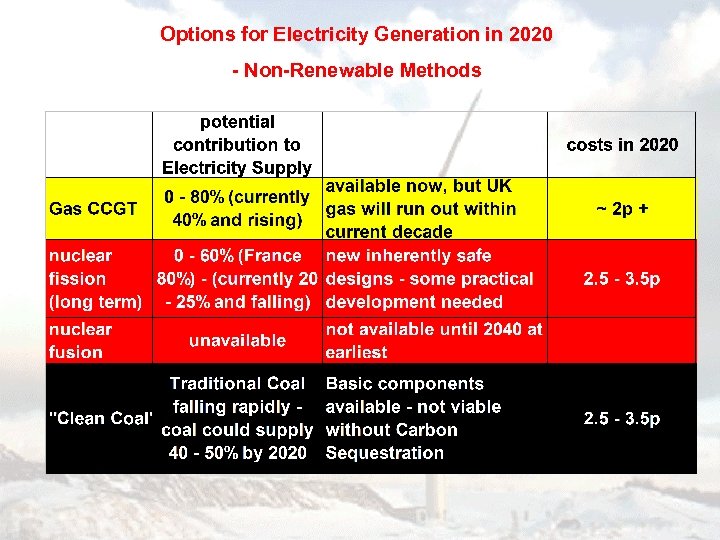
Options for Electricity Generation in 2020 - Non-Renewable Methods
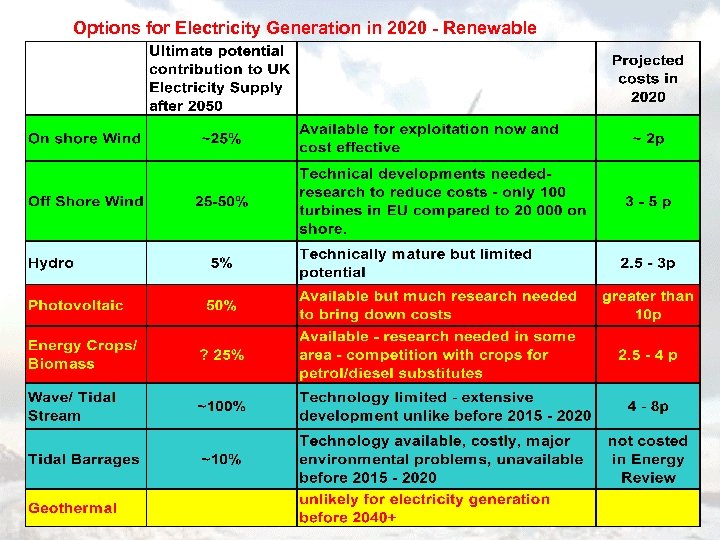
Options for Electricity Generation in 2020 - Renewable
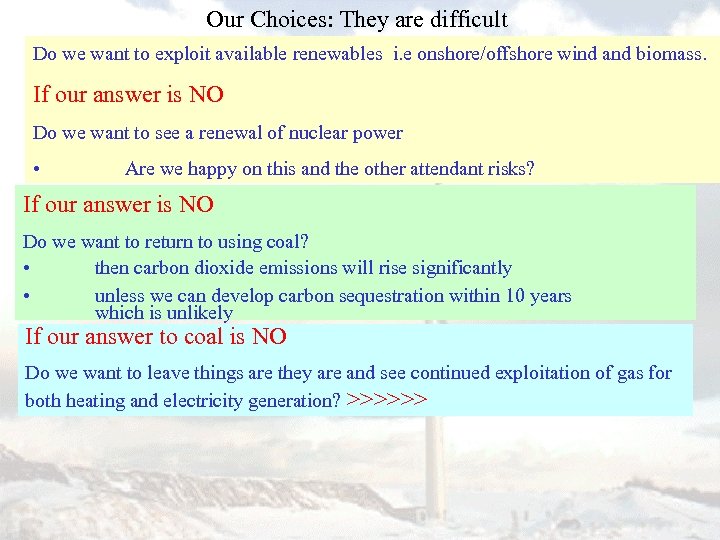
Our Choices: They are difficult Do we want to exploit available renewables i. e onshore/offshore wind and biomass. If our answer is NO Do we want to see a renewal of nuclear power • Are we happy on this and the other attendant risks? If our answer is NO Do we want to return to using coal? • then carbon dioxide emissions will rise significantly • unless we can develop carbon sequestration within 10 years which is unlikely If our answer to coal is NO Do we want to leave things are they are and see continued exploitation of gas for both heating and electricity generation? >>>>>>
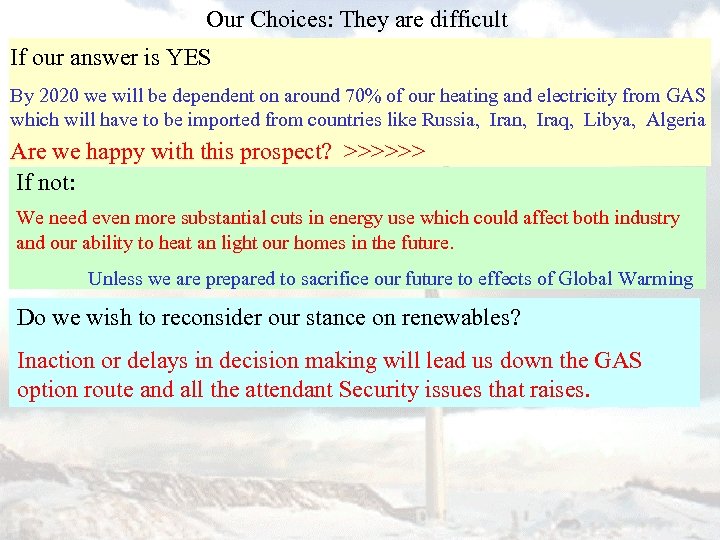
Our Choices: They are difficult If our answer is YES By 2020 we will be dependent on around 70% of our heating and electricity from GAS which will have to be imported from countries like Russia, Iran, Iraq, Libya, Algeria Are we happy with this prospect? >>>>>> If not: We need even more substantial cuts in energy use which could affect both industry and our ability to heat an light our homes in the future. Unless we are prepared to sacrifice our future to effects of Global Warming Do we wish to reconsider our stance on renewables? Inaction or delays in decision making will lead us down the GAS option route and all the attendant Security issues that raises.
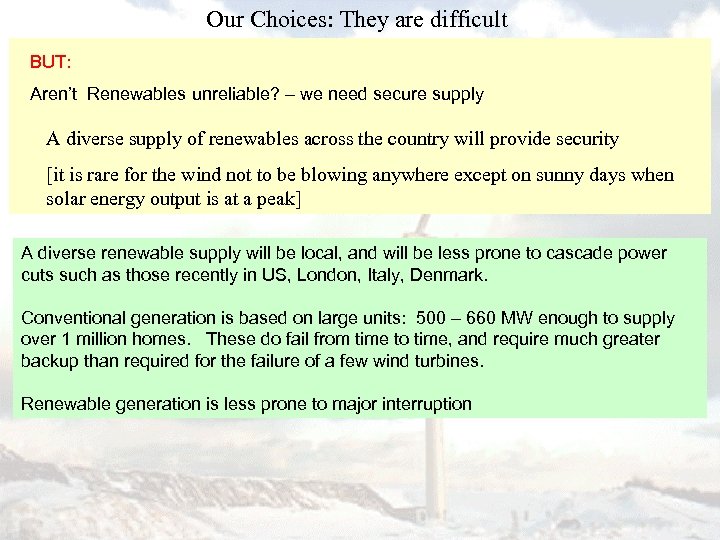
Our Choices: They are difficult BUT: Aren’t Renewables unreliable? – we need secure supply A diverse supply of renewables across the country will provide security [it is rare for the wind not to be blowing anywhere except on sunny days when solar energy output is at a peak] A diverse renewable supply will be local, and will be less prone to cascade power cuts such as those recently in US, London, Italy, Denmark. Conventional generation is based on large units: 500 – 660 MW enough to supply over 1 million homes. These do fail from time to time, and require much greater backup than required for the failure of a few wind turbines. Renewable generation is less prone to major interruption
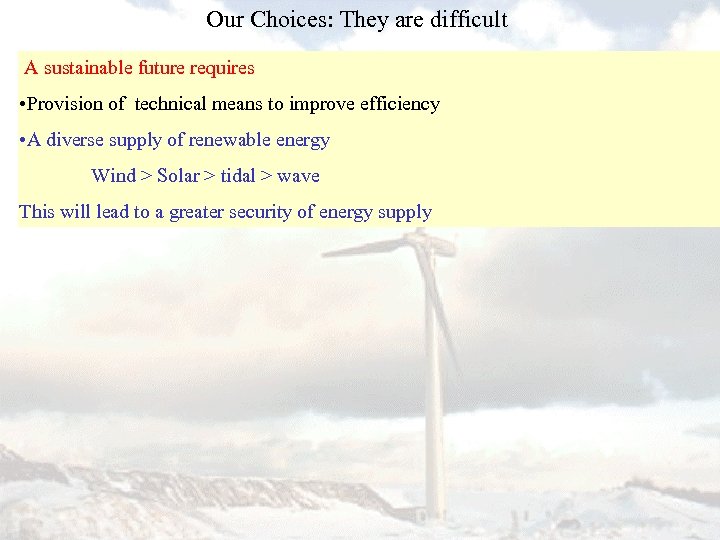
Our Choices: They are difficult A sustainable future requires • Provision of technical means to improve efficiency • A diverse supply of renewable energy Wind > Solar > tidal > wave This will lead to a greater security of energy supply
WEBSITE www. cred-uk. org/ This Presentation may be viewed on the WEB at www 2. env. uea. ac. uk/creduea. htm
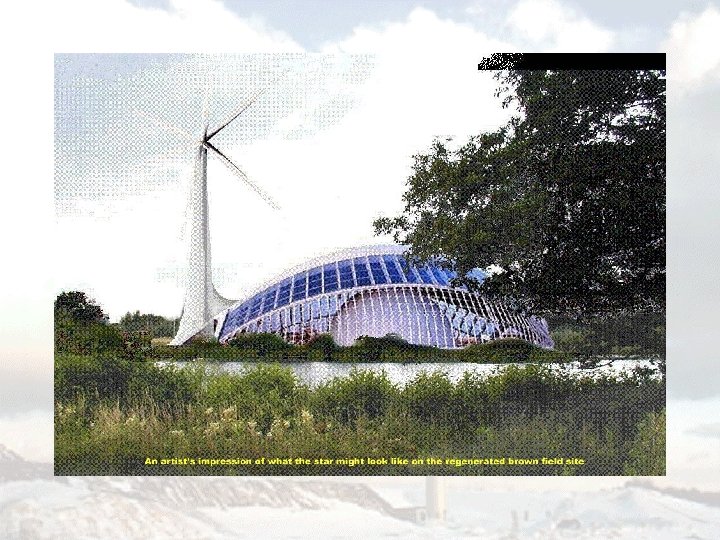
Suspended Star The Star of the EAST Observation Platform “glass” Power Station
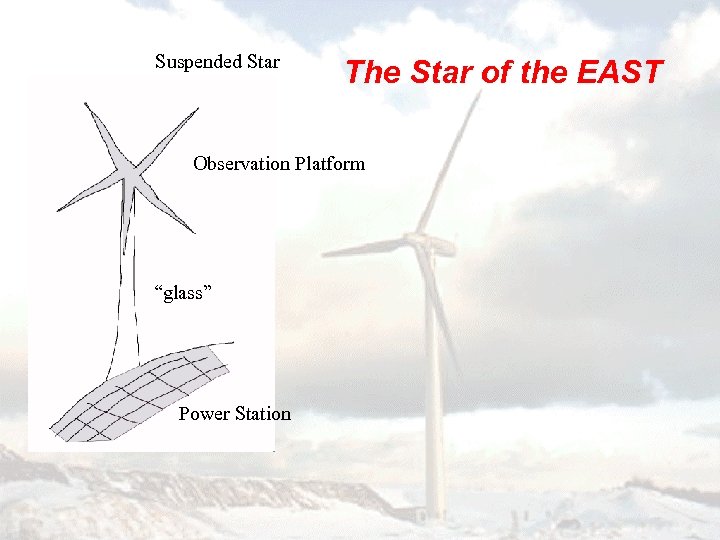
STAR of the East • World-class attraction, demonstration, awareness-raising, technology, leadership in East • Fire imagination • Statement that the East will lead the renewables revolution in the UK/Europe
Integrated time-lines 1 the natural environment Natural climate regimes and response of humans • West Runton Elephant – biggest/best in world • Glacial geology- most spectacular in Europe • Earliest-known hominid presence in NW Europe • Only Neanderthal site in UK • Seahenge – unique in the world • Cromer Forest Bed • The “Elephant Bed” • The “Star Fish” • Other Fossil Beds New Museum of Climate Change at Cromer
Integrated time-lines 2 the environment influenced by the use of energy by humans • The Broads – biggest tourist attraction in EE and unique in the world (new National Park) – first industrial-scale use of nonrenewables in UK (Europe? ) – hydrocarbon-1 - PEAT • Biggest concentration of pre-industrial renewables in world – windmills/pumps for drainage/power; major landscape feature • Most spectacular example of coastal erosion in Europe (revealed the Elephant!); lost towns (Dunwich) • Most vulnerable area to sea-level rise in UK (Broads also threatened) New Broads Headquarters
Integrated time-lines 3 global warming, now and the future • Expertise. School of Environmental Sciences - Tyndall Centre - Climatic Research Unit - Low Carbon Innovation Centre “best in world” (Gvt Chief Scientific Adviser) • Threats- EE – one of most vulnerable in UK - Coast (Sizewell? ) - Broads
Production of energy has been/will be critical 1 Hydrocarbons- now • Hydrocarbon-3 (Oil/GAS) ; North Sea • (Hydrocarbon-2 (coal) is 0. 5 km below) • Bacton – N Sea and now Siberia – “lights will go out in 2020’s” Radio 4 Today Programme July 2003 – Innogy expresses concern over Electricity Supply from 2004/2005 – “Energy. Quotes” – 11 th September 2003.
Time, environment, energy and regional integration • EE can become renewables centre of England/UK (EEDA ambition? ) • EE can lead way in awareness-raising and demonstration of link between energy and the environment • Increase in visitors to region stimulated • EE can organise/integrate what we already have and point to the future
Norwich • Wind-turbine and sculpture – unique in the world • Renewables power station – biomass (local sources), sewage sludge (pipeline in river? ), (waste), (future? – hydrogen? ); biofuels – unique (in world? ) • Rail/river transport • Historic heat-pump : Hydro? • Major tourist and technological attraction • Connecting city and country
Norfolk • Visual links • Physical links – rail/river (biodiesel? ) • Remote links (tele-c, laser? ) To: - New Broads HQ (rivers, lakes, conservation, wetland management, birds etc) - Old windmills - Cromer Elephant Museum (turbine); physical models of cliff collapse - Bacton – gas (CO 2) import? - Scroby Sands (turbines, SL, sediment transport, etc); new turbines - Gas rigs?
The Region • Dunwich (Suffolk) • Canvey Island (worst affected in 1953 floods) • Sizewell (only nuclear station in UK in 2020 s) • Further W – via Swaffham etc, to other turbines/plant (EE has favourable topography) • Only biodiesel train service in UK (Europe? ) Norwich -Cambridge?
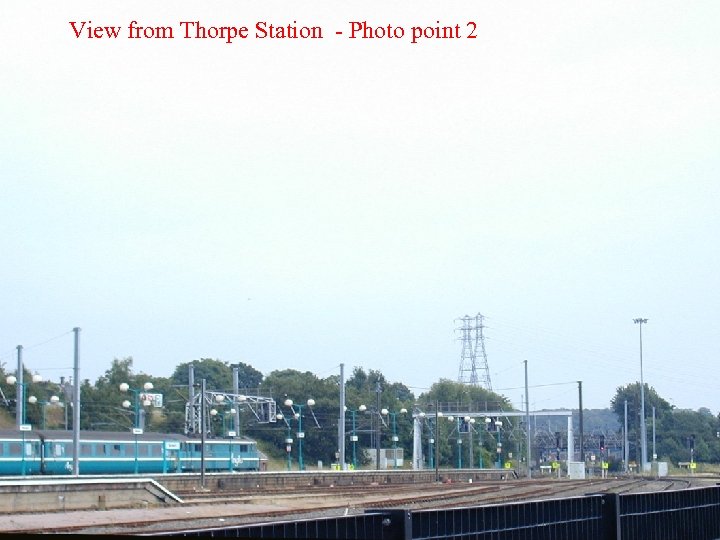
View from Thorpe Station - Photo point 2
 Скачать презентацию Hard Choices Ahead Strumpshaw 30 th September 2003
13c9a1421176f6be09e6a51d0f88a7cd.ppt