 Скачать презентацию Haninge participatory budgeting You decide Strasbourg 10
9ed166bcbb06e0da0f2c46be9c519b08.ppt
- Количество слайдов: 15



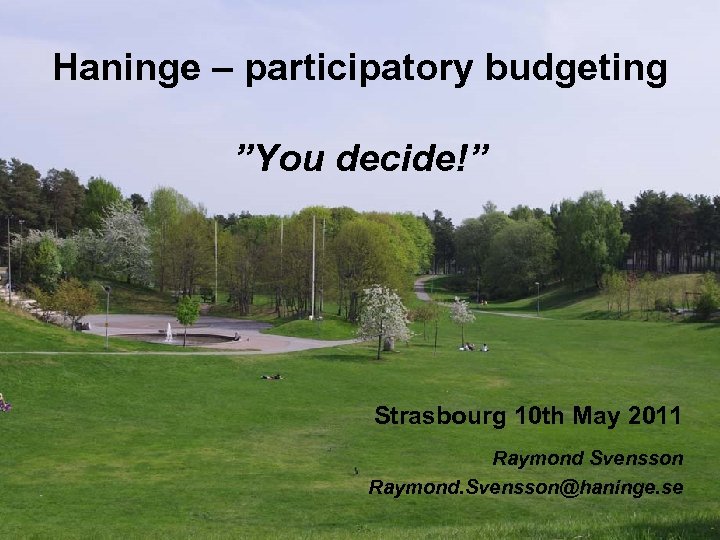
Haninge – participatory budgeting ”You decide!” Strasbourg 10 th May 2011 Raymond Svensson Raymond. Svensson@haninge. se
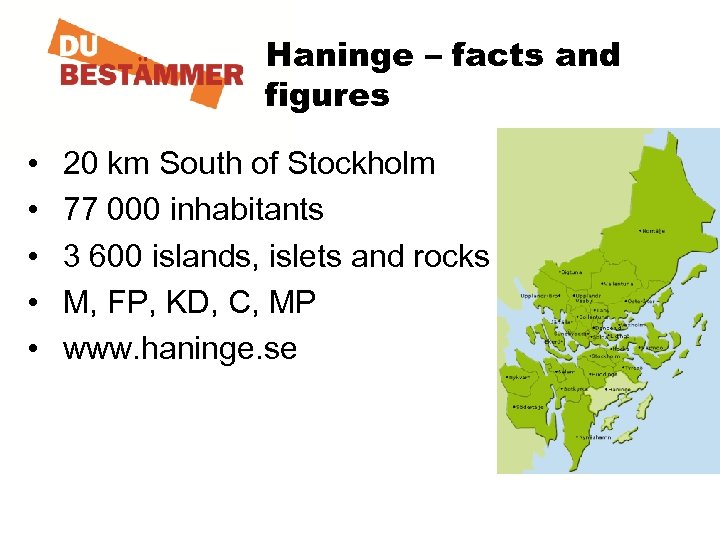
Haninge – facts and figures • • • 20 km South of Stockholm 77 000 inhabitants 3 600 islands, islets and rocks M, FP, KD, C, MP www. haninge. se
General conditions • SALAR network • A dialogue with the citizens • A decision made by the municipal government
Points of departure • Everyone who live and work in Haninge is invited to give a suggestion. Inhabitants from other communes were also welcomed to leave proposals. • Only inhabitants was allowed to vote • The suggestions must lead to a permanent change of the park – not to a single arrangement or event
Purpose • Eskilsparken will be turned into a city park and a meeting point • Develop new methods for citizen involvement: participatory budgeting and E-dialogue • New experiences and contacts
The project step by step 1. September-december: Planning 2. 23 rd January: Kick-off / Handing in proposals 3. February-March: Processing the suggestions 4. April: Voting 5. 25 th April: Last day of voting / Final meeting 6. June: Decision COMMUNICATION
Communication • Website • Local newspapers and radio • Posters and flyers • Meeting with organisations, schools, community youth center • Contact with the proposers via telephone, email, letters → →→
Communication… • Open citizen meeting – suggestion board, – suggestions on the internet, – ask politicians or officials, – get more information, – make a model, paint, – get a coffee – = 30 new suggestions, 70 participants, a success! • Voting at lap tops in the city centre → →→
Handling the suggestions • From 101 ideas to 21 financially calculated suggestions • Email and telephone contacts with the participants • The participatory budgeting tool developed
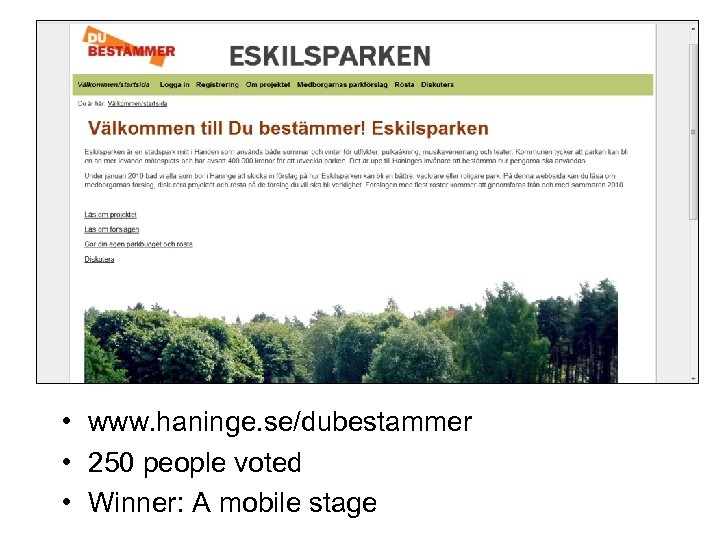
• www. haninge. se/dubestammer • 250 people voted • Winner: A mobile stage
Challenges • Hard to attract participants • A first try: demands flexibility and extra time
Good experiences • A lot of people participated in the meetings • Cooperation with schools • New experiences for the officials and politicians • Well functioning, flexible and useful web-tool • An interested and engaged project leader (Karin Gavelin)
Difficulties • Lack of a deeper dialogue 1. Open house 23 January • Hard to firmly establish the creative ideas • Some obscurity over the aim of the project • Difficult for people to understand what it was all about – many were suspicious
To consider in the future • Clear purposes and criterias from the beginning • 1. Open house involved parts Early communication with 23 January • Use as many communications channels as possible • Invest a lot of time to engage with the public: flyers, flexible voting opportunities, etcetera • Offer extended period of time for voting • Combine depth and width by focussing specific groups, e. g. students
Thank you!
Скачать презентацию Haninge participatory budgeting You decide Strasbourg 10
9ed166bcbb06e0da0f2c46be9c519b08.ppt