


 Скачать презентацию Hands-On Microsoft Windows Server 2003 Networking Chapter 9
7964c3bb4b8e7649d5d176580ba346e8.ppt
- Количество слайдов: 55
 Hands-On Microsoft Windows Server 2003 Networking Chapter 9 IP Security
 Objectives • Describe IP security issues and how the IPSec protocol addresses them • Choose the appropriate IPSec mode for a given situation • Implement authentication for IPSec • Enable IPSec • Creat IPSec policies • Monitor and troubleshoot IPSec 2
 IP Security (IPSec) Overview • Techniques used to eavesdrop on IP-based communication – Packet sniffing • Packet sniffer software used to view all packets traversing your network – Data replay • Packets are captured and replayed at later time – Data modification • Packets can be modified before being replayed – Address spoofing • Hackers can falsify source IP address and gain unauthorized access to resources 3
 IPSec Overview (Continued) • IPSec – Secures IP-based communication – Supported by Internet Engineering Task Force (IETF) – Authenticates endpoints of any IP-based conversation – Encryption can be used to hide contents of data packets – Exists at Network layer of TCP/IP architecture 4
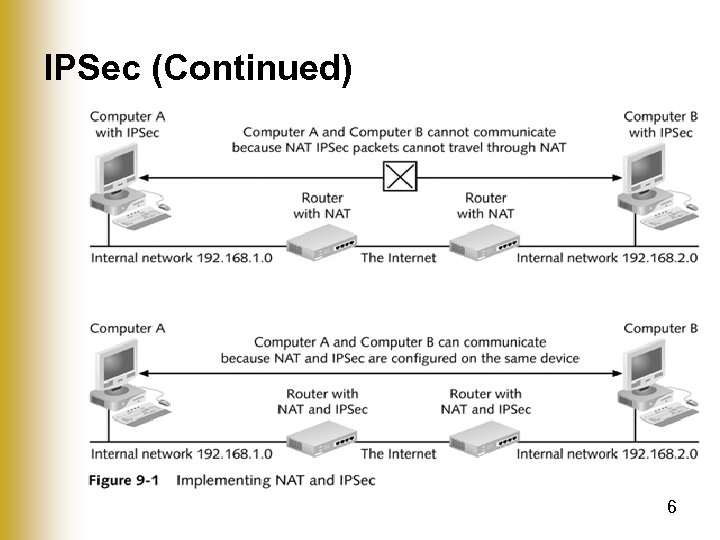
 IPSec Overview (Continued) – Not supported by pre-Windows 2000 operating systems – Can significantly slow communication on a network – Cannot be routed through NAT – Adds complexity to a network – Can be valuable addition to a network when data integrity or confidentiality are required 5
 IPSec (Continued) 6
 IPSec Modes • Tunnel mode – IPSec communication between two networks • Transport mode – IPSec communication between two hosts • Authentication headers (AH) mode – Enforces authentication of the two IPSec clients – Includes a digital signature on each packet • Encapsulating security payload (ESP) mode – Has all the features of AH mode plus encryption of data in the packet 7
 AH Mode • • • Provides authentication of the two endpoints Adds checksum to the packet Does not provide data confidentiality Payload of the packet is unencrypted Used in situations where you are concerned about packets being captured • Less processor-intensive than ESP mode 8
 ESP Mode • Provides authentication of the two endpoints – Guarantees that the two endpoints are known • Adds a checksum to each packet – Guarantees that the packet was not modified in transit • Encrypts the data in the packet – Ensures that unintended recipients cannot read the data in the packet • Used in most implementations of IPSec because data encryption is desired 9
 Transport Mode • Used between two hosts • Both endpoints in the communication must support IPSec – Limits implementation of IPSec – Many devices, such as printers, rarely offer IPSec support 10
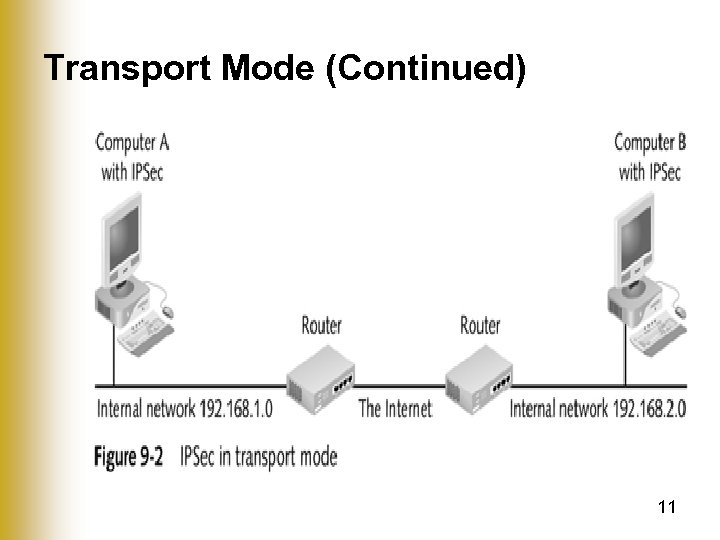 Transport Mode (Continued) 11
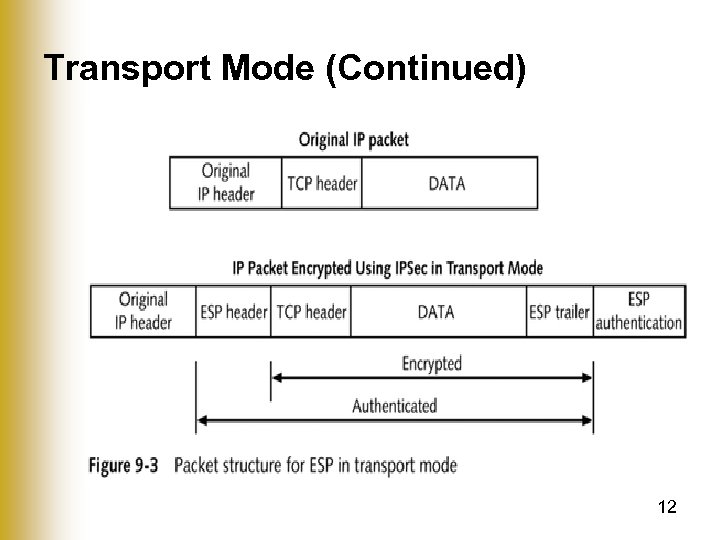 Transport Mode (Continued) 12
 Tunnel Mode • Used between two routers • Hosts communicating through the routers do not need to support IPSec – Routers take the original IP packets and encapsulate them – Any IP device can take advantage of routers running IPSec in tunnel mode 13
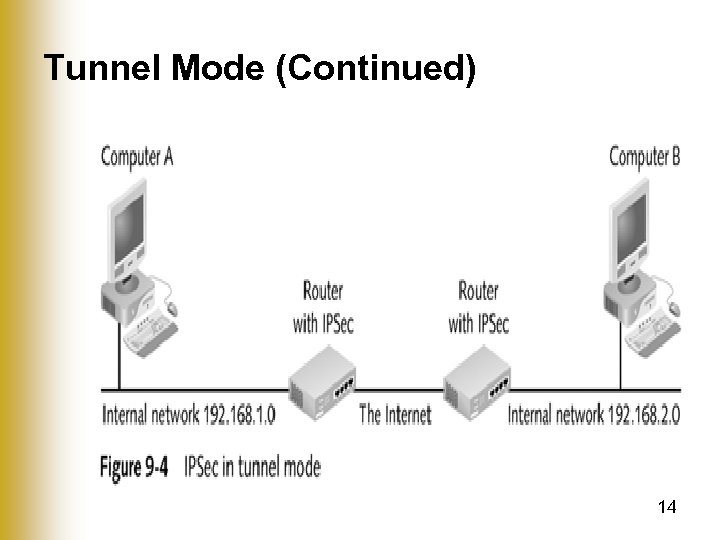 Tunnel Mode (Continued) 14
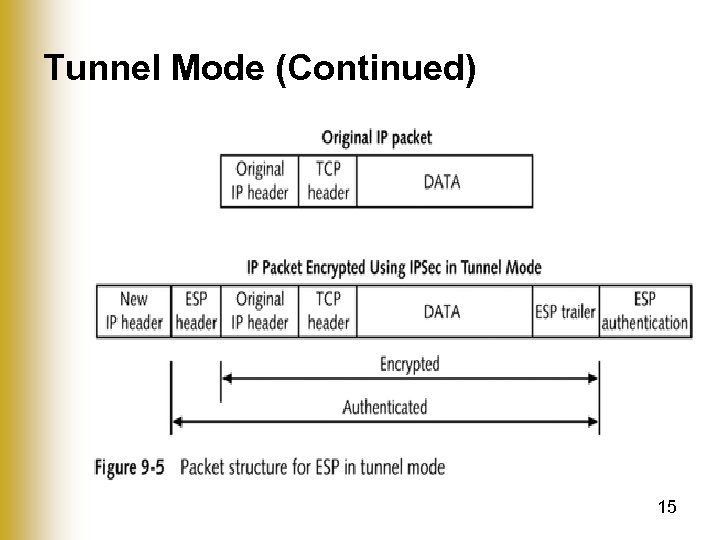 Tunnel Mode (Continued) 15
 IPSec Authentication • IPSec communication – Both endpoints are authenticated • Internet Key Exchange (IKE) – Process used by two IPSec hosts to negotiate their security parameters • Security association (SA) – Term used when security parameters have been agreed upon • Authentication methods – Preshared key – Certificates – Kerberos 16
 Preshared Key • A combination of characters entered at each endpoint of the IPSec connection • Authentication – Both endpoints know the same secret, and no one else has been told – Advantage • Simplicity • Authentication occurs as long as the preshared key is typed in correctly on each device – Disadvantage • Movement of the preshared key when configuring the two devices 17
 Certificates • May be presented for authentication • Useful when clients are from outside of your organization • Disadvantage of using third-party certificates – Cost: Each client needs to buy a certificate – Clients may not be technically savvy enough to obtain certificates 18
 Kerberos • Authentication system used by Windows 2000/XP/2003 for access to network resources • In Active Directory – Domain is equivalent to a Kerberos realm • Advantage – Seamless integration with domain security • Not a commonly supported authentication system for IPSec on non-Microsoft products • Not appropriate for Windows computers that are not part of the Active Directory forest 19
 Enabling IPSec • IPSec Policies – Used to enable IPSec – Can be configured manually on each server or distributed through Group Policy – Define the circumstances under which IP traffic is • Tunneled using IPSec • Permitted without using IPSec • Blocked – Also define • Type of authentication • Which network connections are affected • Whether IPSec is to be used in tunnel mode or transport mode 20
 Enabling IPSec (Continued) • IPSec policies installed by default – Server (Request Security) – Client (Respond Only) – Secure Server (Require Security) • Default policies – Configured to use Kerberos for authentication – Permits ICMP traffic – Respond to requests to use IPSec – Differ in the way they request security • IPSec Policy – Must be in place to use IPSec 21
 Assigning IPSec Policies • Single server – Can be configured with many IPSec policies • No Policy is used until assigned • Once policy has been assigned – Does not take effect immediately – IPSec Policy Agent must be restarted 22
 Creating an IPSec Policy • IPSec policy – Composed of IPSec rules • IPSec rule composed of – IP filter list – IPSec filter action – Authentication methods – Tunnel endpoint – Connection type 23
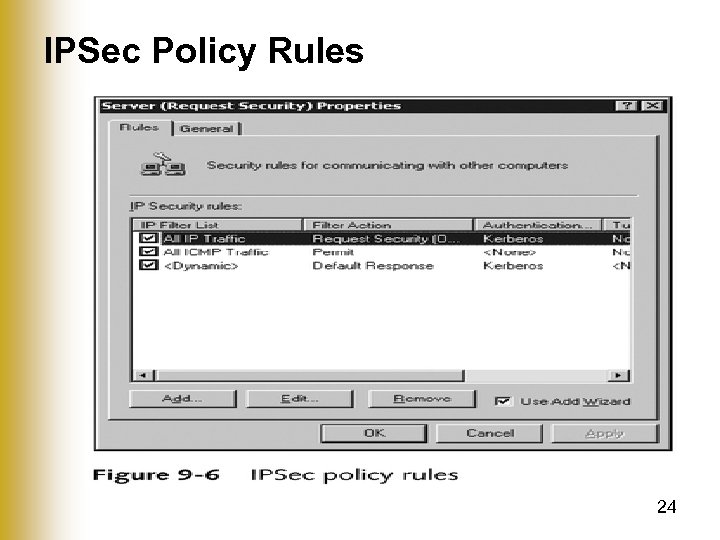 IPSec Policy Rules 24
 Creating an IPSec Policy (Continued) • IP filter lists and IPSec filter actions – Maintained in a central list by Windows Server 2003 – Once created, can be reused by other rules within a policy or other policies 25
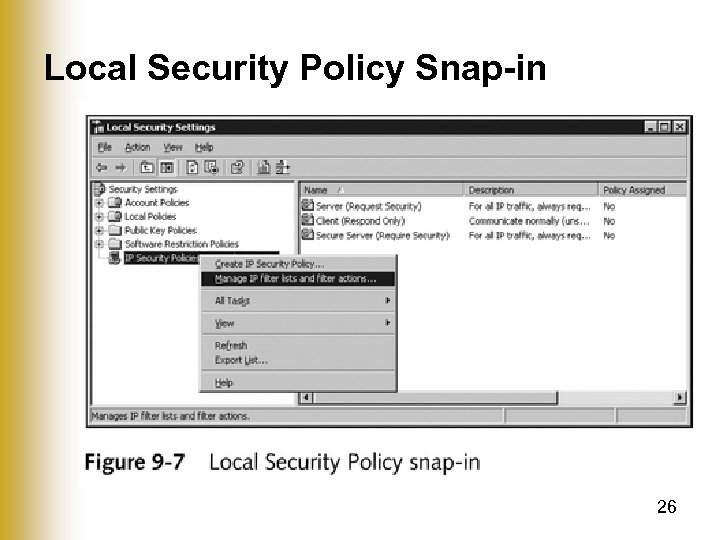 Local Security Policy Snap-in 26
 Creating an IPSec Policy (Continued) • To create a new IPSec policy – Use the IP Security Policy Wizard • IP Security Policy Wizard requests – Name, description – Whether to activate the default response rule – Authentication type 27
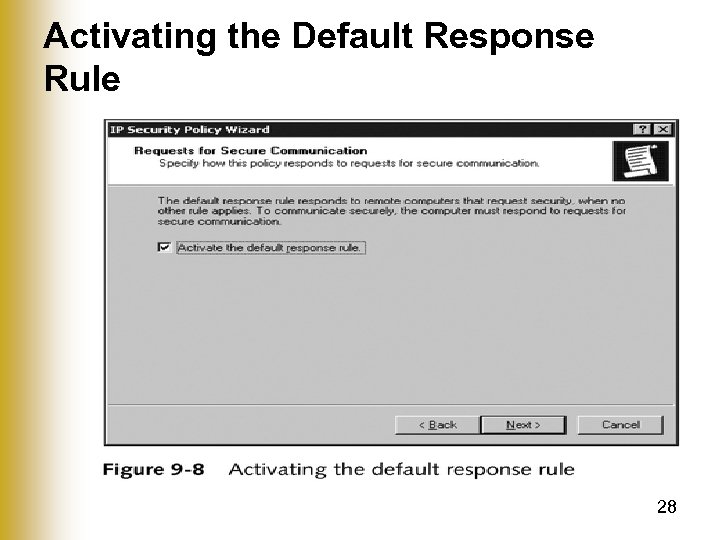 Activating the Default Response Rule 28
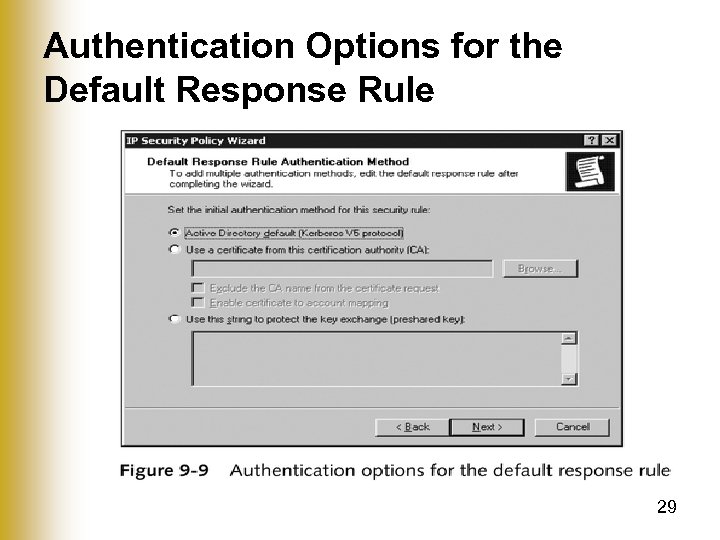 Authentication Options for the Default Response Rule 29
 Creating Rules • IPSec policy – Once created, must be edited to add rules – Rules define how different types of IP traffic are handled – Default Response rule exists by default • Create IP Security Rule Wizard – Used when adding a rule – Allows you to configure the most commonly used options 30
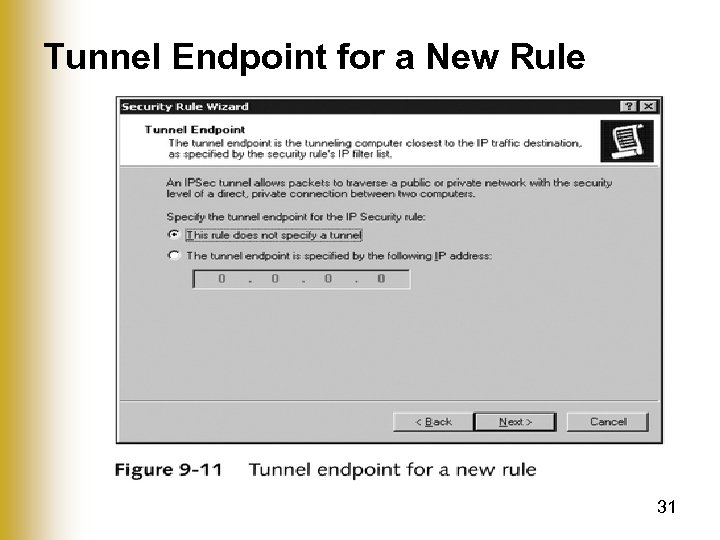 Tunnel Endpoint for a New Rule 31
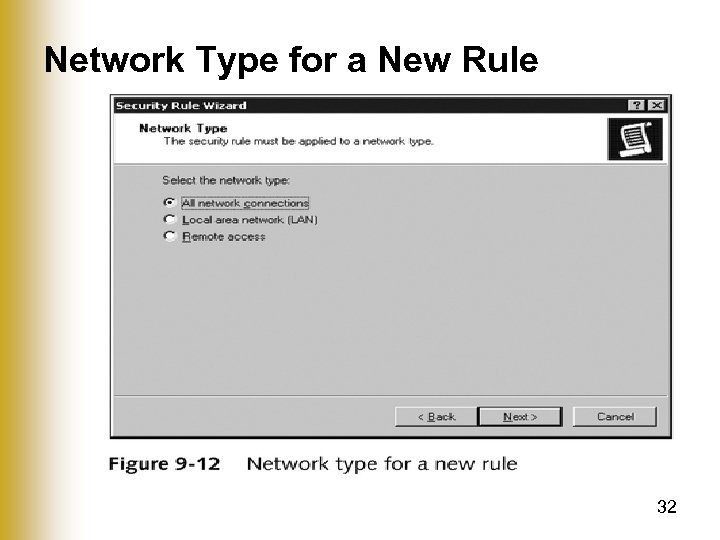 Network Type for a New Rule 32
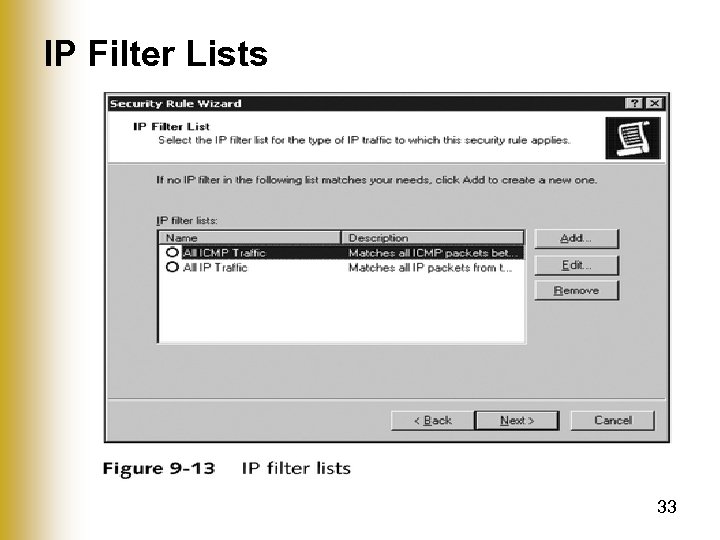 IP Filter Lists 33
 The Filter Action Window • Three default actions – Permit • Allows packets to pass through the IP filter unmodified – Request Security (Optional) • Attempts to create IPSec connections with all other computers • Uses non-IPSec communication if an SA cannot be established – Require Security • Accepts non-IPSec packets • Responds only using IPSec packet 34
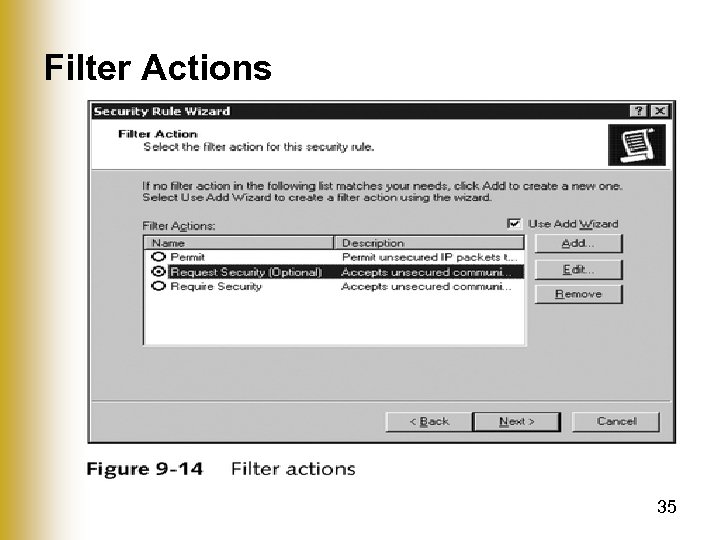 Filter Actions 35
 IPSec Filter Lists • If multiple applications running on a server – may be unnecessary for all IP traffic to be encrypted • Creating IP filter list – Give it a name and description (optional) – Add IP filters – Specify the traffic to which the list will apply 36
 IPSec Filter Lists (Continued) • IP Filter Wizard – Requests a description for the new IP filter – Mirrored option applies the IP filter to • Opposite source • Selected destination ports specified in the IP filter – Second window requests the source IP address in the filter – Third asks for the destination IP address in the filter 37
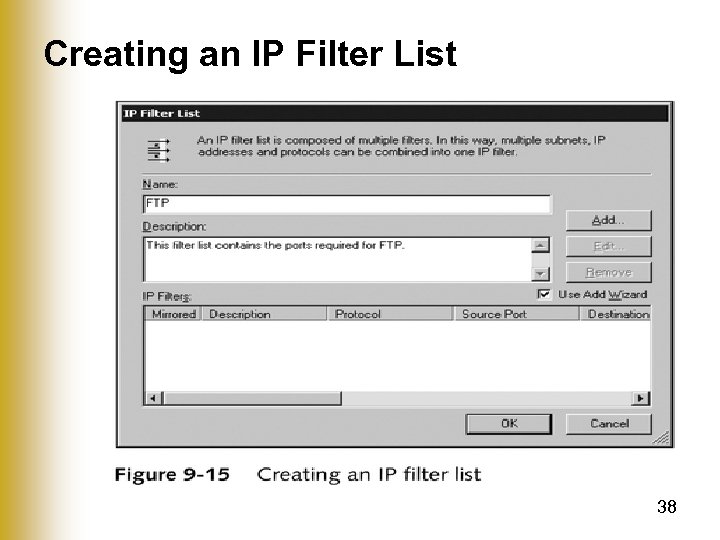 Creating an IP Filter List 38
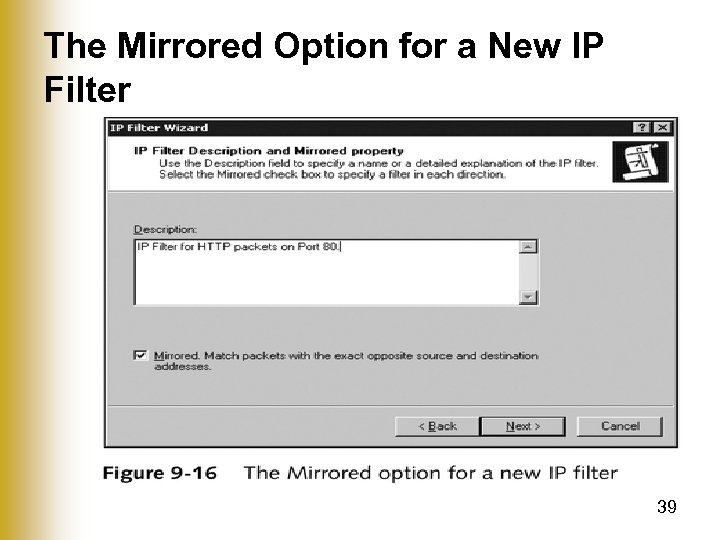 The Mirrored Option for a New IP Filter 39
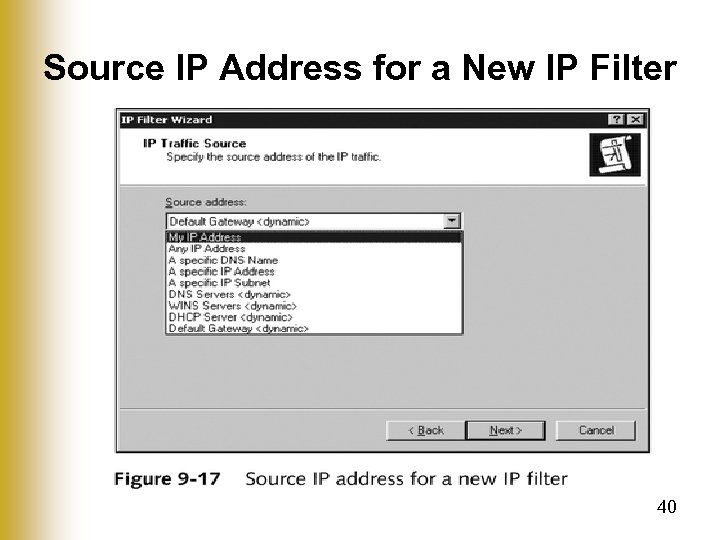 Source IP Address for a New IP Filter 40
 Filter Actions • Define what is done to traffic that matches an IP filter list • Default filter actions – Permit – Request Security (Optional) – Require Security 41
 Filter Actions (Continued) • IP Security Filter Action Wizard – Used to create filter actions – First window requests a name and description – Second window asks for an action behavior – Third window asks whether to allow unencrypted communication with computers that do not support IPSec – Allows you to add only one security method 42
 Cryptography Algorithms • IPSec – Offers both data integrity and encryption • Two algorithms used for AH and ESP data integrity – Secure Hashing Algorithm (SHA 1) • Produces a 160 -bit message digest • Federal Information Processing Standards (FIPS) specifies this for use in U. S. federal government contracts – Message Digest 5 (MD 5) • Commonly used hashing algorithm for commercial applications • Produces a 128 -bit message digest • Less secure than SHA 1, but faster 43
 Cryptography Algorithms (Continued) • Two algorithms used for ESP data encryption – Data Encryption Standard (DES) • Common encryption algorithm that uses a 56 -bit key • First designated for U. S. federal government use in 1977 44
 Cryptography Algorithms (Continued) – Triple Data Encryption Standard (3 DES) • Performs three rounds of encryption using three different 56 -bit keys giving an effective key length of 168 -bits • Windows 2000 computers must have installed the High Encryption Pack or have Service Pack 2 to use 3 DES 45
 Troubleshooting IPSec • Common IPSec troubleshooting tools – Ping – IPSec Security Monitor – Event Viewer – Resultant Set of Policy – Netsh – Oakley logs – Network Monitor 46
 Troubleshooting IPSec (Continued) • Ping – Used to test network connectivity between two hosts – Default IPSec policies • Permit ICMP packets • Do not interfere with the operation of ping – Does not test IPSec specifially – Can be used to confirm that two hosts can communicate 47
 Troubleshooting IPSec (Continued) • IPSec Security Monitor – An MMC snap-in that allows you to view the status of IPSec SAs – Can be used to confirm that an SA was negotiated between two hosts – Can be used to view the configuration of the IPSec policy that is applied 48
 Troubleshooting IPSec (Continued) • Event Viewer – To enable logging • Set the key HKEY_LOCAL_MACHINESYSTEMCurrent. Contr ol. Set ServicesIPSecEnable. Diagnostics to a value of 7 • Resultant Set of Policy – Allows you to • View which policies apply • Simulate the application of new policies to test their results 49
 Troubleshooting IPSec (Continued) • Netsh – Allows you to configure network-related settings – Configuration categories include • Bridging, DHCP, diagnostics • IP configuration, remote access, routing • WINS, and remote procedure calls – Can be used to modify IPSec configuration 50
 Troubleshooting IPSec (Continued) • Oakley Logs – Track the establishment of SAs – Must be enabled with the command “netsh ipsec dynamic set config ike logging 1” • Network Monitor – Can be used to view packets that are traveling on the network – Can identify IPSec traffic – Cannot view encrypted information inside an IPSec packet – Not useful for troubleshooting application-level problems if traffic is encrypted 51
 Summary • IPV 4 – Has no built in security mechanisms – Uses IPSec as an add-on protocol to make communication • Secure from packet sniffing, data replay • Data modification, and address spoofing 52
 Summary (Continued) • IPSec – Operates at the Network layer – Not supported by pre-Windows 2000 operating systems – Cannot be used with NAT – AH mode does not perform data encryption – ESP mode has ability to perform data encryption and authentication – Transport mode is used between two hosts – Tunnel mode is used between two routers 53
 Summary (Continued) • Windows Server 2003 implementation – Can perform authentication using a preshared key, certificates, or Kerberos • IPSec policies – Contain rules that control authentication, which traffic is affected, what is done to the affected traffic • Filter lists – Used in IPSec rules to define the packets affected by a rule • Filter actions – Define what is done to traffic that matches filter list 54
 Summary (Continued) • SHA 1 and MD 5 – Algorithms used for data integrity • DES and 3 DES – Algorithms used for data encryption • Tools used to troubleshoot IPSec – Ping – IPSec Security Monitor snap-in – Event Viewer – Resultant Set of Policy snap-in – Netsh – Oakley logs – Network Monitor 55