


 Скачать презентацию Handout 3 Japanese and Luganda Two languages with
9e2bf335f0b7cd82ec04eaf320bab355.ppt
- Количество слайдов: 18
 Handout #3 Japanese and Luganda: Two languages with very little in common
![Japanese: [t], [t. S] and [ts] • • [t] is a voiceless alveolar plosive](https://present5.com/presentation/9e2bf335f0b7cd82ec04eaf320bab355/image-2.jpg "Japanese: [t], [t. S] and [ts] • • [t] is a voiceless alveolar plosive") Japanese: [t], [t. S] and [ts] • • [t] is a voiceless alveolar plosive stop. [t. S] is a voiceless alveopalatal affricate stop. [ts] is a voiceless alveolar affricate stop. What is the distribution of these three stops in Japanese? • To determine this, we first identify every instance of the three stops in the following data.
Japanese: [t], [t. S] and [ts] • • [t] is a voiceless alveolar plosive stop. [t. S] is a voiceless alveopalatal affricate stop. [ts] is a voiceless alveolar affricate stop. What is the distribution of these three stops in Japanese? • To determine this, we first identify every instance of the three stops in the following data.
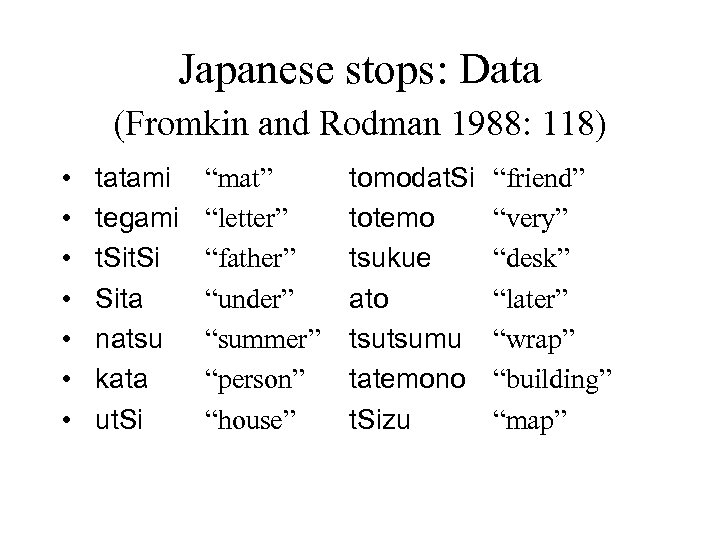 Japanese stops: Data (Fromkin and Rodman 1988: 118) • • tatami tegami t. Si Sita natsu kata ut. Si “mat” “letter” “father” “under” “summer” “person” “house” tomodat. Si totemo tsukue ato tsutsumu tatemono t. Sizu “friend” “very” “desk” “later” “wrap” “building” “map”
![Contexts of [t] Word Before [t] After [t] tatami, tatemono # (= edge of](https://present5.com/presentation/9e2bf335f0b7cd82ec04eaf320bab355/image-4.jpg "Contexts of [t] Word Before [t] After [t] tatami, tatemono # (= edge of") Contexts of [t] Word Before [t] After [t] tatami, tatemono # (= edge of word) a tatami, kata a a tegami # e Sita i a tomodat. Si, totemo # o ato a o tatemono a e
Contexts of [t] Word Before [t] After [t] tatami, tatemono # (= edge of word) a tatami, kata a a tegami # e Sita i a tomodat. Si, totemo # o ato a o tatemono a e
![Contexts of [t. S] Word Before [t. S] After [t. S] t. Si, t.](https://present5.com/presentation/9e2bf335f0b7cd82ec04eaf320bab355/image-5.jpg "Contexts of [t. S] Word Before [t. S] After [t. S] t. Si, t.") Contexts of [t. S] Word Before [t. S] After [t. S] t. Si, t. Sizu # i t. Si i i ut. Si u i tomodat. Si a i
Contexts of [t. S] Word Before [t. S] After [t. S] t. Si, t. Sizu # i t. Si i i ut. Si u i tomodat. Si a i
![Contexts of [ts] Word Before [ts] After [ts] natsu a u tsukue, tsutsumu #](https://present5.com/presentation/9e2bf335f0b7cd82ec04eaf320bab355/image-6.jpg "Contexts of [ts] Word Before [ts] After [ts] natsu a u tsukue, tsutsumu #") Contexts of [ts] Word Before [ts] After [ts] natsu a u tsukue, tsutsumu # u tsutsumu u u
Contexts of [ts] Word Before [ts] After [ts] natsu a u tsukue, tsutsumu # u tsutsumu u u
![Japanese stops: Statement of distribution • [t. S] occurs only before [i]. • [ts]](https://present5.com/presentation/9e2bf335f0b7cd82ec04eaf320bab355/image-7.jpg "Japanese stops: Statement of distribution • [t. S] occurs only before [i]. • [ts]") Japanese stops: Statement of distribution • [t. S] occurs only before [i]. • [ts] occurs only before [u]. • [t] occurs only elsewhere.
Japanese stops: Statement of distribution • [t. S] occurs only before [i]. • [ts] occurs only before [u]. • [t] occurs only elsewhere.
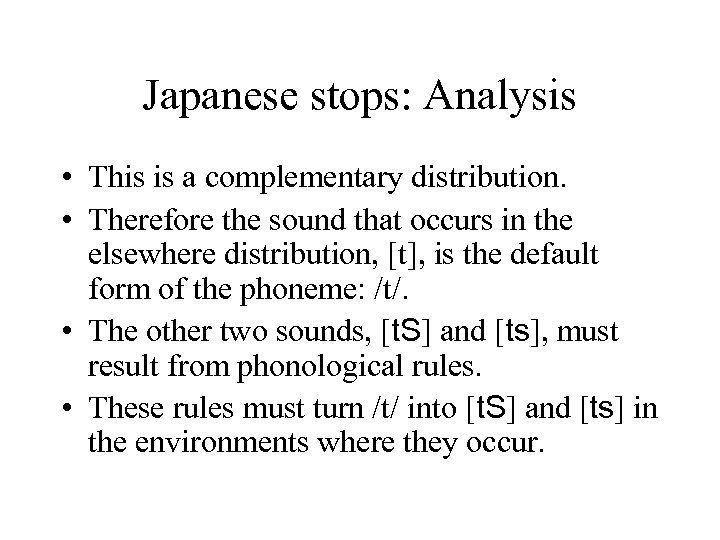 Japanese stops: Analysis • This is a complementary distribution. • Therefore the sound that occurs in the elsewhere distribution, [t], is the default form of the phoneme: /t/. • The other two sounds, [t. S] and [ts], must result from phonological rules. • These rules must turn /t/ into [t. S] and [ts] in the environments where they occur.
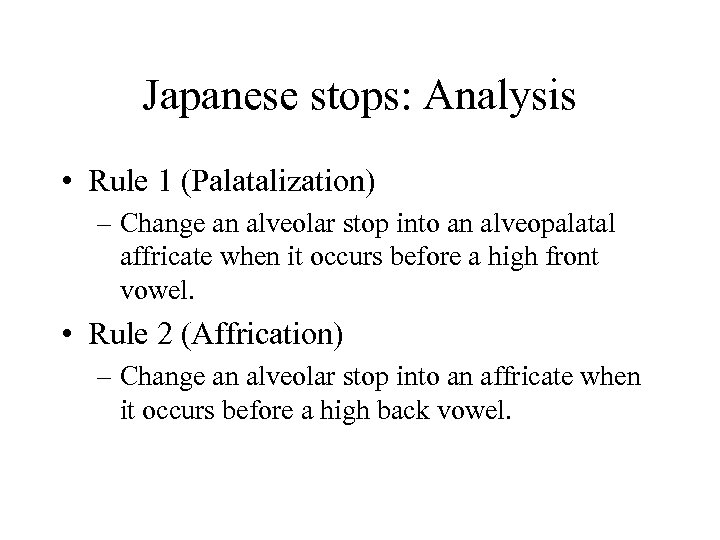 Japanese stops: Analysis • Rule 1 (Palatalization) – Change an alveolar stop into an alveopalatal affricate when it occurs before a high front vowel. • Rule 2 (Affrication) – Change an alveolar stop into an affricate when it occurs before a high back vowel.
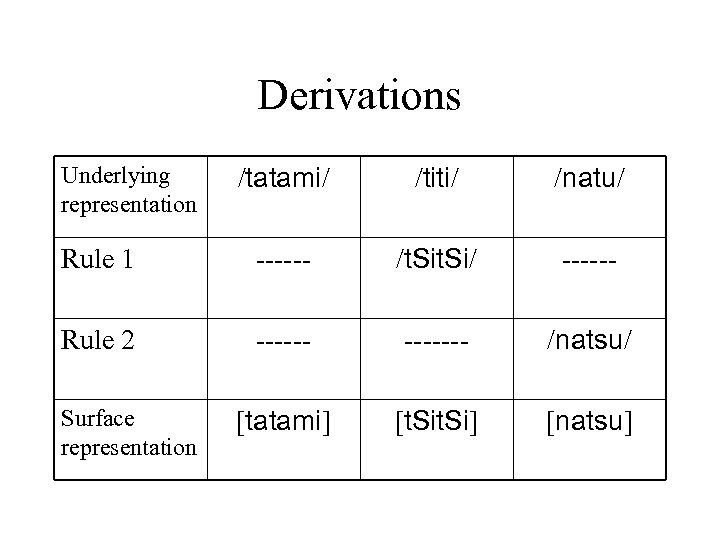 Derivations Underlying representation /tatami/ /titi/ /natu/ Rule 1 ------ /t. Si/ ------ Rule 2 ------- /natsu/ [tatami] [t. Si] [natsu] Surface representation
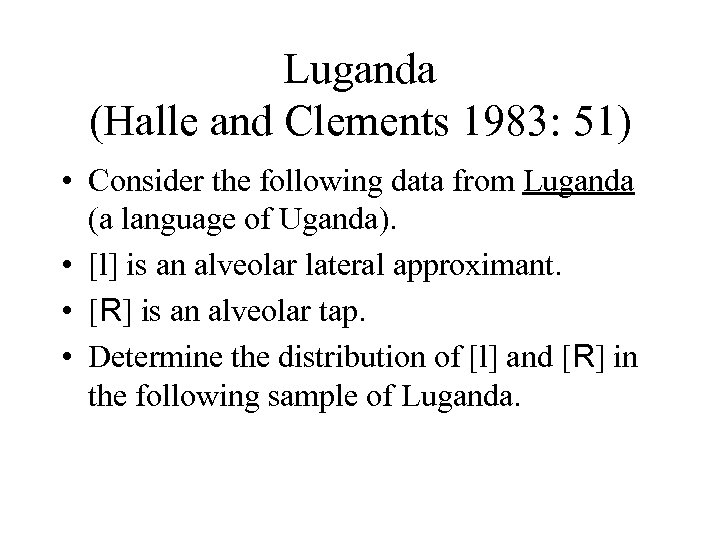 Luganda (Halle and Clements 1983: 51) • Consider the following data from Luganda (a language of Uganda). • [l] is an alveolar lateral approximant. • [R] is an alveolar tap. • Determine the distribution of [l] and [R] in the following sample of Luganda.
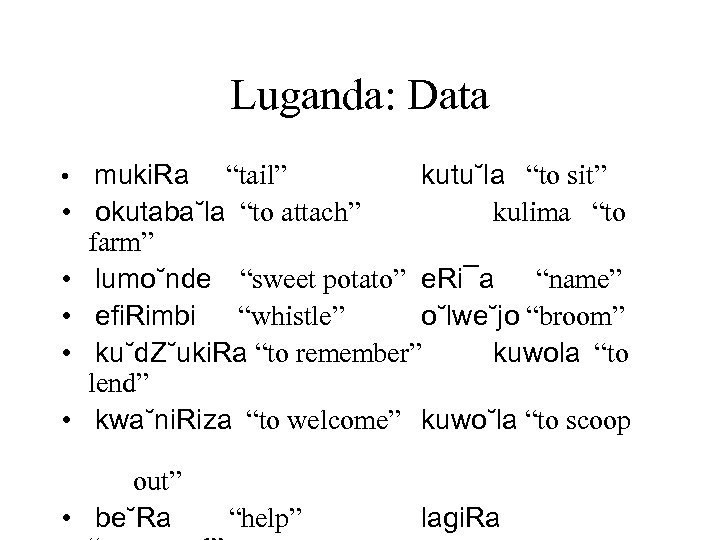 Luganda: Data • muki. Ra • • • “tail” kutu˘la “to sit” okutaba˘la “to attach” kulima “to farm” lumo˘nde “sweet potato” e. Ri¯a “name” efi. Rimbi “whistle” o˘lwe˘jo “broom” ku˘d. Z˘uki. Ra “to remember” kuwola “to lend” kwa˘ni. Riza “to welcome” kuwo˘la “to scoop out” • be˘Ra “help” lagi. Ra
![Contexts of [l] Word Before [l] After [l]](https://present5.com/presentation/9e2bf335f0b7cd82ec04eaf320bab355/image-13.jpg "Contexts of [l] Word Before [l] After [l]") Contexts of [l] Word Before [l] After [l]
Contexts of [l] Word Before [l] After [l]
![Contexts of [R] Word Before [R] After [R]](https://present5.com/presentation/9e2bf335f0b7cd82ec04eaf320bab355/image-14.jpg "Contexts of [R] Word Before [R] After [R]") Contexts of [R] Word Before [R] After [R]
Contexts of [R] Word Before [R] After [R]
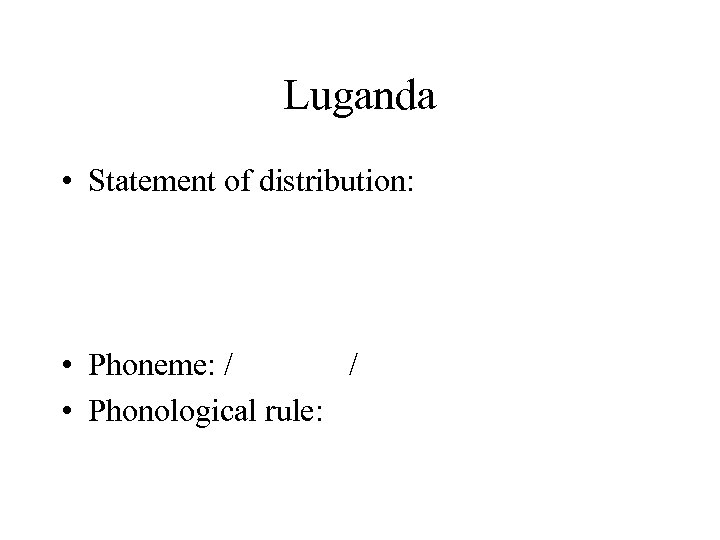 Luganda • Statement of distribution: • Phoneme: / / • Phonological rule:
![Luganda: Derivations Underlying representation Rule Surface representation [muki. Ra] [kutu˘la] [e. Ri¯a]](https://present5.com/presentation/9e2bf335f0b7cd82ec04eaf320bab355/image-16.jpg "Luganda: Derivations Underlying representation Rule Surface representation [muki. Ra] [kutu˘la] [e. Ri¯a]") Luganda: Derivations Underlying representation Rule Surface representation [muki. Ra] [kutu˘la] [e. Ri¯a]
Luganda: Derivations Underlying representation Rule Surface representation [muki. Ra] [kutu˘la] [e. Ri¯a]
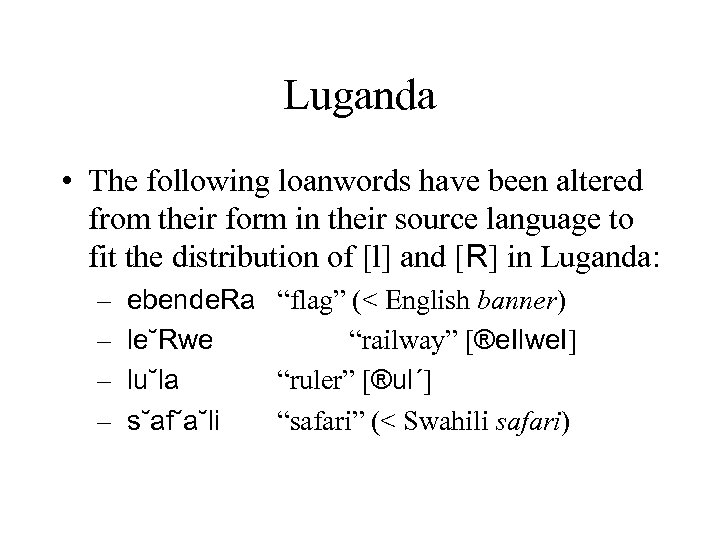 Luganda • The following loanwords have been altered from their form in their source language to fit the distribution of [l] and [R] in Luganda: – – ebende. Ra “flag” (< English banner) le˘Rwe “railway” [®e. Ilwe. I] lu˘la “ruler” [®ul´] s˘af˘a˘li “safari” (< Swahili safari)
 References • Fromkin, Victoria and Robert Rodman (1988). An Introduction to Language (4 th ed. ). Holt, Rinehart, and Winston, New York. • Halle, Morris, and G. N. Clements (1983). Problem Book in Phonology. MIT Press, Cambridge.