 Скачать презентацию HANDBOOK ON GREEN INFORMATION AND COMMUNICATION SYSTEMS Chapter
3ebaeddf859f26b041ad662933ca513b.ppt
- Количество слайдов: 29



HANDBOOK ON GREEN INFORMATION AND COMMUNICATION SYSTEMS Chapter 5: Smart Grid Communications Networks: Wireless. Technologies, Protocols, Issues and Standards Quang-Dung Ho and Tho Le-Ngoc ECE Dept. , Mc. Gill University, Montreal, Canada Mc. Gill University 1
Contents • Introduction to Smart Grid • Smart Grid Communications Network (SGCN) • Communications Traffic and Required Quality of Services (Qo. Ss) • Wireless Communications Technologies for SGCN • Neighbor Area Network (NAN) and Open Research Issues • Smart Grid Standards • Summary • References Mc. Gill University 2
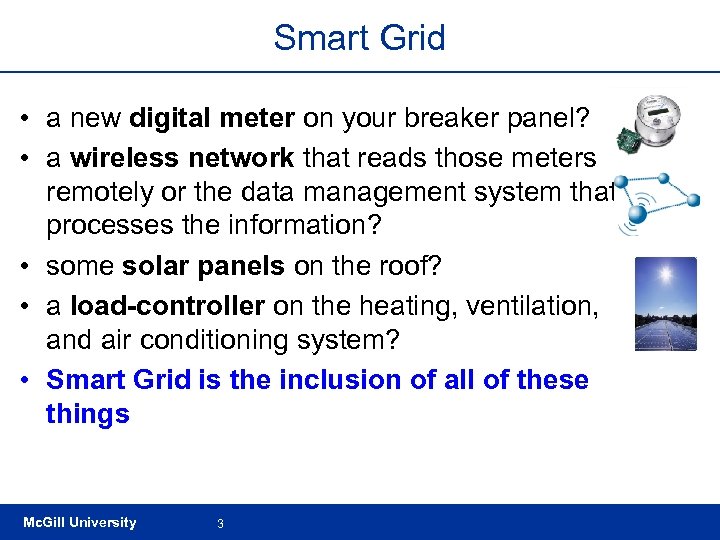
Smart Grid • a new digital meter on your breaker panel? • a wireless network that reads those meters remotely or the data management system that processes the information? • some solar panels on the roof? • a load-controller on the heating, ventilation, and air conditioning system? • Smart Grid is the inclusion of all of these things Mc. Gill University 3
Smart Grid • “an automated, widely distributed energy delivery network characterized by a two-way flow of electricity and information, capable of monitoring and responding to changes in everything from power plants to customer preferences to individual appliances” [1] • “the electricity delivery system (from point of generation to point of consumption) integrated with communications and information technology for enhanced grid operations, customer services, and environmental benefits” (Funding for Smart Gri. Funding Grid Activities, US Department of Energy, 2009, link: www. gefa. org/Modules/Show. Document. aspx? documentid=925) Mc. Gill University 4
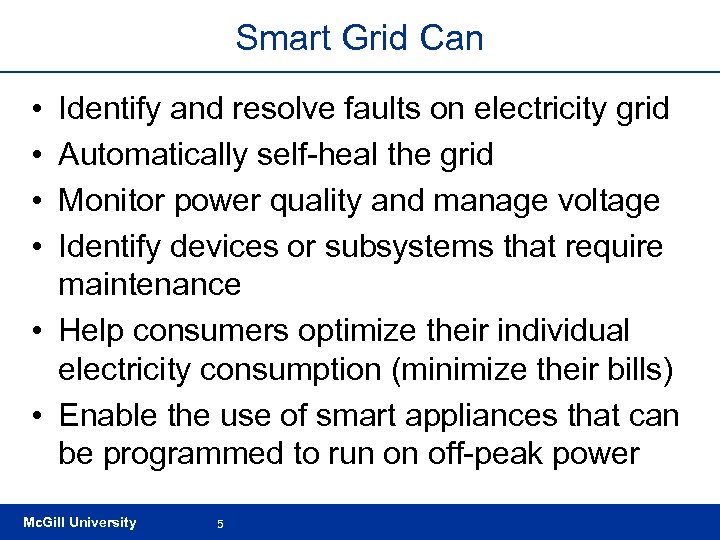
Smart Grid Can • • Identify and resolve faults on electricity grid Automatically self-heal the grid Monitor power quality and manage voltage Identify devices or subsystems that require maintenance • Help consumers optimize their individual electricity consumption (minimize their bills) • Enable the use of smart appliances that can be programmed to run on off-peak power Mc. Gill University 5
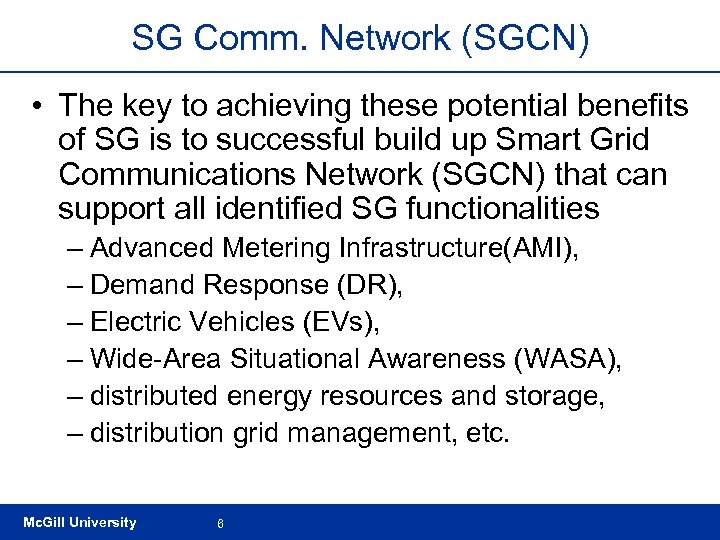
SG Comm. Network (SGCN) • The key to achieving these potential benefits of SG is to successful build up Smart Grid Communications Network (SGCN) that can support all identified SG functionalities – Advanced Metering Infrastructure(AMI), – Demand Response (DR), – Electric Vehicles (EVs), – Wide-Area Situational Awareness (WASA), – distributed energy resources and storage, – distribution grid management, etc. Mc. Gill University 6
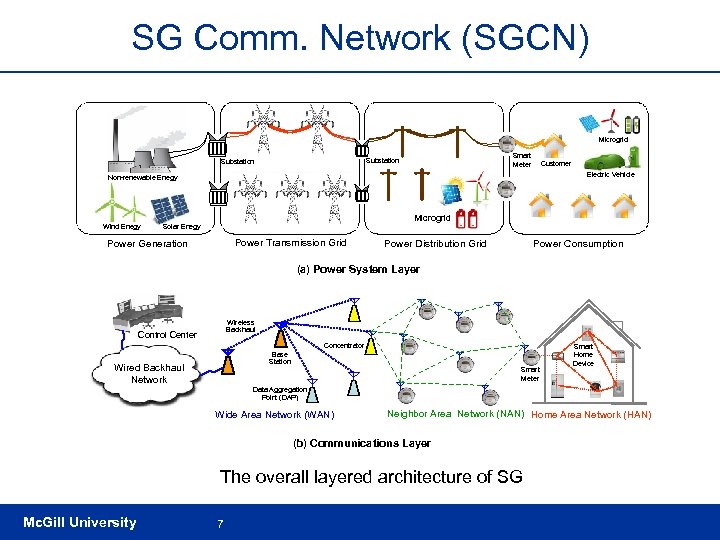
SG Comm. Network (SGCN) Microgrid Smart Meter Substation Customer Electric Vehicle Non-renewable Enegy Microgrid Wind Enegy Solar Enegy Power Transmission Grid Power Generation Power Distribution Grid Power Consumption (a) Power System Layer Wireless Backhaul Control Center Concentrator Base Station Wired Backhaul Network Smart Meter Smart Home Device Data Aggregation Point (DAP) Wide Area Network (WAN) Neighbor Area Network (NAN) Home Area Network (HAN) (b) Communications Layer The overall layered architecture of SG Mc. Gill University 7
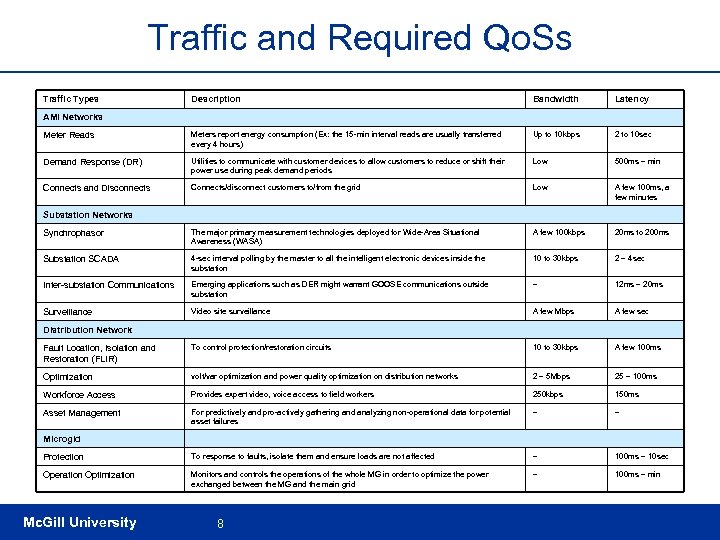
Traffic and Required Qo. Ss Traffic Types Description Bandwidth Latency Meter Reads Meters report energy consumption (Ex: the 15 -min interval reads are usually transferred every 4 hours) Up to 10 kbps 2 to 10 sec Demand Response (DR) Utilities to communicate with customer devices to allow customers to reduce or shift their power use during peak demand periods Low 500 ms ~ min Connects and Disconnects Connects/disconnect customers to/from the grid Low A few 100 ms, a few minutes Synchrophasor The major primary measurement technologies deployed for Wide-Area Situational Awareness (WASA) A few 100 kbps 20 ms to 200 ms Substation SCADA 4 -sec interval polling by the master to all the intelligent electronic devices inside the substation 10 to 30 kbps 2 ~ 4 sec Inter-substation Communications Emerging applications such as DER might warrant GOOSE communications outside substation -- 12 ms ~ 20 ms Surveillance Video site surveillance A few Mbps A few sec Fault Location, Isolation and Restoration (FLIR) To control protection/restoration circuits 10 to 30 kbps A few 100 ms Optimization volt/var optimization and power quality optimization on distribution networks 2 ~ 5 Mbps 25 ~ 100 ms Workforce Access Provides expert video, voice access to field workers 250 kbps 150 ms Asset Management For predictively and pro-actively gathering and analyzing non-operational data for potential asset failures -- -- Protection To response to faults, isolate them and ensure loads are not affected -- 100 ms ~ 10 sec Operation Optimization Monitors and controls the operations of the whole MG in order to optimize the power exchanged between the MG and the main grid -- 100 ms ~ min AMI Networks Substation Networks Distribution Network Microgid Mc. Gill University 8
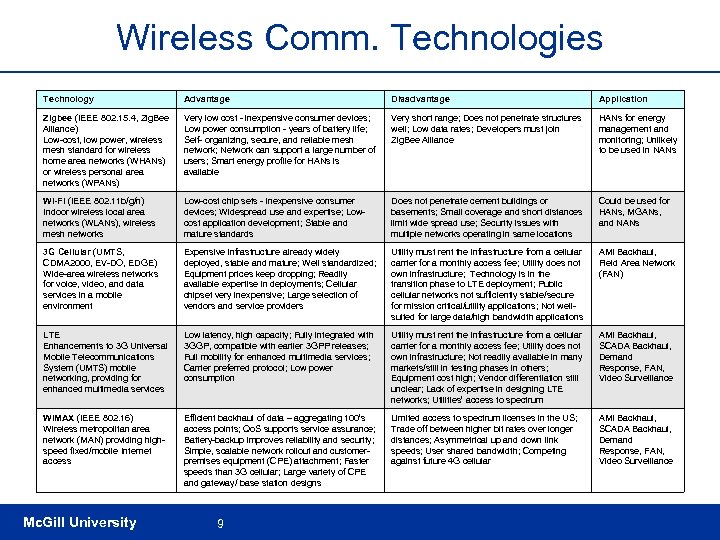
Wireless Comm. Technologies Technology Advantage Disadvantage Application Zigbee (IEEE 802. 15. 4, Zig. Bee Alliance) Low-cost, low power, wireless mesh standard for wireless home area networks (WHANs) or wireless personal area networks (WPANs) Very low cost - inexpensive consumer devices; Low power consumption - years of battery life; Self- organizing, secure, and reliable mesh network; Network can support a large number of users; Smart energy profile for HANs is available Very short range; Does not penetrate structures well; Low data rates; Developers must join Zig. Bee Alliance HANs for energy management and monitoring; Unlikely to be used in NANs Wi-Fi (IEEE 802. 11 b/g/n) Indoor wireless local area networks (WLANs), wireless mesh networks Low-cost chip sets - inexpensive consumer devices; Widespread use and expertise; Lowcost application development; Stable and mature standards Does not penetrate cement buildings or basements; Small coverage and short distances limit wide spread use; Security issues with multiple networks operating in same locations Could be used for HANs, MGANs, and NANs 3 G Cellular (UMTS, CDMA 2000, EV-DO, EDGE) Wide-area wireless networks for voice, video, and data services in a mobile environment Expensive infrastructure already widely deployed, stable and mature; Well standardized; Equipment prices keep dropping; Readily available expertise in deployments; Cellular chipset very inexpensive; Large selection of vendors and service providers Utility must rent the infrastructure from a cellular carrier for a monthly access fee; Utility does not own infrastructure; Technology is in the transition phase to LTE deployment; Public cellular networks not sufficiently stable/secure for mission critical/utility applications; Not wellsuited for large data/high bandwidth applications AMI Backhaul, Field Area Network (FAN) LTE Enhancements to 3 G Universal Mobile Telecommunications System (UMTS) mobile networking, providing for enhanced multimedia services Low latency, high capacity; Fully integrated with 3 GGP, compatible with earlier 3 GPP releases; Full mobility for enhanced multimedia services; Carrier preferred protocol; Low power consumption Utility must rent the infrastructure from a cellular carrier for a monthly access fee; Utility does not own infrastructure; Not readily available in many markets/still in testing phases in others; Equipment cost high; Vendor differentiation still unclear; Lack of expertise in designing LTE networks; Utilities’ access to spectrum AMI Backhaul, SCADA Backhaul, Demand Response, FAN, Video Surveillance Wi. MAX (IEEE 802. 16) Wireless metropolitan area network (MAN) providing highspeed fixed/mobile Internet access Efficient backhaul of data – aggregating 100’s access points; Qo. S supports service assurance; Battery-backup improves reliability and security; Simple, scalable network rollout and customerpremises equipment (CPE) attachment; Faster speeds than 3 G cellular; Large variety of CPE and gateway/ base station designs Limited access to spectrum licenses in the US; Trade off between higher bit rates over longer distances; Asymmetrical up and down link speeds; User shared bandwidth; Competing against future 4 G cellular AMI Backhaul, SCADA Backhaul, Demand Response, FAN, Video Surveillance Mc. Gill University 9
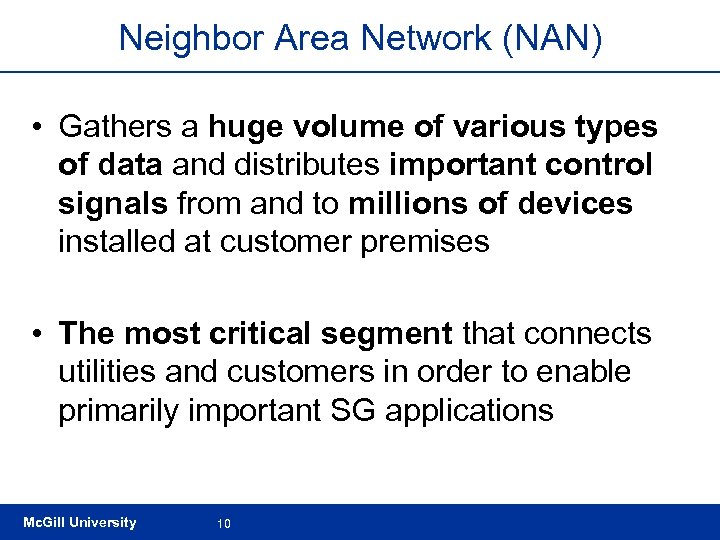
Neighbor Area Network (NAN) • Gathers a huge volume of various types of data and distributes important control signals from and to millions of devices installed at customer premises • The most critical segment that connects utilities and customers in order to enable primarily important SG applications Mc. Gill University 10
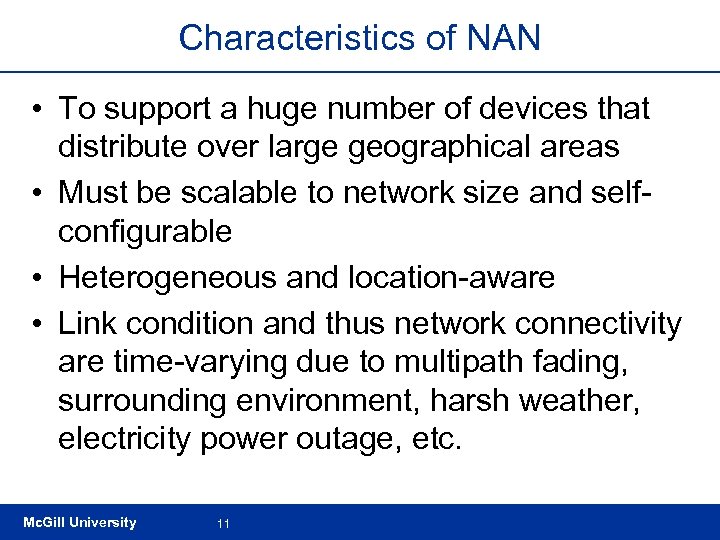
Characteristics of NAN • To support a huge number of devices that distribute over large geographical areas • Must be scalable to network size and selfconfigurable • Heterogeneous and location-aware • Link condition and thus network connectivity are time-varying due to multipath fading, surrounding environment, harsh weather, electricity power outage, etc. Mc. Gill University 11
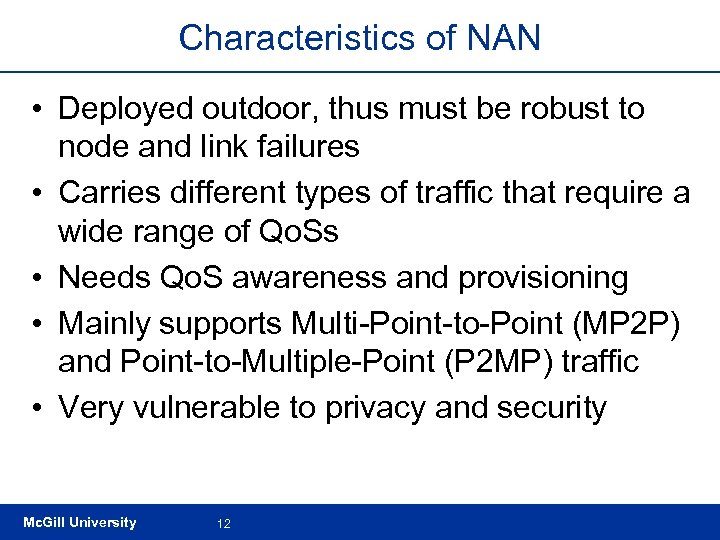
Characteristics of NAN • Deployed outdoor, thus must be robust to node and link failures • Carries different types of traffic that require a wide range of Qo. Ss • Needs Qo. S awareness and provisioning • Mainly supports Multi-Point-to-Point (MP 2 P) and Point-to-Multiple-Point (P 2 MP) traffic • Very vulnerable to privacy and security Mc. Gill University 12
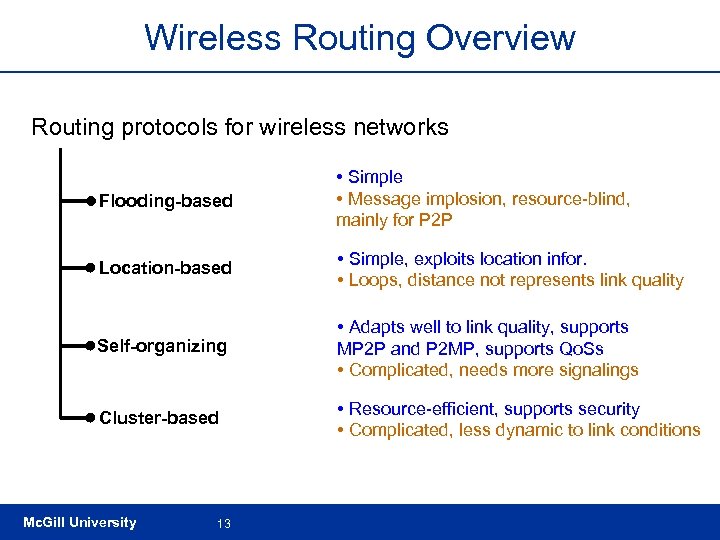
Wireless Routing Overview Routing protocols for wireless networks Flooding-based • Simple • Message implosion, resource-blind, mainly for P 2 P Location-based • Simple, exploits location infor. • Loops, distance not represents link quality Self-organizing • Adapts well to link quality, supports MP 2 P and P 2 MP, supports Qo. Ss • Complicated, needs more signalings Cluster-based • Resource-efficient, supports security • Complicated, less dynamic to link conditions Mc. Gill University 13
![Candidate Routing Protocols for NAN • Greedy Geographic routing (GEO) [40] • Routing Protocol](https://present5.com/presentation/3ebaeddf859f26b041ad662933ca513b/image-14.jpg "Candidate Routing Protocols for NAN • Greedy Geographic routing (GEO) [40] • Routing Protocol")
Candidate Routing Protocols for NAN • Greedy Geographic routing (GEO) [40] • Routing Protocol for Low Power and Lossy Networks (RPL) [41 46] • IEEE 802. 11 s Hybrid Wireless Mesh Protocol (HWMP) [47 49] Mc. Gill University 14
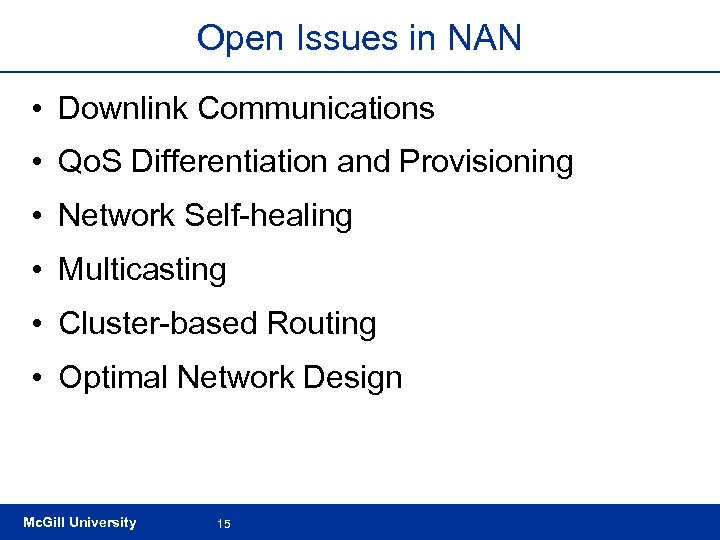
Open Issues in NAN • Downlink Communications • Qo. S Differentiation and Provisioning • Network Self-healing • Multicasting • Cluster-based Routing • Optimal Network Design Mc. Gill University 15
Smart Grid Standards • Inter-operability: “the ability of two or more systems or components to exchange information and to use the information that has been exchanged” • The overall SG system is lacking widely accepted standards Mc. Gill University 16
Smart Grid Standards • Standards Development Organizations (SDOs): – – – National Institute of Standards and Technology (NIST), American National Standards Institute (ANSI), International Electrotechnical Commission (IEC), Institute of Electrical and Electronics Engineers (IEEE), International Organization for Standardization (ISO), International Telecommunication Union (ITU), – etc. • Alliances: – Zig. Bee Alliance, Wi-Fi Alliance, Home. Plug Powerline Alliance, Z-Wave Alliance, etc. Mc. Gill University 17
NIST Activities • “primary responsibility to coordinate development of a framework that includes protocols and model standards for information management to achieve inter-operability of smart grid devices and systems. . . ” (Energy Independence and Security Act of 2007, Title XIII, Section 1305) • Specific activities: – (i) identifying existing applicable standards – (ii) addressing and solving gaps where a standard extension or new standard is needed and – (iii) identifying overlaps where multiple standards address some common information Mc. Gill University 18
NIST Activities • NIST Framework and Roadmap for Smart Grid Inter-operability Standards, Release 1. 0 [52] – 25 relevant standards (and additional 50 standards for further review) • NIST Framework and Roadmap for Smart Grid Inter-operability Standards, Release 2. 0 [53] – 34 reviewed standards (and additional 62 standards for further review) Mc. Gill University 19
NIST Activities • Priority Action Plans (PAPs), each addresses one of the following situations: – a gap exists, where a standard extension or new standard is needed; – an overlap exists, where two complementary standards address some information that is in common but different for the same scope of application Mc. Gill University 20
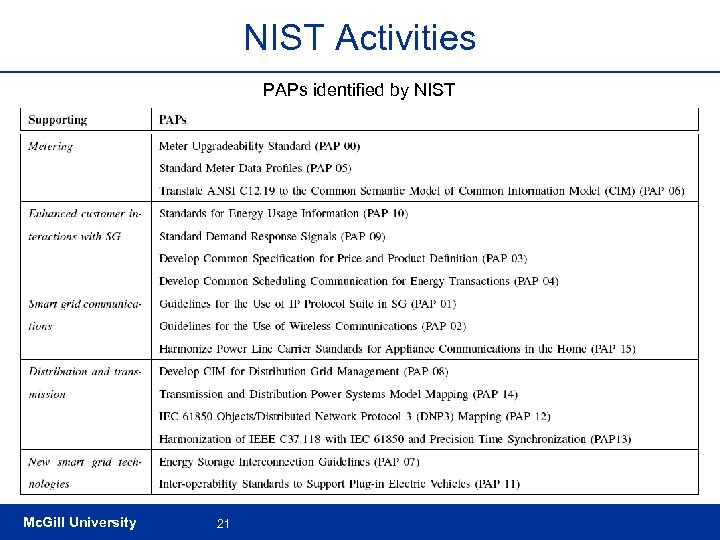
NIST Activities PAPs identified by NIST Mc. Gill University 21
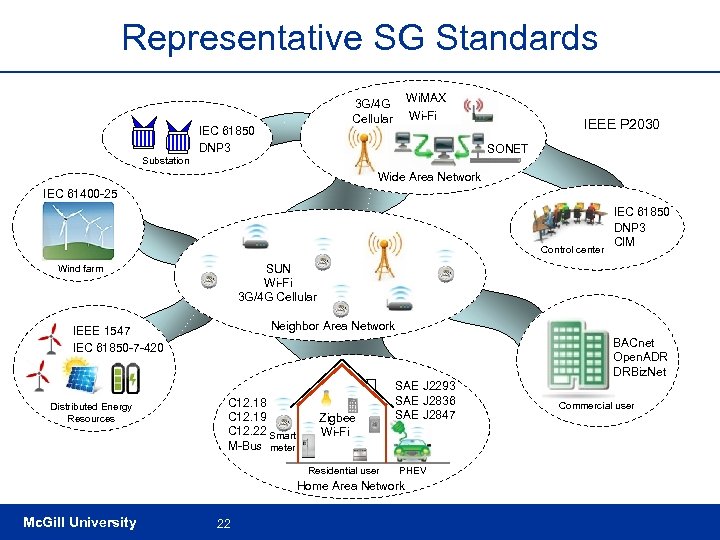
Representative SG Standards Substation Wi. MAX Wi-Fi 3 G/4 G Cellular IEC 61850 DNP 3 IEEE P 2030 SONET Wide Area Network IEC 61400 -25 Control center SUN Wi-Fi 3 G/4 G Cellular Wind farm Neighbor Area Network IEEE 1547 IEC 61850 -7 -420 Distributed Energy Resources C 12. 18 C 12. 19 C 12. 22 Smart M-Bus meter Zigbee Wi-Fi Residential user SAE J 2293 SAE J 2836 SAE J 2847 PHEV Home Area Network Mc. Gill University IEC 61850 DNP 3 CIM 22 BACnet Open. ADR DRBiz. Net Commercial user
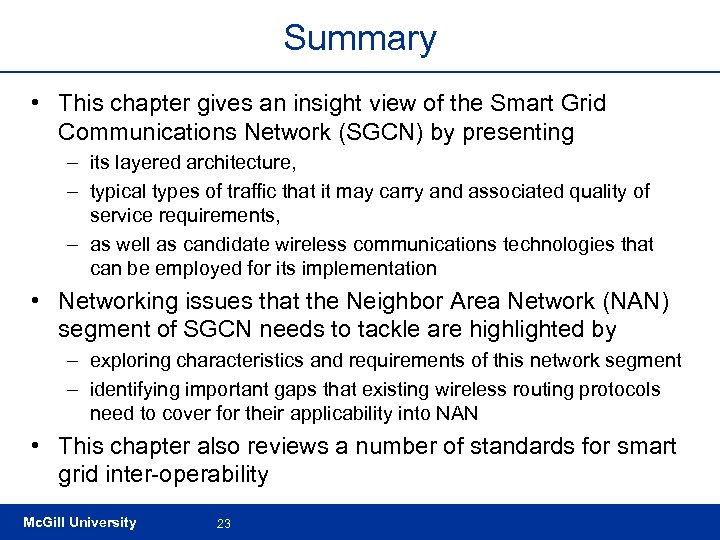
Summary • This chapter gives an insight view of the Smart Grid Communications Network (SGCN) by presenting – its layered architecture, – typical types of traffic that it may carry and associated quality of service requirements, – as well as candidate wireless communications technologies that can be employed for its implementation • Networking issues that the Neighbor Area Network (NAN) segment of SGCN needs to tackle are highlighted by – exploring characteristics and requirements of this network segment – identifying important gaps that existing wireless routing protocols need to cover for their applicability into NAN • This chapter also reviews a number of standards for smart grid inter-operability Mc. Gill University 23
References Mc. Gill University 24
References Mc. Gill University 25
References Mc. Gill University 26
References Mc. Gill University 27
References Mc. Gill University 28
References Mc. Gill University 29
Скачать презентацию HANDBOOK ON GREEN INFORMATION AND COMMUNICATION SYSTEMS Chapter
3ebaeddf859f26b041ad662933ca513b.ppt