 Скачать презентацию Handbook on Deriving Capital Measures of IPPs Charles
4ab6f5811c133b2d8f35b85de07fde6e.ppt
- Количество слайдов: 13



Handbook on Deriving Capital Measures of IPPs Charles Aspden, OECD
Introduction • Recognition of R&D as a fixed asset is one of the major changes in the new SNA • OECD and EU task forces created to promote its implementation quickly, efficiently, and accurately , while achieving international comparability • New OECD handbook to provide guidance on compiling estimates of intellectual property products (IPP)
OECD R&D TF Objective • Complete handbook on deriving capital measures of intellectual property products by the end of 2008, encompasses: – Software and databases – R&D – Mineral exploration and evaluation – Literary and artistic originals
Composition of TF • • • US (chair Brent Moulton plus 5 others) Canada (1) France (2) Germany (4) Israel (2) Korea (2) Netherlands (1) Switzerland (1) UK (1) OECD (2) Australia and New Zealand partial members
Five sub groups • SG A: R&D service lives (Soli Peleg) • SG B: R&D output price indices (Denis Fixler) • SG C: R&D GFCF boundary (Dirk van den Bergen) • SG D: R&D international trade (Francisco Moris) • SG E: Software (Charles Aspden) • 5 -9 people in each SG • Each SG has its own work plan
Meetings and communications in 2008 • First meeting in Geneva, 24 -25 April • Second meeting Paris-Washington, 21 -22 July • Third meeting Paris-Washington. Winnipeg, 16 -17 October • SGs communicate by email.
SG A: R&D service lives Activities 1. Overview of existing methods • • Econometric Patent renewal 2. Possibility of using enterprise surveys – i. e. asking the head of R&D for the firm’s expectations 3. Possibility of seeking expert opinions, e. g. experts in venture capital companies 4. Israel, Germany and UK have undertaken pilot surveys. The results are encouraging, but more refinement of survey methods is needed.
SG B: R&D output price indices Activities • Considered a proposal for a pseudo output price index at the meeting in July. • Will consider refinements to the proposal this week.
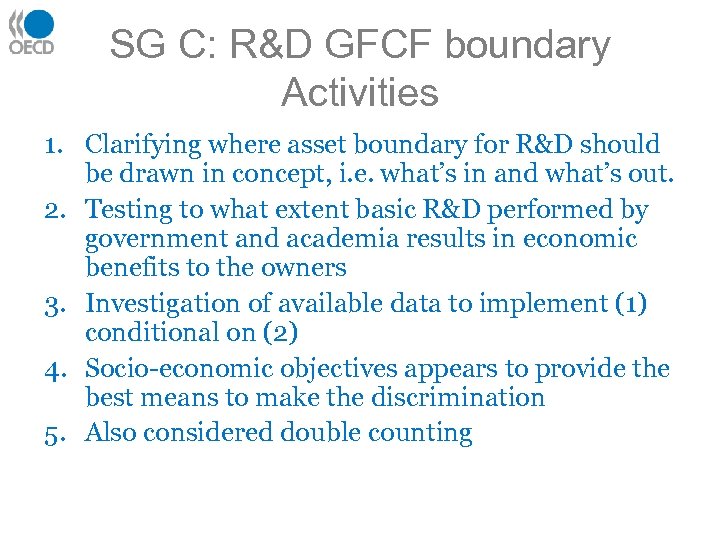
SG C: R&D GFCF boundary Activities 1. Clarifying where asset boundary for R&D should be drawn in concept, i. e. what’s in and what’s out. 2. Testing to what extent basic R&D performed by government and academia results in economic benefits to the owners 3. Investigation of available data to implement (1) conditional on (2) 4. Socio-economic objectives appears to provide the best means to make the discrimination 5. Also considered double counting
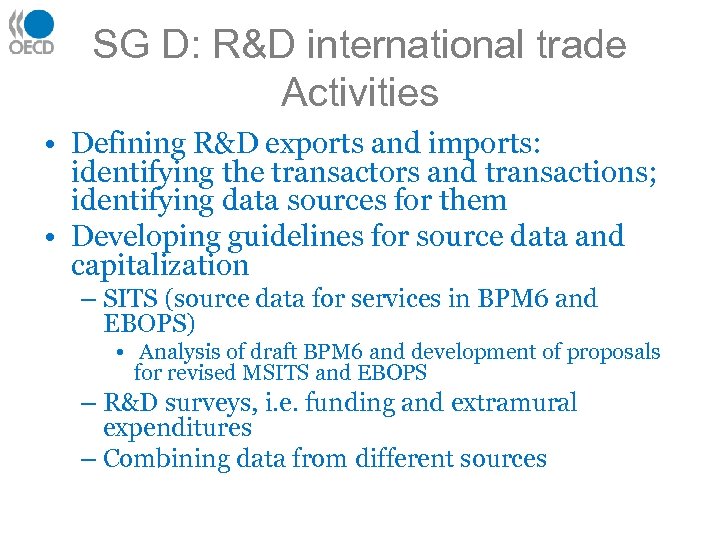
SG D: R&D international trade Activities • Defining R&D exports and imports: identifying the transactors and transactions; identifying data sources for them • Developing guidelines for source data and capitalization – SITS (source data for services in BPM 6 and EBOPS) • Analysis of draft BPM 6 and development of proposals for revised MSITS and EBOPS – R&D surveys, i. e. funding and extramural expenditures – Combining data from different sources
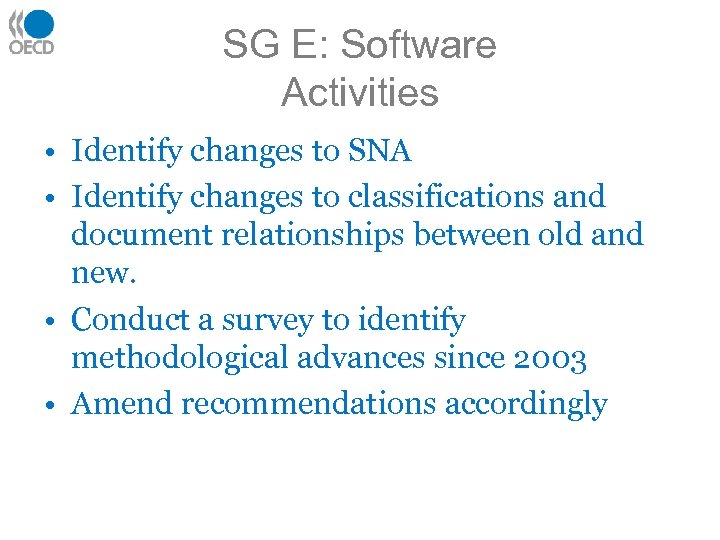
SG E: Software Activities • Identify changes to SNA • Identify changes to classifications and document relationships between old and new. • Conduct a survey to identify methodological advances since 2003 • Amend recommendations accordingly
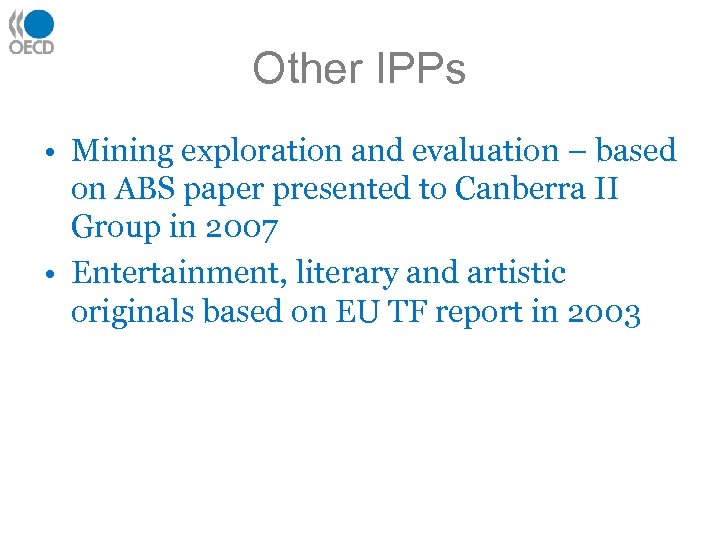
Other IPPs • Mining exploration and evaluation – based on ABS paper presented to Canberra II Group in 2007 • Entertainment, literary and artistic originals based on EU TF report in 2003
Next steps • Conclude remaining outstanding issues at this week’s meeting – Surveys on service lives and use of innovation survey data – Practicalities of using socio-economic objective data to identify R&D GFCF by nonmarket producers – Further consideration of trade data and MNCs – Review the draft Handbook • Finalise draft Handbook
Скачать презентацию Handbook on Deriving Capital Measures of IPPs Charles
4ab6f5811c133b2d8f35b85de07fde6e.ppt