


 Скачать презентацию Hall C Summer Workshop Exclusive study of Short
86fc1d6162c5c7008cde93ab31201add.ppt
- Количество слайдов: 65
 Hall C Summer Workshop Exclusive study of Short range correlations Eli Piasetzky Tel Aviv University, ISRAEL
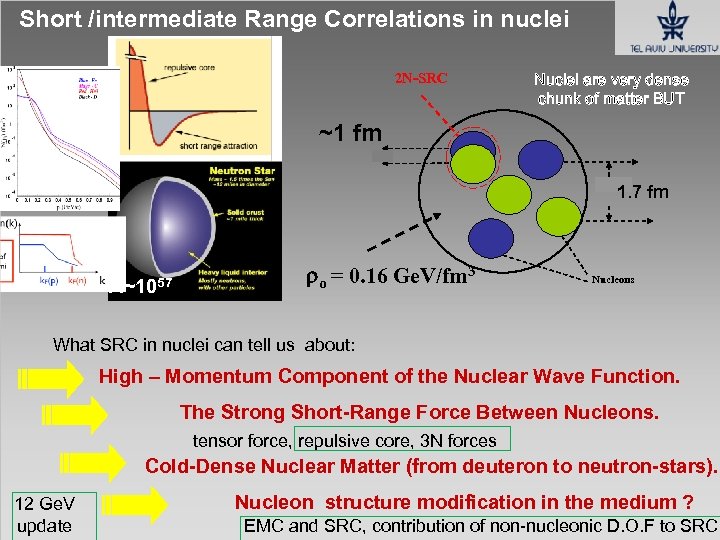 Short /intermediate Range Correlations in nuclei 2 N-SRC Nuclei are very dense chunk of matter BUT ~1 fm 1. f 1. 7 f A~1057 o = 0. 16 Ge. V/fm 3 1. 7 fm Nucleons What SRC in nuclei can tell us about: High – Momentum Component of the Nuclear Wave Function. The Strong Short-Range Force Between Nucleons. tensor force, repulsive core, 3 N forces Cold-Dense Nuclear Matter (from deuteron to neutron-stars). 12 Ge. V update Nucleon structure modification in the medium ? EMC and SRC, contribution of non-nucleonic D. O. F to SRC
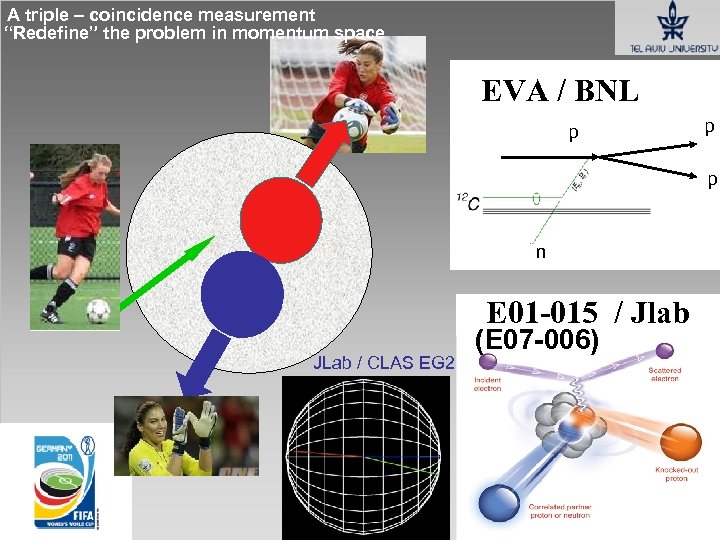 A triple – coincidence measurement “Redefine” the problem in momentum space EVA / BNL p p p n E 01 -015 / Jlab JLab / CLAS EG 2 (E 07 -006)
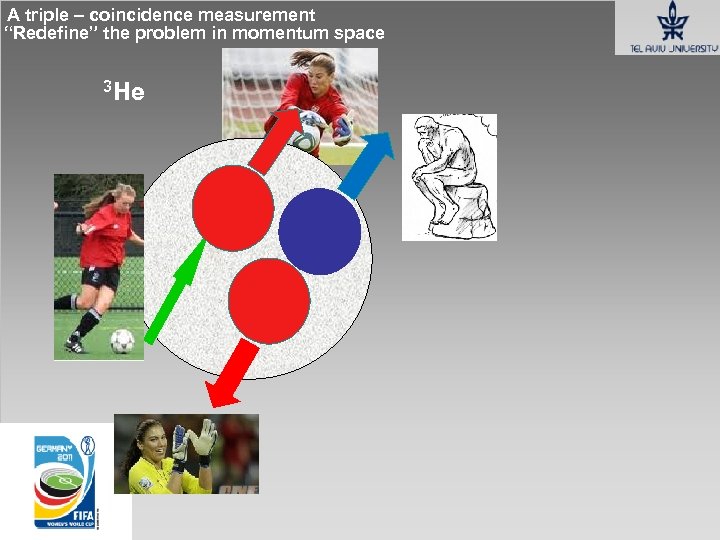 A triple – coincidence measurement “Redefine” the problem in momentum space 3 He he
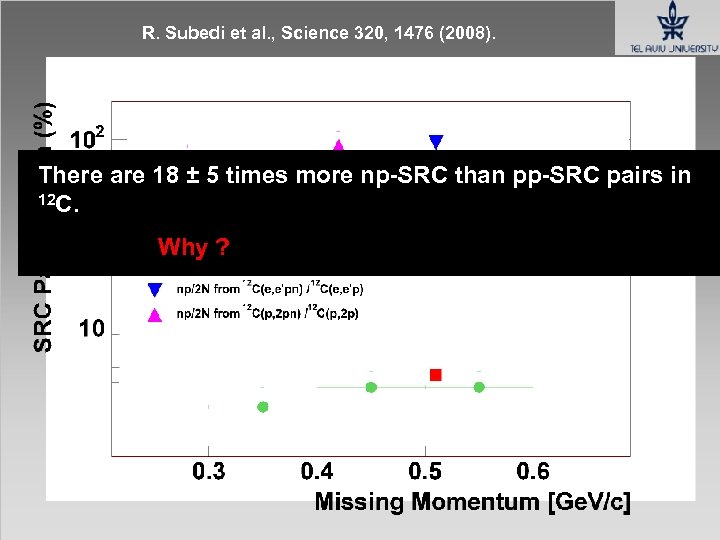 R. Subedi et al. , Science 320, 1476 (2008). BNL / EVA 12 C(e, e’pn) / 12 C(e, e’p) There are 18 ± 5 times more np-SRC than pp-SRC pairs in 12 C. Why ? [12 C(e, e’pn) / 12 C(e, e’pp)] [12 C(e, e’pp) / /2 12 C(e, e’p)] /2
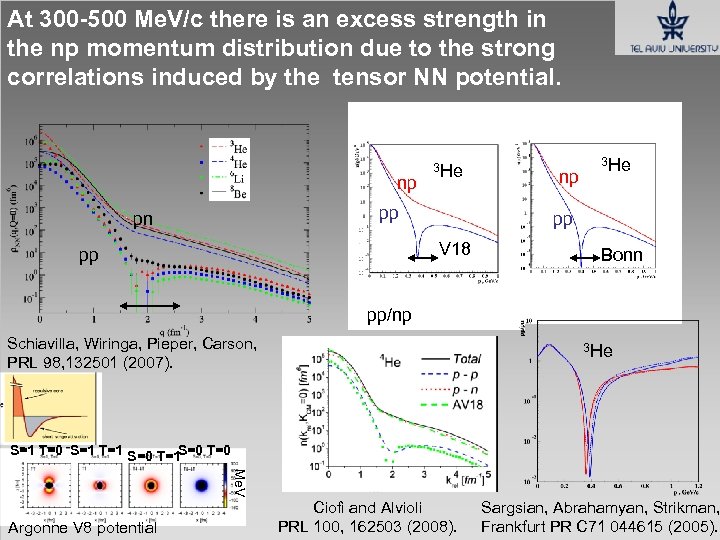 At 300 -500 Me. V/c there is an excess strength in the np momentum distribution due to the strong correlations induced by the tensor NN potential. np 3 He pp pn pp V 18 pp np 3 He Bonn pp/np Schiavilla, Wiringa, Pieper, Carson, PRL 98, 132501 (2007). 3 He S=1 T=0 S=1 T=1 S=0 T=0 S=1 T=0 Me. V Argonne V 8 potential Ciofi and Alvioli PRL 100, 162503 (2008). Sargsian, Abrahamyan, Strikman, Frankfurt PR C 71 044615 (2005).
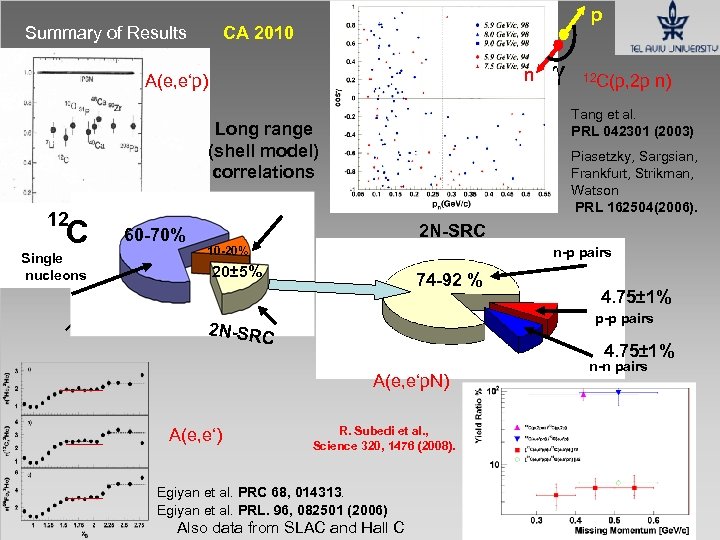 Summary of Results p CA 2010 n A(e, e‘p) C Single nucleons 60 -70% 12 C(p, 2 p n) Tang et al. PRL 042301 (2003) Long range (shell model) correlations 12 γ Piasetzky, Sargsian, Frankfurt, Strikman, Watson PRL 162504(2006). 2 N-SRC 10 -20% n-p pairs 20± 5% 74 -92 % p-p pairs 2 N-SRC 4. 75± 1% A(e, e‘p. N) A(e, e‘) 4. 75± 1% R. Subedi et al. , Science 320, 1476 (2008). Egiyan et al. PRC 68, 014313. Egiyan et al. PRL. 96, 082501 (2006) Also data from SLAC and Hall C n-n pairs
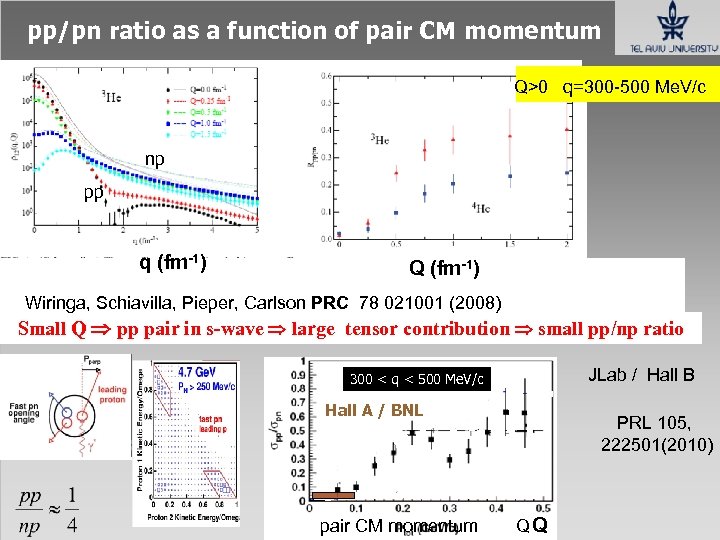
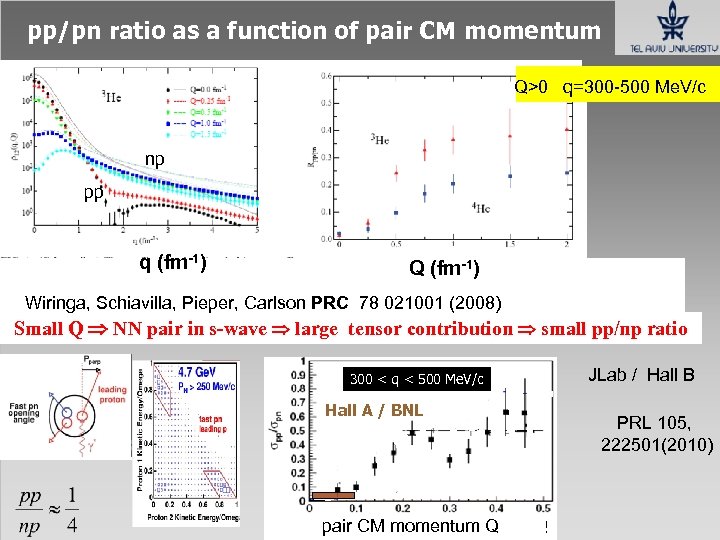 pp/pn ratio as a function of pair CM momentum Q>0 q=300 -500 Me. V/c np pp q (fm-1) Q (fm-1) Wiringa, Schiavilla, Pieper, Carlson PRC 78 021001 (2008) Small Q NN pair in s-wave large tensor contribution small pp/np ratio 300 < q < 500 Me. V/c Hall A / BNL pair CM momentum Q Q Q JLab / Hall B PRL 105, 222501(2010)
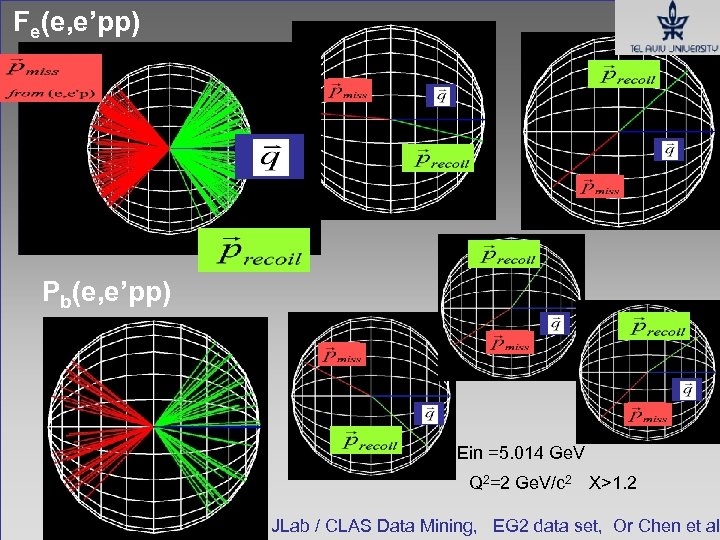 Fe(e, e’pp) Pb(e, e’pp) Ein =5. 014 Ge. V Q 2=2 Ge. V/c 2 X>1. 2 JLab / CLAS Data Mining, EG 2 data set, Or Chen et al.
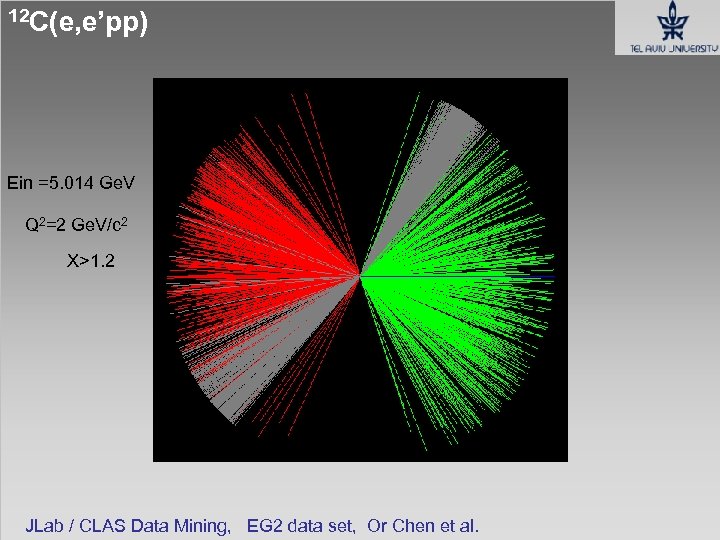 12 C(e, e’pp) Ein =5. 014 Ge. V Q 2=2 Ge. V/c 2 X>1. 2 JLab / CLAS Data Mining, EG 2 data set, Or Chen et al.
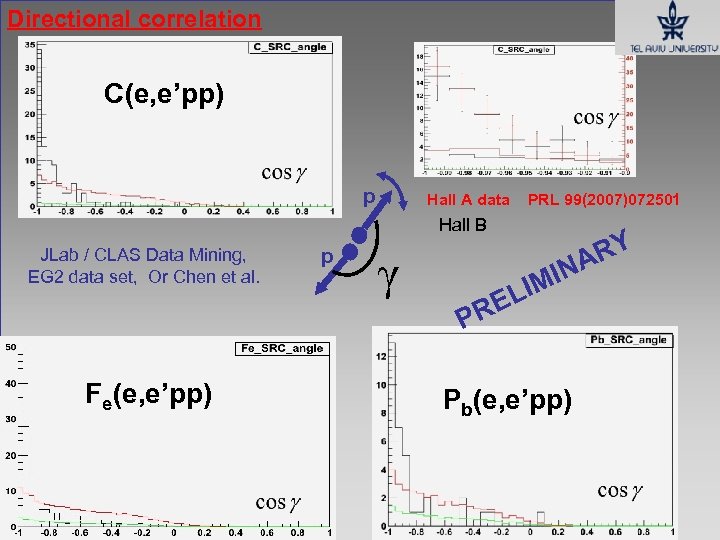 Directional correlation C(e, e’pp) p Hall A data PRL 99(2007)072501 Hall B JLab / CLAS Data Mining, EG 2 data set, Or Chen et al. p γ RY INA LIM RE P Fe(e, e’pp) Pb(e, e’pp)
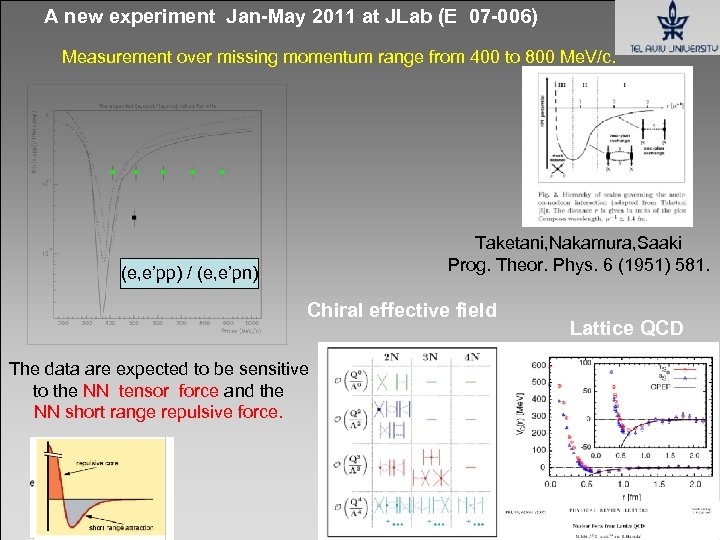 A new experiment Jan-May 2011 at JLab (E 07 -006) Measurement over missing momentum range from 400 to 800 Me. V/c. Taketani, Nakamura, Saaki Prog. Theor. Phys. 6 (1951) 581. (e, e’pp) / (e, e’pn) Chiral effective field The data are expected to be sensitive to the NN tensor force and the NN short range repulsive force. Lattice QCD
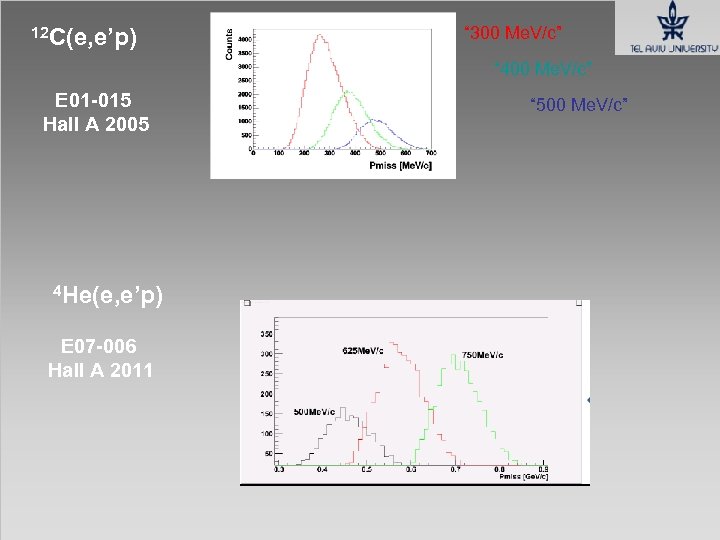 12 C(e, e’p) “ 300 Me. V/c” “ 400 Me. V/c” E 01 -015 Hall A 2005 4 He(e, e’p) E 07 -006 Hall A 2011 “ 500 Me. V/c”
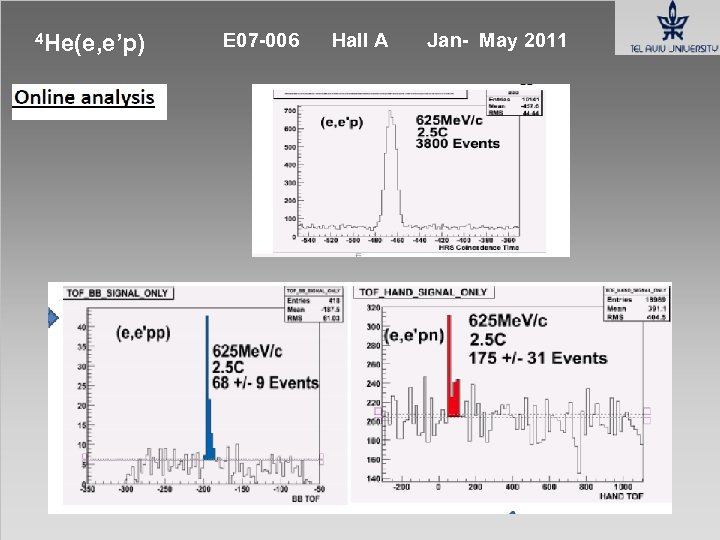 4 He(e, e’p) E 07 -006 Hall A Jan- May 2011
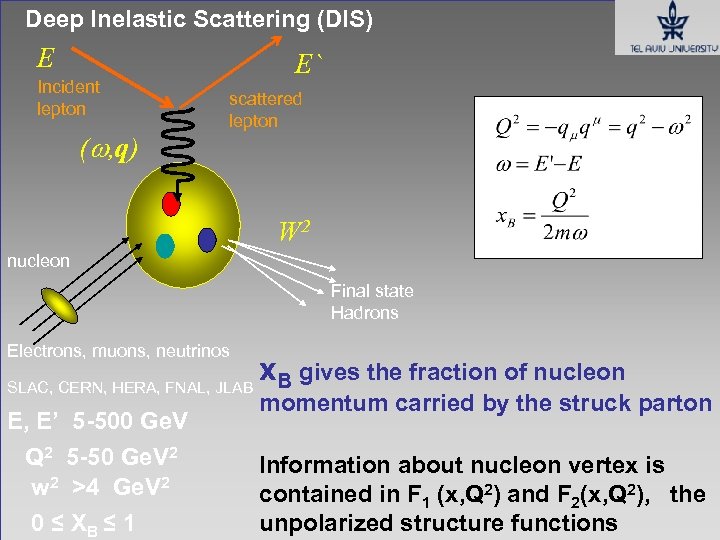 Deep Inelastic Scattering (DIS) E Incident lepton ( , q) E` scattered lepton W 2 nucleon Final state Hadrons Electrons, muons, neutrinos SLAC, CERN, HERA, FNAL, JLAB x. B gives the fraction of nucleon E, E’ 5 -500 Ge. V Q 2 5 -50 Ge. V 2 w 2 >4 Ge. V 2 0 ≤ XB ≤ 1 Information about nucleon vertex is contained in F 1 (x, Q 2) and F 2(x, Q 2), the unpolarized structure functions momentum carried by the struck parton
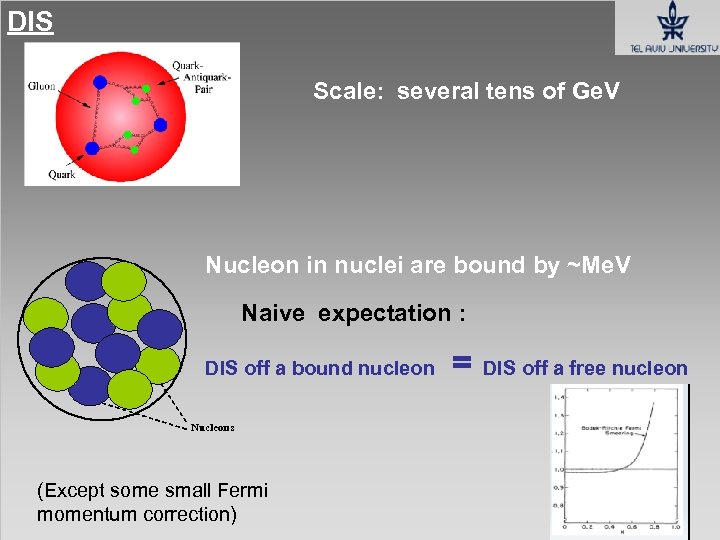 DIS Scale: several tens of Ge. V Nucleon in nuclei are bound by ~Me. V Naive expectation : DIS off a bound nucleon Nucleons (Except some small Fermi momentum correction) = DIS off a free nucleon
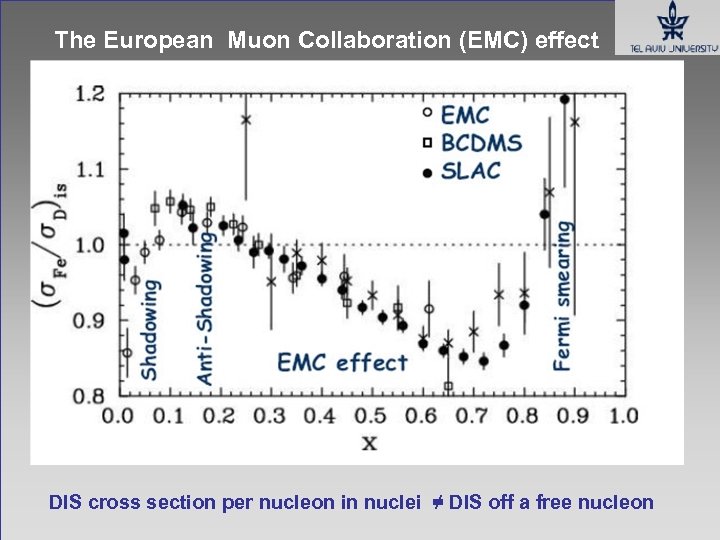 The European Muon Collaboration (EMC) effect DIS cross section per nucleon in nuclei ≠ DIS off a free nucleon
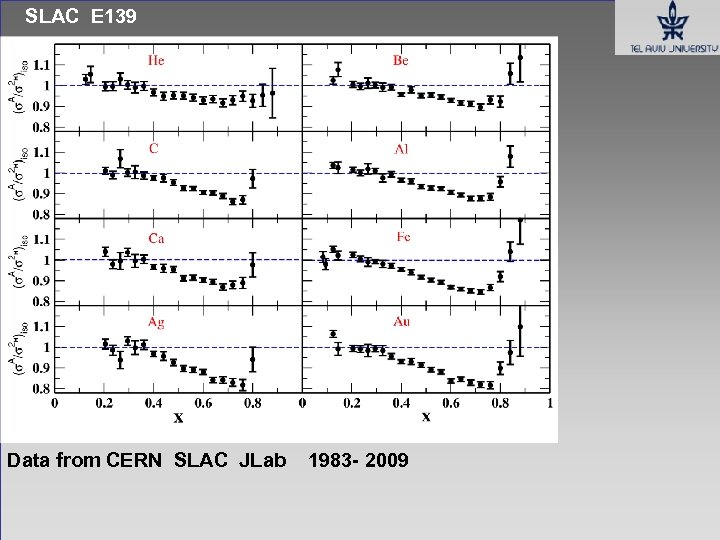 SLAC E 139 Data from CERN SLAC JLab 1983 - 2009
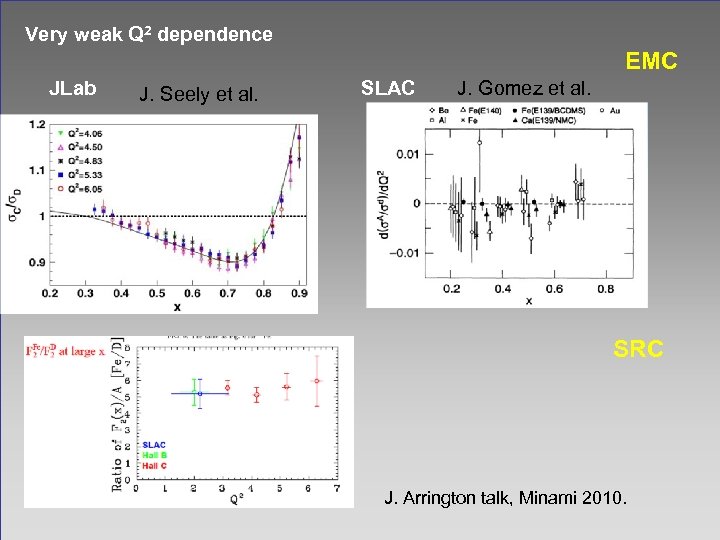
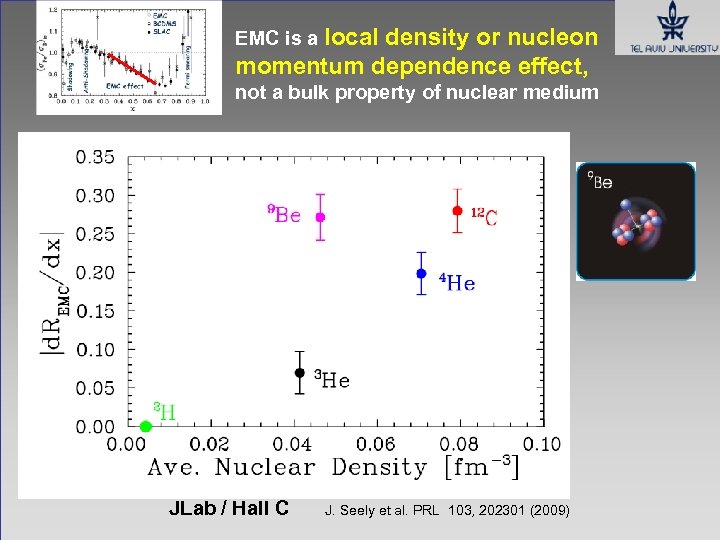 EMC is a local density or nucleon momentum dependence effect, not a bulk property of nuclear medium JLab / Hall C J. Seely et al. PRL 103, 202301 (2009)
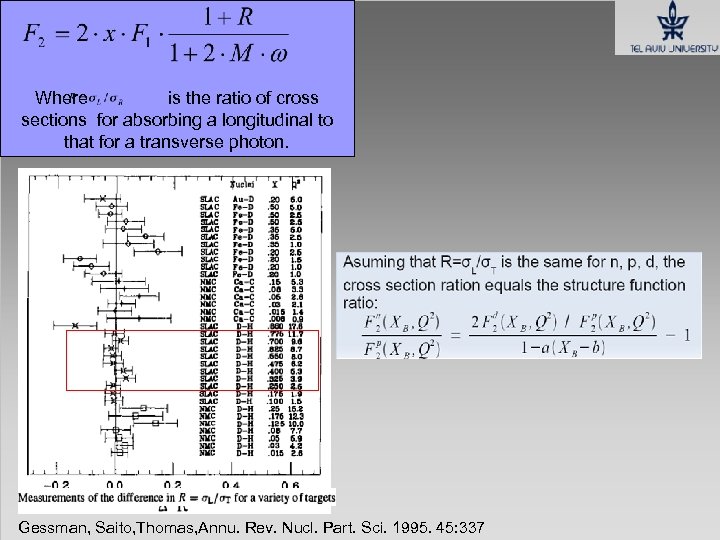
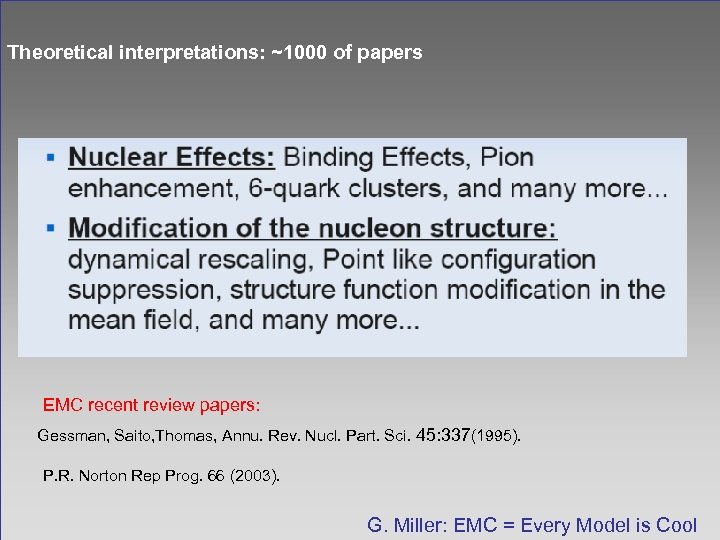 Theoretical interpretations: ~1000 of papers EMC recent review papers: Gessman, Saito, Thomas, Annu. Rev. Nucl. Part. Sci. 45: 337(1995). P. R. Norton Rep Prog. 66 (2003). G. Miller: EMC = Every Model is Cool
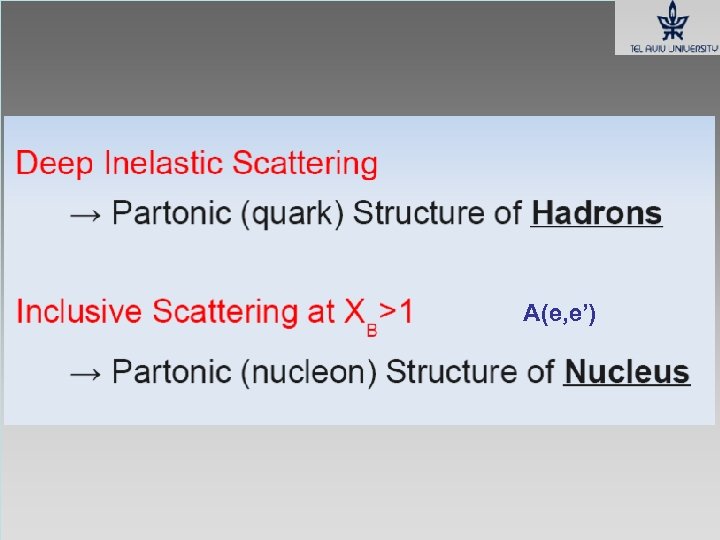 A(e, e’)
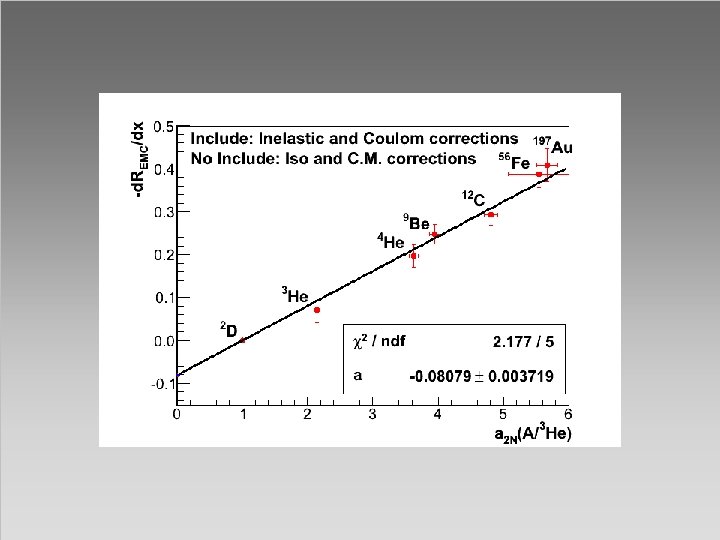
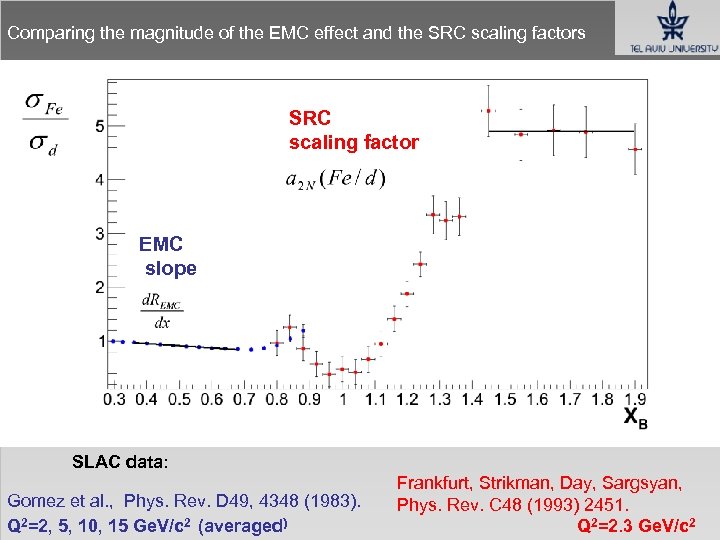 Comparing the magnitude of the EMC effect and the SRC scaling factors SRC scaling factor EMC slope : SLAC data: Gomez et al. , Phys. Rev. D 49, 4348 (1983). Q 2=2, 5, 10, 15 Ge. V/c 2 (averaged) Frankfurt, Strikman, Day, Sargsyan, Phys. Rev. C 48 (1993) 2451. Q 2=2. 3 Ge. V/c 2
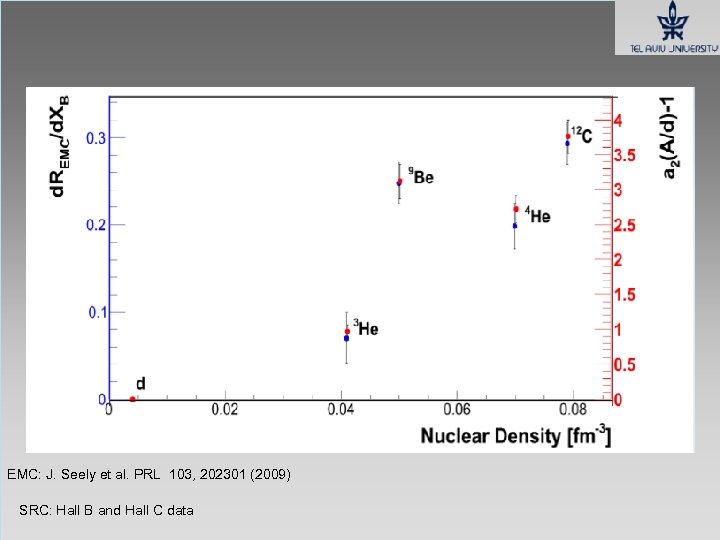 EMC: J. Seely et al. PRL 103, 202301 (2009) SRC: Hall B and Hall C data
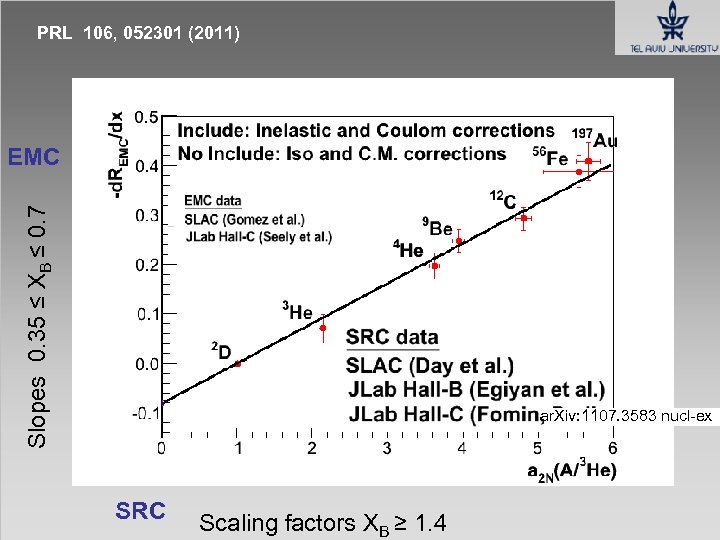 PRL 106, 052301 (2011) Slopes 0. 35 ≤ XB ≤ 0. 7 EMC ar. Xiv: 1107. 3583 nucl-ex SRC Scaling factors XB ≥ 1. 4
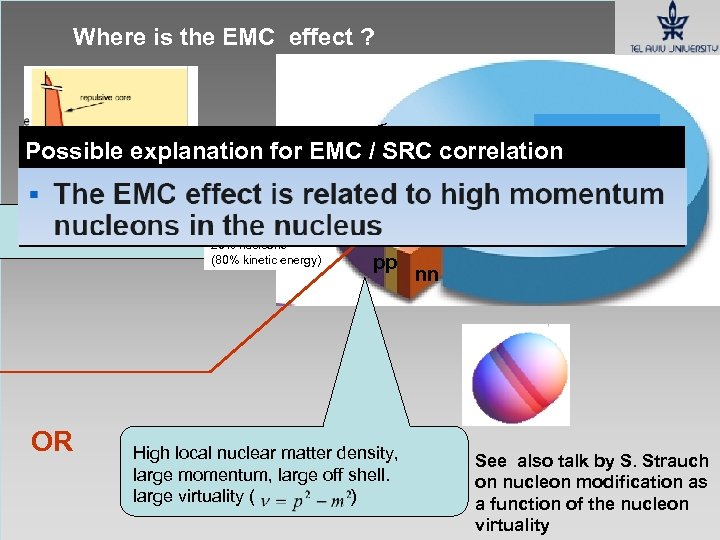 Where is the EMC effect ? 80% nucleons (20% kinetic energy) Possible explanation for EMC / SRC correlation SRC np Largest attractive force 20% nucleons (80% kinetic energy) OR pp High local nuclear matter density, large momentum, large off shell. large virtuality ( ) Mean field nn See also talk by S. Strauch on nucleon modification as a function of the nucleon virtuality
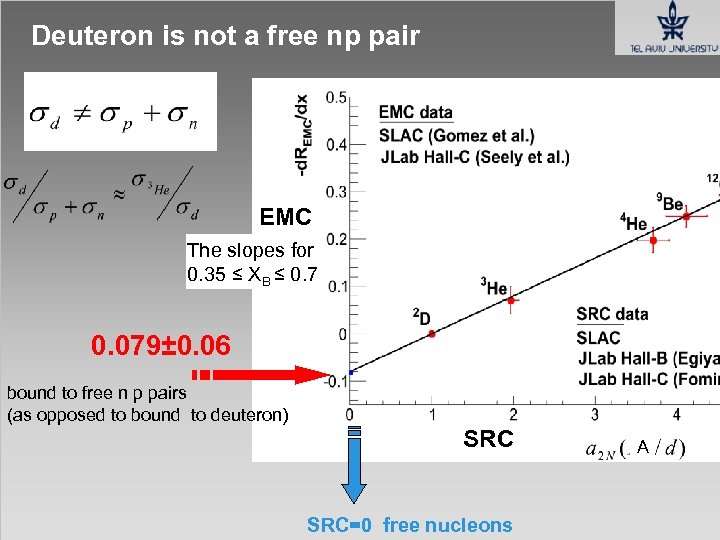 Deuteron is not a free np pair EMC The slopes for 0. 35 ≤ XB ≤ 0. 7 0. 079± 0. 06 bound to free n p pairs (as opposed to bound to deuteron) SRC=0 free nucleons A
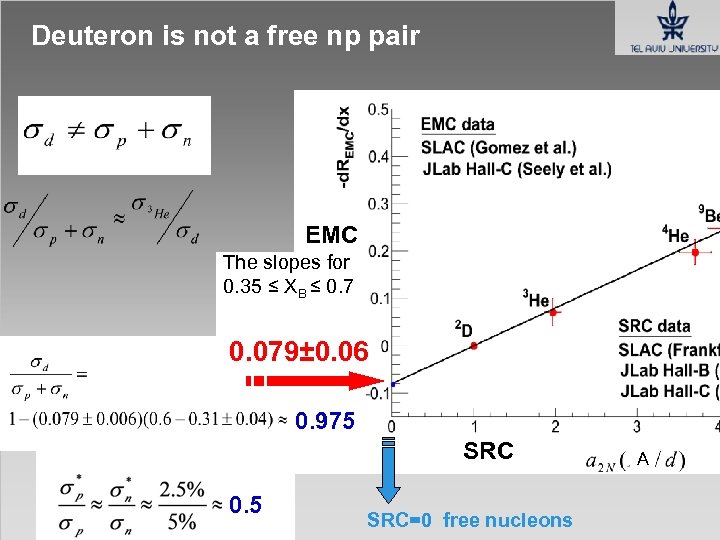 Deuteron is not a free np pair EMC The slopes for 0. 35 ≤ XB ≤ 0. 7 0. 079± 0. 06 0. 975 SRC 0. 5 SRC=0 free nucleons A
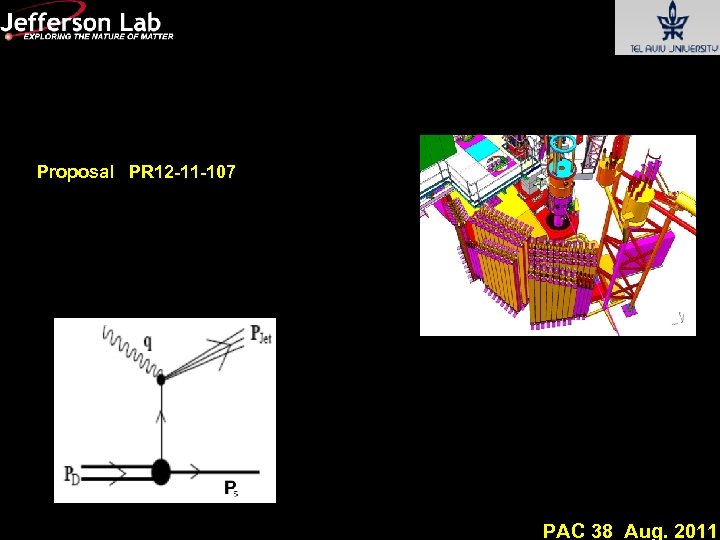 In Medium Nucleon Structure Function, SRC, and the EMC Effect Proposal PR 12 -11 -107 Spokepersons: O. Hen (TAU), L. B. Weinstein (ODU), S. A. Wood (JLab), S. Gilad (MIT) Collaboration: Experimental groups from : ANL, CNU, FIU, HU, JLab, KSU, MIT, NRCN, ODU, TAU, U. of Glasgow, U. of Ljubljana, UTFSM, UVa Theoretical support: Accardi, Ciofi Degli Atti, Cosyn, Frankfurt, Kaptari, Melnitchouk, Mezzetti, Miller, Ryckebusch, Sargsian, Strikman PAC 38 Aug. 2011
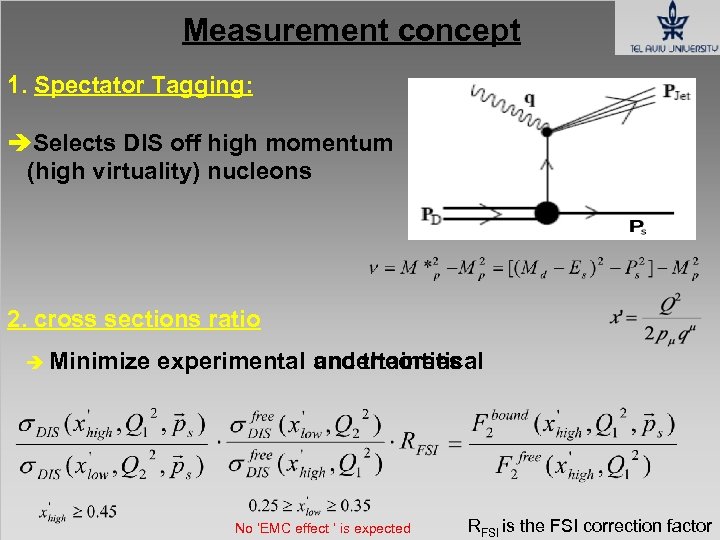 Measurement concept 1. Spectator Tagging: Selects DIS off high momentum (high virtuality) nucleons 2. cross sections ratio Minimize experimental and theoretical uncertainties No ‘EMC effect ‘ is expected RFSI is the FSI correction factor
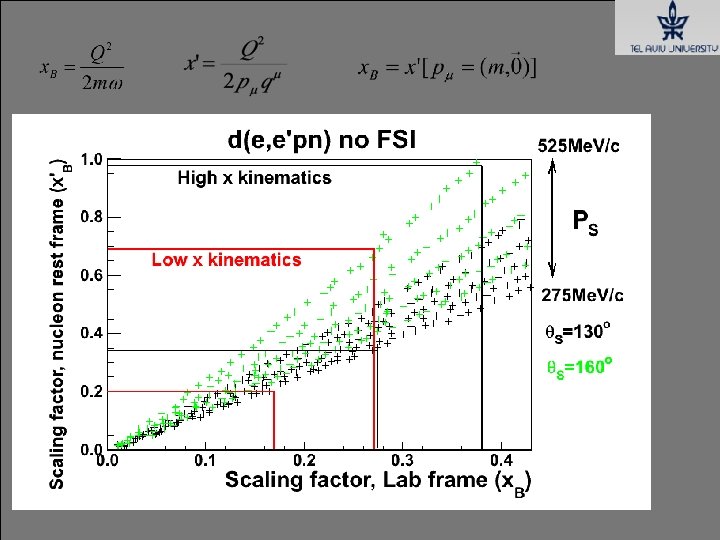
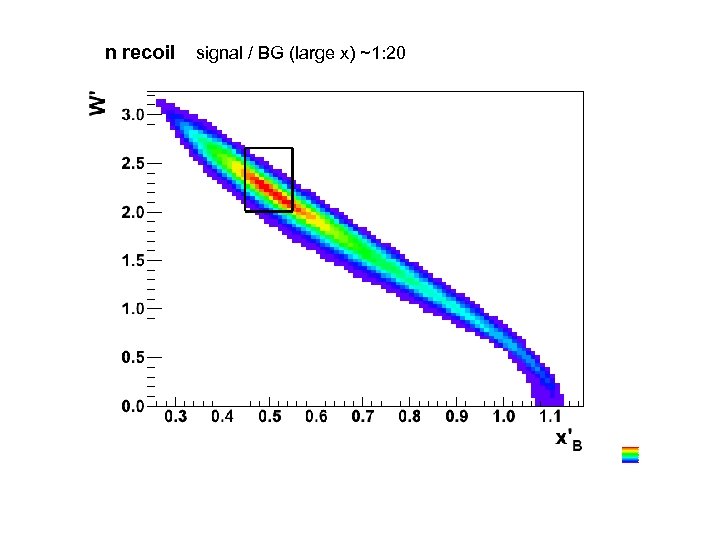
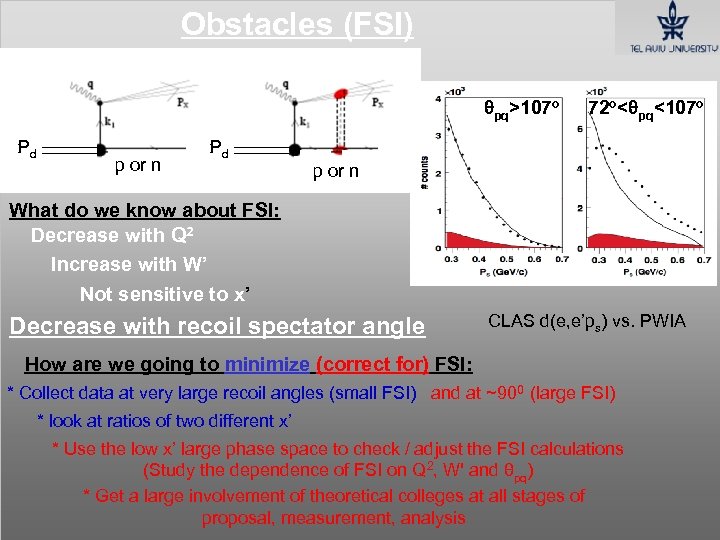 Obstacles (FSI) θpq>107 o P Pd d p or n 72 o<θpq<107 o P Pd d p or n What do we know about FSI: Decrease with Q 2 Increase with W’ Not sensitive to x’ Decrease with recoil spectator angle CLAS d(e, e’ps) vs. PWIA How are we going to minimize (correct for) FSI: * Collect data at very large recoil angles (small FSI) and at ~900 (large FSI) * look at ratios of two different x’ * Use the low x’ large phase space to check / adjust the FSI calculations (Study the dependence of FSI on Q 2, W' and θpq) * Get a large involvement of theoretical colleges at all stages of proposal, measurement, analysis
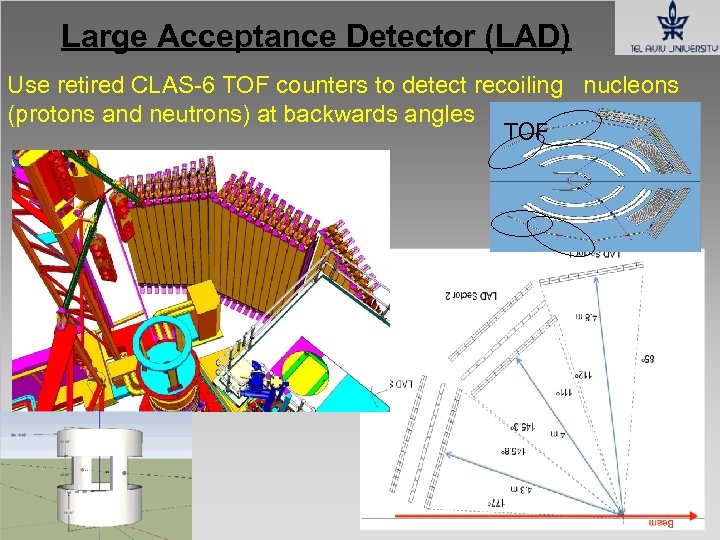 Large Acceptance Detector (LAD) Use retired CLAS-6 TOF counters to detect recoiling nucleons (protons and neutrons) at backwards angles TOF
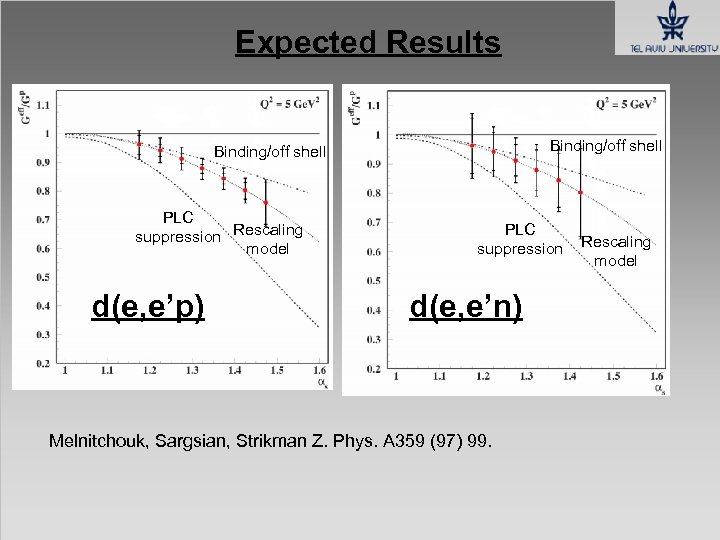 Expected Results Binding/off shell PLC suppression Rescaling model d(e, e’p) PLC suppression d(e, e’n) Melnitchouk, Sargsian, Strikman Z. Phys. A 359 (97) 99. Rescaling model
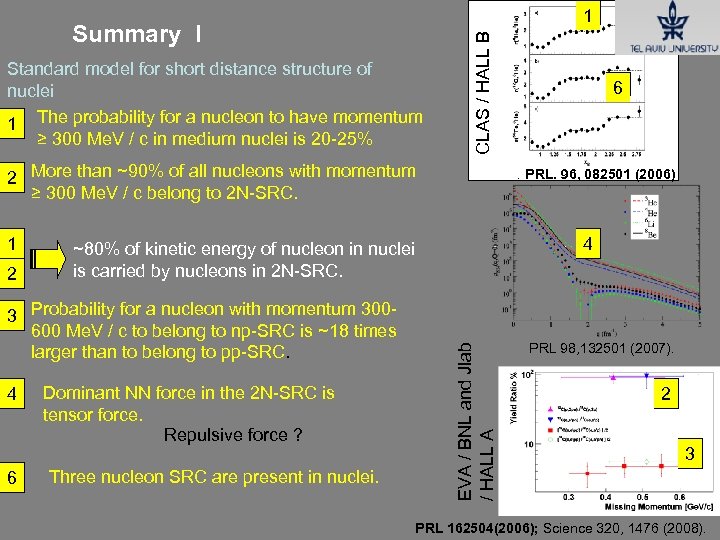 Summary I Standard model for short distance structure of nuclei 1 The probability for a nucleon to have momentum ≥ 300 Me. V / c in medium nuclei is 20 -25% CLAS / HALL B 1 2 More than ~90% of all nucleons with momentum ≥ 300 Me. V / c belong to 2 N-SRC. 2 6 4 ~80% of kinetic energy of nucleon in nuclei is carried by nucleons in 2 N-SRC. 3 Probability for a nucleon with momentum 300600 Me. V / c to belong to np-SRC is ~18 times larger than to belong to pp-SRC. 4 . PRL. 96, 082501 (2006) Dominant NN force in the 2 N-SRC is tensor force. Repulsive force ? Three nucleon SRC are present in nuclei. EVA / BNL and Jlab / HALL A 1 6 PRL 98, 132501 (2007). 2 3 PRL 162504(2006); Science 320, 1476 (2008).
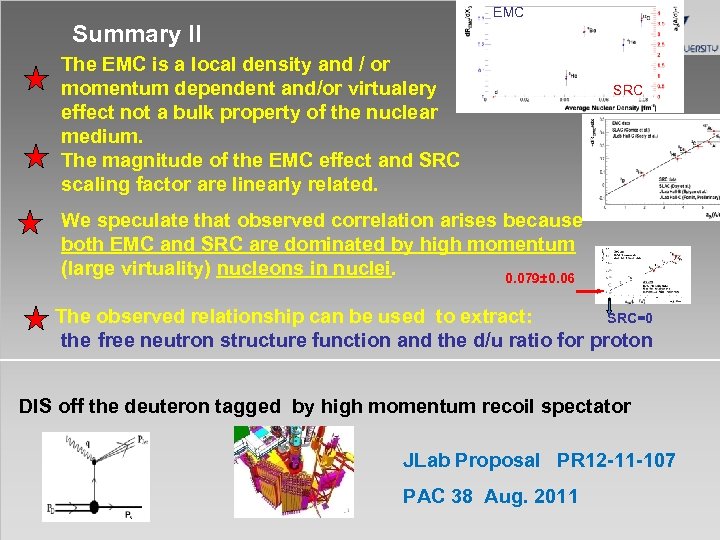 EMC Summary II The EMC is a local density and / or momentum dependent and/or virtualery effect not a bulk property of the nuclear medium. The magnitude of the EMC effect and SRC scaling factor are linearly related. SRC We speculate that observed correlation arises because both EMC and SRC are dominated by high momentum (large virtuality) nucleons in nuclei. 0. 079± 0. 06 The observed relationship can be used to extract: SRC=0 the free neutron structure function and the d/u ratio for proton DIS off the deuteron tagged by high momentum recoil spectator JLab Proposal PR 12 -11 -107 PAC 38 Aug. 2011
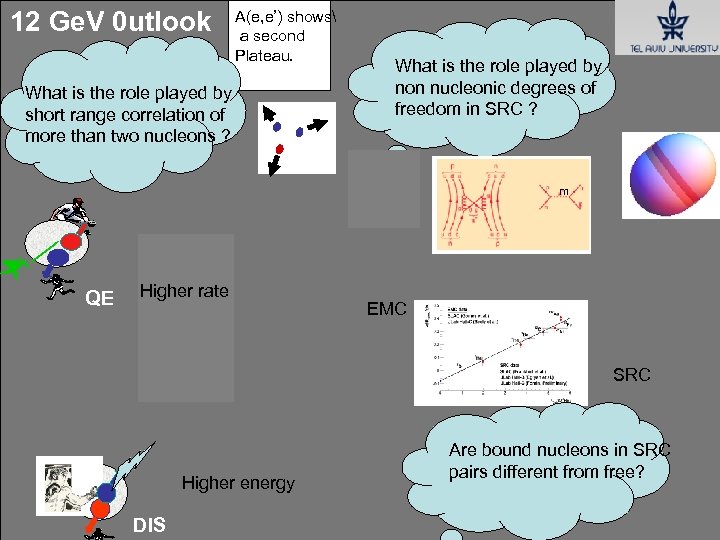
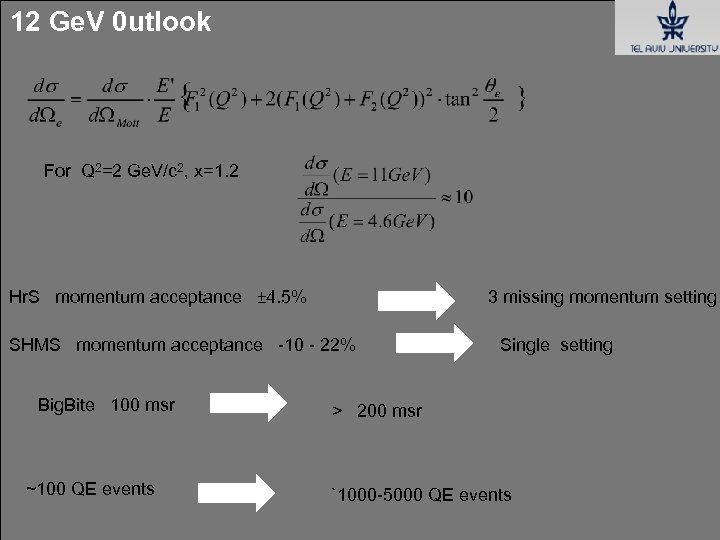 12 Ge. V 0 utlook For Q 2=2 Ge. V/c 2, x=1. 2 Hr. S momentum acceptance ± 4. 5% 3 missing momentum setting SHMS momentum acceptance -10 - 22% Big. Bite 100 msr ~100 QE events Single setting > 200 msr `1000 -5000 QE events
 12 Ge. V 0 utlook A(e, e’) shows a second Plateau. What is the role played by short range correlation of more than two nucleons ? What is the role played by non nucleonic degrees of freedom in SRC ? m QE Higher rate EMC SRC Higher energy DIS Are bound nucleons in SRC pairs different from free?

 n recoil signal / BG (large x) ~1: 20
 Ciofi, )
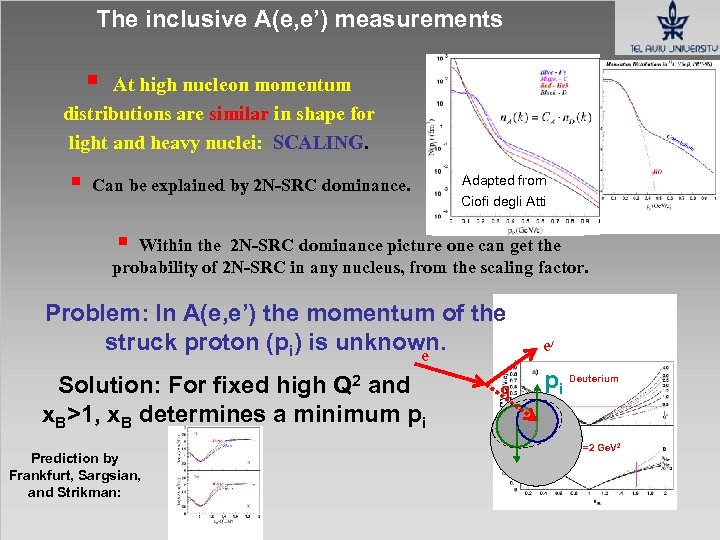 The inclusive A(e, e’) measurements § At high nucleon momentum distributions are similar in shape for light and heavy nuclei: SCALING. § Can be explained by 2 N-SRC dominance. Adapted from Ciofi degli Atti § Within the 2 N-SRC dominance picture one can get the probability of 2 N-SRC in any nucleus, from the scaling factor. Problem: In A(e, e’) the momentum of the struck proton (pi) is unknown. e Solution: For fixed high Q 2 and x. B>1, x. B determines a minimum pi Prediction by Frankfurt, Sargsian, and Strikman: q e/ pi Deuterium Q 2=2 Ge. V 2
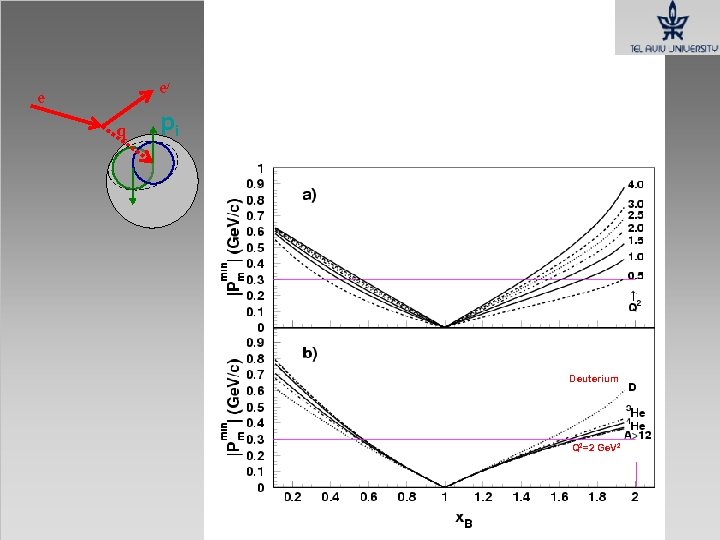 e/ e q pi Deuterium Q 2=2 Ge. V 2
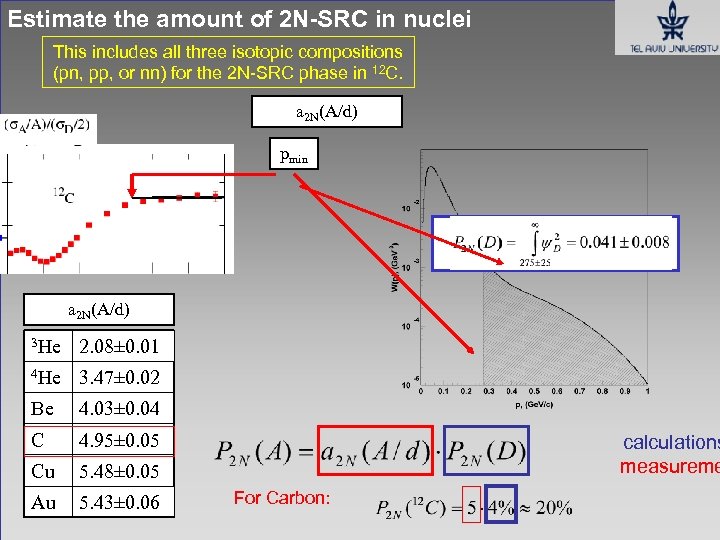 Estimate the amount of 2 N-SRC in nuclei This includes all three isotopic compositions (pn, pp, or nn) for the 2 N-SRC phase in 12 C. a 2 N(A/d) pmin a 2 N(A/d) 3 He 2. 08± 0. 01 4 He 3. 47± 0. 02 Be 4. 03± 0. 04 C 4. 95± 0. 05 Cu 5. 48± 0. 05 Au 5. 43± 0. 06 calculations measureme For Carbon:
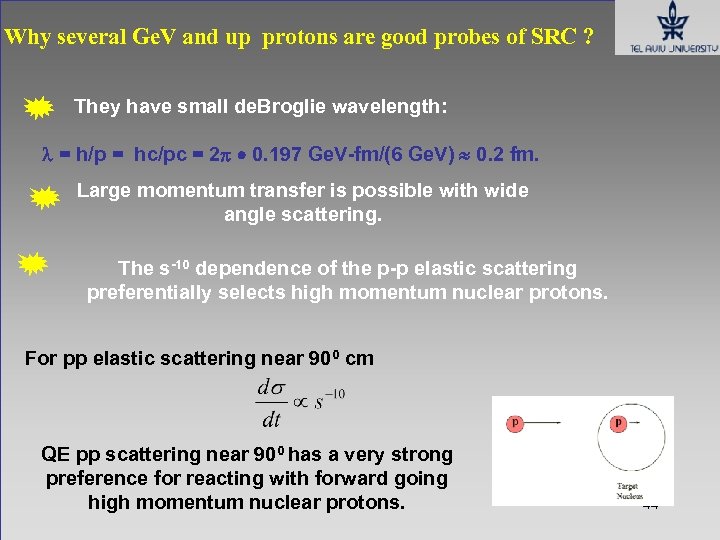 Why several Ge. V and up protons are good probes of SRC ? They have small de. Broglie wavelength: = h/p = hc/pc = 2 0. 197 Ge. V-fm/(6 Ge. V) 0. 2 fm. Large momentum transfer is possible with wide angle scattering. The s-10 dependence of the p-p elastic scattering preferentially selects high momentum nuclear protons. For pp elastic scattering near 900 cm QE pp scattering near 900 has a very strong preference for reacting with forward going high momentum nuclear protons. 44
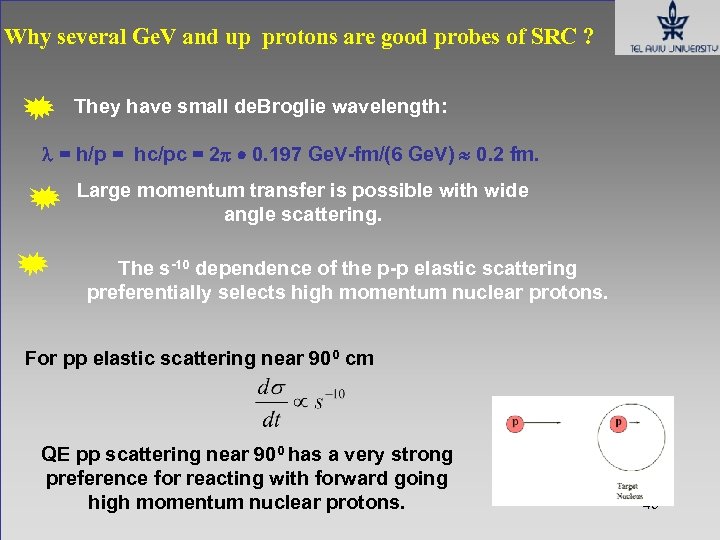 Why several Ge. V and up protons are good probes of SRC ? They have small de. Broglie wavelength: = h/p = hc/pc = 2 0. 197 Ge. V-fm/(6 Ge. V) 0. 2 fm. Large momentum transfer is possible with wide angle scattering. The s-10 dependence of the p-p elastic scattering preferentially selects high momentum nuclear protons. For pp elastic scattering near 900 cm QE pp scattering near 900 has a very strong preference for reacting with forward going high momentum nuclear protons. 45
 ”M e. V /c , ” 5 00 The kinematics selected for the measurement ”, ” 40 0” p “ 3 00 Ee’ = 3. 724 Ge. V Pm = e’ Ee = 4. 627 Ge. V 19. 50 e 40. 1, 35. 8, 32. 00 00 M e. V/c 50. 40 P=3 00 -6 p= n or p 99 ± 50 Q 2=2 (Ge. V/c)2 qv=1. 65 Ge. V/c X=1. 245 1. 4 5, 1. 42 , 1. 36 p Ge V/c
 pp/pn ratio as a function of pair CM momentum Q>0 q=300 -500 Me. V/c np pp q (fm-1) Q (fm-1) Wiringa, Schiavilla, Pieper, Carlson PRC 78 021001 (2008) Small Q pp pair in s-wave large tensor contribution small pp/np ratio JLab / Hall B 300 < q < 500 Me. V/c Hall A / BNL pair CM momentum PRL 105, 222501(2010) QQ
 Very weak Q 2 dependence EMC JLab J. Seely et al. SLAC J. Gomez et al. SRC J. Arrington talk, Minami 2010.
 SRC in nuclei: implication for neutron stars • At the outer core of neutron stars, ~95% neutrons, ~5% protons and ~5% electrons (β-stability). • Neglecting the np-SRC interactions, one can assume three separate Fermi gases (n, p, and e). At T=0 Pauli blocking prevent direct n decay n k Fermi Strong SR np interaction p k Fermi e k Fermi
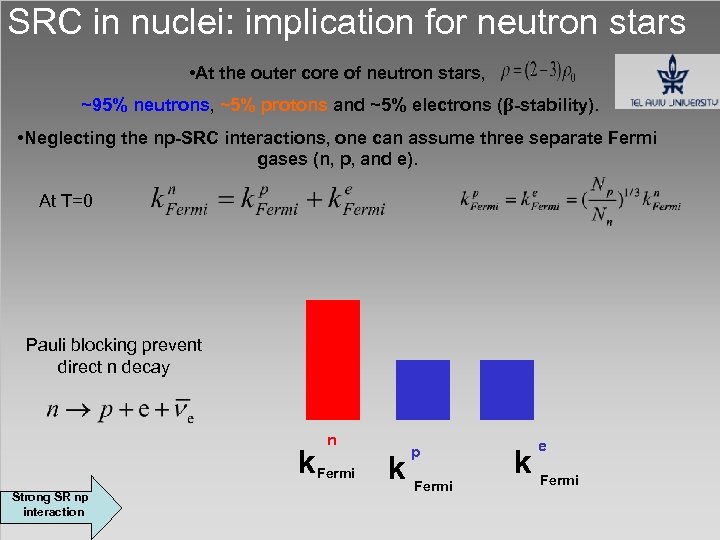
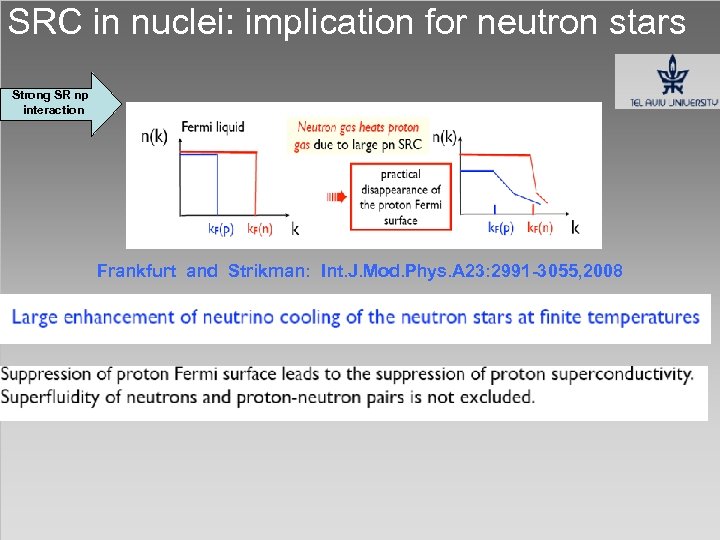 SRC in nuclei: implication for neutron stars Strong SR np interaction Frankfurt and Strikman: Int. J. Mod. Phys. A 23: 2991 -3055, 2008
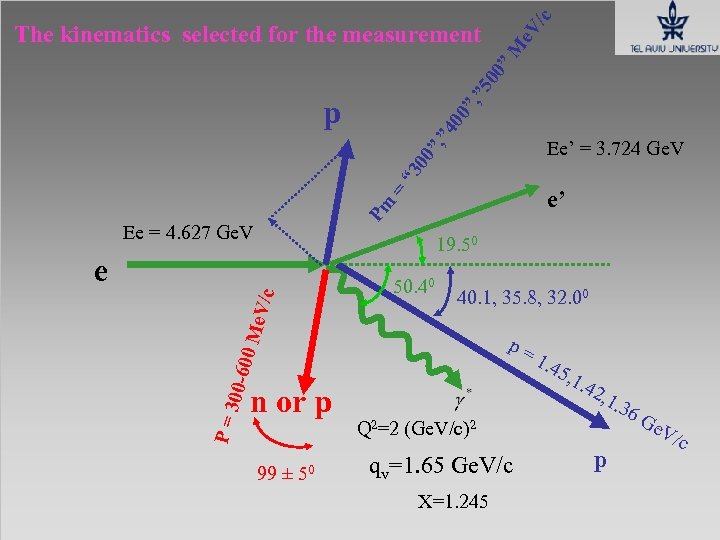
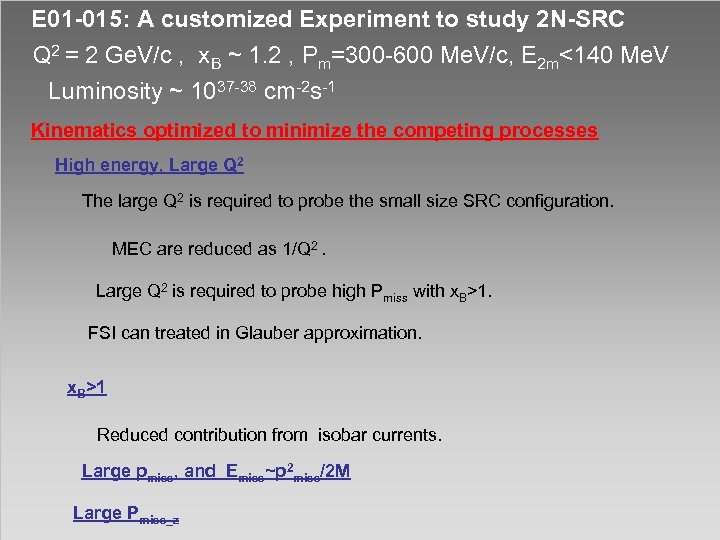 E 01 -015: A customized Experiment to study 2 N-SRC Q 2 = 2 Ge. V/c , x. B ~ 1. 2 , Pm=300 -600 Me. V/c, E 2 m<140 Me. V Luminosity ~ 1037 -38 cm-2 s-1 Kinematics optimized to minimize the competing processes High energy, Large Q 2 The large Q 2 is required to probe the small size SRC configuration. MEC are reduced as 1/Q 2. Large Q 2 is required to probe high Pmiss with x. B>1. FSI can treated in Glauber approximation. x. B>1 Reduced contribution from isobar currents. Large pmiss, and Emiss~p 2 miss/2 M Large Pmiss_z
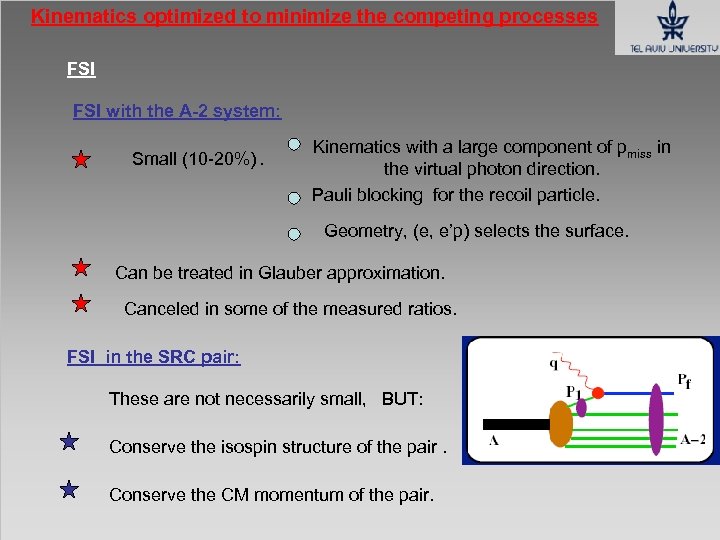 Kinematics optimized to minimize the competing processes FSI with the A-2 system: Small (10 -20%). Kinematics with a large component of pmiss in the virtual photon direction. Pauli blocking for the recoil particle. Geometry, (e, e’p) selects the surface. Can be treated in Glauber approximation. Canceled in some of the measured ratios. FSI in the SRC pair: These are not necessarily small, BUT: Conserve the isospin structure of the pair. Conserve the CM momentum of the pair.
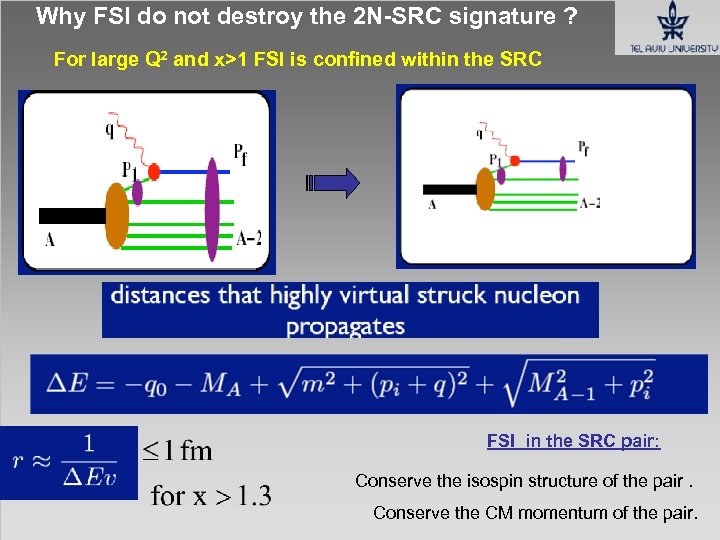 Why FSI do not destroy the 2 N-SRC signature ? For large Q 2 and x>1 FSI is confined within the SRC FSI in the SRC pair: Conserve the isospin structure of the pair. Conserve the CM momentum of the pair.
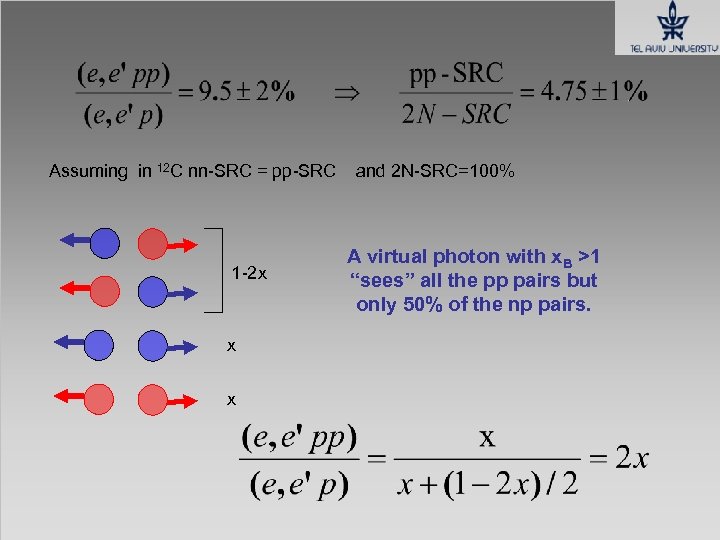 Assuming in 12 C nn-SRC = pp-SRC 1 -2 x x x and 2 N-SRC=100% A virtual photon with x. B >1 “sees” all the pp pairs but only 50% of the np pairs.
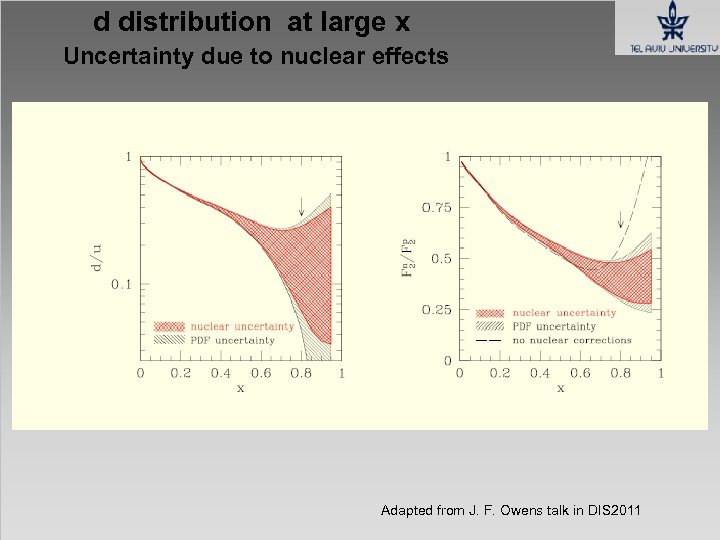 d distribution at large x Uncertainty due to nuclear effects Adapted from J. F. Owens talk in DIS 2011
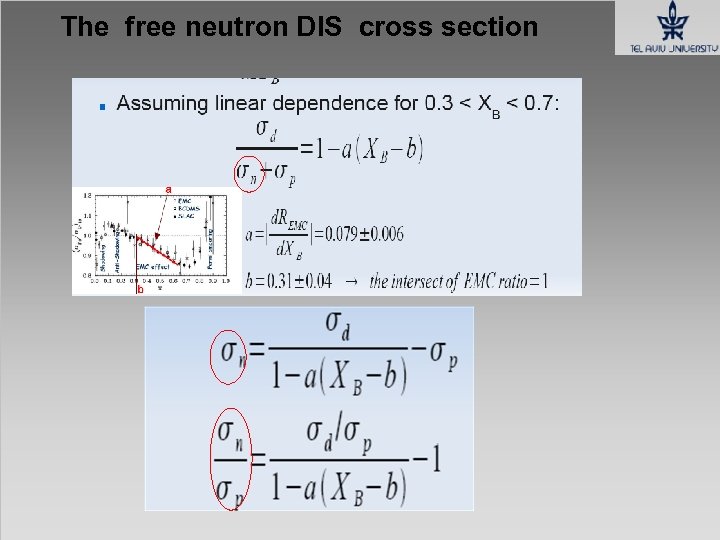
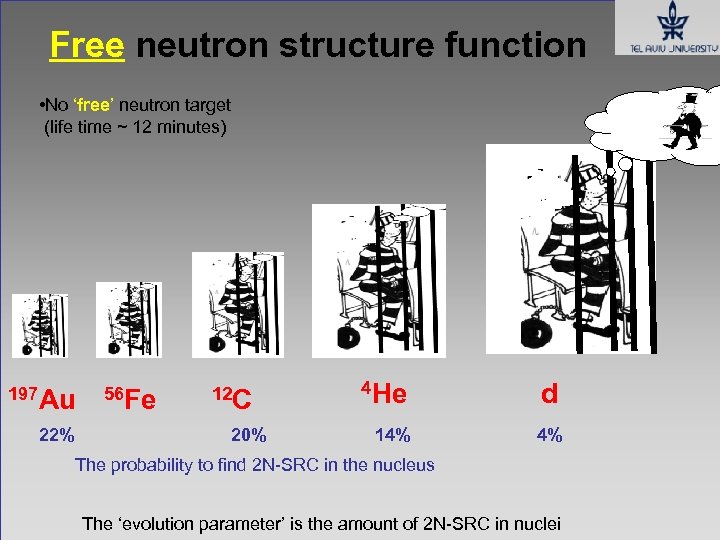 Free neutron structure function • No ‘free’ neutron target (life time ~ 12 minutes) 197 Au 22% 56 Fe 12 C 20% 4 He d 14% 4% The probability to find 2 N-SRC in the nucleus The ‘evolution parameter’ is the amount of 2 N-SRC in nuclei
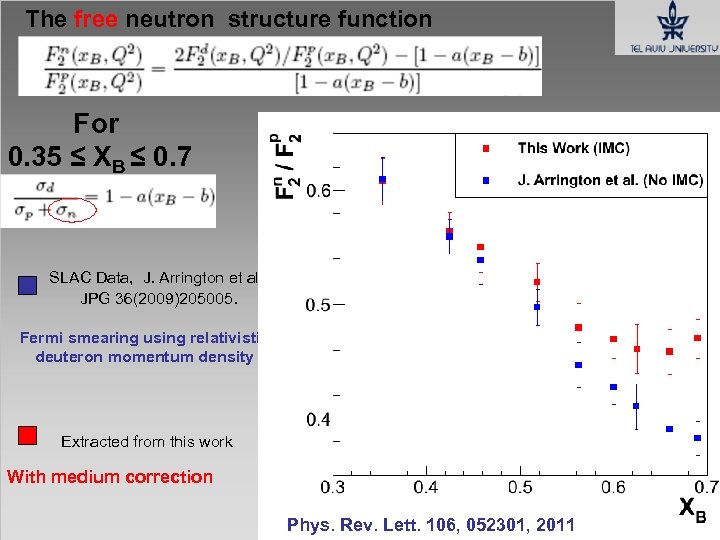
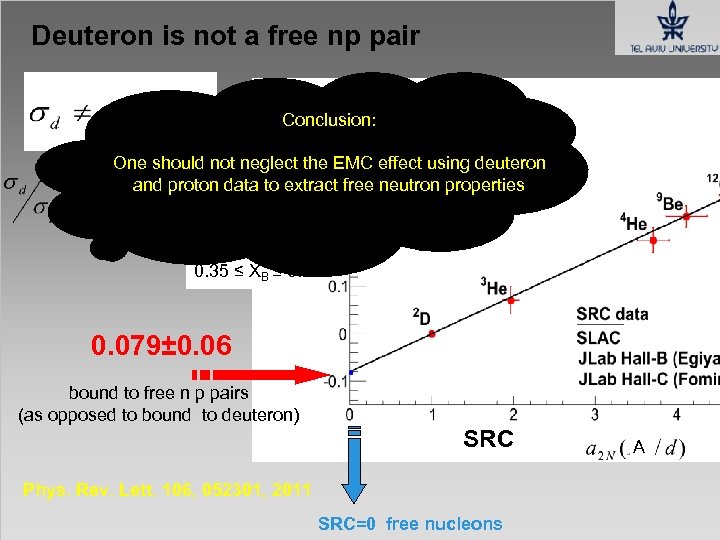 Deuteron is not a free np pair Conclusion: One should not neglect the EMC effect using deuteron and proton data to extract free neutron properties EMC The slopes for 0. 35 ≤ XB ≤ 0. 7 0. 079± 0. 06 bound to free n p pairs (as opposed to bound to deuteron) SRC Phys. Rev. Lett. 106, 052301, 2011 SRC=0 free nucleons A
 The free neutron DIS cross section
 Where is the ratio of cross sections for absorbing a longitudinal to that for a transverse photon. Gessman, Saito, Thomas, Annu. Rev. Nucl. Part. Sci. 1995. 45: 337
 The free neutron structure function For 0. 35 ≤ XB ≤ 0. 7 SLAC Data, J. Arrington et al. JPG 36(2009)205005. Fermi smearing using relativistic deuteron momentum density Extracted from this work With medium correction Phys. Rev. Lett. 106, 052301, 2011
 The free neutron structure function Compared to CT calculations Preliminary calculation by : H. l. Lai, P. Nadolsky, J. Pumplin, . P. Yuan SU 6 Fh 07 b / fh 02 c are CT 10 / CT 10 W like Chebyshev fits p. QCD See talk by J. Pumplin in DIS 2011 SLAC Data, Scalar qq
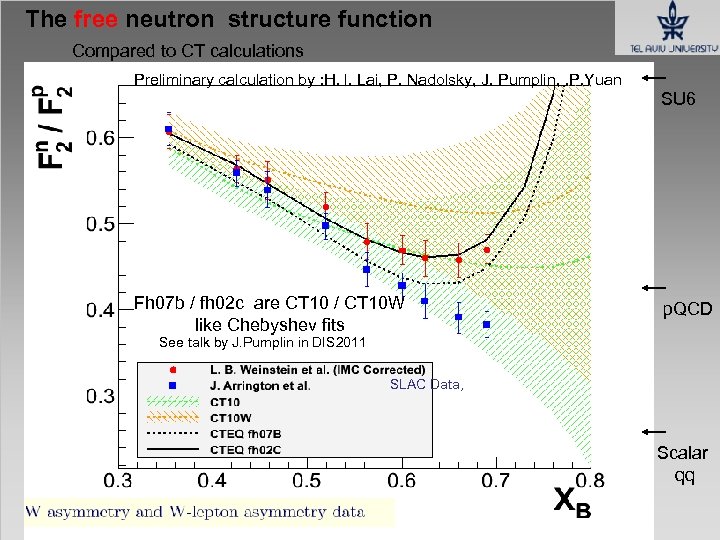
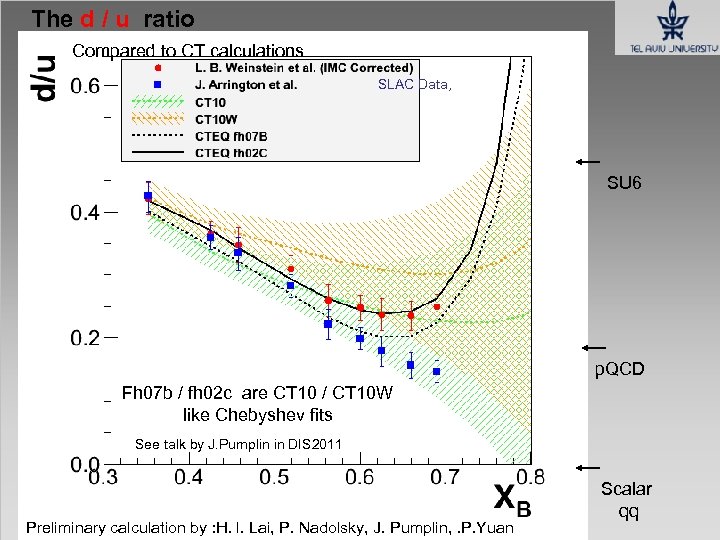 The d / u ratio Compared to CT calculations SLAC Data, SU 6 p. QCD Fh 07 b / fh 02 c are CT 10 / CT 10 W like Chebyshev fits See talk by J. Pumplin in DIS 2011 Preliminary calculation by : H. l. Lai, P. Nadolsky, J. Pumplin, . P. Yuan Scalar qq
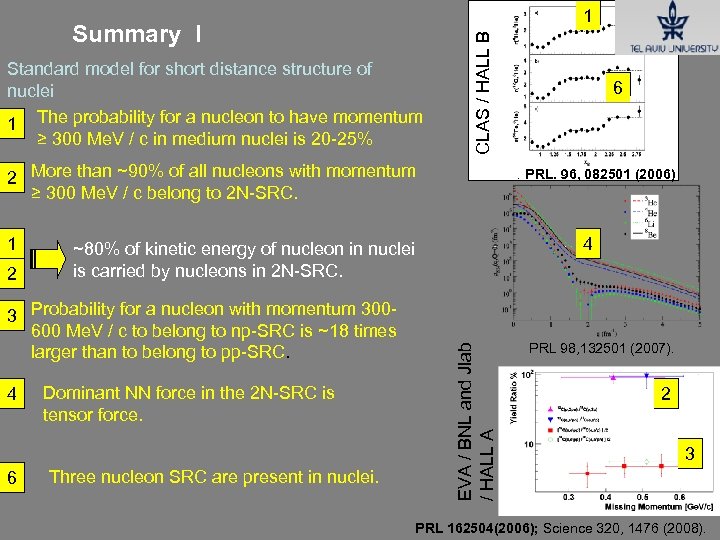 Summary I Standard model for short distance structure of nuclei 1 The probability for a nucleon to have momentum ≥ 300 Me. V / c in medium nuclei is 20 -25% CLAS / HALL B 1 2 More than ~90% of all nucleons with momentum ≥ 300 Me. V / c belong to 2 N-SRC. 2 6 4 ~80% of kinetic energy of nucleon in nuclei is carried by nucleons in 2 N-SRC. 3 Probability for a nucleon with momentum 300600 Me. V / c to belong to np-SRC is ~18 times larger than to belong to pp-SRC. 4 . PRL. 96, 082501 (2006) Dominant NN force in the 2 N-SRC is tensor force. Three nucleon SRC are present in nuclei. EVA / BNL and Jlab / HALL A 1 6 PRL 98, 132501 (2007). 2 3 PRL 162504(2006); Science 320, 1476 (2008).
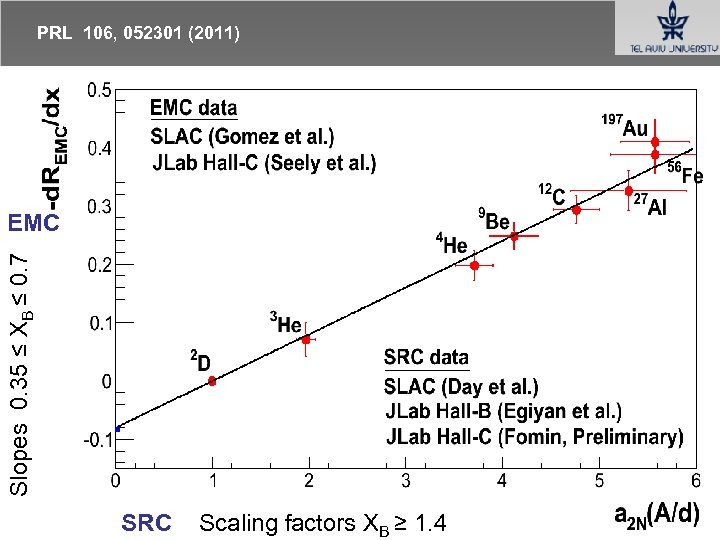 PRL 106, 052301 (2011) Slopes 0. 35 ≤ XB ≤ 0. 7 EMC SRC Scaling factors XB ≥ 1. 4