


 Скачать презентацию Hal World Re-Development Creating a Single-Entry Portal Overview
1ed16239b45d01e30e1bbb8d6771bb6b.ppt
- Количество слайдов: 20
 Hal. World Re-Development Creating a Single-Entry Portal: Overview Employee Central. Migrating Hal. World to a personalized portal environment – Employee Central – supported by three major components: • Portal • Content Management System -- CMS • Taxonomy Learning Objectives: To learn all the basics, including governance, about Halliburton’s Portal, Content Management System (CMS), and Taxonomy and what these components provide for Halliburton’s Employee Central. 1
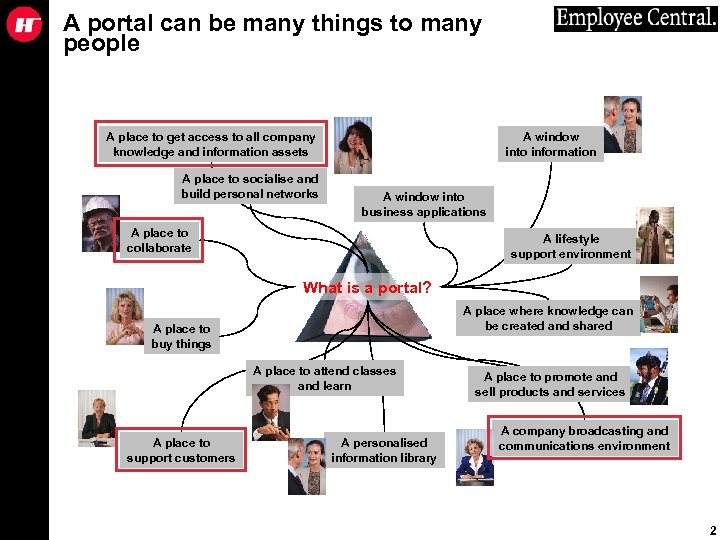 A portal can be many things to many people A place to get access to all company knowledge and information assets A place to socialise and build personal networks A window into information A window into business applications A place to collaborate A lifestyle support environment What is a portal? A place where knowledge can be created and shared A place to buy things A place to attend classes and learn A place to support customers A personalised information library A place to promote and sell products and services A company broadcasting and communications environment 2
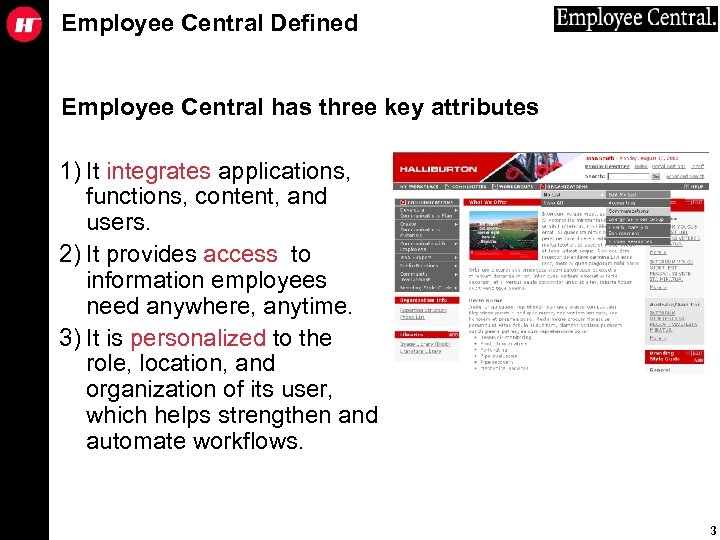 Employee Central Defined Employee Central has three key attributes 1) It integrates applications, functions, content, and users. 2) It provides access to information employees need anywhere, anytime. 3) It is personalized to the role, location, and organization of its user, which helps strengthen and automate workflows. 3
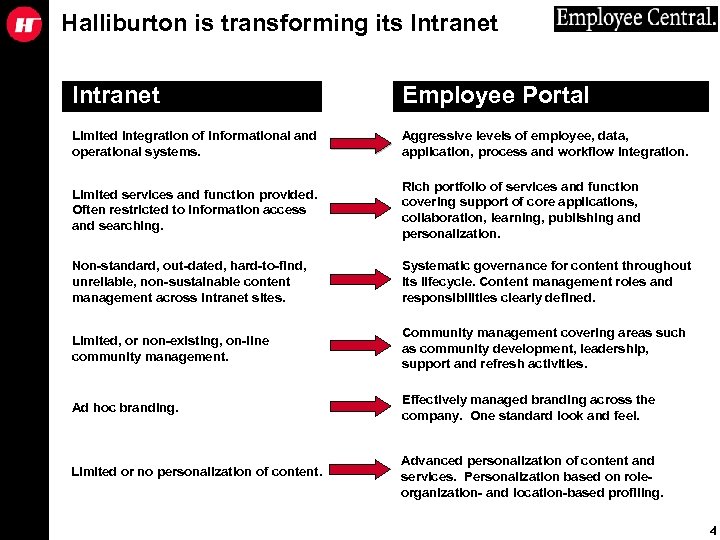 Halliburton is transforming its Intranet Employee Portal Limited integration of informational and operational systems. Aggressive levels of employee, data, application, process and workflow integration. Limited services and function provided. Often restricted to information access and searching. Rich portfolio of services and function covering support of core applications, collaboration, learning, publishing and personalization. Non-standard, out-dated, hard-to-find, unreliable, non-sustainable content management across Intranet sites. Systematic governance for content throughout its lifecycle. Content management roles and responsibilities clearly defined. Limited, or non-existing, on-line community management. Community management covering areas such as community development, leadership, support and refresh activities. Ad hoc branding. Effectively managed branding across the company. One standard look and feel. Limited or no personalization of content. Advanced personalization of content and services. Personalization based on role- organization- and location-based profiling. 4
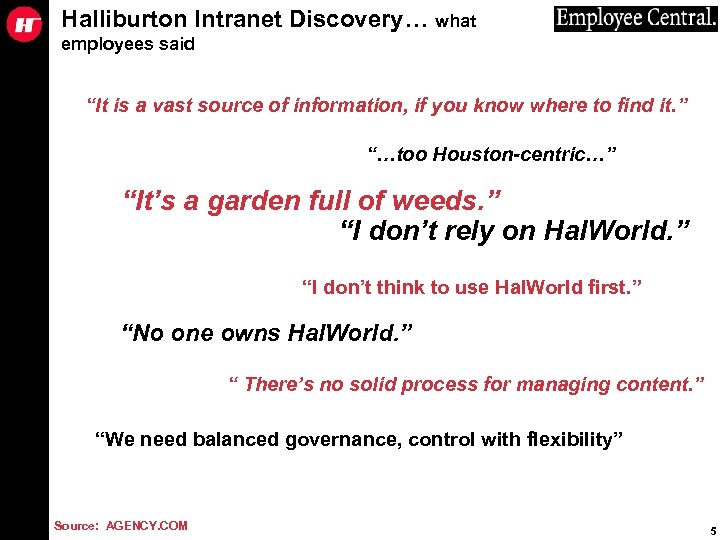 Halliburton Intranet Discovery… what employees said “It is a vast source of information, if you know where to find it. ” “…too Houston-centric…” “It’s a garden full of weeds. ” “I don’t rely on Hal. World. ” “I don’t think to use Hal. World first. ” “No one owns Hal. World. ” “ There’s no solid process for managing content. ” “We need balanced governance, control with flexibility” Source: AGENCY. COM 5
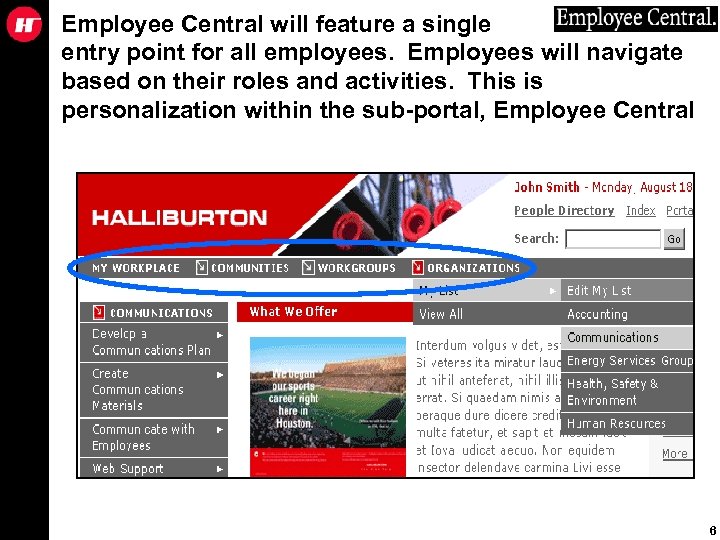 Employee Central will feature a single entry point for all employees. Employees will navigate based on their roles and activities. This is personalization within the sub-portal, Employee Central 6
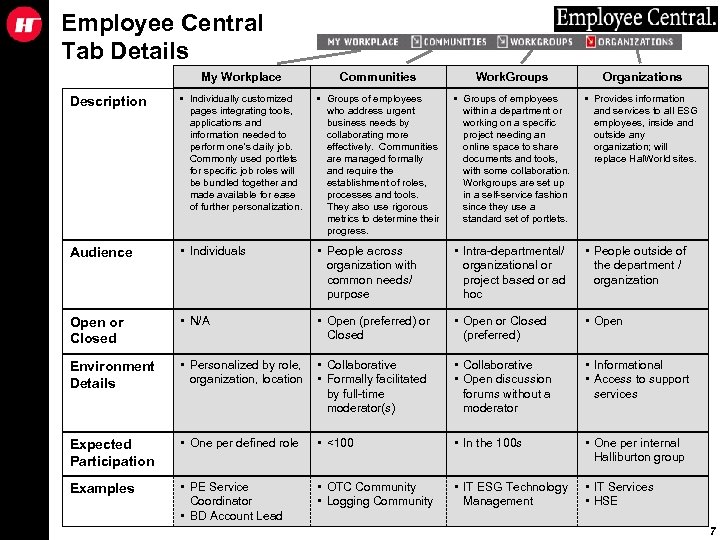 Employee Central Tab Details My Workplace Communities Work. Groups Organizations Description • Individually customized pages integrating tools, applications and information needed to perform one’s daily job. Commonly used portlets for specific job roles will be bundled together and made available for ease of further personalization. • Groups of employees who address urgent business needs by collaborating more effectively. Communities are managed formally and require the establishment of roles, processes and tools. They also use rigorous metrics to determine their progress. • Groups of employees within a department or working on a specific project needing an online space to share documents and tools, with some collaboration. Workgroups are set up in a self-service fashion since they use a standard set of portlets. • Provides information and services to all ESG employees, inside and outside any organization; will replace Hal. World sites. Audience • Individuals • People across organization with common needs/ purpose • Intra-departmental/ organizational or project based or ad hoc • People outside of the department / organization Open or Closed • N/A • Open (preferred) or Closed • Open or Closed (preferred) • Open Environment Details • Personalized by role, organization, location • Collaborative • Formally facilitated by full-time moderator(s) • Collaborative • Open discussion forums without a moderator • Informational • Access to support services Expected Participation • One per defined role • <100 • In the 100 s • One per internal Halliburton group Examples • PE Service Coordinator • BD Account Lead • OTC Community • Logging Community • IT ESG Technology Management • IT Services • HSE 7
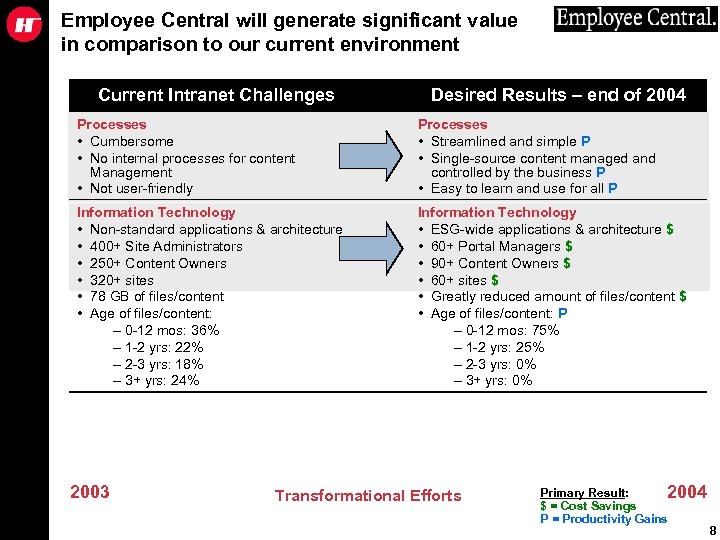 Employee Central will generate significant value in comparison to our current environment Current Intranet Challenges Desired Results – end of 2004 Processes • Cumbersome • No internal processes for content Management • Not user-friendly Processes • Streamlined and simple P • Single-source content managed and controlled by the business P • Easy to learn and use for all P Information Technology • Non-standard applications & architecture • 400+ Site Administrators • 250+ Content Owners • 320+ sites • 78 GB of files/content • Age of files/content: – 0 -12 mos: 36% – 1 -2 yrs: 22% – 2 -3 yrs: 18% – 3+ yrs: 24% Information Technology • ESG-wide applications & architecture $ • 60+ Portal Managers $ • 90+ Content Owners $ • 60+ sites $ • Greatly reduced amount of files/content $ • Age of files/content: P – 0 -12 mos: 75% – 1 -2 yrs: 25% – 2 -3 yrs: 0% – 3+ yrs: 0% 2003 Transformational Efforts Primary Result: 2004 $ = Cost Savings P = Productivity Gains 8
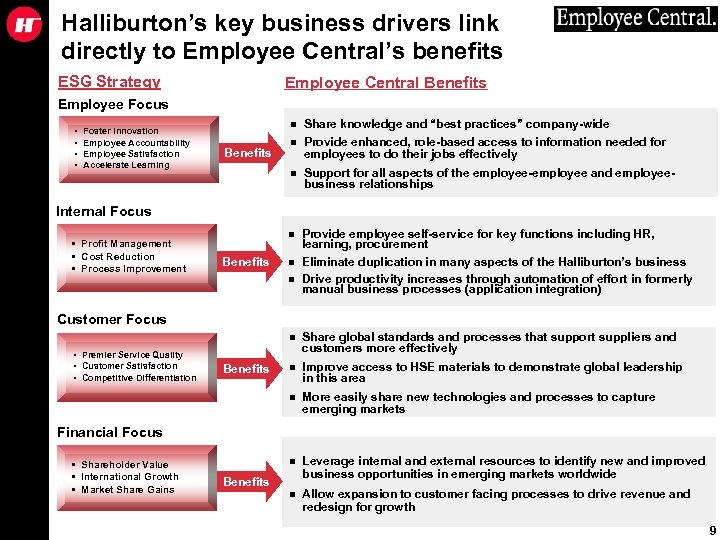 Halliburton’s key business drivers link directly to Employee Central’s benefits ESG Strategy Employee Central Benefits Employee Focus • • Foster Innovation Employee Accountability Employee Satisfaction Accelerate Learning n n Provide enhanced, role-based access to information needed for employees to do their jobs effectively n Support for all aspects of the employee-employee and employeebusiness relationships n Benefits Share knowledge and “best practices” company-wide Provide employee self-service for key functions including HR, learning, procurement Eliminate duplication in many aspects of the Halliburton’s business Drive productivity increases through automation of effort in formerly manual business processes (application integration) Internal Focus • Profit Management • Cost Reduction • Process Improvement Benefits n n Customer Focus n Improve access to HSE materials to demonstrate global leadership in this area More easily share new technologies and processes to capture emerging markets n Benefits n n • Premier Service Quality • Customer Satisfaction • Competitive Differentiation Share global standards and processes that support suppliers and customers more effectively Leverage internal and external resources to identify new and improved business opportunities in emerging markets worldwide n Allow expansion to customer facing processes to drive revenue and redesign for growth Financial Focus • Shareholder Value • International Growth • Market Share Gains Benefits 9
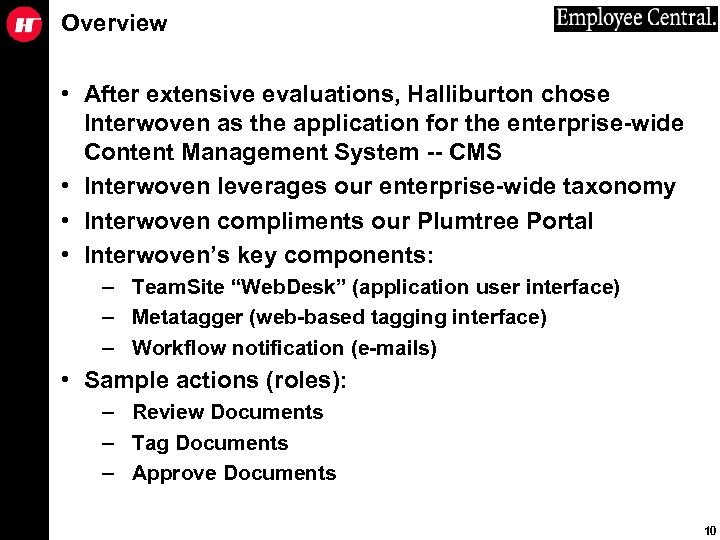 Overview • After extensive evaluations, Halliburton chose Interwoven as the application for the enterprise-wide Content Management System -- CMS • Interwoven leverages our enterprise-wide taxonomy • Interwoven compliments our Plumtree Portal • Interwoven’s key components: – Team. Site “Web. Desk” (application user interface) – Metatagger (web-based tagging interface) – Workflow notification (e-mails) • Sample actions (roles): – Review Documents – Tag Documents – Approve Documents 10
 What are the benefits of CMS? • Enterprise-wide Benefits: – Lower costs by standardizing our content management processes – Single source for internal and external content – Increased content quality • Other Benefits for CMS Users: – Complete content management process flow – One content source (to maintain) for multiple venues – Taxonomy integration to enhance search capabilities, improving content access and reuse – Processes improved, with streamlined content to portal delivery – Features such as Email Notification – to renew, update, and remove content – Preview Capability, Greater Report Generating, and Versioning/Rollback 11
 Future Benefits • Additional content creation sources • Live content editing for additional Content Owners/Authors • Continuing reduction in costs associated with duplicative content 12
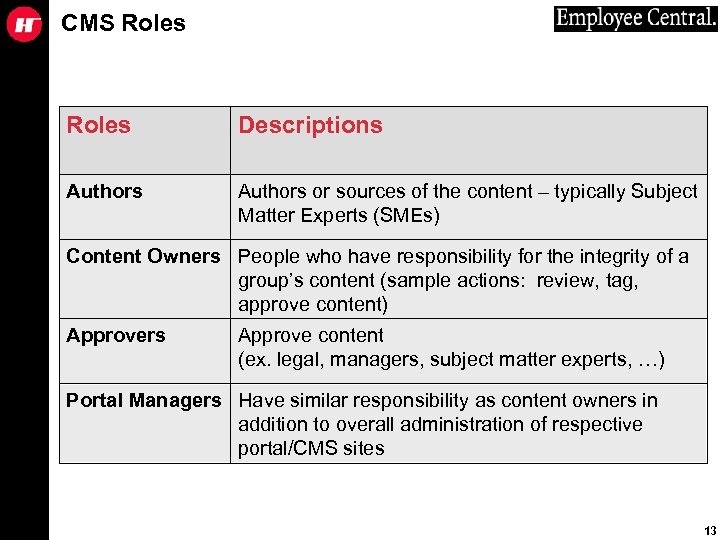 CMS Roles Descriptions Authors or sources of the content – typically Subject Matter Experts (SMEs) Content Owners People who have responsibility for the integrity of a group’s content (sample actions: review, tag, approve content) Approvers Approve content (ex. legal, managers, subject matter experts, …) Portal Managers Have similar responsibility as content owners in addition to overall administration of respective portal/CMS sites 13
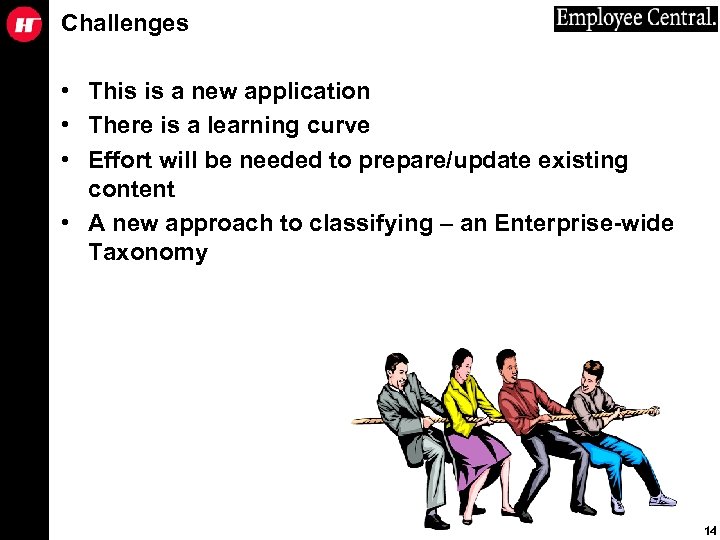 Challenges • This is a new application • There is a learning curve • Effort will be needed to prepare/update existing content • A new approach to classifying – an Enterprise-wide Taxonomy 14
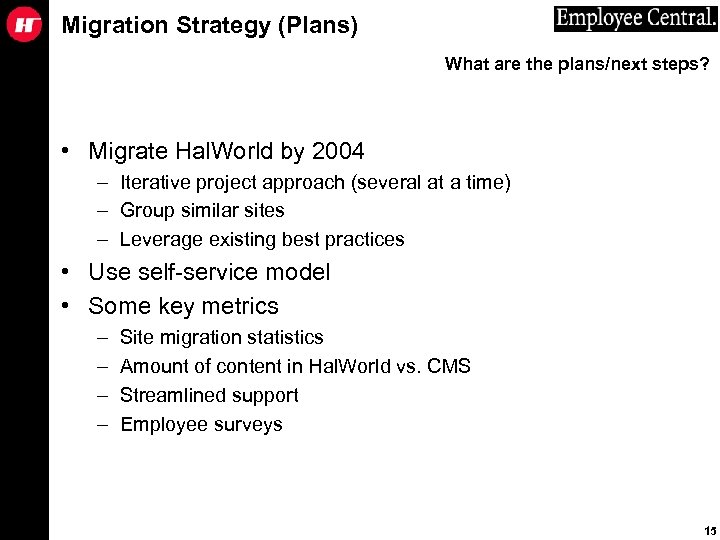 Migration Strategy (Plans) What are the plans/next steps? • Migrate Hal. World by 2004 – Iterative project approach (several at a time) – Group similar sites – Leverage existing best practices • Use self-service model • Some key metrics – – Site migration statistics Amount of content in Hal. World vs. CMS Streamlined support Employee surveys 15
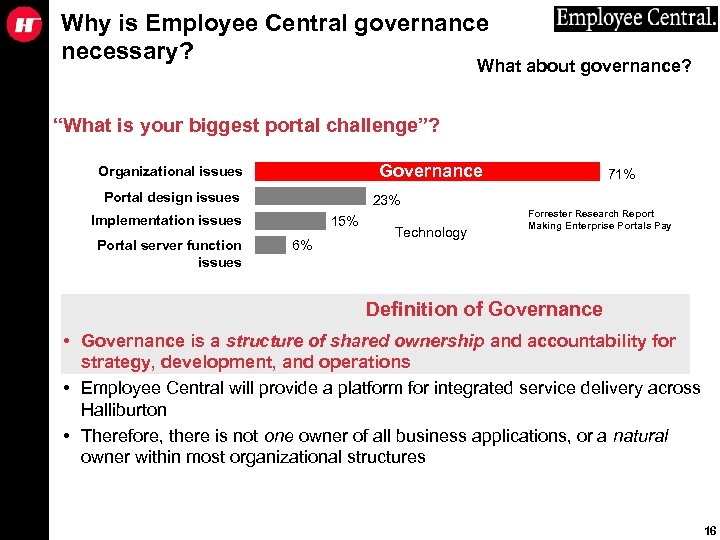 Why is Employee Central governance necessary? What about governance? “What is your biggest portal challenge”? Governance Organizational issues Portal design issues 23% Implementation issues Portal server function issues 15% 6% Technology 71% Forrester Research Report Making Enterprise Portals Pay Definition of Governance • Governance is a structure of shared ownership and accountability for strategy, development, and operations • Employee Central will provide a platform for integrated service delivery across Halliburton • Therefore, there is not one owner of all business applications, or a natural owner within most organizational structures 16
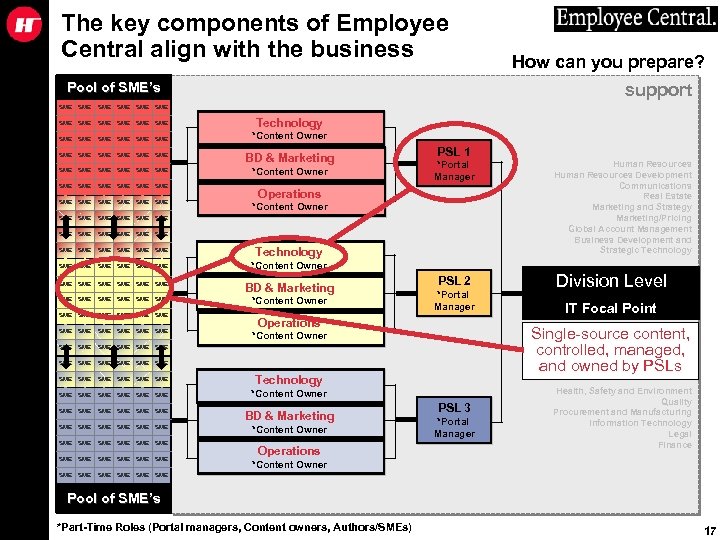 The key components of Employee Central align with the business Pool of SME’s How can you prepare? support SME SME SME Technology *Content Owner SME SME SME BD & Marketing SME SME SME *Content Owner SME SME SME SME SME SME SME SME Technology SME SME SME *Content Owner SME SME SME PSL 1 *Portal Manager Operations *Content Owner BD & Marketing *Content Owner SME SME SME SME SME SME SME SME SME Technology SME SME SME *Content Owner SME SME SME PSL 2 *Portal Manager SME SME SME SME SME SME Operations *Content Owner SME Operations Division Level IT Focal Point Single-source content, controlled, managed, and owned by PSLs *Content Owner BD & Marketing Human Resources Development Communications Real Estate Marketing and Strategy Marketing/Pricing Global Account Management Business Development and Strategic Technology PSL 3 *Portal Manager Health, Safety and Environment Quality Procurement and Manufacturing Information Technology Legal Finance *Content Owner Pool of SME’s *Part-Time Roles (Portal managers, Content owners, Authors/SMEs) 17
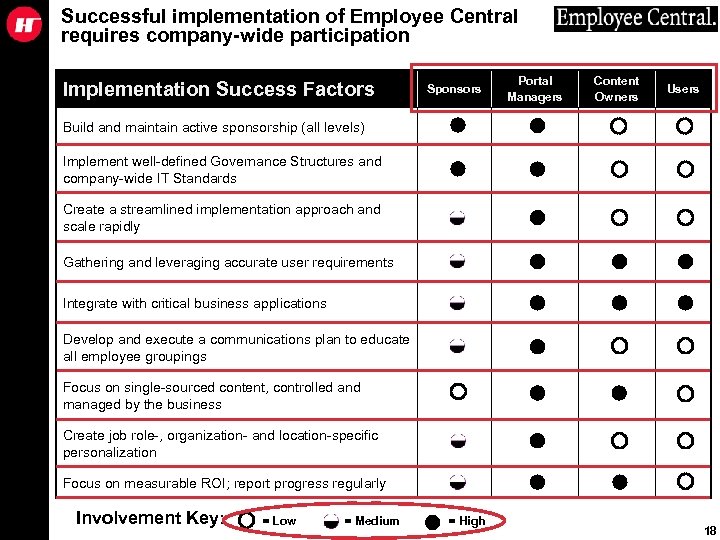 Successful implementation of Employee Central requires company-wide participation Implementation Success Factors Sponsors Portal Managers Content Owners Users Build and maintain active sponsorship (all levels) Implement well-defined Governance Structures and company-wide IT Standards Create a streamlined implementation approach and scale rapidly Gathering and leveraging accurate user requirements Integrate with critical business applications Develop and execute a communications plan to educate all employee groupings Focus on single-sourced content, controlled and managed by the business Create job role-, organization- and location-specific personalization Focus on measurable ROI; report progress regularly Involvement Key: = Low = Medium = High 18
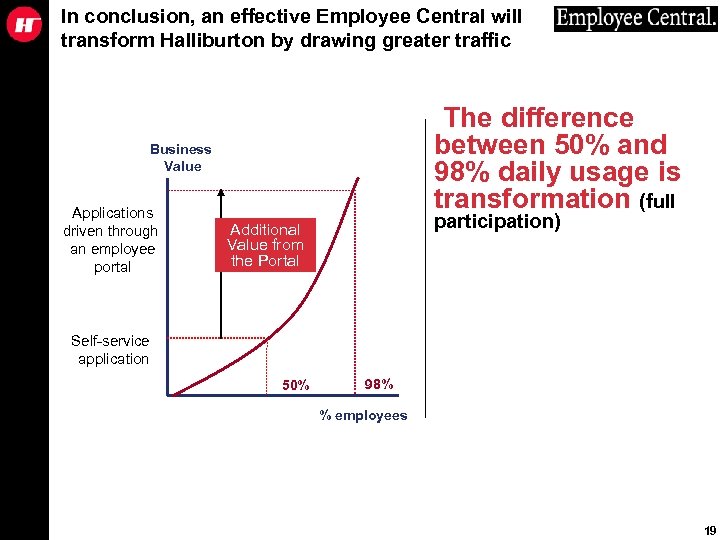 In conclusion, an effective Employee Central will transform Halliburton by drawing greater traffic The difference between 50% and 98% daily usage is transformation (full Business Value Applications driven through an employee portal participation) Additional Value from the Portal Self-service application 50% 98% % employees 19
 PSL Framework • Objective: – To come up with a framework for presenting PSL organization information • Benefit: – Allows us to streamline the migration process and get all PSL Organization on the Portal in 2004 – Presents users with a common navigation and layout thereby making it easier to find information (Human Factors) • Your Contribution: – Provide feedback on the draft we have created – Identify missing components – Keep in mind that the final framework should be generic across PSLs – Look forward to another meeting to migrate your PSL!! 20