


 Скачать презентацию Hail to the Chief Demographic Characteristics of
f6a1c9e82aa30b5681f2dd8c6995b009.ppt
- Количество слайдов: 31
 Hail to the Chief
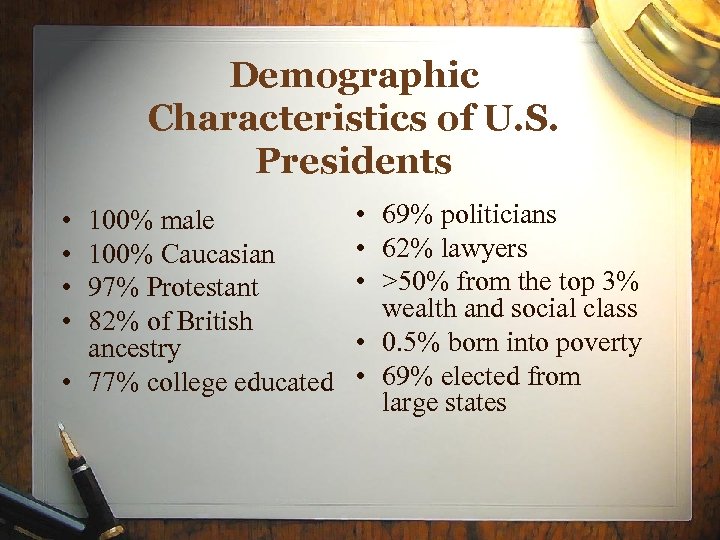 Demographic Characteristics of U. S. Presidents • • 100% male 100% Caucasian 97% Protestant 82% of British ancestry • 77% college educated • 69% politicians • 62% lawyers • >50% from the top 3% wealth and social class • 0. 5% born into poverty • 69% elected from large states
 Fortunate Son Recorded by Creedence Clearwater Revival (1969) Some folks are born made to wave the flag, Ooh, they’re red, white and blue. And when the band plays, “Hail to the Chief, ” Ooh, they point the cannon at you, lord, It ain’t me, it ain’t me, I ain’t no senator’s son, son. Some folks are born silver spoon in hand, Lord, don’t they help themselves, oh. But when the taxman comes to the door, Lord, the house looks like a rummage sale, yes, It ain’t me, it ain’t me, I ain’t no millionaire’s son, son.
 Fortunate Son Recorded by Creedence Clearwater Revival (1969) Some folks inherit star spangled eyes, Ooh, they send you down to war, lord, And when you ask them, “How much should we give? ” Ooh, they only answer more! yo, It ain’t me, it ain’t me, I ain’t no military son, son. It ain’t me, it ain’t me, I ain’t no fortunate one, one. It ain’t me, it ain’t me, I ain’t no fortunate son, son. It ain’t me, it ain’t me, I
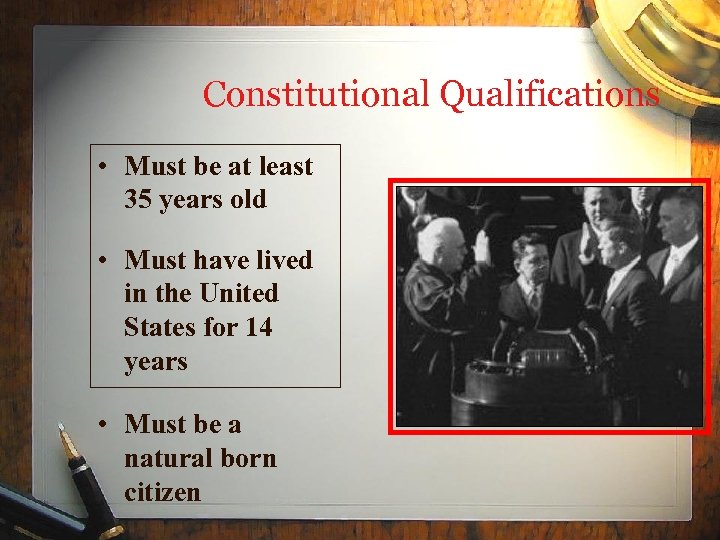 Constitutional Qualifications • Must be at least 35 years old • Must have lived in the United States for 14 years • Must be a natural born citizen
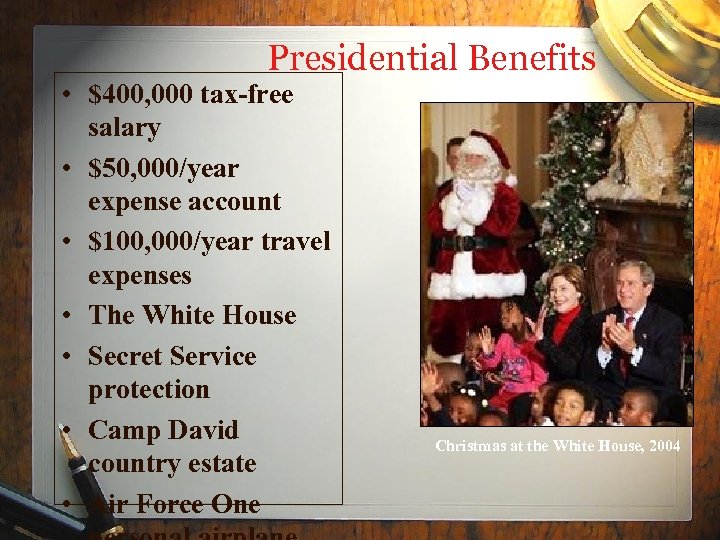 Presidential Benefits • $400, 000 tax-free salary • $50, 000/year expense account • $100, 000/year travel expenses • The White House • Secret Service protection • Camp David country estate • Air Force One Christmas at the White House, 2004
 Presidential Roles
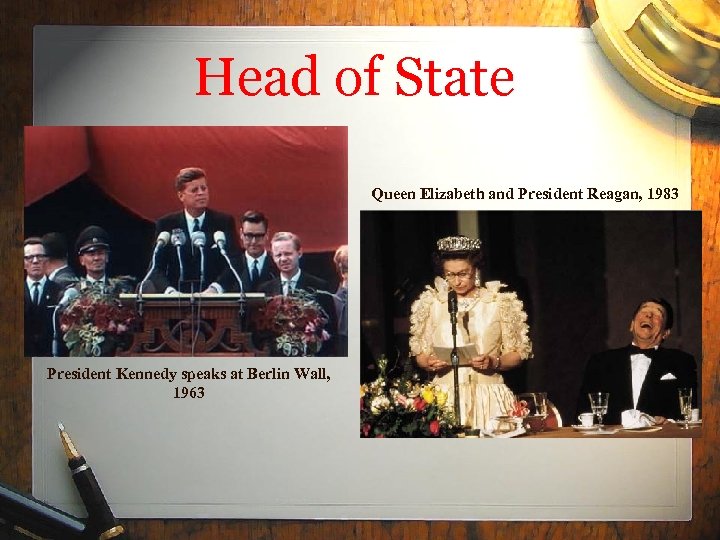 Head of State Queen Elizabeth and President Reagan, 1983 President Kennedy speaks at Berlin Wall, 1963
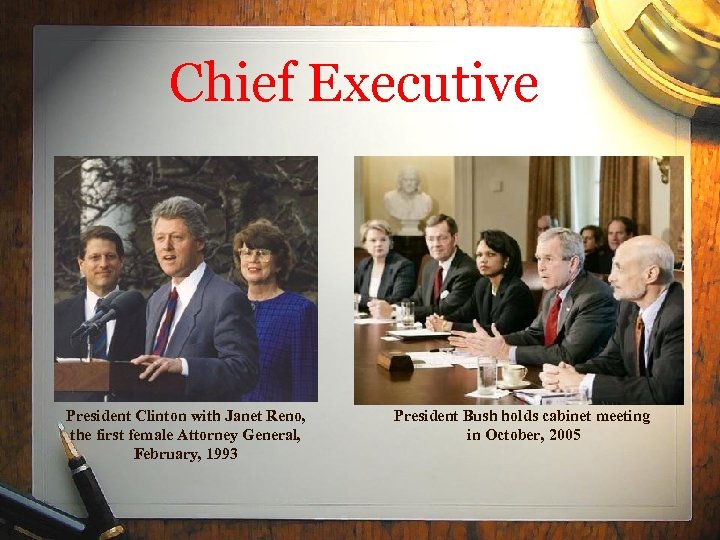 Chief Executive President Clinton with Janet Reno, the first female Attorney General, February, 1993 President Bush holds cabinet meeting in October, 2005
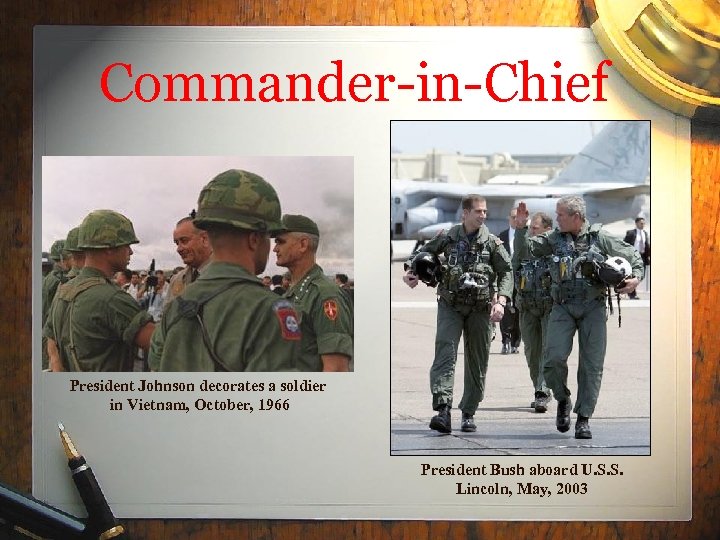 Commander-in-Chief President Johnson decorates a soldier in Vietnam, October, 1966 President Bush aboard U. S. S. Lincoln, May, 2003
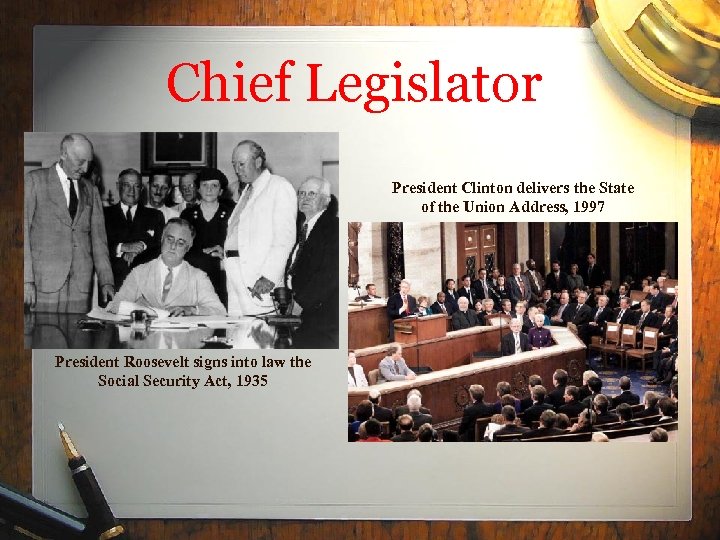 Chief Legislator President Clinton delivers the State of the Union Address, 1997 President Roosevelt signs into law the Social Security Act, 1935
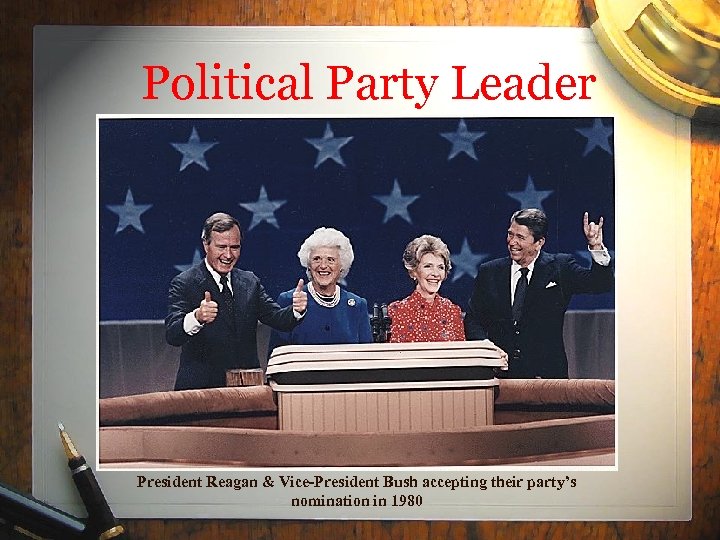 Political Party Leader President Reagan & Vice-President Bush accepting their party’s nomination in 1980
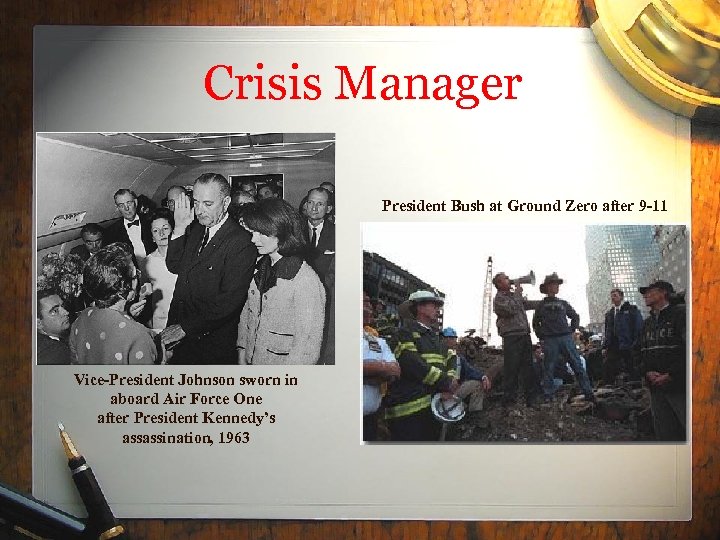 Crisis Manager President Bush at Ground Zero after 9 -11 Vice-President Johnson sworn in aboard Air Force One after President Kennedy’s assassination, 1963
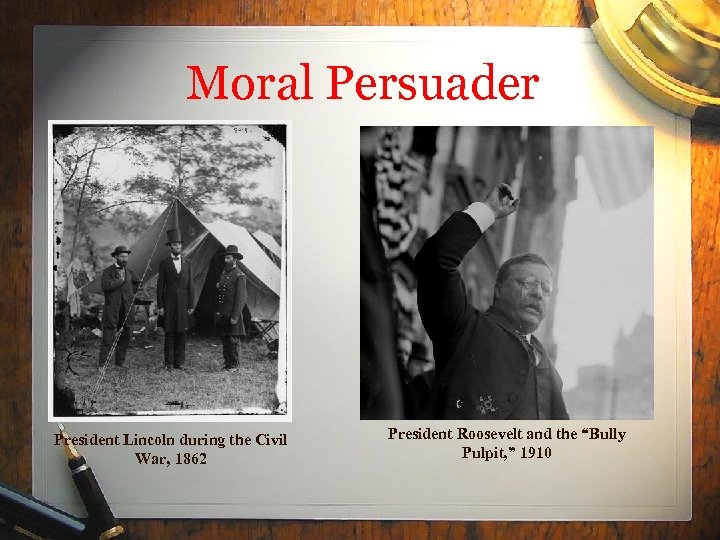 Moral Persuader President Lincoln during the Civil War, 1862 President Roosevelt and the “Bully Pulpit, ” 1910
 Formal Powers of the President • Constitutional or enumerated powers of the presidency • Found primarily in Article II of the Constitution
 Formal Powers: Commander-in-Chief • Commander in Chief of the Army & Navy • Commander in Chief of the state militias (now the National Guard) • Commission all officers
 Formal Powers: Chief Executive • “Faithfully execute” the laws • Require the opinion of heads of executive departments • Grant pardons for federal offenses except for cases of impeachment • Nominate judges of the Supreme Court and all other officers of the U. S. with consent of the Senate • Fill vacancies that may happen during recess of the Senate
 Formal Powers: Foreign Affairs – Appoint ambassadors, ministers and consuls – Make treaties subject to Senate confirmation – Receive ambassadors
 Formal Powers: Chief Legislator • Give State of the Union address to Congress • Recommend “measures” to the Congress • Upon “extraordinary occasions” convene both houses of Congress
 Formal Powers: Chief Legislator (cont. ) • Presidential Veto – Veto Message within 10 days of passing the House of origin – Pocket Veto - President does not sign within 10 days – Congress can override with 2/3 majority from both Houses • Veto Politics – Congressional override is difficult (only 4%)
 Informal Powers • Those powers not explicitly written in the Constitution • Similar to “necessary and proper” powers of Congress • In the modern era (since 1933), the President’s informal powers may be significantly more powerful than his formal powers
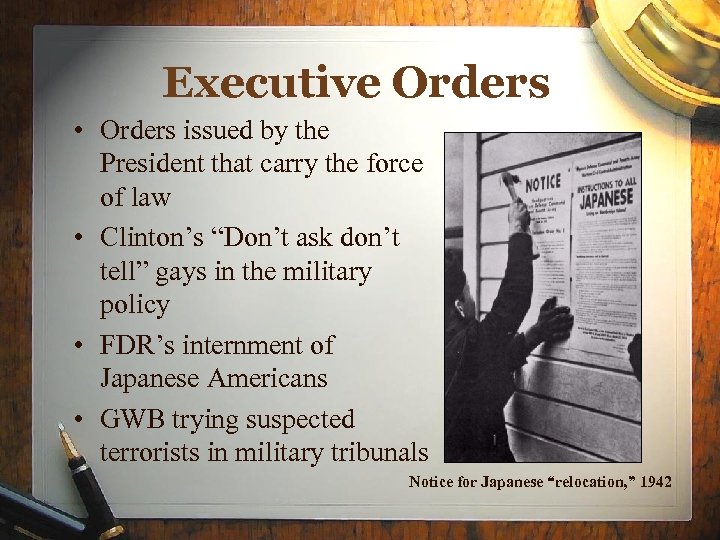 Executive Orders • Orders issued by the President that carry the force of law • Clinton’s “Don’t ask don’t tell” gays in the military policy • FDR’s internment of Japanese Americans • GWB trying suspected terrorists in military tribunals Notice for Japanese “relocation, ” 1942
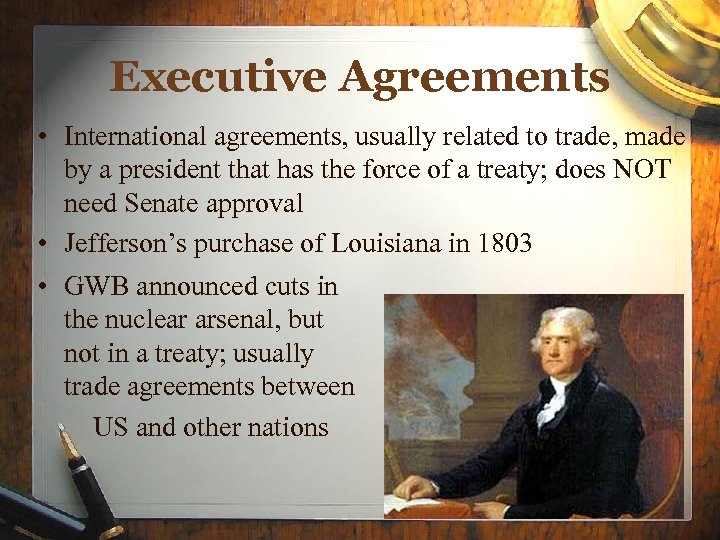 Executive Agreements • International agreements, usually related to trade, made by a president that has the force of a treaty; does NOT need Senate approval • Jefferson’s purchase of Louisiana in 1803 • GWB announced cuts in the nuclear arsenal, but not in a treaty; usually trade agreements between US and other nations
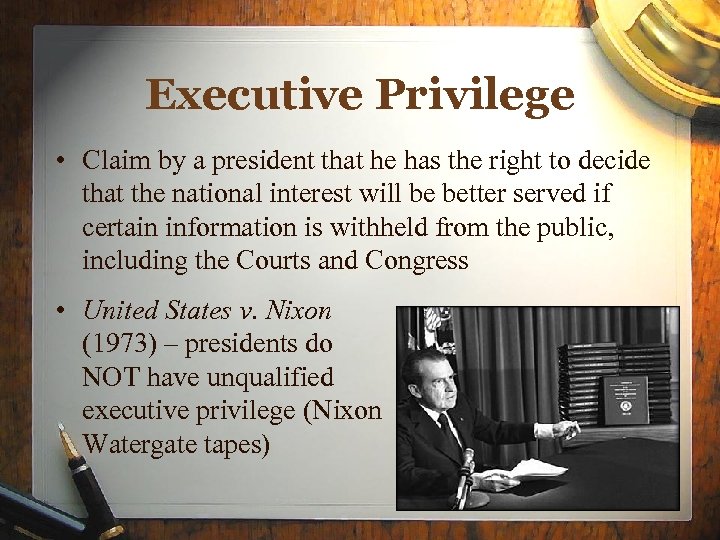 Executive Privilege • Claim by a president that he has the right to decide that the national interest will be better served if certain information is withheld from the public, including the Courts and Congress • United States v. Nixon (1973) – presidents do NOT have unqualified executive privilege (Nixon Watergate tapes)
 Questions for Discussion • • • Why are informal powers more important than formal powers, particularly to modern presidents? Identify several advantages and disadvantages of the use of the president’s informal powers. Has the use and perhaps abuse of the informal powers created an “Imperial Presidency? ” Defend your answer.
 Presidential Quotations
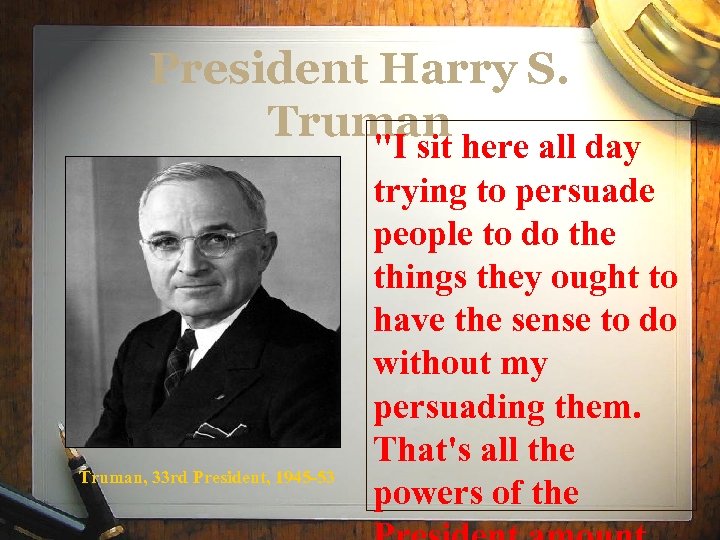 President Harry S. Truman, 33 rd President, 1945 -53 "I sit here all day trying to persuade people to do the things they ought to have the sense to do without my persuading them. That's all the powers of the
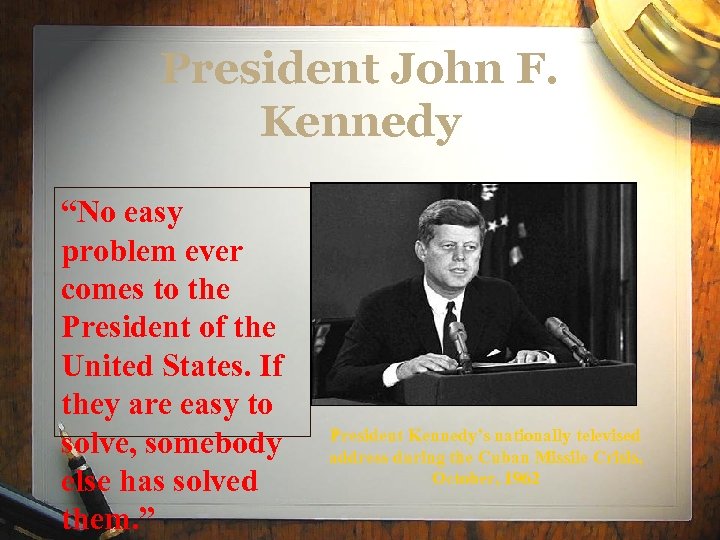 President John F. Kennedy “No easy problem ever comes to the President of the United States. If they are easy to solve, somebody else has solved them. ” President Kennedy’s nationally televised address during the Cuban Missile Crisis, October, 1962
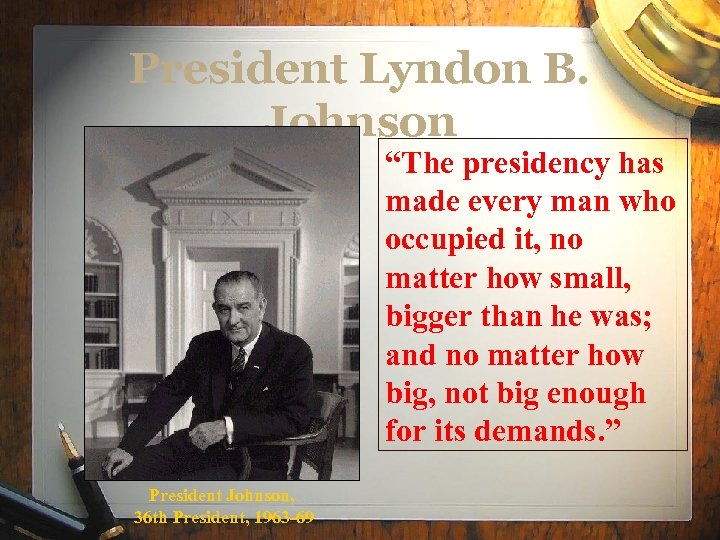 President Lyndon B. Johnson “The presidency has made every man who occupied it, no matter how small, bigger than he was; and no matter how big, not big enough for its demands. ” President Johnson, 36 th President, 1963 -69
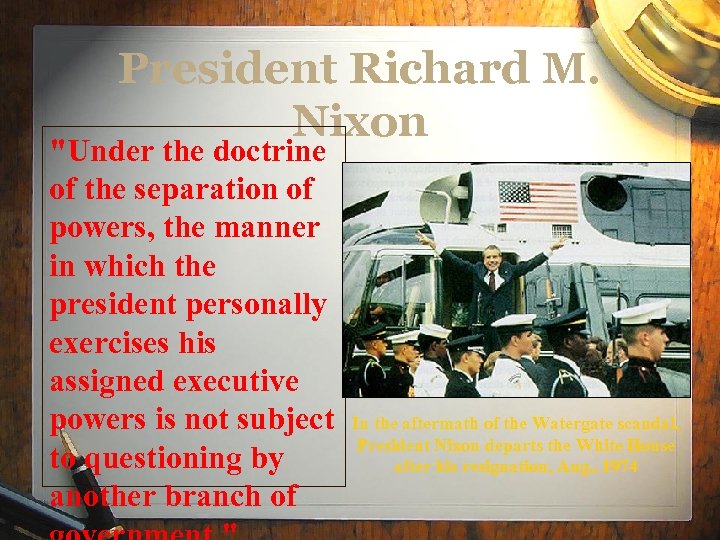 President Richard M. Nixon "Under the doctrine of the separation of powers, the manner in which the president personally exercises his assigned executive powers is not subject to questioning by another branch of In the aftermath of the Watergate scandal, President Nixon departs the White House after his resignation, Aug. , 1974
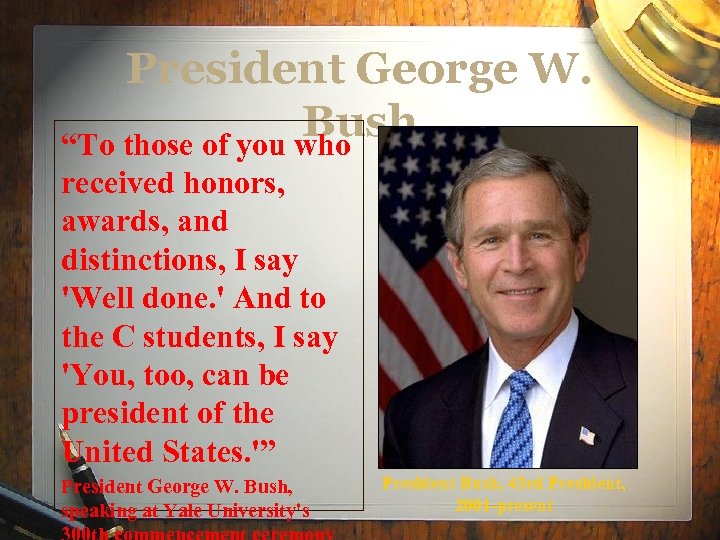 President George W. Bush “To those of you who received honors, awards, and distinctions, I say 'Well done. ' And to the C students, I say 'You, too, can be president of the United States. '” President George W. Bush, speaking at Yale University's President Bush, 43 rd President, 2001 -present