


 Скачать презентацию Hadronic Work Plan 2009 Outline list
595bb2cdc8a65dcfa984b9e5d0292d48.ppt
- Количество слайдов: 25
 Hadronic Work Plan 2009
 Outline • list of high priority deliverables and tentative assignments • list of other main tasks and assignments • milestones and responsibles for 2009 • milestones for 2010 -2012 2
 High-priority Deliverables • study and repair of problems which disrupt smooth simulated calorimeter energy response • identify reasons for differences in shower shape lengths and widths between Geant 4 simulation and test beam data from ATLAS, CMS • complete validation suite for all energy regions • regular validation of hadronic models against thin target and full-setup data 3
 Smooth Energy Response (1) • main tasks: – study of distribution-matching between cascade and string models • V. Uzhinsky • M. Kossov • G. Folger • A. Ribon • V. Ivantchenko • D. Wright – review of internal cross sections in string and cascade models • A. Heikkinen (Bertini) • V. Grichine (string models) 4
 Smooth Energy Response (2) • potential additional tasks (could evolve with time): – develop/test re-interaction of particles from string models (Binary cascade) • G. Folger • V. Uzhinsky – theoretical or parameterized method for smoothly turning off the Bertini cascade in the range 5 – 15 Ge. V • D. Wright • S. Banerjee 5
 Smooth Energy Response (3) • required resources: – expertise in QGS, FTF, Bertini, Binary models – 2. 5 FTE-years: • Required – 1. 0 distribution matching – 0. 5 cross section review • Potential additional – 0. 5 re-interaction of particles – 0. 5 Bertini high energy cut-off 6
 Shower Composition and Shape (1) • main tasks: – study and improve pion production, especially pi 0 • A. Ribon • S. Banerjee • D. Elvira • J. Yarba • D. Wright – improve diffraction in proton-nucleus collisions (both in QGS and FTF) • V. Uzhinsky 7
 Shower Composition and Shape (2) • potential additional tasks: – study neutron and charged particle capture (affects lateral shape) • G. Folger • T. Koi – develop alternative to replace LEP/Gheisha neutron transport model • G. Folger • T. Koi • D. Wright – study and improve precompound and nuclear physics, especially for protons below 200 Me. V • J-M. Quesada • A. Howard • V. Ivantchenko • T. Koi (GEM) 8
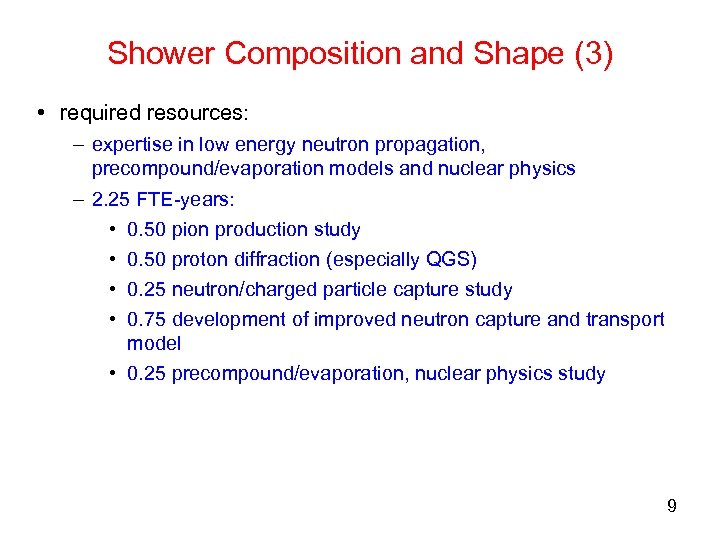 Shower Composition and Shape (3) • required resources: – expertise in low energy neutron propagation, precompound/evaporation models and nuclear physics – 2. 25 FTE-years: • 0. 50 pion production study • 0. 50 proton diffraction (especially QGS) • 0. 25 neutron/charged particle capture study • 0. 75 development of improved neutron capture and transport model • 0. 25 precompound/evaporation, nuclear physics study 9
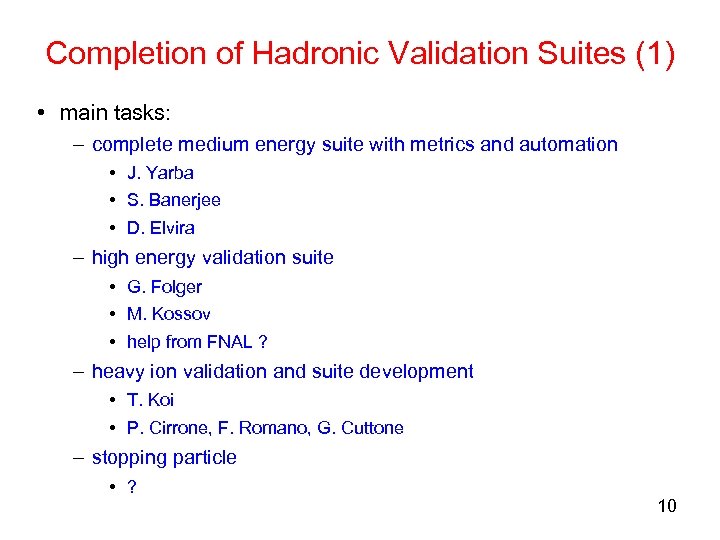 Completion of Hadronic Validation Suites (1) • main tasks: – complete medium energy suite with metrics and automation • J. Yarba • S. Banerjee • D. Elvira – high energy validation suite • G. Folger • M. Kossov • help from FNAL ? – heavy ion validation and suite development • T. Koi • P. Cirrone, F. Romano, G. Cuttone – stopping particle • ? 10
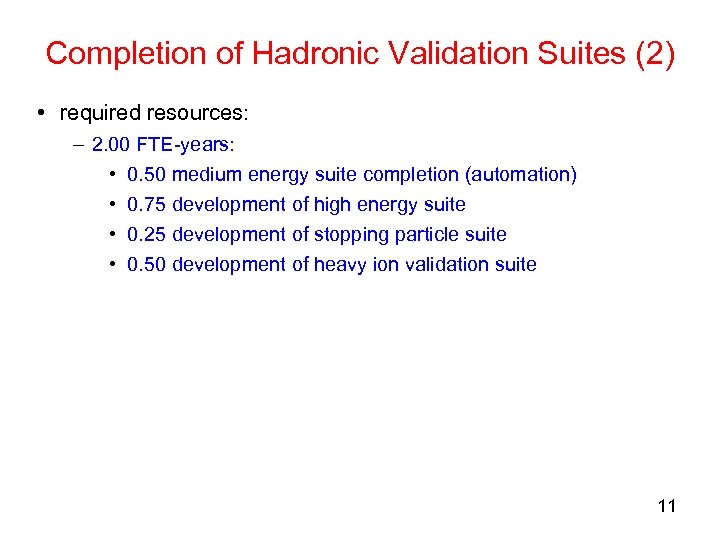 Completion of Hadronic Validation Suites (2) • required resources: – 2. 00 FTE-years: • 0. 50 medium energy suite completion (automation) • 0. 75 development of high energy suite • 0. 25 development of stopping particle suite • 0. 50 development of heavy ion validation suite 11
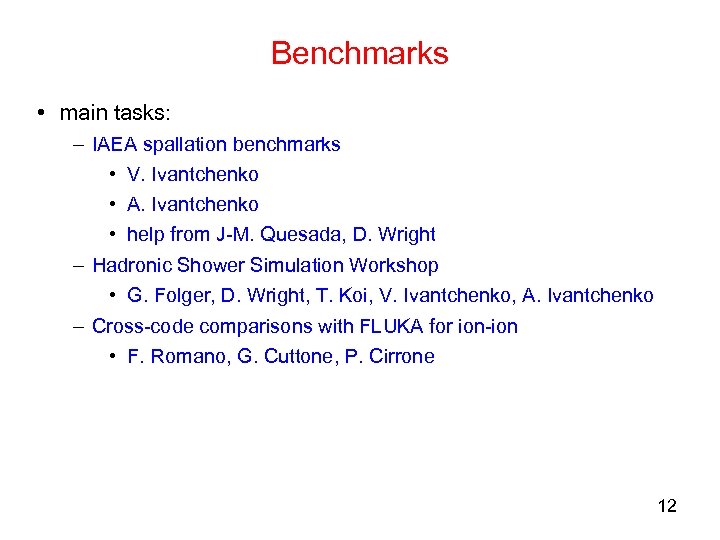 Benchmarks • main tasks: – IAEA spallation benchmarks • V. Ivantchenko • A. Ivantchenko • help from J-M. Quesada, D. Wright – Hadronic Shower Simulation Workshop • G. Folger, D. Wright, T. Koi, V. Ivantchenko, A. Ivantchenko – Cross-code comparisons with FLUKA for ion-ion • F. Romano, G. Cuttone, P. Cirrone 12
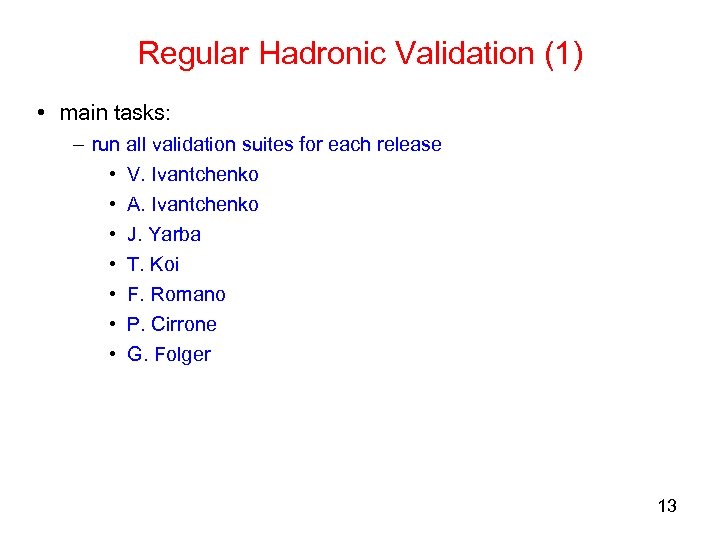 Regular Hadronic Validation (1) • main tasks: – run all validation suites for each release • V. Ivantchenko • A. Ivantchenko • J. Yarba • T. Koi • F. Romano • P. Cirrone • G. Folger 13
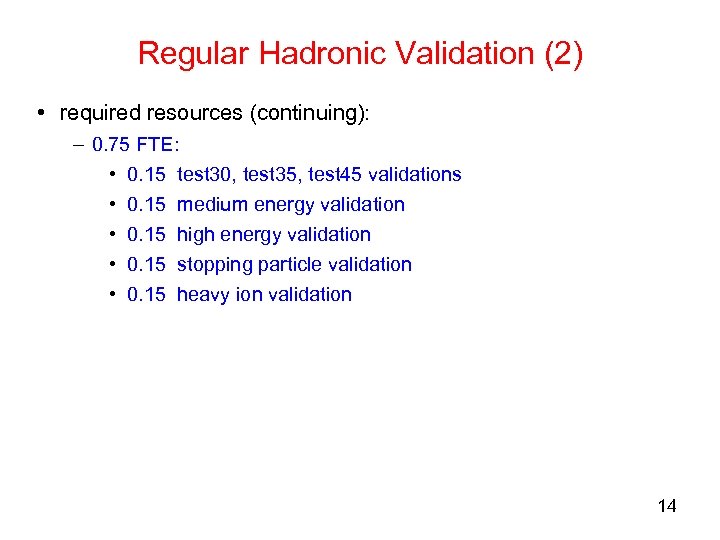 Regular Hadronic Validation (2) • required resources (continuing): – 0. 75 FTE: • 0. 15 test 30, test 35, test 45 validations • 0. 15 medium energy validation • 0. 15 high energy validation • 0. 15 stopping particle validation • 0. 15 heavy ion validation 14
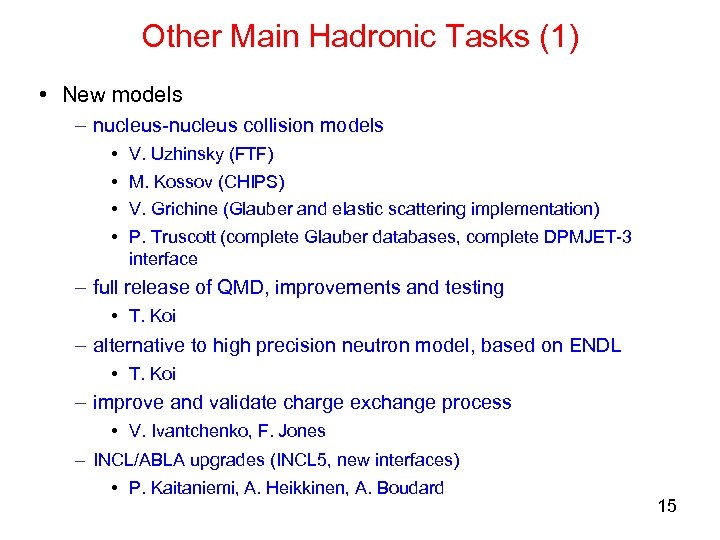 Other Main Hadronic Tasks (1) • New models – nucleus-nucleus collision models • • V. Uzhinsky (FTF) M. Kossov (CHIPS) V. Grichine (Glauber and elastic scattering implementation) P. Truscott (complete Glauber databases, complete DPMJET-3 interface – full release of QMD, improvements and testing • T. Koi – alternative to high precision neutron model, based on ENDL • T. Koi – improve and validate charge exchange process • V. Ivantchenko, F. Jones – INCL/ABLA upgrades (INCL 5, new interfaces) • P. Kaitaniemi, A. Heikkinen, A. Boudard 15
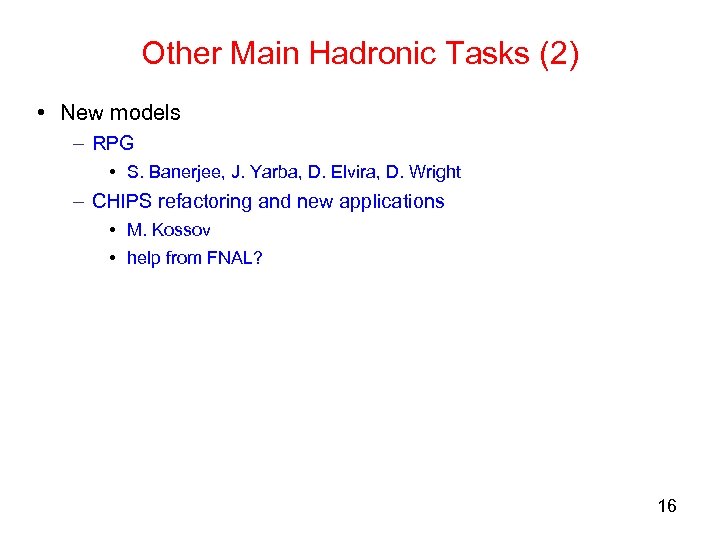 Other Main Hadronic Tasks (2) • New models – RPG • S. Banerjee, J. Yarba, D. Elvira, D. Wright – CHIPS refactoring and new applications • M. Kossov • help from FNAL? 16
 Other Main Hadronic Tasks (3) • Testing – complete system tests • D. Wright • G. Folger – unit tests • each person who is responsible for a model should develop tests (if not already completed) – energy/momentum developer tests • D. Wright • Documentation – model descriptions and validity ranges • D. Wright and all model developers/maintainers 17
 18 Hadronic Milestones and Responsibles for 2009
 Hadronics Milestones 2009 (1) • Feb – complete IAEA spallation benchmarks (V. I, A. I. , J-M. Q. ) • Mar – complete latest validation against changes in Bertini cascade (J. Y. , S. B. , V. I. , A. R. ) – INCL/ABLA physics list completed, validated (P. K. ) • May – complete study of cascade turn-off in Bertini (D. W. , S. B. , J. Y. , D. E. , A. R. ) • Jun – medium energy validation suite completed (J. Y. , S. B. , D. E. ) – run automated validation for next release (J. Y. , S. B. , D. E. ) – carbon ion projectiles allowed in INCL (P. K. ) 19
 Hadronics Milestones 2009 (2) • Aug – ion-ion validation suite completed (T. K. , P. C. , F. R. , G. C. ) – GEM model fixed and validated (T. K. ) – hadronic code clean-up (V. I. , D. W. ) – study and implementation of code speed-up (Z**1/3, etc. ) (V. I. ) – review of natural isotope class (V. I. , T. K. ) • Sep – implementation of developer tests for energy/momentum conservation in all hadronic models (D. W. ) – upgrade of CHIPS C++ code quality (M. K. , FNAL) – extension of CHIPs to nucleus-nucleus (M. K. ) – validation of G 4 QMD (T. K. ) – binary cascade internal cross section review completed (V. G. ) 20
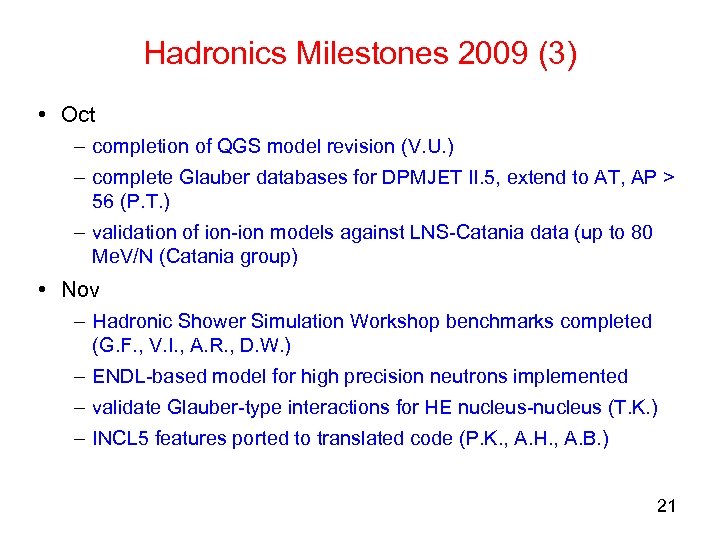 Hadronics Milestones 2009 (3) • Oct – completion of QGS model revision (V. U. ) – complete Glauber databases for DPMJET II. 5, extend to AT, AP > 56 (P. T. ) – validation of ion-ion models against LNS-Catania data (up to 80 Me. V/N (Catania group) • Nov – Hadronic Shower Simulation Workshop benchmarks completed (G. F. , V. I. , A. R. , D. W. ) – ENDL-based model for high precision neutrons implemented – validate Glauber-type interactions for HE nucleus-nucleus (T. K. ) – INCL 5 features ported to translated code (P. K. , A. H. , A. B. ) 21
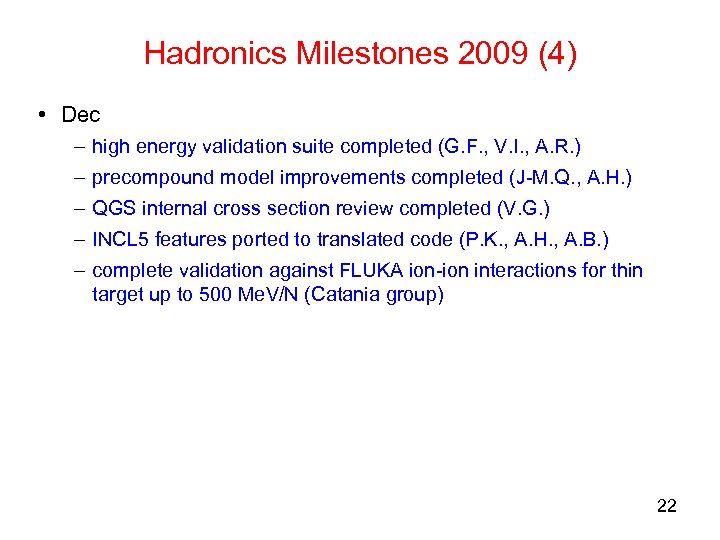 Hadronics Milestones 2009 (4) • Dec – high energy validation suite completed (G. F. , V. I. , A. R. ) – precompound model improvements completed (J-M. Q. , A. H. ) – QGS internal cross section review completed (V. G. ) – INCL 5 features ported to translated code (P. K. , A. H. , A. B. ) – complete validation against FLUKA ion-ion interactions for thin target up to 500 Me. V/N (Catania group) 22
 23 Hadronic Milestones for 2010 -2012
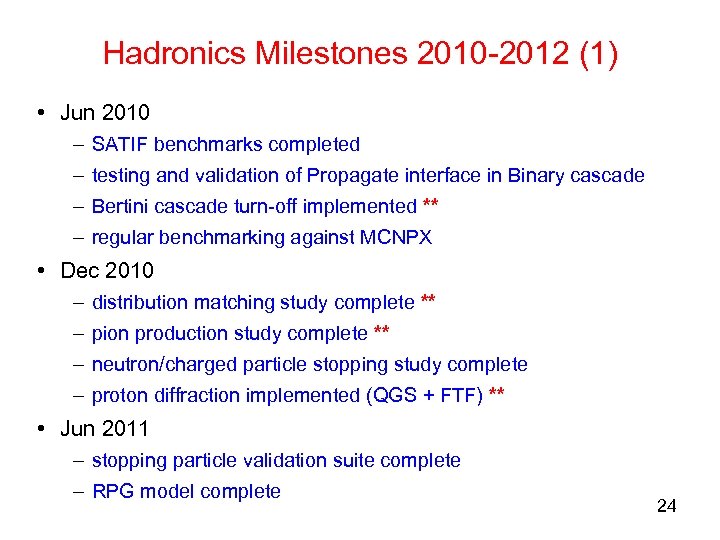 Hadronics Milestones 2010 -2012 (1) • Jun 2010 – SATIF benchmarks completed – testing and validation of Propagate interface in Binary cascade – Bertini cascade turn-off implemented ** – regular benchmarking against MCNPX • Dec 2010 – distribution matching study complete ** – pion production study complete ** – neutron/charged particle stopping study complete – proton diffraction implemented (QGS + FTF) ** • Jun 2011 – stopping particle validation suite complete – RPG model complete 24
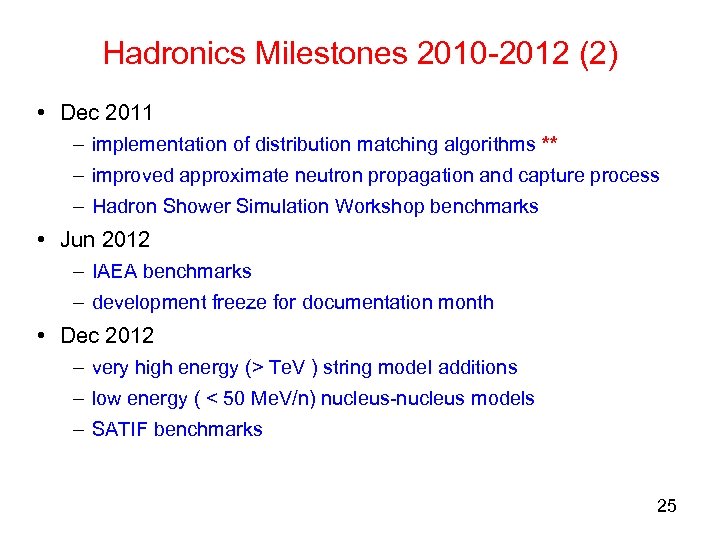 Hadronics Milestones 2010 -2012 (2) • Dec 2011 – implementation of distribution matching algorithms ** – improved approximate neutron propagation and capture process – Hadron Shower Simulation Workshop benchmarks • Jun 2012 – IAEA benchmarks – development freeze for documentation month • Dec 2012 – very high energy (> Te. V ) string model additions – low energy ( < 50 Me. V/n) nucleus-nucleus models – SATIF benchmarks 25