 Скачать презентацию Hadron Calorimeter Felix Sefkow EUDET Annual Meeting October
eb8127441702558e182dee74e89d535c.ppt
- Количество слайдов: 18



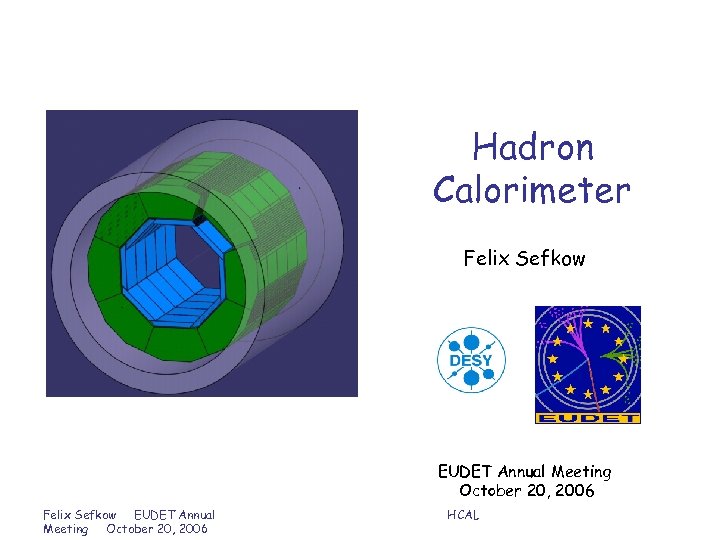
Hadron Calorimeter Felix Sefkow EUDET Annual Meeting October 20, 2006 HCAL
Outline • Goals, milestones, roadmap • Detector structure: experience and R&D • Calibration system studies Felix Sefkow EUDET Annual Meeting October 20, 2006 HCAL 2
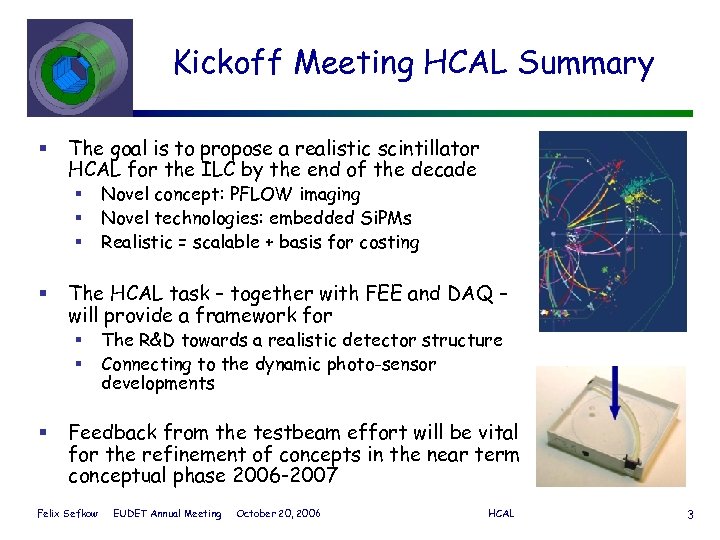
Kickoff Meeting HCAL Summary § The goal is to propose a realistic scintillator HCAL for the ILC by the end of the decade § § The HCAL task – together with FEE and DAQ – will provide a framework for § § § Novel concept: PFLOW imaging Novel technologies: embedded Si. PMs Realistic = scalable + basis for costing The R&D towards a realistic detector structure Connecting to the dynamic photo-sensor developments Feedback from the testbeam effort will be vital for the refinement of concepts in the near term conceptual phase 2006 -2007 Felix Sefkow EUDET Annual Meeting October 20, 2006 HCAL 3
R&D collaborations • JRA 3 work is embedded in international R&D collaborations – Input from previous detector prototypes – Input from operational experience at ongoing testbeams – Input from generic R&D for future detector components • Ensure that the provided infrastructure matches the R&D requirements of the community International collaboration: 36 institutes fom Europe, Asia and America + Japan Felix Sefkow EUDET Annual Meeting October 20, 2006 HCAL 4
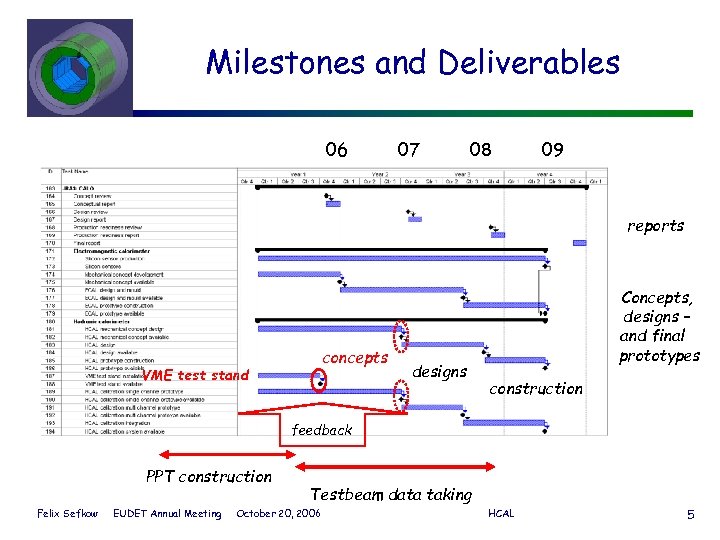
Milestones and Deliverables 06 07 08 09 reports concepts VME test stand designs Concepts, designs – and final prototypes construction feedback PPT construction Felix Sefkow EUDET Annual Meeting Testbeam data taking October 20, 2006 HCAL 5
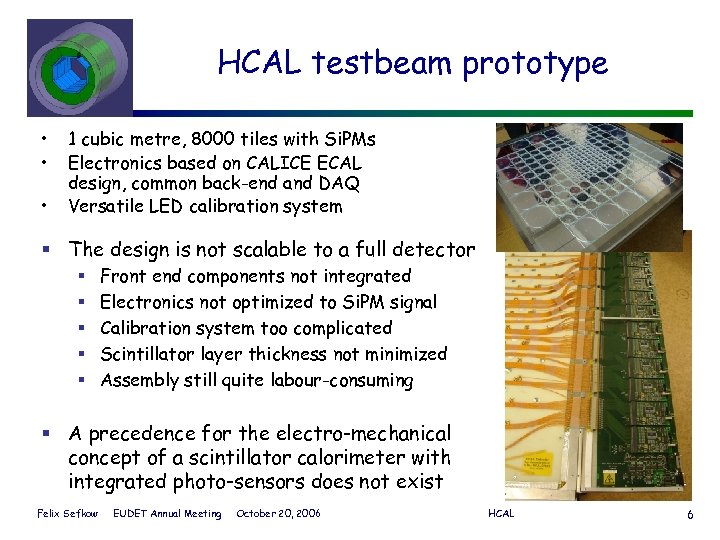
HCAL testbeam prototype • • • 1 cubic metre, 8000 tiles with Si. PMs Electronics based on CALICE ECAL design, common back-end and DAQ Versatile LED calibration system § The design is not scalable to a full detector § § § Front end components not integrated Electronics not optimized to Si. PM signal Calibration system too complicated Scintillator layer thickness not minimized Assembly still quite labour-consuming § A precedence for the electro-mechanical concept of a scintillator calorimeter with integrated photo-sensors does not exist Felix Sefkow EUDET Annual Meeting October 20, 2006 HCAL 6
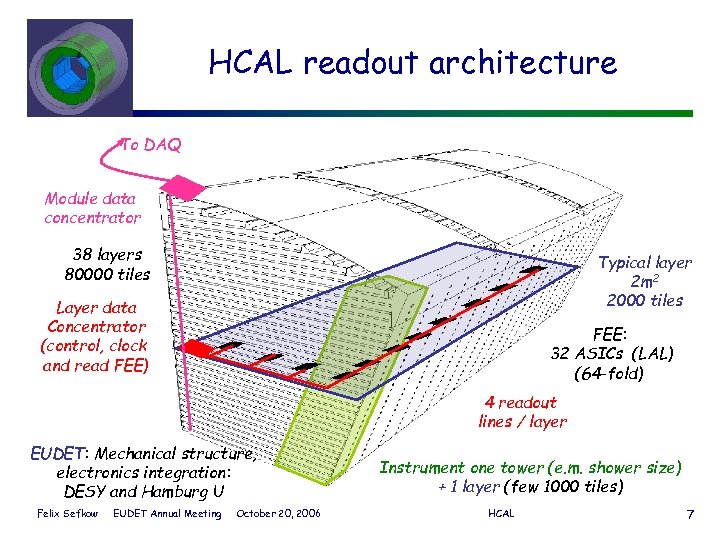
HCAL readout architecture To DAQ Module data concentrator 38 layers 80000 tiles Typical layer 2 m 2 2000 tiles Layer data Concentrator (control, clock and read FEE) FEE: 32 ASICs (LAL) (64 -fold) 4 readout lines / layer EUDET: Mechanical structure, electronics integration: DESY and Hamburg U Felix Sefkow EUDET Annual Meeting October 20, 2006 Instrument one tower (e. m. shower size) + 1 layer (few 1000 tiles) HCAL 7
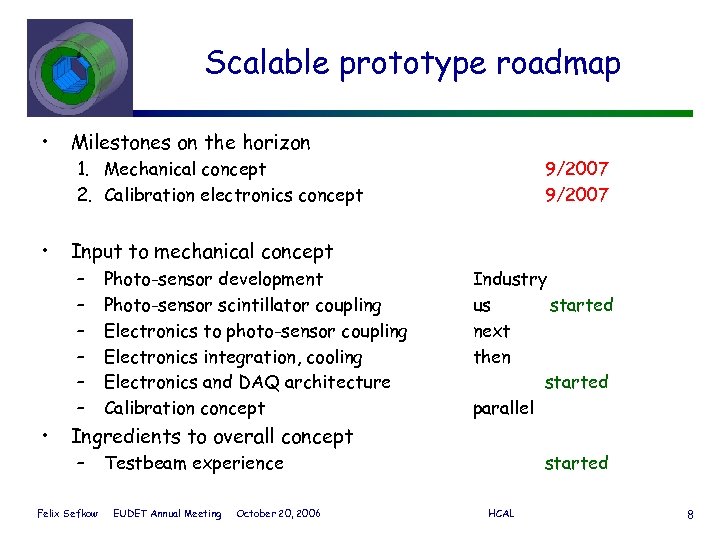
Scalable prototype roadmap • Milestones on the horizon 1. Mechanical concept 2. Calibration electronics concept • Input to mechanical concept – – – • 9/2007 Photo-sensor development Photo-sensor scintillator coupling Electronics to photo-sensor coupling Electronics integration, cooling Electronics and DAQ architecture Calibration concept Industry us started next then started parallel Ingredients to overall concept – Felix Sefkow Testbeam experience EUDET Annual Meeting October 20, 2006 started HCAL 8
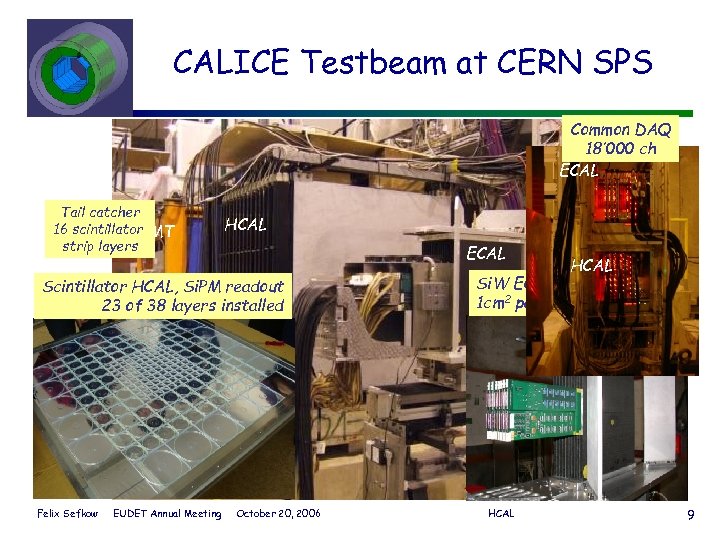
CALICE Testbeam at CERN SPS Common DAQ 18’ 000 ch ECAL Tail catcher 16 scintillator TCMT strip layers HCAL ECAL Scintillator HCAL, Si. PM readout 23 of 38 layers installed Felix Sefkow EUDET Annual Meeting October 20, 2006 HCAL Si. W ECAL 1 cm 2 pads, 30 layers HCAL 9
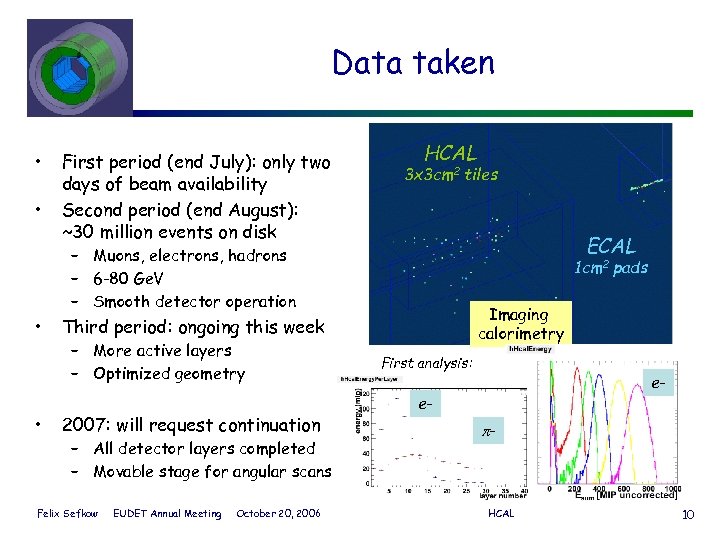
Data taken • • First period (end July): only two days of beam availability Second period (end August): ~30 million events on disk HCAL 3 x 3 cm 2 tiles ECAL – Muons, electrons, hadrons – 6 -80 Ge. V – Smooth detector operation • • 1 cm 2 pads Imaging calorimetry Third period: ongoing this week – More active layers – Optimized geometry 2007: will request continuation – All detector layers completed – Movable stage for angular scans Felix Sefkow EUDET Annual Meeting October 20, 2006 First analysis: e- e- - HCAL 10
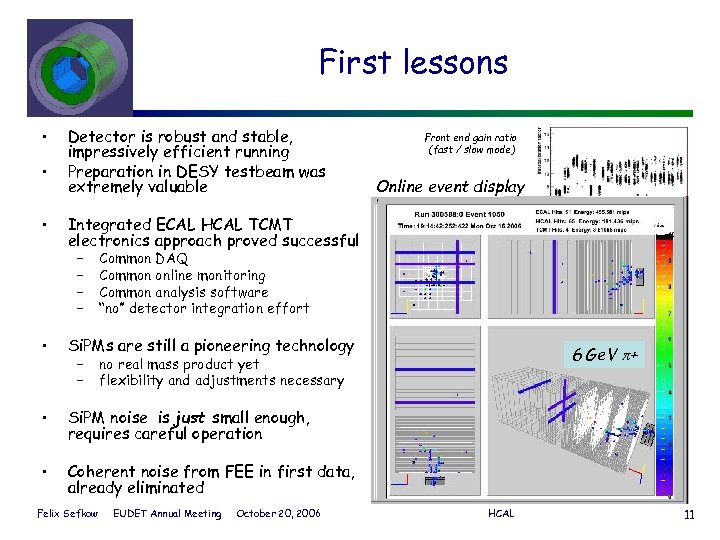
First lessons • • • Detector is robust and stable, impressively efficient running Preparation in DESY testbeam was extremely valuable Front end gain ratio (fast / slow mode) Online event display Integrated ECAL HCAL TCMT electronics approach proved successful – – Common DAQ Common online monitoring Common analysis software “no” detector integration effort • Si. PMs are still a pioneering technology • Si. PM noise is just small enough, requires careful operation • Coherent noise from FEE in first data, already eliminated – – Felix Sefkow 6 Ge. V + no real mass product yet flexibility and adjustments necessary EUDET Annual Meeting October 20, 2006 HCAL 11
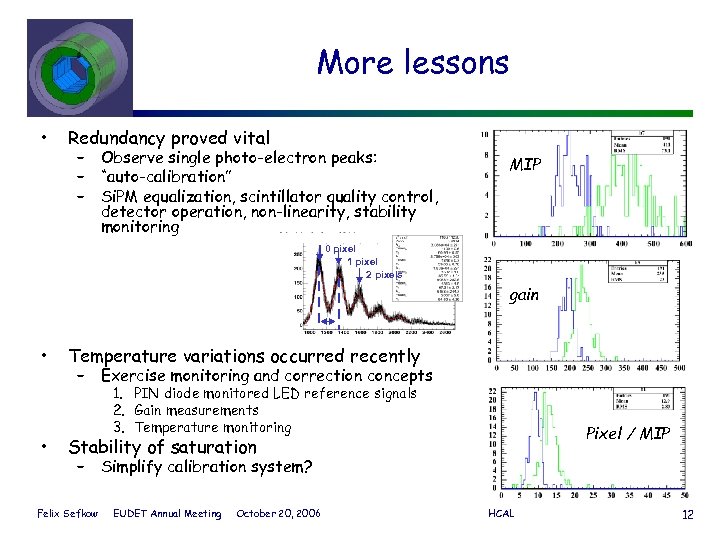
More lessons • Redundancy proved vital – – – Observe single photo-electron peaks: “auto-calibration” Si. PM equalization, scintillator quality control, detector operation, non-linearity, stability monitoring MIP 0 pixel 1 pixel 2 pixels gain • • Temperature variations occurred recently – Exercise monitoring and correction concepts 1. PIN diode monitored LED reference signals 2. Gain measurements 3. Temperature monitoring Pixel / MIP Stability of saturation – Felix Sefkow Simplify calibration system? EUDET Annual Meeting October 20, 2006 HCAL 12
Si. PM development • Very active field, driven by non-HEP applications • More players entering: – Medical imaging (PET), diagnostics, night vision, radiation monitoring – MEPHI/PULSAR, CPTA, JINR, MPI-Munich, Hamamatsu, Sens. L, Geneva, Trento • Directions: higher signal – lower noise –lower cost • Will allow to – Lower noise and / or inter-pixel Xtalk lower thresholds – Better spectral sensitivity – to blue scintillation light – Larger area and / or better geometrical packing factor – Significantly simplify the coupling between Si. PM and scintillator • Eliminate fibre, ease precision requirements – Use thinner scintillator • • Felix Sefkow Save coil cost Buy containment Improve electromagn. Performance maybe keep the fibre… EUDET Annual Meeting October 20, 2006 HCAL 13
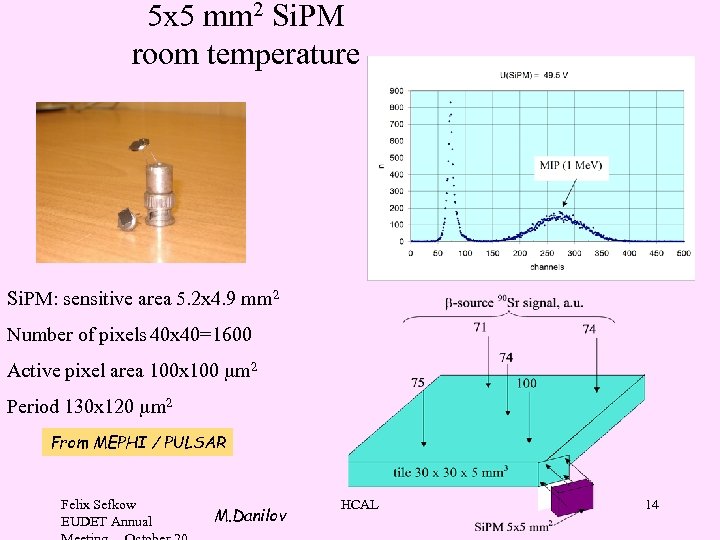
5 x 5 mm 2 Si. PM room temperature Si. PM: sensitive area 5. 2 x 4. 9 mm 2 Number of pixels 40 x 40=1600 Active pixel area 100 x 100 m 2 Period 130 x 120 m 2 From MEPHI / PULSAR Felix Sefkow EUDET Annual M. Danilov HCAL 14
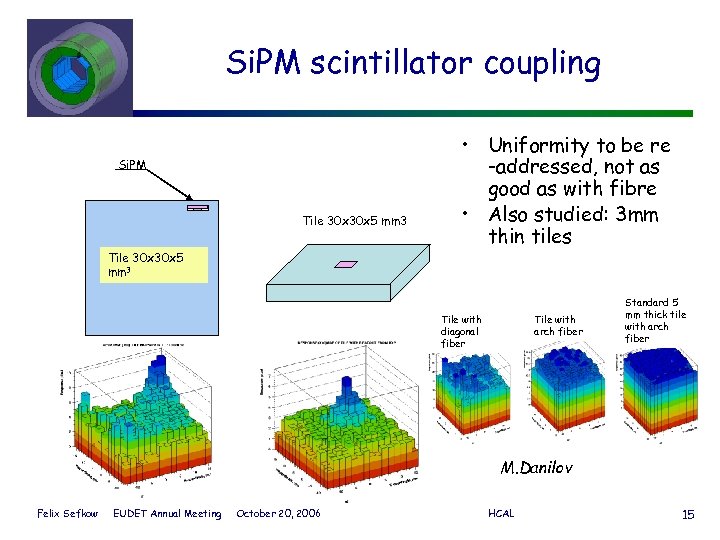
Si. PM scintillator coupling Si. PM Tile 30 x 30 x 5 mm 3 • Uniformity to be re -addressed, not as good as with fibre • Also studied: 3 mm thin tiles Tile with diagonal fiber Tile with arch fiber Standard 5 mm thick tile with arch fiber M. Danilov Felix Sefkow EUDET Annual Meeting October 20, 2006 HCAL 15
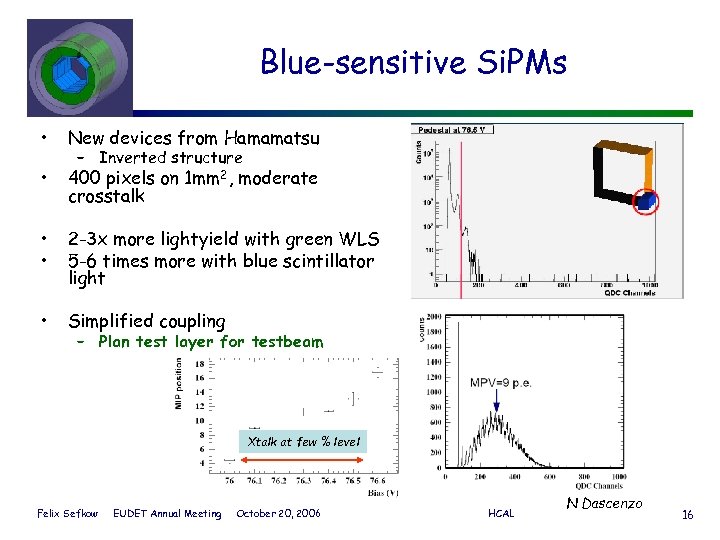
Blue-sensitive Si. PMs • New devices from Hamamatsu • 400 pixels on 1 mm 2, moderate crosstalk • • 2 -3 x more lightyield with green WLS 5 -6 times more with blue scintillator light • Simplified coupling – Inverted structure – Plan test layer for testbeam Xtalk at few % level Felix Sefkow EUDET Annual Meeting October 20, 2006 HCAL N Dascenzo 16
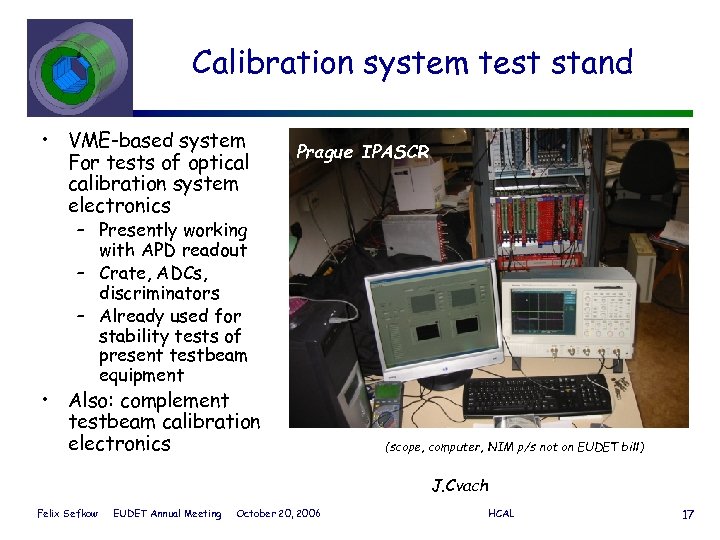
Calibration system test stand • VME-based system For tests of optical calibration system electronics Prague IPASCR – Presently working with APD readout – Crate, ADCs, discriminators – Already used for stability tests of present testbeam equipment • Also: complement testbeam calibration electronics (scope, computer, NIM p/s not on EUDET bill) J. Cvach Felix Sefkow EUDET Annual Meeting October 20, 2006 HCAL 17
Progress summary § EUDET HCAL concept and schedule largely driven by testbeam § Test beam started on schedule - real data are rolling in § Operational experience rapidly accumulating § Engineering resources needed for completion § Critical R&D issues around new photo-sensors identified and being addressed § Next: invent a novel readout structure § Calibration system infrastructure in place: § First milestone met Felix Sefkow EUDET Annual Meeting October 20, 2006 HCAL 18
Скачать презентацию Hadron Calorimeter Felix Sefkow EUDET Annual Meeting October
eb8127441702558e182dee74e89d535c.ppt