


 Скачать презентацию Ha Re The Haskell Refactorer Huiqing Li Claus
7843346d647f4f20727b8b368396bb6c.ppt
- Количество слайдов: 58
 Ha. Re The Haskell Refactorer Huiqing Li Claus Reinke Simon Thompson Computing Lab, University of Kent www. cs. kent. ac. uk/projects/refactor-fp/
 Outline • Introduction • Ha. Re: The Haskell Refactorer • Demo of Ha. Re • The Implementation of Ha. Re • Current Work • Future Work 2
 Outline • Introduction • Ha. Re: The Haskell Refactorer • Demo of Ha. Re • The Implementation of Ha. Re • Current Work • Future Work 3
 Refactoring • What? Changing the structure of existing code … … without changing its meaning. • Essential part of the functional programming process. • Where? Development, maintenance, … -- to make the code easier to understand modify -- to improve code reuse, quality and productivity. • Not just programming … also proof, presentation, … 4
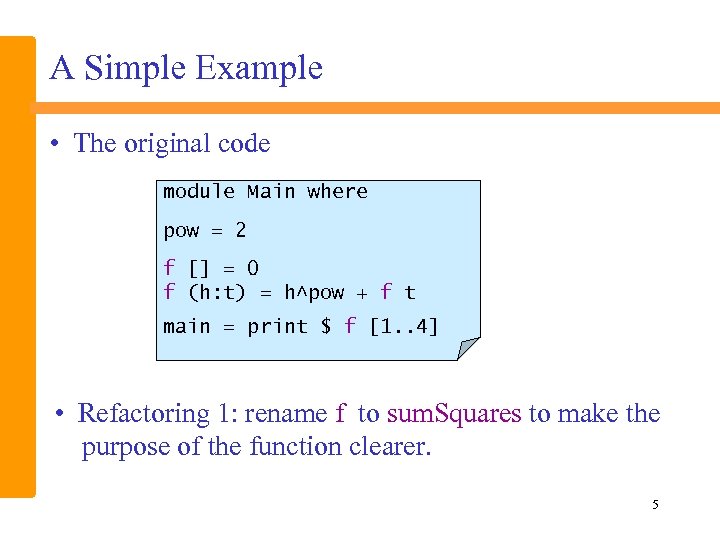 A Simple Example • The original code module Main where pow = 2 f [] = 0 f (h: t) = h^pow + f t main = print $ f [1. . 4] • Refactoring 1: rename f to sum. Squares to make the purpose of the function clearer. 5
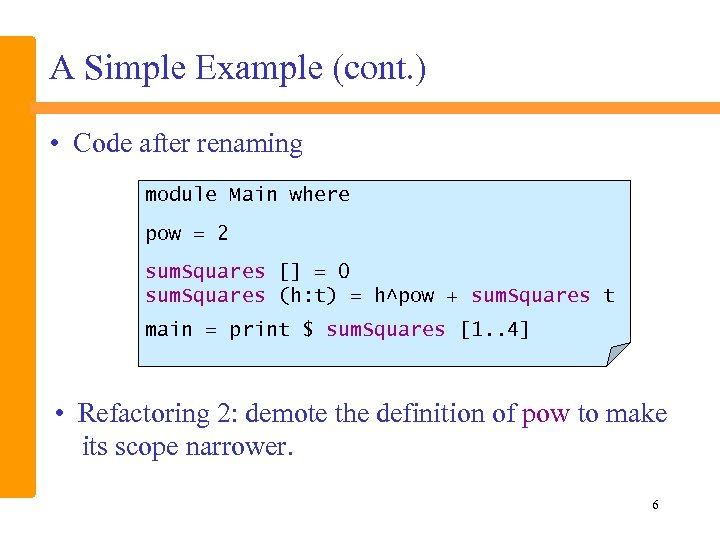 A Simple Example (cont. ) • Code after renaming module Main where pow = 2 sum. Squares [] = 0 sum. Squares (h: t) = h^pow + sum. Squares t main = print $ sum. Squares [1. . 4] • Refactoring 2: demote the definition of pow to make its scope narrower. 6
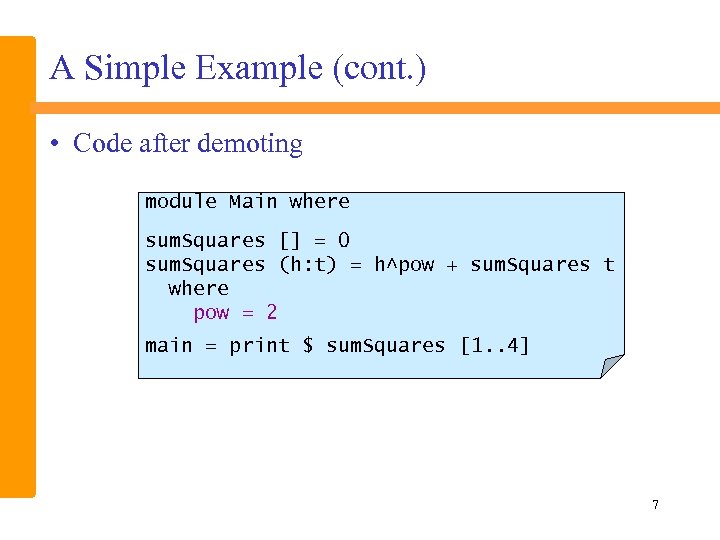 A Simple Example (cont. ) • Code after demoting module Main where sum. Squares [] = 0 sum. Squares (h: t) = h^pow + sum. Squares t where pow = 2 main = print $ sum. Squares [1. . 4] 7
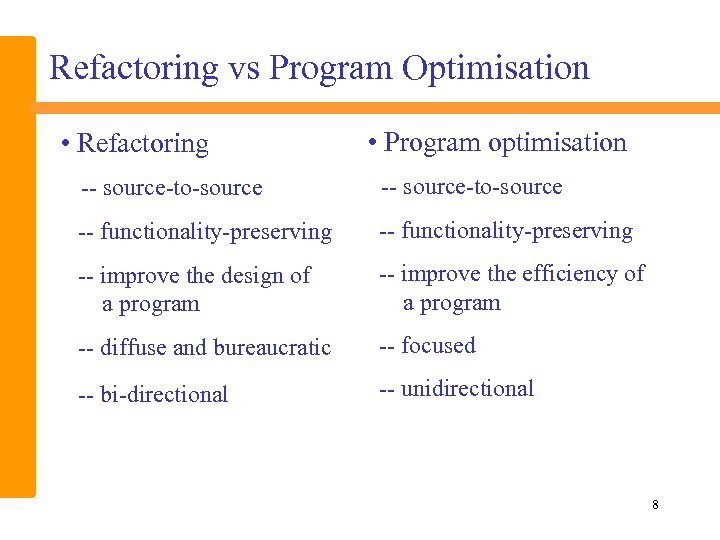 Refactoring vs Program Optimisation • Refactoring • Program optimisation -- source-to-source -- functionality-preserving -- improve the design of a program -- improve the efficiency of a program -- diffuse and bureaucratic -- focused -- bi-directional -- unidirectional 8
 How to apply refactoring? • By hand Tedious Error-prone Depends on extensive testing • With machine support Reliable Low cost: easy to make and un-make large changes Exploratory: a full part of the programmers’ toolkit 9
 Refactoring Functional Programs • 3 -year EPSRC-funded project § Explore the prospects of refactoring functional programs § Catalogue useful refactorings § Look into the difference between OO and FP refactoring § A real life refactoring tool for Haskell programming § A formal way to specify refactorings, and a set of formal proofs that the implemented refactorings are correct. • Currently end of second year: the second Ha. Re is module-aware. 10
 Outline • Introduction • Ha. Re: The Haskell Refactorer • Demo of Ha. Re • The Implementation of Ha. Re • Current Work • Future Work 11
 Ha. Re – The Haskell Refactorer -- A prototype tool for refactoring Haskell programs -- Driving concerns: usability and solid basis for extensions. -- Implemented in Haskell, using Programatica’s frontends and Strafunski’s generic programming technique. -- Full Haskell 98 coverage -- Integrated with the two program editors: Emacs and Vim -- Preserves both comments and layout style of the source 12
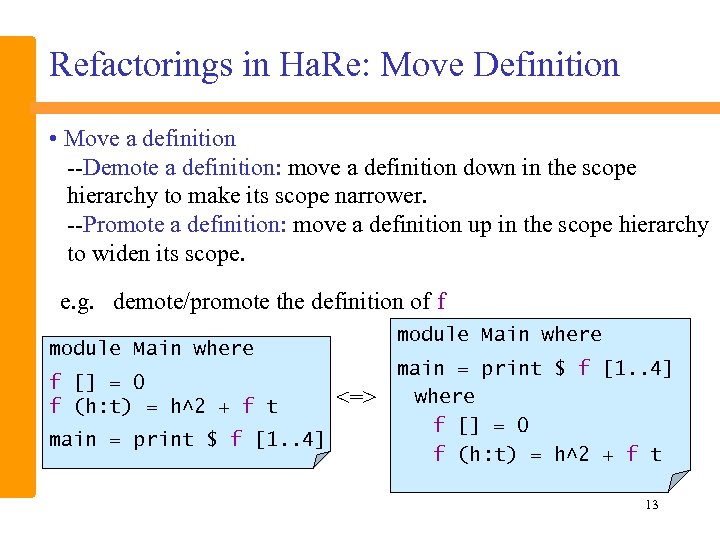 Refactorings in Ha. Re: Move Definition • Move a definition --Demote a definition: move a definition down in the scope hierarchy to make its scope narrower. --Promote a definition: move a definition up in the scope hierarchy to widen its scope. e. g. demote/promote the definition of f module Main where f [] = 0 f (h: t) = h^2 + f t main = print $ f [1. . 4] <=> main = print $ f [1. . 4] where f [] = 0 f (h: t) = h^2 + f t 13
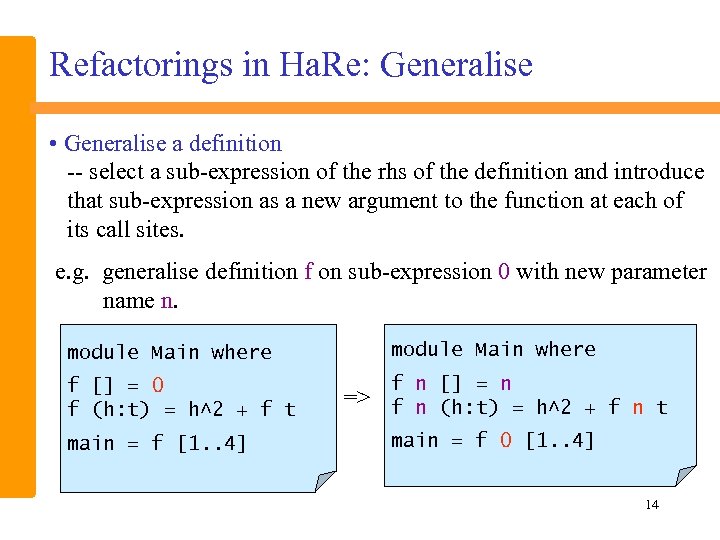 Refactorings in Ha. Re: Generalise • Generalise a definition -- select a sub-expression of the rhs of the definition and introduce that sub-expression as a new argument to the function at each of its call sites. e. g. generalise definition f on sub-expression 0 with new parameter name n. module Main where f [] = 0 f (h: t) = h^2 + f t f n [] = n f n (h: t) = h^2 + f n t main = f [1. . 4] => main = f 0 [1. . 4] 14
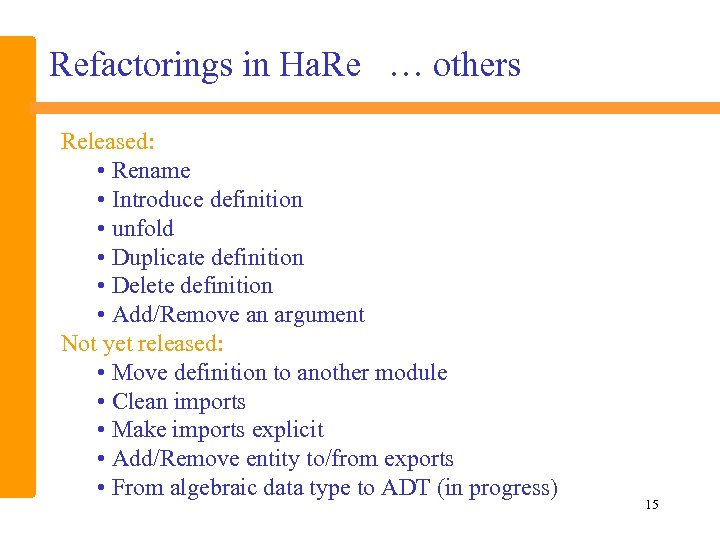 Refactorings in Ha. Re … others Released: • Rename • Introduce definition • unfold • Duplicate definition • Delete definition • Add/Remove an argument Not yet released: • Move definition to another module • Clean imports • Make imports explicit • Add/Remove entity to/from exports • From algebraic data type to ADT (in progress) 15
 Outline • Introduction • Ha. Re: The Haskell Refactorer • Demo of Ha. Re (hosted in Emacs) • The Implementation of Ha. Re • Current Work • Future Work 16
![Demo module Demo(sum. Squares) where sq x = x ^ 2 sum. Squares []](https://present5.com/presentation/7843346d647f4f20727b8b368396bb6c/image-17.jpg "Demo module Demo(sum. Squares) where sq x = x ^ 2 sum. Squares []") Demo module Demo(sum. Squares) where sq x = x ^ 2 sum. Squares [] = 0 sum. Squares (x: xs) = sq x + sum. Squares xs another. Fun = sum. Squares [1. . 4] 17
Demo module Demo(sum. Squares) where sq x = x ^ 2 sum. Squares [] = 0 sum. Squares (x: xs) = sq x + sum. Squares xs another. Fun = sum. Squares [1. . 4] 17
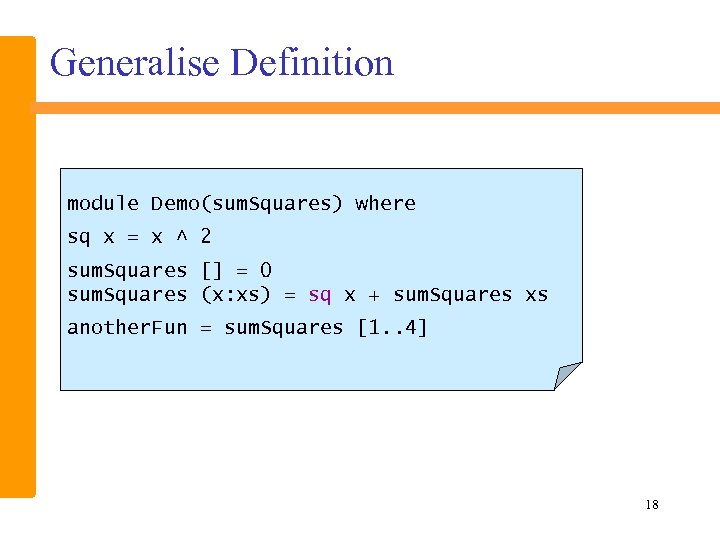 Generalise Definition module Demo(sum. Squares) where sq x = x ^ 2 sum. Squares [] = 0 sum. Squares (x: xs) = sq x + sum. Squares xs another. Fun = sum. Squares [1. . 4] 18
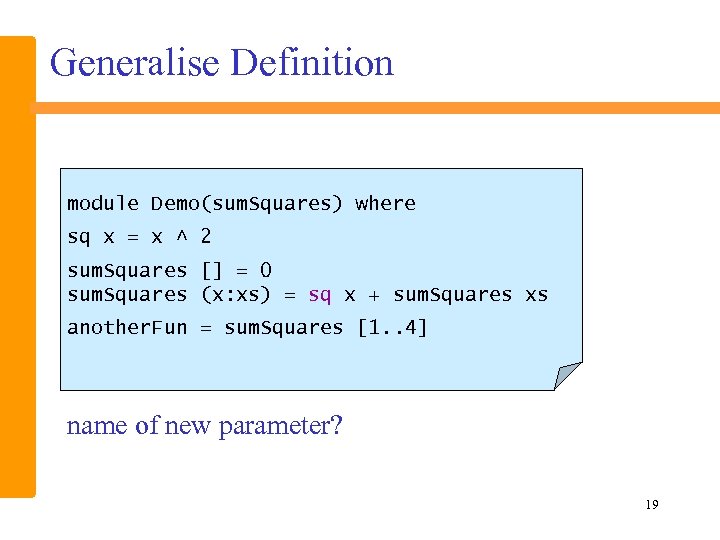 Generalise Definition module Demo(sum. Squares) where sq x = x ^ 2 sum. Squares [] = 0 sum. Squares (x: xs) = sq x + sum. Squares xs another. Fun = sum. Squares [1. . 4] name of new parameter? 19
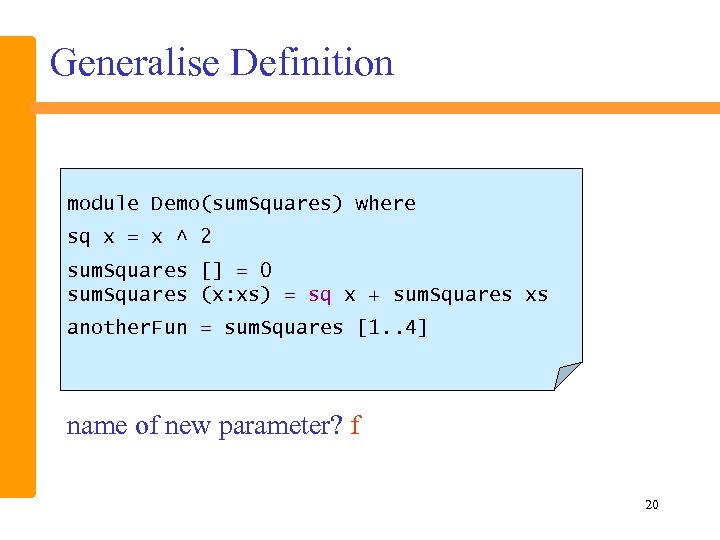 Generalise Definition module Demo(sum. Squares) where sq x = x ^ 2 sum. Squares [] = 0 sum. Squares (x: xs) = sq x + sum. Squares xs another. Fun = sum. Squares [1. . 4] name of new parameter? f 20
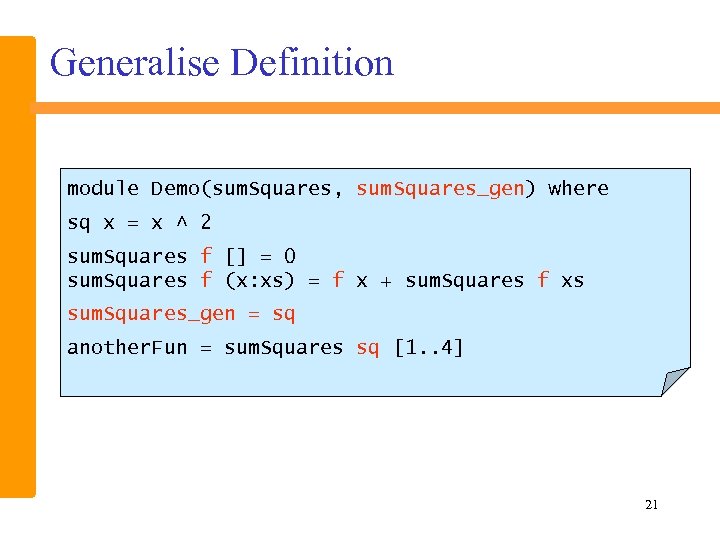 Generalise Definition module Demo(sum. Squares, sum. Squares_gen) where sq x = x ^ 2 sum. Squares f [] = 0 sum. Squares f (x: xs) = f x + sum. Squares f xs sum. Squares_gen = sq another. Fun = sum. Squares sq [1. . 4] 21
![Generalise Definition module Demo. Main where import Demo ints = [1. . 10] main](https://present5.com/presentation/7843346d647f4f20727b8b368396bb6c/image-22.jpg "Generalise Definition module Demo. Main where import Demo ints = [1. . 10] main") Generalise Definition module Demo. Main where import Demo ints = [1. . 10] main = print $ sum. Squares ints 22
Generalise Definition module Demo. Main where import Demo ints = [1. . 10] main = print $ sum. Squares ints 22
![Generalise Definition module Demo. Main where import Demo ints = [1. . 10] main](https://present5.com/presentation/7843346d647f4f20727b8b368396bb6c/image-23.jpg "Generalise Definition module Demo. Main where import Demo ints = [1. . 10] main") Generalise Definition module Demo. Main where import Demo ints = [1. . 10] main = print $ sum. Squares_gen ints 23
Generalise Definition module Demo. Main where import Demo ints = [1. . 10] main = print $ sum. Squares_gen ints 23
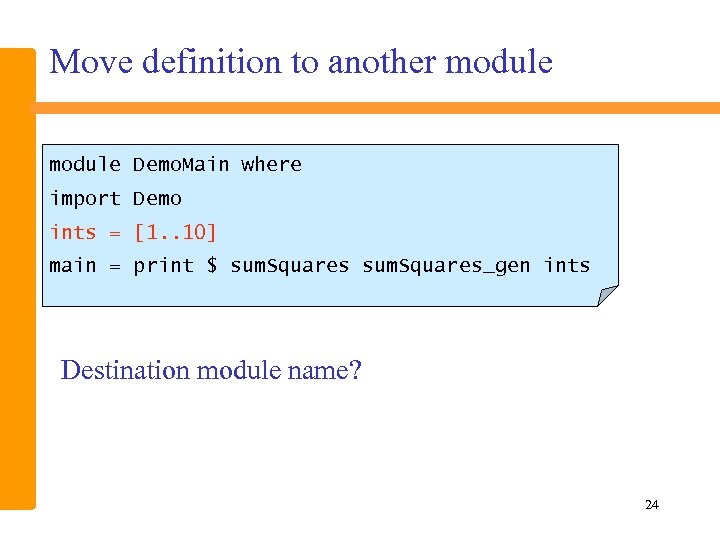 Move definition to another module Demo. Main where import Demo ints = [1. . 10] main = print $ sum. Squares_gen ints Destination module name? 24
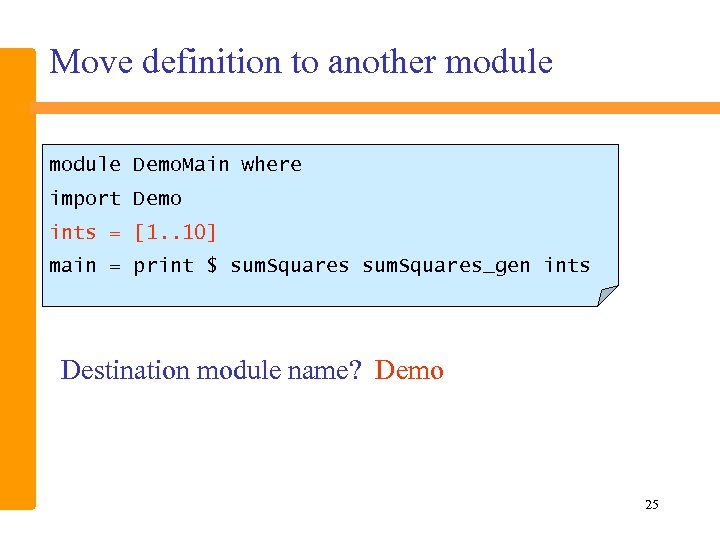 Move definition to another module Demo. Main where import Demo ints = [1. . 10] main = print $ sum. Squares_gen ints Destination module name? Demo 25
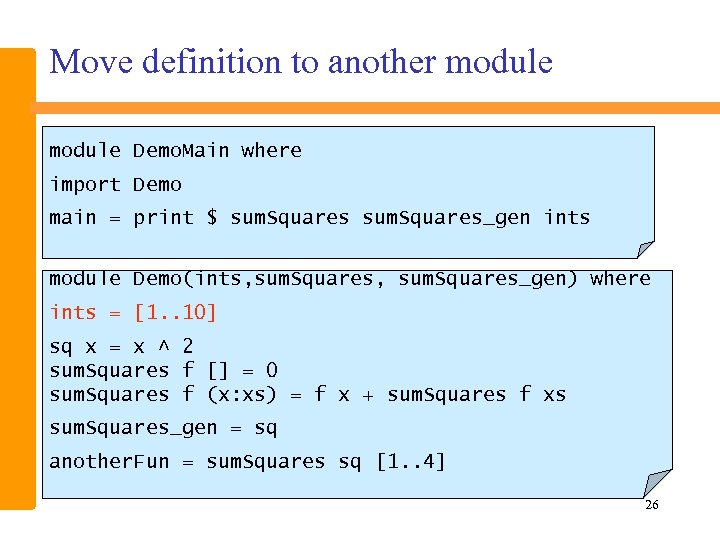 Move definition to another module Demo. Main where import Demo main = print $ sum. Squares_gen ints module Demo(ints, sum. Squares_gen) where ints = [1. . 10] sq x = x ^ 2 sum. Squares f [] = 0 sum. Squares f (x: xs) = f x + sum. Squares f xs sum. Squares_gen = sq another. Fun = sum. Squares sq [1. . 4] 26
 Demo end 27
 Outline • Introduction • Ha. Re: The Haskell Refactorer • Demo of Ha. Re • The Implementation of Ha. Re • Current Work • Future Work 28
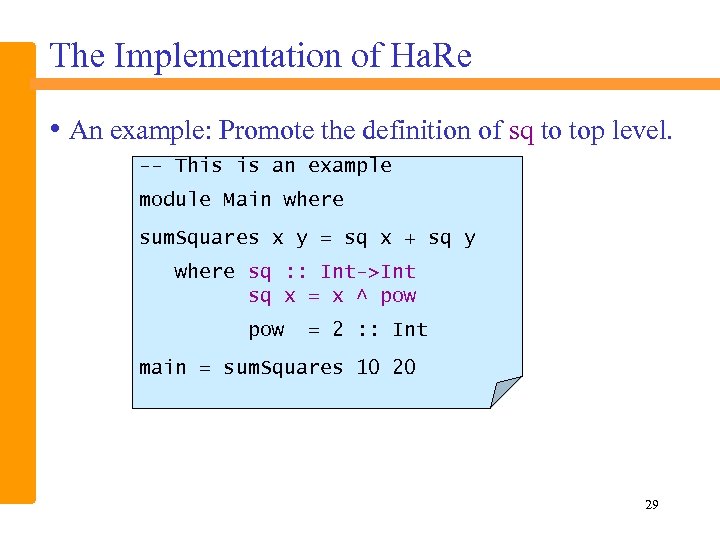 The Implementation of Ha. Re • An example: Promote the definition of sq to top level. -- This is an example module Main where sum. Squares x y = sq x + sq y where sq : : Int->Int sq x = x ^ pow = 2 : : Int main = sum. Squares 10 20 29
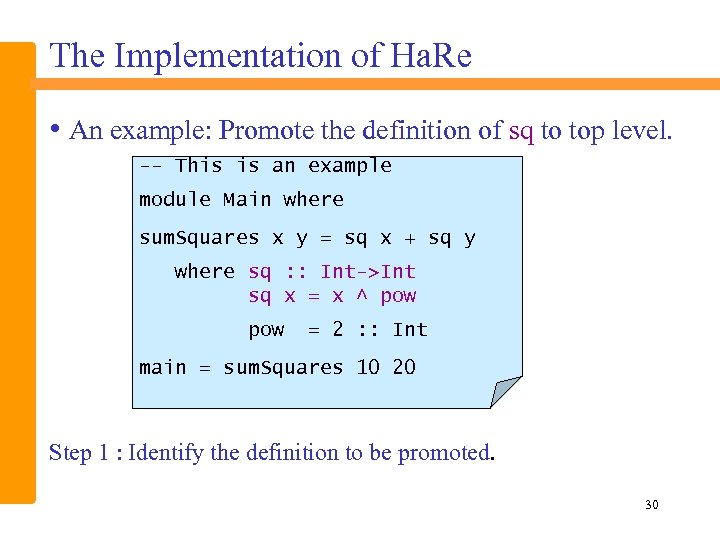 The Implementation of Ha. Re • An example: Promote the definition of sq to top level. -- This is an example module Main where sum. Squares x y = sq x + sq y where sq : : Int->Int sq x = x ^ pow = 2 : : Int main = sum. Squares 10 20 Step 1 : Identify the definition to be promoted. 30
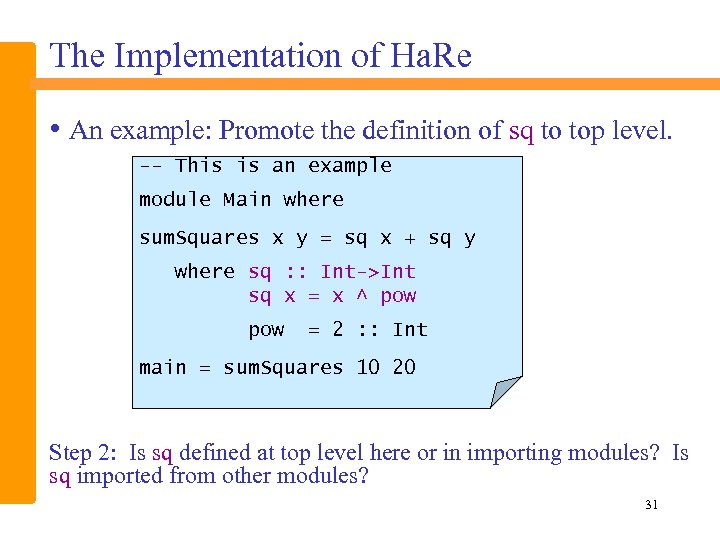 The Implementation of Ha. Re • An example: Promote the definition of sq to top level. -- This is an example module Main where sum. Squares x y = sq x + sq y where sq : : Int->Int sq x = x ^ pow = 2 : : Int main = sum. Squares 10 20 Step 2: Is sq defined at top level here or in importing modules? Is sq imported from other modules? 31
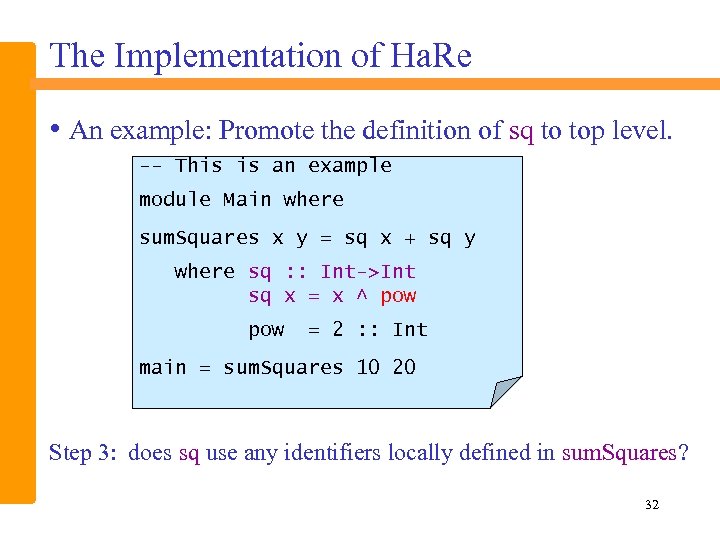 The Implementation of Ha. Re • An example: Promote the definition of sq to top level. -- This is an example module Main where sum. Squares x y = sq x + sq y where sq : : Int->Int sq x = x ^ pow = 2 : : Int main = sum. Squares 10 20 Step 3: does sq use any identifiers locally defined in sum. Squares? 32
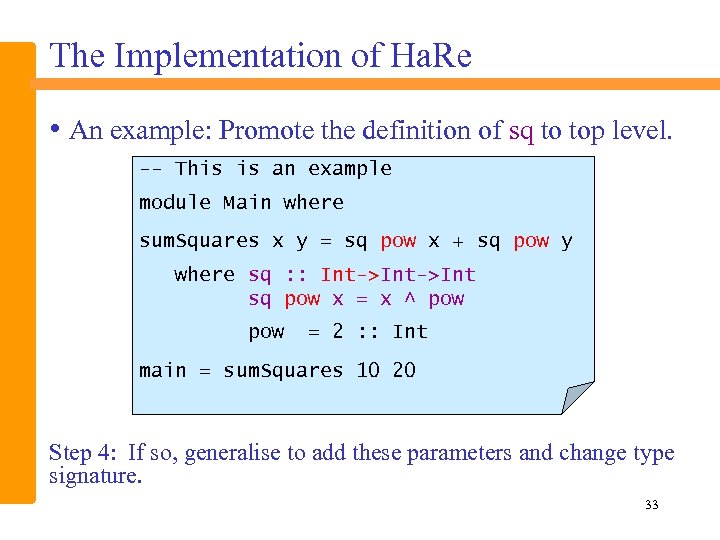 The Implementation of Ha. Re • An example: Promote the definition of sq to top level. -- This is an example module Main where sum. Squares x y = sq pow x + sq pow y where sq : : Int->Int sq pow x = x ^ pow = 2 : : Int main = sum. Squares 10 20 Step 4: If so, generalise to add these parameters and change type signature. 33
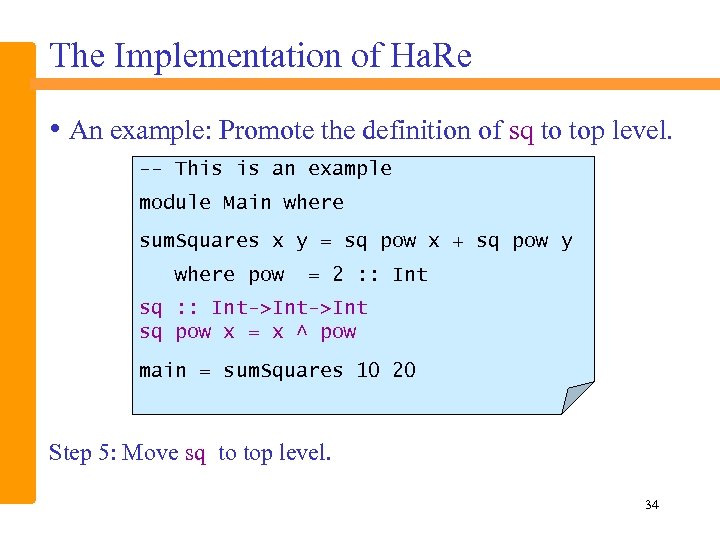 The Implementation of Ha. Re • An example: Promote the definition of sq to top level. -- This is an example module Main where sum. Squares x y = sq pow x + sq pow y where pow = 2 : : Int sq : : Int->Int sq pow x = x ^ pow main = sum. Squares 10 20 Step 5: Move sq to top level. 34
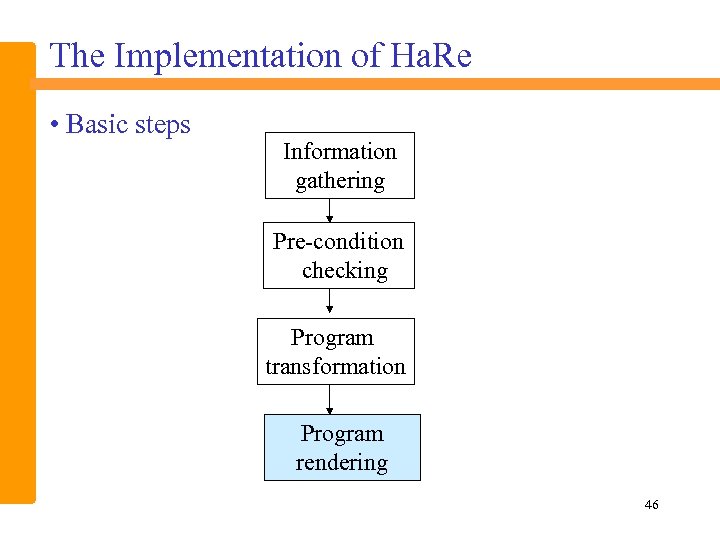
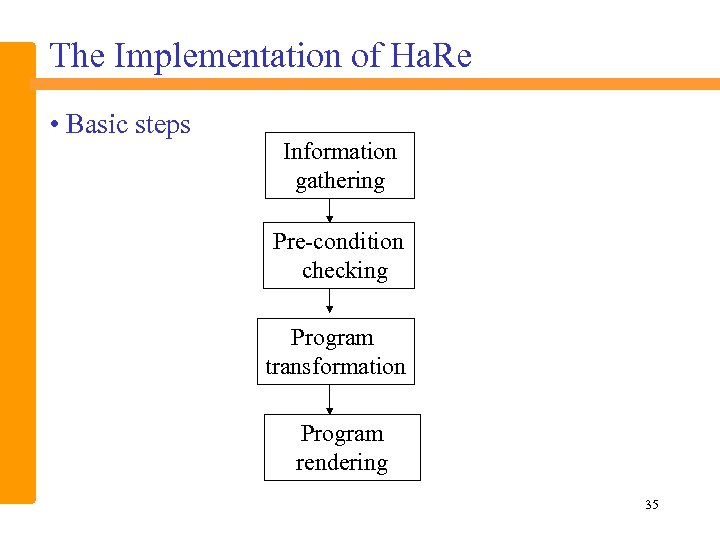 The Implementation of Ha. Re • Basic steps Information gathering Pre-condition checking Program transformation Program rendering 35
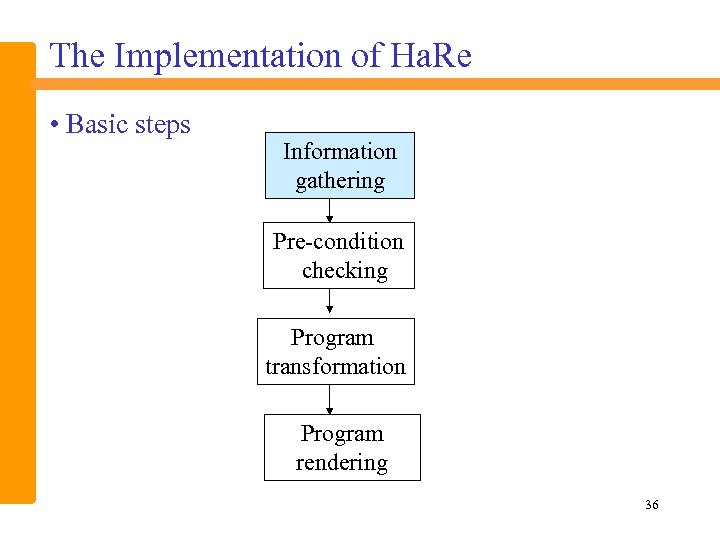 The Implementation of Ha. Re • Basic steps Information gathering Pre-condition checking Program transformation Program rendering 36
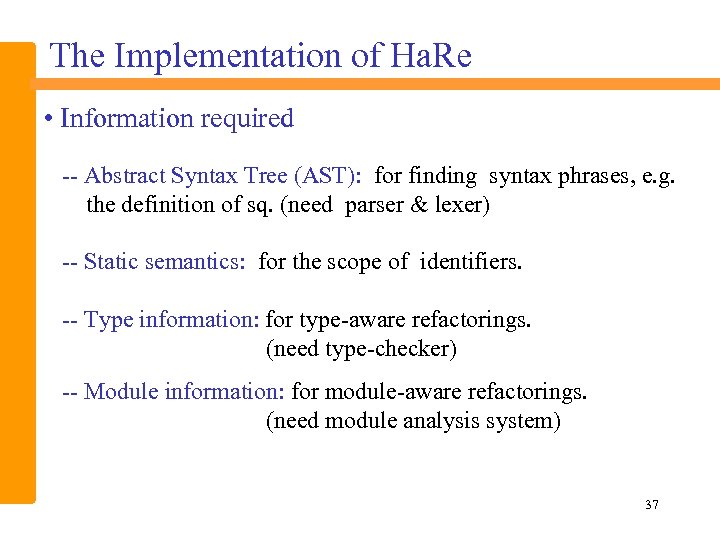 The Implementation of Ha. Re • Information required -- Abstract Syntax Tree (AST): for finding syntax phrases, e. g. the definition of sq. (need parser & lexer) -- Static semantics: for the scope of identifiers. -- Type information: for type-aware refactorings. (need type-checker) -- Module information: for module-aware refactorings. (need module analysis system) 37
 • Project at OGI to build a Haskell system … • … with integral support for verification at various levels: assertion, testing, proof etc. • The Programatica project has built a Haskell front end in Haskell, supporting syntax, static, type and module analysis, and a lexer that preserves location info. • … freely available under BSD licence. 38
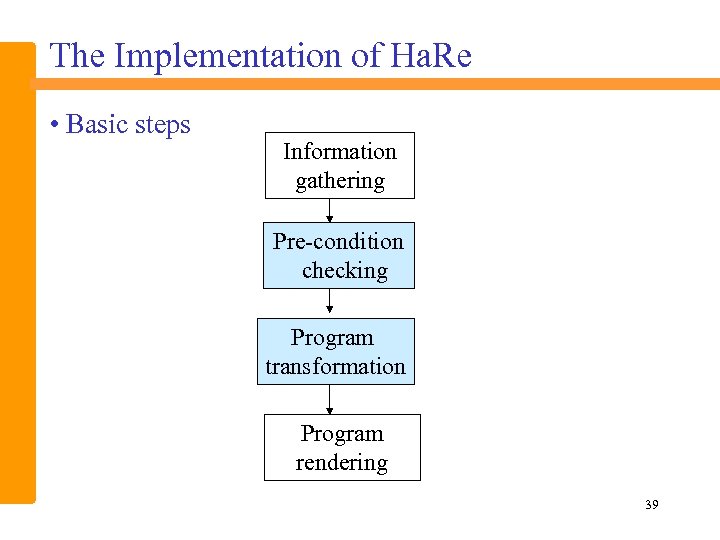 The Implementation of Ha. Re • Basic steps Information gathering Pre-condition checking Program transformation Program rendering 39
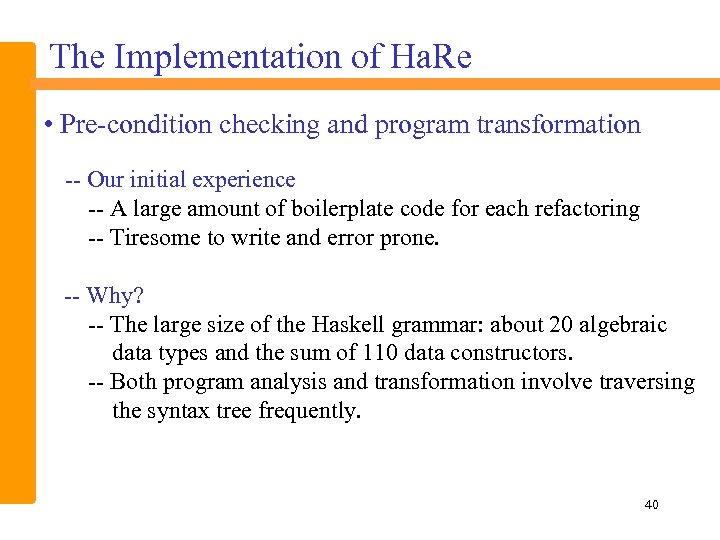 The Implementation of Ha. Re • Pre-condition checking and program transformation -- Our initial experience -- A large amount of boilerplate code for each refactoring -- Tiresome to write and error prone. -- Why? -- The large size of the Haskell grammar: about 20 algebraic data types and the sum of 110 data constructors. -- Both program analysis and transformation involve traversing the syntax tree frequently. 40
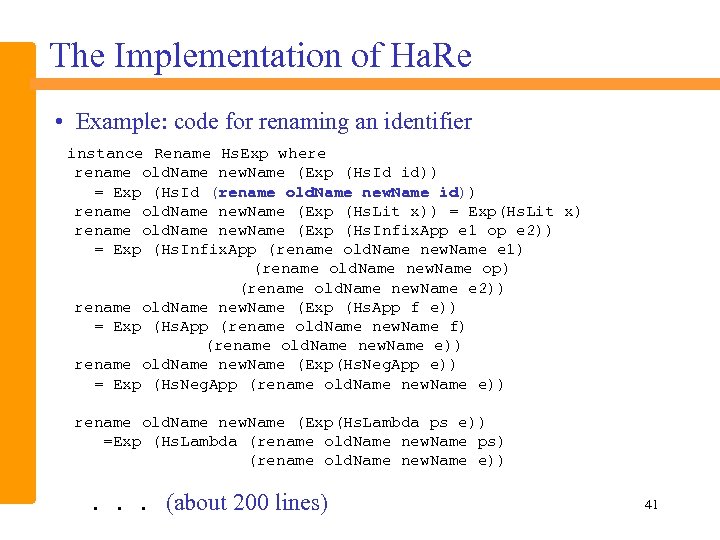 The Implementation of Ha. Re • Example: code for renaming an identifier instance Rename Hs. Exp where rename old. Name new. Name (Exp (Hs. Id id)) = Exp (Hs. Id (rename old. Name new. Name id)) rename old. Name new. Name (Exp (Hs. Lit x)) = Exp(Hs. Lit x) rename old. Name new. Name (Exp (Hs. Infix. App e 1 op e 2)) = Exp (Hs. Infix. App (rename old. Name new. Name e 1) (rename old. Name new. Name op) (rename old. Name new. Name e 2)) rename old. Name new. Name (Exp (Hs. App f e)) = Exp (Hs. App (rename old. Name new. Name f) (rename old. Name new. Name e)) rename old. Name new. Name (Exp(Hs. Neg. App e)) = Exp (Hs. Neg. App (rename old. Name new. Name e)) rename old. Name new. Name (Exp(Hs. Lambda ps e)) =Exp (Hs. Lambda (rename old. Name new. Name ps) (rename old. Name new. Name e)) . . . (about 200 lines) 41
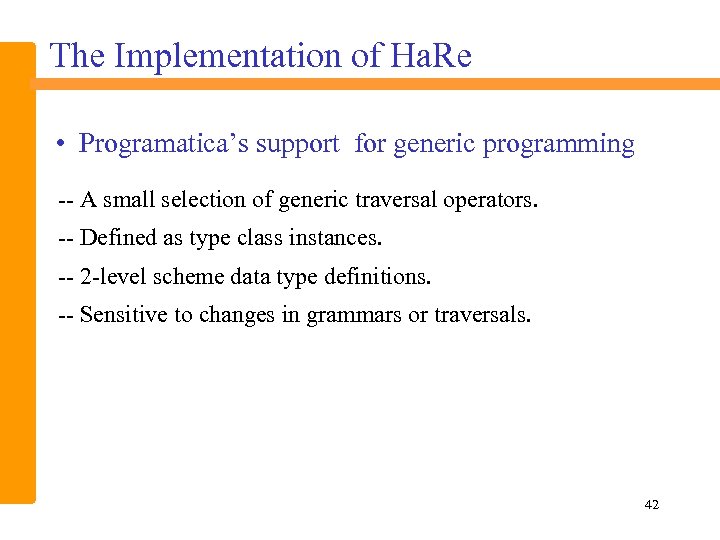 The Implementation of Ha. Re • Programatica’s support for generic programming -- A small selection of generic traversal operators. -- Defined as type class instances. -- 2 -level scheme data type definitions. -- Sensitive to changes in grammars or traversals. 42
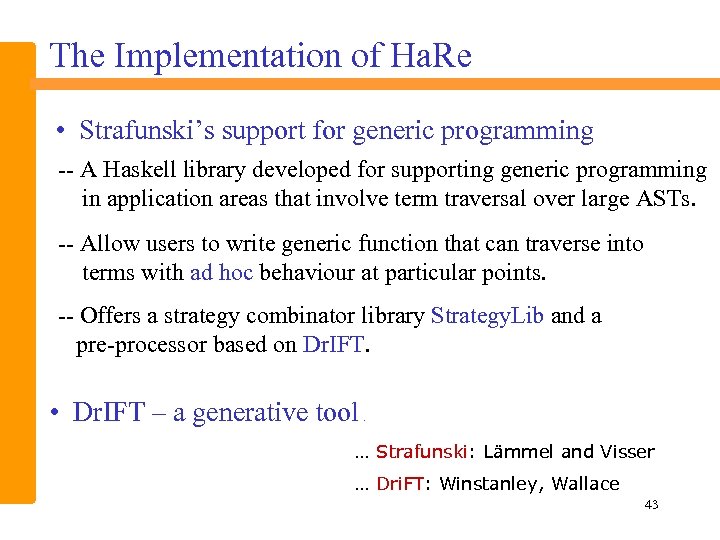 The Implementation of Ha. Re • Strafunski’s support for generic programming -- A Haskell library developed for supporting generic programming in application areas that involve term traversal over large ASTs. -- Allow users to write generic function that can traverse into terms with ad hoc behaviour at particular points. -- Offers a strategy combinator library Strategy. Lib and a pre-processor based on Dr. IFT. • Dr. IFT – a generative tool. … Strafunski: Lämmel and Visser … Dri. FT: Winstanley, Wallace 43
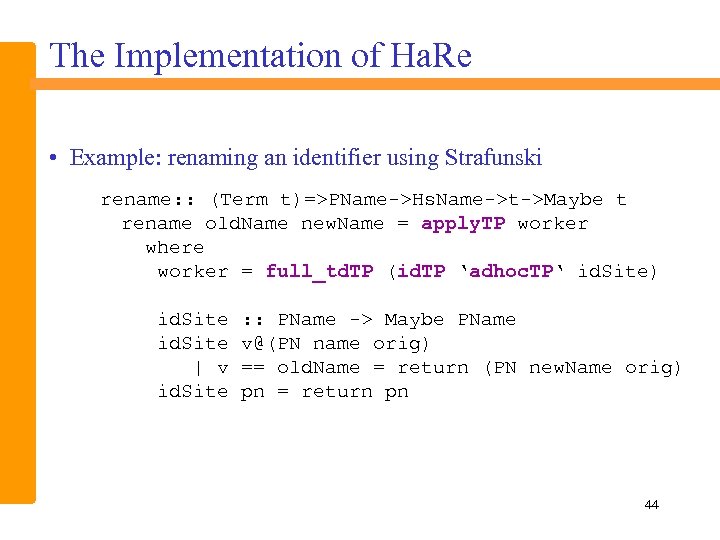 The Implementation of Ha. Re • Example: renaming an identifier using Strafunski rename: : (Term t)=>PName->Hs. Name->t->Maybe t rename old. Name new. Name = apply. TP worker where worker = full_td. TP (id. TP ‘adhoc. TP‘ id. Site) id. Site | v id. Site : : PName -> Maybe PName v@(PN name orig) == old. Name = return (PN new. Name orig) pn = return pn 44
 The Implementation of Ha. Re • Our experience of using Strafunski -- Traversal combinators are extensively used during the development of refactorings. -- Strafunski-style of programming makes the code concise. (average 200 lines per primitive refactoring). Much of the code lies on comment&layout preservation. -- A combinator which combines TP(type-preserving) and TU(type-unifying) would be helpful. -- Generic zipping is helpful too. (supported by the boilerplate approach). 45
 The Implementation of Ha. Re • Basic steps Information gathering Pre-condition checking Program transformation Program rendering 46
 The Implementation of Ha. Re • Program rendering -- A real-life useful refactoring tool should preserve program layout and comments. but, -- layout information and comments are not preserved in AST -- the layout produced by pretty-printer may not be satisfactory and comments are still missing 47
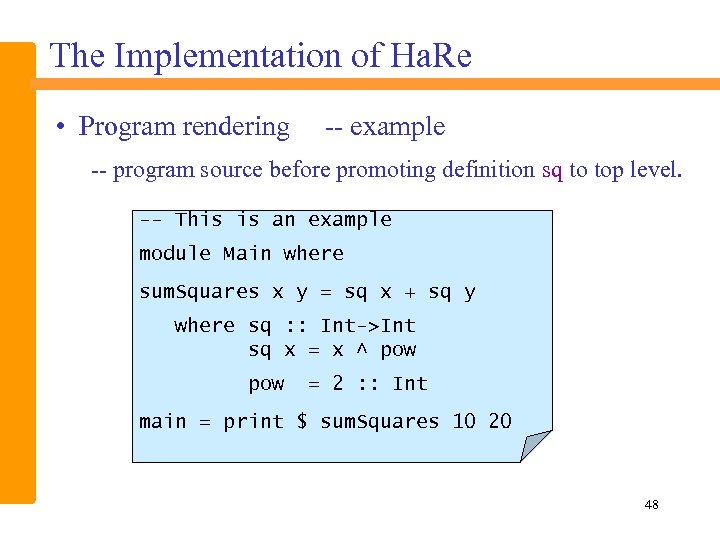 The Implementation of Ha. Re • Program rendering -- example -- program source before promoting definition sq to top level. -- This is an example module Main where sum. Squares x y = sq x + sq y where sq : : Int->Int sq x = x ^ pow = 2 : : Int main = print $ sum. Squares 10 20 48
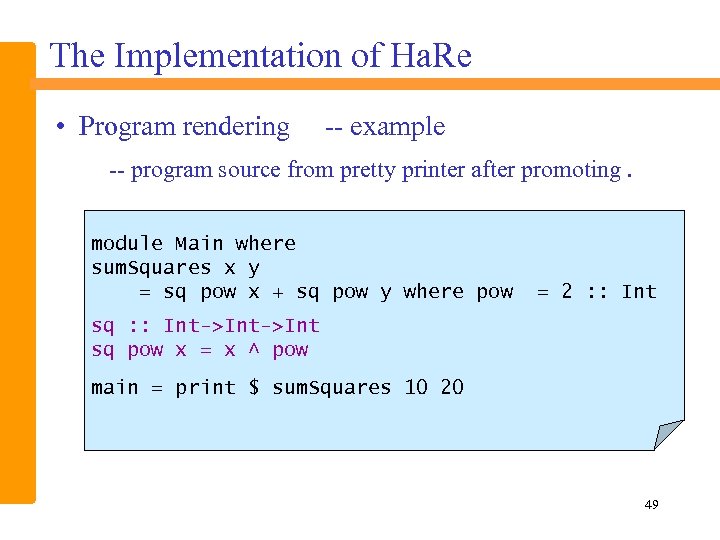 The Implementation of Ha. Re • Program rendering -- example -- program source from pretty printer after promoting. module Main where sum. Squares x y = sq pow x + sq pow y where pow = 2 : : Int sq : : Int->Int sq pow x = x ^ pow main = print $ sum. Squares 10 20 49
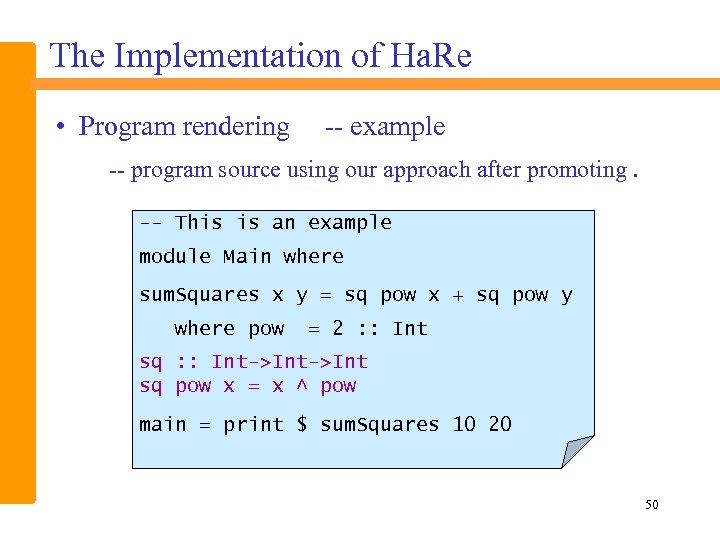 The Implementation of Ha. Re • Program rendering -- example -- program source using our approach after promoting. -- This is an example module Main where sum. Squares x y = sq pow x + sq pow y where pow = 2 : : Int sq : : Int->Int sq pow x = x ^ pow main = print $ sum. Squares 10 20 50
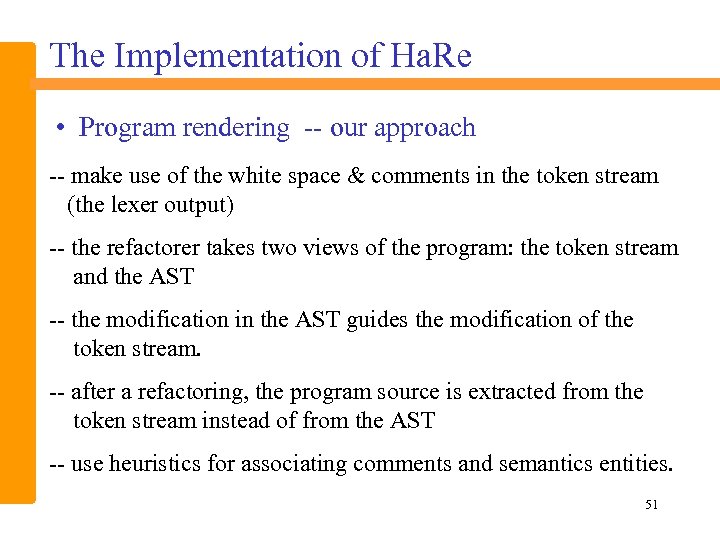 The Implementation of Ha. Re • Program rendering -- our approach -- make use of the white space & comments in the token stream (the lexer output) -- the refactorer takes two views of the program: the token stream and the AST -- the modification in the AST guides the modification of the token stream. -- after a refactoring, the program source is extracted from the token stream instead of from the AST -- use heuristics for associating comments and semantics entities. 51
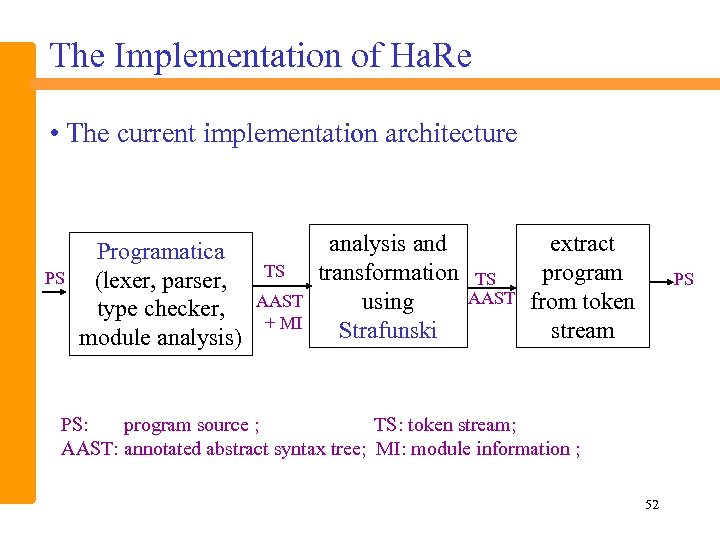 The Implementation of Ha. Re • The current implementation architecture PS Programatica (lexer, parser, type checker, module analysis) TS AAST + MI analysis and transformation using Strafunski TS AAST extract program from token stream PS PS: program source ; TS: token stream; AAST: annotated abstract syntax tree; MI: module information ; 52
 Outline • Introduction • Ha. Re: The Haskell Refactorer • Demo of Ha. Re • The Implementation of Ha. Re • Current Work • Future Work 53
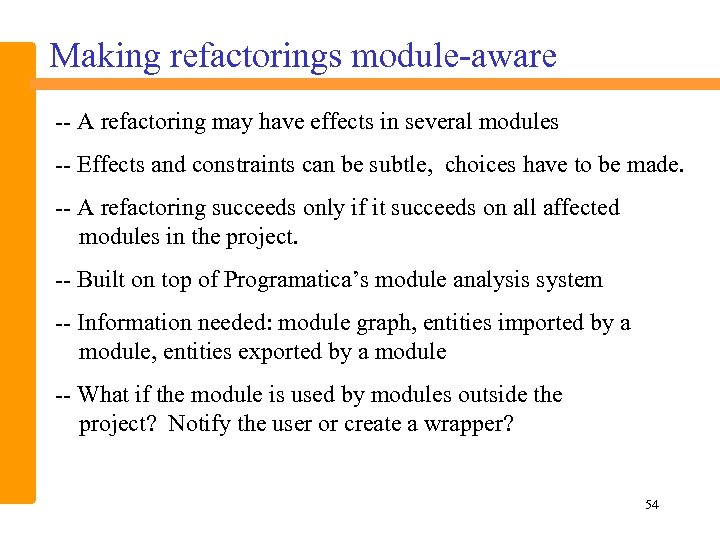 Making refactorings module-aware -- A refactoring may have effects in several modules -- Effects and constraints can be subtle, choices have to be made. -- A refactoring succeeds only if it succeeds on all affected modules in the project. -- Built on top of Programatica’s module analysis system -- Information needed: module graph, entities imported by a module, entities exported by a module -- What if the module is used by modules outside the project? Notify the user or create a wrapper? 54
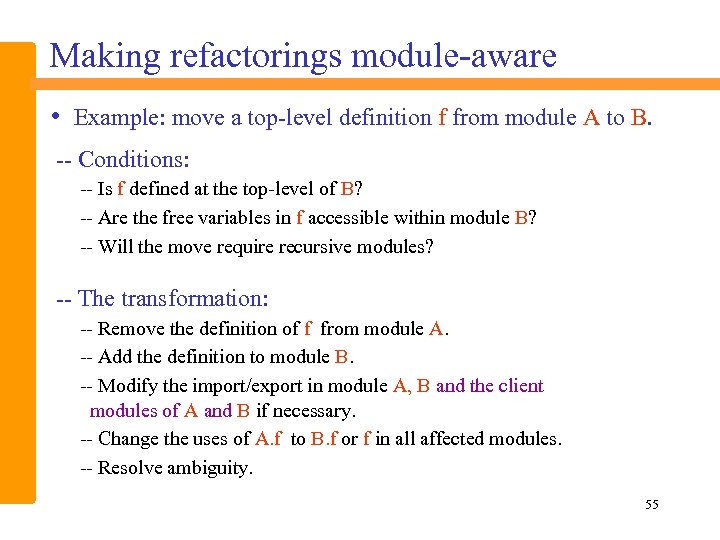 Making refactorings module-aware • Example: move a top-level definition f from module A to B. -- Conditions: -- Is f defined at the top-level of B? -- Are the free variables in f accessible within module B? -- Will the move require recursive modules? -- The transformation: -- Remove the definition of f from module A. -- Add the definition to module B. -- Modify the import/export in module A, B and the client modules of A and B if necessary. -- Change the uses of A. f to B. f or f in all affected modules. -- Resolve ambiguity. 55
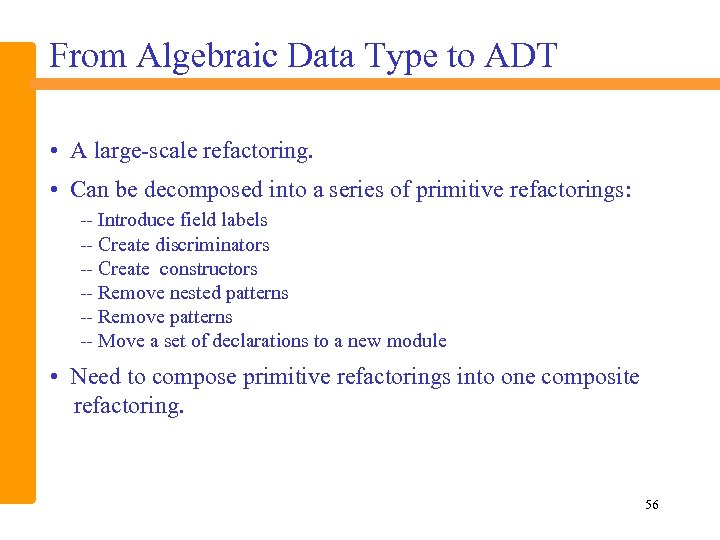 From Algebraic Data Type to ADT • A large-scale refactoring. • Can be decomposed into a series of primitive refactorings: -- Introduce field labels -- Create discriminators -- Create constructors -- Remove nested patterns -- Remove patterns -- Move a set of declarations to a new module • Need to compose primitive refactorings into one composite refactoring. 56
 Outline • Introduction • Ha. Re: The Haskell Refactorer • Demo of Ha. Re • The Implementation of Ha. Re • Current Work • Future Work 57
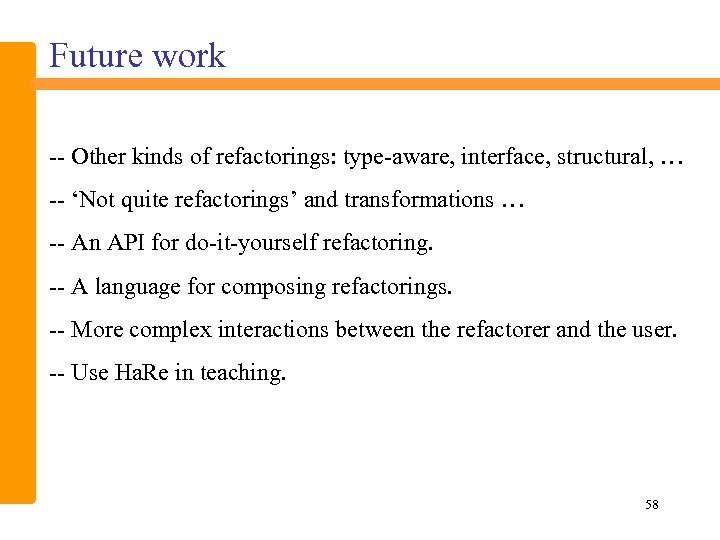 Future work -- Other kinds of refactorings: type-aware, interface, structural, … -- ‘Not quite refactorings’ and transformations … -- An API for do-it-yourself refactoring. -- A language for composing refactorings. -- More complex interactions between the refactorer and the user. -- Use Ha. Re in teaching. 58